reset FORD CROWN VICTORIA 2011 2.G Owner's Manual
[x] Cancel search | Manufacturer: FORD, Model Year: 2011, Model line: CROWN VICTORIA, Model: FORD CROWN VICTORIA 2011 2.GPages: 333, PDF Size: 2.23 MB
Page 243 of 333
•Theservice engine soonindicator light will illuminate.
•The message center (if equipped) will display COOLANT OVER
TEMPERATURE.
•The
symbol will illuminate.
If the engine reaches a preset over-temperature condition, the engine
will automatically switch to alternating cylinder operation. Each disabled
cylinder acts as an air pump and cools the engine.
When this occurs the vehicle will still operate. However:
•The engine power will be limited.
•The air conditioning system will be disabled.
Continued operation will increase the engine temperature:
•The engine will completely shut down, causing steering and braking
effort to increase.
Once the engine temperature cools, the engine can be re-started. Take
your vehicle to an authorized dealer as soon as possible to minimize
engine damage.
When fail-safe mode is activated
You have limited engine power when in the fail-safe mode, so drive the
vehicle with caution. The vehicle will not be able to maintain high-speed
operation and the engine will run rough. Remember that the engine is
capable of completely shutting down automatically to prevent engine
damage, therefore:
1. Pull off the road as soon as safely possible and turn off the engine.
2. Arrange for the vehicle to be taken to an authorized dealer.
3. If this is not possible, wait a short period for the engine to cool.
4. Check the coolant level and replenish if low.
WARNING:Fail-safe mode is for use during emergencies only.
Operate the vehicle in fail-safe mode only as long as necessary to
bring the vehicle to rest in a safe location and seek immediate repairs.
When in fail-safe mode, the vehicle will have limited power, will not be
able to maintain high-speed operation, and may completely shut down
without warning, potentially losing engine power, power steering assist,
and power brake assist, which may increase the possibility of a crash
resulting in serious injury.
Maintenance and Specifications
243
2011 Crown Victoria(cro)
Owners Guide, 3rd Printing
USA(fus)
Page 248 of 333
At the next opportunity, safely pull off of the road, remove the fuel filler
cap, align the cap properly and reinstall it. The check fuel cap
light
or CHECK FUEL CAP message may not reset immediately; it
may take several driving cycles for the check fuel cap light
or CHECK
FUEL CAP message to turn off. A driving cycle consists of an engine
start-up (after four or more hours with the engine off) followed by city
and highway driving.
Continuing to drive with the check fuel cap light
or CHECK FUEL
CAP message on may cause the
light to turn on as well.
If you must replace the fuel filler cap, replace it with a fuel filler
cap that is designed for your vehicle. The customer warranty may
be void for any damage to the fuel tank or fuel system if the
correct genuine Ford, Motorcraft or other certified fuel filler cap
is not used.
WARNING:The fuel system may be under pressure. If the fuel
filler cap is venting vapor or if you hear a hissing sound, wait
until it stops before completely removing the fuel filler cap. Otherwise,
fuel may spray out and injure you or others.
WARNING:If you do not use the proper fuel filler cap,
excessive vacuum in the fuel tank may damage the fuel system
or cause the fuel cap to disengage in a collision, which may result in
personal injury.
FFV (Flex Fuel Vehicle) fuel cap
If your vehicle is FFV capable, it will have a yellow colored fuel cap.
Choosing the right fuel
If your vehicle is a flexible fuel vehicle (FFV), use only UNLEADED
FUEL and FUEL ETHANOL (Ed75–Ed85).
If your vehicle is not a flexible fuel vehicle (FFV), then only use
UNLEADED fuel or UNLEADED fuel blended with a maximum of 10%
ethanol. Do not use fuel ethanol (E85), diesel, methanol, leaded fuel or
any other fuel.
The use of leaded fuel is prohibited by law and could damage your
vehicle.
Your vehicle was not designed to use fuel or fuel additives with metallic
compounds, including manganese-based additives.
Maintenance and Specifications
248
2011 Crown Victoria(cro)
Owners Guide, 3rd Printing
USA(fus)
Page 262 of 333
Note:During extended periods of vehicle storage (30 days or more),
fuel may deteriorate due to oxidation. Add a quality gas stabilizer
product to the vehicle fuel system whenever actual or expected storage
periods exceed 30 days. Follow the instructions on the additive label.
The vehicle should then be operated at idle speed to circulate the
additive throughout the fuel system.
Cooling system
•Protect against freezing temperatures.
•When removing vehicle from storage, check coolant fluid level.
Confirm there are no cooling system leaks, and fluid is at the
recommended level.
Battery
•Check and recharge as necessary. Keep connections clean.
•If storing your vehicle for more than 30 days without recharging the
battery, it may be advisable to disconnect the battery cables to ensure
battery charge is maintained for quick starting.
Note:If battery cables are disconnected, it will be necessary to reset
memory features.
Brakes
•Make sure brakes and parking brake are fully released.
Tires
•Maintain recommended air pressure.
Miscellaneous
•Make sure all linkages, cables, levers and pins under vehicle are
covered with grease to prevent rust.
•Move vehicles at least 25 feet (8 m) every 15 days to lubricate
working parts and prevent corrosion.
Removing vehicle from storage
When your vehicle is ready to come out of storage, do the following:
•Wash your vehicle to remove any dirt or grease film build-up on
window surfaces.
•Check windshield wipers for any deterioration.
•Check under the hood for any foreign material that may have collected
during storage (mice/squirrel nests).
•Check the exhaust for any foreign material that may have collected
during storage.
Maintenance and Specifications
262
2011 Crown Victoria(cro)
Owners Guide, 3rd Printing
USA(fus)
Page 271 of 333
Driving in the overdrive cancel mode for prolonged periods at high speeds
will deteriorate performance and may cause extensive engine damage.
Crown Victoria police vehicles are designed to operate in
the
(Overdrive) gear selector position while in pursuit. Optimum
performance will be obtained in
(Overdrive). Operation in the overdrive
cancel mode should only be used in situations noted in this publication.
WARNING:Under no circumstances should the aluminum
driveshaft be replaced with a steel driveshaft. Doing so will
adversely affect vehicle operation which could lead to personal injury.
POWERTRAIN OVERSPEED PROTECTION
The powertrain control module (PCM) includes logic to electronically
prevent powertrain overspeed in any transmission selector position.
IDLE METER
Your vehicle may be equipped with an idle meter to indicate how much
time the vehicle is idling in P (Park) or N (Neutral). The meter is
incorporated with the vehicle odometer. Pressing the odometer-reset
button once will display the trip odometer (miles followed by a “T” for
trip odometer). Pressing the odometer-reset button a second time will
display the idle meter (hours followed by an “h”for hours). The idle
meter only accumulates time when the vehicle is in P (Park) or N
(Neutral). Displayed time is cumulative for the vehicle. It cannot be reset
to zero.
Police/Fleet vehicles often experience long periods of idling, during
which engine oil will continue to break down but mileage is not
accumulated on the odometer.
To assist fleet managers in maintaining proper oil change intervals, the
idle meter will help determine when an oil change is required. For every
hour that the vehicle idles, it has accumulated the equivalent of
approximately 33 miles (53 km) of driving. Using the combination of the
vehicle odometer and idle meter allows the fleet manager to better
determine when the oil needs to be changed.
Example:When the odometer has accumulated 3,000 miles (4,828 km)
and the idle meter shows 61 hours, a 5,000 mile (8047 km) oil change
interval will have been reached: 3,000 road miles + (61 idle hours x
33 miles/idle hour) = 5,013 miles. In metric units this calculation would
be 4,828 kilometers + (61 idle hours x 53 km/idle hour) = 8,061 km.
Crown Victoria Severe Duty
271
2011 Crown Victoria(cro)
Owners Guide, 3rd Printing
USA(fus)
Page 277 of 333
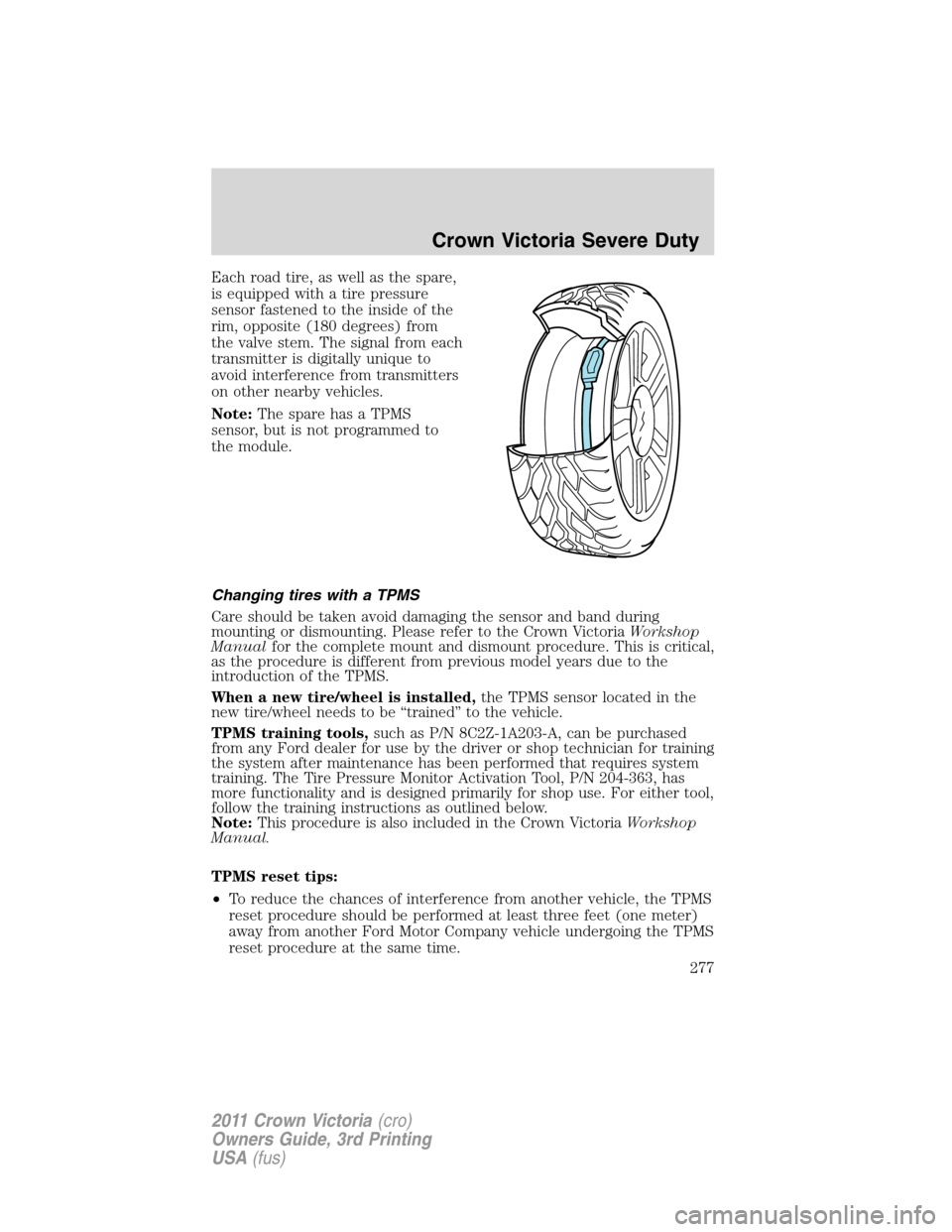
Each road tire, as well as the spare,
is equipped with a tire pressure
sensor fastened to the inside of the
rim, opposite (180 degrees) from
the valve stem. The signal from each
transmitter is digitally unique to
avoid interference from transmitters
on other nearby vehicles.
Note:The spare has a TPMS
sensor, but is not programmed to
the module.
Changing tires with a TPMS
Care should be taken avoid damaging the sensor and band during
mounting or dismounting. Please refer to the Crown VictoriaWorkshop
Manualfor the complete mount and dismount procedure. This is critical,
as the procedure is different from previous model years due to the
introduction of the TPMS.
When a new tire/wheel is installed,the TPMS sensor located in the
new tire/wheel needs to be “trained” to the vehicle.
TPMS training tools,such as P/N 8C2Z-1A203-A, can be purchased
from any Ford dealer for use by the driver or shop technician for training
the system after maintenance has been performed that requires system
training. The Tire Pressure Monitor Activation Tool, P/N 204-363, has
more functionality and is designed primarily for shop use. For either tool,
follow the training instructions as outlined below.
Note:This procedure is also included in the Crown VictoriaWorkshop
Manual.
TPMS reset tips:
•To reduce the chances of interference from another vehicle, the TPMS
reset procedure should be performed at least three feet (one meter)
away from another Ford Motor Company vehicle undergoing the TPMS
reset procedure at the same time.
Crown Victoria Severe Duty
277
2011 Crown Victoria(cro)
Owners Guide, 3rd Printing
USA(fus)
Page 278 of 333
•Do not wait more than two minutes between resetting each tire sensor
or the system will time-out and the entire procedure will have to be
repeated on all four wheels.
•A double horn chirp indicates the need to repeat the procedure.
TPMS reset procedure
Note:It is recommended that you read the entire procedure before
attempting.
Note:To enter the reset mode, Steps 1–6 MUST be completed within
60 seconds.
1. Place the ignition in the off position and keep the key in the ignition.
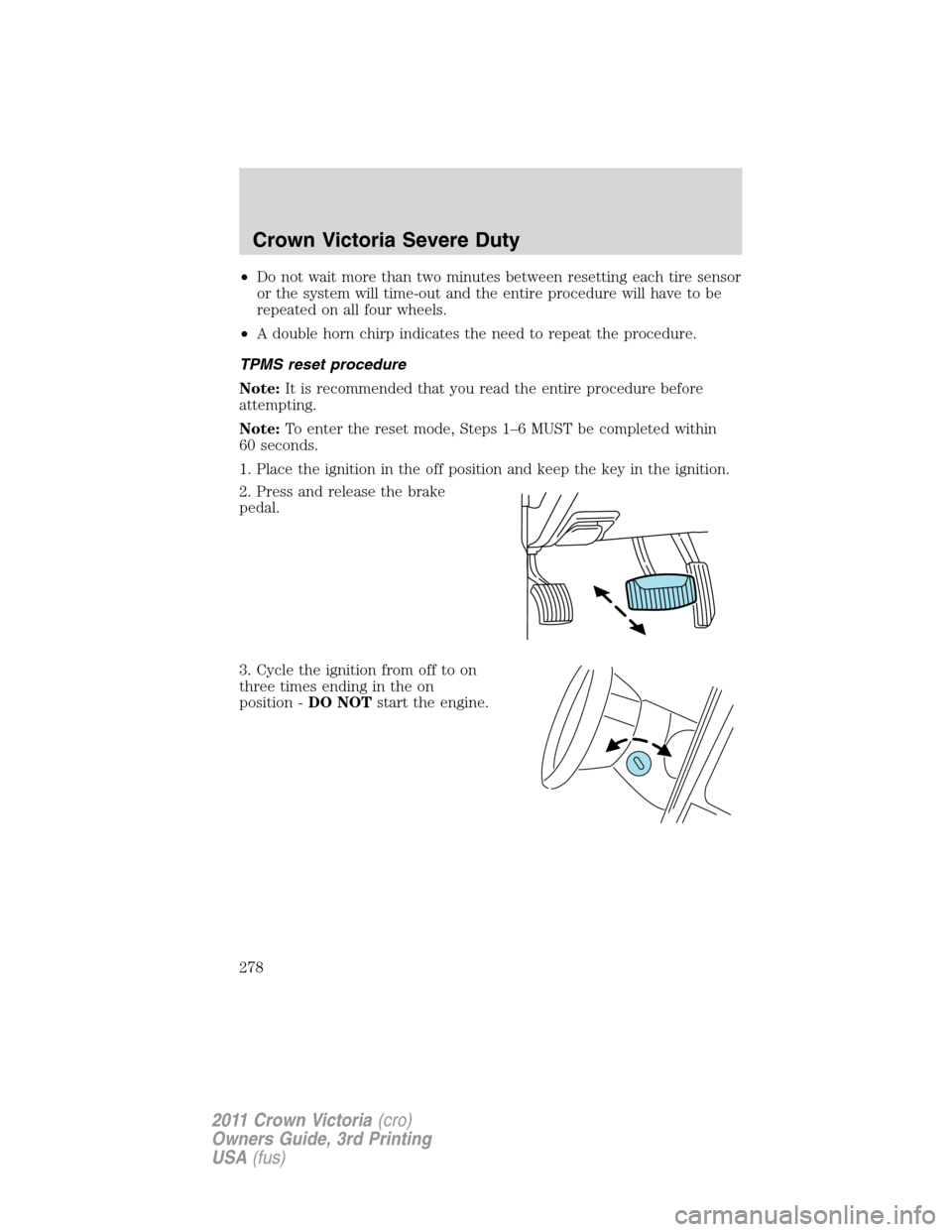
2. Press and release the brake
pedal.
3. Cycle the ignition from off to on
three times ending in the on
position -DO NOTstart the engine.
Crown Victoria Severe Duty
278
2011 Crown Victoria(cro)
Owners Guide, 3rd Printing
USA(fus)
Page 279 of 333
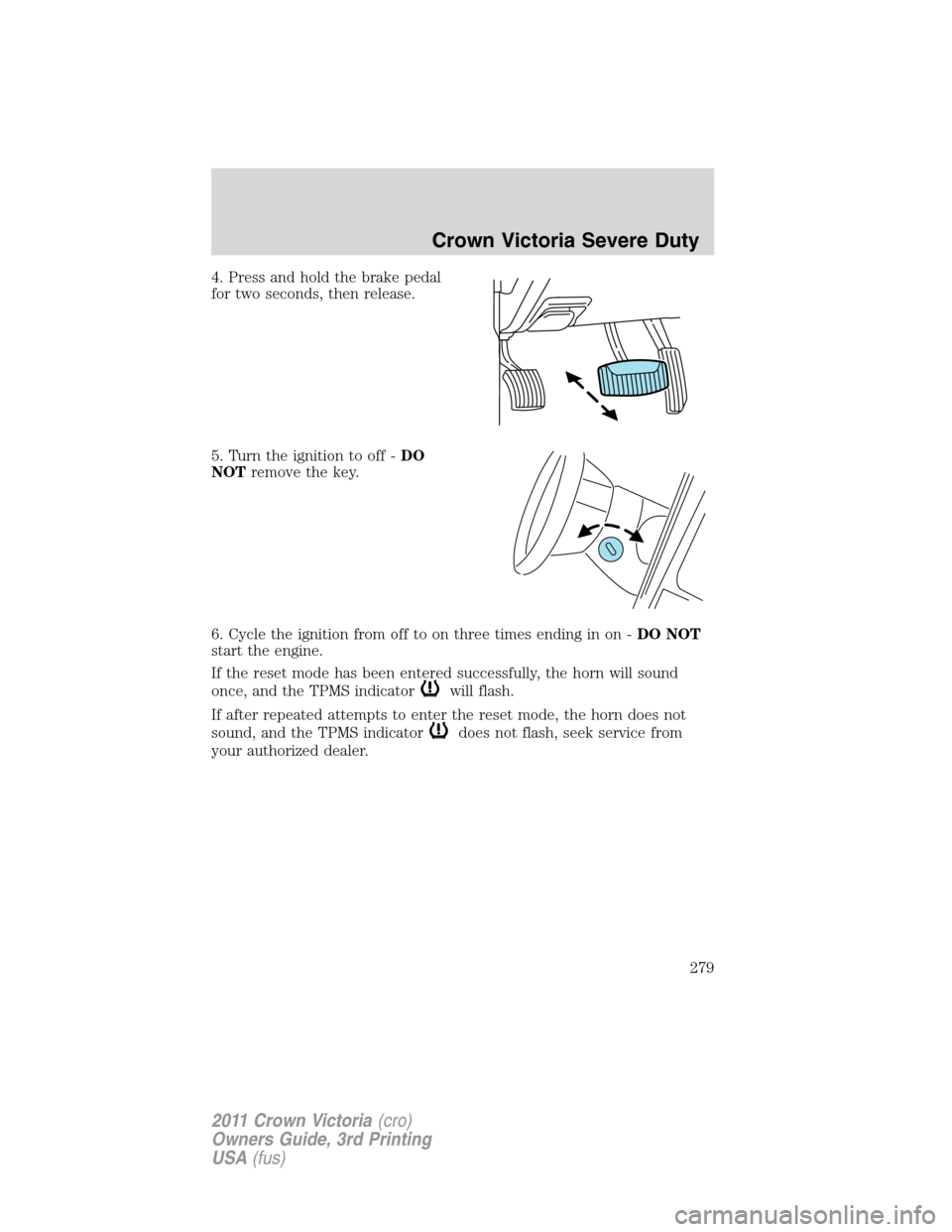
4. Press and hold the brake pedal
for two seconds, then release.
5. Turn the ignition to off -DO
NOTremove the key.
6. Cycle the ignition from off to on three times ending in on -DO NOT
start the engine.
If the reset mode has been entered successfully, the horn will sound
once, and the TPMS indicator
will flash.
If after repeated attempts to enter the reset mode, the horn does not
sound, and the TPMS indicator
does not flash, seek service from
your authorized dealer.
Crown Victoria Severe Duty
279
2011 Crown Victoria(cro)
Owners Guide, 3rd Printing
USA(fus)
Page 280 of 333
7. Train the TPMS sensors in the tires using the following TPMS reset
sequence starting with theleft front tirein the following clockwise
order:
•Left front (Driver’s side front tire)
•Right front (Passenger’s side front tire)
•Right rear (Passenger’s side rear tire)
•Left rear (Driver’s side rear tire)
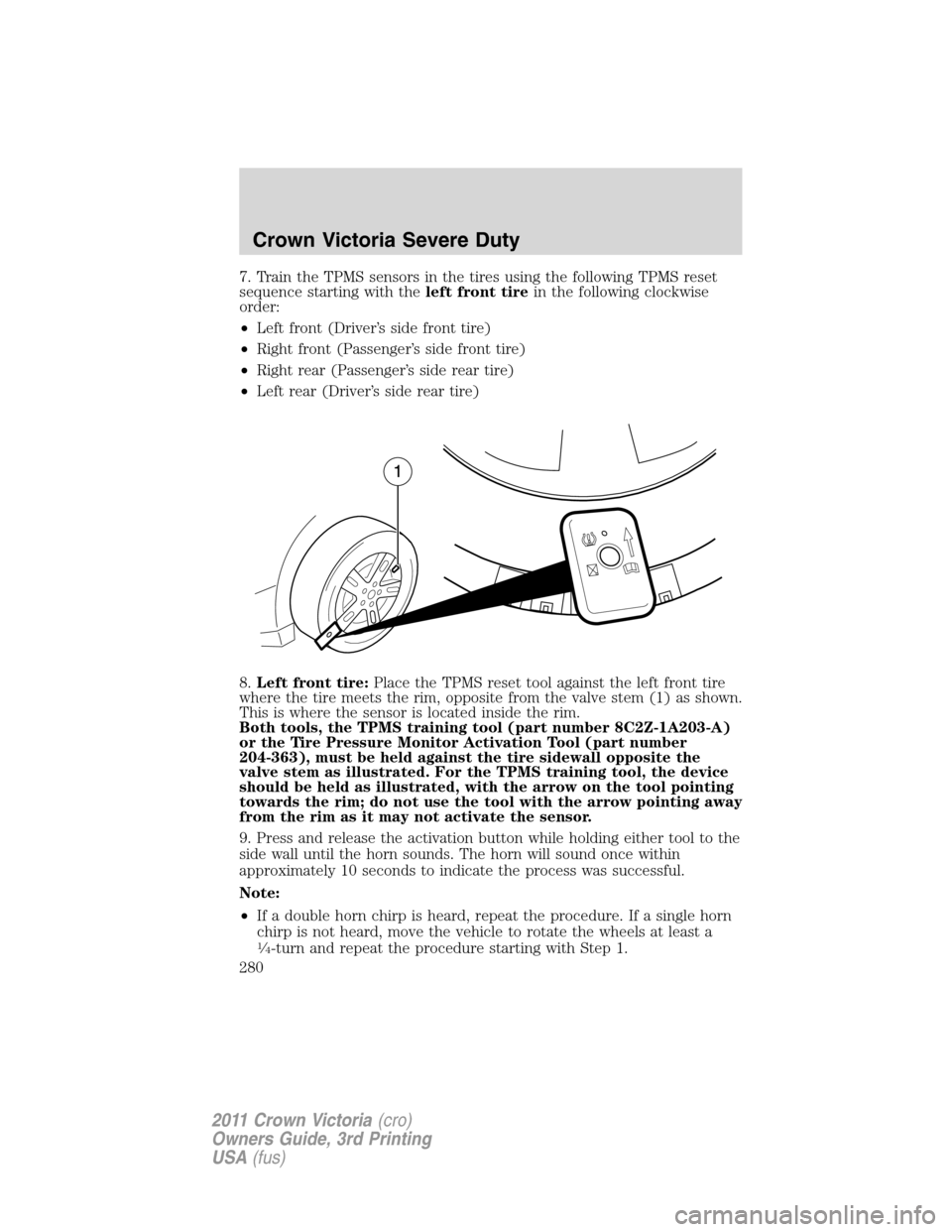
8.Left front tire:Place the TPMS reset tool against the left front tire
where the tire meets the rim, opposite from the valve stem (1) as shown.
This is where the sensor is located inside the rim.
Both tools, the TPMS training tool (part number 8C2Z-1A203-A)
or the Tire Pressure Monitor Activation Tool (part number
204-363), must be held against the tire sidewall opposite the
valve stem as illustrated. For the TPMS training tool, the device
should be held as illustrated, with the arrow on the tool pointing
towards the rim; do not use the tool with the arrow pointing away
from the rim as it may not activate the sensor.
9. Press and release the activation button while holding either tool to the
side wall until the horn sounds. The horn will sound once within
approximately 10 seconds to indicate the process was successful.
Note:
•If a double horn chirp is heard, repeat the procedure. If a single horn
chirp is not heard, move the vehicle to rotate the wheels at least a
14-turn and repeat the procedure starting with Step 1.
Crown Victoria Severe Duty
280
2011 Crown Victoria(cro)
Owners Guide, 3rd Printing
USA(fus)
Page 281 of 333
•If the horn does not sound while attempting to reset any wheel, seek
service from your authorized dealer.
10. Perform Steps 8 and 9 on the right front tire, right rear tire and
finally the left rear tire. Training is complete after the horn sounds for
the last tire trained (left rear tire).
Turn the ignition to off. If two short horn beeps are heard, the reset
procedure was unsuccessful and must be repeated.
If after repeating the procedure and two short beeps are heard when the
ignition is turned to off, seek assistance from your authorized dealer.
Brakes - police
The police vehicle is equipped with heavy duty front disc brake pads to
meet the varying demands of different police service for fade resistance
and other performance requirements.
The police vehicle has standard anti-lock brakes and may be equipped
with traction control.
Brake fluid maintenance
Police pursuits involving hard braking result in very high temperatures in
the brake system, including the brake fluid. Over time, repeated
exposure to high brake temperatures can degrade brake fluid, potentially
reducing its boiling point. A lower boiling point could cause long brake
pedal travel and a loss of braking confidence during subsequent pursuit
driving. Ford recommends that police fleets replace the brake fluid at
every brake pad service interval. Brake fluid may be replaced more
frequently on vehicles involved in frequent high-speed pursuits with
heavy brake usage.
INTERIOR
Heavy duty seats - police
The front seat assemblies, including the seat adjustment mechanisms and
supports, are ruggedly designed and ensure working comfort. An
anti-stab plate is integrated into the seat back to reduce the risk of
officer injury. An adjustable power lumbar system is standard on the
driver’s seat.
Seat belt extenders
Some police departments have begun employing the use of seat belt
extenders to make the practice of buckling and unbuckling seat belts
easier for officers wearing hip mounted radios, side arms, etc.
Crown Victoria Severe Duty
281
2011 Crown Victoria(cro)
Owners Guide, 3rd Printing
USA(fus)
Page 321 of 333
ENGINE IDLE HOUR METER (IF EQUIPPED):
Your vehicle may be equipped with an idle meter to indicate how much
time the vehicle is idling in P (Park) or N (Neutral). The meter is
incorporated with the vehicle odometer. Depressing the odometer-reset
button once will display the trip odometer (miles [km] followed by a “T”
for trip odometer); depressing the odometer-reset button a second time
will display the idle meter (hours followed by an “H” for hours). The idle
meter only accumulates time when the vehicle is in P (Park) or N
(Neutral). Displayed time is cumulative for the vehicle.It cannot be
reset to zero.Police/Fleet vehicles often experience long periods of
idling, during which engine oil will continue to break down but distance
is not accumulated on the odometer.
To assist fleet managers in maintaining proper oil change intervals, the
idle meter will help determine when an oil change is required. For every
hour that the vehicle idles, it has accumulated the equivalent of
approximately 33 miles (53 km) of driving. Using the combination of the
vehicle odometer and idle meter allows the fleet manager to better
determine when the oil needs to be changed
Engine idle hour meter calculation:
Idle hours x 33 = miles (km) equivalency
Miles (km) driven + miles (km) equivalency = oil change interval
Example:When the odometer has accumulated 3,000 miles (4,800 km)
and the idle meter shows 61 hours, a 5,000 mile (8,000 km) oil change
interval will have been reached: 3,000 road miles (4,800 road km) + (61
idle hours x 33 miles [53 km]/idle hour) = 5,013 miles (8,067 km).
Scheduled Maintenance
321
2011 Crown Victoria(cro)
Owners Guide, 3rd Printing
USA(fus)