wheel FORD E-150 2008 Workshop Manual
[x] Cancel search | Manufacturer: FORD, Model Year: 2008, Model line: E-150, Model: FORD E-150 2008Pages: 285, PDF Size: 2.81 MB
Page 155 of 285
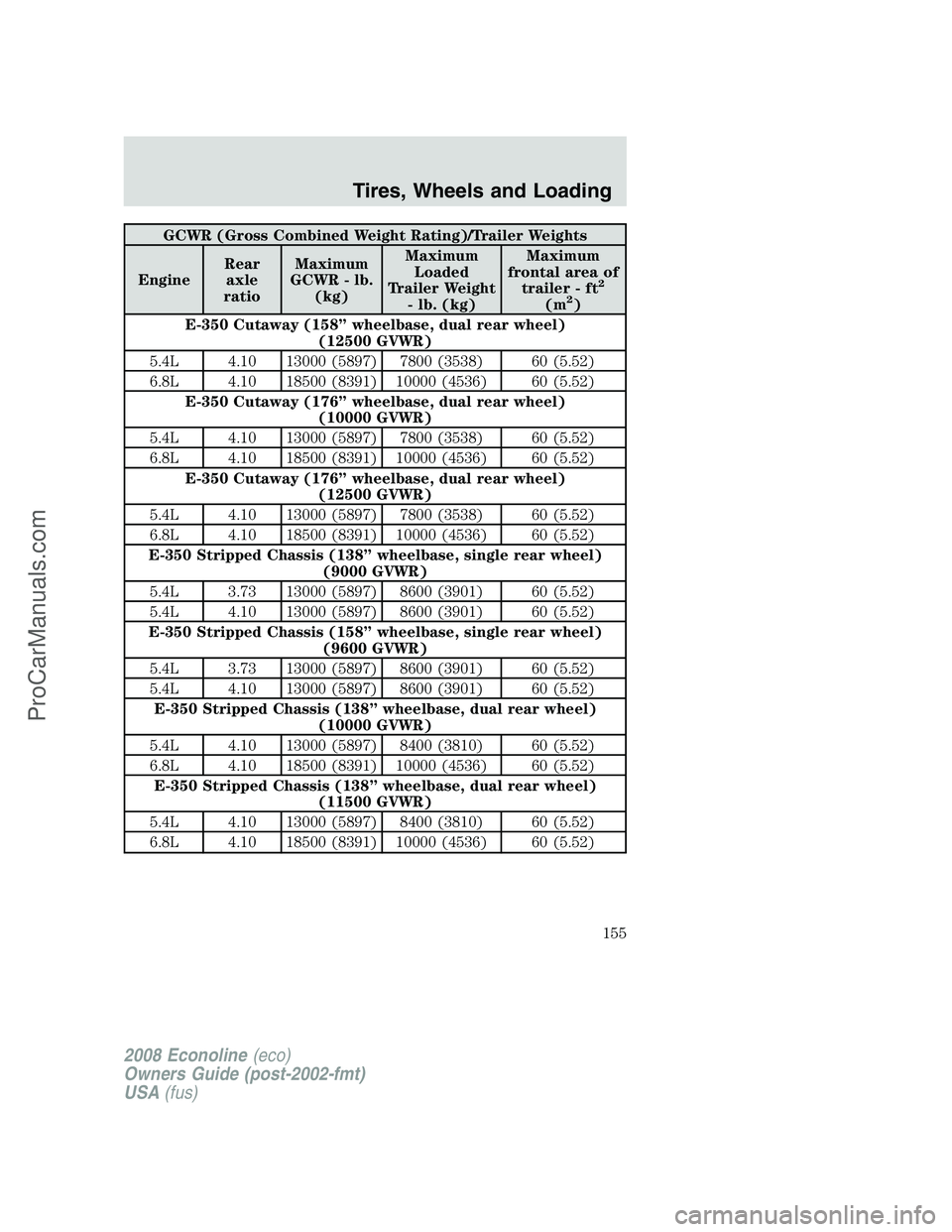
GCWR (Gross Combined Weight Rating)/Trailer Weights
EngineRear
axle
ratioMaximum
GCWR - lb.
(kg)Maximum
Loaded
Trailer Weight
- lb. (kg)Maximum
frontal area of
trailer - ft
2
(m2)
E-350 Cutaway (158” wheelbase, dual rear wheel)
(12500 GVWR)
5.4L 4.10 13000 (5897) 7800 (3538) 60 (5.52)
6.8L 4.10 18500 (8391) 10000 (4536) 60 (5.52)
E-350 Cutaway (176” wheelbase, dual rear wheel)
(10000 GVWR)
5.4L 4.10 13000 (5897) 7800 (3538) 60 (5.52)
6.8L 4.10 18500 (8391) 10000 (4536) 60 (5.52)
E-350 Cutaway (176” wheelbase, dual rear wheel)
(12500 GVWR)
5.4L 4.10 13000 (5897) 7800 (3538) 60 (5.52)
6.8L 4.10 18500 (8391) 10000 (4536) 60 (5.52)
E-350 Stripped Chassis (138” wheelbase, single rear wheel)
(9000 GVWR)
5.4L 3.73 13000 (5897) 8600 (3901) 60 (5.52)
5.4L 4.10 13000 (5897) 8600 (3901) 60 (5.52)
E-350 Stripped Chassis (158” wheelbase, single rear wheel)
(9600 GVWR)
5.4L 3.73 13000 (5897) 8600 (3901) 60 (5.52)
5.4L 4.10 13000 (5897) 8600 (3901) 60 (5.52)
E-350 Stripped Chassis (138” wheelbase, dual rear wheel)
(10000 GVWR)
5.4L 4.10 13000 (5897) 8400 (3810) 60 (5.52)
6.8L 4.10 18500 (8391) 10000 (4536) 60 (5.52)
E-350 Stripped Chassis (138” wheelbase, dual rear wheel)
(11500 GVWR)
5.4L 4.10 13000 (5897) 8400 (3810) 60 (5.52)
6.8L 4.10 18500 (8391) 10000 (4536) 60 (5.52)
2008 Econoline(eco)
Owners Guide (post-2002-fmt)
USA(fus)
Tires, Wheels and Loading
155
ProCarManuals.com
Page 156 of 285
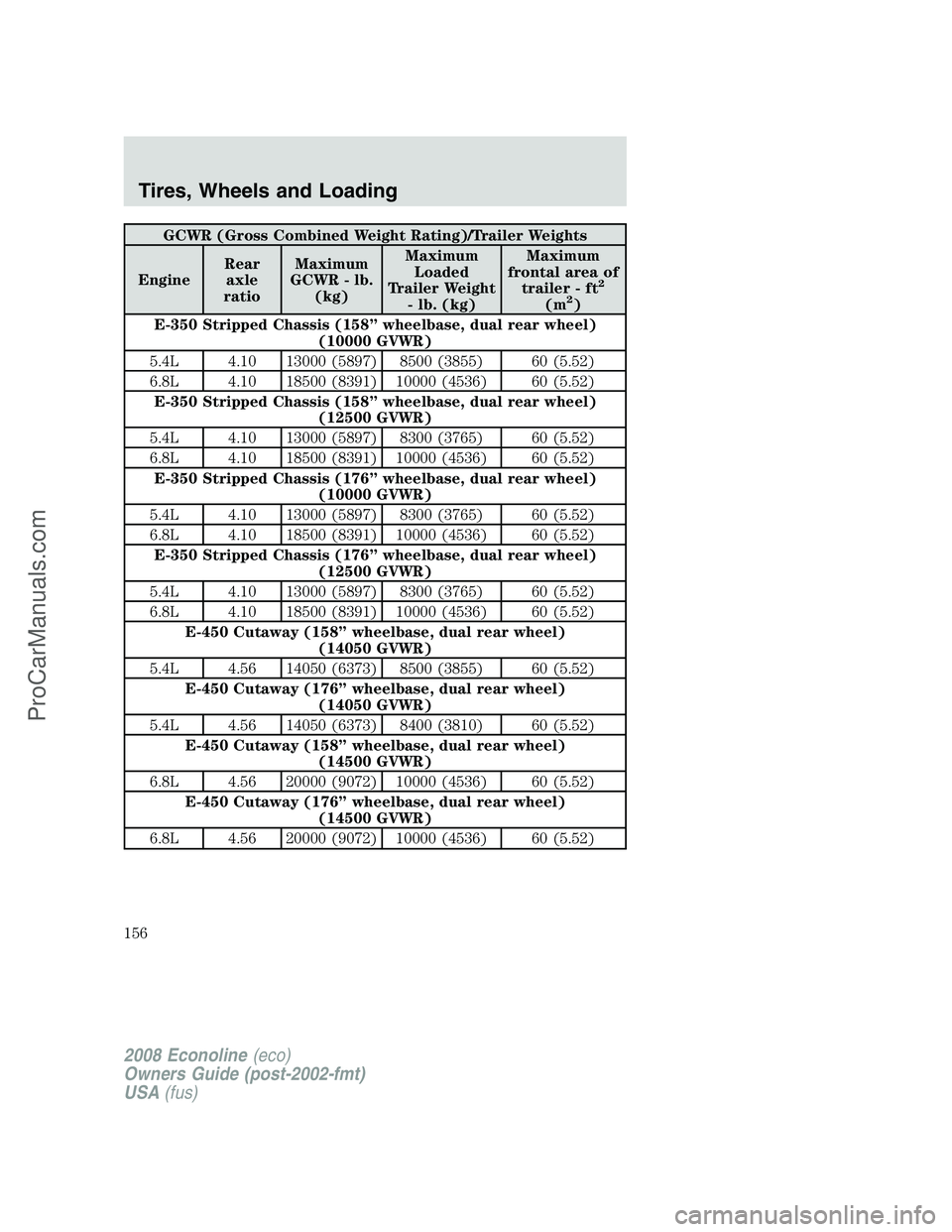
GCWR (Gross Combined Weight Rating)/Trailer Weights
EngineRear
axle
ratioMaximum
GCWR - lb.
(kg)Maximum
Loaded
Trailer Weight
- lb. (kg)Maximum
frontal area of
trailer - ft
2
(m2)
E-350 Stripped Chassis (158” wheelbase, dual rear wheel)
(10000 GVWR)
5.4L 4.10 13000 (5897) 8500 (3855) 60 (5.52)
6.8L 4.10 18500 (8391) 10000 (4536) 60 (5.52)
E-350 Stripped Chassis (158” wheelbase, dual rear wheel)
(12500 GVWR)
5.4L 4.10 13000 (5897) 8300 (3765) 60 (5.52)
6.8L 4.10 18500 (8391) 10000 (4536) 60 (5.52)
E-350 Stripped Chassis (176” wheelbase, dual rear wheel)
(10000 GVWR)
5.4L 4.10 13000 (5897) 8300 (3765) 60 (5.52)
6.8L 4.10 18500 (8391) 10000 (4536) 60 (5.52)
E-350 Stripped Chassis (176” wheelbase, dual rear wheel)
(12500 GVWR)
5.4L 4.10 13000 (5897) 8300 (3765) 60 (5.52)
6.8L 4.10 18500 (8391) 10000 (4536) 60 (5.52)
E-450 Cutaway (158” wheelbase, dual rear wheel)
(14050 GVWR)
5.4L 4.56 14050 (6373) 8500 (3855) 60 (5.52)
E-450 Cutaway (176” wheelbase, dual rear wheel)
(14050 GVWR)
5.4L 4.56 14050 (6373) 8400 (3810) 60 (5.52)
E-450 Cutaway (158” wheelbase, dual rear wheel)
(14500 GVWR)
6.8L 4.56 20000 (9072) 10000 (4536) 60 (5.52)
E-450 Cutaway (176” wheelbase, dual rear wheel)
(14500 GVWR)
6.8L 4.56 20000 (9072) 10000 (4536) 60 (5.52)
2008 Econoline(eco)
Owners Guide (post-2002-fmt)
USA(fus)
Tires, Wheels and Loading
156
ProCarManuals.com
Page 157 of 285
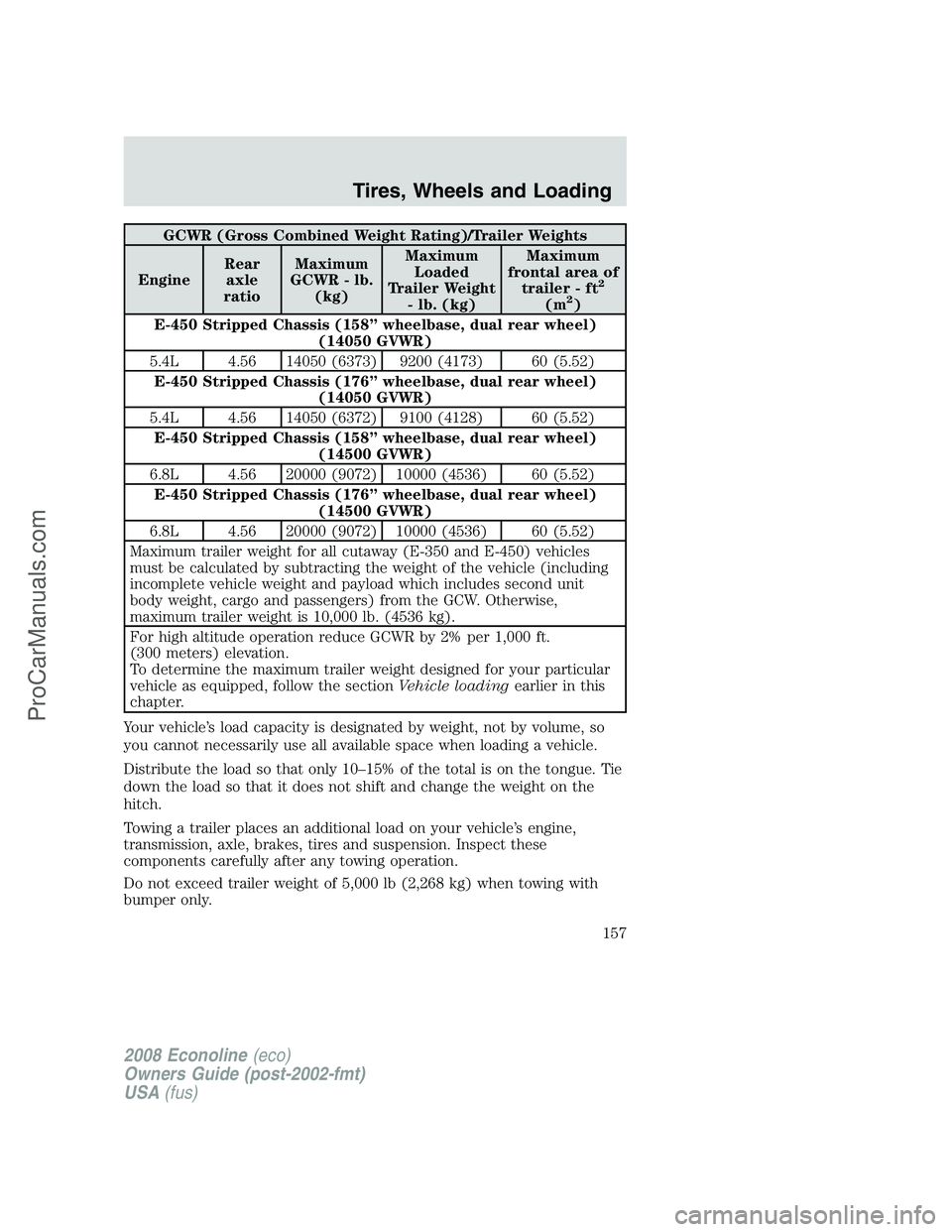
GCWR (Gross Combined Weight Rating)/Trailer Weights
EngineRear
axle
ratioMaximum
GCWR - lb.
(kg)Maximum
Loaded
Trailer Weight
- lb. (kg)Maximum
frontal area of
trailer - ft
2
(m2)
E-450 Stripped Chassis (158” wheelbase, dual rear wheel)
(14050 GVWR)
5.4L 4.56 14050 (6373) 9200 (4173) 60 (5.52)
E-450 Stripped Chassis (176” wheelbase, dual rear wheel)
(14050 GVWR)
5.4L 4.56 14050 (6372) 9100 (4128) 60 (5.52)
E-450 Stripped Chassis (158” wheelbase, dual rear wheel)
(14500 GVWR)
6.8L 4.56 20000 (9072) 10000 (4536) 60 (5.52)
E-450 Stripped Chassis (176” wheelbase, dual rear wheel)
(14500 GVWR)
6.8L 4.56 20000 (9072) 10000 (4536) 60 (5.52)
Maximum trailer weight for all cutaway (E-350 and E-450) vehicles
must be calculated by subtracting the weight of the vehicle (including
incomplete vehicle weight and payload which includes second unit
body weight, cargo and passengers) from the GCW. Otherwise,
maximum trailer weight is 10,000 lb. (4536 kg).
For high altitude operation reduce GCWR by 2% per 1,000 ft.
(300 meters) elevation.
To determine the maximum trailer weight designed for your particular
vehicle as equipped, follow the sectionVehicle loadingearlier in this
chapter.
Your vehicle’s load capacity is designated by weight, not by volume, so
you cannot necessarily use all available space when loading a vehicle.
Distribute the load so that only 10–15% of the total is on the tongue. Tie
down the load so that it does not shift and change the weight on the
hitch.
Towing a trailer places an additional load on your vehicle’s engine,
transmission, axle, brakes, tires and suspension. Inspect these
components carefully after any towing operation.
Do not exceed trailer weight of 5,000 lb (2,268 kg) when towing with
bumper only.
2008 Econoline(eco)
Owners Guide (post-2002-fmt)
USA(fus)
Tires, Wheels and Loading
157
ProCarManuals.com
Page 158 of 285
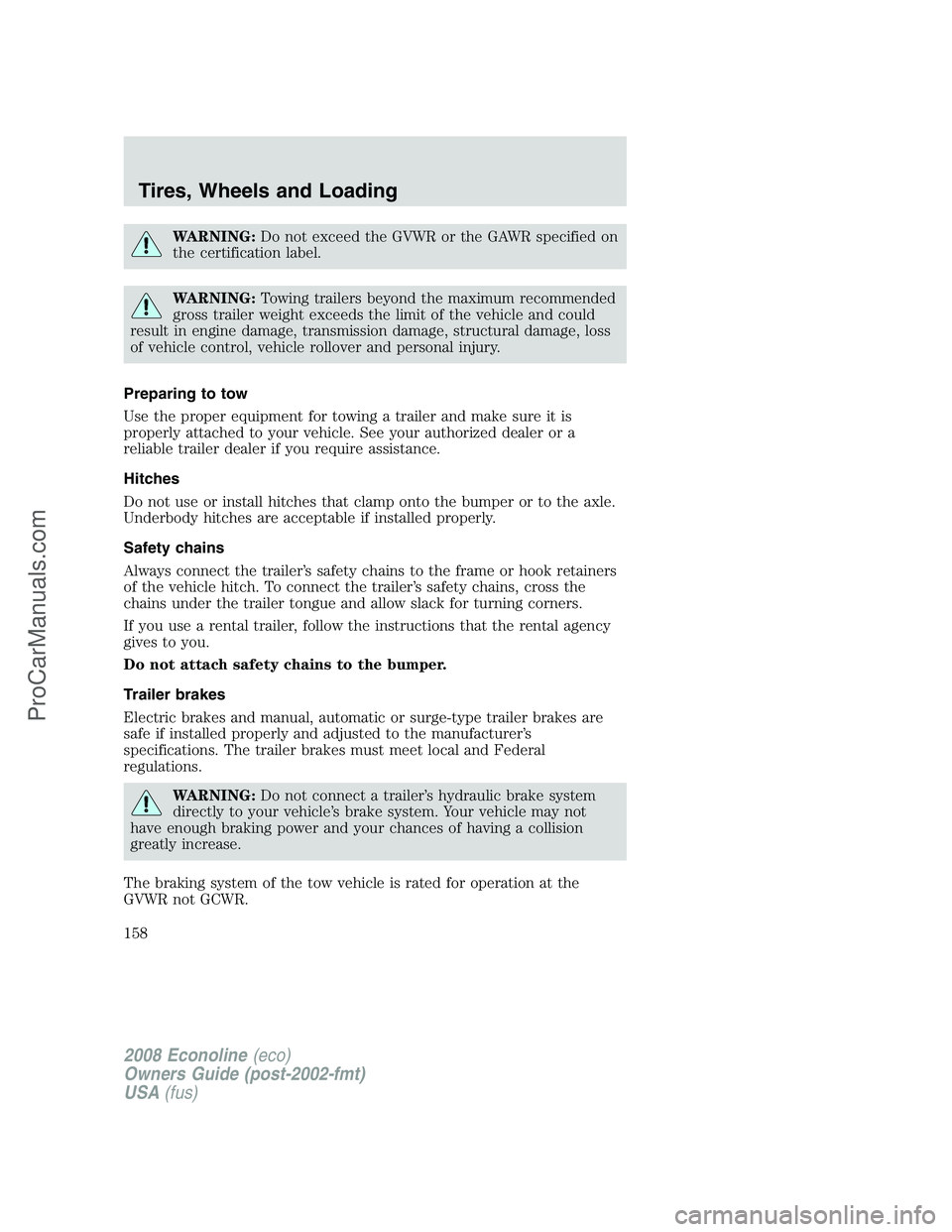
WARNING:Do not exceed the GVWR or the GAWR specified on
the certification label.
WARNING:Towing trailers beyond the maximum recommended
gross trailer weight exceeds the limit of the vehicle and could
result in engine damage, transmission damage, structural damage, loss
of vehicle control, vehicle rollover and personal injury.
Preparing to tow
Use the proper equipment for towing a trailer and make sure it is
properly attached to your vehicle. See your authorized dealer or a
reliable trailer dealer if you require assistance.
Hitches
Do not use or install hitches that clamp onto the bumper or to the axle.
Underbody hitches are acceptable if installed properly.
Safety chains
Always connect the trailer’s safety chains to the frame or hook retainers
of the vehicle hitch. To connect the trailer’s safety chains, cross the
chains under the trailer tongue and allow slack for turning corners.
If you use a rental trailer, follow the instructions that the rental agency
gives to you.
Do not attach safety chains to the bumper.
Trailer brakes
Electric brakes and manual, automatic or surge-type trailer brakes are
safe if installed properly and adjusted to the manufacturer’s
specifications. The trailer brakes must meet local and Federal
regulations.
WARNING:Do not connect a trailer’s hydraulic brake system
directly to your vehicle’s brake system. Your vehicle may not
have enough braking power and your chances of having a collision
greatly increase.
The braking system of the tow vehicle is rated for operation at the
GVWR not GCWR.
2008 Econoline(eco)
Owners Guide (post-2002-fmt)
USA(fus)
Tires, Wheels and Loading
158
ProCarManuals.com
Page 159 of 285
Trailer lamps
Trailer lamps are required on most towed vehicles. Make sure all running
lights, brake lights, turn signals and hazard lights are working. See your
authorized dealer or trailer rental agency for proper instructions and
equipment for hooking up trailer lamps.
Using a step bumper (if equipped)
The rear bumper is equipped with an integral hitch and only requires a
ball with a one inch (25.4 mm) shank diameter. The bumper has a
5,000 lb (2,270 kg) trailer weight and 500 lb (227 kg) tongue weight
capacity.
If it is necessary to relocate the trailer hitch ball position, a
frame-mounted trailer hitch must be installed.
Driving while you tow
When towing a trailer:
•To ensure proper “break-in” of powertrain components, do not trailer
tow during the first 1,000 miles (1,600 km) of a new vehicle.
•To ensure proper “break-in” of powertrain components during the first
500 miles (800 km) of trailer towing, drive no faster than 70 mph
(113 km/h) with no full throttle starts.
•Turn off the speed control. The speed control may shut off
automatically when you are towing on long, steep grades.
•Consult your local motor vehicle speed regulations for towing a trailer.
•To eliminate excessive shifting, use a lower gear. This will also assist
in transmission cooling.
•Anticipate stops and brake gradually.
When descending long, steep downhill grades, always use a lower gear to
provide engine braking to save wear on brakes. Use Drive (Overdrive
OFF) on moderately steep hills, Second (2) on steep hills, and First (1)
on very steep hills.Do not apply your brakes continuously, as they
may overheat and become less effective.
Servicing after towing
If you tow a trailer for long distances, your vehicle will require more
frequent service intervals. Refer to yourscheduled maintenance
informationfor more information.
2008 Econoline(eco)
Owners Guide (post-2002-fmt)
USA(fus)
Tires, Wheels and Loading
159
ProCarManuals.com
Page 160 of 285
Trailer towing tips
•Practice turning, stopping and backing up before starting on a trip to
get the feel of the vehicle trailer combination. When turning, make
wider turns so the trailer wheels will clear curbs and other obstacles.
•Allow more distance for stopping with a trailer attached.
•The trailer tongue weight should be 10–15% of the loaded trailer
weight.
•If you will be towing a trailer frequently in hot weather, hilly
conditions, at GCWR, or any combination of these factors, consider
refilling your rear axle with synthetic gear lube if not already so
equipped. Refer to theMaintenance and specificationschapter for
the lubricant specification. Remember that regardless of the rear axle
lube used, do not tow a trailer for the first 1,000 miles (1,600 km) of a
new vehicle, and that the first 500 miles (800 km) of towing be done
at no faster than 70 mph (113 km/h) with no full throttle starts.
•Do not tow a trailer for the first 500 miles (800 km) after changing
the rear axle lube.
•After you have traveled 50 miles (80 km), thoroughly check your
hitch, electrical connections and trailer wheel lug nuts.
•When stopped in traffic for long periods of time in hot weather, place
the gearshift in P (Park) and increase idle speed. This aids engine
cooling and air conditioner efficiency.
•Vehicles with trailers should not be parked on a grade. If you must
park on a grade, place wheel chocks under the trailer’s wheels.
Launching or retrieving a boat
Disconnect the wiring to the trailer before backing the trailer
into the water. Reconnect the wiring to the trailer after the
trailer is removed from the water.
When backing down a ramp during boat launching or retrieval:
•do not allow the static water level to rise above the bottom edge of
the rear bumper.
•do not allow waves to break higher than 6 inches (15 cm) above the
bottom edge of the rear bumper.
Exceeding these limits may allow water to enter vehicle components:
•causing internal damage to the components.
•affecting driveability, emissions and reliability.
2008 Econoline(eco)
Owners Guide (post-2002-fmt)
USA(fus)
Tires, Wheels and Loading
160
ProCarManuals.com
Page 161 of 285
Replace the rear axle lubricant any time the axle has been submerged in
water. Rear axle lubricant quantities are not to be checked or changed
unless a leak is suspected or repair required.
RECREATIONAL TOWING
Follow these guidelines if you have a need for recreational (RV) towing.
An example of recreational towing would be towing your vehicle behind
a motorhome. These guidelines are designed to ensure that your
transmission is not damaged.
All vehicles:Do not tow your vehicle with any wheels on the ground, as
vehicle or transmission damage may occur. It is recommended to tow
your vehicle with all four (4) wheels off the ground such as when using a
car-hauling trailer. Otherwise, no recreational towing is permitted.
In case of a roadside emergency with a disabled vehicle, seeWrecker
towingin theRoadside Emergencieschapter.
2008 Econoline(eco)
Owners Guide (post-2002-fmt)
USA(fus)
Tires, Wheels and Loading
161
ProCarManuals.com
Page 162 of 285
STARTING
Positions of the ignition
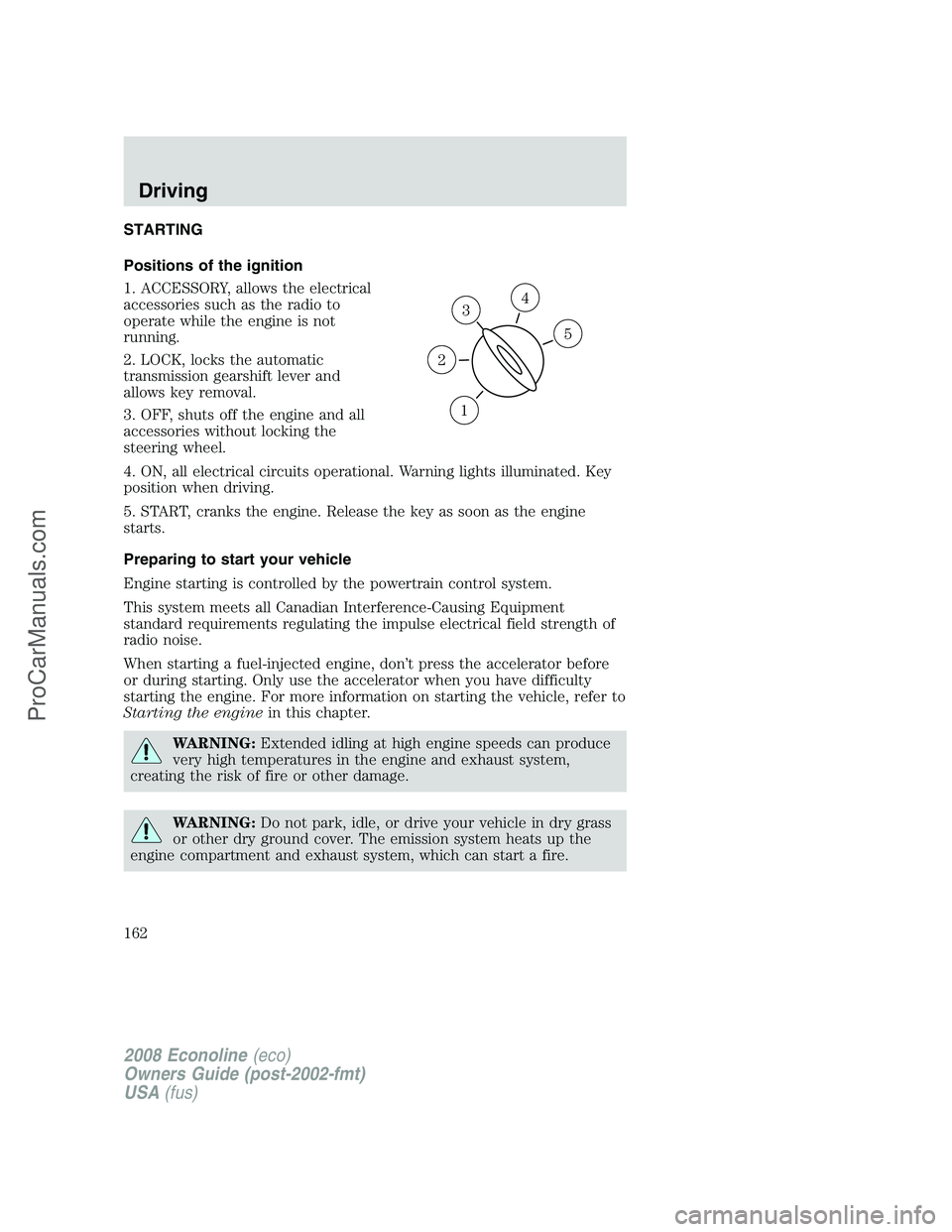
1. ACCESSORY, allows the electrical
accessories such as the radio to
operate while the engine is not
running.
2. LOCK, locks the automatic
transmission gearshift lever and
allows key removal.
3. OFF, shuts off the engine and all
accessories without locking the
steering wheel.
4. ON, all electrical circuits operational. Warning lights illuminated. Key
position when driving.
5. START, cranks the engine. Release the key as soon as the engine
starts.
Preparing to start your vehicle
Engine starting is controlled by the powertrain control system.
This system meets all Canadian Interference-Causing Equipment
standard requirements regulating the impulse electrical field strength of
radio noise.
When starting a fuel-injected engine, don’t press the accelerator before
or during starting. Only use the accelerator when you have difficulty
starting the engine. For more information on starting the vehicle, refer to
Starting the enginein this chapter.
WARNING:Extended idling at high engine speeds can produce
very high temperatures in the engine and exhaust system,
creating the risk of fire or other damage.
WARNING:Do not park, idle, or drive your vehicle in dry grass
or other dry ground cover. The emission system heats up the
engine compartment and exhaust system, which can start a fire.
3
1
2
5
4
2008 Econoline(eco)
Owners Guide (post-2002-fmt)
USA(fus)
Driving
162
ProCarManuals.com
Page 167 of 285
•Be sure that the engine block heater, heater cord and extension cord
are solidly connected. A poor connection can cause the cord to
become very hot and may result in an electrical shock or fire. Be sure
to check for heat anywhere in the electrical hookup once the system
has been operating for approximately a half hour.
•Finally, have the engine block heater system checked during your fall
tune-up to be sure it’s in good working order.
How to use the engine block heater
Ensure the receptacle terminals are clean and dry prior to use. To clean
them, use a dry cloth.
Depending on the type of factory installed equipment, your engine block
heater system may consume anywhere between 400 watts or 1000 watts
of energy per hour. Your factory installed block heater system does not
have a thermostat; however, maximum temperature is attained after
approximately three hours of operation. Block heater operation longer
than 3 hours will not improve system performance and will unnecessarily
use additional electricity.
Make sure system is unplugged and properly stowed before driving the
vehicle. While not in use, make sure the protective cover seals the
prongs of the engine block heater cord plug.
BRAKES
Occasional brake noise is normal. If a metal-to-metal, continuous grinding
or continuous squeal sound is present, the brake linings may be worn-out
and should be inspected by an authorized dealer. If the vehicle has
continuous vibration or shudder in the steering wheel while braking, the
vehicle should be inspected by an authorized dealer.
Refer toBrake system warning
lightin theInstrument Cluster
chapter for information on the brake
system warning light.
Four-wheel anti-lock brake system (ABS)
Your vehicle is equipped with an Anti-lock Braking System (ABS). This
system helps you maintain steering control during emergency stops by
keeping the brakes from locking. Noise from the ABS pump motor and
brake pedal pulsation may be observed during ABS braking and the
brake pedal may suddenly travel a little farther as soon as ABS braking is
done and normal brake operation resumes. These are normal
characteristics of the ABS and should be no reason for concern.
P!
BRAKE
2008 Econoline(eco)
Owners Guide (post-2002-fmt)
USA(fus)
Driving
167
ProCarManuals.com
Page 169 of 285
The parking brake is not recommended to stop a moving vehicle.
However, if the normal brakes fail, the parking brake can be used to stop
your vehicle in an emergency. Since the parking brake applies only the
rear brakes, the vehicle’s stopping distance will increase greatly and the
handling of your vehicle will be adversely affected.
TRACTION CONTROL™ (IF EQUIPPED)
Your vehicle may be equipped with a Traction Control™ system. This
system helps you maintain the stability and steerability of your vehicle,
especially on slippery road surfaces such as snow- or ice-covered roads
and gravel roads. The system will allow your vehicle to make better use
of available traction in these conditions.
During Traction Control™ operation,
the traction control active light will
flash and the engine will not
“rev-up” when you push further on
the accelerator. This is normal
system behavior and should be no
reason for concern.
WARNING:Aggressive driving in any road conditions can cause
you to lose control of your vehicle increasing the risk of severe
personal injury or property damage. The occurrence of a Traction
Control™ event is an indication that at least some of the tires have
exceeded their ability to grip the road; this may lead to an increased
risk of loss of vehicle control, vehicle rollover, personal injury and
death. If you experience a severe road event, SLOW DOWN.
The Traction Control™ switch,
located on the center console, has
an indicator light that illuminates
when the system is off. The Traction
Control™ system will automatically
turn on every time the ignition is
turned off and on. The Traction
Control™ system should normally be left on.
If you should become stuck in snow or ice or on a very slippery road
surface, try switching the Traction Control™ system off. This may allow
excess wheel spin to “dig” the vehicle out and enable a successful
“rocking” maneuver. Remember to switch the Traction Control™ system
back on once the vehicle is no longer stuck.
2008 Econoline(eco)
Owners Guide (post-2002-fmt)
USA(fus)
Driving
169
ProCarManuals.com