trailer FORD E-450 2002 User Guide
[x] Cancel search | Manufacturer: FORD, Model Year: 2002, Model line: E-450, Model: FORD E-450 2002Pages: 256, PDF Size: 3.52 MB
Page 164 of 256
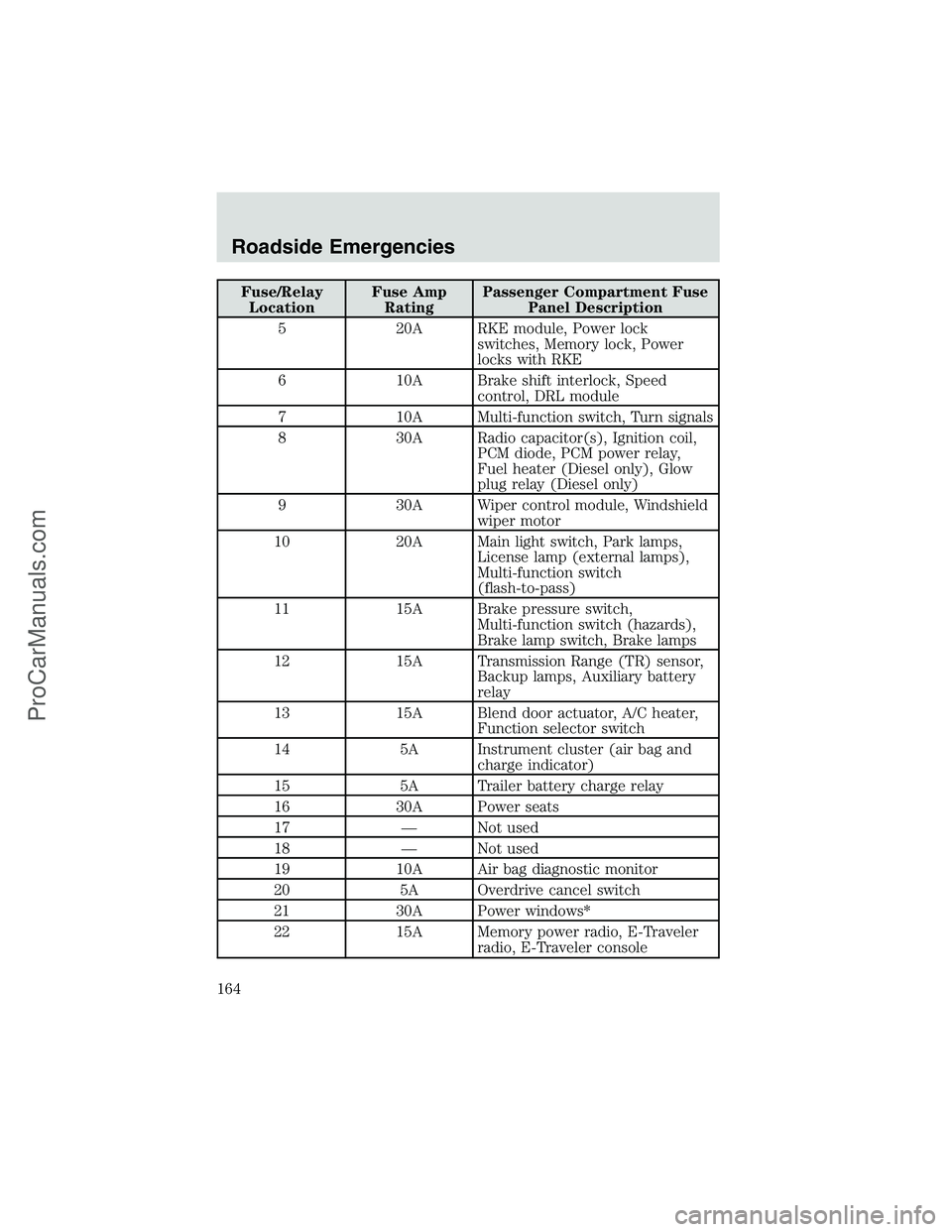
Fuse/Relay
LocationFuse Amp
RatingPassenger Compartment Fuse
Panel Description
5 20A RKE module, Power lock
switches, Memory lock, Power
locks with RKE
6 10A Brake shift interlock, Speed
control, DRL module
7 10A Multi-function switch, Turn signals
8 30A Radio capacitor(s), Ignition coil,
PCM diode, PCM power relay,
Fuel heater (Diesel only), Glow
plug relay (Diesel only)
9 30A Wiper control module, Windshield
wiper motor
10 20A Main light switch, Park lamps,
License lamp (external lamps),
Multi-function switch
(flash-to-pass)
11 15A Brake pressure switch,
Multi-function switch (hazards),
Brake lamp switch, Brake lamps
12 15A Transmission Range (TR) sensor,
Backup lamps, Auxiliary battery
relay
13 15A Blend door actuator, A/C heater,
Function selector switch
14 5A Instrument cluster (air bag and
charge indicator)
15 5A Trailer battery charge relay
16 30A Power seats
17—Not used
18—Not used
19 10A Air bag diagnostic monitor
20 5A Overdrive cancel switch
21 30A Power windows*
22 15A Memory power radio, E-Traveler
radio, E-Traveler console
Roadside Emergencies
164
ProCarManuals.com
Page 166 of 256
Always disconnect the battery before servicing high current
fuses.
Always replace the cover to the power distribution box before
reconnecting the battery or refilling fluid reservoirs
If the battery has been disconnected and reconnected, refer to the
Batterysection of theMaintenance and specificationschapter.
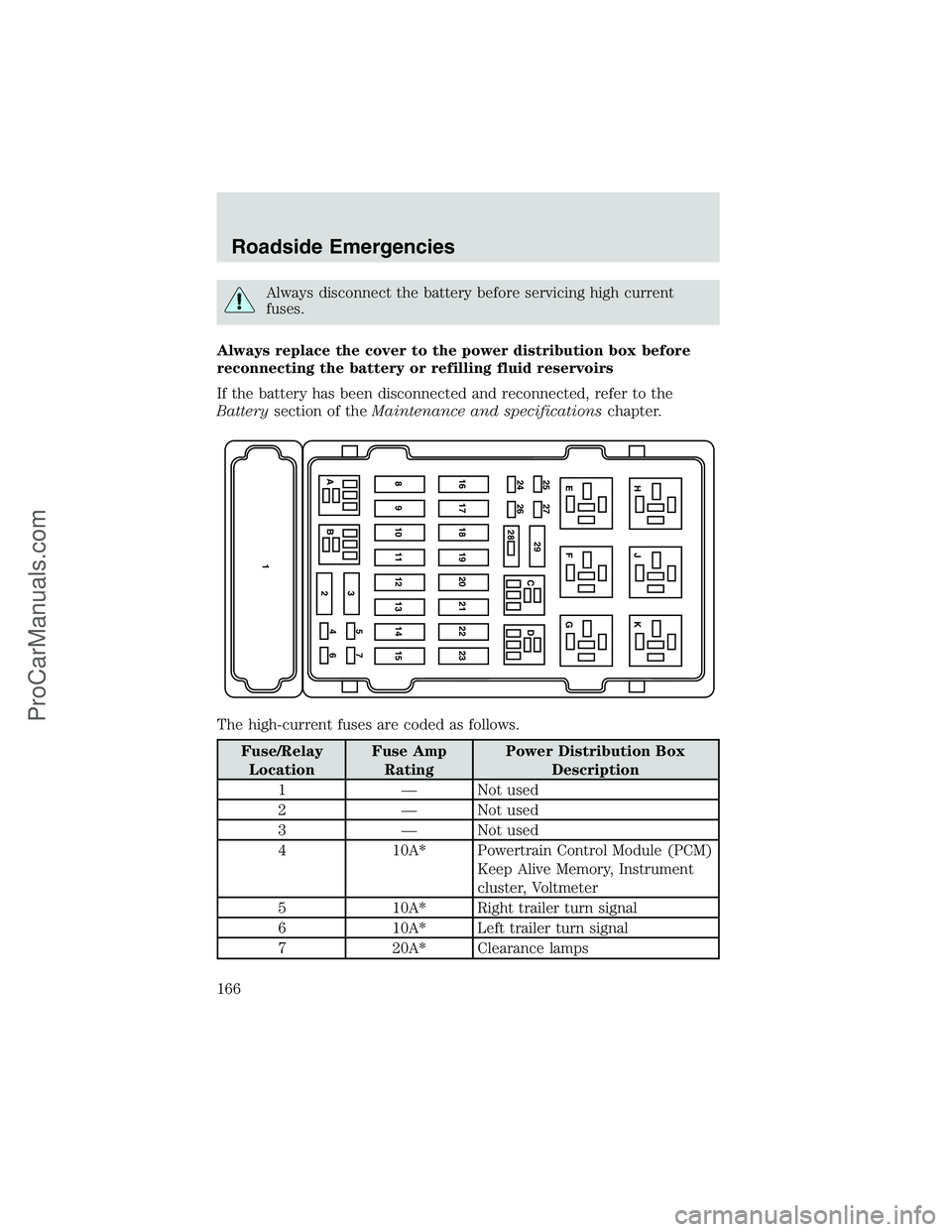
The high-current fuses are coded as follows.
Fuse/Relay
LocationFuse Amp
RatingPower Distribution Box
Description
1—Not used
2—Not used
3—Not used
4 10A* Powertrain Control Module (PCM)
Keep Alive Memory, Instrument
cluster, Voltmeter
5 10A* Right trailer turn signal
6 10A* Left trailer turn signal
7 20A* Clearance lamps
AB3
2
146 5715 14 13 12 11 10 9 823 22 21 20 19 18 17 1624 26 25 27
29
CDG F EK J H
28
Roadside Emergencies
166
ProCarManuals.com
Page 167 of 256
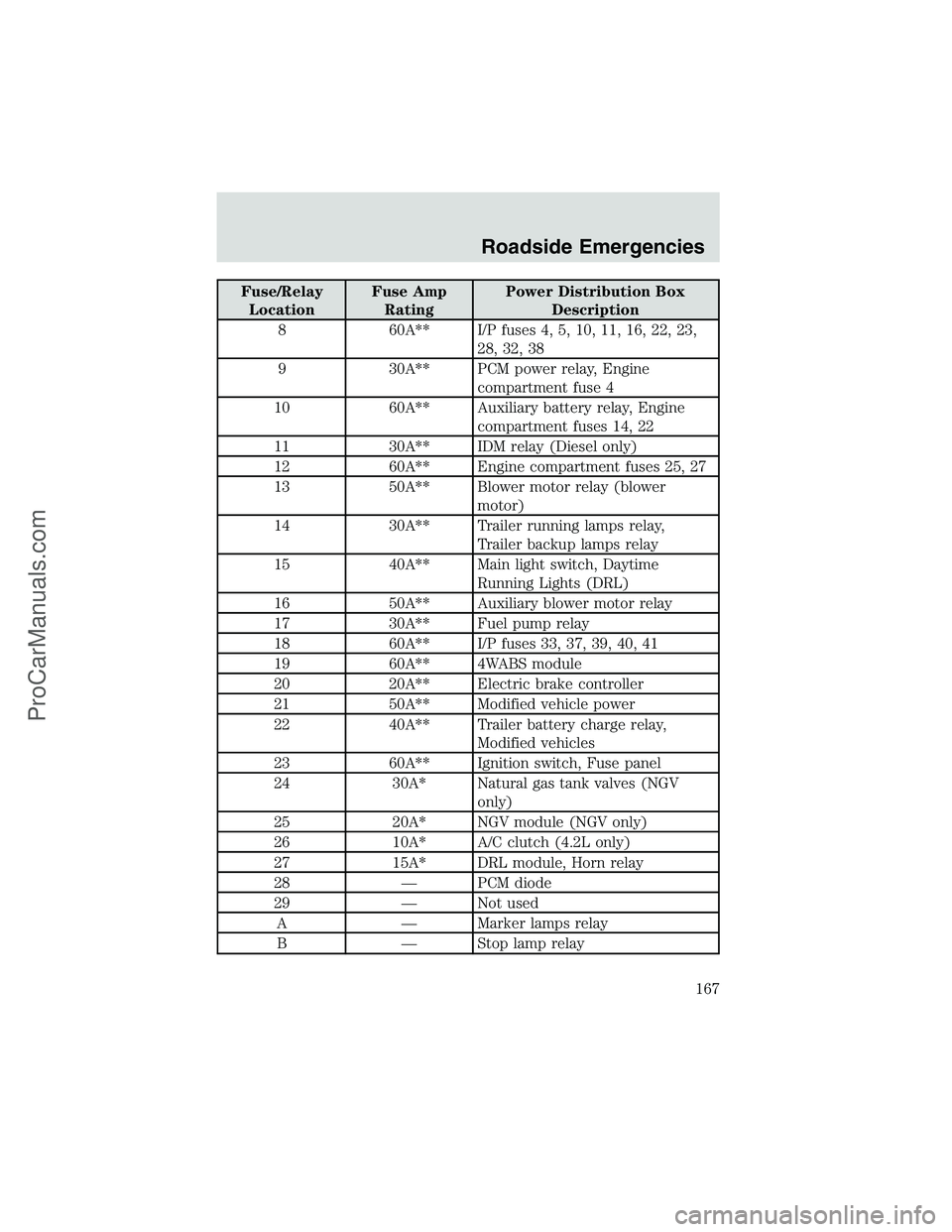
Fuse/Relay
LocationFuse Amp
RatingPower Distribution Box
Description
8 60A** I/P fuses 4, 5, 10, 11, 16, 22, 23,
28, 32, 38
9 30A** PCM power relay, Engine
compartment fuse 4
10 60A** Auxiliary battery relay, Engine
compartment fuses 14, 22
11 30A** IDM relay (Diesel only)
12 60A** Engine compartment fuses 25, 27
13 50A** Blower motor relay (blower
motor)
14 30A** Trailer running lamps relay,
Trailer backup lamps relay
15 40A** Main light switch, Daytime
Running Lights (DRL)
16 50A** Auxiliary blower motor relay
17 30A** Fuel pump relay
18 60A** I/P fuses 33, 37, 39, 40, 41
19 60A** 4WABS module
20 20A** Electric brake controller
21 50A** Modified vehicle power
22 40A** Trailer battery charge relay,
Modified vehicles
23 60A** Ignition switch, Fuse panel
24 30A* Natural gas tank valves (NGV
only)
25 20A* NGV module (NGV only)
26 10A* A/C clutch (4.2L only)
27 15A* DRL module, Horn relay
28—PCM diode
29—Not used
A—Marker lamps relay
B—Stop lamp relay
Roadside Emergencies
167
ProCarManuals.com
Page 168 of 256
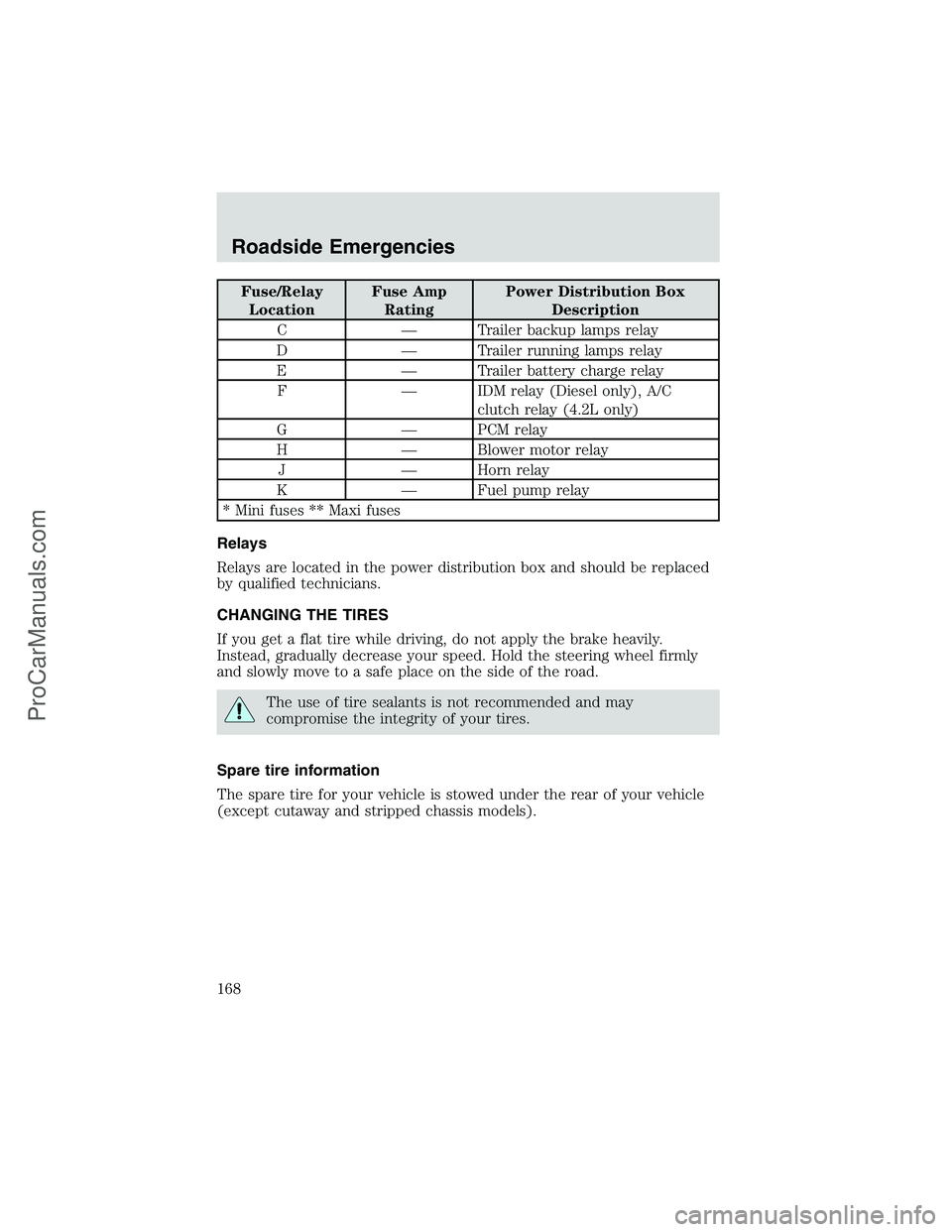
Fuse/Relay
LocationFuse Amp
RatingPower Distribution Box
Description
C—Trailer backup lamps relay
D—Trailer running lamps relay
E—Trailer battery charge relay
F—IDM relay (Diesel only), A/C
clutch relay (4.2L only)
G—PCM relay
H—Blower motor relay
J—Horn relay
K—Fuel pump relay
* Mini fuses ** Maxi fuses
Relays
Relays are located in the power distribution box and should be replaced
by qualified technicians.
CHANGING THE TIRES
If you get a flat tire while driving, do not apply the brake heavily.
Instead, gradually decrease your speed. Hold the steering wheel firmly
and slowly move to a safe place on the side of the road.
The use of tire sealants is not recommended and may
compromise the integrity of your tires.
Spare tire information
The spare tire for your vehicle is stowed under the rear of your vehicle
(except cutaway and stripped chassis models).
Roadside Emergencies
168
ProCarManuals.com
Page 223 of 256
•Perform all regularly scheduled maintenance items. Follow the
recommended maintenance schedule and owner maintenance checks
found in your vehicle scheduled maintenance guide.
Conditions
•Heavily loading a vehicle or towing a trailer may reduce fuel economy
at any speed.
•Carrying unnecessary weight may reduce fuel economy (approximately
0.4 km/L [1 mpg] is lost for every 180 kg [400 lb] of weight carried).
•Adding certain accessories to your vehicle (for example bug
deflectors, rollbars/light bars, running boards, ski/luggage racks) may
reduce fuel economy.
•Using fuel blended with alcohol may lower fuel economy.
•Fuel economy may decrease with lower temperatures during the first
12–16 km (8–10 miles) of driving.
•Driving on flat terrain offers improved fuel economy as compared to
driving on hilly terrain.
•Transmissions give their best fuel economy when operated in the top
cruise gear and with steady pressure on the gas pedal.
•Close windows for high speed driving.
EPA window sticker
Every new vehicle should have the EPA window sticker. Contact your
dealer if the window sticker is not supplied with your vehicle. The EPA
window sticker should be your guide for the fuel economy comparisons
with other vehicles.
It is important to note the box in the lower left corner of the window
sticker. These numbers represent the Range of L/100 km (MPG)
expected on the vehicle under optimum conditions. Your fuel economy
may vary depending upon the method of operation and conditions.
EMISSION CONTROL SYSTEM
Your vehicle is equipped with various emission control components and a
catalytic converter which will enable your vehicle to comply with
applicable exhaust emission standards. To make sure that the catalytic
converter and other emission control components continue to work
properly:
•Use only the specified fuel listed.
•Avoid running out of fuel.
Maintenance and Specifications
223
ProCarManuals.com
Page 227 of 256
Brake fluid is toxic. If brake fluid contacts the eyes, flush eyes
with running water for 15 minutes. Seek medical attention if
irritation persists. If taken internally, drink water and induce vomiting.
Seek medical attention immediately.
If you use a brake fluid that is not DOT 3, you will cause
permanent damage to your brakes.
Do not let the reservoir for the master cylinder run dry. This
may cause the brakes to fail.
DRIVELINE UNIVERSAL JOINT AND SLIP YOKE
Your vehicle may be equipped with universal joints that require
lubrication. Refer to the scheduled maintenance guide for maintenance
intervals. If the original universal joints are replaced with universal joints
equipped with grease fittings, lubrication will also be necessary.
TRANSMISSION FLUID
Checking automatic transmission fluid (if equipped)
Refer to your scheduled maintenance guide for scheduled intervals for
fluid checks and changes. Your transmission does not consume fluid.
However, the fluid level should be checked if the transmission is not
working properly, i.e., if the transmission slips or shifts slowly or if you
notice some sign of fluid leakage.
Automatic transmission fluid expands when warmed. To obtain an
accurate fluid check, drive the vehicle until it is at normal operating
temperature (approximately 30 km [20 miles]). If your vehicle has been
operated for an extended period at high speeds, in city traffic during hot
weather or pulling a trailer, the vehicle should be turned off for about 30
minutes to allow fluid to cool before checking.
1. Drive the vehicle 30 km (20 miles) or until it reaches normal operating
temperature.
2. Park the vehicle on a level surface and engage the parking brake.
3. With the parking brake engaged and your foot on the brake pedal,
start the engine and move the gearshift lever through all of the gear
ranges. Allow sufficient time for each gear to engage.
4. Latch the gearshift lever in P (Park) and leave the engine running.
Maintenance and Specifications
227
ProCarManuals.com
Page 249 of 256
First aid and highway kits
Fog lights
Hitch mount bicycle carrier
Inside mirror, electrochromic with compass (with and without
temperature display)
Removable roof rack
Running boards—Aluminum and Platinum elliptical
Speed control
Tailgate table
TracRac
Trailer hitch (Class III)
Trailer hitch bars and balls
Trailer hitch wiring adaptor
Protection and appearance equipment
Air bag anti-theft locks
Battery warmer
Carpet floor mats
Cleaners, waxes and polishes
Door edge guards
Flat splash guards
Front end covers (full)
Hood deflector
Rear step bumpers
Side window air deflectors
For maximum vehicle performance, keep the following information in
mind when adding accessories or equipment to your vehicle:
•When adding accessories, equipment, passengers and luggage to your
vehicle, do not exceed the total weight capacity of the vehicle or of
the front or rear axle (GVWR or GAWR as indicated on the Safety
compliance certification label). Consult your dealer for specific weight
information.
•The Federal Communications Commission (FCC) and Canadian Radio
Telecommunications Commission (CRTC) regulate the use of mobile
Accessories
249
ProCarManuals.com
Page 254 of 256
Infant seats
(see Safety seats) .....................127
Inspection/maintenance (I/M)
testing ........................................224
Instrument panel
cleaning ...................................194
cluster ........................................10
lighting up panel and
interior .......................................77
J
Jack ............................................168
positioning ...............................168
storage .....................................168
Jump-starting your vehicle ......175
K
Keys
key in ignition chime ...............14
positions of the ignition .........136
L
Lamps
bulb replacement
specifications chart ..................79
cargo lamps ...............................77
daytime running light ...............76
headlamps .................................76
headlamps, flash to pass ..........77
instrument panel, dimming .....77
interior lamps ...........................78
replacing bulbs ...................79–83
Lane change indicator
(see Turn signal) ........................77
Lights, warning and indicator ....10
air bag ........................................12
anti-lock brakes (ABS) ....12, 142
brake ..........................................11charging system ........................12
check coolant ............................13
cruise indicator .........................13
engine oil pressure ...................13
high beam .................................13
low fuel ......................................12
safety belt .................................12
service engine soon ..................10
speed control ............................92
turn signal indicator .................13
Limited slip axle (see Traction
Loc) ............................................143
Load limits .................................149
GAWR ......................................149
GVWR ......................................149
trailer towing ..........................149
Loading instructions .................150
Lubricant specifications ...240, 243
Lumbar support, seats .............102
M
Mirrors
fold away ...................................88
side view mirrors (power) .......87
Motorcraft parts ................220, 235
O
Octane rating ............................219
Odometer .....................................16
Oil (see Engine oil) ..................201
Overdrive .....................................92
P
Panic alarm feature, remote
entry system ................................99
Parking brake ............................142
Index
254
ProCarManuals.com
Page 256 of 256
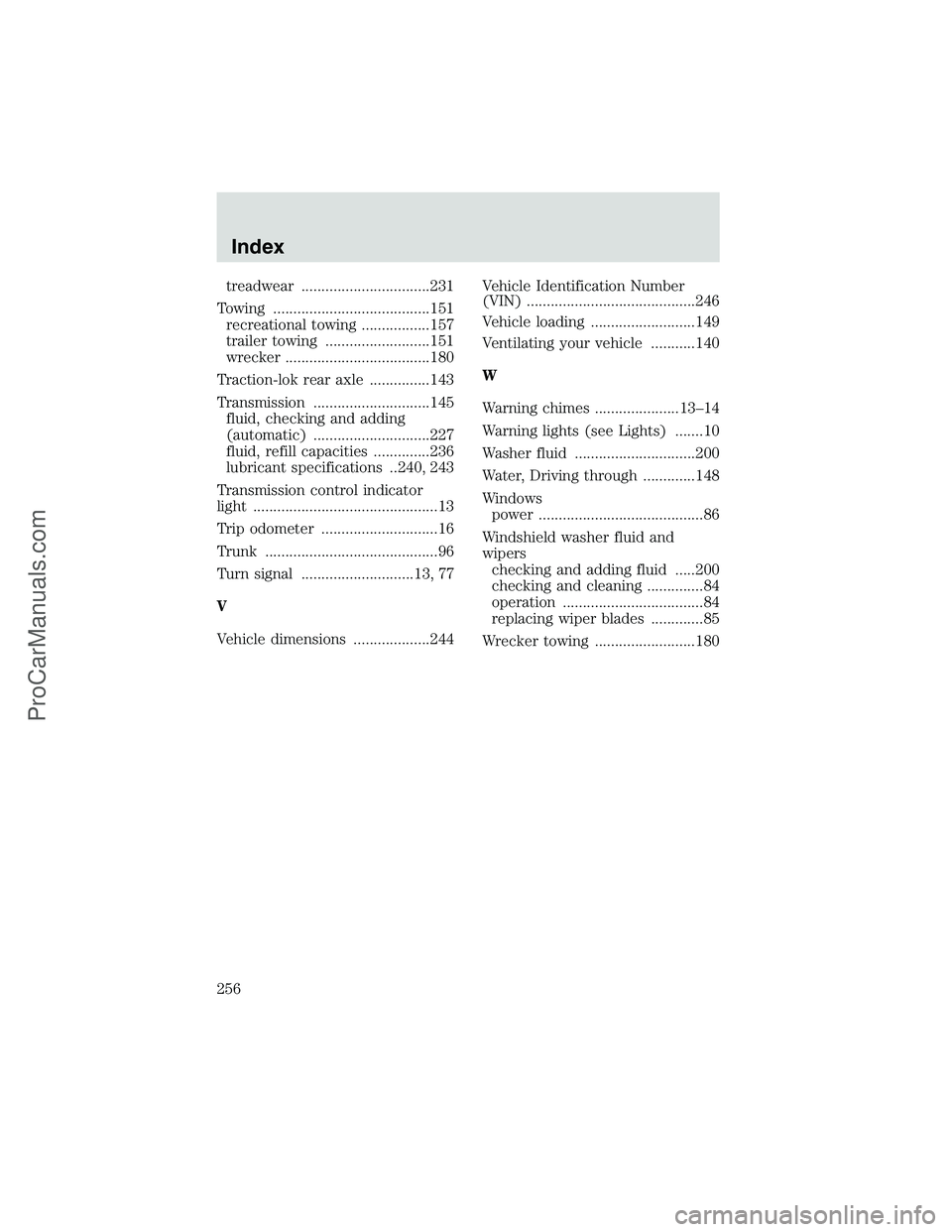
treadwear ................................231
Towing .......................................151
recreational towing .................157
trailer towing ..........................151
wrecker ....................................180
Traction-lok rear axle ...............143
Transmission .............................145
fluid, checking and adding
(automatic) .............................227
fluid, refill capacities ..............236
lubricant specifications ..240, 243
Transmission control indicator
light ..............................................13
Trip odometer .............................16
Trunk ...........................................96
Turn signal ............................13, 77
V
Vehicle dimensions ...................244Vehicle Identification Number
(VIN) ..........................................246
Vehicle loading ..........................149
Ventilating your vehicle ...........140
W
Warning chimes .....................13–14
Warning lights (see Lights) .......10
Washer fluid ..............................200
Water, Driving through .............148
Windows
power .........................................86
Windshield washer fluid and
wipers
checking and adding fluid .....200
checking and cleaning ..............84
operation ...................................84
replacing wiper blades .............85
Wrecker towing .........................180
Index
256
ProCarManuals.com