ECO mode FORD E SERIES 1997 4.G User Guide
[x] Cancel search | Manufacturer: FORD, Model Year: 1997, Model line: E SERIES, Model: FORD E SERIES 1997 4.GPages: 192, PDF Size: 3.44 MB
Page 85 of 192

word ªOFFº) will no longer be
illuminated.
Each time the vehicle is started,
the transmission will automatically
return to normal overdrive mode
and you must press the TCS to
deactivate overdrive again if you
do not want overdrive operation.
2 (Second)Ð Use 2 (Second) to
start-up on slippery roads or to
provide additional engine braking
on downgrades. Transmission
operates in first and second gears.
1 (Low)Ð Use 1 (Low) to
provide maximum engine braking
on steep downgrades. Upshifts can
be made by shifting to 2 (Second)
or to
D(Overdrive). Selecting 1
(Low) at higher speeds causes a
shift to 2 (Second), and will shift
to 1 (Low) after vehicle
decelerates to the proper speed.
Brake-shift interlock
The brake-shift interlock feature
prevents you from shifting from P
(Park) unless the brake pedal is
depressed (with the ignition in the
ON position). If you cannot move
the gearshift out of P (Park) with
the brake pedal depressed:
1. Turn ignition key to Off.
2. Apply the parking brake.
3. Turn ignition key to Lock and
remove the key.
4. Re-insert the ignition key and
turn it to Off.
eco_brake_shift_inter-lock
Driving
85
Page 112 of 192
Position Circuit
J Horn
K Fuel pump or IDM
CHANGING TIRES
Spare tire location
The spare tire is stowed under the
rear of your vehicle (except
cutaway and stripped chassis
models).
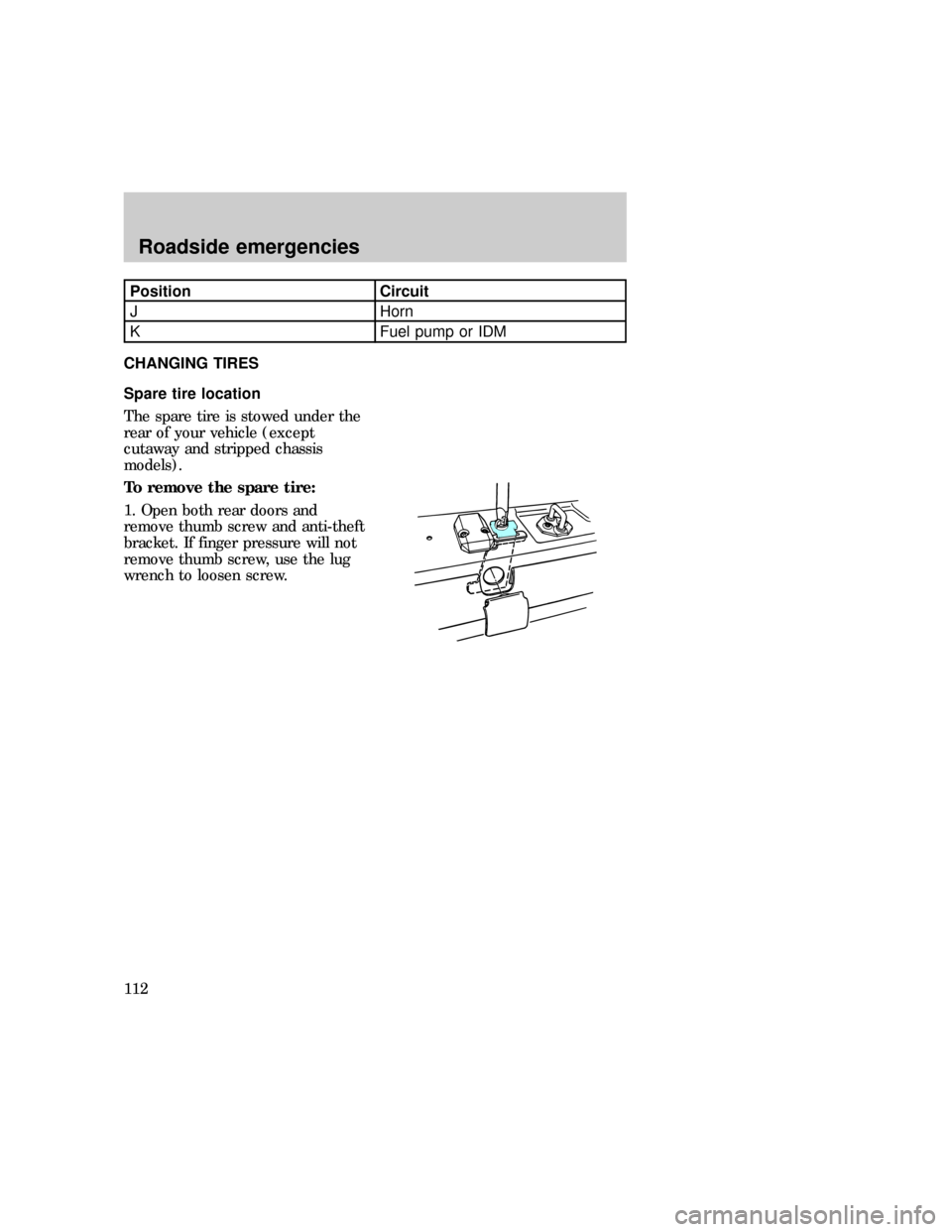
To remove the spare tire:
1. Open both rear doors and
remove thumb screw and anti-theft
bracket. If finger pressure will not
remove thumb screw, use the lug
wrench to loosen screw.
eco_tire_location
Roadside emergencies
112
Page 120 of 192
On vehicles equipped with dual
rear wheels retighten the wheel
lug nuts to the specified torque at
160 km (100 miles), and again at
800 km (500 miles) of new vehicle
operation and at intervals specified
in the ªService Guide.º
On vehicles equipped with single
rear wheels retighten the lug nuts
to the specified torque at 800 km
(500 miles) of operation after any
wheel change or any time the lug
nuts are loosened.
Model Bolt Size Wheel Lug nut Torque*
N²M Ft-Lb
E-150 1/2-20 135 100
E-250, E-350
and E-Super
Duty9/16-18 190 140
* Torque specifications are for nut and bolt threads free of dirt and
rust. Do not use oil or grease on threads. Use only Ford recommened
replacement fasteners.
JUMP STARTING YOUR
VEHICLE
The gases around the
battery can explode if
exposed to flames, sparks, or lit
cigarettes. An explosion could
result in injury or vehicle
damage.
com_jump-starting.01
Roadside emergencies
120
Page 122 of 192
![FORD E SERIES 1997 4.G User Guide Do not connect the end of
the second cable to the
negative ([-]) terminal of the
battery to be jumped. A spark
may cause an explosion of the
gases that surround the battery.
Jump starting
1. Start the](/img/11/4790/w960_4790-121.png "FORD E SERIES 1997 4.G User Guide Do not connect the end of
the second cable to the
negative ([-]) terminal of the
battery to be jumped. A spark
may cause an explosion of the
gases that surround the battery.
Jump starting
1. Start the")
Do not connect the end of
the second cable to the
negative ([-]) terminal of the
battery to be jumped. A spark
may cause an explosion of the
gases that surround the battery.
Jump starting
1. Start the booster vehicle and
run the engine at moderately
increased speed.
2. Start the engine of the vehicle
with the discharged battery.
3. Once the engine has been
started, run both vehicles for a
further three minutes before
disconnecting the leads.
Removing the jumper cables
1. Remove the jumper cables in
reverse order. Take the cable off
the metallic surface (1) first,
followed by the cable on the
negative (-) booster battery
terminal (2).
2. Remove the cable from the
positive (+) terminal of the booster
battery (3) and then the
discharged battery (4).
3. After the disabled vehicle has
been started, allow it to idle for a
while so the engine can ªrelearnº
its idle conditions.
+–
+–
2
3
4
1
com_jump_starting.01
com_removing_cables.01
eco_wrecker_towing
Roadside emergencies
122
Page 140 of 192
When fail-safe mode is
activated
²Pull off the road as soon as
possible.
²Immediately turn the engine off
to prevent severe engine
damage.
²Wait for the engine to cool.
²Check the coolant level.
CHECKING AND ADDING
POWER STEERING FLUID
Check the power steering fluid
level at least twice a year.
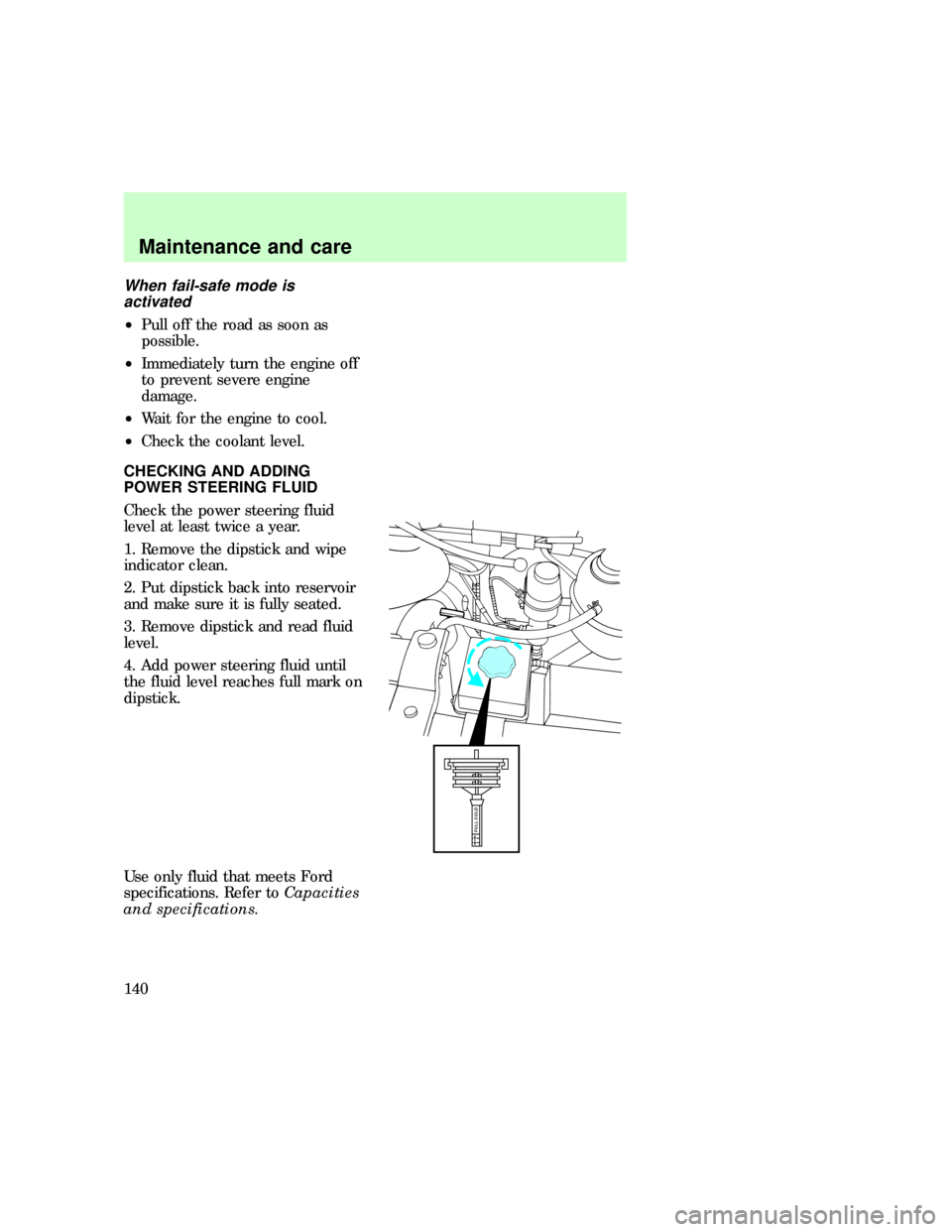
1. Remove the dipstick and wipe
indicator clean.
2. Put dipstick back into reservoir
and make sure it is fully seated.
3. Remove dipstick and read fluid
level.
4. Add power steering fluid until
the fluid level reaches full mark on
dipstick.
Use only fluid that meets Ford
specifications. Refer toCapacities
and specifications.
FULL COLD
eco_power_steering
eco_checking_adding_autotrans
Maintenance and care
140
Page 164 of 192

Preparing your vehicle for
inspection/maintenance (I/M)
testing
In some localities it may be a legal
requirement to pass an I/M test of
the on-board diagnostic (OBD) II
system. If your vehicle's powertrain
system or battery has just been
serviced, the OBD II system is
reset to a condition unready for
I/M testing. To ready the OBD II
system for I/M testing, the law
specifies that additional city and
highway driving is necessary to
complete the check of the OBD II
system.
The driving modes required to
reach the ready condition consist
of a minimum of 30 minutes of city
and highway driving:
²At least 20 minutes driving in
stop and go city-type traffic with
at least four idle periods.
²At least ten minutes of driving
on an expressway or highway.
Before completing the above
driving modes, the engine must be
warmed up and at operating
temperature. Once started, the
vehicle must not be turned off
during these modes.
eco_bulbs_replace
Maintenance and care
164
Page 173 of 192

MOTORCRAFT PART NUMBERS
Component Engine application
4.2L 4.6L 5.4L 6.8L
Spark plug AWSF-42EE AWSF-32PP AWSF-22E AWSF-22E
Air filter FA-1632 FA-1632 FA-1632 FA-1632
Oil filter FL-400-S FL-820-S FL-820-S FL-820-S
Fuel filter FG-872 FG-872 FG-872 FG-872
Battery
Standard BXT-65-650 BXT-65-650 BXT-65-650 BXT-65-650
Optional BXT-65-750 BXT-65-750 BXT-65-750 BXT-65-750
Auxiliary BH-65DC BH-65DC BH-65DC BH-65DC
P.C.V. valve EV-152 EV-233 EV-233 EV-233
REFILL CAPACITIES
Fluid Application Capacity
Engine oil (includes
filter change)4.2L engine 5.7L (6.0 qts.)
4.6L engine 5.7L (6.0 qts.)
5.4L engine 5.7L (6.0 qts.)
6.8L engine 5.7L (6.0 qts.)
Engine coolant 4.2L engine 22.0L (23.2 qts.)
4.6L engine 23.7L (25.0 qts.)
5.4L engine 27.4L (29.0 qts.)
6.8L engine 29.0L (30.6 qts.)
Rear axle Ford 8.8º/9.75º
conventional and
Traction-Lok2.6L (5.5 pints)
1
Dana 9.75º (M60-IU) 3.0L (6.3 pints)2
Dana 10.5º (M70-2U) 3.1L (6.6 pints)2
Dana 10.5º M70-1HD) 3.5L (7.5 pints)2
Dana 11.25º (model
80)3.5L (7.5 pints)2
eco_motorcraft_part_numbers
eco_refill_capacities
Capacities and specifications
173
Page 179 of 192
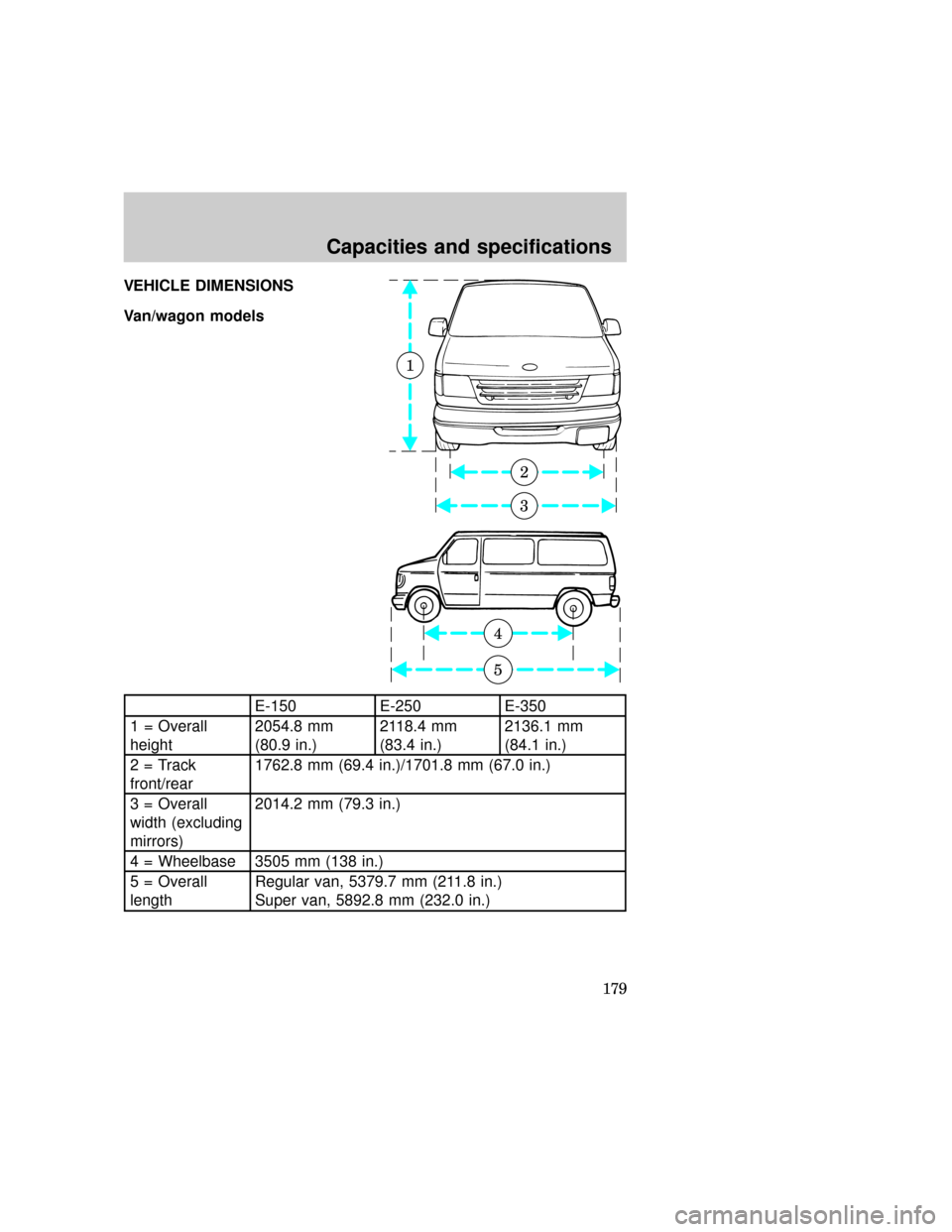
VEHICLE DIMENSIONS
Van/wagon models
E-150 E-250 E-350
1 = Overall
height2054.8 mm
(80.9 in.)2118.4 mm
(83.4 in.)2136.1 mm
(84.1 in.)
2 = Track
front/rear1762.8 mm (69.4 in.)/1701.8 mm (67.0 in.)
3 = Overall
width (excluding
mirrors)2014.2 mm (79.3 in.)
4 = Wheelbase 3505 mm (138 in.)
5 = Overall
lengthRegular van, 5379.7 mm (211.8 in.)
Super van, 5892.8 mm (232.0 in.)
3
2
1
5 4
eco_dimensions_van
Capacities and specifications
179
Page 180 of 192

Cutaway/commercial stripped
chassis models
E-250 E-350 E-Super Duty
1 = Overall
heightRefer to Body Builder for specifications.
2 = Track
front/rear1762.8 mm
(69.4 in.)/1701.8
mm (67.0 in.)1762.8 mm
(69.4 in.)/SRW
1701.8 mm
(67.0 in.), DRW
1859.3 mm
(73.2 in.)1762.8 mm
(69.4 in.)/1973.6
mm (77.7 in.)
3 = Overall
width (excluding
mirrors)Refer to Body Builder for specifications.
4 = Wheelbase 3149.6 mm
(124 in.)3505 mm
(138 in.)
4013 mm
(158 in.)
4470 mm
(176 in.)4013 mm
(158 in.)
4470 mm
(176 in.)
5 = Overall
lengthRefer to Body Builder for specifications.
VEHICLE IDENTIFICATION
NUMBER
Complete Ford built vehicles
The vehicle identification number
is attached to your vehicle in the
following places:
²On the metal tag attached to the
top of the instrument panel on
the driver's side.
eco_dimensions_stripped
eco_vin
eco_vin_complete_vehicle
Capacities and specifications
180