brake FORD E SERIES 1997 4.G User Guide
[x] Cancel search | Manufacturer: FORD, Model Year: 1997, Model line: E SERIES, Model: FORD E SERIES 1997 4.GPages: 192, PDF Size: 3.44 MB
Page 83 of 192
steering wheel seem to be in a
different position while going
straight down the road, have the
suspension and steering checked
for possible damage.
AUTOMATIC TRANSMISSION
OPERATION
Hold the brake pedal down
while you move the
gearshift lever from position to
position. If you do not hold the
brake pedal down, your vehicle
may move unexpectedly and
injure someone.
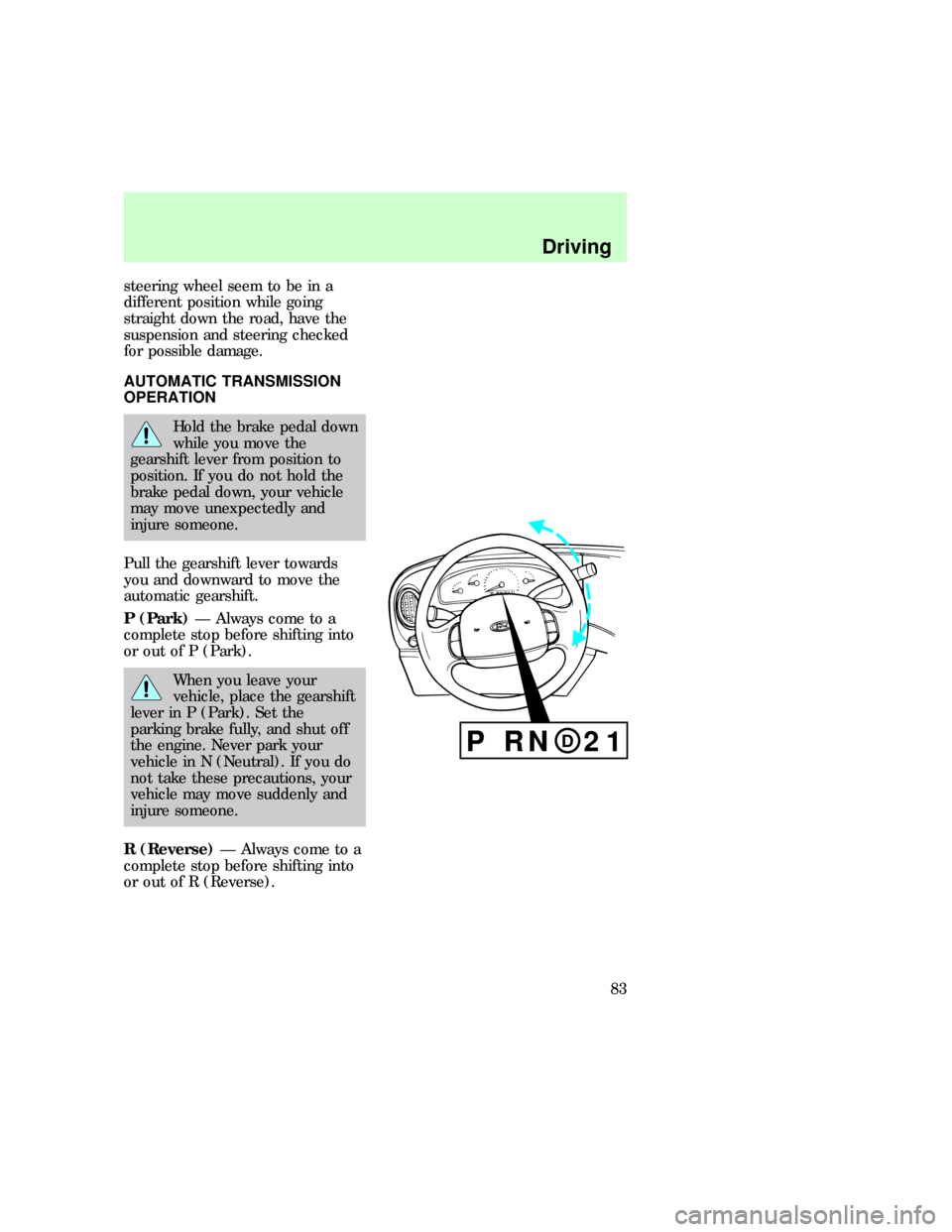
Pull the gearshift lever towards
you and downward to move the
automatic gearshift.
P (Park)Ð Always come to a
complete stop before shifting into
or out of P (Park).
When you leave your
vehicle, place the gearshift
lever in P (Park). Set the
parking brake fully, and shut off
the engine. Never park your
vehicle in N (Neutral). If you do
not take these precautions, your
vehicle may move suddenly and
injure someone.
R (Reverse)Ð Always come to a
complete stop before shifting into
or out of R (Reverse).
P RN 21D
P RN 21D
eco_automatic_trans
Driving
83
Page 85 of 192

word ªOFFº) will no longer be
illuminated.
Each time the vehicle is started,
the transmission will automatically
return to normal overdrive mode
and you must press the TCS to
deactivate overdrive again if you
do not want overdrive operation.
2 (Second)Ð Use 2 (Second) to
start-up on slippery roads or to
provide additional engine braking
on downgrades. Transmission
operates in first and second gears.
1 (Low)Ð Use 1 (Low) to
provide maximum engine braking
on steep downgrades. Upshifts can
be made by shifting to 2 (Second)
or to
D(Overdrive). Selecting 1
(Low) at higher speeds causes a
shift to 2 (Second), and will shift
to 1 (Low) after vehicle
decelerates to the proper speed.
Brake-shift interlock
The brake-shift interlock feature
prevents you from shifting from P
(Park) unless the brake pedal is
depressed (with the ignition in the
ON position). If you cannot move
the gearshift out of P (Park) with
the brake pedal depressed:
1. Turn ignition key to Off.
2. Apply the parking brake.
3. Turn ignition key to Lock and
remove the key.
4. Re-insert the ignition key and
turn it to Off.
eco_brake_shift_inter-lock
Driving
85
Page 86 of 192
5. Shift the transmission to N
(Neutral).
6. Start the vehicle.
If you need to use the above
procedure, it is possible that a fuse
has blown and your brakelamps
may not be functioning. Refer to
theRoadside emergencies
chapter for instructions on
replacing fuses.
Do not drive your vehicle
until you verify that the
brakelamps are working.
VEHICLE LOADING
It is extremely dangerous
to ride in a cargo area,
inside or outside of a vehicle. In
a collision, people riding in these
areas are more likely to be
seriously injured or killed. Do not
allow people to ride in any area
of your vehicle that is not
equipped with seats and safety
belts. Be sure everyone in your
vehicle is in a seat and using a
safety belt properly.
Before loading a vehicle, familiarize
yourself with the following terms:
²Base Curb Weight:Weight of
the vehicle including any
standard equipment, fluids,
lubricants, etc. It does not
include passengers or
aftermarket equipment.
eco_heavy-load
Driving
86
Page 95 of 192
it does not shift and change the
weight on the hitch.
Towing a trailer places an
additional load on your vehicle's
engine, transmission, axle, brakes,
tires and suspension. Inspect these
components carefully after any
towing operation.
Do not exceed the GVWR
or the GAWR specified on
the Safety Compliance
Certification Label.
Towing trailers beyond the
maximum recommended
gross trailer weight could result
in engine damage,
transmission/axle damage,
structural damage, loss of
control, and personal injury.
Preparing to tow
Use the proper equipment for
towing a trailer, and make sure it
is properly attached to your
vehicle. See your dealer or a
reliable trailer dealer if you require
assistance.
Hitches
Do not use or install hitches that
clamp onto the bumper or to the
axle. Underbody hitches are
acceptable if installed properly.
Step bumper (if equipped)
Step bumpers have a built-in hitch
and only require a ball with a 2.5
cm (1 in.) shank diameter. Step
eco_preparing_tow
eco_hitch
eco_step-bumper
Driving
95
Page 96 of 192
![FORD E SERIES 1997 4.G User Guide bumpers have a Class III capability
(2,270 kg [5,000 lb] trailer weight
and 227 kg [500 lb] tongue weight.
Safety chains
Always use safety chains between
your vehicle and trailer. Cross
chains under t](/img/11/4790/w960_4790-95.png "FORD E SERIES 1997 4.G User Guide bumpers have a Class III capability
(2,270 kg [5,000 lb] trailer weight
and 227 kg [500 lb] tongue weight.
Safety chains
Always use safety chains between
your vehicle and trailer. Cross
chains under t")
bumpers have a Class III capability
(2,270 kg [5,000 lb] trailer weight
and 227 kg [500 lb] tongue weight.
Safety chains
Always use safety chains between
your vehicle and trailer. Cross
chains under the trailer tongue and
allow slack for turning corners.
Connect safety chains to the
vehicle frame or hook retainers.
Never attach chains to the bumper.
Trailer brakes
Trailer brakes are required on
most towed vehicles weighing over
680 kg (1,500 lbs)
Do not connect a trailer's
hydraulic brake system
directly to your vehicle's brake
system. Your vehicle may not
have enough braking power and
your chances of having a
collision greatly increase.
Trailer lamps
Trailer lamps are required on most
towed vehicles. Make sure your
trailer lamps conform to Federal
and local regulations. See your
dealer or trailer rental agency for
the proper instructions and
equipment for hooking up trailer
lamps.
Driving while you tow
Do not drive faster than 88 km/h
(55 mph) while towing a trailer. Do
not drive faster than 72 km/h (45
mph) with a trailer while towing in
eco_safety_chains
eco_trailer_brakes
eco_trailer_lamps
eco_driving_towing
Driving
96
Page 97 of 192

hilly country or on hot days.
Speed control may shut off if you
are towing on very long, steep
grades.
When towing a trailer
If towing a trailer and your vehicle
is not equipped with the Ford
trailer tow package, an auxiliary
transmission fluid cooler is
recommended.
²Use D (Drive) rather than
D(Overdrive) while towing up
or down steep hills. This will
eliminate excessive downshifting
and upshifting for optimum fuel
economy and transmission
cooling.
²Anticipate stops and brake
gradually.
²Allow more room for stopping
with a trailer attached.
²Practice turning, stopping and
backing in an area before
starting on a trip to get the feel
of the vehicle/trailer
combination.
²When turning, drive slightly
beyond the normal turning point
so the trailer wheels will clear
curbs and other obstacles.
²When stopped in traffic for long
periods of time in hot weather,
place the gearshift in P (Park)
to increase idle speed. This aids
engine cooling and air
conditioner efficiency.
²Vehicles with trailers should not
be parked on a grade. If you
eco_when_towing
Driving
97
Page 105 of 192

Number Fuse amperage
ratingCircuits protected
1 20 amp 4WABS or RABS
module
2 15 amp 4WABS relay (coil),
RABS (diode/resistor),
instrument cluster,
warning chime
3 15 amp Headlamp switch,
radio sense, rear
radio control, Remote
keyless entry module
4 15 amp Power mirrors,
modified vehicle,
power locks w/RKE,
Headlamp switch
(dome), illuminated
entry, Courtesy lamp
switches, Radio
(KAP), Cluster (KAP),
warning chime
5 20 amp Remote keyless entry
module, power door
lock switches,
memory lock
6 10 amp Brake shift interlock,
speed control,
daytime running light
module
7 10 amp Multi-function switch
Roadside emergencies
105
Page 106 of 192

Number Fuse amperage
ratingCircuits protected
8 30 amp Noise supression
capacitor, ignition coil
positive feed, PCM
relay diode/PCM
power relay, fuel
heater (diesel), glow
plug relay (diesel)
9 30 amp Wiper control module,
wiper motor
10 20 amp Headlamp switch
(exterior lamps),
Multi-function switch
(flash-to-pass)
11 15 amp Stoplight switch, brake
pressure switch,
multi-function switch
12 15 amp Digital transmission
range sensor (backup
lamps), auxiliary
battery relay
13 15 amp A/C mode switch,
blend door actuator
14 5 amp Instrument cluster (air
bag and charge
indicator lamps)
15 5 amp Trailer tow battery
charge relay (coil)
16 30 amp Power seats
17 - Not used
18 - Not used
19 10 amp Air bag module
20 5 amp Overdrive cancel
switch
Roadside emergencies
106
Page 109 of 192

Number Fuse amperage
ratingCircuits protected
4 5 amp PCM keep alive
memory
5 10 amp Right trailer turn
signal
6 10 amp Left trailer turn signal
7 - Not used
8 60 amp Instrument panel
fuses
9 30 amp PCM power relay
10 60 amp Auxiliary battery
11 - Not used
12 60 amp Misc.
13 50 amp Blower motor relay
14 30 amp Trailer running lamps,
trailer backup lamps
15 40 amp Headlamp switch
16 50 amp Auxiliary A/C, remote
keyless entry module
17 30 amp Fuel pump relay
(gasoline), injector
driver module relay
(diesel)
18 60 amp Modified vehicle
power
19 60 amp Anti-lock brake
system (4WABS)
20 20 amp Electric brake
controller (trailer tow)
21 50 amp Modified vehicle
power
22 40 amp Trailer battery charge
(relay)
Roadside emergencies
109
Page 115 of 192
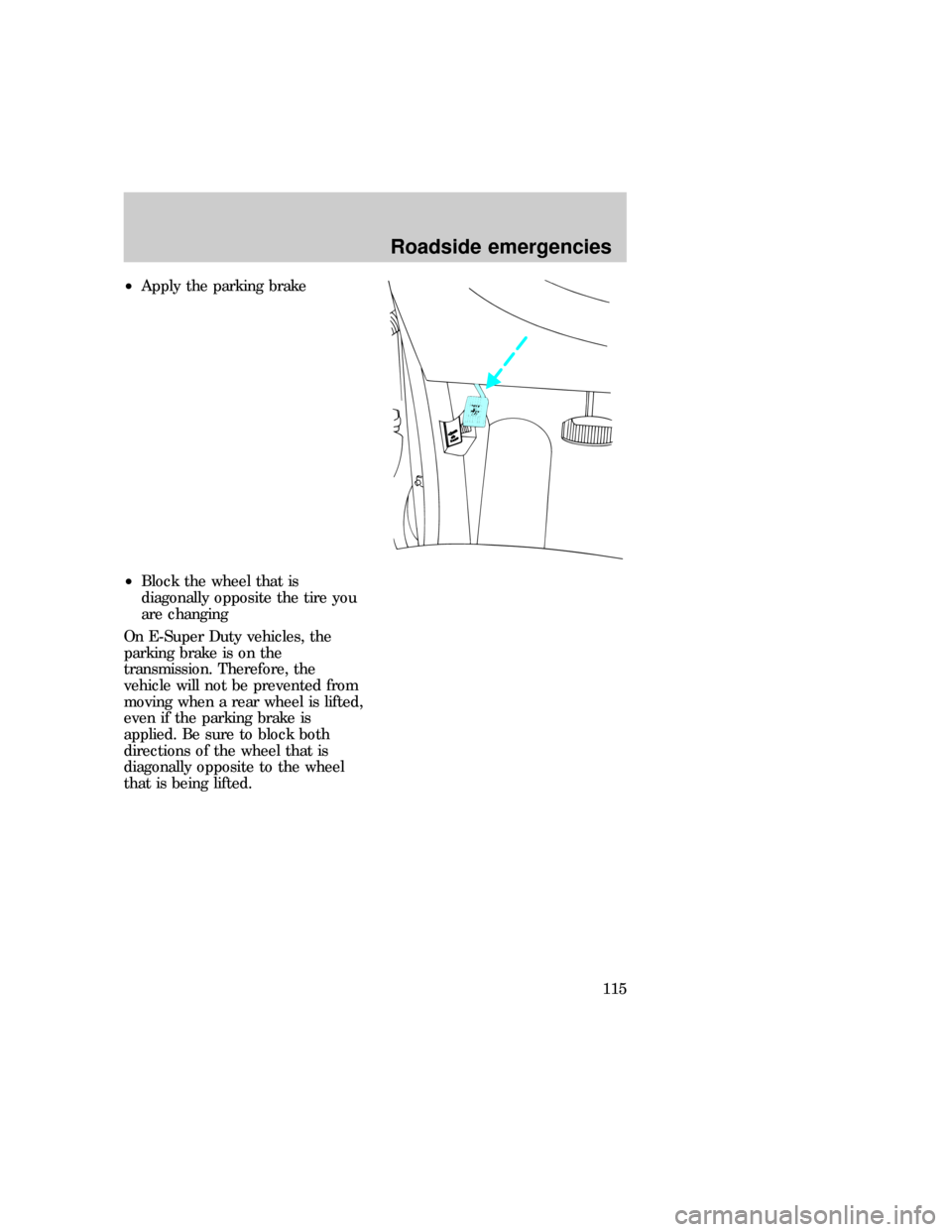
²Apply the parking brake
²Block the wheel that is
diagonally opposite the tire you
are changing
On E-Super Duty vehicles, the
parking brake is on the
transmission. Therefore, the
vehicle will not be prevented from
moving when a rear wheel is lifted,
even if the parking brake is
applied. Be sure to block both
directions of the wheel that is
diagonally opposite to the wheel
that is being lifted.
Roadside emergencies
115