ignition FORD E SERIES 1997 4.G User Guide
[x] Cancel search | Manufacturer: FORD, Model Year: 1997, Model line: E SERIES, Model: FORD E SERIES 1997 4.GPages: 192, PDF Size: 3.44 MB
Page 36 of 192
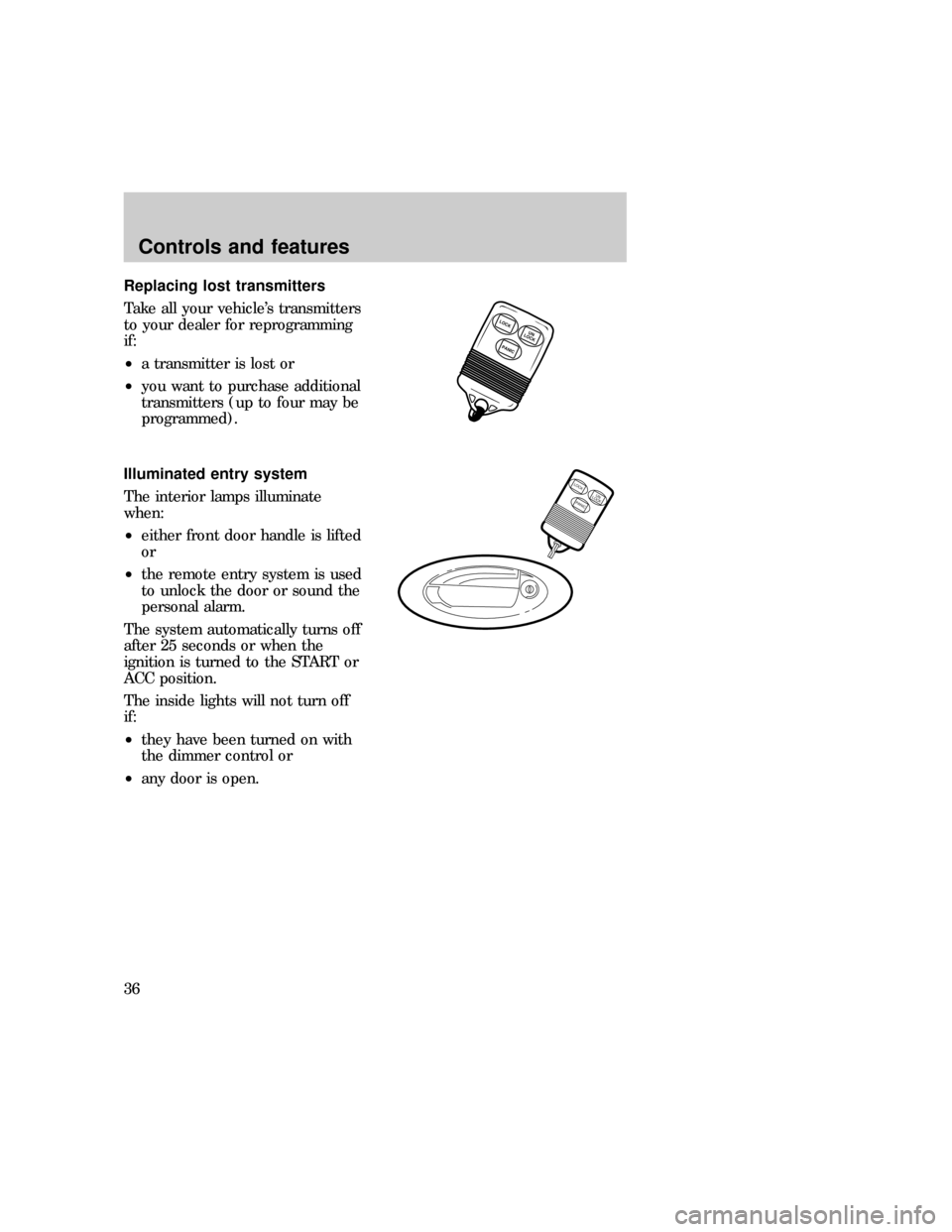
Replacing lost transmitters
Take all your vehicle's transmitters
to your dealer for reprogramming
if:
²a transmitter is lost or
²you want to purchase additional
transmitters (up to four may be
programmed).
Illuminated entry system
The interior lamps illuminate
when:
²either front door handle is lifted
or
²the remote entry system is used
to unlock the door or sound the
personal alarm.
The system automatically turns off
after 25 seconds or when the
ignition is turned to the START or
ACC position.
The inside lights will not turn off
if:
²they have been turned on with
the dimmer control or
²any door is open.
LOCK
PANICUN
LOCK
LOCKUN
LOCK
PANIC
com_illuminated_entry.01
Controls and features
36
Page 51 of 192

Use only extensions manufactured
by the same supplier as the safety
belt. Manufacturer identification is
located at the end of the webbing
on the label. Also, use the safety
belt extension only if the safety
belt is too short for you when fully
extended. Do not use extension to
change the fit of the shoulder belt
across the torso.
Safety belt indicator light and
warning chime
The seat belt warning light
illuminates in the instrument
cluster and a chime sounds to
remind the occupants to fasten
their safety belts.
Conditions of operation
If... Then...
The driver's safety belt is not
buckled before the ignition key
is turned to ON...The safety belt indicator illuminates
and the warning chime/buzzer
sounds for four to eight seconds.
The driver's side safety belt is
buckled while the indicator
light is illuminated and the
warning chime is sounding...The safety belt warning chime turns
off.
The driver's safety belt is
buckled before the ignition key
is turned to ON...The safety belt indicator
chime/buzzer remains off.
Safety belt inspection after a
collision, maintenance and care
Check the safety belt system
periodically to make sure that it
works properly and is not
damaged. Check the safety belts to
eco_warning-light_chime
eco_light-chime_operation
eco_belt_maintenance
Seating and safety restraints
51
Page 57 of 192

²one or more impact and safing
sensors,
²a readiness light and tone,
²driver and front passenger
safety belt buckle pretensioners
²and the electrical wiring which
connects the components.
The diagnostic module monitors its
own internal circuits and the
supplemental air bag electrical
system readiness (including the
impact sensors), the system wiring,
the air bag system readiness light,
the air bag back up power and the
air bag ignitors.
Determining if the system is
operational
The SRS uses a readiness light in
the instrument cluster or a tone to
indicate the condition of the
system. Refer to theAir bag
readinesssection in the
Instrumentationchapter. Routine
maintenance of the air bag is not
required.
A difficulty with the system is
indicated by one or more of the
following:
²The readiness light will either
flash or stay lit.
²The readiness light will not
illuminate immediately after
ignition is turned on.
²A group of five beeps will be
heard. The tone pattern will
repeat periodically until the
problem and light are repaired.
com_determing_operational.01
Seating and safety restraints
57
Page 74 of 192
If you smell exhaust fumes
inside your vehicle, have
your dealer inspect your vehicle
immediately. Do not drive if you
smell exhaust fumes.
Preparing to start the vehicle
Engine starting is controlled by the
spark ignition system. This system
meets all Canadian
Interference-Causing Equipment
standard requirements regulating
the impulse electrical field strength
of radio noise.
When starting a fuel-injected
engine, avoid pressing the
accelerator before or during
starting. Only use the accelerator
when you have difficulty starting
the engine. For more information
on starting the vehicle, refer to
Starting the vehiclein this
chapter.
Before starting the vehicle:
1. Make sure all vehicle occupants
have buckled their safety belts. For
more information on safety belts
and their proper usage, refer to
eco_preparing_start
Starting
74
Page 81 of 192
vehicle. However, if the normal
brakes fail, the parking brake can
be used to stop your vehicle in an
emergency. Since the parking
brake applies only the rear brakes,
the vehicle's stopping distance will
increase greatly and the handling
of your vehicle will be adversely
affected.
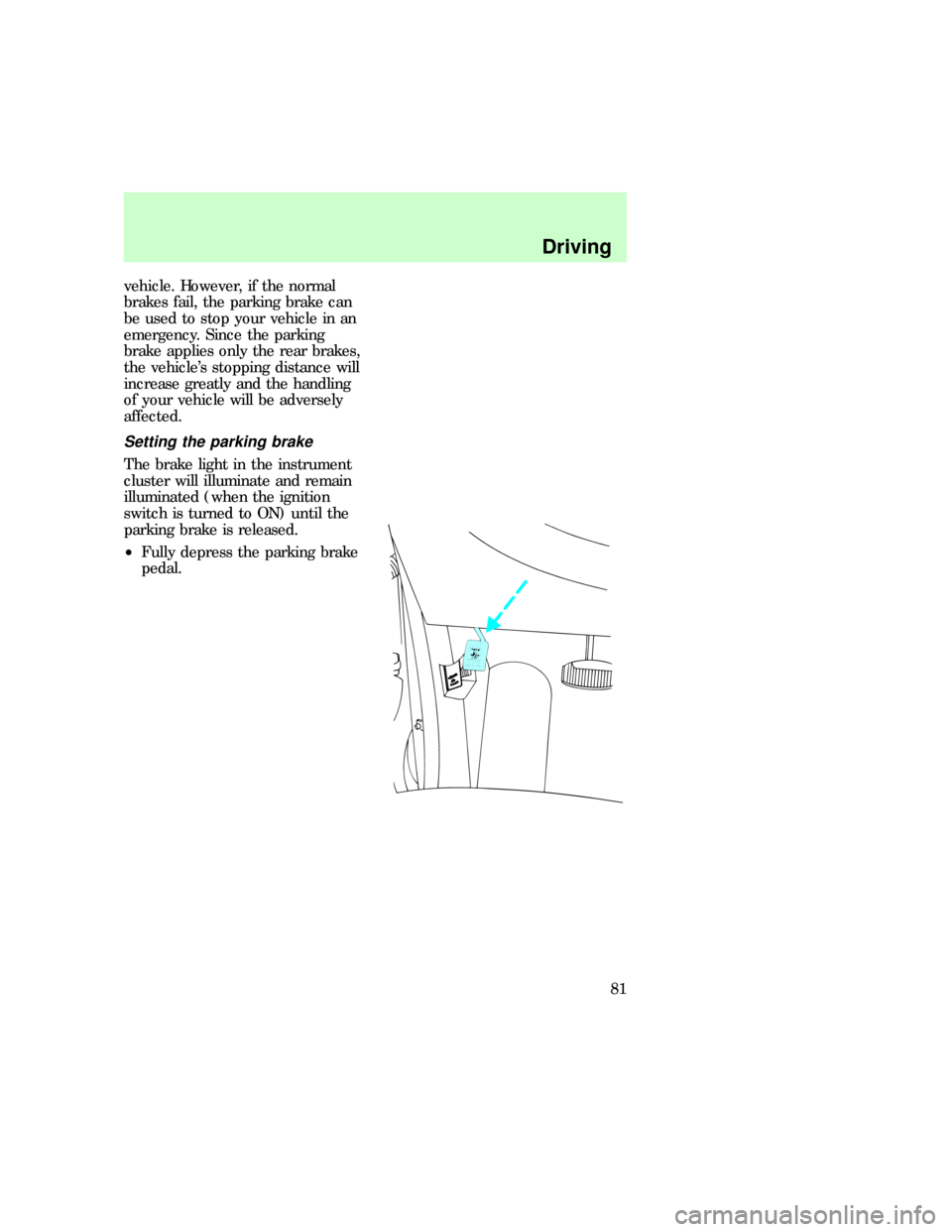
Setting the parking brake
The brake light in the instrument
cluster will illuminate and remain
illuminated (when the ignition
switch is turned to ON) until the
parking brake is released.
²Fully depress the parking brake
pedal.
eco_setting_pbrake eco_releasing_pbrake
Driving
81
Page 85 of 192

word ªOFFº) will no longer be
illuminated.
Each time the vehicle is started,
the transmission will automatically
return to normal overdrive mode
and you must press the TCS to
deactivate overdrive again if you
do not want overdrive operation.
2 (Second)Ð Use 2 (Second) to
start-up on slippery roads or to
provide additional engine braking
on downgrades. Transmission
operates in first and second gears.
1 (Low)Ð Use 1 (Low) to
provide maximum engine braking
on steep downgrades. Upshifts can
be made by shifting to 2 (Second)
or to
D(Overdrive). Selecting 1
(Low) at higher speeds causes a
shift to 2 (Second), and will shift
to 1 (Low) after vehicle
decelerates to the proper speed.
Brake-shift interlock
The brake-shift interlock feature
prevents you from shifting from P
(Park) unless the brake pedal is
depressed (with the ignition in the
ON position). If you cannot move
the gearshift out of P (Park) with
the brake pedal depressed:
1. Turn ignition key to Off.
2. Apply the parking brake.
3. Turn ignition key to Lock and
remove the key.
4. Re-insert the ignition key and
turn it to Off.
eco_brake_shift_inter-lock
Driving
85
Page 100 of 192
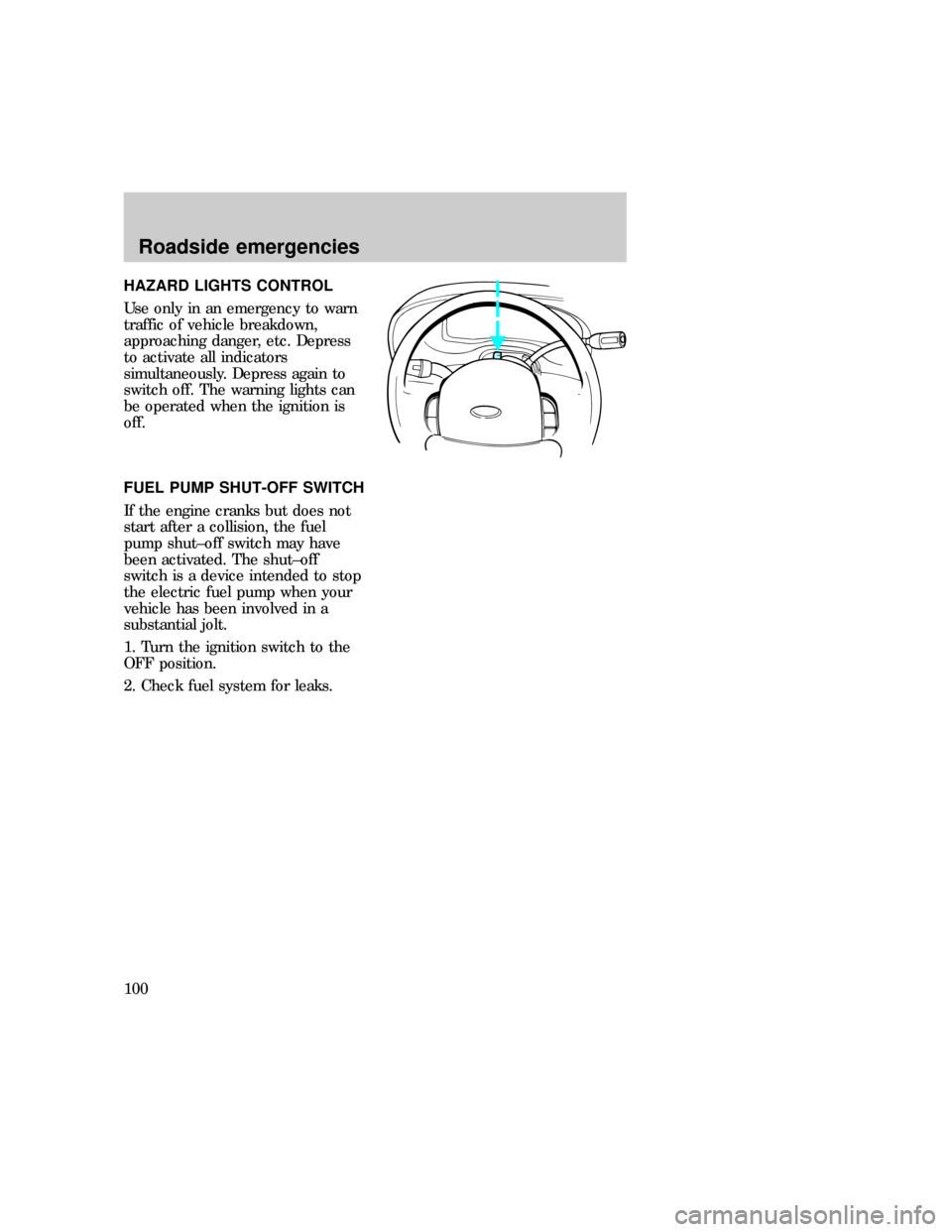
HAZARD LIGHTS CONTROL
Use only in an emergency to warn
traffic of vehicle breakdown,
approaching danger, etc. Depress
to activate all indicators
simultaneously. Depress again to
switch off. The warning lights can
be operated when the ignition is
off.
FUEL PUMP SHUT-OFF SWITCH
If the engine cranks but does not
start after a collision, the fuel
pump shut±off switch may have
been activated. The shut±off
switch is a device intended to stop
the electric fuel pump when your
vehicle has been involved in a
substantial jolt.
1. Turn the ignition switch to the
OFF position.
2. Check fuel system for leaks.com_hazard_switch.01
eco_fuel_shut-off
Roadside emergencies
100
Page 102 of 192
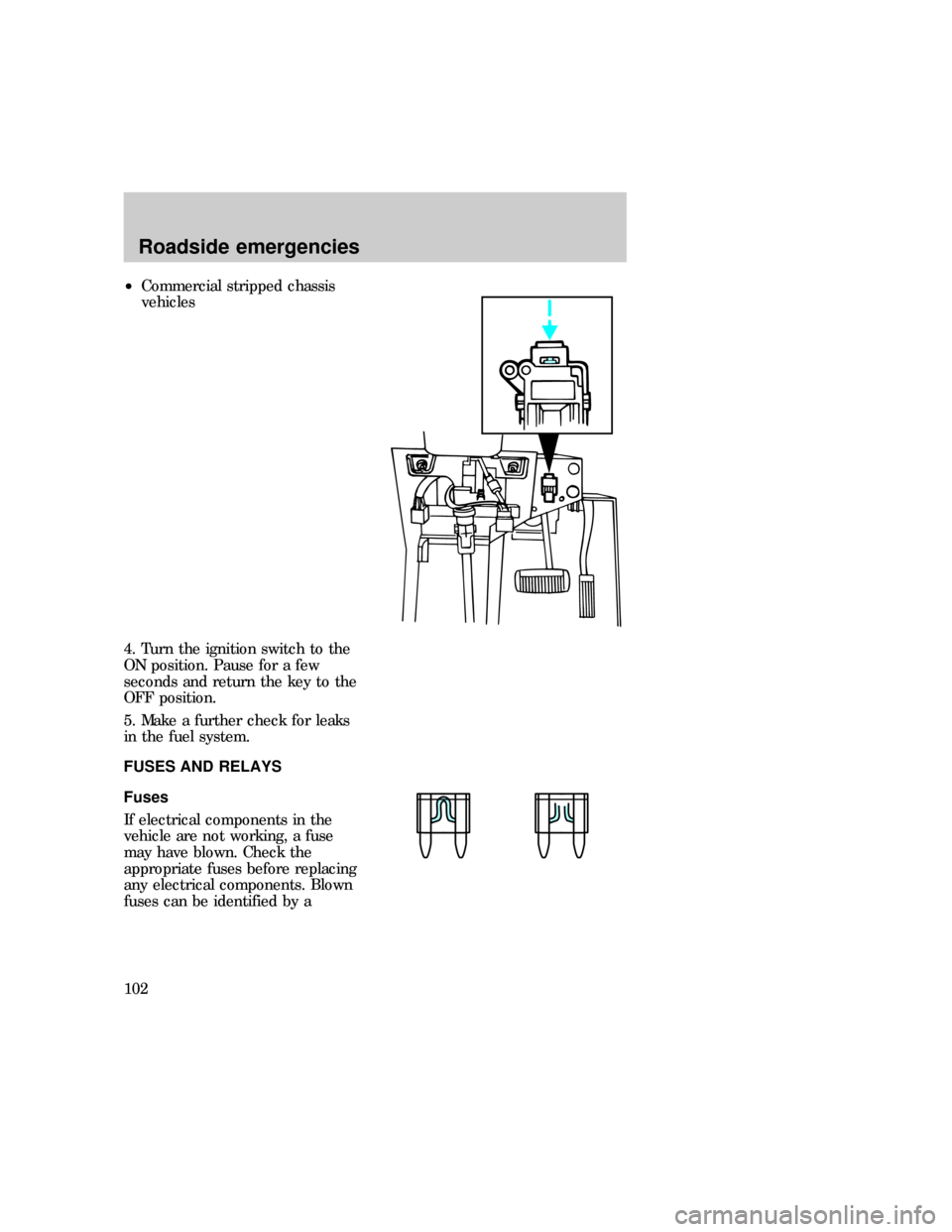
²Commercial stripped chassis
vehicles
4. Turn the ignition switch to the
ON position. Pause for a few
seconds and return the key to the
OFF position.
5. Make a further check for leaks
in the fuel system.
FUSES AND RELAYS
Fuses
If electrical components in the
vehicle are not working, a fuse
may have blown. Check the
appropriate fuses before replacing
any electrical components. Blown
fuses can be identified by a
eco_fuse-relay_intro
eco_fuses
Roadside emergencies
102
Page 106 of 192

Number Fuse amperage
ratingCircuits protected
8 30 amp Noise supression
capacitor, ignition coil
positive feed, PCM
relay diode/PCM
power relay, fuel
heater (diesel), glow
plug relay (diesel)
9 30 amp Wiper control module,
wiper motor
10 20 amp Headlamp switch
(exterior lamps),
Multi-function switch
(flash-to-pass)
11 15 amp Stoplight switch, brake
pressure switch,
multi-function switch
12 15 amp Digital transmission
range sensor (backup
lamps), auxiliary
battery relay
13 15 amp A/C mode switch,
blend door actuator
14 5 amp Instrument cluster (air
bag and charge
indicator lamps)
15 5 amp Trailer tow battery
charge relay (coil)
16 30 amp Power seats
17 - Not used
18 - Not used
19 10 amp Air bag module
20 5 amp Overdrive cancel
switch
Roadside emergencies
106
Page 110 of 192

Number Fuse amperage
ratingCircuits protected
23 60 amp Ignition switch feed
24 - Not used
25 - Not used
26 10 amp Alternator (diesel)
27 15 amp Horn, daytime running
lamp module
28 - PCM diode
29 - Not used
Roadside emergencies
110