belt FORD E SERIES 1997 4.G Owner's Manual
[x] Cancel search | Manufacturer: FORD, Model Year: 1997, Model line: E SERIES, Model: FORD E SERIES 1997 4.GPages: 192, PDF Size: 3.44 MB
Page 60 of 192
Children and safety belts
Children who are too large for
child safety seats (as specified by
your child safety seat
manufacturer) should always wear
safety belts.
Follow all the important safety
restraint and air bag precautions
that apply to adult passengers in
your vehicle.
If the shoulder belt portion of a
combination lap and shoulder belt
can be positioned so it does not
cross or rest in front of the child's
face or neck, the child should wear
the lap and shoulder belt. Moving
the child closer to the center of
the vehicle may help provide a
good shoulder belt fit.
To improve the fit of lap and
shoulder belts on children who
have outgrown child safety seats,
Ford recommends use of a
belt-positioning booster seat that is
labelled as conforming to all
Federal motor vehicle safety
standards. Belt-positioning booster
seats raise the child and provide a
shorter, firmer seating cushion that
encourages safer seating posture
and better fit of lap and shoulder
belts on the child. A
belt-positioning booster should be
used if the shoulder belt rests in
front of the child's face or neck, or
if the lap belt does not fit snugly
on both thighs, or if the thighs are
too short to let the child sit all the
way back on the seat cushion
when the lower legs hang over the
Seating and safety restraints
60
Page 61 of 192
edge of the seat cushion. You may
wish to discuss the special needs
of your child with your
pediatrician.
Child and infant or child safety
seats
Carefully follow all of the
manufacturer's instructions
included with the safety seat you
put in your vehicle. If you do not
install and use the safety seat
properly, the child may be
injured in a sudden stop or
collision.
Ford recommends the use of a
child safety seat having a top
tether strap. Install the child safety
seat in a seating position which is
capable of providing a tether
anchorage. For more information
on top tether straps seeAttaching
safety seats with tether strapsin
this chapter.
When installing a child safety seat:
²Use the correct safety belt
buckle for that seating position.
²Make sure the tongue is
securely fastened in the buckle.
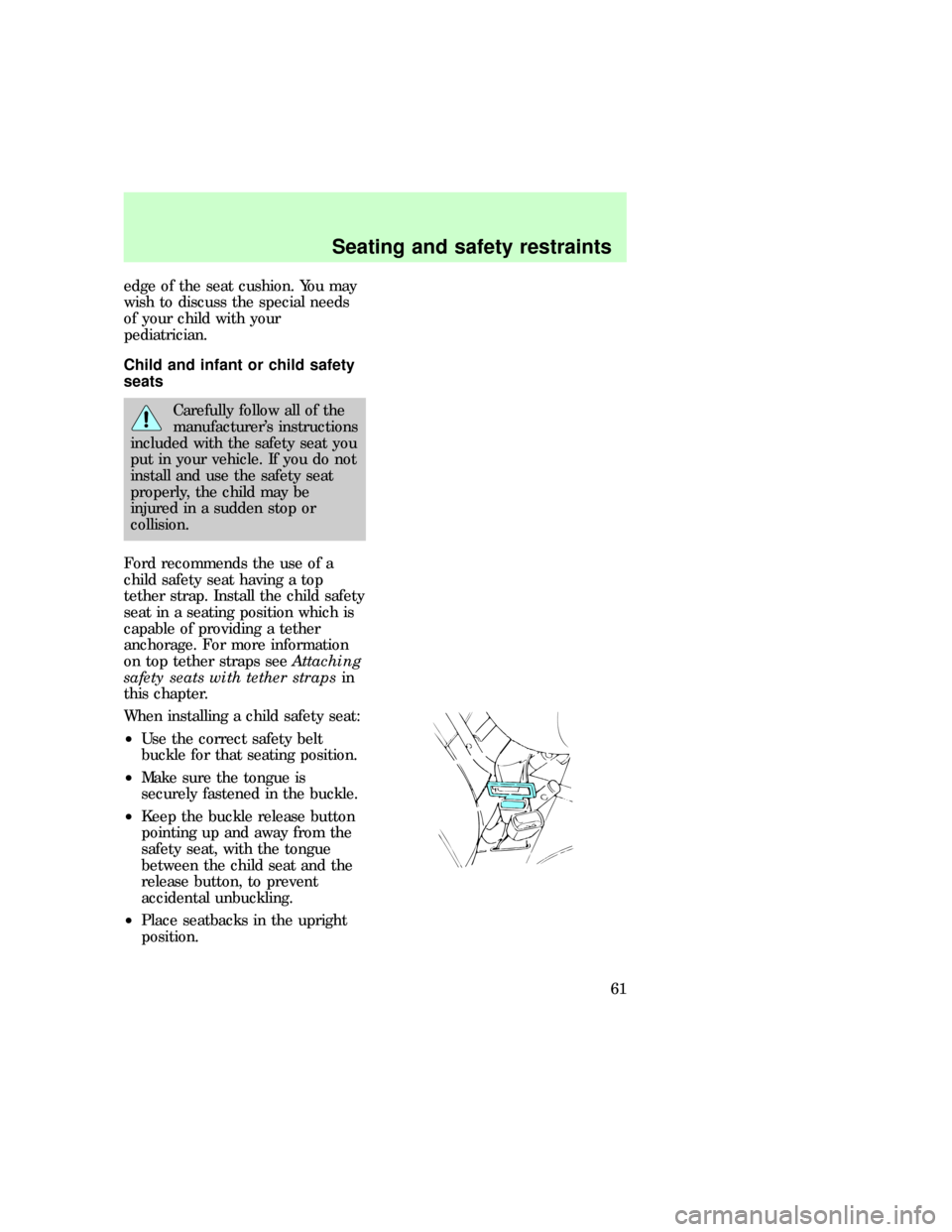
²Keep the buckle release button
pointing up and away from the
safety seat, with the tongue
between the child seat and the
release button, to prevent
accidental unbuckling.
²Place seatbacks in the upright
position.
com_safety_seats.01
Seating and safety restraints
61
Page 62 of 192
²Put the safety belt in the
automatic locking mode. Refer
toUsing the automatic locking
modein this chapter.
Installing child safety seats in
combination lap and shoulder
belt seating positions
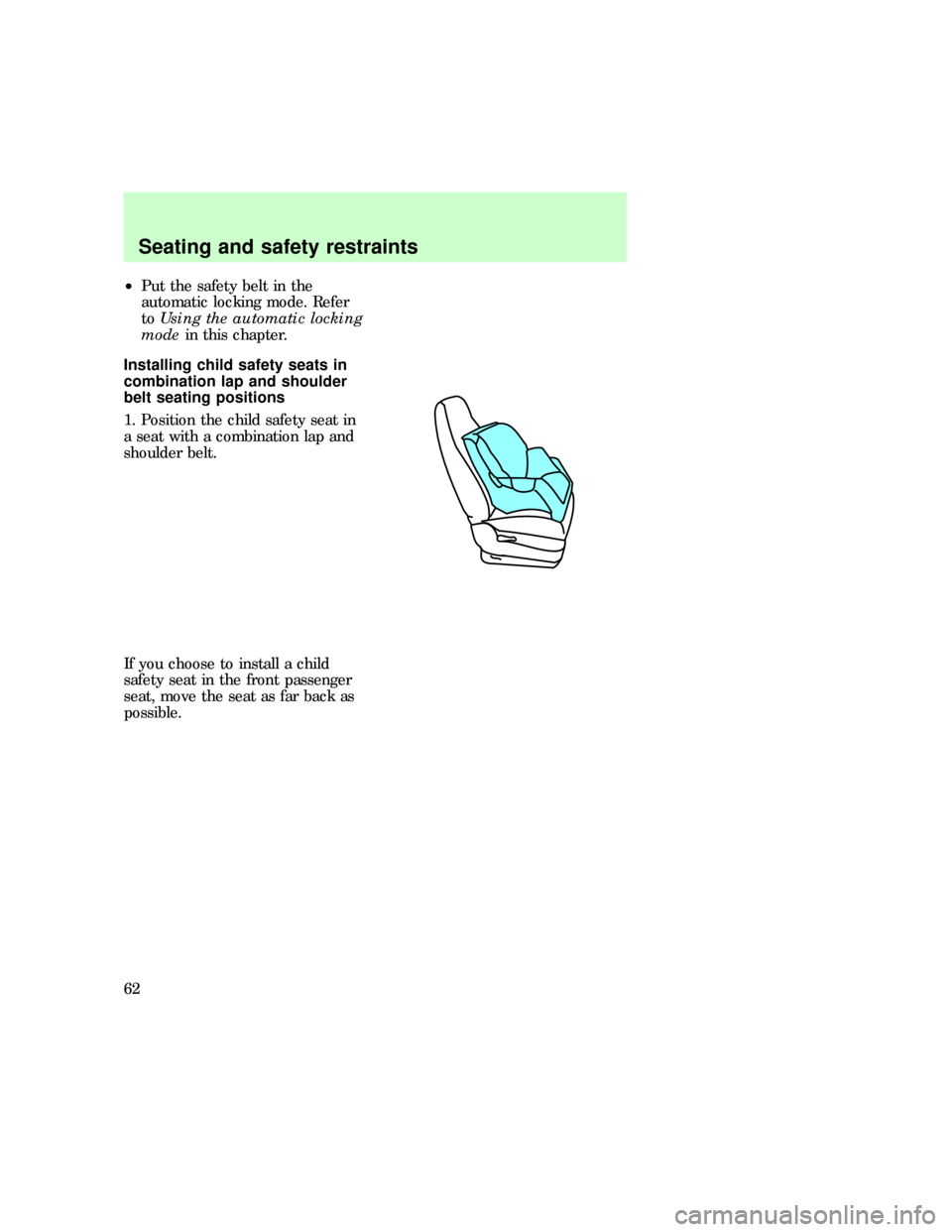
1. Position the child safety seat in
a seat with a combination lap and
shoulder belt.
If you choose to install a child
safety seat in the front passenger
seat, move the seat as far back as
possible.
com_installing_seats.01
Seating and safety restraints
62
Page 63 of 192
Rear-facing child seats or
infant carriers should
never be placed in the front
seats.
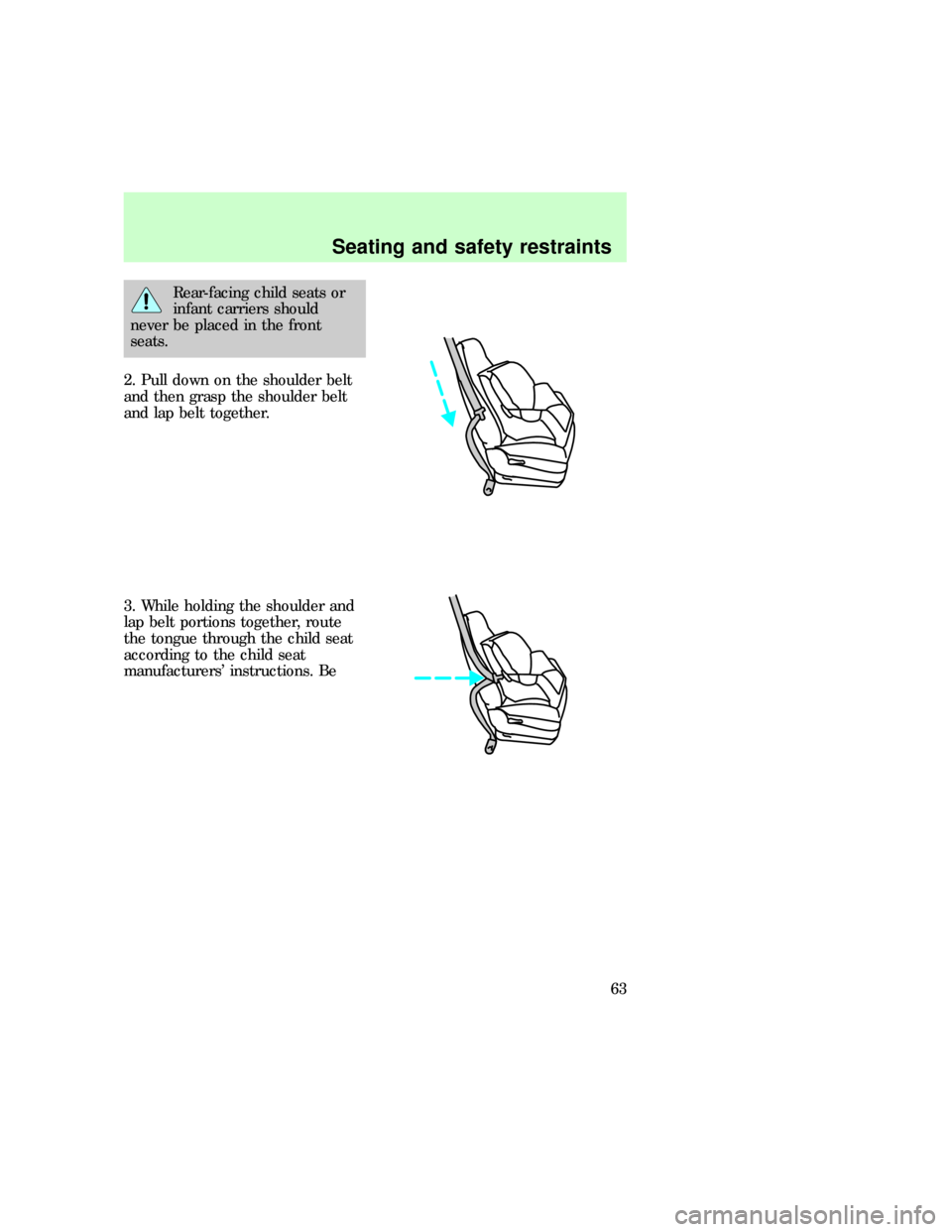
2. Pull down on the shoulder belt
and then grasp the shoulder belt
and lap belt together.
3. While holding the shoulder and
lap belt portions together, route
the tongue through the child seat
according to the child seat
manufacturers' instructions. Be
Seating and safety restraints
63
Page 64 of 192
sure the belt webbing is not
twisted.
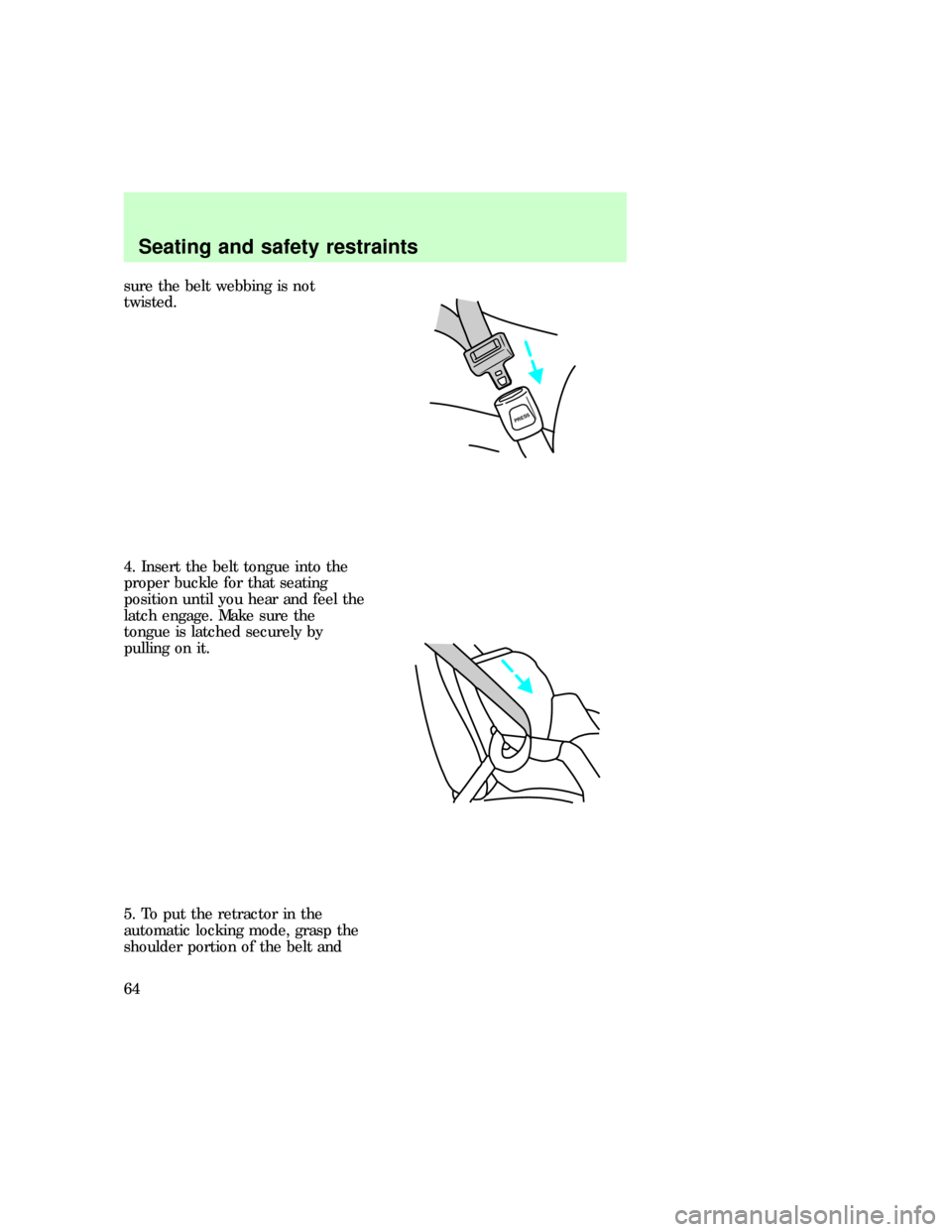
4. Insert the belt tongue into the
proper buckle for that seating
position until you hear and feel the
latch engage. Make sure the
tongue is latched securely by
pulling on it.
5. To put the retractor in the
automatic locking mode, grasp the
shoulder portion of the belt and
PRESS
Seating and safety restraints
64
Page 65 of 192
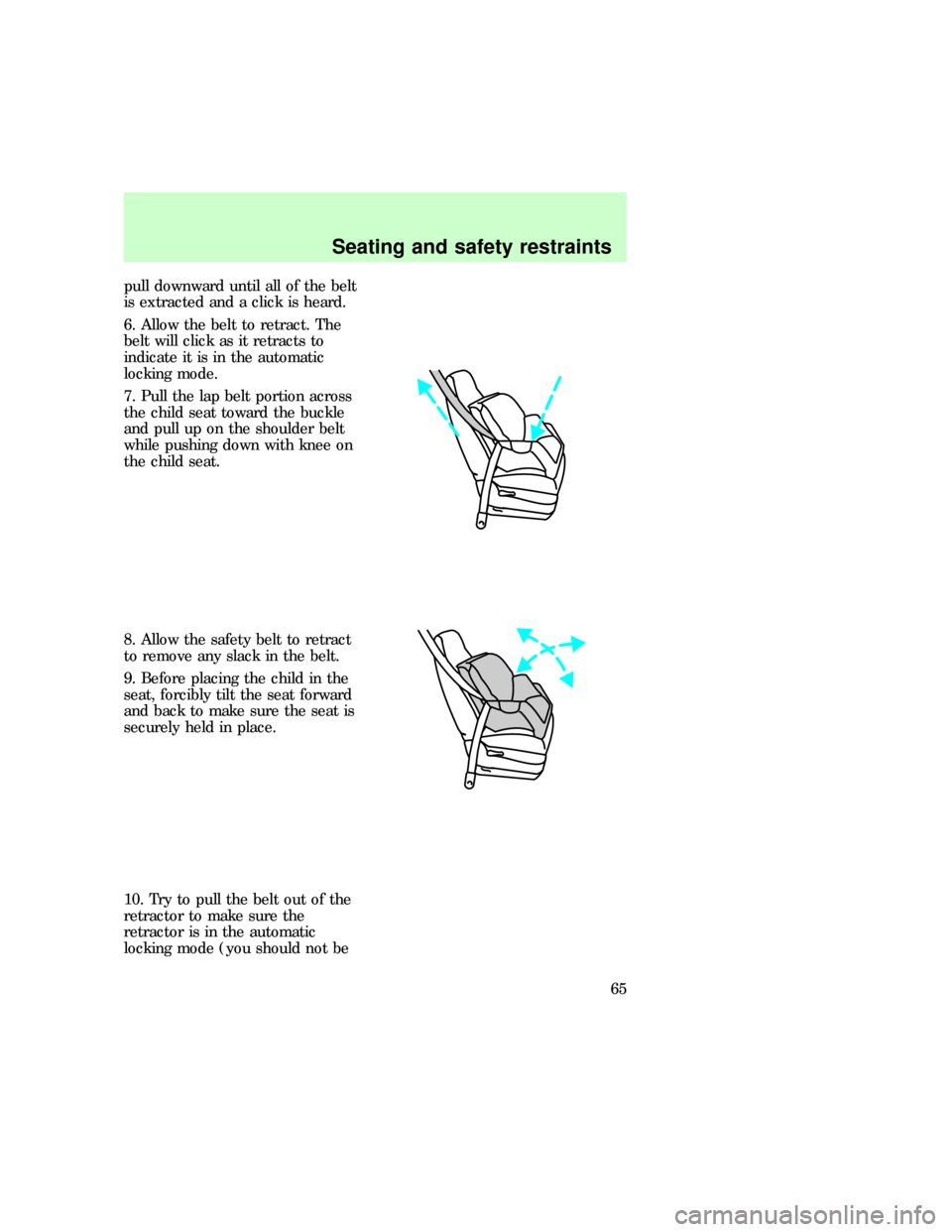
pull downward until all of the belt
is extracted and a click is heard.
6. Allow the belt to retract. The
belt will click as it retracts to
indicate it is in the automatic
locking mode.
7. Pull the lap belt portion across
the child seat toward the buckle
and pull up on the shoulder belt
while pushing down with knee on
the child seat.
8. Allow the safety belt to retract
to remove any slack in the belt.
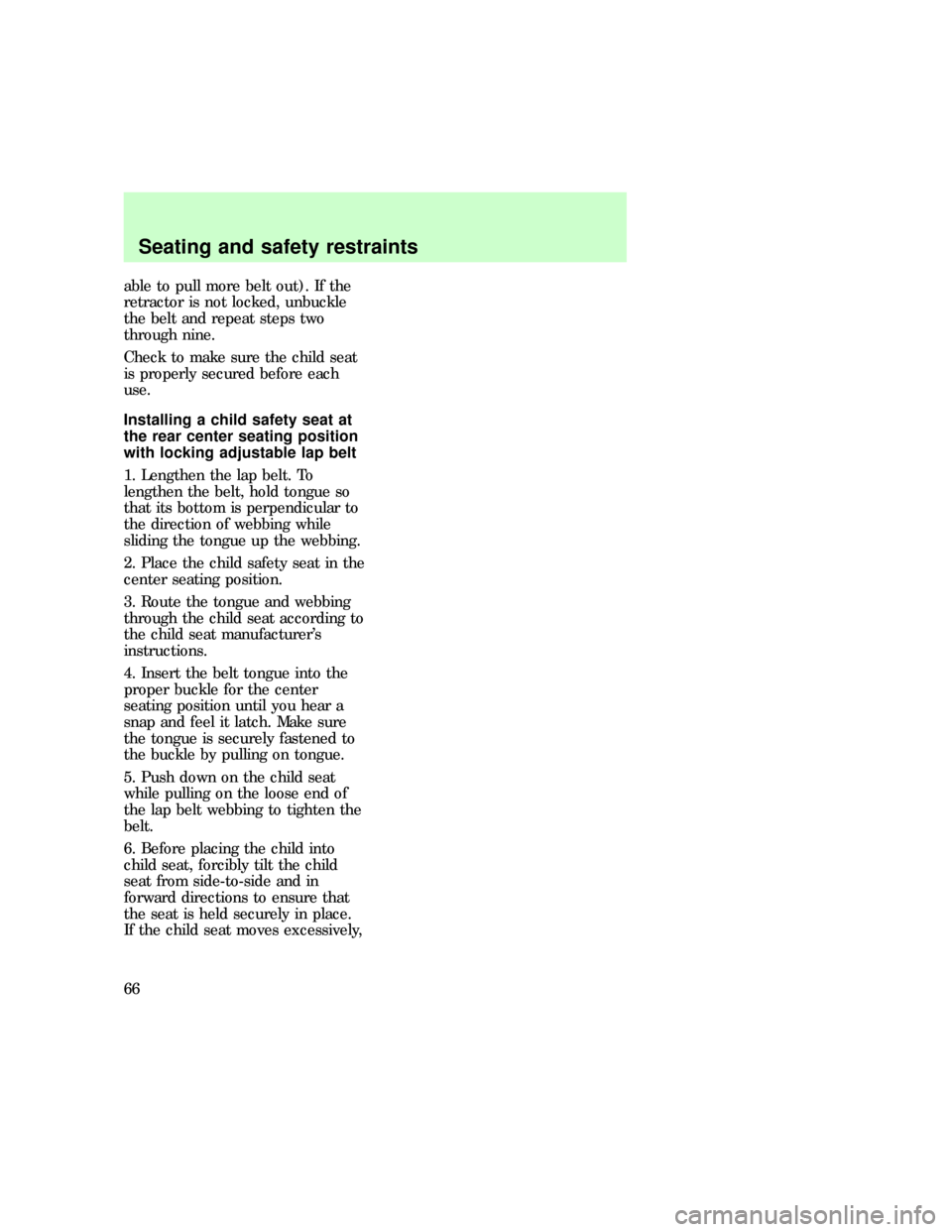
9. Before placing the child in the
seat, forcibly tilt the seat forward
and back to make sure the seat is
securely held in place.
10. Try to pull the belt out of the
retractor to make sure the
retractor is in the automatic
locking mode (you should not be
Seating and safety restraints
65
Page 66 of 192
able to pull more belt out). If the
retractor is not locked, unbuckle
the belt and repeat steps two
through nine.
Check to make sure the child seat
is properly secured before each
use.
Installing a child safety seat at
the rear center seating position
with locking adjustable lap belt
1. Lengthen the lap belt. To
lengthen the belt, hold tongue so
that its bottom is perpendicular to
the direction of webbing while
sliding the tongue up the webbing.
2. Place the child safety seat in the
center seating position.
3. Route the tongue and webbing
through the child seat according to
the child seat manufacturer's
instructions.
4. Insert the belt tongue into the
proper buckle for the center
seating position until you hear a
snap and feel it latch. Make sure
the tongue is securely fastened to
the buckle by pulling on tongue.
5. Push down on the child seat
while pulling on the loose end of
the lap belt webbing to tighten the
belt.
6. Before placing the child into
child seat, forcibly tilt the child
seat from side-to-side and in
forward directions to ensure that
the seat is held securely in place.
If the child seat moves excessively,
eco_chils_seat_lap-belt
Seating and safety restraints
66
Page 71 of 192
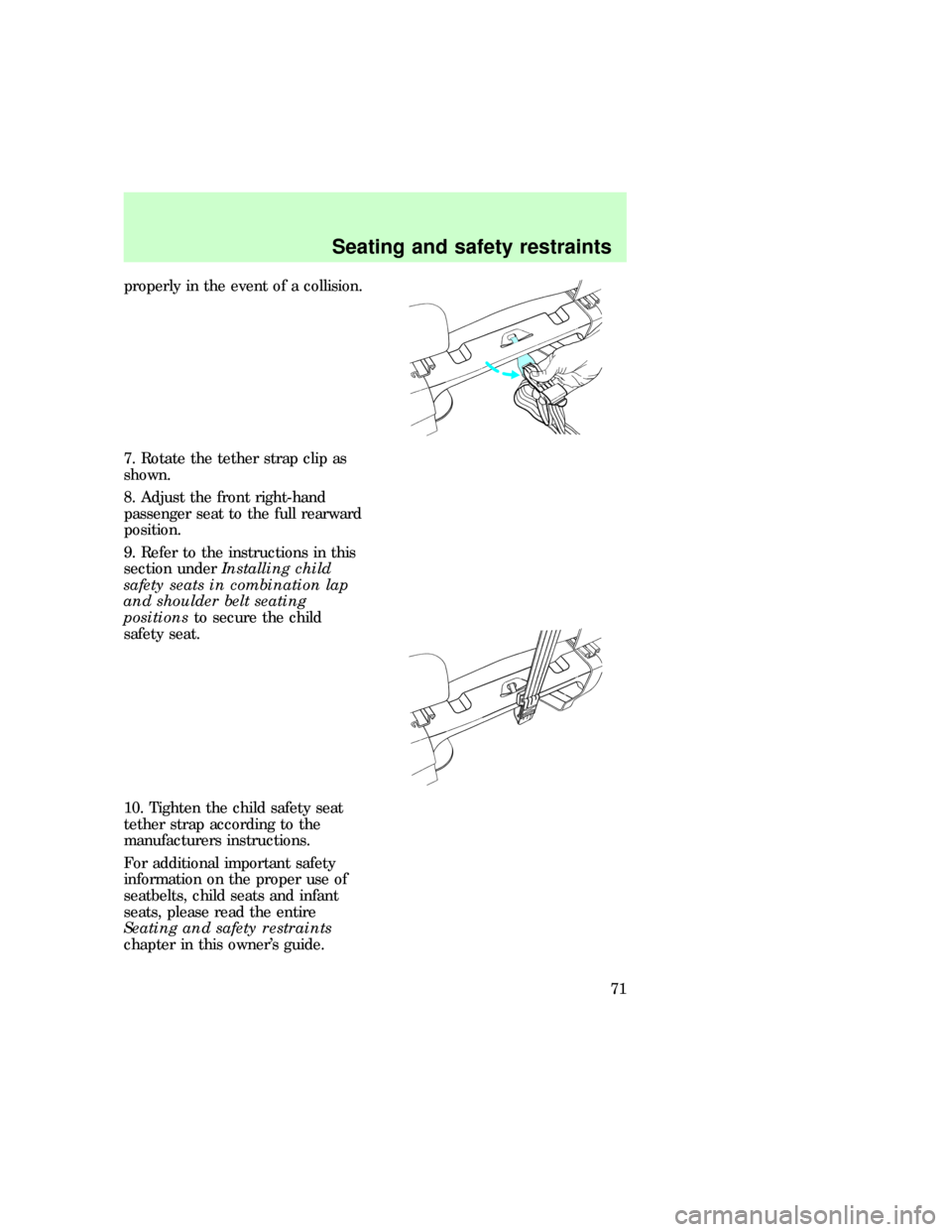
properly in the event of a collision.
7. Rotate the tether strap clip as
shown.
8. Adjust the front right-hand
passenger seat to the full rearward
position.
9. Refer to the instructions in this
section underInstalling child
safety seats in combination lap
and shoulder belt seating
positionsto secure the child
safety seat.
10. Tighten the child safety seat
tether strap according to the
manufacturers instructions.
For additional important safety
information on the proper use of
seatbelts, child seats and infant
seats, please read the entire
Seating and safety restraints
chapter in this owner's guide.
Seating and safety restraints
71
Page 74 of 192
If you smell exhaust fumes
inside your vehicle, have
your dealer inspect your vehicle
immediately. Do not drive if you
smell exhaust fumes.
Preparing to start the vehicle
Engine starting is controlled by the
spark ignition system. This system
meets all Canadian
Interference-Causing Equipment
standard requirements regulating
the impulse electrical field strength
of radio noise.
When starting a fuel-injected
engine, avoid pressing the
accelerator before or during
starting. Only use the accelerator
when you have difficulty starting
the engine. For more information
on starting the vehicle, refer to
Starting the vehiclein this
chapter.
Before starting the vehicle:
1. Make sure all vehicle occupants
have buckled their safety belts. For
more information on safety belts
and their proper usage, refer to
eco_preparing_start
Starting
74
Page 77 of 192
Make sure the corresponding lights
illuminate briefly. If a light fails to
illuminate, have the vehicle
serviced.
²If the driver's safety belt is
fastened, the
light does not
illuminate.
STARTING PROCEDURE
Starting the engine
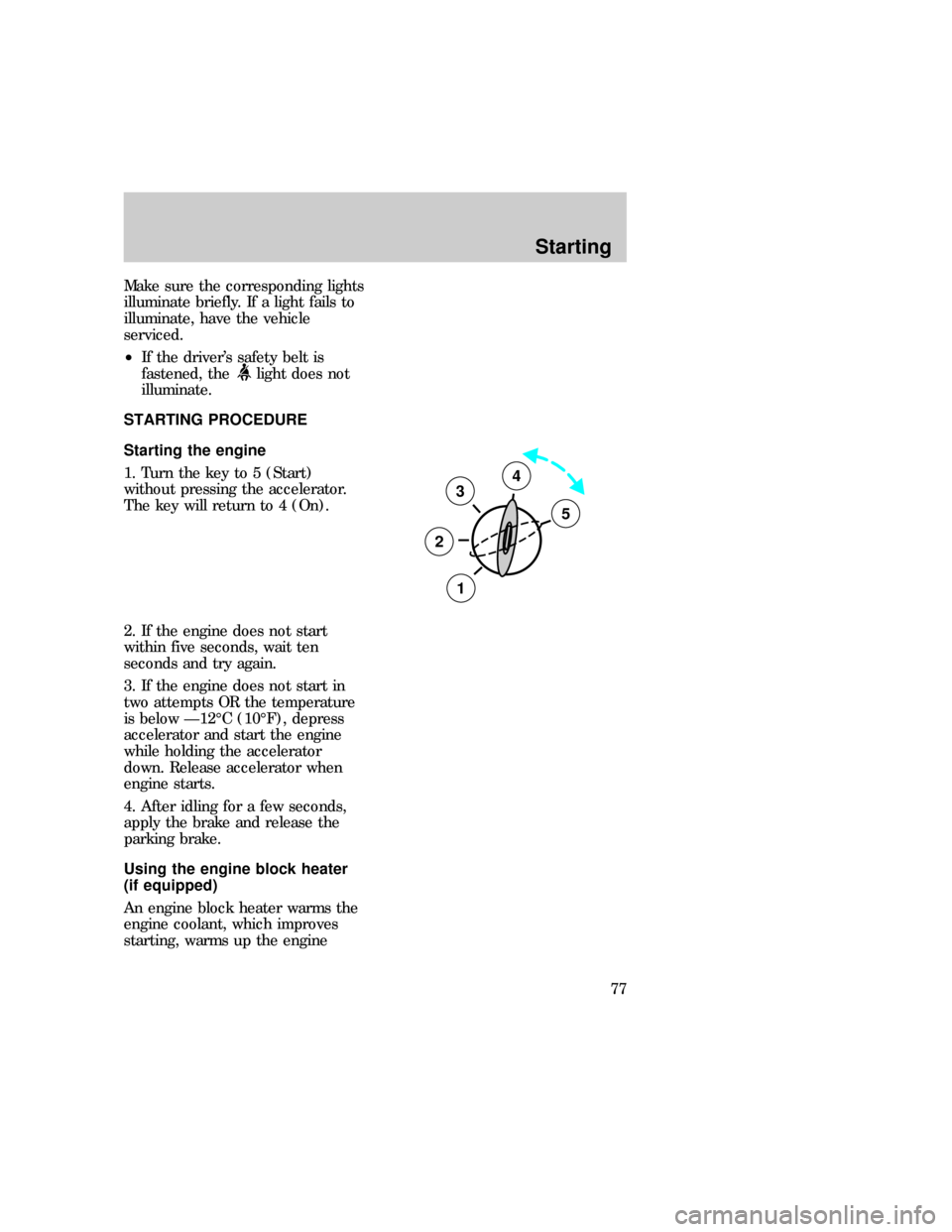
1. Turn the key to 5 (Start)
without pressing the accelerator.
The key will return to 4 (On).
2. If the engine does not start
within five seconds, wait ten
seconds and try again.
3. If the engine does not start in
two attempts OR the temperature
is below Ð12ÉC (10ÉF), depress
accelerator and start the engine
while holding the accelerator
down. Release accelerator when
engine starts.
4. After idling for a few seconds,
apply the brake and release the
parking brake.
Using the engine block heater
(if equipped)
An engine block heater warms the
engine coolant, which improves
starting, warms up the engine
3
2
1
5
4
eco_start_title
com_starting_vehicle.01
com_engine_heater.01
Starting
77