belt FORD E SERIES 1997 4.G User Guide
[x] Cancel search | Manufacturer: FORD, Model Year: 1997, Model line: E SERIES, Model: FORD E SERIES 1997 4.GPages: 192, PDF Size: 3.44 MB
Page 48 of 192
Using the automatic locking
mode
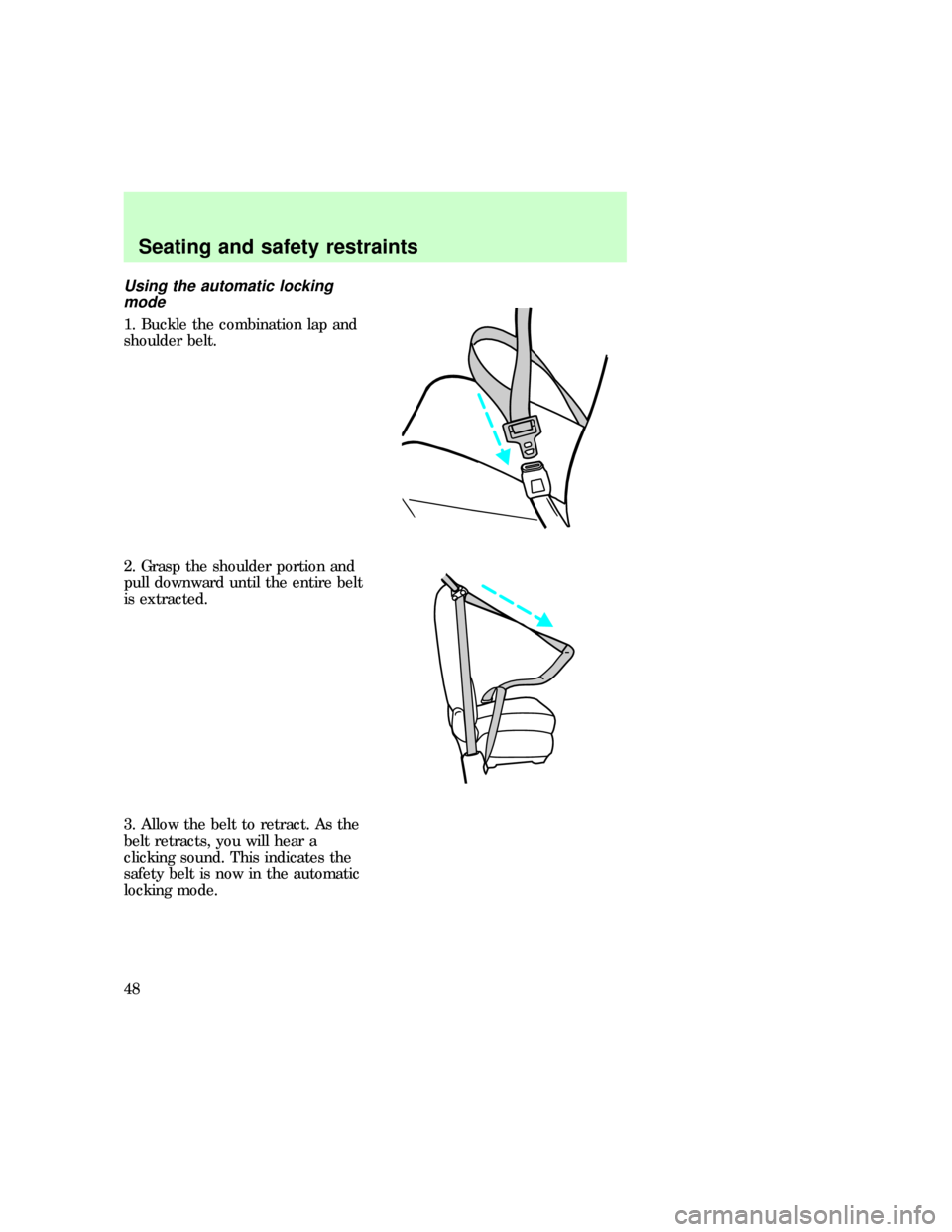
1. Buckle the combination lap and
shoulder belt.
2. Grasp the shoulder portion and
pull downward until the entire belt
is extracted.
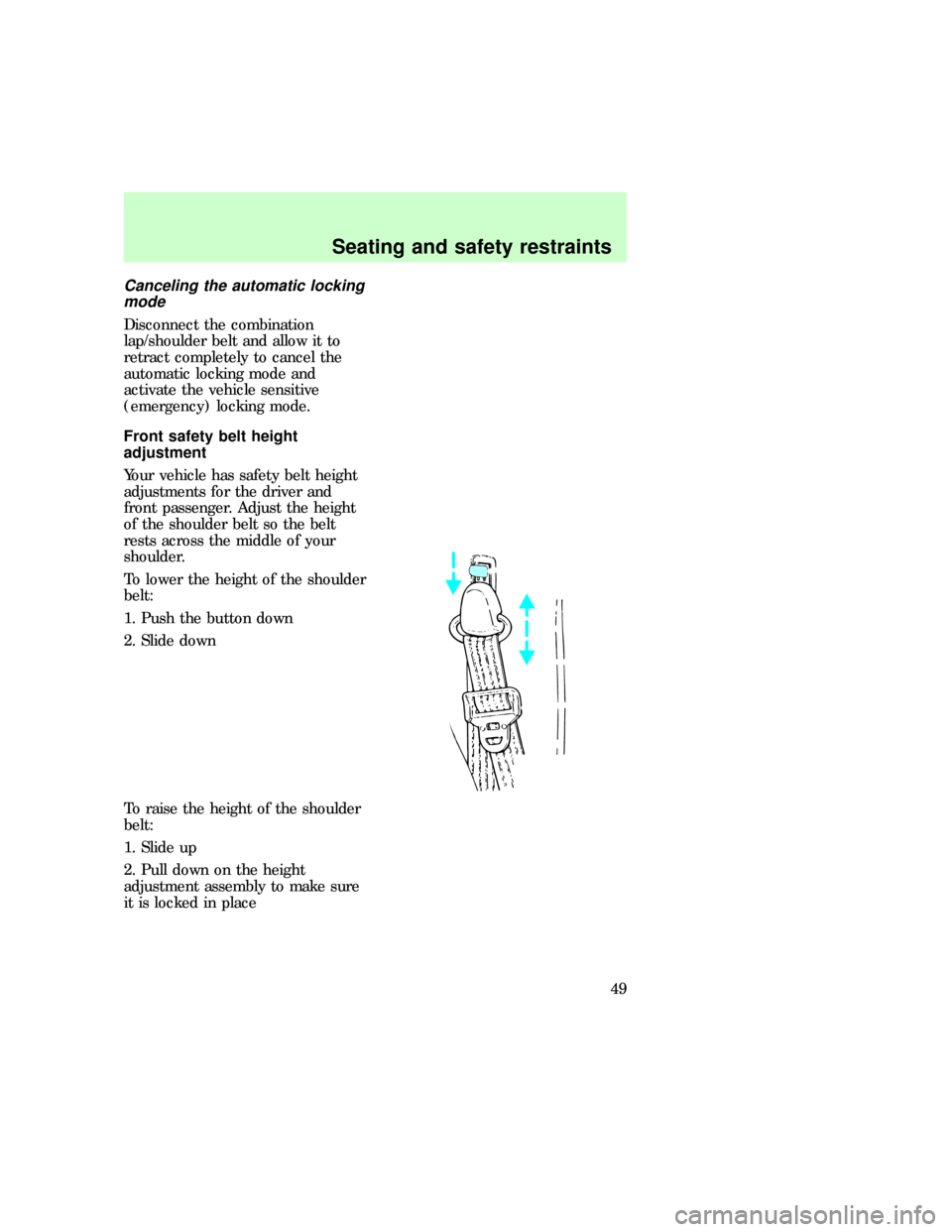
3. Allow the belt to retract. As the
belt retracts, you will hear a
clicking sound. This indicates the
safety belt is now in the automatic
locking mode.
eco_how-to-cancel_locking-mode
Seating and safety restraints
48
Page 49 of 192
Canceling the automatic locking
mode
Disconnect the combination
lap/shoulder belt and allow it to
retract completely to cancel the
automatic locking mode and
activate the vehicle sensitive
(emergency) locking mode.
Front safety belt height
adjustment
Your vehicle has safety belt height
adjustments for the driver and
front passenger. Adjust the height
of the shoulder belt so the belt
rests across the middle of your
shoulder.
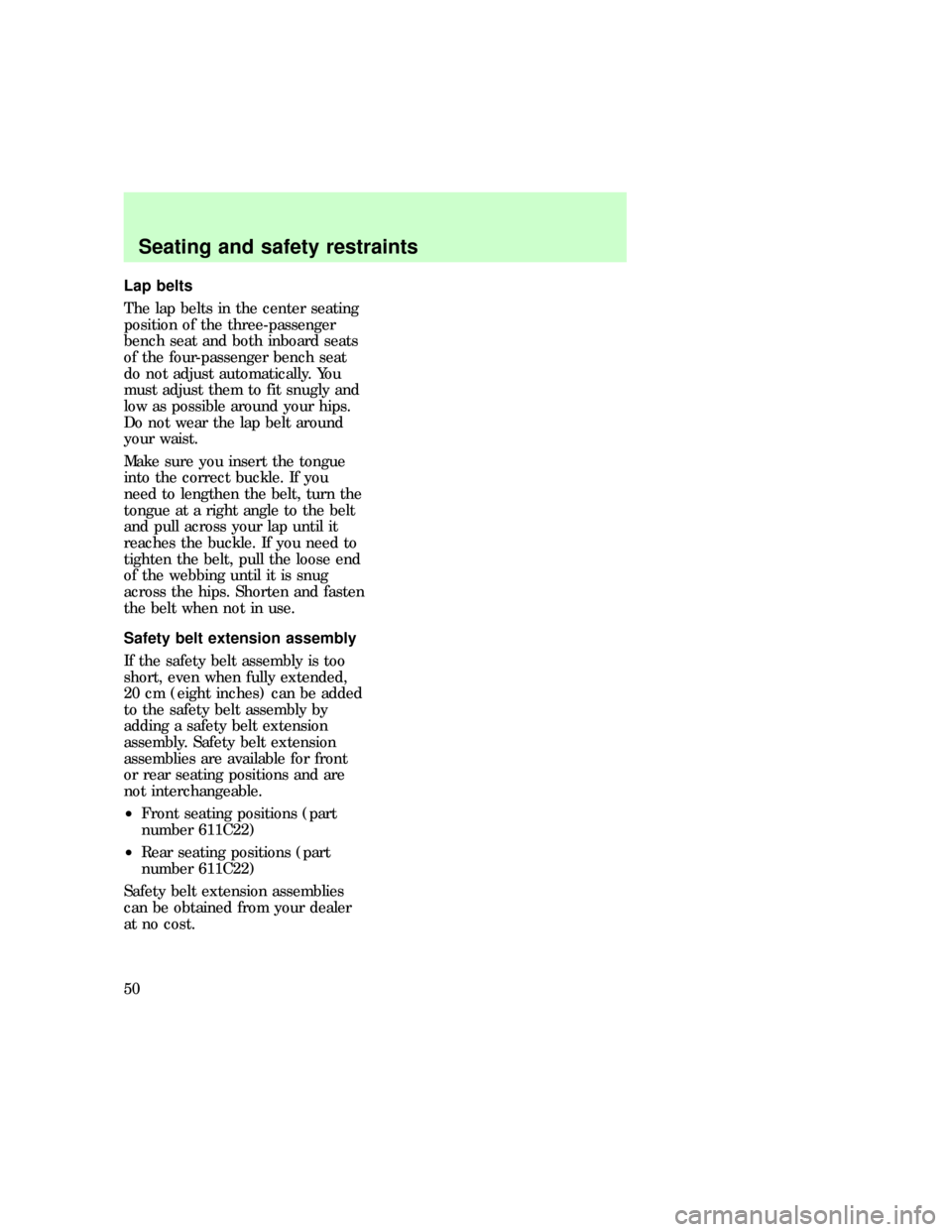
To lower the height of the shoulder
belt:
1. Push the button down
2. Slide down
To raise the height of the shoulder
belt:
1. Slide up
2. Pull down on the height
adjustment assembly to make sure
it is locked in place
eco_belt-height_adjust
eco_lap_belts
Seating and safety restraints
49
Page 50 of 192
Lap belts
The lap belts in the center seating
position of the three-passenger
bench seat and both inboard seats
of the four-passenger bench seat
do not adjust automatically. You
must adjust them to fit snugly and
low as possible around your hips.
Do not wear the lap belt around
your waist.
Make sure you insert the tongue
into the correct buckle. If you
need to lengthen the belt, turn the
tongue at a right angle to the belt
and pull across your lap until it
reaches the buckle. If you need to
tighten the belt, pull the loose end
of the webbing until it is snug
across the hips. Shorten and fasten
the belt when not in use.
Safety belt extension assembly
If the safety belt assembly is too
short, even when fully extended,
20 cm (eight inches) can be added
to the safety belt assembly by
adding a safety belt extension
assembly. Safety belt extension
assemblies are available for front
or rear seating positions and are
not interchangeable.
²Front seating positions (part
number 611C22)
²Rear seating positions (part
number 611C22)
Safety belt extension assemblies
can be obtained from your dealer
at no cost.
eco_belt_extension
Seating and safety restraints
50
Page 51 of 192
Use only extensions manufactured
by the same supplier as the safety
belt. Manufacturer identification is
located at the end of the webbing
on the label. Also, use the safety
belt extension only if the safety
belt is too short for you when fully
extended. Do not use extension to
change the fit of the shoulder belt
across the torso.
Safety belt indicator light and
warning chime
The seat belt warning light
illuminates in the instrument
cluster and a chime sounds to
remind the occupants to fasten
their safety belts.
Conditions of operation
If... Then...
The driver's safety belt is not
buckled before the ignition key
is turned to ON...The safety belt indicator illuminates
and the warning chime/buzzer
sounds for four to eight seconds.
The driver's side safety belt is
buckled while the indicator
light is illuminated and the
warning chime is sounding...The safety belt warning chime turns
off.
The driver's safety belt is
buckled before the ignition key
is turned to ON...The safety belt indicator
chime/buzzer remains off.
Safety belt inspection after a
collision, maintenance and care
Check the safety belt system
periodically to make sure that it
works properly and is not
damaged. Check the safety belts to
eco_warning-light_chime
eco_light-chime_operation
eco_belt_maintenance
Seating and safety restraints
51
Page 52 of 192
make sure there are no nicks,
wears or cuts.
All safety belt assemblies,
including retractors, buckles, front
seat belt buckle support assemblies
(slide bar) (if so equipped),
shoulder belt height adjusters (if
so equipped), child safety seat
tether bracket assemblies (if so
equipped) and attaching hardware,
should be inspected after any
collision. Ford recommends that all
safety belt assemblies used in
vehicles involved in a collision be
replaced. However, if the collision
was minor and a qualified
technician finds that the belts do
not show damage and continue to
operate properly, they do not need
to be replaced. Safety belt
assemblies not in use during a
collision should also be inspected
and replaced if either damage or
improper operation is noted.
AIR BAG SUPPLEMENTAL
RESTRAINT SYSTEM (SRS)
Important air bag precautions
and warnings
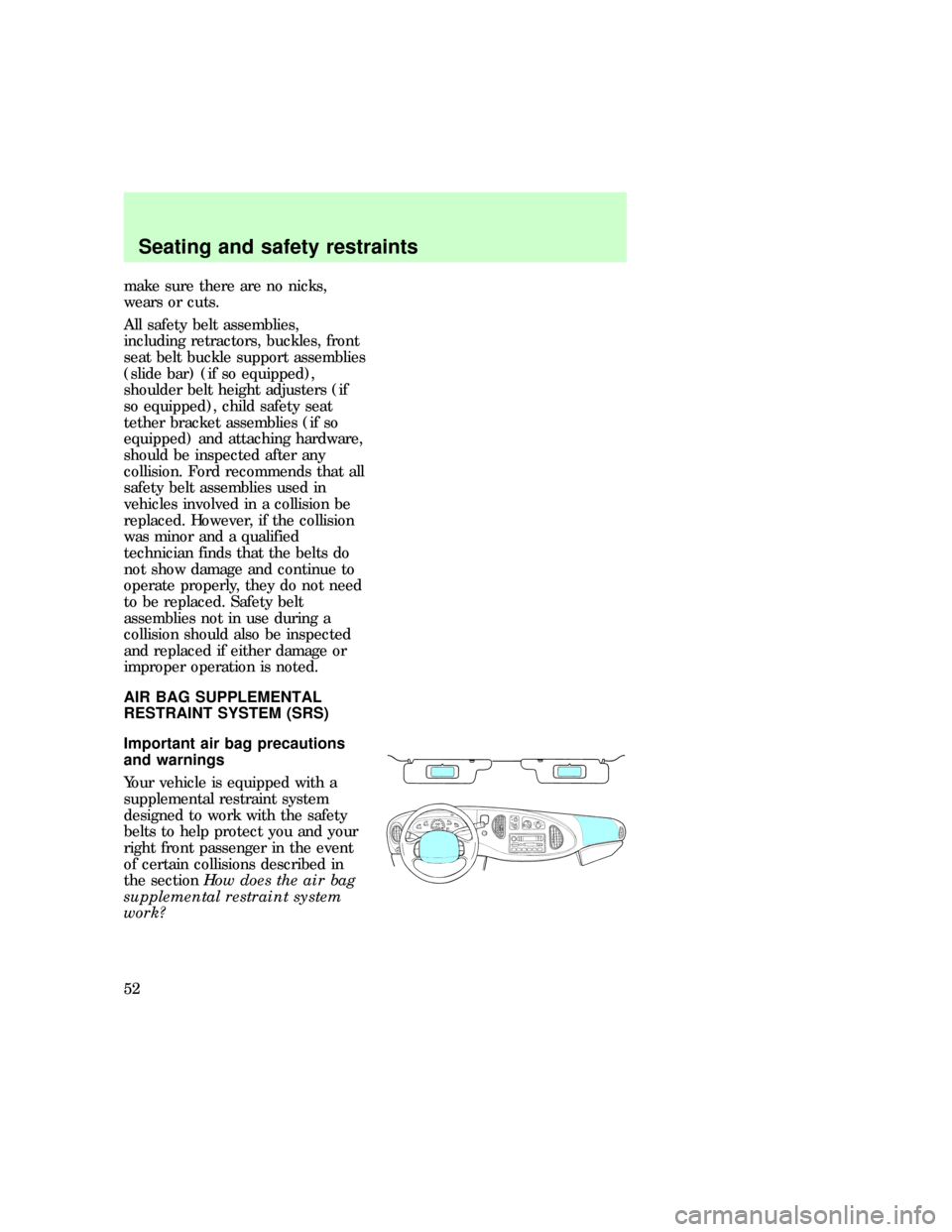
Your vehicle is equipped with a
supplemental restraint system
designed to work with the safety
belts to help protect you and your
right front passenger in the event
of certain collisions described in
the sectionHow does the air bag
supplemental restraint system
work?
eco_air-bags
eco_important_precautions
Seating and safety restraints
52
Page 53 of 192
All occupants of the
vehicle, including the
driver, should always wear their
safety belts, failure to do so may
increase the risk of personal
injury in the event of a collision.
The right front passenger
air bag is not designed to
restrain occupants in the center
front seating position.
Do not place objects or
mount equipment on or
near the dashboard area,
steering wheel or in front of the
passenger that may come in
contact with a deploying air bag.
Failure to follow this instruction
may increase the risk of personal
injury in the event of a collision.
Do not attempt to service,
repair, or modify the Air
Bag Supplemental Restraint
System or its fuses. See your
Ford or Lincoln-Mercury dealer.
If you are close to an
inflating air bag, it could
seriously injure you. Sit against
the seatback and position your
seat such that it is as far back
from the steering wheel as
possible but still allows you to
properly control the vehicle.
eco_children
Seating and safety restraints
53
Page 54 of 192
Children and air bags
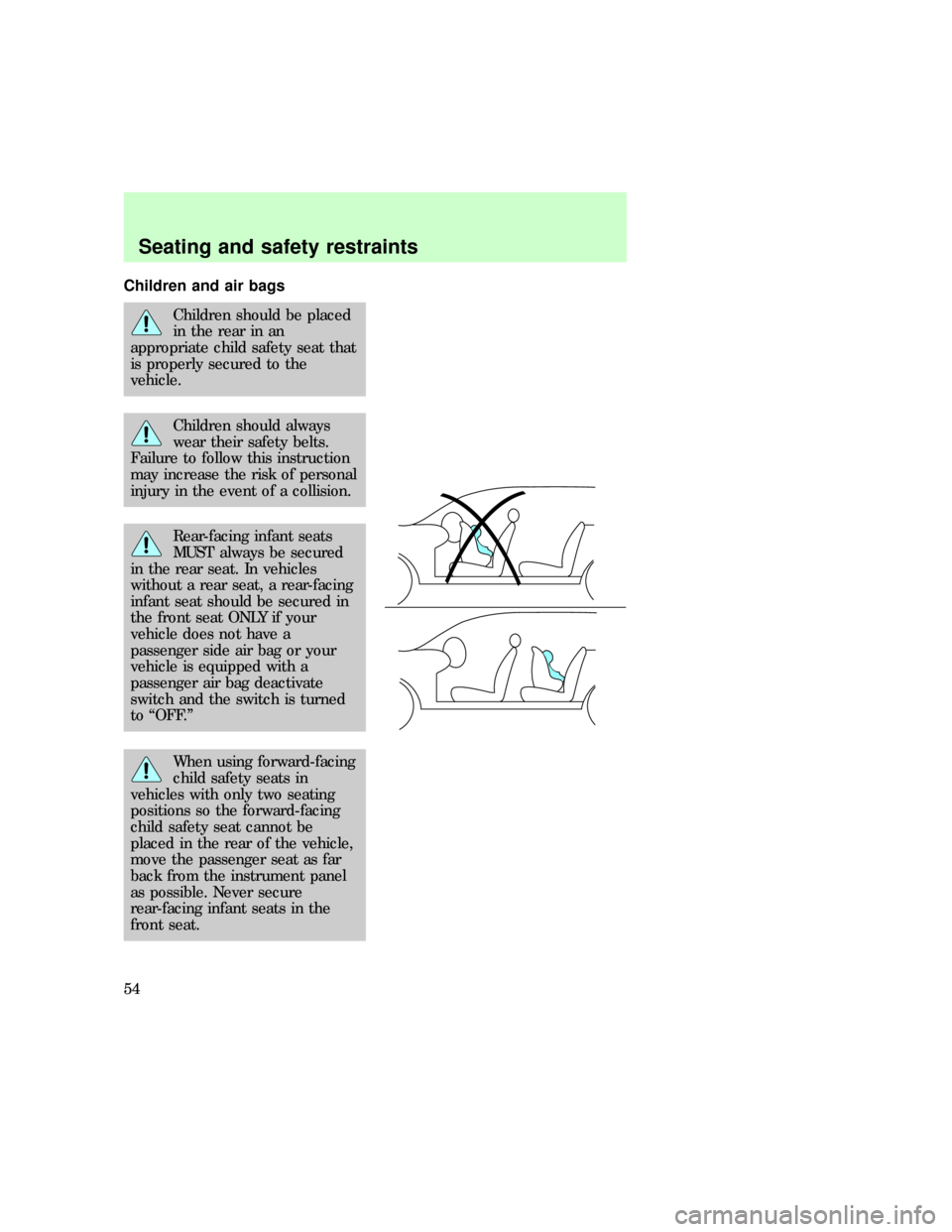
Children should be placed
in the rear in an
appropriate child safety seat that
is properly secured to the
vehicle.
Children should always
wear their safety belts.
Failure to follow this instruction
may increase the risk of personal
injury in the event of a collision.
Rear-facing infant seats
MUST always be secured
in the rear seat. In vehicles
without a rear seat, a rear-facing
infant seat should be secured in
the front seat ONLY if your
vehicle does not have a
passenger side air bag or your
vehicle is equipped with a
passenger air bag deactivate
switch and the switch is turned
to ªOFF.º
When using forward-facing
child safety seats in
vehicles with only two seating
positions so the forward-facing
child safety seat cannot be
placed in the rear of the vehicle,
move the passenger seat as far
back from the instrument panel
as possible. Never secure
rear-facing infant seats in the
front seat.
Seating and safety restraints
54
Page 55 of 192
For additional important safety
information on the proper use of
seat belts, child seats and infant
seats, please read the entire
Seating and safety restraints
chapter in this owner's guide.
How does the air bag
supplemental restraint system
work?
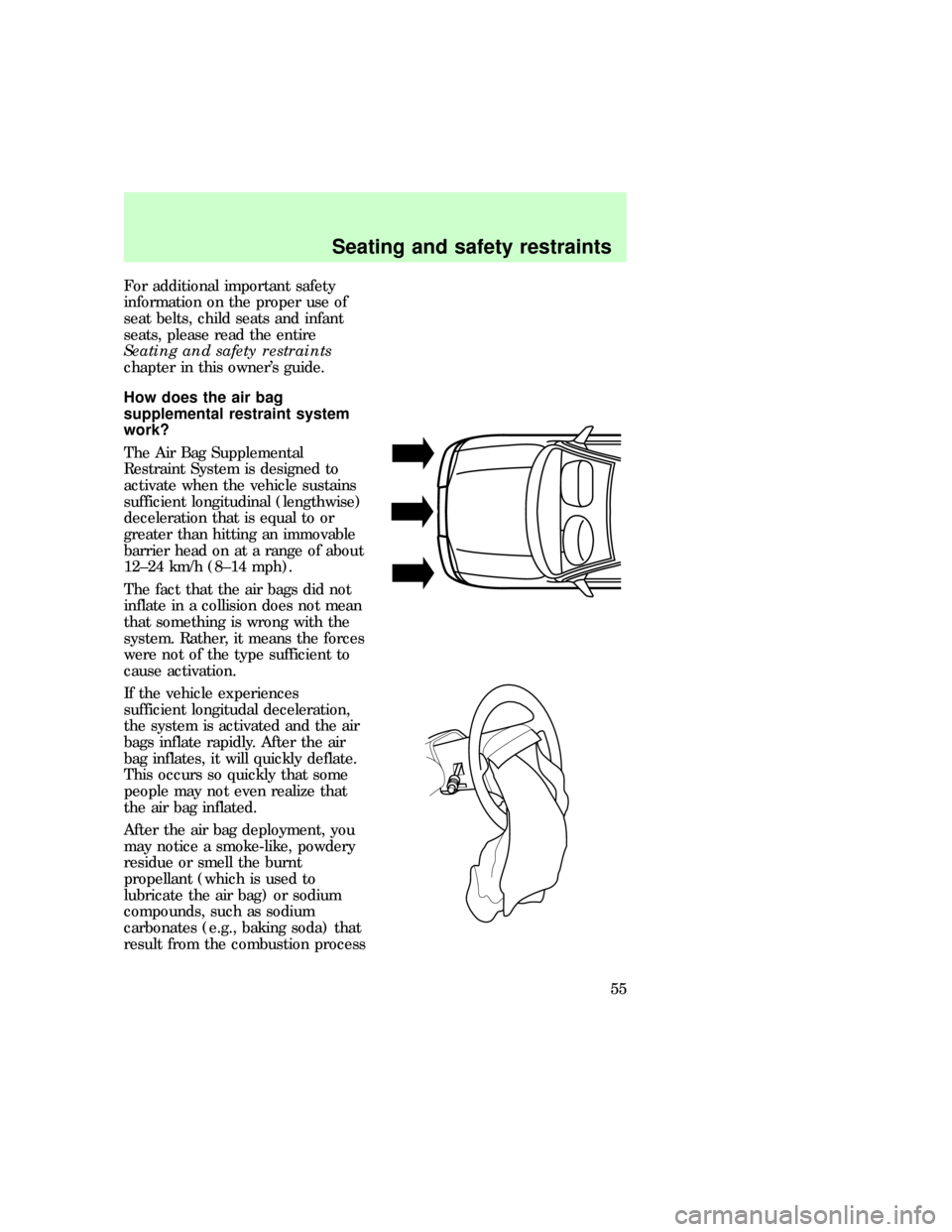
The Air Bag Supplemental
Restraint System is designed to
activate when the vehicle sustains
sufficient longitudinal (lengthwise)
deceleration that is equal to or
greater than hitting an immovable
barrier head on at a range of about
12±24 km/h (8±14 mph).
The fact that the air bags did not
inflate in a collision does not mean
that something is wrong with the
system. Rather, it means the forces
were not of the type sufficient to
cause activation.
If the vehicle experiences
sufficient longitudal deceleration,
the system is activated and the air
bags inflate rapidly. After the air
bag inflates, it will quickly deflate.
This occurs so quickly that some
people may not even realize that
the air bag inflated.
After the air bag deployment, you
may notice a smoke-like, powdery
residue or smell the burnt
propellant (which is used to
lubricate the air bag) or sodium
compounds, such as sodium
carbonates (e.g., baking soda) that
result from the combustion process
eco_how_work
Seating and safety restraints
55
Page 57 of 192
²one or more impact and safing
sensors,
²a readiness light and tone,
²driver and front passenger
safety belt buckle pretensioners
²and the electrical wiring which
connects the components.
The diagnostic module monitors its
own internal circuits and the
supplemental air bag electrical
system readiness (including the
impact sensors), the system wiring,
the air bag system readiness light,
the air bag back up power and the
air bag ignitors.
Determining if the system is
operational
The SRS uses a readiness light in
the instrument cluster or a tone to
indicate the condition of the
system. Refer to theAir bag
readinesssection in the
Instrumentationchapter. Routine
maintenance of the air bag is not
required.
A difficulty with the system is
indicated by one or more of the
following:
²The readiness light will either
flash or stay lit.
²The readiness light will not
illuminate immediately after
ignition is turned on.
²A group of five beeps will be
heard. The tone pattern will
repeat periodically until the
problem and light are repaired.
com_determing_operational.01
Seating and safety restraints
57
Page 59 of 192
Always follow the instructions and
warnings that come with any infant
or child restraint you might use.
Children should be placed in the
rear seat of your vehicle. Accident
statistics suggest that children are
safer when properly restrained in
the rear seating positions than in
the front seating position.
Install forward-facing convertible
safety seats only in vehicle seating
positions equipped with
lap-shoulder belts. Forward facing
convertible safety seats can be
used in the center of the
three-passenger second row bench
seat only if a top tether strap is
used. Ford recommends placing
forward-facing safety seats in the
second row and using safety seats
with top tether straps for added
protection. For more information
on top tether straps seeattaching
safety seats with tether strapsin
this section.
Any booster seat that places the
vehicle's lap belt or shoulder belt
around a shield above and ahead
of the child's hips should not be
used in this vehicle.
Do notuse a
forward-facing safety seat
or an infant seat in the last row
of a 12- or 15-passenger Club
Wagon.
eco_safety_belts
Seating and safety restraints
59