engine FORD E SERIES 1997 4.G Owner's Manual
[x] Cancel search | Manufacturer: FORD, Model Year: 1997, Model line: E SERIES, Model: FORD E SERIES 1997 4.GPages: 192, PDF Size: 3.44 MB
Page 91 of 192

Trailer Towing Table
GCWR (Gross Combined Weight Rating)/Trailer Weights
EngineRear axle
ratioMaximum
GCWR kg
(lb)Trailer weight
range kg (lb)
(0-Maximum)Maximum
Frontal Area Of
Trailer Ft
2
5.4L 4.105,897
(13,000)3,402
(7,500)60
7.3L
(Diesel)3.557,258
(16,000)4,536
(10,000)60
7.3L
(Diesel)4.109,072
(20,000)4,536
(10,000)60
6.8L 3.736,804
(15,000)4,218
(9,300)60
6.8L 4.108,392
(18,500)4,536
(10,000)60
Super Van E-350
5.4L 3.555,443
(12,000)2,858
(6,300)60
5.4L 4.105,897
(13,000)3,311
(7,300)60
7.3L
(Diesel)3.557,258
(16,000)4,445
(9,800)60
7.3L
(Diesel)4.109,072
(20,000)4,536
(10,000)60
6.8L 3.736,804
(15,000)4,173
(9,200)60
6.8L 4.108,392
(18,500)4,536
(10,000)60
Club Wagon E-150 (8 passenger)
4.2L 3.314,082
(9,000)1,678
(3,700)60
4.2L 3.554,536
(10,000)2,132
(4,700)60
Driving
91
Page 92 of 192

Trailer Towing Table
GCWR (Gross Combined Weight Rating)/Trailer Weights
EngineRear axle
ratioMaximum
GCWR kg
(lb)Trailer weight
range kg (lb)
(0-Maximum)Maximum
Frontal Area Of
Trailer Ft
2
4.6L 3.314,990
(11,000)2,540
(5,600)60
4.6L 3.555,216
(11,500)2,767
(6,100)60
5.4L 3.555,443
(12,000)2,948
(6,500)60
Club Wagon Regular E-350 (12 passenger)
5.4L 3.555,443
(12,000)2,722
(6,000)60
5.4L 4.105,897
(13,000)3,175
(7,000)60
7.3L
(Diesel)3.557,258
(16,000)4,309
(9,500)60
7.3L
(Diesel)4.109,072
(20,000)4,536
(10,000)60
6.8L 3.736,804
(15,000)4,037
(8,900)60
6.8L 4.108,392
(18,500)4,536
(10,000)60
Club Wagon Super E-350 (15 passenger)
5.4L 3.555,443
(12,000)2,586
(5,700)60
5.4L 4.105,897
(13,000)3,039
(6,700)60
7.3L
(Diesel)3.557,258
(16,000)4,173
(9,200)60
7.3L
(Diesel)4.109,072
(20,000)4,536
(10,000)60
Driving
92
Page 93 of 192

Trailer Towing Table
GCWR (Gross Combined Weight Rating)/Trailer Weights
EngineRear axle
ratioMaximum
GCWR kg
(lb)Trailer weight
range kg (lb)
(0-Maximum)Maximum
Frontal Area Of
Trailer Ft
2
6.8L 3.736,804
(15,000)3,901
(8,600)60
6.8L 4.108,392
(18,500)4,536
(10,000)60
E-350 RV Cutaway (single rear wheel)
7.3L
(Diesel)4.109,072
(20,000)4,717
(10,400)60
E-350 RV Cutaway (dual rear wheel)
5.4L 4.105,897
(13,000)1,134
(2,500)60
6.8L 4.108,392
(18,500)3,629
(8,000)60
7.3L
(Diesel)4.109,072
(20,000)4,309
(9,500)60
E-350 Commercial Cutaway (single rear wheel)
7.3L
(Diesel)4.109,072
(20,000)4,717
(10,400)60
E-350 Commercial Cutaway (dual rear wheel)
5.4L 4.105,897
(13,000)1,225
(2,700)60
6.8L 4.108,392
(18,500)3,720
(8,200)60
7.3L
(Diesel)4.109,072
(20,000)4,400
(9,700)60
E-Super Duty
6.8L 4.639,072
(20,000)4,536
(10,000)60
7.3L
(Diesel)4.639,072
(20,000)4,536
(10,000)60
Driving
93
Page 94 of 192

Trailer Towing Table
GCWR (Gross Combined Weight Rating)/Trailer Weights
EngineRear axle
ratioMaximum
GCWR kg
(lb)Trailer weight
range kg (lb)
(0-Maximum)Maximum
Frontal Area Of
Trailer Ft
2
E-250/350 Stripped Chassis (single rear wheel)
5.4L 4.105,897
(13,000)1,542
(3,400)60
6.8L 3.736,804
(15,000)2,540
(5,600)60
E-250/350 Stripped Chassis (dual rear wheel)
5.4L 4.105,897
(13,000)1,361
(3,000)60
6.8L 4.108,392
(18,500)3,856
(8,500)60
For high altitude operation, reduce GCWR by 2% per 300 meters
(1,000 ft) elevation.
To determine the maximum trailer weight designed for you particular
vehicle as equipped, follow the section Calculating the load your
vehicle can tow/carryearlier in this chapter.
TRAILER TOWING
Your vehicle may tow a class I, II
or III trailer provided the
maximum trailer weight is less
than or equal to the maximum
trailer weight listed for your engine
and rear axle ratio on the above
charts.
Your vehicle's load capacity is
designated by weight, not by
volume, so you cannot necessarily
use all available space when
loading a vehicle.
Distribute the load so that only 10
to 15% of the total is on the
tongue. Tie down the load so that
eco_trailer
Driving
94
Page 95 of 192
it does not shift and change the
weight on the hitch.
Towing a trailer places an
additional load on your vehicle's
engine, transmission, axle, brakes,
tires and suspension. Inspect these
components carefully after any
towing operation.
Do not exceed the GVWR
or the GAWR specified on
the Safety Compliance
Certification Label.
Towing trailers beyond the
maximum recommended
gross trailer weight could result
in engine damage,
transmission/axle damage,
structural damage, loss of
control, and personal injury.
Preparing to tow
Use the proper equipment for
towing a trailer, and make sure it
is properly attached to your
vehicle. See your dealer or a
reliable trailer dealer if you require
assistance.
Hitches
Do not use or install hitches that
clamp onto the bumper or to the
axle. Underbody hitches are
acceptable if installed properly.
Step bumper (if equipped)
Step bumpers have a built-in hitch
and only require a ball with a 2.5
cm (1 in.) shank diameter. Step
eco_preparing_tow
eco_hitch
eco_step-bumper
Driving
95
Page 97 of 192

hilly country or on hot days.
Speed control may shut off if you
are towing on very long, steep
grades.
When towing a trailer
If towing a trailer and your vehicle
is not equipped with the Ford
trailer tow package, an auxiliary
transmission fluid cooler is
recommended.
²Use D (Drive) rather than
D(Overdrive) while towing up
or down steep hills. This will
eliminate excessive downshifting
and upshifting for optimum fuel
economy and transmission
cooling.
²Anticipate stops and brake
gradually.
²Allow more room for stopping
with a trailer attached.
²Practice turning, stopping and
backing in an area before
starting on a trip to get the feel
of the vehicle/trailer
combination.
²When turning, drive slightly
beyond the normal turning point
so the trailer wheels will clear
curbs and other obstacles.
²When stopped in traffic for long
periods of time in hot weather,
place the gearshift in P (Park)
to increase idle speed. This aids
engine cooling and air
conditioner efficiency.
²Vehicles with trailers should not
be parked on a grade. If you
eco_when_towing
Driving
97
Page 100 of 192
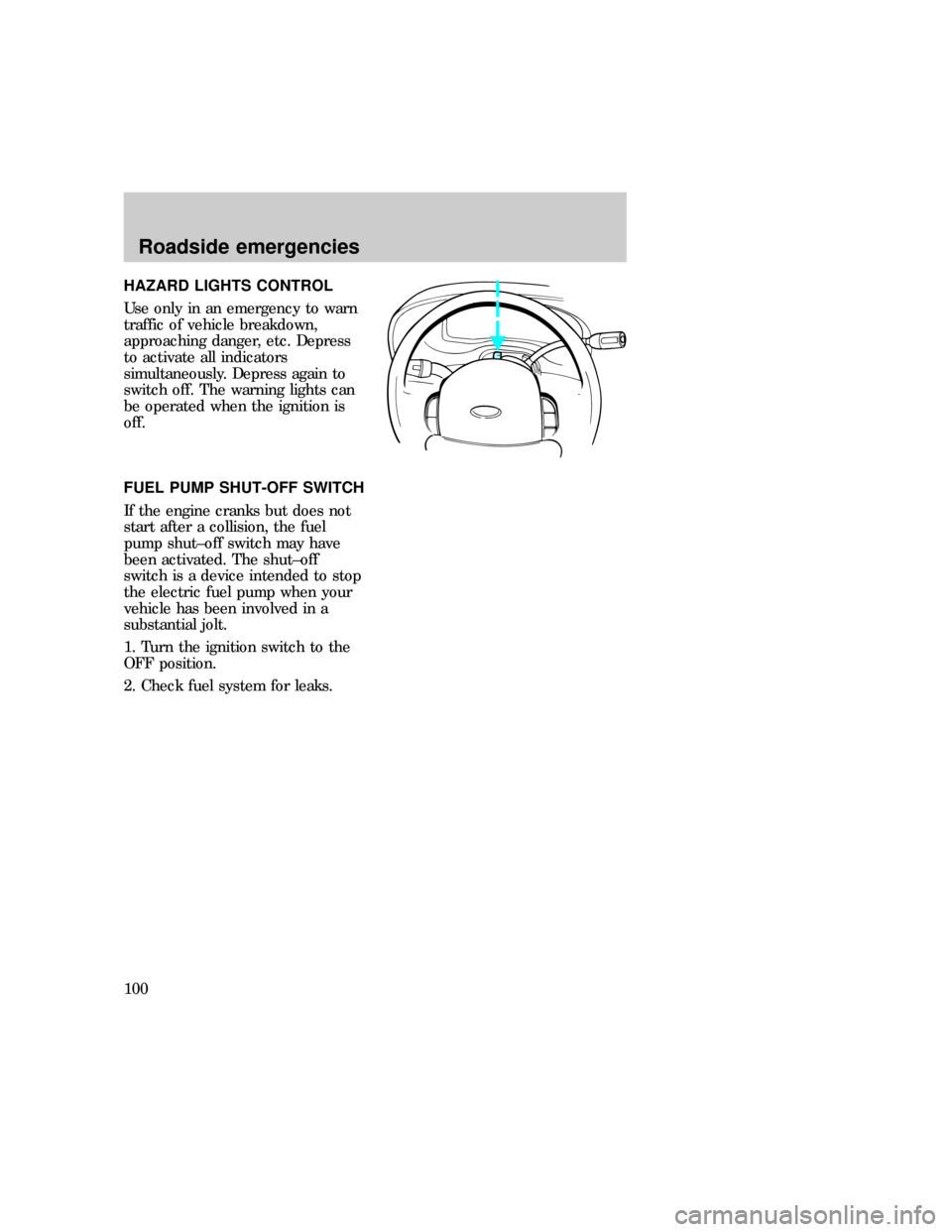
HAZARD LIGHTS CONTROL
Use only in an emergency to warn
traffic of vehicle breakdown,
approaching danger, etc. Depress
to activate all indicators
simultaneously. Depress again to
switch off. The warning lights can
be operated when the ignition is
off.
FUEL PUMP SHUT-OFF SWITCH
If the engine cranks but does not
start after a collision, the fuel
pump shut±off switch may have
been activated. The shut±off
switch is a device intended to stop
the electric fuel pump when your
vehicle has been involved in a
substantial jolt.
1. Turn the ignition switch to the
OFF position.
2. Check fuel system for leaks.com_hazard_switch.01
eco_fuel_shut-off
Roadside emergencies
100
Page 114 of 192
Continue until the lift mechanism
ªclicks.º
4. Check that the tire is tightly
seated under the vehicle by
pushing against tire. Retighten as
necessary.
5. Replace the access cover,
anti-theft bracket and thumb
screw. Use finger pressure only to
secure the thumb screw.
Make sure the spare tire
and jacking equipment are
stowed and secured in the
proper storage location.
Never run the engine with
one wheel off the ground.
Preparing to change the tire
1. Make sure your vehicle will not
move or roll.
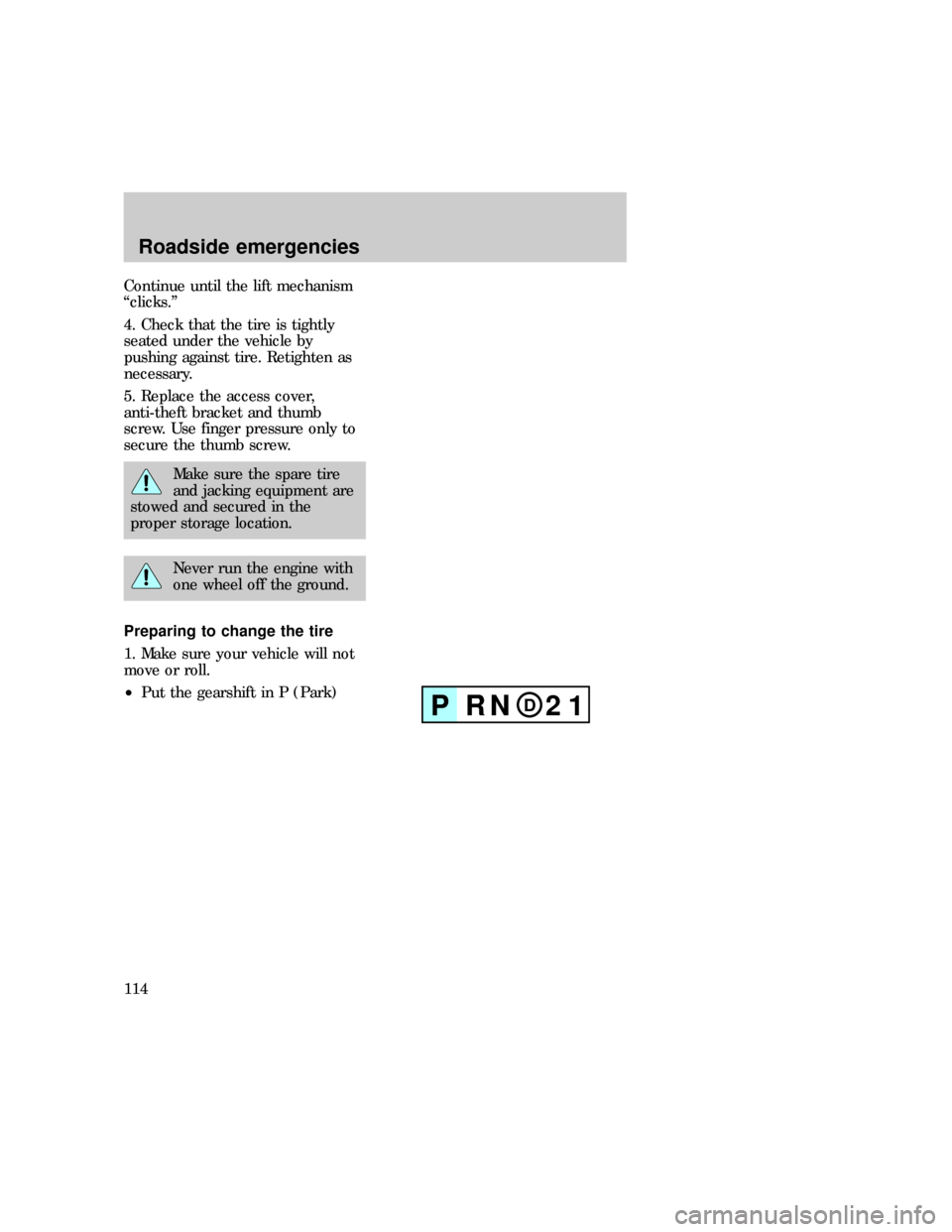
²Put the gearshift in P (Park)
DPRN 21
eco_preparing_tire_change
Roadside emergencies
114
Page 117 of 192
slide the jack under the vehicle.
To lessen the risk of
personal injury, do not put
any part of your body under the
vehicle while changing a tire. Do
not start the engine when your
vehicle is on the jack. The jack is
only meant for changing the tire.
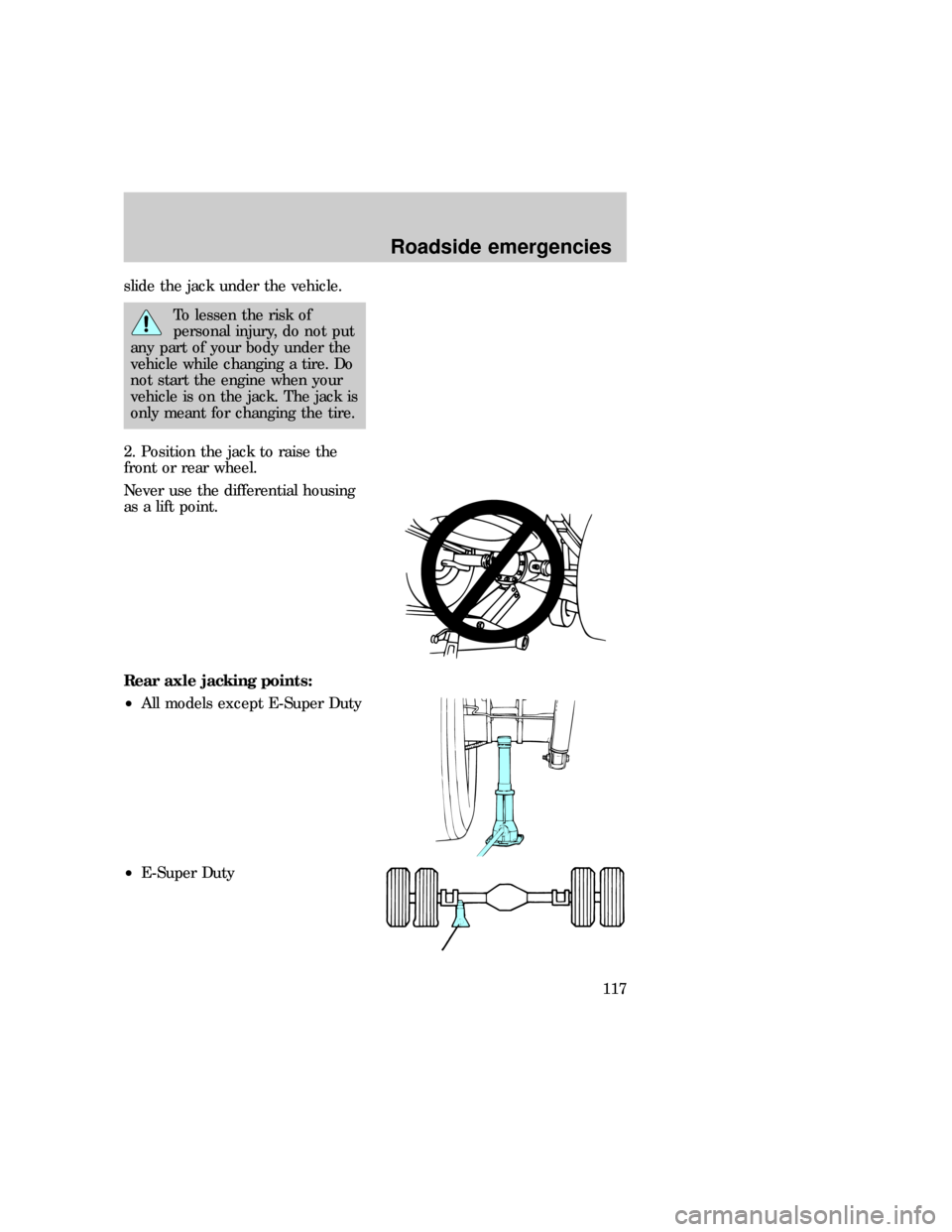
2. Position the jack to raise the
front or rear wheel.
Never use the differential housing
as a lift point.
Rear axle jacking points:
²All models except E-Super Duty
²E-Super Duty
Roadside emergencies
117
Page 121 of 192
Do not push-start your
vehicle. You could damage
the catalytic converter. For
further information, seeJumper
Cablesin the Index.
Batteries contain sulfuric
acid which burns skin,
eyes, and clothing.
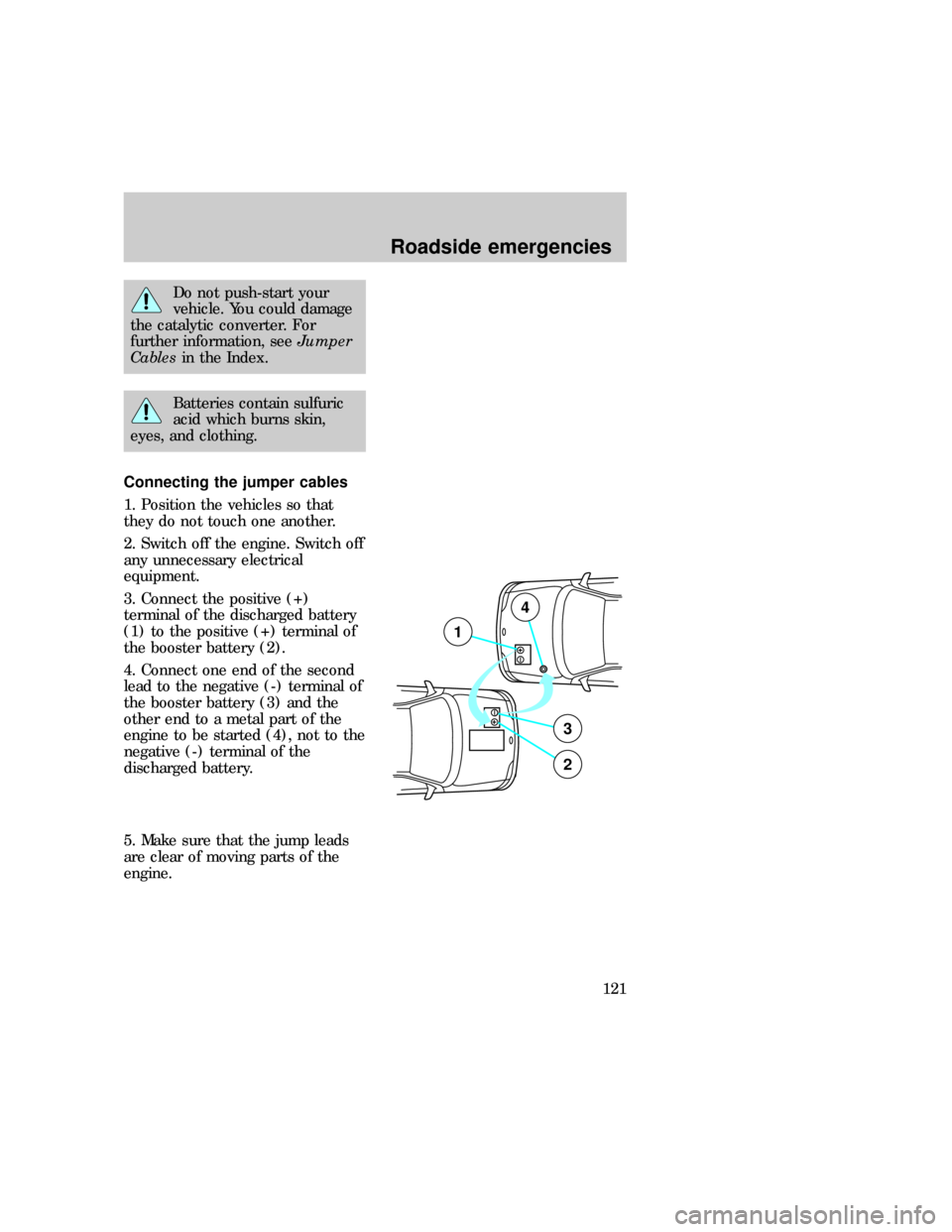
Connecting the jumper cables
1. Position the vehicles so that
they do not touch one another.
2. Switch off the engine. Switch off
any unnecessary electrical
equipment.
3. Connect the positive (+)
terminal of the discharged battery
(1) to the positive (+) terminal of
the booster battery (2).
4. Connect one end of the second
lead to the negative (-) terminal of
the booster battery (3) and the
other end to a metal part of the
engine to be started (4), not to the
negative (-) terminal of the
discharged battery.
5. Make sure that the jump leads
are clear of moving parts of the
engine.
+–
+–
3
2
1
4
com_connecting_cables.01
Roadside emergencies
121