lock FORD E SERIES 1997 4.G Owner's Manual
[x] Cancel search | Manufacturer: FORD, Model Year: 1997, Model line: E SERIES, Model: FORD E SERIES 1997 4.GPages: 192, PDF Size: 3.44 MB
Page 66 of 192

able to pull more belt out). If the
retractor is not locked, unbuckle
the belt and repeat steps two
through nine.
Check to make sure the child seat
is properly secured before each
use.
Installing a child safety seat at
the rear center seating position
with locking adjustable lap belt
1. Lengthen the lap belt. To
lengthen the belt, hold tongue so
that its bottom is perpendicular to
the direction of webbing while
sliding the tongue up the webbing.
2. Place the child safety seat in the
center seating position.
3. Route the tongue and webbing
through the child seat according to
the child seat manufacturer's
instructions.
4. Insert the belt tongue into the
proper buckle for the center
seating position until you hear a
snap and feel it latch. Make sure
the tongue is securely fastened to
the buckle by pulling on tongue.
5. Push down on the child seat
while pulling on the loose end of
the lap belt webbing to tighten the
belt.
6. Before placing the child into
child seat, forcibly tilt the child
seat from side-to-side and in
forward directions to ensure that
the seat is held securely in place.
If the child seat moves excessively,
eco_chils_seat_lap-belt
Seating and safety restraints
66
Page 77 of 192
Make sure the corresponding lights
illuminate briefly. If a light fails to
illuminate, have the vehicle
serviced.
²If the driver's safety belt is
fastened, the
light does not
illuminate.
STARTING PROCEDURE
Starting the engine
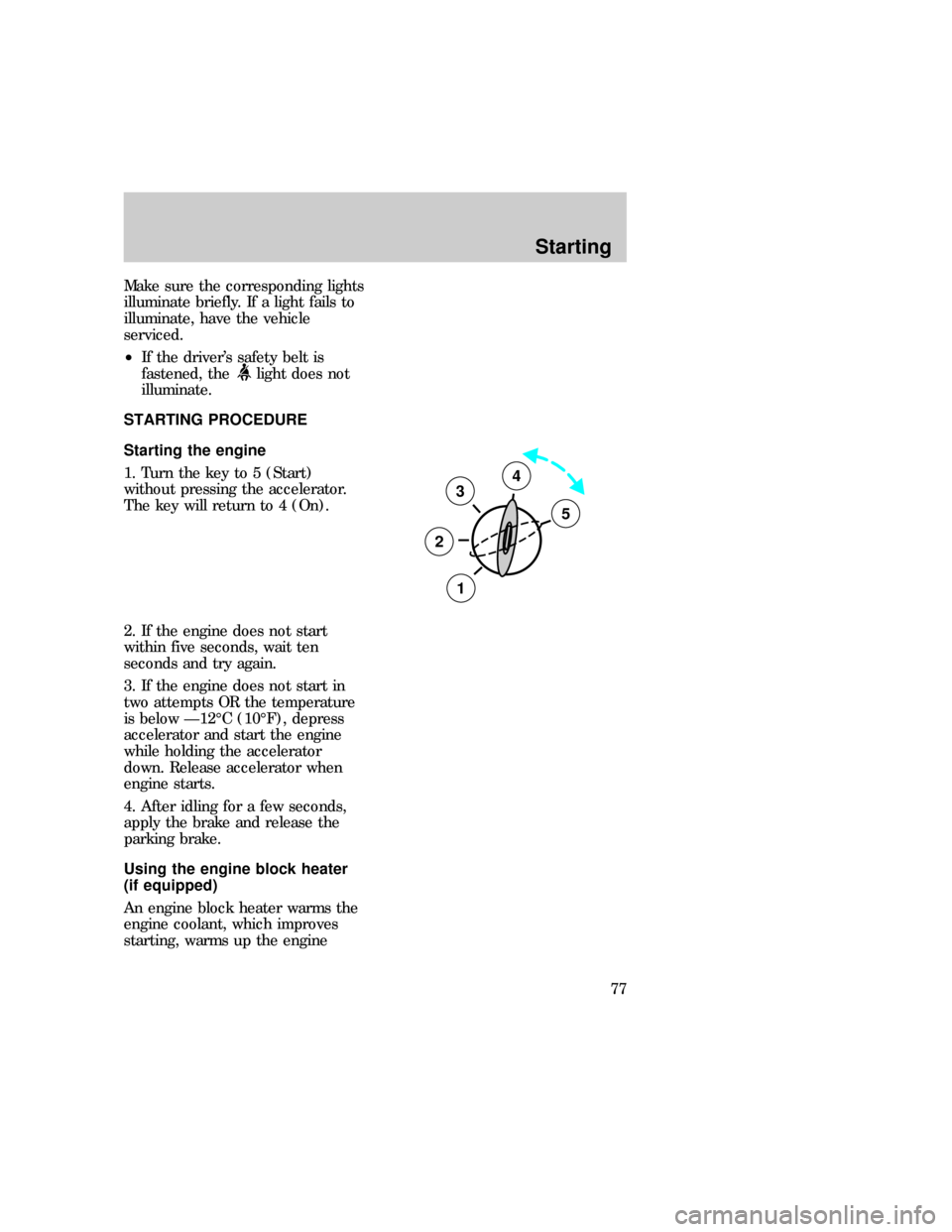
1. Turn the key to 5 (Start)
without pressing the accelerator.
The key will return to 4 (On).
2. If the engine does not start
within five seconds, wait ten
seconds and try again.
3. If the engine does not start in
two attempts OR the temperature
is below Ð12ÉC (10ÉF), depress
accelerator and start the engine
while holding the accelerator
down. Release accelerator when
engine starts.
4. After idling for a few seconds,
apply the brake and release the
parking brake.
Using the engine block heater
(if equipped)
An engine block heater warms the
engine coolant, which improves
starting, warms up the engine
3
2
1
5
4
eco_start_title
com_starting_vehicle.01
com_engine_heater.01
Starting
77
Page 80 of 192

BRAKES
Your brakes are self-adjusting.
Refer to the ªService Guideº for
maintenance scheduling.
Anti-lock brake system (ABS) (if
equipped)
The ABS operates by detecting the
onset of wheel lock up during
brake applications and
compensating for this tendency.
The front wheels are prevented
from locking even when the brakes
are firmly applied. The
accompanying illustration depicts
the advantage of an ABS equipped
vehicle (on bottom) to a non-ABS
equipped vehicle (on top) during
hard braking.
Using ABS
²In an emergency, apply full force
on the brake. The ABS will be
activated immediately, thus
allowing you to retain full
steering control of your vehicle
and, providing there is sufficient
space, will enable you to avoid
obstacles and bring the vehicle
to a quiet stop.
²We recommend that you
familiarize yourself with this
braking technique. However,
avoid taking any unnecessary
risks.
Parking brake
The parking brake should be used
whenever you park your vehicle. It
is not designed to stop a moving
com_brakes.01
com_abs.01
com_using_abs.01
eco_parking_brake
Driving
80
Page 85 of 192

word ªOFFº) will no longer be
illuminated.
Each time the vehicle is started,
the transmission will automatically
return to normal overdrive mode
and you must press the TCS to
deactivate overdrive again if you
do not want overdrive operation.
2 (Second)Ð Use 2 (Second) to
start-up on slippery roads or to
provide additional engine braking
on downgrades. Transmission
operates in first and second gears.
1 (Low)Ð Use 1 (Low) to
provide maximum engine braking
on steep downgrades. Upshifts can
be made by shifting to 2 (Second)
or to
D(Overdrive). Selecting 1
(Low) at higher speeds causes a
shift to 2 (Second), and will shift
to 1 (Low) after vehicle
decelerates to the proper speed.
Brake-shift interlock
The brake-shift interlock feature
prevents you from shifting from P
(Park) unless the brake pedal is
depressed (with the ignition in the
ON position). If you cannot move
the gearshift out of P (Park) with
the brake pedal depressed:
1. Turn ignition key to Off.
2. Apply the parking brake.
3. Turn ignition key to Lock and
remove the key.
4. Re-insert the ignition key and
turn it to Off.
eco_brake_shift_inter-lock
Driving
85
Page 105 of 192

Number Fuse amperage
ratingCircuits protected
1 20 amp 4WABS or RABS
module
2 15 amp 4WABS relay (coil),
RABS (diode/resistor),
instrument cluster,
warning chime
3 15 amp Headlamp switch,
radio sense, rear
radio control, Remote
keyless entry module
4 15 amp Power mirrors,
modified vehicle,
power locks w/RKE,
Headlamp switch
(dome), illuminated
entry, Courtesy lamp
switches, Radio
(KAP), Cluster (KAP),
warning chime
5 20 amp Remote keyless entry
module, power door
lock switches,
memory lock
6 10 amp Brake shift interlock,
speed control,
daytime running light
module
7 10 amp Multi-function switch
Roadside emergencies
105
Page 109 of 192

Number Fuse amperage
ratingCircuits protected
4 5 amp PCM keep alive
memory
5 10 amp Right trailer turn
signal
6 10 amp Left trailer turn signal
7 - Not used
8 60 amp Instrument panel
fuses
9 30 amp PCM power relay
10 60 amp Auxiliary battery
11 - Not used
12 60 amp Misc.
13 50 amp Blower motor relay
14 30 amp Trailer running lamps,
trailer backup lamps
15 40 amp Headlamp switch
16 50 amp Auxiliary A/C, remote
keyless entry module
17 30 amp Fuel pump relay
(gasoline), injector
driver module relay
(diesel)
18 60 amp Modified vehicle
power
19 60 amp Anti-lock brake
system (4WABS)
20 20 amp Electric brake
controller (trailer tow)
21 50 amp Modified vehicle
power
22 40 amp Trailer battery charge
(relay)
Roadside emergencies
109
Page 113 of 192
2. Remove the access cover from
the rubber strip behind the left
door.
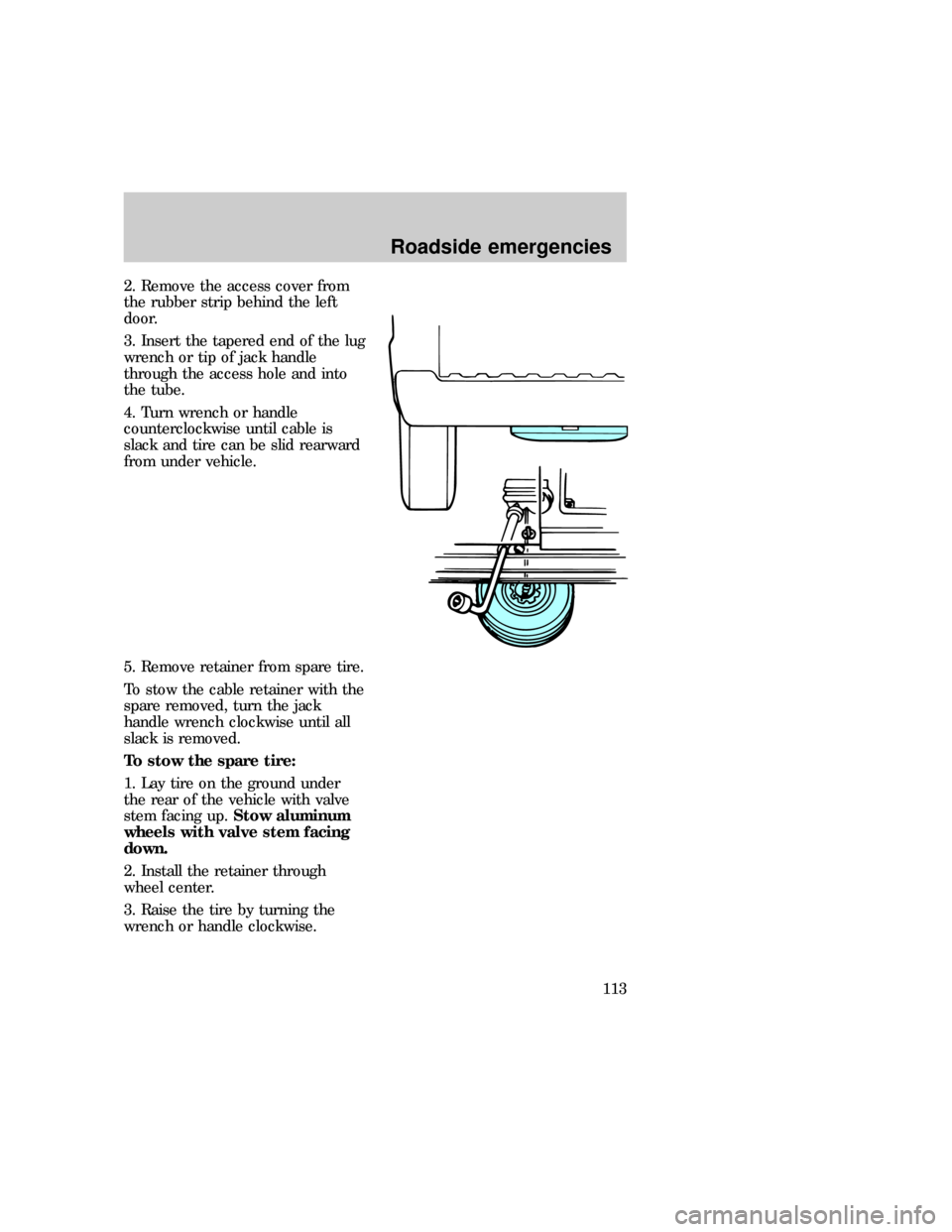
3. Insert the tapered end of the lug
wrench or tip of jack handle
through the access hole and into
the tube.
4. Turn wrench or handle
counterclockwise until cable is
slack and tire can be slid rearward
from under vehicle.
5. Remove retainer from spare tire.
To stow the cable retainer with the
spare removed, turn the jack
handle wrench clockwise until all
slack is removed.
To stow the spare tire:
1. Lay tire on the ground under
the rear of the vehicle with valve
stem facing up.Stow aluminum
wheels with valve stem facing
down.
2. Install the retainer through
wheel center.
3. Raise the tire by turning the
wrench or handle clockwise.
Roadside emergencies
113
Page 115 of 192
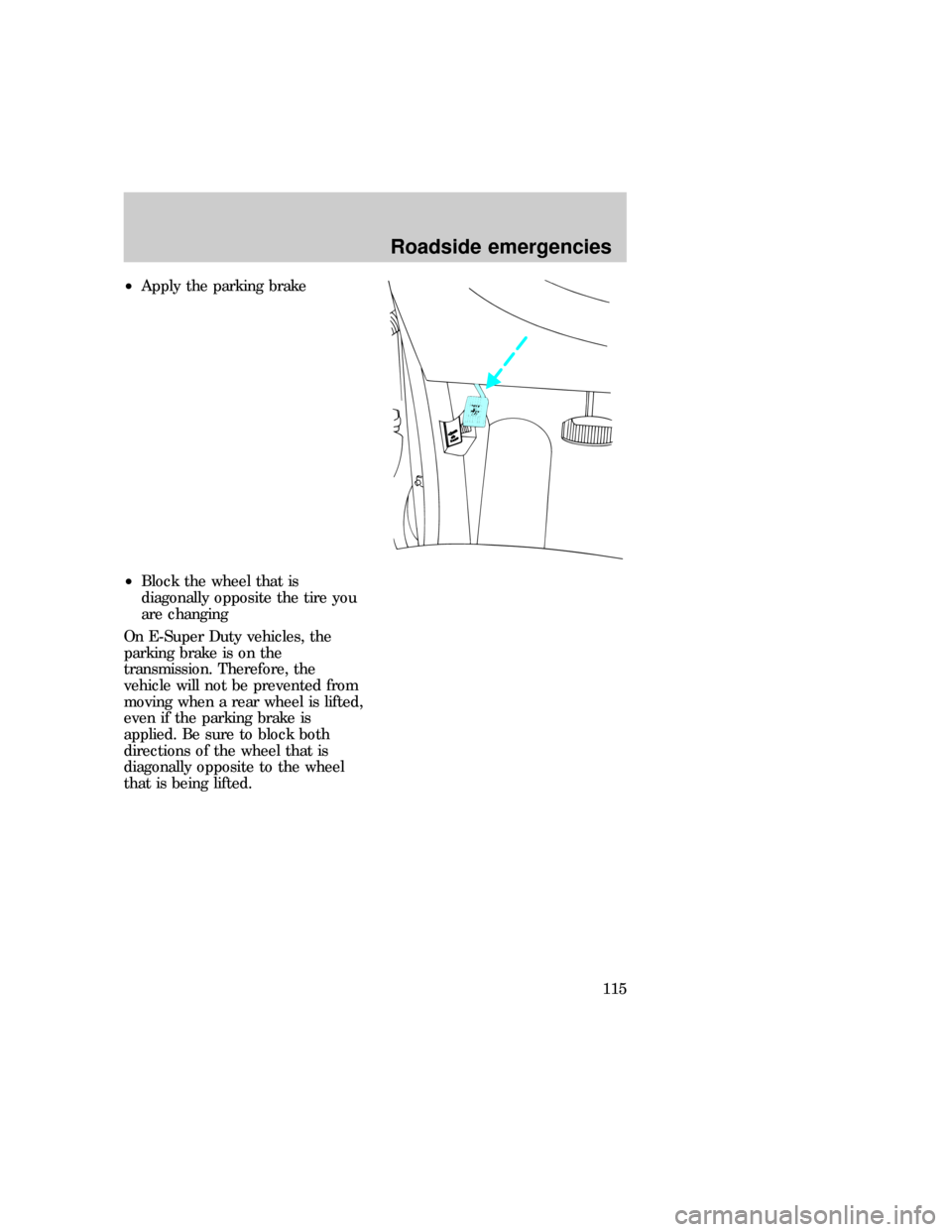
²Apply the parking brake
²Block the wheel that is
diagonally opposite the tire you
are changing
On E-Super Duty vehicles, the
parking brake is on the
transmission. Therefore, the
vehicle will not be prevented from
moving when a rear wheel is lifted,
even if the parking brake is
applied. Be sure to block both
directions of the wheel that is
diagonally opposite to the wheel
that is being lifted.
Roadside emergencies
115
Page 116 of 192
If the vehicle slips off the
jack, you or someone else
could be seriously injured.
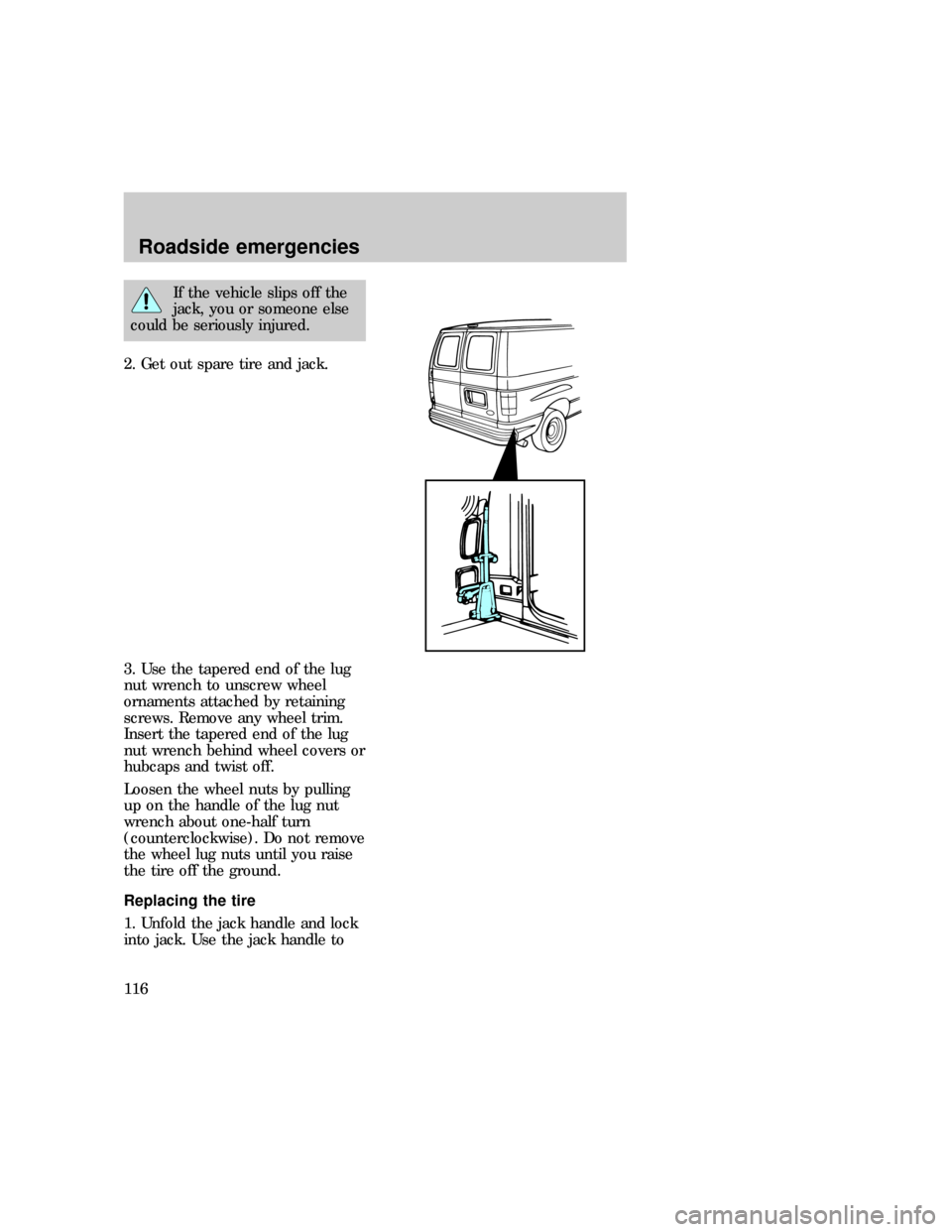
2. Get out spare tire and jack.
3. Use the tapered end of the lug
nut wrench to unscrew wheel
ornaments attached by retaining
screws. Remove any wheel trim.
Insert the tapered end of the lug
nut wrench behind wheel covers or
hubcaps and twist off.
Loosen the wheel nuts by pulling
up on the handle of the lug nut
wrench about one-half turn
(counterclockwise). Do not remove
the wheel lug nuts until you raise
the tire off the ground.
Replacing the tire
1. Unfold the jack handle and lock
into jack. Use the jack handle to
eco_changing-tire
Roadside emergencies
116
Page 118 of 192

Front axle jacking points:
²All models
3. Turn the jack handle clockwise
until the wheel is completely off
the ground.
4. Remove the lug nuts with the
lug nut wrench.
5. Replace the flat tire with the
spare tire.
If your vehicle has dual rear
wheels, there are locating pins on
the hubs and wheels with
corresponding holes. When you
install the wheel make sure that
the pins are aligned with the
proper holes.
If your vehicle has single rear
wheels, thread the lug nuts on the
studs with the beveled face toward
the wheel.
If your vehicle has dual rear
wheels, thread the two element
swiveling lug nut on the studs with
the flange facing toward the wheel.
6. Use the lug nut wrench to screw
the lug nut snugly against the
wheel.
Roadside emergencies
118