tow FORD E SERIES 1997 4.G Owner's Manual
[x] Cancel search | Manufacturer: FORD, Model Year: 1997, Model line: E SERIES, Model: FORD E SERIES 1997 4.GPages: 192, PDF Size: 3.44 MB
Page 97 of 192

hilly country or on hot days.
Speed control may shut off if you
are towing on very long, steep
grades.
When towing a trailer
If towing a trailer and your vehicle
is not equipped with the Ford
trailer tow package, an auxiliary
transmission fluid cooler is
recommended.
²Use D (Drive) rather than
D(Overdrive) while towing up
or down steep hills. This will
eliminate excessive downshifting
and upshifting for optimum fuel
economy and transmission
cooling.
²Anticipate stops and brake
gradually.
²Allow more room for stopping
with a trailer attached.
²Practice turning, stopping and
backing in an area before
starting on a trip to get the feel
of the vehicle/trailer
combination.
²When turning, drive slightly
beyond the normal turning point
so the trailer wheels will clear
curbs and other obstacles.
²When stopped in traffic for long
periods of time in hot weather,
place the gearshift in P (Park)
to increase idle speed. This aids
engine cooling and air
conditioner efficiency.
²Vehicles with trailers should not
be parked on a grade. If you
eco_when_towing
Driving
97
Page 98 of 192

must park on a grade, place
wheel chocks under the trailer's
wheels.
²After you have travelled about
80 km (50 miles), thoroughly
check your hitch, electrical
connections and trailer wheel
lug nuts.
Launching or retrieving a boat
When backing down a ramp during
boat launching or retrieval,
²Do not allow the static water
level to rise above the bottom
edge of the rear bumper and
²Do not allow waves to break
higher than 15 cm (six inches)
above the bottom edge of the
rear bumper.
Exceeding these limits may allow
water to enter critical vehicle
components, adversely affecting
driveability, emissions and
reliability.
Servicing when towing
If you tow a trailer for long
distances, your vehicle will require
more frequent service intervals.
Follow the severe duty
maintenance schedule outlined in
the ªService Guide.º
com_launch-retrieving_boat.01
eco_service_when_towing
com_fuel_consumption.01
Driving
98
Page 106 of 192

Number Fuse amperage
ratingCircuits protected
8 30 amp Noise supression
capacitor, ignition coil
positive feed, PCM
relay diode/PCM
power relay, fuel
heater (diesel), glow
plug relay (diesel)
9 30 amp Wiper control module,
wiper motor
10 20 amp Headlamp switch
(exterior lamps),
Multi-function switch
(flash-to-pass)
11 15 amp Stoplight switch, brake
pressure switch,
multi-function switch
12 15 amp Digital transmission
range sensor (backup
lamps), auxiliary
battery relay
13 15 amp A/C mode switch,
blend door actuator
14 5 amp Instrument cluster (air
bag and charge
indicator lamps)
15 5 amp Trailer tow battery
charge relay (coil)
16 30 amp Power seats
17 - Not used
18 - Not used
19 10 amp Air bag module
20 5 amp Overdrive cancel
switch
Roadside emergencies
106
Page 109 of 192

Number Fuse amperage
ratingCircuits protected
4 5 amp PCM keep alive
memory
5 10 amp Right trailer turn
signal
6 10 amp Left trailer turn signal
7 - Not used
8 60 amp Instrument panel
fuses
9 30 amp PCM power relay
10 60 amp Auxiliary battery
11 - Not used
12 60 amp Misc.
13 50 amp Blower motor relay
14 30 amp Trailer running lamps,
trailer backup lamps
15 40 amp Headlamp switch
16 50 amp Auxiliary A/C, remote
keyless entry module
17 30 amp Fuel pump relay
(gasoline), injector
driver module relay
(diesel)
18 60 amp Modified vehicle
power
19 60 amp Anti-lock brake
system (4WABS)
20 20 amp Electric brake
controller (trailer tow)
21 50 amp Modified vehicle
power
22 40 amp Trailer battery charge
(relay)
Roadside emergencies
109
Page 112 of 192
Position Circuit
J Horn
K Fuel pump or IDM
CHANGING TIRES
Spare tire location
The spare tire is stowed under the
rear of your vehicle (except
cutaway and stripped chassis
models).
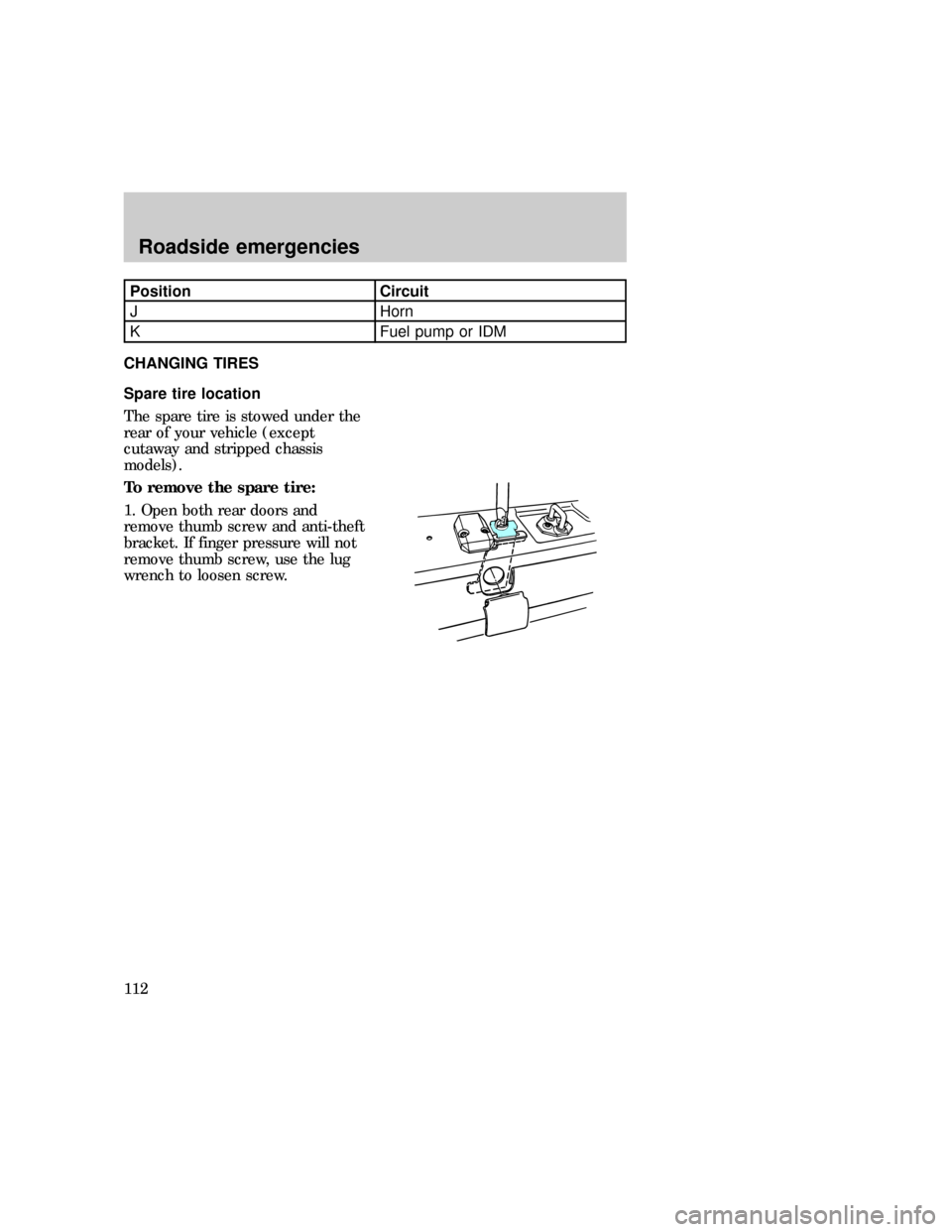
To remove the spare tire:
1. Open both rear doors and
remove thumb screw and anti-theft
bracket. If finger pressure will not
remove thumb screw, use the lug
wrench to loosen screw.
eco_tire_location
Roadside emergencies
112
Page 113 of 192
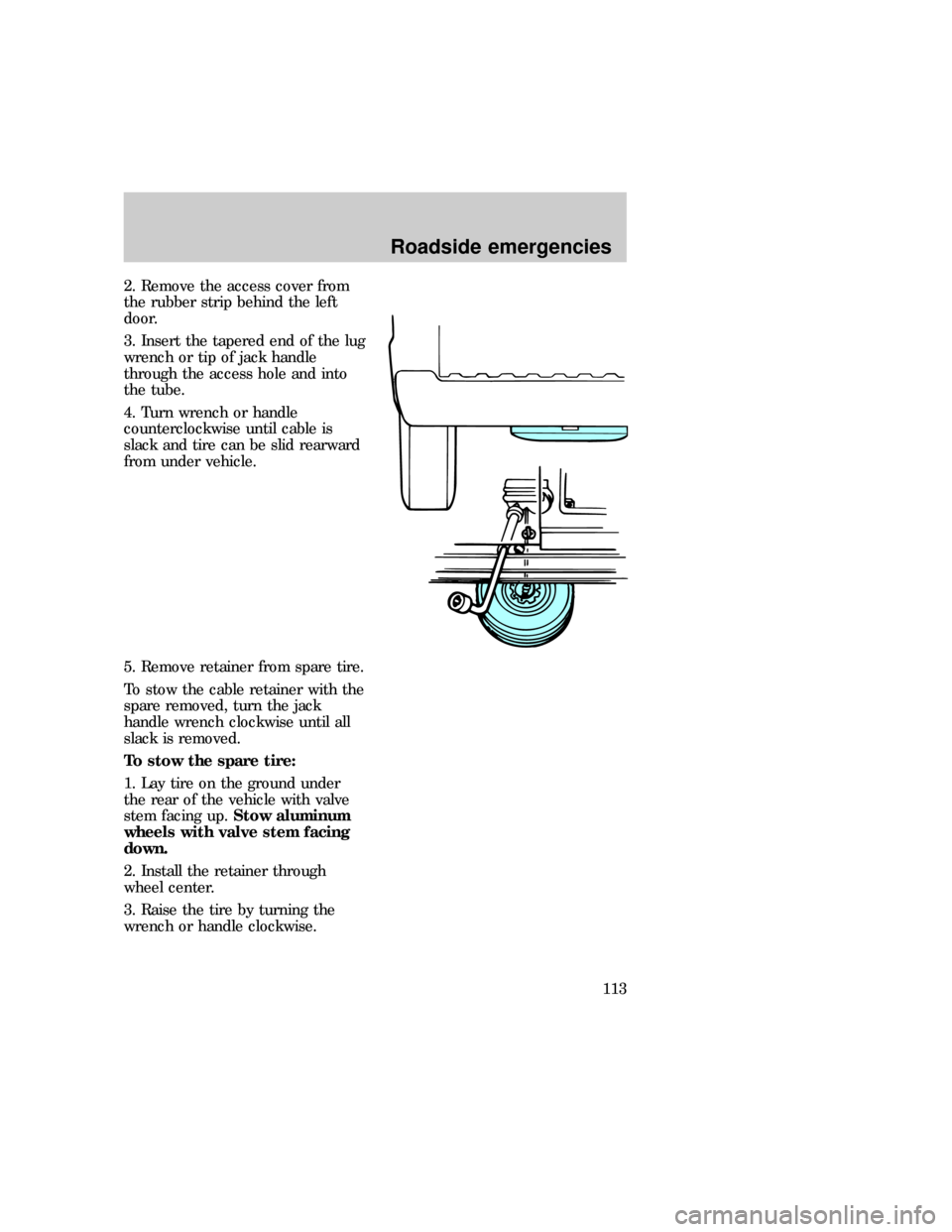
2. Remove the access cover from
the rubber strip behind the left
door.
3. Insert the tapered end of the lug
wrench or tip of jack handle
through the access hole and into
the tube.
4. Turn wrench or handle
counterclockwise until cable is
slack and tire can be slid rearward
from under vehicle.
5. Remove retainer from spare tire.
To stow the cable retainer with the
spare removed, turn the jack
handle wrench clockwise until all
slack is removed.
To stow the spare tire:
1. Lay tire on the ground under
the rear of the vehicle with valve
stem facing up.Stow aluminum
wheels with valve stem facing
down.
2. Install the retainer through
wheel center.
3. Raise the tire by turning the
wrench or handle clockwise.
Roadside emergencies
113
Page 114 of 192
Continue until the lift mechanism
ªclicks.º
4. Check that the tire is tightly
seated under the vehicle by
pushing against tire. Retighten as
necessary.
5. Replace the access cover,
anti-theft bracket and thumb
screw. Use finger pressure only to
secure the thumb screw.
Make sure the spare tire
and jacking equipment are
stowed and secured in the
proper storage location.
Never run the engine with
one wheel off the ground.
Preparing to change the tire
1. Make sure your vehicle will not
move or roll.
²Put the gearshift in P (Park)
DPRN 21
eco_preparing_tire_change
Roadside emergencies
114
Page 118 of 192
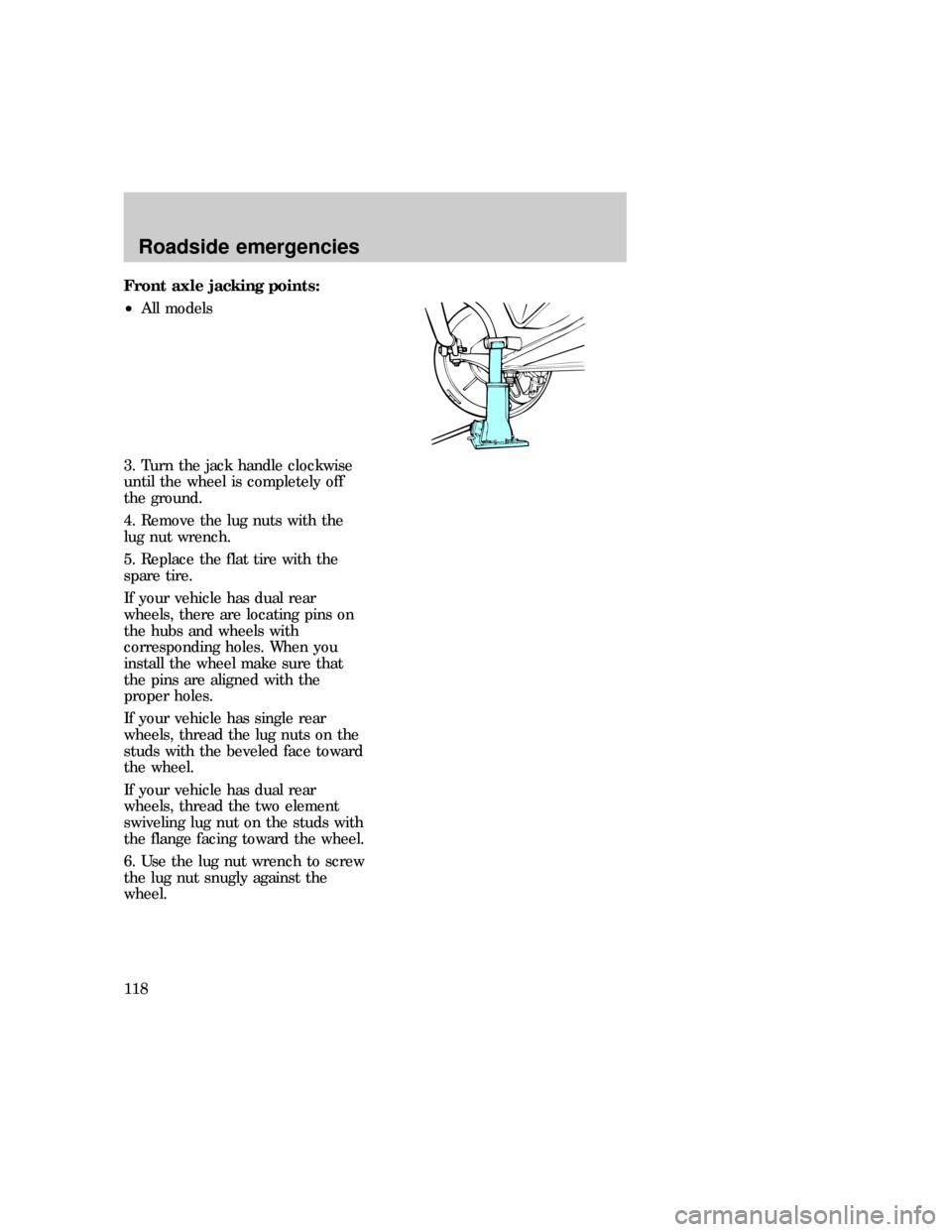
Front axle jacking points:
²All models
3. Turn the jack handle clockwise
until the wheel is completely off
the ground.
4. Remove the lug nuts with the
lug nut wrench.
5. Replace the flat tire with the
spare tire.
If your vehicle has dual rear
wheels, there are locating pins on
the hubs and wheels with
corresponding holes. When you
install the wheel make sure that
the pins are aligned with the
proper holes.
If your vehicle has single rear
wheels, thread the lug nuts on the
studs with the beveled face toward
the wheel.
If your vehicle has dual rear
wheels, thread the two element
swiveling lug nut on the studs with
the flange facing toward the wheel.
6. Use the lug nut wrench to screw
the lug nut snugly against the
wheel.
Roadside emergencies
118
Page 119 of 192
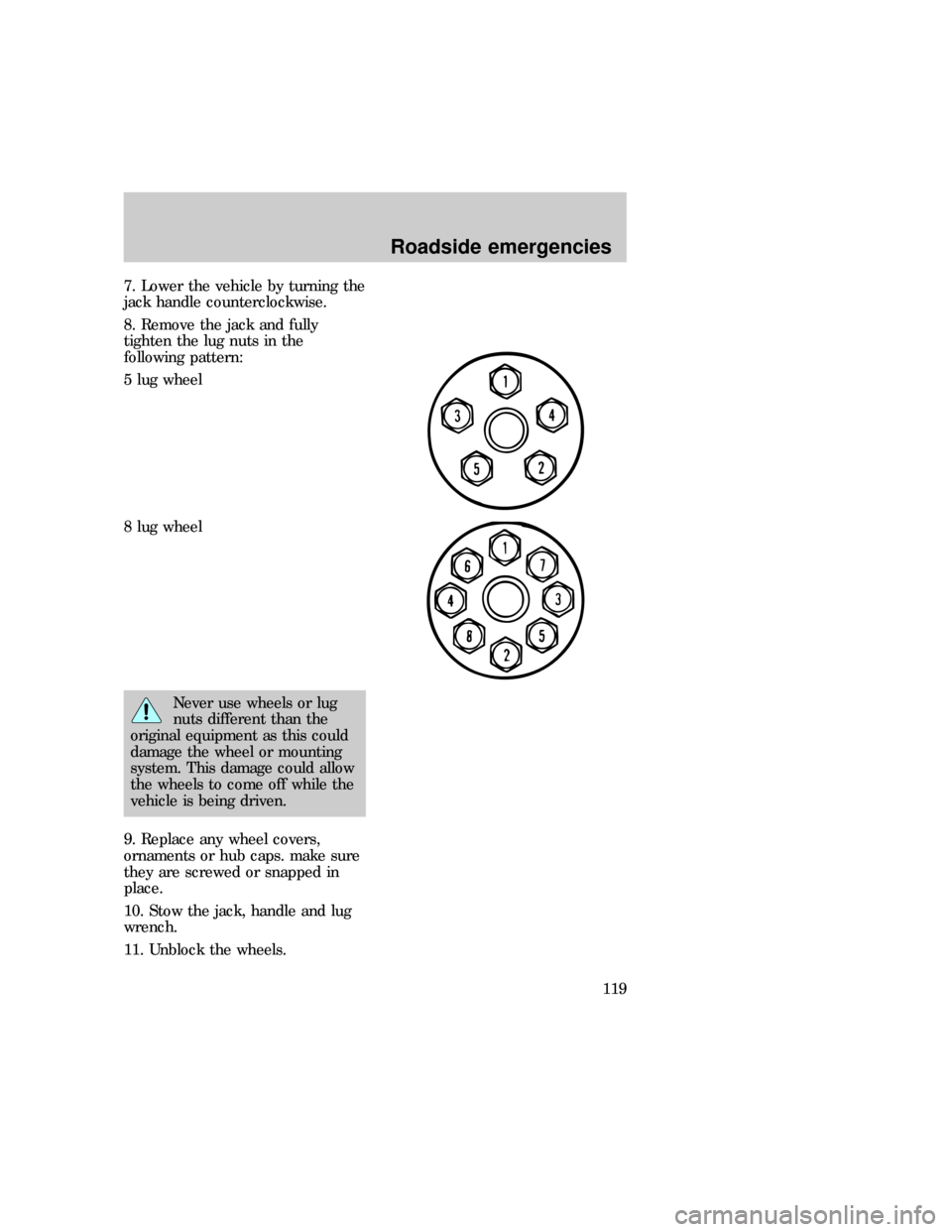
7. Lower the vehicle by turning the
jack handle counterclockwise.
8. Remove the jack and fully
tighten the lug nuts in the
following pattern:
5 lug wheel
8 lug wheel
Never use wheels or lug
nuts different than the
original equipment as this could
damage the wheel or mounting
system. This damage could allow
the wheels to come off while the
vehicle is being driven.
9. Replace any wheel covers,
ornaments or hub caps. make sure
they are screwed or snapped in
place.
10. Stow the jack, handle and lug
wrench.
11. Unblock the wheels.
Roadside emergencies
119
Page 122 of 192
![FORD E SERIES 1997 4.G Owners Manual Do not connect the end of
the second cable to the
negative ([-]) terminal of the
battery to be jumped. A spark
may cause an explosion of the
gases that surround the battery.
Jump starting
1. Start the](/img/11/4790/w960_4790-121.png "FORD E SERIES 1997 4.G Owners Manual Do not connect the end of
the second cable to the
negative ([-]) terminal of the
battery to be jumped. A spark
may cause an explosion of the
gases that surround the battery.
Jump starting
1. Start the")
Do not connect the end of
the second cable to the
negative ([-]) terminal of the
battery to be jumped. A spark
may cause an explosion of the
gases that surround the battery.
Jump starting
1. Start the booster vehicle and
run the engine at moderately
increased speed.
2. Start the engine of the vehicle
with the discharged battery.
3. Once the engine has been
started, run both vehicles for a
further three minutes before
disconnecting the leads.
Removing the jumper cables
1. Remove the jumper cables in
reverse order. Take the cable off
the metallic surface (1) first,
followed by the cable on the
negative (-) booster battery
terminal (2).
2. Remove the cable from the
positive (+) terminal of the booster
battery (3) and then the
discharged battery (4).
3. After the disabled vehicle has
been started, allow it to idle for a
while so the engine can ªrelearnº
its idle conditions.
+–
+–
2
3
4
1
com_jump_starting.01
com_removing_cables.01
eco_wrecker_towing
Roadside emergencies
122