belt FORD E SERIES 1998 4.G Owner's Manual
[x] Cancel search | Manufacturer: FORD, Model Year: 1998, Model line: E SERIES, Model: FORD E SERIES 1998 4.GPages: 144, PDF Size: 2.14 MB
Page 54 of 144
8. Allow the safety belt to retract to
remove any slack in the belt.
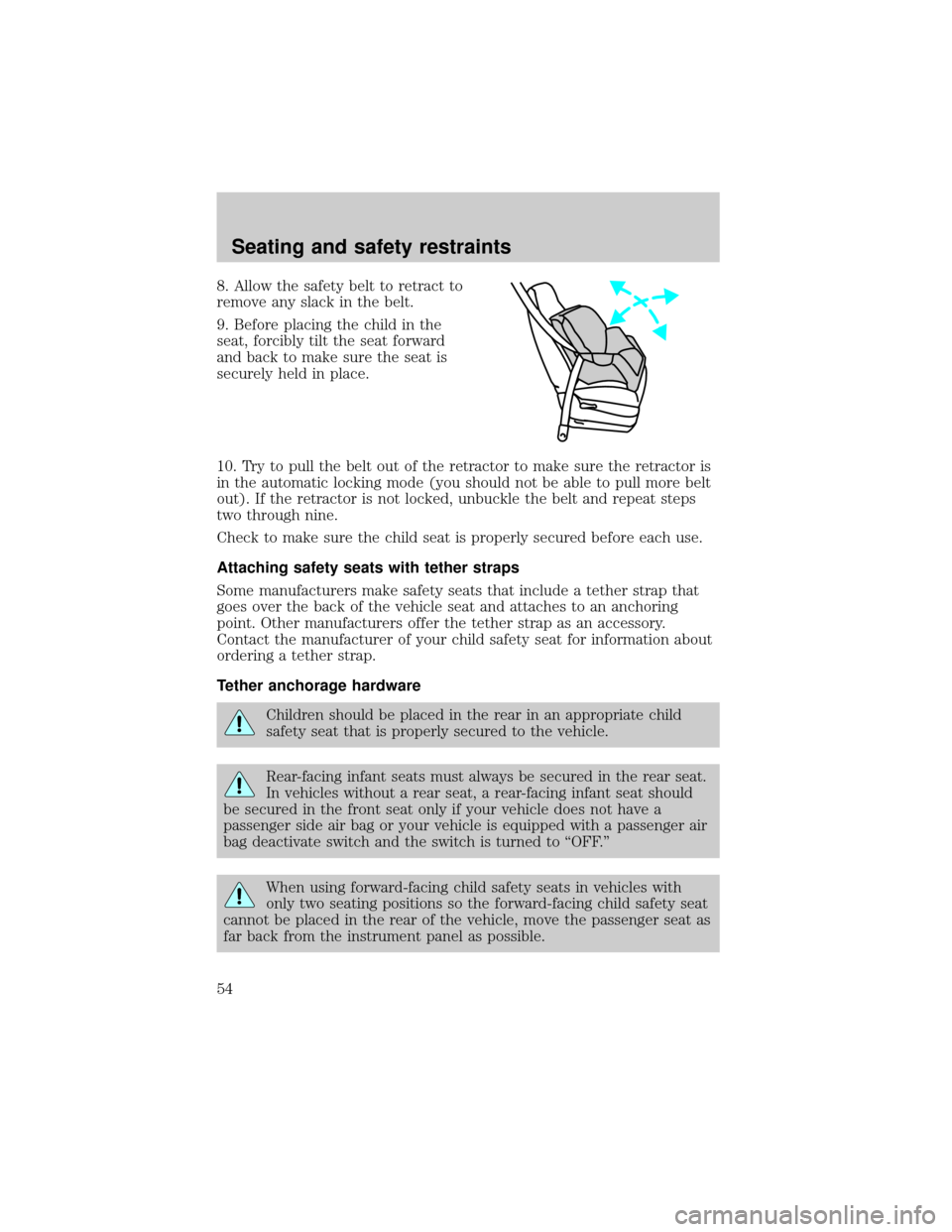
9. Before placing the child in the
seat, forcibly tilt the seat forward
and back to make sure the seat is
securely held in place.
10. Try to pull the belt out of the retractor to make sure the retractor is
in the automatic locking mode (you should not be able to pull more belt
out). If the retractor is not locked, unbuckle the belt and repeat steps
two through nine.
Check to make sure the child seat is properly secured before each use.
Attaching safety seats with tether straps
Some manufacturers make safety seats that include a tether strap that
goes over the back of the vehicle seat and attaches to an anchoring
point. Other manufacturers offer the tether strap as an accessory.
Contact the manufacturer of your child safety seat for information about
ordering a tether strap.
Tether anchorage hardware
Children should be placed in the rear in an appropriate child
safety seat that is properly secured to the vehicle.
Rear-facing infant seats must always be secured in the rear seat.
In vehicles without a rear seat, a rear-facing infant seat should
be secured in the front seat only if your vehicle does not have a
passenger side air bag or your vehicle is equipped with a passenger air
bag deactivate switch and the switch is turned to ªOFF.º
When using forward-facing child safety seats in vehicles with
only two seating positions so the forward-facing child safety seat
cannot be placed in the rear of the vehicle, move the passenger seat as
far back from the instrument panel as possible.
Seating and safety restraints
54
Page 57 of 144
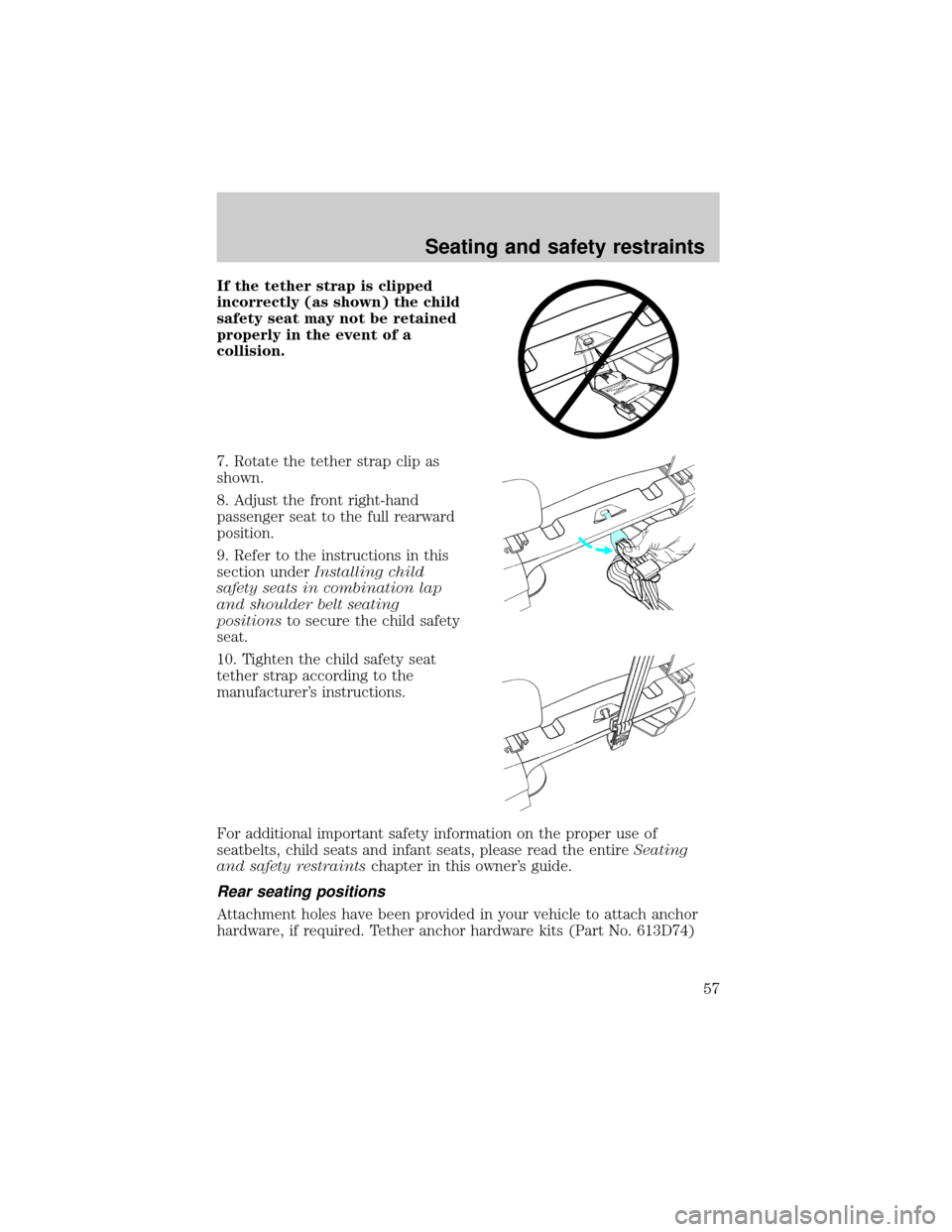
If the tether strap is clipped
incorrectly (as shown) the child
safety seat may not be retained
properly in the event of a
collision.
7. Rotate the tether strap clip as
shown.
8. Adjust the front right-hand
passenger seat to the full rearward
position.
9. Refer to the instructions in this
section underInstalling child
safety seats in combination lap
and shoulder belt seating
positionsto secure the child safety
seat.
10. Tighten the child safety seat
tether strap according to the
manufacturer's instructions.
For additional important safety information on the proper use of
seatbelts, child seats and infant seats, please read the entireSeating
and safety restraintschapter in this owner's guide.
Rear seating positions
Attachment holes have been provided in your vehicle to attach anchor
hardware, if required. Tether anchor hardware kits (Part No. 613D74)
Seating and safety restraints
57
Page 59 of 144
PREPARING TO START YOUR VEHICLE
Engine starting is controlled by the ignition system. This system meets
all Canadian Interference-Causing Equipment standard requirements
regulating the impulse electrical field strength of radio noise.
When starting a fuel-injected engine, avoid pressing the accelerator
before or during starting. Only use the accelerator when you have
difficulty starting the engine. For more information on starting the
vehicle, refer toStarting the enginein this chapter.
Extended idling at high engine speeds can produce very high
temperatures in the engine and exhaust system, creating the risk
of fire or other damage.
Do not park, idle, or drive your vehicle in dry grass or other dry
ground cover. The emission system heats up the engine
compartment and exhaust system, which can start a fire.
Do not start your vehicle in a closed garage or in other enclosed
areas. Exhaust fumes can be toxic. Always open the garage door
before you start the engine. SeeGuarding against exhaust fumesin
this chapter for more instructions.
If you smell exhaust fumes inside your vehicle, have your dealer
inspect your vehicle immediately. Do not drive if you smell
exhaust fumes.
Important safety precautions
A computer system controls the engine's idle revolutions per minute
(RPM). When the engine starts, the idle RPM runs faster to warm the
engine. If the engine idle speed does not slow down automatically, have
the vehicle checked. Do not allow the vehicle to idle for more than ten
minutes.
Before starting the vehicle:
1. Make sure all vehicle occupants have buckled their safety belts. For
more information on safety belts and their proper usage, refer to the
Seating and safety restraintschapter.
Starting
59
Page 61 of 144
Make sure the corresponding lights illuminate briefly. If a light fails to
illuminate, have the vehicle serviced.
²If the driver's safety belt is fastened, the light (
) will not illuminate.
STARTING THE ENGINE
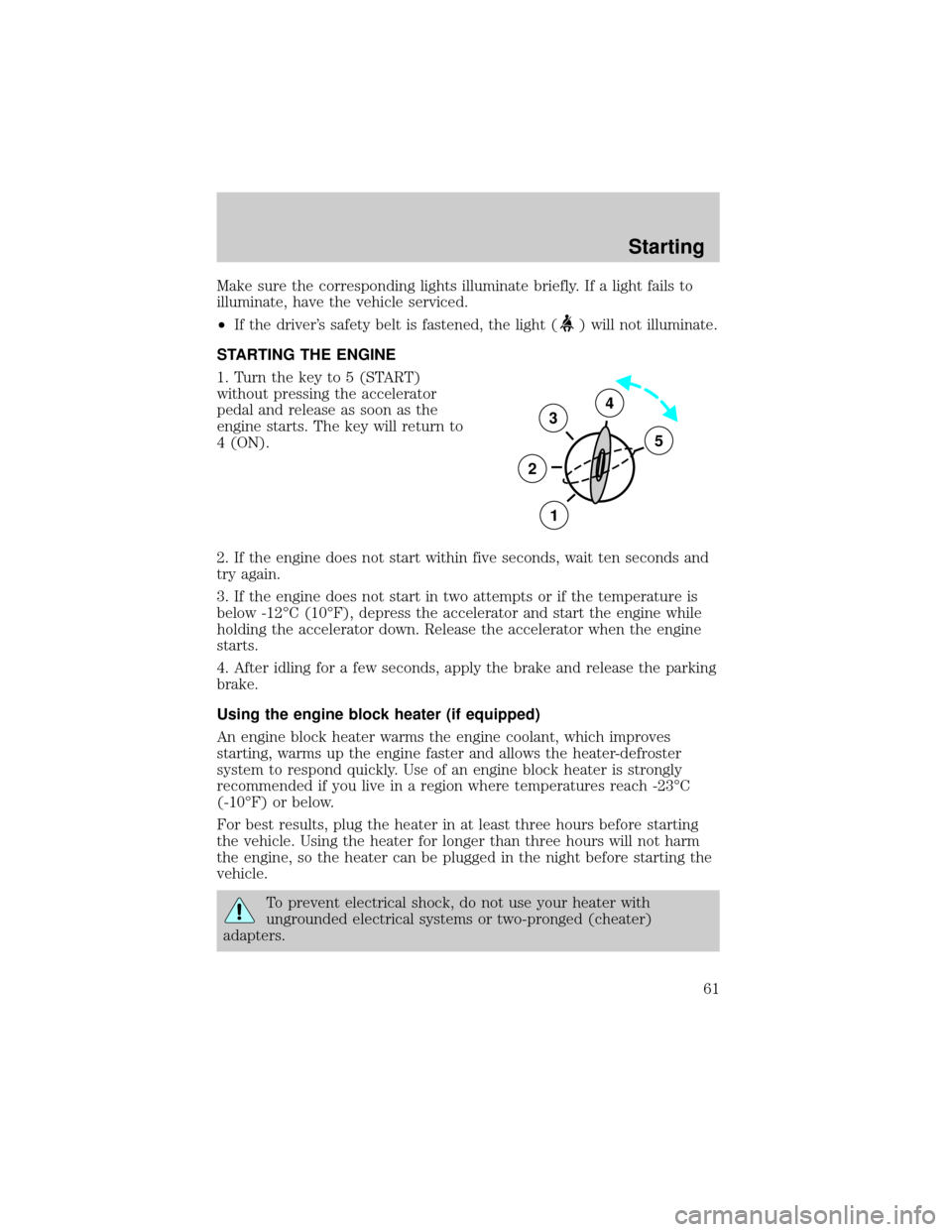
1. Turn the key to 5 (START)
without pressing the accelerator
pedal and release as soon as the
engine starts. The key will return to
4 (ON).
2. If the engine does not start within five seconds, wait ten seconds and
try again.
3. If the engine does not start in two attempts or if the temperature is
below -12ÉC (10ÉF), depress the accelerator and start the engine while
holding the accelerator down. Release the accelerator when the engine
starts.
4. After idling for a few seconds, apply the brake and release the parking
brake.
Using the engine block heater (if equipped)
An engine block heater warms the engine coolant, which improves
starting, warms up the engine faster and allows the heater-defroster
system to respond quickly. Use of an engine block heater is strongly
recommended if you live in a region where temperatures reach -23ÉC
(-10ÉF) or below.
For best results, plug the heater in at least three hours before starting
the vehicle. Using the heater for longer than three hours will not harm
the engine, so the heater can be plugged in the night before starting the
vehicle.
To prevent electrical shock, do not use your heater with
ungrounded electrical systems or two-pronged (cheater)
adapters.
3
2
1
5
4
Starting
61
Page 128 of 144

Cleaning the exterior lamps
Wash with the same detergent as the exterior of your vehicle. Use glass
cleaner or tar remover if necessary.
To avoid scratching the lamps, do not use a dry paper towel, chemical
solvents or abrasive cleaners.
Cleaning the wiper blades
If the wiper blades do not wipe properly, clean the windshield and wiper
blades with undiluted windshield wiper solution or a mild detergent.
Rinse thoroughly with clean water. To avoid damaging the blades, do not
use fuel, kerosene, paint thinner or other solvents.
Cleaning the instrument panel
Clean with a damp cloth, then dry with a dry cloth.
Avoid cleaner or polish that increases the gloss of the upper portion of
the instrument panel. The dull finish in this area helps protect the driver
from undesirable windshield reflection.
Cleaning the interior fabric
Remove dust and loose dirt with a whisk broom or a vacuum cleaner.
Remove fresh spots immediately. Follow the directions that come with
the cleaner.
Cleaning and maintaining the safety belts
Clean the safety belts with a mild soap solution recommended for
cleaning upholstery or carpets. Do not bleach or dye the belts, because
these actions may weaken the belt webbing.
Check the safety belt system periodically to make sure there are no
nicks, wear or cuts. If your vehicle has been involved in an accident,
refer to theSafety belt maintenancesection in theSeating and safety
restraintschapter.
Underbody
Flush the complete underside of vehicle frequently. Keep body drain
holes unplugged. Inspect for road damage.
Inside windows
Use glass cleaner for the inside windows if they become fogged.
Maintenance and care
128
Page 140 of 144

Aiming headlamps ....................125
Air bag supplemental
restraint system ..........................46
and child safety seats ..............47
description ................................46
disposal ......................................49
indicator light ...........................48
passenger air bag .....................47
Air conditioning
manual heating and air
conditioning system .......16,17,18
Anti-lock brake system (ABS)
description ................................64
Battery .......................................108
voltage gauge ............................12
Brake fluid
checking and adding ..............100
Brakes ..........................................63
anti-lock .....................................63
anti-lock brake system (ABS)
warning light .............................63
fluid, checking and adding ....100
Brake-shift interlock ...................65
Break-in period .............................2
Bulbs, replacing ........................122
headlamps ...............................123
specifications ..........................125
Changing a tire ...........................85
Child safety seats ........................51
Chime
headlamps on ..............................9
Cleaning your vehicle ...............125
engine compartment ..............127
fabric ........................................128
instrument panel ....................128
plastic parts ............................127
safety belts ..............................128
tail lamps .................................128
washing ....................................126
waxing .....................................126
wheels ......................................126
windows ..................................128Controls .......................................20
Emission control system ..........121
Engine ........................................134
check engine temperature
warning, message center .........96
service points ............................96
Engine block heater ...................61
Engine coolant
checking and adding .......101,102
disposal ....................................103
refill capacities ........................103
Engine oil ...............................97,99
changing oil and oil filter .........99
checking and adding ...........97,99
Exhaust fumes ............................62
Fail safe cooling ........................103
Fuel
calculating fuel economy .......120
improving fuel economy ..........76
octane rating ...........................119
quality ......................................120
running out of fuel .................120
safety information relating
to automotive fuels ................118
Fuel gauge ...................................10
Fuel pump shut-off switch .........77
Fuse panels
instrument panel ......................79
power distribution box .............82
Fuses ............................................79
Gauges, Mechanical ....................10
engine coolant temperature
gauge .........................................11
Hazard flashers ...........................77
Headlamps ...................................13
daytime running lights .............13
flashing ......................................14
high beam .................................13
Heating ........................................14
High beams
indicator light .............................9
Index
140
Page 141 of 144

Hood
release lever ..............................96
Ignition
positions of the ignition ...........21
Instrument panel
lighting up panel and interior .14
Jump-starting your vehicle ...91,93
attaching cables ........................92
disconnecting cables ................93
Keys
key in ignition chime .................9
Lamps
interior lamps ....................28,124
Lights, warning and indicator
air bag ..........................................8
anti-lock brakes (ABS) ..............6
brake ............................................6
charging system ..........................8
engine oil pressure .....................9
safety belt ...................................8
service engine soon .................6,7
turn signal indicator ...................8
Load limits
trailer towing ............................69
Lubricant specifications ...........132
Mirrors
side view mirrors (power) .......30
Odometer .....................................12
Overdrive .....................................27
Panic alarm feature, remote
entry system ................................31
Parking brake ..............................64
Parts (see Motorcraft parts) ....129
Power door locks ........................29
Power steering
fluid, checking and adding ....105
Refill capacities for fluids ........129
Relays .....................................79,84
Remote entry system .................30
illuminated entry .................33,34
locking/unlocking doors ......30,31replacement/additional
transmitters ...............................32
replacing the batteries .............31
Reporting safety defects ..........139
Safety restraints
extension assembly ..................44
for children ...............................49
lap and shoulder belts ...40,41,42
maintenance ..............................45
proper use .................................39
warning light and chime ..9,44,45
Safety seats for children
attaching with tether straps ....54
tether anchorage
hardware .........................54,55,57
Seats
adjusting the seat, manual .......34
adjusting the seat, power ........35
bench seat ............................36,37
lumbar support .........................36
quick release rear captain's
chair ......................................38,39
Servicing your vehicle ................95
precautions when servicing .....95
Snowplowing .................................3
Special notice
ambulance conversions ..............3
diesel-powered vehicles .............3
Speed control ..............................22
canceling a set speed ...............25
resuming a set speed ...............25
tap up/tap down ..................23,24
turning off .................................22
Speedometer ...............................10
Starting your vehicle .............59,61
Tilt steering wheel ......................26
Tires ....................................114,115
changing ...............................85,86
checking the pressure ............115
replacing .............................88,117
rotating ....................................115
snow tires and chains ............117
Index
141