light FORD E SERIES 1998 4.G Owner's Manual
[x] Cancel search | Manufacturer: FORD, Model Year: 1998, Model line: E SERIES, Model: FORD E SERIES 1998 4.GPages: 144, PDF Size: 2.14 MB
Page 67 of 144
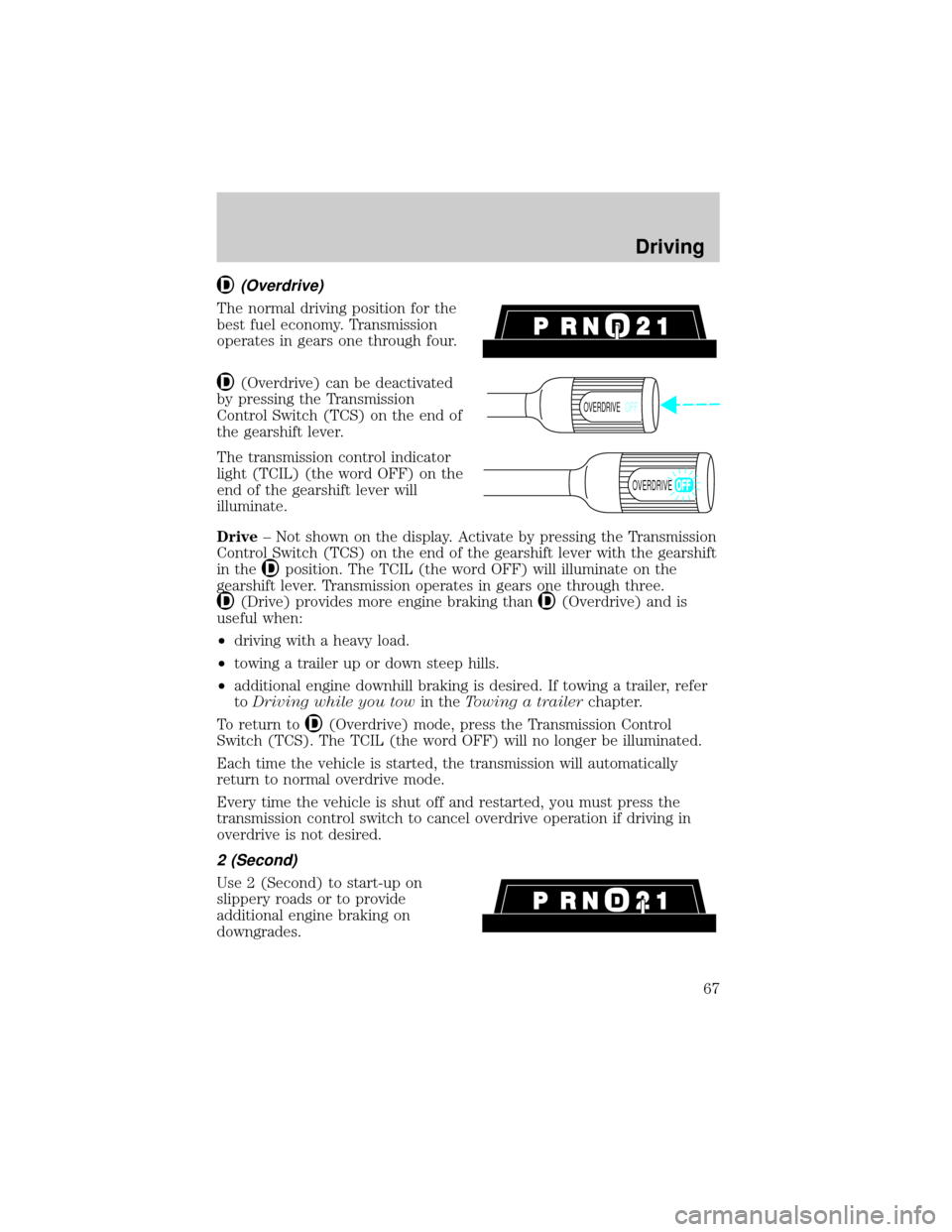
(Overdrive)
The normal driving position for the
best fuel economy. Transmission
operates in gears one through four.
(Overdrive) can be deactivated
by pressing the Transmission
Control Switch (TCS) on the end of
the gearshift lever.
The transmission control indicator
light (TCIL) (the word OFF) on the
end of the gearshift lever will
illuminate.
Drive± Not shown on the display. Activate by pressing the Transmission
Control Switch (TCS) on the end of the gearshift lever with the gearshift
in the
position. The TCIL (the word OFF) will illuminate on the
gearshift lever. Transmission operates in gears one through three.
(Drive) provides more engine braking than(Overdrive) and is
useful when:
²driving with a heavy load.
²towing a trailer up or down steep hills.
²additional engine downhill braking is desired. If towing a trailer, refer
toDriving while you towin theTowing a trailerchapter.
To return to
(Overdrive) mode, press the Transmission Control
Switch (TCS). The TCIL (the word OFF) will no longer be illuminated.
Each time the vehicle is started, the transmission will automatically
return to normal overdrive mode.
Every time the vehicle is shut off and restarted, you must press the
transmission control switch to cancel overdrive operation if driving in
overdrive is not desired.
2 (Second)
Use 2 (Second) to start-up on
slippery roads or to provide
additional engine braking on
downgrades.
OVERDRIVEOFF
OVERDRIVE
Driving
67
Page 70 of 144

DRIVING THROUGH WATER
Do not drive quickly through standing water, especially if the depth is
unknown. Traction or brake capability may be limited and if the ignition
system gets wet, your engine may stall. Water may also enter your
engine's air intake and severely damage your engine.
If driving through deep or standing water is unavoidable, proceed very
slowly. Never drive through water that is higher than the bottom of the
hubs (truck)/wheel rims (car).
Once through the water, always try the brakes. Wet brakes do not stop
the vehicle as effectively as dry brakes. Drying can be improved by
moving your vehicle slowly while applying light pressure on the brake
pedal.
TRAILER TOWING
Your vehicle may tow a class I, II or III trailer provided the maximum
trailer weight is less than or equal to the maximum trailer weight listed
for your engine and rear axle ratio on the following charts.
Trailer Towing Table
GCWR (Gross Combined Weight Rating)/Trailer Weights
EngineRear
axle
ratioMaximum
GCWR-kg
(lbs.)Trailer weight
range-kg (lbs.)
(0-Maximum)Maximum
Frontal Area
Of Trailer-m
2
(ft2)
Regular Van E-150
4.2L 3.31 4 082 (9 000) 1 860 (4 100) 5.52 (60)
4.2L 3.55 4 536 (10 000) 2 313 (5 100) 5.52 (60)
4.6L 3.31 4 990 (11 000) 2 766 (6 100) 5.52 (60)
4.6L 3.55 5 216 (11 500) 2 993 (6 600) 5.52 (60)
5.4L 3.55 5 443 (12 000) 3 130 (6 900) 5.52 (60)
Regular Van E-250
4.2L 3.73 4 763 (10 500) 2 359 (5 200) 5.52 (60)
5.4L 3.73 5 897 (13 000) 3 402 (7 500) 5.52 (60)
Regular Van E-250 HD
4.2L 4.09 4 990 (11 000) 2 586 (5 700) 5.52 (60)
5.4L 3.73 5 897 (13 000) 3 402 (7 500) 5.52 (60)
Driving
70
Page 77 of 144
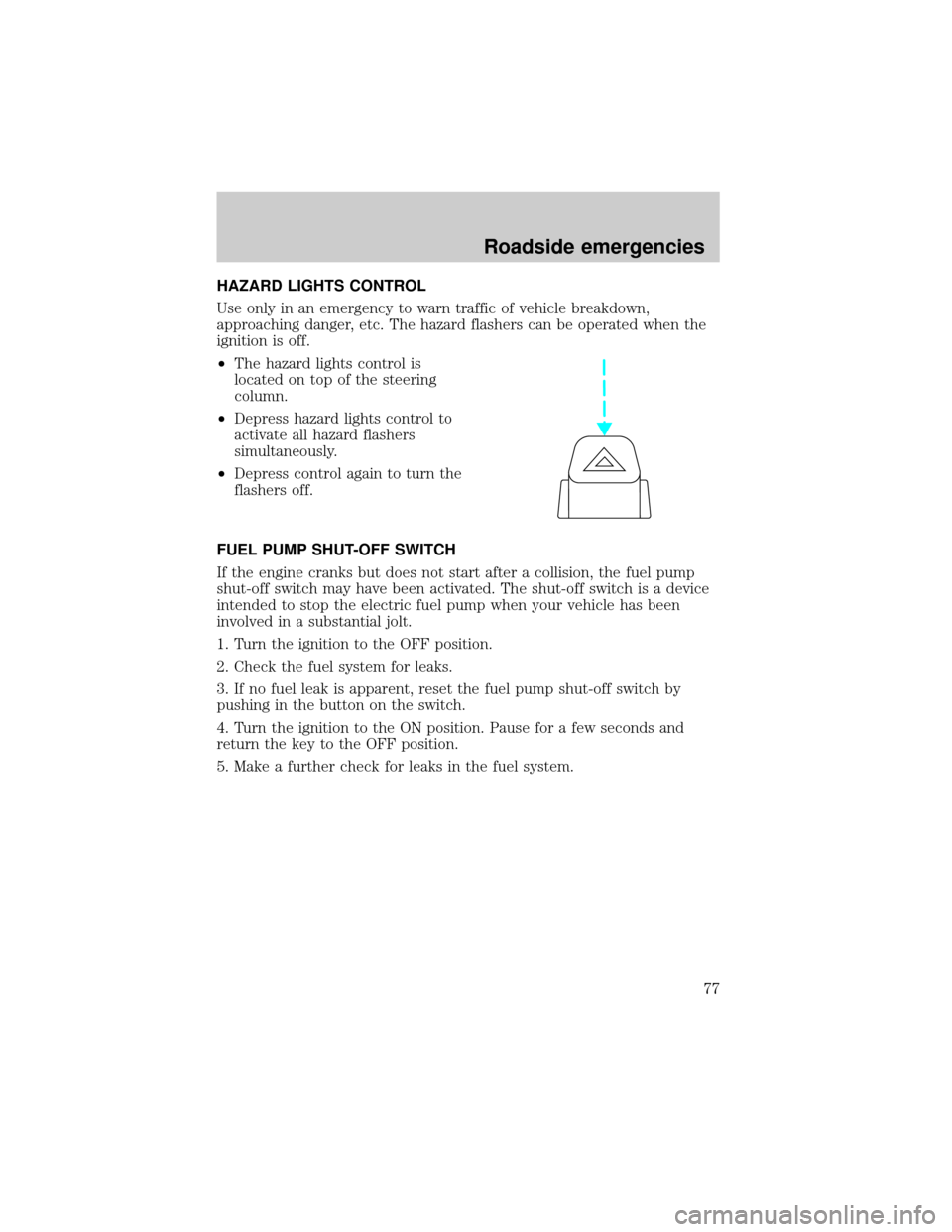
HAZARD LIGHTS CONTROL
Use only in an emergency to warn traffic of vehicle breakdown,
approaching danger, etc. The hazard flashers can be operated when the
ignition is off.
²The hazard lights control is
located on top of the steering
column.
²Depress hazard lights control to
activate all hazard flashers
simultaneously.
²Depress control again to turn the
flashers off.
FUEL PUMP SHUT-OFF SWITCH
If the engine cranks but does not start after a collision, the fuel pump
shut-off switch may have been activated. The shut-off switch is a device
intended to stop the electric fuel pump when your vehicle has been
involved in a substantial jolt.
1. Turn the ignition to the OFF position.
2. Check the fuel system for leaks.
3. If no fuel leak is apparent, reset the fuel pump shut-off switch by
pushing in the button on the switch.
4. Turn the ignition to the ON position. Pause for a few seconds and
return the key to the OFF position.
5. Make a further check for leaks in the fuel system.
Roadside emergencies
77
Page 79 of 144
FUSES AND RELAYS
Fuses
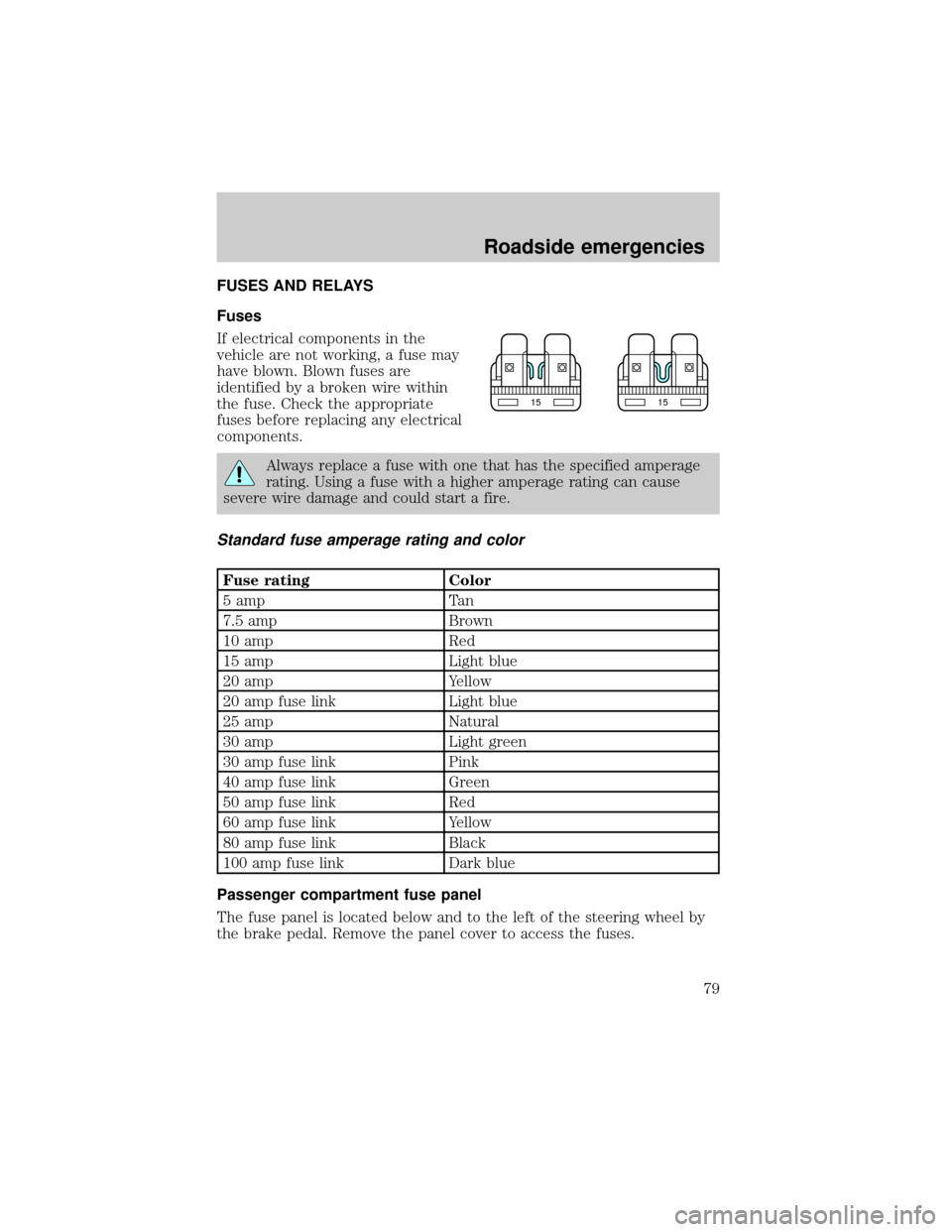
If electrical components in the
vehicle are not working, a fuse may
have blown. Blown fuses are
identified by a broken wire within
the fuse. Check the appropriate
fuses before replacing any electrical
components.
Always replace a fuse with one that has the specified amperage
rating. Using a fuse with a higher amperage rating can cause
severe wire damage and could start a fire.
Standard fuse amperage rating and color
Fuse rating Color
5 amp Tan
7.5 amp Brown
10 amp Red
15 amp Light blue
20 amp Yellow
20 amp fuse link Light blue
25 amp Natural
30 amp Light green
30 amp fuse link Pink
40 amp fuse link Green
50 amp fuse link Red
60 amp fuse link Yellow
80 amp fuse link Black
100 amp fuse link Dark blue
Passenger compartment fuse panel
The fuse panel is located below and to the left of the steering wheel by
the brake pedal. Remove the panel cover to access the fuses.
1515
Roadside emergencies
79
Page 80 of 144
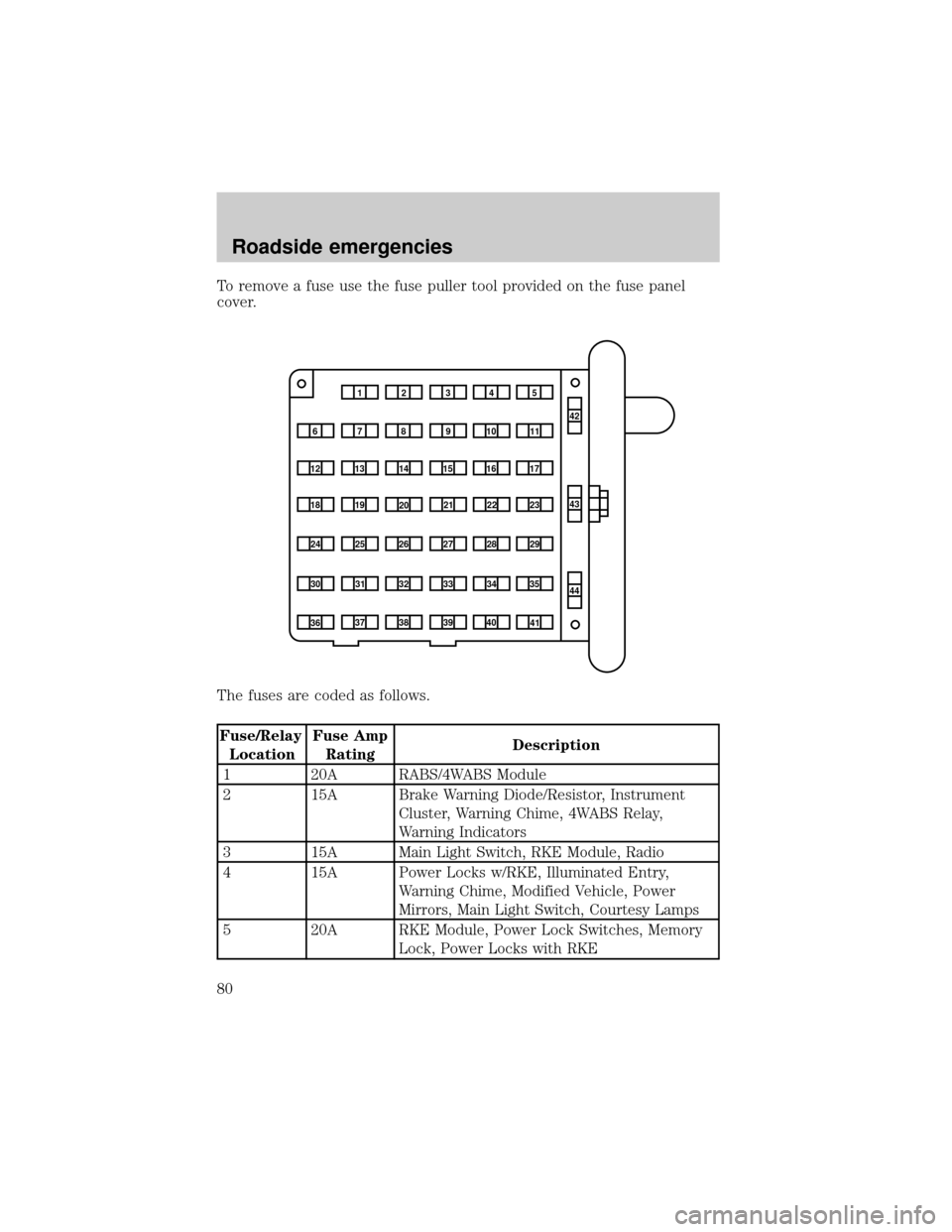
To remove a fuse use the fuse puller tool provided on the fuse panel
cover.
The fuses are coded as follows.
Fuse/Relay
LocationFuse Amp
RatingDescription
1 20A RABS/4WABS Module
2 15A Brake Warning Diode/Resistor, Instrument
Cluster, Warning Chime, 4WABS Relay,
Warning Indicators
3 15A Main Light Switch, RKE Module, Radio
4 15A Power Locks w/RKE, Illuminated Entry,
Warning Chime, Modified Vehicle, Power
Mirrors, Main Light Switch, Courtesy Lamps
5 20A RKE Module, Power Lock Switches, Memory
Lock, Power Locks with RKE
1234
5
7
689101142
43
44 13 12 14
15 16 17
19 18
2021 22 23
25 24
26 27 28 29
31 30 32 33 3435
37
3638 3940
41
Roadside emergencies
80
Page 81 of 144

Fuse/Relay
LocationFuse Amp
RatingDescription
6 10A Shift Interlock, Speed Control, DRL Module
7 10A Multi-Function Switch, Turn Signals
8 30A Radio Capacitor(s), Ignition Coil, PCM Diode,
PCM Power Relay, Fuel Heater, Glow Plug
Relay (Diesel)
9 30A Wiper Control Module, Windshield Wiper
Motor
10 20A Main Light Switch, (External Lamps)
Multi-Function Switch (Flash-to-pass)
11 15A Brake Pressure Switch, Multi-Function Switch
(Hazards), RABS, Brake Pedal Position
Switch
12 15A Transmission Range (TR) Sensor, Auxiliary
Battery Relay
13 15A Blend Door Actuator, Function Selector
Switch
14 5A Instrument Cluster (Air Bag and Charge
Indicator)
15 5A Trailer Battery Charge Relay
16 30A Power Seats
17 Ð Not Used
18 Ð Not Used
19 10A Air Bag Diagnostic Monitor
20 5A Overdrive Cancel Switch
21 30A Power Windows*
22 15A Memory Power Radio
23 20A Cigar Lighter, Data Link Connector (DLC)
24 5A Illuminated Entry Module
25 10A Left Headlamp (Low Beam)
26 - Not Used
27 5A Radio
28 25A Power Plug
Roadside emergencies
81
Page 84 of 144
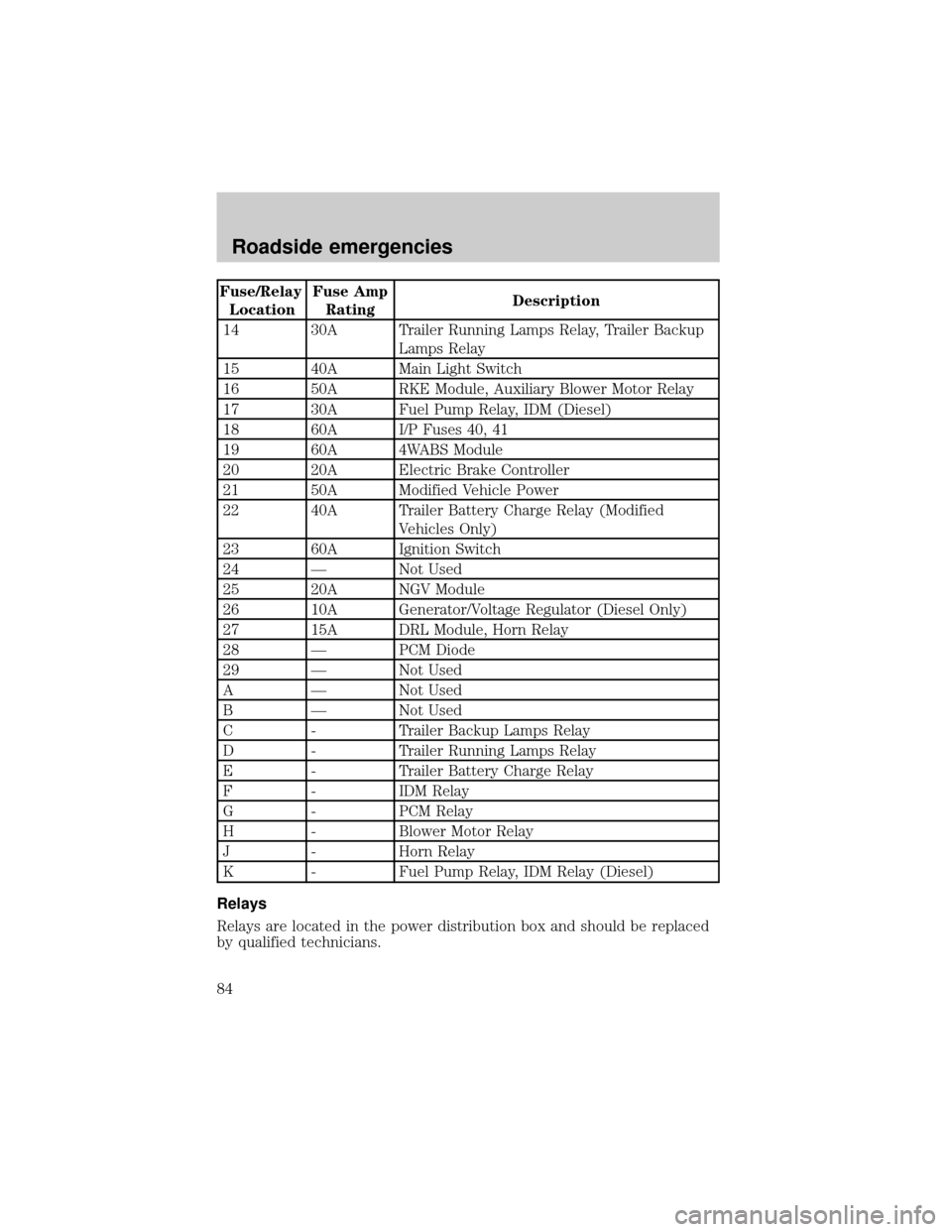
Fuse/Relay
LocationFuse Amp
RatingDescription
14 30A Trailer Running Lamps Relay, Trailer Backup
Lamps Relay
15 40A Main Light Switch
16 50A RKE Module, Auxiliary Blower Motor Relay
17 30A Fuel Pump Relay, IDM (Diesel)
18 60A I/P Fuses 40, 41
19 60A 4WABS Module
20 20A Electric Brake Controller
21 50A Modified Vehicle Power
22 40A Trailer Battery Charge Relay (Modified
Vehicles Only)
23 60A Ignition Switch
24 Ð Not Used
25 20A NGV Module
26 10A Generator/Voltage Regulator (Diesel Only)
27 15A DRL Module, Horn Relay
28 Ð PCM Diode
29 Ð Not Used
A Ð Not Used
B Ð Not Used
C - Trailer Backup Lamps Relay
D - Trailer Running Lamps Relay
E - Trailer Battery Charge Relay
F - IDM Relay
G - PCM Relay
H - Blower Motor Relay
J - Horn Relay
K - Fuel Pump Relay, IDM Relay (Diesel)
Relays
Relays are located in the power distribution box and should be replaced
by qualified technicians.
Roadside emergencies
84
Page 95 of 144

SERVICE RECOMMENDATIONS
To help you service your vehicle:
²We highlight do-it-yourself items in the engine compartment for easy
location.
²We provide a ªService Guideº which makes tracking routine service
easy.
If your vehicle requires professional service, your dealership can provide
necessary parts and service. Check your ªWarranty Guideº to find out
which parts and services are covered.
Use only recommended fuels, lubricants, fluids and service parts
conforming to specifications. Motorcraft parts are designed and built to
provide the best performance in your vehicle.
PRECAUTIONS WHEN SERVICING YOUR VEHICLE
Be especially careful when inspecting or servicing your vehicle.
²Do not work on a hot engine.
²When the engine is running, make sure that loose clothing, jewelry or
long hair does not get caught up in moving parts.
²Do not work on a vehicle with the engine running in an enclosed
space, unless you are sure you have enough ventilation.
²Keep all lit cigarettes, open flames and other lit material away from
the battery and all fuel related parts.
If you disconnect the battery, the engine must ªrelearnº its idle
conditions before your vehicle will drive properly, as explained inBattery
in this chapter.
Working with the engine off
1. Set the parking brake and ensure the gearshift is securely latched in P
(Park).
2. Turn off the engine and remove the key.
3. Block the wheels to prevent the vehicle from moving unexpectedly.
Maintenance and care
95
Page 101 of 144
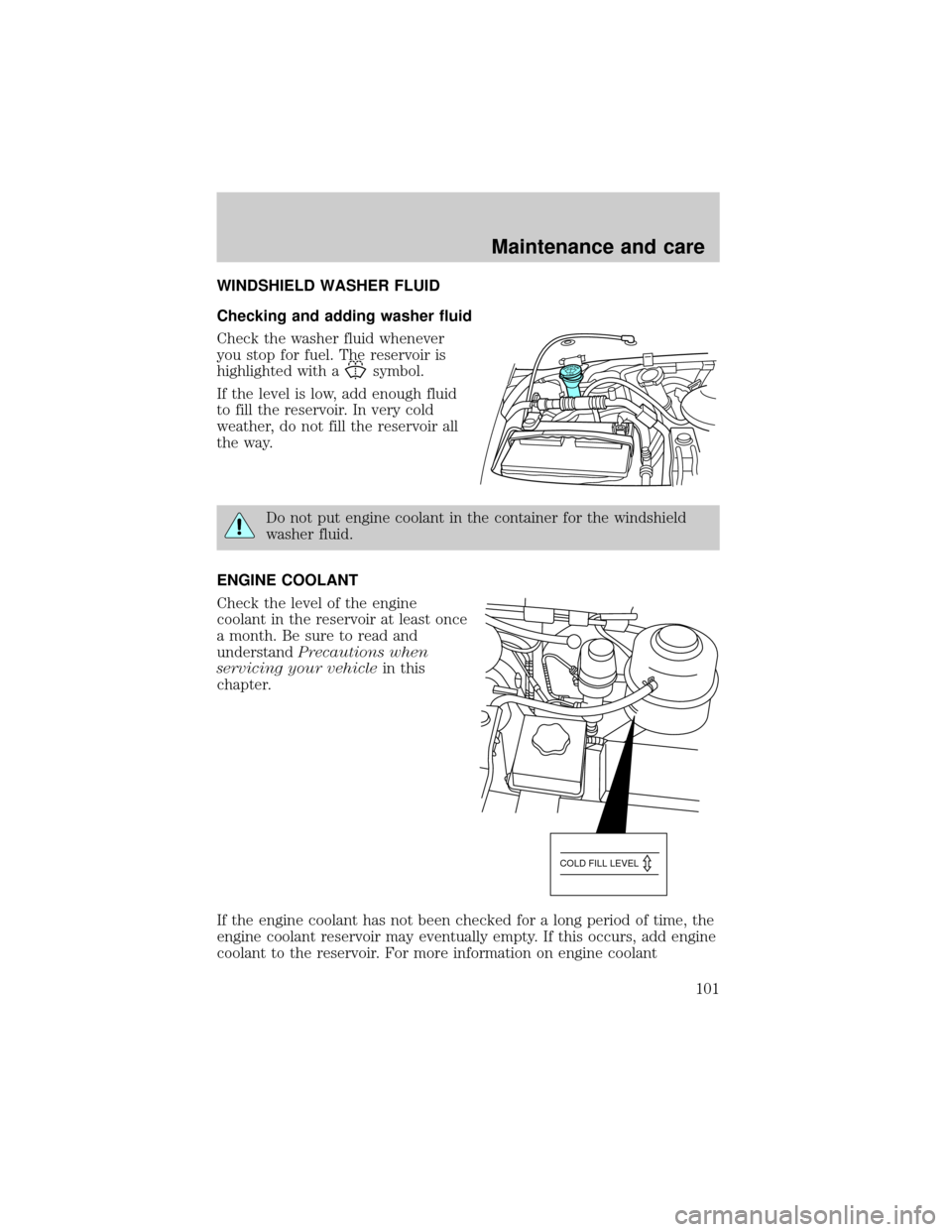
WINDSHIELD WASHER FLUID
Checking and adding washer fluid
Check the washer fluid whenever
you stop for fuel. The reservoir is
highlighted with a
symbol.
If the level is low, add enough fluid
to fill the reservoir. In very cold
weather, do not fill the reservoir all
the way.
Do not put engine coolant in the container for the windshield
washer fluid.
ENGINE COOLANT
Check the level of the engine
coolant in the reservoir at least once
a month. Be sure to read and
understandPrecautions when
servicing your vehiclein this
chapter.
If the engine coolant has not been checked for a long period of time, the
engine coolant reservoir may eventually empty. If this occurs, add engine
coolant to the reservoir. For more information on engine coolant
COLD FILL LEVEL
Maintenance and care
101
Page 104 of 144
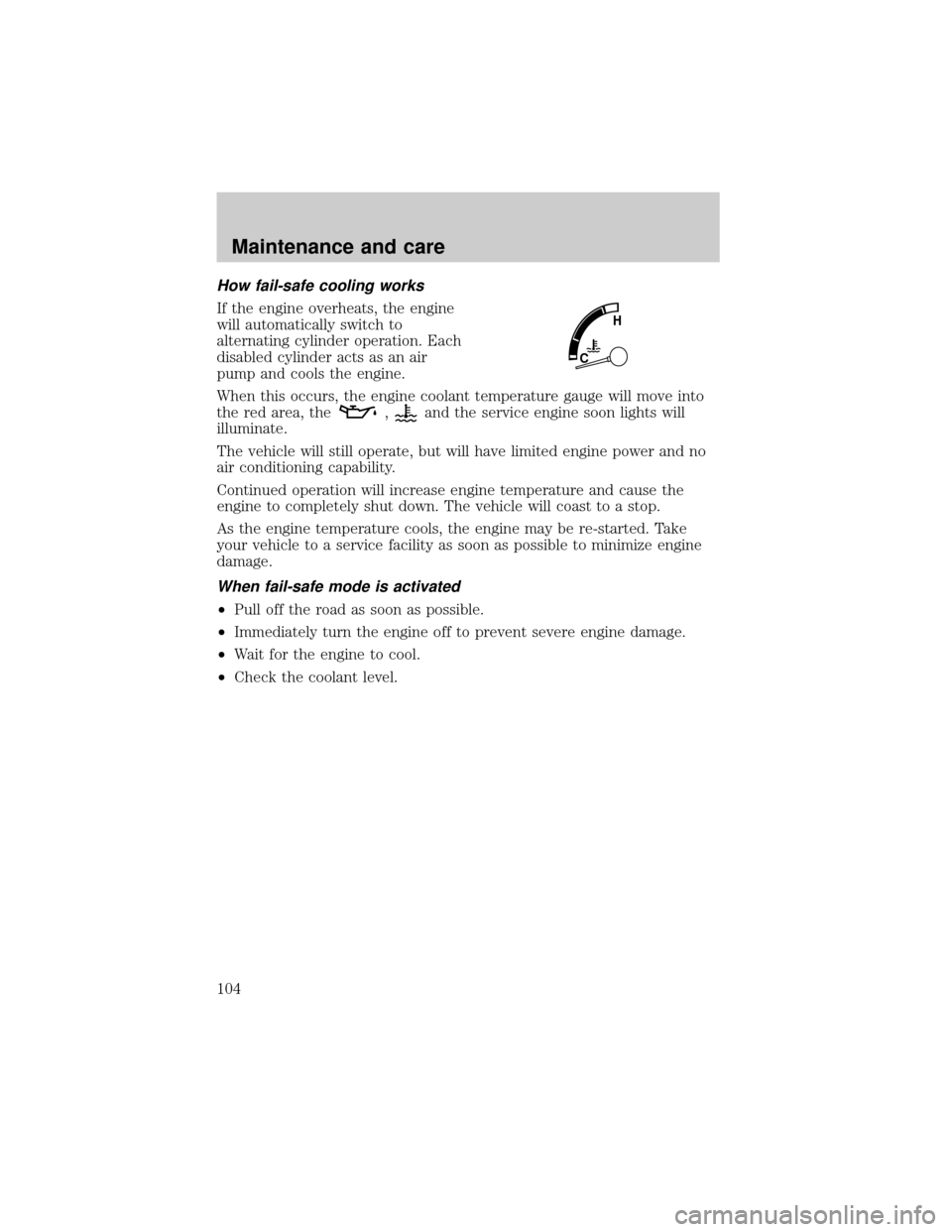
How fail-safe cooling works
If the engine overheats, the engine
will automatically switch to
alternating cylinder operation. Each
disabled cylinder acts as an air
pump and cools the engine.
When this occurs, the engine coolant temperature gauge will move into
the red area, the
,and the service engine soon lights will
illuminate.
The vehicle will still operate, but will have limited engine power and no
air conditioning capability.
Continued operation will increase engine temperature and cause the
engine to completely shut down. The vehicle will coast to a stop.
As the engine temperature cools, the engine may be re-started. Take
your vehicle to a service facility as soon as possible to minimize engine
damage.
When fail-safe mode is activated
²Pull off the road as soon as possible.
²Immediately turn the engine off to prevent severe engine damage.
²Wait for the engine to cool.
²Check the coolant level.
H
C
Maintenance and care
104