light FORD E SERIES 1998 4.G Owner's Guide
[x] Cancel search | Manufacturer: FORD, Model Year: 1998, Model line: E SERIES, Model: FORD E SERIES 1998 4.GPages: 144, PDF Size: 2.14 MB
Page 119 of 144
²Fuels can also be harmful if absorbed through the skin. If fuel is
splashed on the skin, promptly remove contaminated clothing and
wash skin thoroughly with soap and water.
²If fuel is splashed in the eyes, remove contact lenses, flush with water
for 15 minutes and seek medical attention.
²Be particularly careful if you are taking ªAntabuseº or other forms of
disulfiram for the treatment of alcoholism. Breathing gasoline vapors
or skin contact could cause an adverse reaction. Consult a physician
immediately.
Choosing the right fuel
Use only UNLEADED FUEL. The use of leaded fuel is prohibited by law
and could damage your vehicle.
Your vehicle was not designed to use fuel or fuel additives with metallic
compounds, including manganese-based compounds containing MMT.
Vehicles certified to California emission standards (indicated on the
underhood Vehicle Emissions Control Information label) are designed to
operate on California reformulated gasolines. If California reformulated
gasoline is not available when you refuel, your vehicle can be operated
on non-California fuels. However, even though your engine will perform
adequately on other gasolines, the performance of the emission control
devices and systems may be adversely affected.
Repair of damage caused by using a fuel that your vehicle was not
designed for may not be covered by your warranty.
Octane recommendations
Your vehicle is designed to use
ªRegularº unleaded with an (R+M)/2
octane rating of 87. We do not
recommend gasolines labeled as
ªRegularº in high altitude areas that
are sold with octane ratings of 86 or
even less.
Do not be concerned if your vehicle sometimes knocks lightly. However,
if it knocks heavily under most driving conditions on fuel with the
recommended octane, see your dealer or a qualified service technician to
prevent any engine damage.
87
Maintenance and care
119
Page 120 of 144

Fuel quality
If you are experiencing starting, rough idle or hesitation driveability
problems during a cold start, try a different brand of ªRegularº gasoline.
ªPremiumº gasoline is not recommended (particularly in the United
States) because it may cause these problems to become more
pronounced. If the problems persist, see your dealer or a qualified
service technician.
The American Automobile Manufacturers Association (AAMA) issued a
gasoline specification to provide information on high quality fuels that
optimize the performance of your vehicle. We recommend the use of
gasolines that meet the AAMA specification if they are available.
It should not be necessary to add any aftermarket products to your fuel
tank if you continue to use a high-quality fuel.
Cleaner air
Ford approves the use of gasolines to improve air quality, including
reformulated gasolines that contain oxygenates up to 10% ethanol or
15% MTBE.
Do not use gasolines containing methanol, which can damage critical fuel
system components. Damage resulting from the use of methanol may not
be covered by your warranty.
Running out of fuel
Avoid running out fuel because this situation may have an adverse affect
on modern powertrain components.
You may need to crank the engine several times before the system starts
to pump fuel from the tank to the engine. If you run out of fuel, your
Service Engine Soon light may come on. For more information on the
Service Engine Soon light, refer to theInstrumentationchapter.
Calculating fuel economy
To accurately calculate your vehicle's fuel economy:
1. Fill the tank completely and record the initial odometer reading.
2. Each time you fill the tank, record the amount of fuel added
(in liters or gallons).
3. After at least three to five fuel tank fill-ups, fill the fuel tank and
record the current mileage reading.
Maintenance and care
120
Page 121 of 144
4. Use one of the following equations to calculate fuel economy.
Liters used x 1004Total kilometers traveled
Total miles traveled4Total gallons used
Keep a record for at least one month. This will provide an accurate
estimate of the vehicle's fuel economy.
EMISSION CONTROL SYSTEM
Your vehicle is equipped with various emission control components and a
catalytic converter which will enable your vehicle to comply with
applicable exhaust emission standards. To make sure that the catalytic
converter and other emission control components continue to work
properly:
²Use only unleaded fuel.
²Avoid running out of fuel.
²Do not turn off the ignition while your vehicle is moving, especially at
high speeds.
²Have the services listed in your ªService Guideº performed according
to the specified schedule.
The Scheduled Maintenance Services listed in the ªService Guideº are
required because they are considered essential to the life and
performance of your vehicle and to its emissions system.
If other than Ford, Motorcraft or Ford authorized parts are used for
maintenance replacements or for service of components affecting
emission control such non-Ford parts should be equivalent to genuine
Ford Motor Company parts in performance and durability.
Do not park, idle, or drive your vehicle in dry grass or other dry
ground cover. The emission system heats up the engine
compartment and exhaust system, which can start a fire.
Watch for fluid leaks, strange odors, smoke, loss of oil pressure, the
charging system warning light, the ªService Engine Soonº light or the
temperature warning light. These events could indicate that the emission
control system is not working properly.
If you smell exhaust fumes of any kind inside your vehicle, have
the dealer inspect and fix your vehicle immediately. Do not drive
if you smell exhaust fumes. These fumes are harmful and could kill
you.
Maintenance and care
121
Page 122 of 144

Do not make any unauthorized changes to your vehicle or engine. By
law, vehicle owners and anyone who manufactures, repairs, services,
sells, leases, trades vehicles, or supervises a fleet of vehicles are not
permitted to intentionally remove an emission control device or prevent
it from working. Information about your vehicle's emission system is on
the Vehicle Emission Control Information Decal located on or near the
engine. This decal identifies engine displacement and gives some tune up
specifications.
Please consult your ªWarranty Guideº for complete emission warranty
information.
Readiness for inspection/maintenance (I/M) testing
In some localities, it may be a legal requirement to pass an I/M test of
the on-board diagnostic (OBD-II) system. If your ªcheck engine/service
engine soonº light is on, reference the applicable light description in the
Warning Lights and Chimessection of your owners guide. Your vehicle
may not pass the I/M test with the ªcheck engine/service engine soonº
light on.
If the vehicle's powertrain system or its battery has just been serviced,
the OBD-II system is reset to a ªnot ready for I/M testº condition. To
ready the OBD-II system for I/M testing, a minimum of 30 minutes of city
and highway driving is necessary as described below:
²First, at least 10 minutes of driving on an expressway or highway.
²Next, at least 20 minutes driving in stop and go, city type traffic with
at least four idle periods.
Allow the vehicle to sit for at least eight hours without starting the
engine. Then, start the engine and complete the above driving cycle. The
engine must warm up to its normal operating temperature. Once started,
do not turn off the engine until the above driving cycle is complete.
EXTERIOR BULBS
Replacing exterior bulbs
Check the operation of the following lamps frequently:
²Headlamps
²Tail lamps
²Brakelamps
²High-mount brakelamp
Maintenance and care
122
Page 125 of 144

USING THE RIGHT BULBS
Function Number of
bulbsTrade number
Headlamps (low series) 2 H6054
Headlamps (high series) 2 9007
Park lamp and turn signal (front) 2 3157 NAK
Back-up lamps 2 3156 K
License plate lamps 1 186
Stop/tail/side marker lamp 2 3357 K
Turn lamp (rear) 2 3156 K
High-mount brakelamp 2 912
Cargo lamp 1 211-2
Dome lamp (standard) 1 912
Map/reading lamp 2 211-2
To replace all instrument panel lights - see your dealer
AIMING THE HEADLAMPS
The alignment of your headlamps should be checked by a qualified
service technician if:
1. Oncoming motorists frequently signal you to deactivate your high
beams, and your high beams are not activated.
2. The headlamps do not seem to provide enough light for clear night
vision.
3. The headlamp beams are pointed substantially away from a slightly
down and to the right position.
CLEANING AND CARING FOR YOUR VEHICLE
Refer to the ªCustomer Assistance Guideº for a list of Ford-approved
cleaners, polishes and waxes.
Maintenance and care
125
Page 126 of 144
Washing your vehicle
Wash your vehicle regularly with
cold or lukewarm water. Never use
strong detergents or soap. If your
vehicle is particularly dirty, use a
quality car wash detergent. Always
use a clean sponge, washing glove
or similar device and plenty of water
for best results. To avoid spots,
avoid washing when the hood is still
warm, immediately after or during
exposure to strong sunlight.
During winter months, it is especially important to wash the vehicle on a
regular basis. Large quantities of dirt and road salt are difficult to
remove and also cause damage to the vehicle. Remove any exterior
accessories, such as antennas, before entering a car wash.
After washing, apply the brakes several times to dry them.
Waxing your vehicle
Wax when water stops beading on the surface. This could be every three
or four months, depending on operating conditions.
Use only carnauba or synthetic-based waxes. Remove any bugs and tar
before waxing vehicle. Use cleaning fluid or alcohol with a clean cloth to
remove. Use tar remover to remove any tar spots.
Repairing paint chips
Minor scratches or paint damage from road debris may be repaired with
touch-up paint, repair foil or aerosol paint spray from the Ford accessory
line. Observe the application instructions on the products.
Remove particles such as bird droppings, tree sap, insect remains, tar
spots, road salt and industrial fallout immediately.
Cleaning the wheels
Wash with the same detergent as the body of your vehicle. Do not use
acid-based wheel cleaners, steel wool, fuel or strong detergents. Never
use abrasives that will damage the finish of special wheel surfaces. Use a
tar remover to remove grease and tar.
Maintenance and care
126
Page 127 of 144
Cleaning the engine
Engines are more efficient when they are clean because grease and dirt
buildup keep the engine warmer than normal. When washing:
²Take care when using a power washer to clean the engine. The high
pressure fluid could penetrate the sealed parts and cause damage.
²Do not spray with cold water to avoid cracking the engine block or
other engine components.
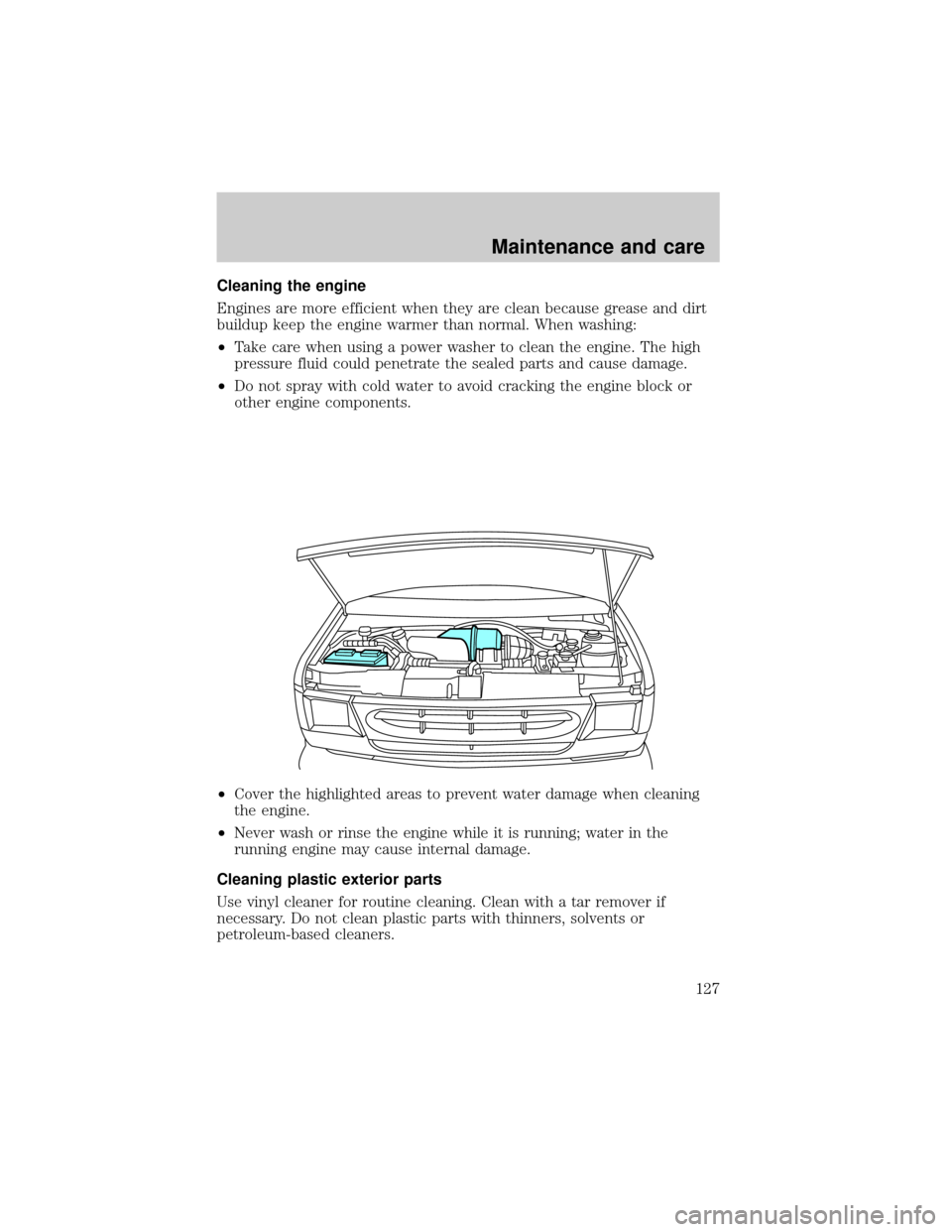
²Cover the highlighted areas to prevent water damage when cleaning
the engine.
²Never wash or rinse the engine while it is running; water in the
running engine may cause internal damage.
Cleaning plastic exterior parts
Use vinyl cleaner for routine cleaning. Clean with a tar remover if
necessary. Do not clean plastic parts with thinners, solvents or
petroleum-based cleaners.
Maintenance and care
127
Page 140 of 144

Aiming headlamps ....................125
Air bag supplemental
restraint system ..........................46
and child safety seats ..............47
description ................................46
disposal ......................................49
indicator light ...........................48
passenger air bag .....................47
Air conditioning
manual heating and air
conditioning system .......16,17,18
Anti-lock brake system (ABS)
description ................................64
Battery .......................................108
voltage gauge ............................12
Brake fluid
checking and adding ..............100
Brakes ..........................................63
anti-lock .....................................63
anti-lock brake system (ABS)
warning light .............................63
fluid, checking and adding ....100
Brake-shift interlock ...................65
Break-in period .............................2
Bulbs, replacing ........................122
headlamps ...............................123
specifications ..........................125
Changing a tire ...........................85
Child safety seats ........................51
Chime
headlamps on ..............................9
Cleaning your vehicle ...............125
engine compartment ..............127
fabric ........................................128
instrument panel ....................128
plastic parts ............................127
safety belts ..............................128
tail lamps .................................128
washing ....................................126
waxing .....................................126
wheels ......................................126
windows ..................................128Controls .......................................20
Emission control system ..........121
Engine ........................................134
check engine temperature
warning, message center .........96
service points ............................96
Engine block heater ...................61
Engine coolant
checking and adding .......101,102
disposal ....................................103
refill capacities ........................103
Engine oil ...............................97,99
changing oil and oil filter .........99
checking and adding ...........97,99
Exhaust fumes ............................62
Fail safe cooling ........................103
Fuel
calculating fuel economy .......120
improving fuel economy ..........76
octane rating ...........................119
quality ......................................120
running out of fuel .................120
safety information relating
to automotive fuels ................118
Fuel gauge ...................................10
Fuel pump shut-off switch .........77
Fuse panels
instrument panel ......................79
power distribution box .............82
Fuses ............................................79
Gauges, Mechanical ....................10
engine coolant temperature
gauge .........................................11
Hazard flashers ...........................77
Headlamps ...................................13
daytime running lights .............13
flashing ......................................14
high beam .................................13
Heating ........................................14
High beams
indicator light .............................9
Index
140
Page 141 of 144

Hood
release lever ..............................96
Ignition
positions of the ignition ...........21
Instrument panel
lighting up panel and interior .14
Jump-starting your vehicle ...91,93
attaching cables ........................92
disconnecting cables ................93
Keys
key in ignition chime .................9
Lamps
interior lamps ....................28,124
Lights, warning and indicator
air bag ..........................................8
anti-lock brakes (ABS) ..............6
brake ............................................6
charging system ..........................8
engine oil pressure .....................9
safety belt ...................................8
service engine soon .................6,7
turn signal indicator ...................8
Load limits
trailer towing ............................69
Lubricant specifications ...........132
Mirrors
side view mirrors (power) .......30
Odometer .....................................12
Overdrive .....................................27
Panic alarm feature, remote
entry system ................................31
Parking brake ..............................64
Parts (see Motorcraft parts) ....129
Power door locks ........................29
Power steering
fluid, checking and adding ....105
Refill capacities for fluids ........129
Relays .....................................79,84
Remote entry system .................30
illuminated entry .................33,34
locking/unlocking doors ......30,31replacement/additional
transmitters ...............................32
replacing the batteries .............31
Reporting safety defects ..........139
Safety restraints
extension assembly ..................44
for children ...............................49
lap and shoulder belts ...40,41,42
maintenance ..............................45
proper use .................................39
warning light and chime ..9,44,45
Safety seats for children
attaching with tether straps ....54
tether anchorage
hardware .........................54,55,57
Seats
adjusting the seat, manual .......34
adjusting the seat, power ........35
bench seat ............................36,37
lumbar support .........................36
quick release rear captain's
chair ......................................38,39
Servicing your vehicle ................95
precautions when servicing .....95
Snowplowing .................................3
Special notice
ambulance conversions ..............3
diesel-powered vehicles .............3
Speed control ..............................22
canceling a set speed ...............25
resuming a set speed ...............25
tap up/tap down ..................23,24
turning off .................................22
Speedometer ...............................10
Starting your vehicle .............59,61
Tilt steering wheel ......................26
Tires ....................................114,115
changing ...............................85,86
checking the pressure ............115
replacing .............................88,117
rotating ....................................115
snow tires and chains ............117
Index
141
Page 142 of 144

treadwear ................................114
Traction-lok rear axle ...............107
Trailer towing ..............................70
tips .............................................76
Transmission .............................106
automatic operation ..65,66,67,68
fluid, checking and adding
(automatic) .............................106
Transmission control indictor
light ................................................8
Trip odometer .............................12
Turn signal
lever ...........................................21
Vehicle Identification Number
(VIN) ..........................................137Vehicle loading ............................68
Ventilating your vehicle .............62
Warning chimes .............................6
Windows
power windows, operating .......29
Windshield washer fluid and
wipers
checking and adding fluid .....101
checking and replacing wiper
blades ......................................113
operation ...................................26
Wrecker towing ...........................94
Index
142