wheel FORD E SERIES 1998 4.G Owner's Manual
[x] Cancel search | Manufacturer: FORD, Model Year: 1998, Model line: E SERIES, Model: FORD E SERIES 1998 4.GPages: 144, PDF Size: 2.14 MB
Page 115 of 144
Temperature A B C
The temperature grades are A (the highest), B, and C, representing the
tire's resistance to the generation of heat and its ability to dissipate heat
when tested under controlled conditions on a specified indoor laboratory
test wheel. Sustained high temperature can cause the material of the tire
to degenerate and reduce tire life, and excessive temperature can lead to
sudden tire failure. The grade C corresponds to a level of performance
which all passenger car tires must meet under the Federal Motor Vehicle
Safety Standard No. 109. Grades B and A represent higher levels of
performance on the laboratory test wheel than the minimum required by
law.
The temperature grade for this tire is established for a tire that
is properly inflated and not overloaded. Excessive speed,
underinflation, or excessive loading, either separately or in
combination, can cause heat buildup and possible tire failure.
SERVICING YOUR TIRES
Checking the tire pressure
²Use an accurate tire pressure gauge.
²Check the tire pressure when tires are cold, after the vehicle has been
parked for at least one hour or has been driven less than 5 km
(3 miles).
²Adjust tire pressure to recommended specifications found on the Tire
Pressure Label.
Improperly inflated tires can affect vehicle handling and can fail
suddenly, possibly resulting in loss of vehicle control.
Tire rotation
Because your vehicle's tires perform different jobs, they often wear
differently. To make sure your tires wear evenly and last longer, rotate
them as indicated in the ªService Guide.º If you notice that the tires
wear unevenly, have them checked.
The following procedure applies to vehicles equipped with single rear
wheels, if your vehicle is equipped with dual rear wheels it is
recommended that only the front wheels be rotated (side to side).
Maintenance and care
115
Page 117 of 144
Replacing the tires
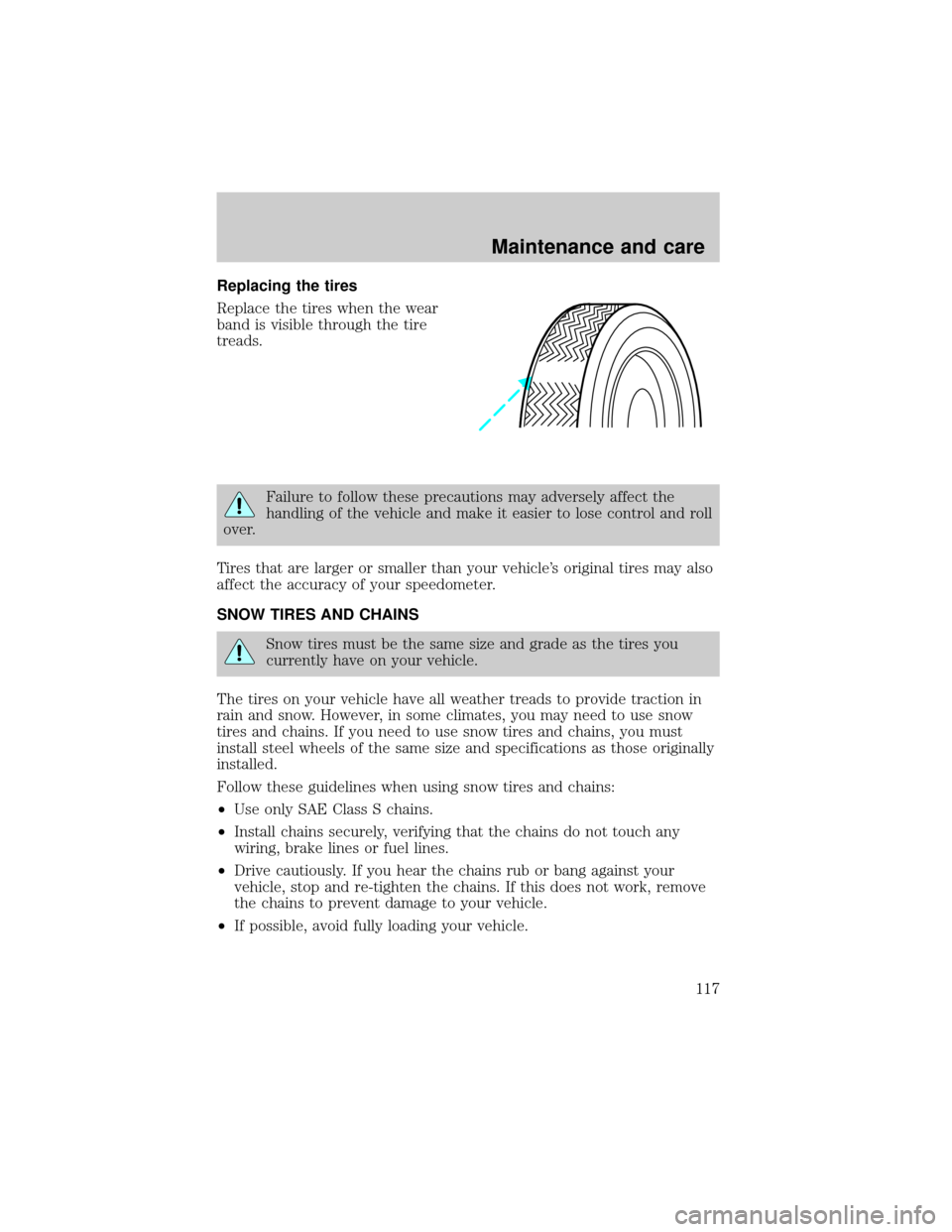
Replace the tires when the wear
band is visible through the tire
treads.
Failure to follow these precautions may adversely affect the
handling of the vehicle and make it easier to lose control and roll
over.
Tires that are larger or smaller than your vehicle's original tires may also
affect the accuracy of your speedometer.
SNOW TIRES AND CHAINS
Snow tires must be the same size and grade as the tires you
currently have on your vehicle.
The tires on your vehicle have all weather treads to provide traction in
rain and snow. However, in some climates, you may need to use snow
tires and chains. If you need to use snow tires and chains, you must
install steel wheels of the same size and specifications as those originally
installed.
Follow these guidelines when using snow tires and chains:
²Use only SAE Class S chains.
²Install chains securely, verifying that the chains do not touch any
wiring, brake lines or fuel lines.
²Drive cautiously. If you hear the chains rub or bang against your
vehicle, stop and re-tighten the chains. If this does not work, remove
the chains to prevent damage to your vehicle.
²If possible, avoid fully loading your vehicle.
Maintenance and care
117
Page 118 of 144
²Do not use tire chains on aluminum wheels. Chains may chip the
wheels.
²Remove the tire chains when they are no longer needed. Do not use
tire chains on dry roads.
²The suspension insulation and bumpers will help prevent vehicle
damage. Do not remove these components from your vehicle when
using snow tires and chains.
WHAT YOU SHOULD KNOW ABOUT AUTOMOTIVE FUELS
Important safety precautions
Do not overfill the fuel tank. The pressure in an overfilled tank
may cause leakage and lead to fuel spray and fire.
If you do not use the proper fuel cap, the pressure in the fuel
tank can damage the fuel system or cause it to work improperly
in a collision.
The fuel system may be under pressure. If the fuel cap is venting
vapor or if you hear a hissing sound, wait until it stops before
completely removing the cap.
Automotive fuels can cause serious injury or death if misused or
mishandled.
Observe the following guidelines when handling automotive fuel:
²Extinguish all smoking materials
and any open flames before
fueling your vehicle.
²Always turn off the vehicle before
fueling.
²Automotive fuels can be harmful
or fatal if swallowed. If fuel is
swallowed, call a physician
immediately, even if no symptoms
are immediately apparent. The
toxic effects of fuel may not be visible for hours.
Maintenance and care
118
Page 126 of 144

Washing your vehicle
Wash your vehicle regularly with
cold or lukewarm water. Never use
strong detergents or soap. If your
vehicle is particularly dirty, use a
quality car wash detergent. Always
use a clean sponge, washing glove
or similar device and plenty of water
for best results. To avoid spots,
avoid washing when the hood is still
warm, immediately after or during
exposure to strong sunlight.
During winter months, it is especially important to wash the vehicle on a
regular basis. Large quantities of dirt and road salt are difficult to
remove and also cause damage to the vehicle. Remove any exterior
accessories, such as antennas, before entering a car wash.
After washing, apply the brakes several times to dry them.
Waxing your vehicle
Wax when water stops beading on the surface. This could be every three
or four months, depending on operating conditions.
Use only carnauba or synthetic-based waxes. Remove any bugs and tar
before waxing vehicle. Use cleaning fluid or alcohol with a clean cloth to
remove. Use tar remover to remove any tar spots.
Repairing paint chips
Minor scratches or paint damage from road debris may be repaired with
touch-up paint, repair foil or aerosol paint spray from the Ford accessory
line. Observe the application instructions on the products.
Remove particles such as bird droppings, tree sap, insect remains, tar
spots, road salt and industrial fallout immediately.
Cleaning the wheels
Wash with the same detergent as the body of your vehicle. Do not use
acid-based wheel cleaners, steel wool, fuel or strong detergents. Never
use abrasives that will damage the finish of special wheel surfaces. Use a
tar remover to remove grease and tar.
Maintenance and care
126
Page 130 of 144

Fluid Ford Part
NameApplication Capacity
Rear axle
1Refer to
footnote 4Ford 8.8/9.75
inch
conventional and
Traction-Lok2.6-2.7L
(5.5-5.8 pints)1
Dana 9.75 inch
(M60-IU)3.0L
(6.3 pints)2
Dana 10.5 inch
(M70-2U)3.1L
(6.6 pints)2
Dana 10.5 inch
(M70-1HD)3.5L
(7.5 pints)2
Dana 11.25 inch
(model 80)3.5L
(7.5 pints)2
Fuel tank N/A All regular and
extended length
vans and wagons
with 138 inch
wheelbase132.4L
(35.0 gallons)
138 inch
wheelbase
(except E-Super
Duty)140.0L
(37.0 gallons)
158 inch
wheelbase
(except E-Super
Duty)140.0L
(37.0 gallons)
4
176 inch
wheelbase
(except E-Super
Duty)140.0L
(37.0 gallons)
158 inch and
176 inch
wheelbase
(E-Super Duty)208.0L
(55 .0 gallons)
Capacities and specifications
130
Page 135 of 144

Engine 6.8L V10 engine
Cubic inches 415
Horsepower 265 @ 4250 rpm
Torque 405 lbs.ft. @ 2750 rpm
Required fuel grade 87 octane
Firing order 1-6-5-10-2-7-3-8-4-9
Spark plug gap 1.3-1.4 mm (0.052-.056 inch
Ignition system EDIS
Compression ratio 9.0:1
VEHICLE DIMENSIONS
Van/wagon models
E-150 E-250 E-350
(1) Overall height 2 054.8 mm (80.9
in)2 118.4 mm
(83.4)2 136.1
(84.1 in)
(2) Track front/rear 1 762.8 mm (69.4 in)/ 1 701.8 mm (67.0 in)
(3) Overall width
(excluding mirrors)2 014.2 mm (79.3 in)
(4) Wheelbase 3 505 mm (138 in)
(5) Overall length Regular van, 5 379.7 mm (211.8 in) Supervan, 5
892.8 mm (232.0 in)
Capacities and specifications
135
Page 137 of 144

Cutaway/commercial stripped chassis models
E-250 E-350 E-Super Duty
(1) Overall
heightRefer to Body Builder for specifications
(2) Track
front/rear1 762.8 mm
(69.4 in)
1 701.8 mm
(67.0 in)1 762.8 mm
(69.4 in.)/SRW 1
701.8 mm (67.0 in.),
DRW 1 859.3 mm
(73.2 in.)1 762.8 mm
(69.4 in.)/1
973.6 mm
(77.7 in.)
(3) Overall
width
(excluding
mirrors)Refer to Body Builder for specifications.
(4) Wheelbase 3 149.6 mm
(124 in)3 505 mm
(138 in.)
4 013 mm
(158 in.)
4 470 mm
(176 in.)4 013 mm
(158 in.)
4 470 mm
(176 in.)
(5) Overall
lengthRefer to Body Builder for specifications.
VEHICLE IDENTIFICATION NUMBER
Complete Ford built vehicles
The vehicle identification number is attached to your vehicle in the
following places:
²On the metal tag attached to the top of the instrument panel on the
driver's side.
Capacities and specifications
137
Page 140 of 144

Aiming headlamps ....................125
Air bag supplemental
restraint system ..........................46
and child safety seats ..............47
description ................................46
disposal ......................................49
indicator light ...........................48
passenger air bag .....................47
Air conditioning
manual heating and air
conditioning system .......16,17,18
Anti-lock brake system (ABS)
description ................................64
Battery .......................................108
voltage gauge ............................12
Brake fluid
checking and adding ..............100
Brakes ..........................................63
anti-lock .....................................63
anti-lock brake system (ABS)
warning light .............................63
fluid, checking and adding ....100
Brake-shift interlock ...................65
Break-in period .............................2
Bulbs, replacing ........................122
headlamps ...............................123
specifications ..........................125
Changing a tire ...........................85
Child safety seats ........................51
Chime
headlamps on ..............................9
Cleaning your vehicle ...............125
engine compartment ..............127
fabric ........................................128
instrument panel ....................128
plastic parts ............................127
safety belts ..............................128
tail lamps .................................128
washing ....................................126
waxing .....................................126
wheels ......................................126
windows ..................................128Controls .......................................20
Emission control system ..........121
Engine ........................................134
check engine temperature
warning, message center .........96
service points ............................96
Engine block heater ...................61
Engine coolant
checking and adding .......101,102
disposal ....................................103
refill capacities ........................103
Engine oil ...............................97,99
changing oil and oil filter .........99
checking and adding ...........97,99
Exhaust fumes ............................62
Fail safe cooling ........................103
Fuel
calculating fuel economy .......120
improving fuel economy ..........76
octane rating ...........................119
quality ......................................120
running out of fuel .................120
safety information relating
to automotive fuels ................118
Fuel gauge ...................................10
Fuel pump shut-off switch .........77
Fuse panels
instrument panel ......................79
power distribution box .............82
Fuses ............................................79
Gauges, Mechanical ....................10
engine coolant temperature
gauge .........................................11
Hazard flashers ...........................77
Headlamps ...................................13
daytime running lights .............13
flashing ......................................14
high beam .................................13
Heating ........................................14
High beams
indicator light .............................9
Index
140
Page 141 of 144

Hood
release lever ..............................96
Ignition
positions of the ignition ...........21
Instrument panel
lighting up panel and interior .14
Jump-starting your vehicle ...91,93
attaching cables ........................92
disconnecting cables ................93
Keys
key in ignition chime .................9
Lamps
interior lamps ....................28,124
Lights, warning and indicator
air bag ..........................................8
anti-lock brakes (ABS) ..............6
brake ............................................6
charging system ..........................8
engine oil pressure .....................9
safety belt ...................................8
service engine soon .................6,7
turn signal indicator ...................8
Load limits
trailer towing ............................69
Lubricant specifications ...........132
Mirrors
side view mirrors (power) .......30
Odometer .....................................12
Overdrive .....................................27
Panic alarm feature, remote
entry system ................................31
Parking brake ..............................64
Parts (see Motorcraft parts) ....129
Power door locks ........................29
Power steering
fluid, checking and adding ....105
Refill capacities for fluids ........129
Relays .....................................79,84
Remote entry system .................30
illuminated entry .................33,34
locking/unlocking doors ......30,31replacement/additional
transmitters ...............................32
replacing the batteries .............31
Reporting safety defects ..........139
Safety restraints
extension assembly ..................44
for children ...............................49
lap and shoulder belts ...40,41,42
maintenance ..............................45
proper use .................................39
warning light and chime ..9,44,45
Safety seats for children
attaching with tether straps ....54
tether anchorage
hardware .........................54,55,57
Seats
adjusting the seat, manual .......34
adjusting the seat, power ........35
bench seat ............................36,37
lumbar support .........................36
quick release rear captain's
chair ......................................38,39
Servicing your vehicle ................95
precautions when servicing .....95
Snowplowing .................................3
Special notice
ambulance conversions ..............3
diesel-powered vehicles .............3
Speed control ..............................22
canceling a set speed ...............25
resuming a set speed ...............25
tap up/tap down ..................23,24
turning off .................................22
Speedometer ...............................10
Starting your vehicle .............59,61
Tilt steering wheel ......................26
Tires ....................................114,115
changing ...............................85,86
checking the pressure ............115
replacing .............................88,117
rotating ....................................115
snow tires and chains ............117
Index
141