tires FORD E SERIES 2002 4.G User Guide
[x] Cancel search | Manufacturer: FORD, Model Year: 2002, Model line: E SERIES, Model: FORD E SERIES 2002 4.GPages: 272, PDF Size: 2.6 MB
Page 249 of 272
Treadwear
The treadwear grade is a comparative rating based on the wear rate of
the tire when tested under controlled conditions on a specified
government test course. For example, a tire graded 150 would wear one
and one-half (1 1/2) times as well on the government course as a tire
graded 100. The relative performance of tires depends upon the actual
conditions of their use, however, and may depart significantly from the
norm due to variations in driving habits, service practices, and
differences in road characteristics and climate.
Traction AA A B C
The traction grades, from highest to lowest are AA, A, B, and C. The
grades represent the tire's ability to stop on wet pavement as measured
under controlled conditions on specified government test surfaces of
asphalt and concrete. A tire marked C may have poor traction
performance.
The traction grade assigned to this tire is based on
straight-ahead braking traction tests, and does not include
acceleration, cornering, hydroplaning or peak traction characteristics.
Temperature A B C
The temperature grades are A (the highest), B, and C, representing the
tire's resistance to the generation of heat and its ability to dissipate heat
when tested under controlled conditions on a specified indoor laboratory
test wheel. Sustained high temperature can cause the material of the tire
to degenerate and reduce tire life, and excessive temperature can lead to
sudden tire failure. The grade C corresponds to a level of performance
which all passenger car tires must meet under the Federal Motor Vehicle
Safety Standard No. 109. Grades B and A represent higher levels of
performance on the laboratory test wheel than the minimum required by
law.
The temperature grade for this tire is established for a tire that
is properly inflated and not overloaded. Excessive speed,
underinflation, or excessive loading, either separately or in
combination, can cause heat buildup and possible tire failure.
Maintenance and specifications
249
Page 250 of 272
SERVICING YOUR TIRES
Checking the tire pressure
²Use an accurate tire pressure gauge.
²Check the tire pressure when tires are cold, after the vehicle has been
parked for at least one hour or has been driven less than 5 km
(3 miles).
²Adjust tire pressure to recommended specifications found on the
Certification Label. Tire pressure information can also be found on the
Tire Information label located on the inside of the fuel filler door.
Improperly inflated tires can affect vehicle handling and can fail
suddenly, possibly resulting in loss of vehicle control.
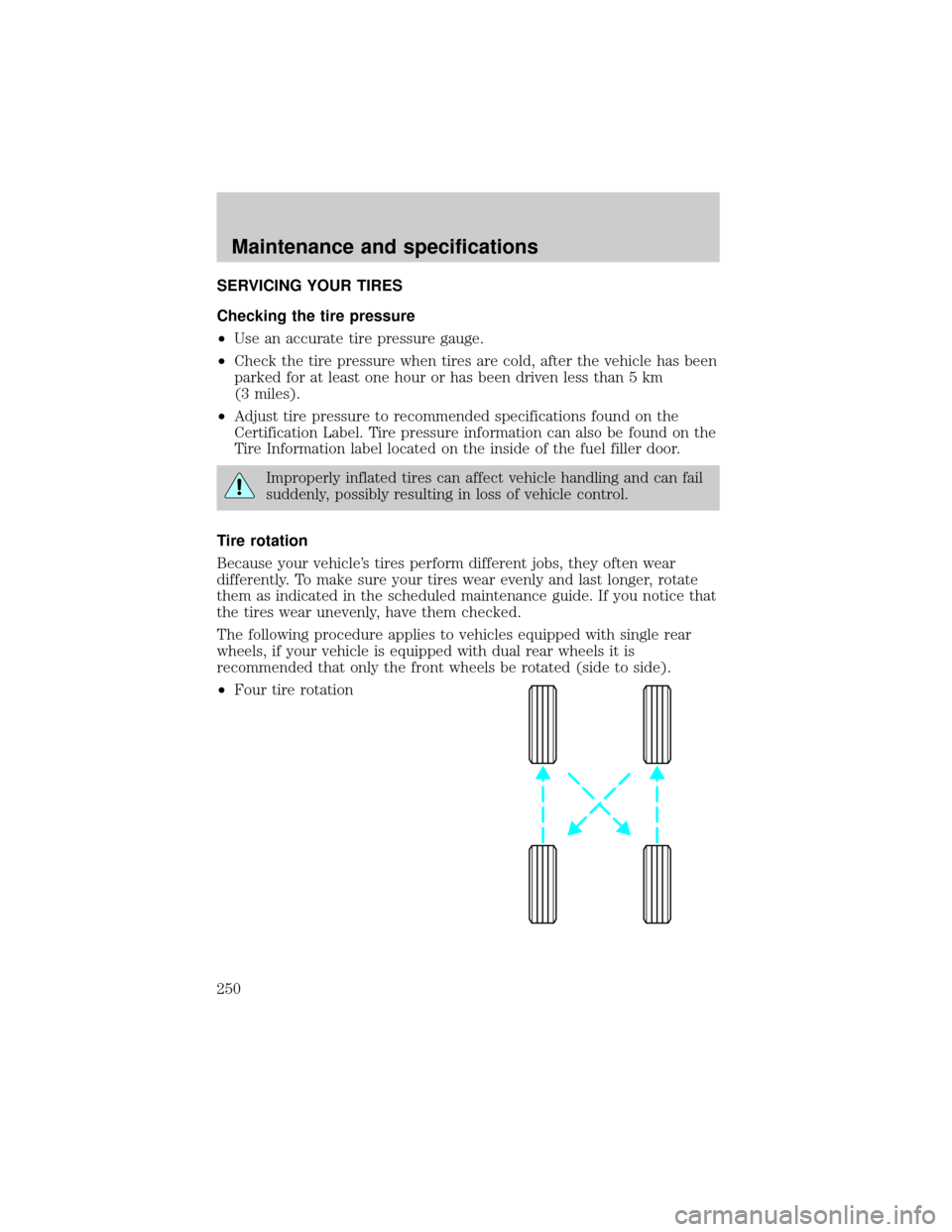
Tire rotation
Because your vehicle's tires perform different jobs, they often wear
differently. To make sure your tires wear evenly and last longer, rotate
them as indicated in the scheduled maintenance guide. If you notice that
the tires wear unevenly, have them checked.
The following procedure applies to vehicles equipped with single rear
wheels, if your vehicle is equipped with dual rear wheels it is
recommended that only the front wheels be rotated (side to side).
²Four tire rotation
Maintenance and specifications
250
Page 251 of 272
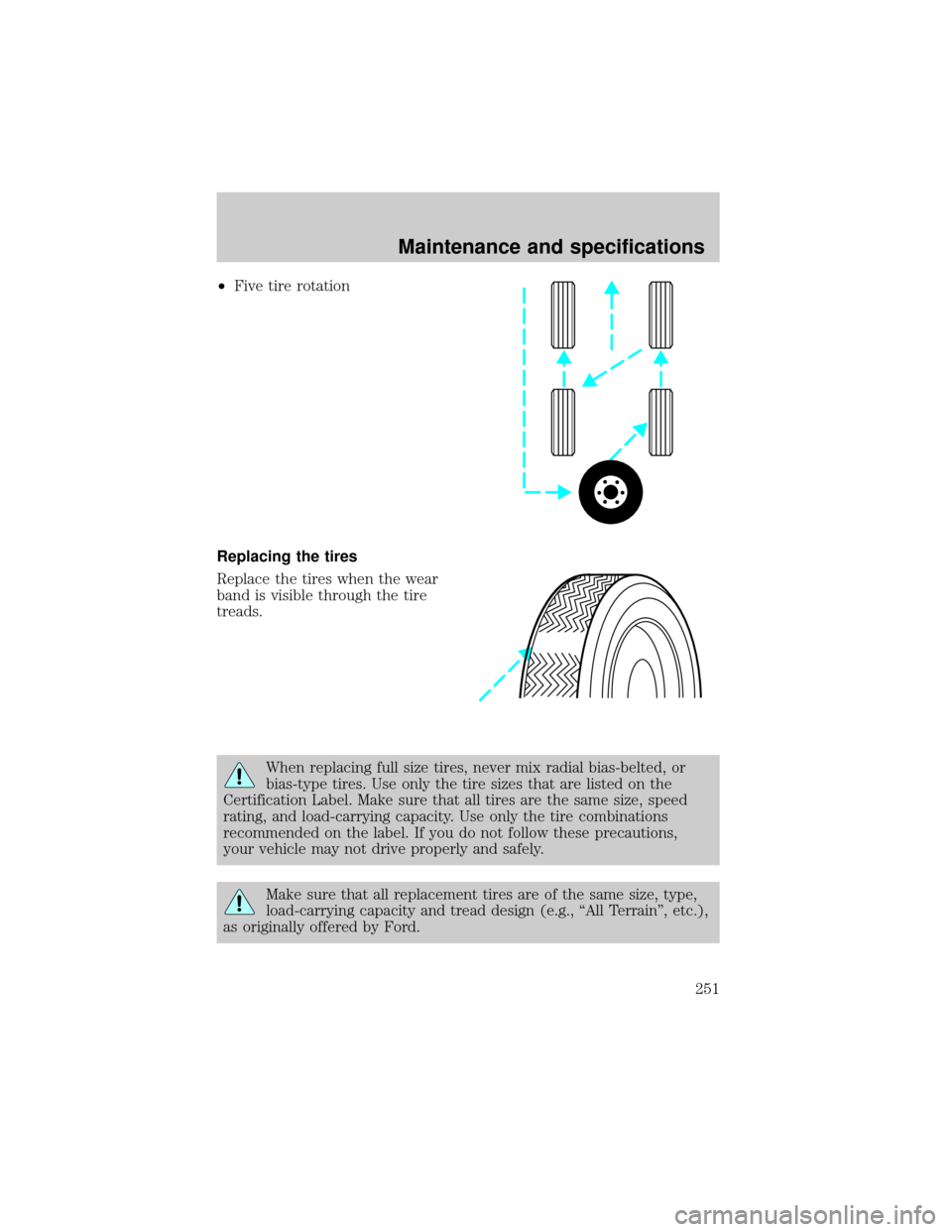
²Five tire rotation
Replacing the tires
Replace the tires when the wear
band is visible through the tire
treads.
When replacing full size tires, never mix radial bias-belted, or
bias-type tires. Use only the tire sizes that are listed on the
Certification Label. Make sure that all tires are the same size, speed
rating, and load-carrying capacity. Use only the tire combinations
recommended on the label. If you do not follow these precautions,
your vehicle may not drive properly and safely.
Make sure that all replacement tires are of the same size, type,
load-carrying capacity and tread design (e.g., ªAll Terrainº, etc.),
as originally offered by Ford.
Maintenance and specifications
251
Page 252 of 272
Do not replace your tires with ªhigh performanceº tires or larger
size tires.
Failure to follow these precautions may adversely affect the
handling of the vehicle and make it easier for the driver to lose
control and roll over.
Tires that are larger or smaller than your vehicle's original tires may also
affect the accuracy of your speedometer.
SNOW TIRES AND CHAINS
Snow tires must be the same size and grade as the tires you
currently have on your vehicle.
The tires on your vehicle have all weather treads to provide traction in
rain and snow. However, in some climates, you may need to use snow
tires and chains. If you need to use chains, it is recommended that steel
wheels (of the same size and specifications) be used as chains may chip
aluminum wheels.
Follow these guidelines when using snow tires and chains:
²Use only SAE Class S chains.
²Install chains securely, verifying that the chains do not touch any
wiring, brake lines or fuel lines.
²Drive cautiously. If you hear the chains rub or bang against your
vehicle, stop and re-tighten the chains. If this does not work, remove
the chains to prevent damage to your vehicle.
²If possible, avoid fully loading your vehicle.
²Remove the tire chains when they are no longer needed. Do not use
tire chains on dry roads.
²The suspension insulation and bumpers will help prevent vehicle
damage. Do not remove these components from your vehicle when
using snow tires and chains.
Maintenance and specifications
252
Page 271 of 272

P
Panic alarm feature, remote
entry system ..............................110
Parking brake ............................154
Parts (see Motorcraft parts) ....253
Power distribution box (see
Fuses) ........................................181
Power door locks ......................108
Power steering ..........................155
fluid, checking and adding ....243
fluid, refill capacity ................254
fluid, specifications .........258, 260
Preparing to drive your
vehicle ........................................156
R
Radio ............................................20
Relays ................................177, 184
Remote entry system .......109±110
illuminated entry ....................112
locking/unlocking
doors ................................108±110
panic alarm .............................110
replacement/additional
transmitters .............................111
replacing the batteries ...........110
S
Safety belts (see Safety
restraints) ....................16, 121±125
Safety defects, reporting ..........206
Safety restraints ................121±125
belt minder .............................127
cleaning the safety
belts .................................131, 212extension assembly ................131
for adults .........................122±124
for children .....................137±138
lap belt ....................................125
warning light and
chime ...................13, 15, 126±127
Safety seats for children ..........139
Seat belts (see Safety
restraints) ..................................121
Seats ..........................................113
child safety seats ....................139
Servicing your vehicle ..............214
Spark plugs,
specifications .............253, 260±261
Special notice
ambulance conversions ..............7
diesel-powered vehicles .............6
utility-type vehicles ....................7
Specification chart,
lubricants ...........................258, 260
Speed control ..............................98
Speedometer ...............................18
Starting your vehicle ........148±150
jump starting ..........................191
Steering wheel
controls ................................95, 98
tilting .........................................95
T
Temperature control (see
Climate control) ..........................78
Tires ...........................184, 248±250
changing ..........................184, 186
checking the pressure ............250
replacing ..........................187, 251
rotating ....................................250
Index
271
Page 272 of 272

snow tires and chains ............252
tire grades ...............................249
treadwear ................................249
Towing .......................................163
recreational towing .................172
trailer towing ..........................163
wrecker ....................................196
Traction-lok rear axle ...............155
Transmission .............................156
fluid, checking and adding
(automatic) .............................245
fluid, refill capacities ..............254
lubricant specifications ..258, 260
Transmission control indicator
light ..............................................15
Trip odometer .............................19
Trunk .........................................106
Turn signal ............................15, 86V
Vehicle dimensions ...................261
Vehicle Identification Number
(VIN) ..........................................263
Vehicle loading ..........................160
Ventilating your vehicle ...........152
W
Warning chimes .....................15±16
Warning lights (see Lights) .......12
Washer fluid ..............................217
Water, Driving through .............160
Windows
power .........................................96
Windshield washer fluid and
wipers
checking and adding fluid .....217
checking and cleaning ..............94
operation ...................................94
replacing wiper blades .............95
Wrecker towing .........................196
Index
272