warning FORD E SERIES 2003 4.G Owner's Manual
[x] Cancel search | Manufacturer: FORD, Model Year: 2003, Model line: E SERIES, Model: FORD E SERIES 2003 4.GPages: 232, PDF Size: 3.4 MB
Page 142 of 232
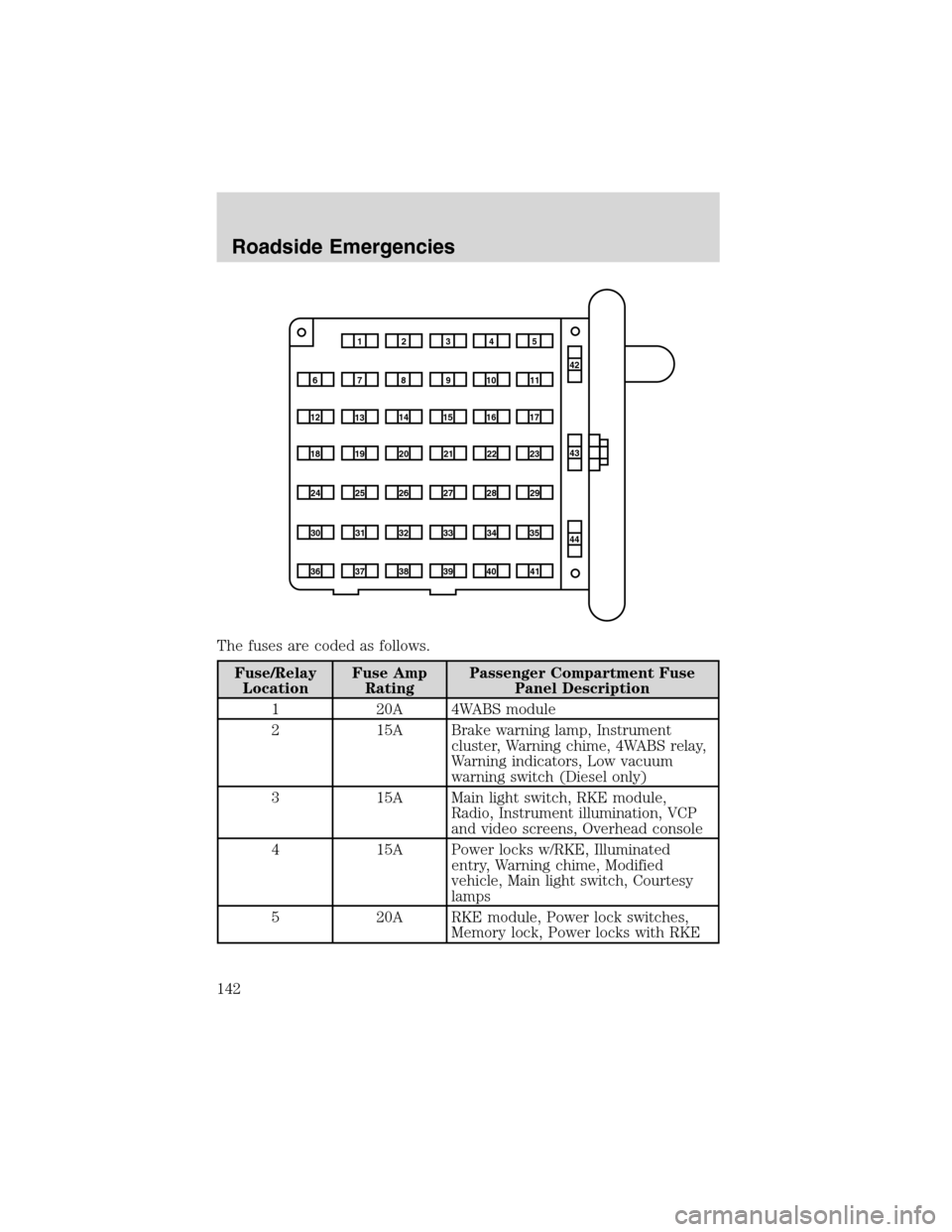
The fuses are coded as follows.
Fuse/Relay
LocationFuse Amp
RatingPassenger Compartment Fuse
Panel Description
1 20A 4WABS module
2 15A Brake warning lamp, Instrument
cluster, Warning chime, 4WABS relay,
Warning indicators, Low vacuum
warning switch (Diesel only)
3 15A Main light switch, RKE module,
Radio, Instrument illumination, VCP
and video screens, Overhead console
4 15A Power locks w/RKE, Illuminated
entry, Warning chime, Modified
vehicle, Main light switch, Courtesy
lamps
5 20A RKE module, Power lock switches,
Memory lock, Power locks with RKE
1234
5
7
689101142
43
44 13 12 14
15 16 17
19 18
2021 22 23
25 24
26 27 28 29
31 30 32 33 3435
37
3638 3940
41
Roadside Emergencies
142
Page 148 of 232
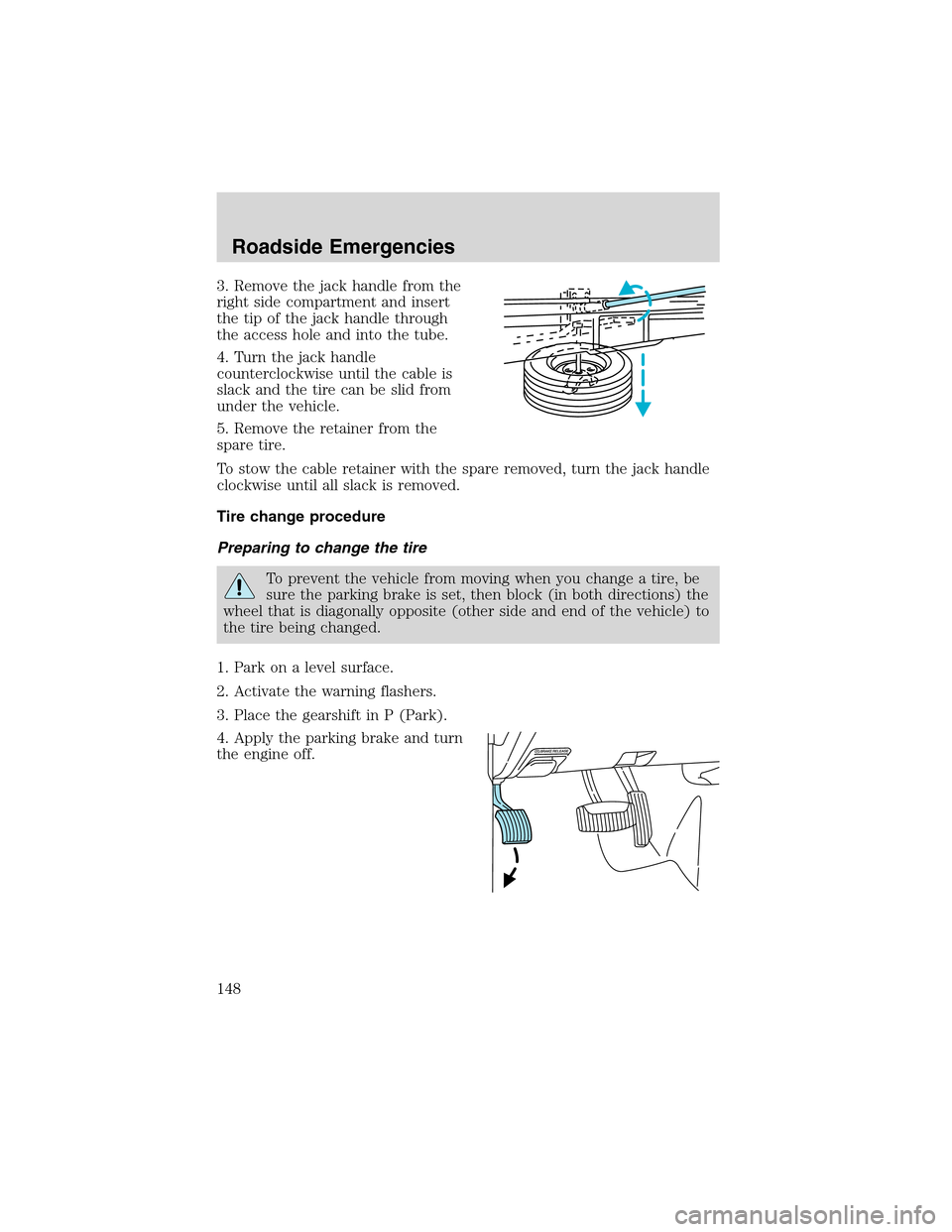
3. Remove the jack handle from the
right side compartment and insert
the tip of the jack handle through
the access hole and into the tube.
4. Turn the jack handle
counterclockwise until the cable is
slack and the tire can be slid from
under the vehicle.
5. Remove the retainer from the
spare tire.
To stow the cable retainer with the spare removed, turn the jack handle
clockwise until all slack is removed.
Tire change procedure
Preparing to change the tire
To prevent the vehicle from moving when you change a tire, be
sure the parking brake is set, then block (in both directions) the
wheel that is diagonally opposite (other side and end of the vehicle) to
the tire being changed.
1. Park on a level surface.
2. Activate the warning flashers.
3. Place the gearshift in P (Park).
4. Apply the parking brake and turn
the engine off.
Roadside Emergencies
148
Page 202 of 232
emission control, such non-Ford parts should be equivalent to genuine
Ford Motor Company parts in performance and durability.
Do not park, idle, or drive your vehicle in dry grass or other dry
ground cover. The emission system heats up the engine
compartment and exhaust system, which can start a fire.
Illumination of the“Service Engine Soon”light, charging system warning
light or the temperature warning light, fluid leaks, strange odors, smoke
or loss of engine power, could indicate that the emission control system
is not working properly.
Exhaust leaks may result in entry of harmful and potentially
lethal fumes into the passenger compartment.
Do not make any unauthorized changes to your vehicle or engine. By
law, vehicle owners and anyone who manufactures, repairs, services,
sells, leases, trades vehicles, or supervises a fleet of vehicles are not
permitted to intentionally remove an emission control device or prevent
it from working. Information about your vehicle’s emission system is on
the Vehicle Emission Control Information Decal located on or near the
engine. This decal identifies engine displacement and gives some tune up
specifications.
Please consult yourWarranty Guidefor complete emission warranty
information.
Readiness for Inspection/Maintenance (I/M) testing
In some localities, it may be a legal requirement to pass an I/M test of
the on-board diagnostics system. If your“Check Engine/Service Engine
Soon”light is on, refer to the description in theWarning lights and
chimessection of theInstrument clusterchapter. Your vehicle may not
pass the I/M test with the“Check Engine/Service Engine Soon”light on.
If the vehicle’s powertrain system or its battery has just been serviced,
the on-board diagnostics system is reset to a“not ready for I/M test”
condition. To ready the on-board diagnostics system for I/M testing, a
minimum of 30 minutes of city and highway driving is necessary as
described below:
•First, at least 10 minutes of driving on an expressway or highway.
•Next, at least 20 minutes driving in stop-and-go, city-type traffic with
at least four idle periods.
Allow the vehicle to sit for at least eight hours without starting the
engine. Then, start the engine and complete the above driving cycle. The
Maintenance and Specifications
202
Page 204 of 232
6. If the fluid is low, add fluid in small amounts, continuously checking
the level until it reaches the FULL COLD range. Be sure to put the
dipstick back in the reservoir.
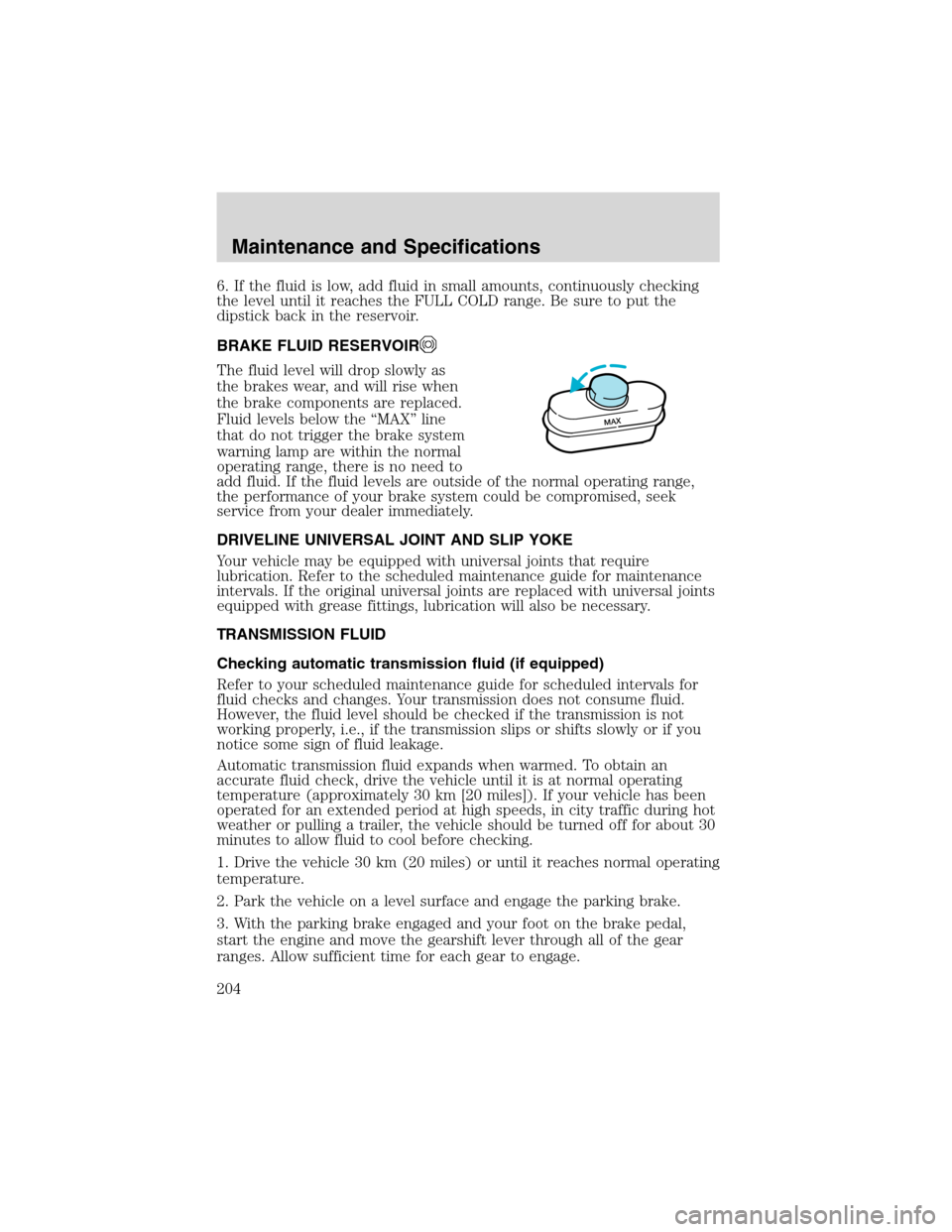
BRAKE FLUID RESERVOIR
The fluid level will drop slowly as
the brakes wear, and will rise when
the brake components are replaced.
Fluid levels below the“MAX”line
that do not trigger the brake system
warning lamp are within the normal
operating range, there is no need to
add fluid. If the fluid levels are outside of the normal operating range,
the performance of your brake system could be compromised, seek
service from your dealer immediately.
DRIVELINE UNIVERSAL JOINT AND SLIP YOKE
Your vehicle may be equipped with universal joints that require
lubrication. Refer to the scheduled maintenance guide for maintenance
intervals. If the original universal joints are replaced with universal joints
equipped with grease fittings, lubrication will also be necessary.
TRANSMISSION FLUID
Checking automatic transmission fluid (if equipped)
Refer to your scheduled maintenance guide for scheduled intervals for
fluid checks and changes. Your transmission does not consume fluid.
However, the fluid level should be checked if the transmission is not
working properly, i.e., if the transmission slips or shifts slowly or if you
notice some sign of fluid leakage.
Automatic transmission fluid expands when warmed. To obtain an
accurate fluid check, drive the vehicle until it is at normal operating
temperature (approximately 30 km [20 miles]). If your vehicle has been
operated for an extended period at high speeds, in city traffic during hot
weather or pulling a trailer, the vehicle should be turned off for about 30
minutes to allow fluid to cool before checking.
1. Drive the vehicle 30 km (20 miles) or until it reaches normal operating
temperature.
2. Park the vehicle on a level surface and engage the parking brake.
3. With the parking brake engaged and your foot on the brake pedal,
start the engine and move the gearshift lever through all of the gear
ranges. Allow sufficient time for each gear to engage.
MAX
Maintenance and Specifications
204
Page 209 of 232
SERVICING YOUR TIRES
Tire inflation information
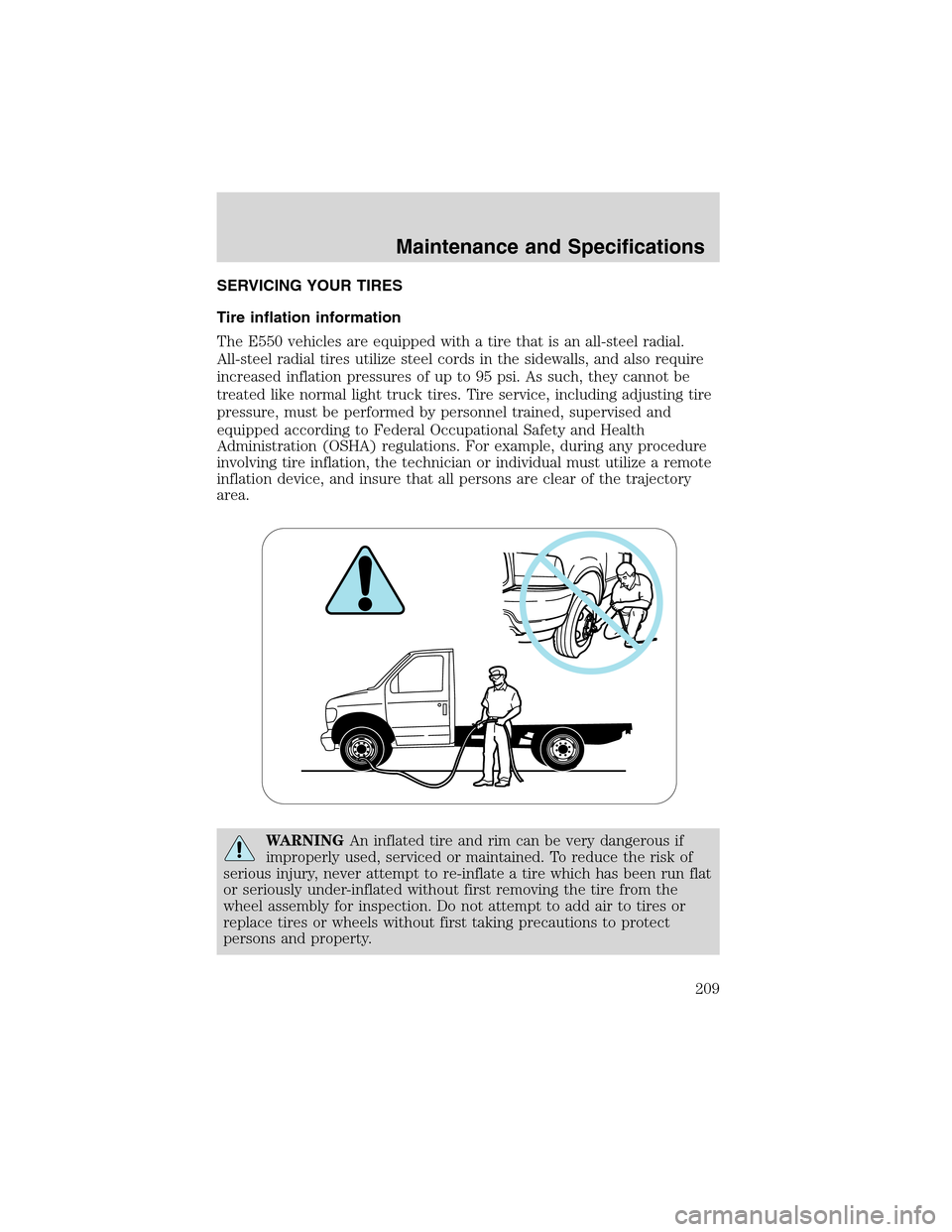
The E550 vehicles are equipped with a tire that is an all-steel radial.
All-steel radial tires utilize steel cords in the sidewalls, and also require
increased inflation pressures of up to 95 psi. As such, they cannot be
treated like normal light truck tires. Tire service, including adjusting tire
pressure, must be performed by personnel trained, supervised and
equipped according to Federal Occupational Safety and Health
Administration (OSHA) regulations. For example, during any procedure
involving tire inflation, the technician or individual must utilize a remote
inflation device, and insure that all persons are clear of the trajectory
area.
WARNINGAn inflated tire and rim can be very dangerous if
improperly used, serviced or maintained. To reduce the risk of
serious injury, never attempt to re-inflate a tire which has been run flat
or seriously under-inflated without first removing the tire from the
wheel assembly for inspection. Do not attempt to add air to tires or
replace tires or wheels without first taking precautions to protect
persons and property.
Maintenance and Specifications
209
Page 227 of 232
A
Air bag supplemental restraint
system ..........................................91
and child safety seats ..............93
description ................................91
disposal ......................................95
driver air bag ............................93
indicator light ...........................95
operation ...................................93
passenger air bag .....................93
Air cleaner filter ...............206, 212
Ambulance packages ....................6
Antifreeze (see Engine
coolant) .....................................187
Anti-lock brake system
(see Brakes) ......................114–115
Audio system
(see Radio) ................15, 17, 20, 24
Automatic transmission
driving an automatic
overdrive .................................118
fluid, adding ............................204
fluid, checking ........................204
fluid, refill capacities ..............213
fluid, specification ..................220
Auxiliary power point .................65
Axle
lubricant specifications ..217, 220
refill capacities ........................213
traction lok ..............................116
B
Battery .......................................182
acid, treating emergencies .....182
disconnecting ..........................184
jumping a disabled battery ....155
maintenance-free ....................182
replacement, specifications ...212servicing ..................................182
BeltMinder ...................................86
Brakes ........................................114
anti-lock ...........................114–115
anti-lock brake system (ABS)
warning light ...........................114
fluid, checking and adding ....204
fluid, refill capacities ..............213
fluid, specifications .........217, 220
lubricant specifications ..217, 220
parking ....................................115
shift interlock ..........................117
Break-in period .............................5
Bulbs ............................................55
C
Calculating load ........................124
Capacities for refilling fluids ....213
Cassette tape player ...................24
CD-single premium .........15, 17, 20
Cell phone use ............................65
Child safety restraints ................96
child safety belts ......................96
Child safety seats ........................99
in front seat ............................101
in rear seat ..............................101
tether anchorage hardware ...103
Cleaning your vehicle
engine compartment ..............171
exterior ....................................174
instrument panel ....................173
interior .....................................173
interior trim ............................173
plastic parts ............................172
washing ....................................170
waxing .....................................170
wheels ......................................171
Index
227
Page 230 of 232
L
Lamps
bulb replacement
specifications chart ..................55
cargo lamps ...............................54
daytime running light ...............53
headlamps .................................53
headlamps, flash to pass ..........54
instrument panel, dimming .....54
interior lamps ...........................55
replacing bulbs ...................55–60
Lane change indicator
(see Turn signal) ........................54
Lights, warning and indicator ....10
anti-lock brakes (ABS) ..........114
speed control ............................69
Load limits .................................122
GAWR ......................................122
GVWR ......................................122
trailer towing ..........................122
Loading instructions .................124
Lubricant specifications ...217, 220
Lumbar support, seats ...............76
M
Mirrors
fold away ...................................67
side view mirrors (power) .......66
Motorcraft parts ................198, 212
O
Octane rating ............................197
Oil (see Engine oil) ..................179
P
Parking brake ............................115Parts (see Motorcraft parts) ....212
Power distribution box (see
Fuses) ........................................144
Power door locks ........................71
Power point .................................65
Power steering ..........................115
fluid, checking and adding ....203
fluid, refill capacity ................213
fluid, specifications .........217, 220
Power Windows ...........................66
Preparing to drive your
vehicle ........................................116
R
Radio ..........................15, 17, 20, 24
Relays ................................140, 147
Remote entry system
illuminated entry ......................74
locking/unlocking doors ...........71
Roadside assistance ..................137
S
Safety belts (see Safety
restraints) ........................80, 82–85
Safety defects, reporting ..........169
Safety restraints ..............80, 82–85
belt minder ...............................86
cleaning the safety belts ..........90
extension assembly ..................90
for adults .............................82–84
for children .........................95–96
lap belt ......................................85
warning light and chime ..........86
Safety seats for children ............99
Seat belts (see Safety
restraints) ....................................80
Index
230
Page 231 of 232
Seats ............................................75
child safety seats ......................99
Servicing your vehicle ..............176
Spare tire (see Changing the
Tire) ...........................................147
Spark plugs,
specifications .....................212, 220
Special notice
ambulance conversions ..............6
diesel-powered vehicles .............6
utility-type vehicles ....................6
Specification chart,
lubricants ...........................217, 220
Speed control ..............................67
Starting your vehicle ........111–113
jump starting ..........................155
Steering wheel
tilting .........................................62
T
Temperature control
(see Climate control) ...........50, 52
Tires ...................................207–209
changing ..........................147–148
replacing ..........................150, 211
rotating ....................................210
snow tires and chains ............211
tire grades ...............................208
treadwear ................................207
Towing .......................................124
recreational towing .................136trailer towing ..........................124
wrecker ....................................160
Traction-lok rear axle ...............116
Transmission .............................117
fluid, checking and adding
(automatic) .............................204
fluid, refill capacities ..............213
lubricant specifications ..217, 220
Trunk ...........................................70
Turn signal ..................................54
V
Vehicle dimensions ...................220
Vehicle Identification Number
(VIN) ..........................................222
Vehicle loading ..........................122
Ventilating your vehicle ...........114
W
Warning lights (see Lights) .......10
Washer fluid ..............................178
Water, Driving through .............121
Windows
power .........................................66
Windshield washer fluid and
wipers ..........................................61
checking and adding fluid .....178
replacing wiper blades .............61
Wrecker towing .........................160
Index
231