weight FORD E SERIES 2005 4.G User Guide
[x] Cancel search | Manufacturer: FORD, Model Year: 2005, Model line: E SERIES, Model: FORD E SERIES 2005 4.GPages: 248, PDF Size: 5.53 MB
Page 136 of 248
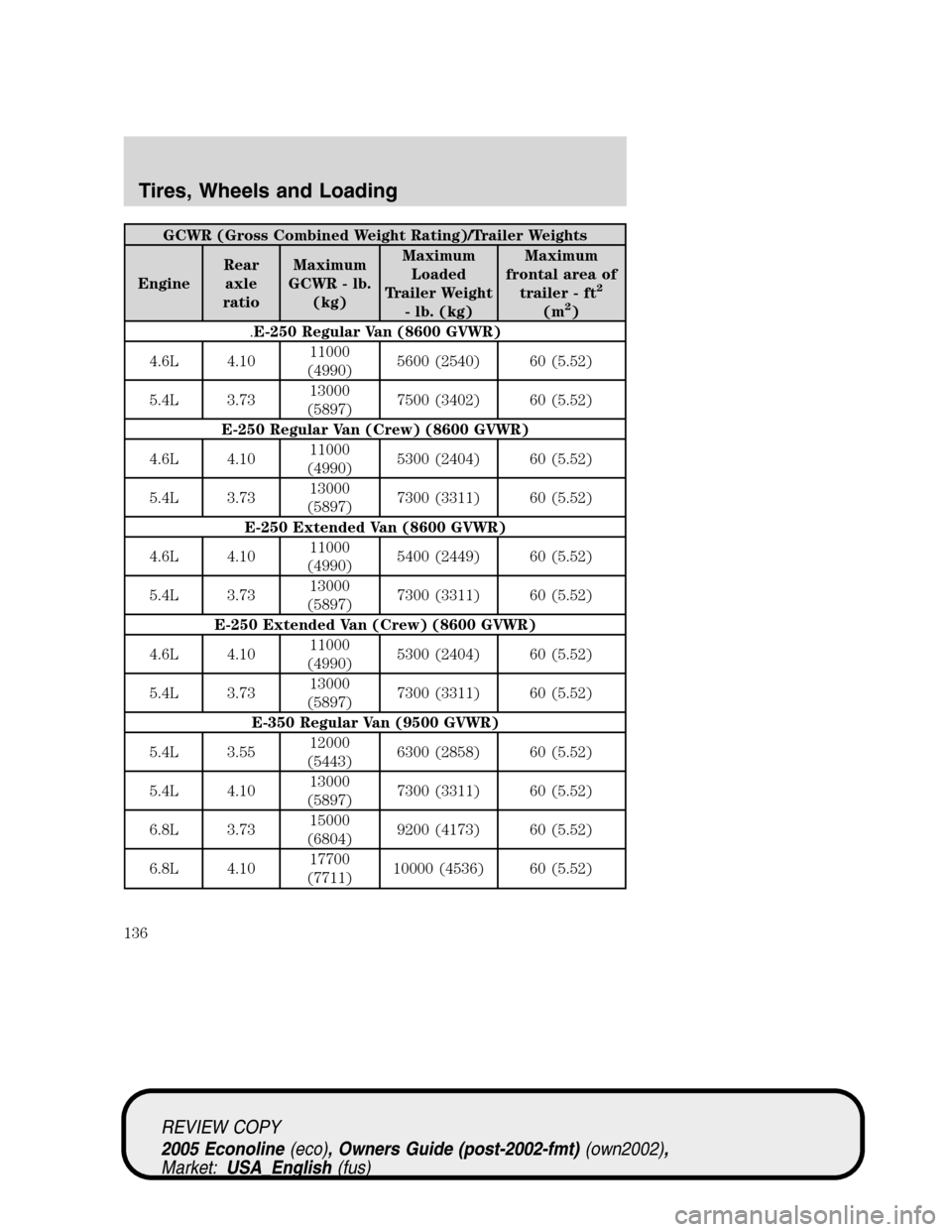
GCWR (Gross Combined Weight Rating)/Trailer Weights
EngineRear
axle
ratioMaximum
GCWR - lb.
(kg)Maximum
Loaded
Trailer Weight
- lb. (kg)Maximum
frontal area of
trailer - ft
2
(m2)
.E-250 Regular Van (8600 GVWR)
4.6L 4.1011000
(4990)5600 (2540) 60 (5.52)
5.4L 3.7313000
(5897)7500 (3402) 60 (5.52)
E-250 Regular Van (Crew) (8600 GVWR)
4.6L 4.1011000
(4990)5300 (2404) 60 (5.52)
5.4L 3.7313000
(5897)7300 (3311) 60 (5.52)
E-250 Extended Van (8600 GVWR)
4.6L 4.1011000
(4990)5400 (2449) 60 (5.52)
5.4L 3.7313000
(5897)7300 (3311) 60 (5.52)
E-250 Extended Van (Crew) (8600 GVWR)
4.6L 4.1011000
(4990)5300 (2404) 60 (5.52)
5.4L 3.7313000
(5897)7300 (3311) 60 (5.52)
E-350 Regular Van (9500 GVWR)
5.4L 3.5512000
(5443)6300 (2858) 60 (5.52)
5.4L 4.1013000
(5897)7300 (3311) 60 (5.52)
6.8L 3.7315000
(6804)9200 (4173) 60 (5.52)
6.8L 4.1017700
(7711)10000 (4536) 60 (5.52)
REVIEW COPY
2005 Econoline(eco), Owners Guide (post-2002-fmt)(own2002),
Market:USA_English(fus)
Tires, Wheels and Loading
136
Page 137 of 248
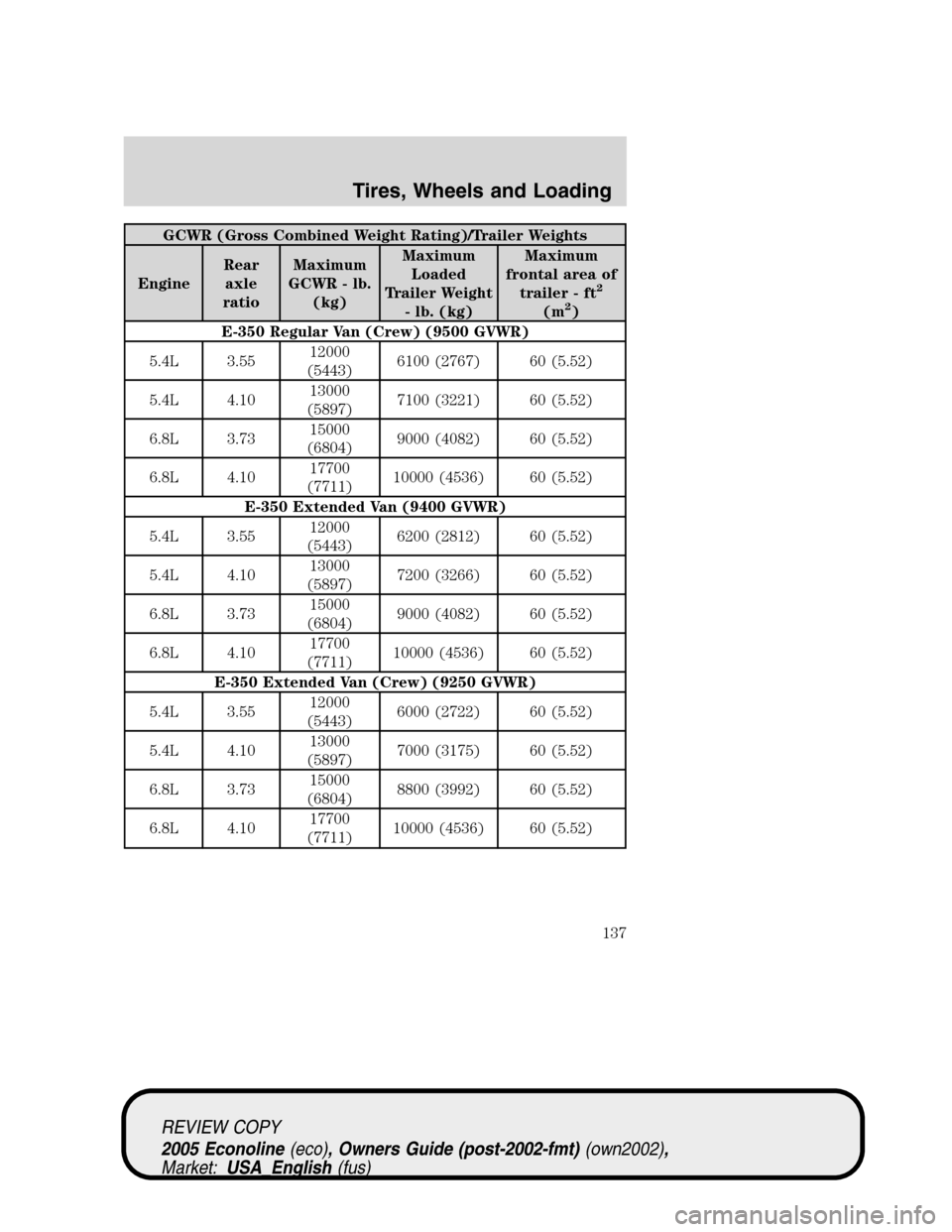
GCWR (Gross Combined Weight Rating)/Trailer Weights
EngineRear
axle
ratioMaximum
GCWR - lb.
(kg)Maximum
Loaded
Trailer Weight
- lb. (kg)Maximum
frontal area of
trailer - ft
2
(m2)
E-350 Regular Van (Crew) (9500 GVWR)
5.4L 3.5512000
(5443)6100 (2767) 60 (5.52)
5.4L 4.1013000
(5897)7100 (3221) 60 (5.52)
6.8L 3.7315000
(6804)9000 (4082) 60 (5.52)
6.8L 4.1017700
(7711)10000 (4536) 60 (5.52)
E-350 Extended Van (9400 GVWR)
5.4L 3.5512000
(5443)6200 (2812) 60 (5.52)
5.4L 4.1013000
(5897)7200 (3266) 60 (5.52)
6.8L 3.7315000
(6804)9000 (4082) 60 (5.52)
6.8L 4.1017700
(7711)10000 (4536) 60 (5.52)
E-350 Extended Van (Crew) (9250 GVWR)
5.4L 3.5512000
(5443)6000 (2722) 60 (5.52)
5.4L 4.1013000
(5897)7000 (3175) 60 (5.52)
6.8L 3.7315000
(6804)8800 (3992) 60 (5.52)
6.8L 4.1017700
(7711)10000 (4536) 60 (5.52)
REVIEW COPY
2005 Econoline(eco), Owners Guide (post-2002-fmt)(own2002),
Market:USA_English(fus)
Tires, Wheels and Loading
137
Page 138 of 248
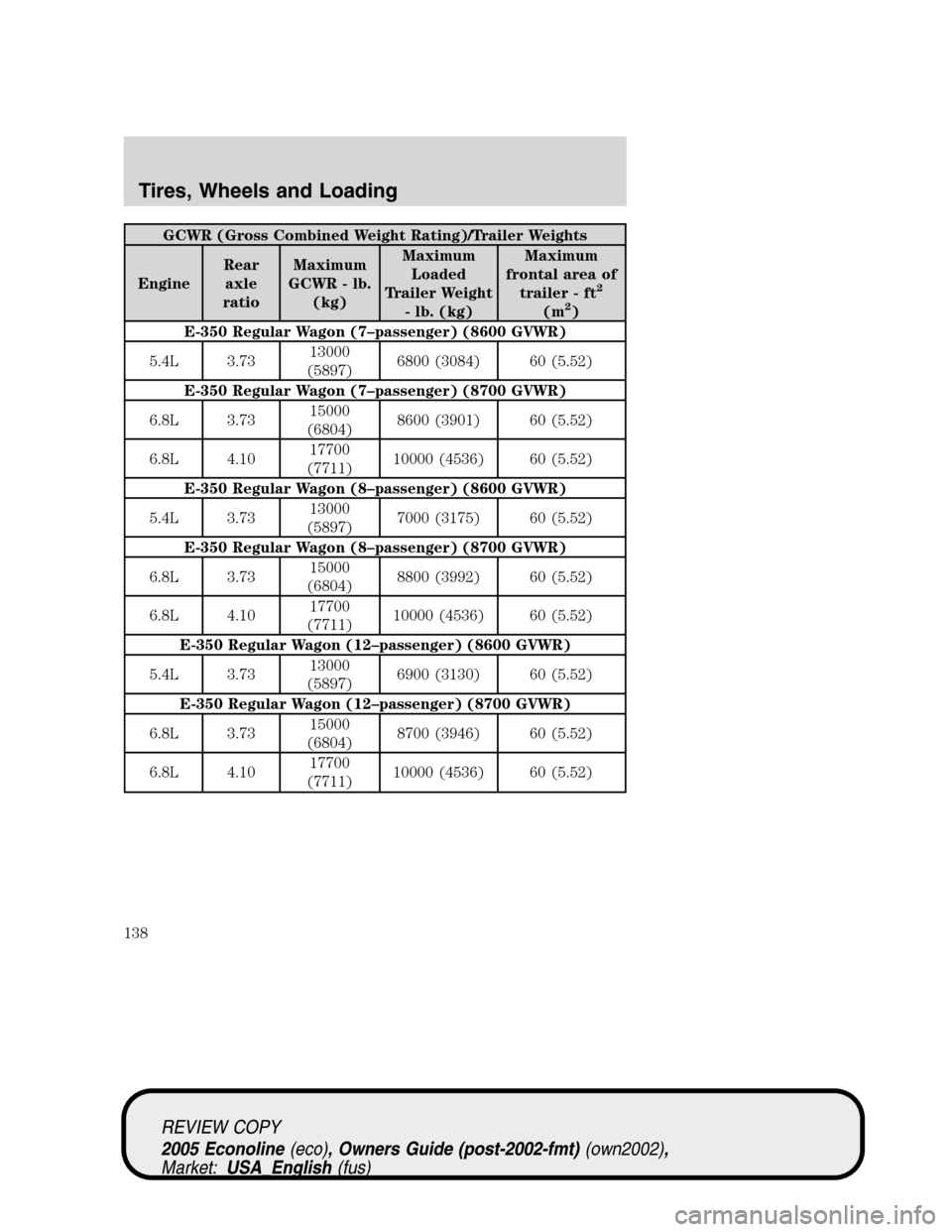
GCWR (Gross Combined Weight Rating)/Trailer Weights
EngineRear
axle
ratioMaximum
GCWR - lb.
(kg)Maximum
Loaded
Trailer Weight
- lb. (kg)Maximum
frontal area of
trailer - ft
2
(m2)
E-350 Regular Wagon (7–passenger) (8600 GVWR)
5.4L 3.7313000
(5897)6800 (3084) 60 (5.52)
E-350 Regular Wagon (7–passenger) (8700 GVWR)
6.8L 3.7315000
(6804)8600 (3901) 60 (5.52)
6.8L 4.1017700
(7711)10000 (4536) 60 (5.52)
E-350 Regular Wagon (8–passenger) (8600 GVWR)
5.4L 3.7313000
(5897)7000 (3175) 60 (5.52)
E-350 Regular Wagon (8–passenger) (8700 GVWR)
6.8L 3.7315000
(6804)8800 (3992) 60 (5.52)
6.8L 4.1017700
(7711)10000 (4536) 60 (5.52)
E-350 Regular Wagon (12–passenger) (8600 GVWR)
5.4L 3.7313000
(5897)6900 (3130) 60 (5.52)
E-350 Regular Wagon (12–passenger) (8700 GVWR)
6.8L 3.7315000
(6804)8700 (3946) 60 (5.52)
6.8L 4.1017700
(7711)10000 (4536) 60 (5.52)
REVIEW COPY
2005 Econoline(eco), Owners Guide (post-2002-fmt)(own2002),
Market:USA_English(fus)
Tires, Wheels and Loading
138
Page 139 of 248
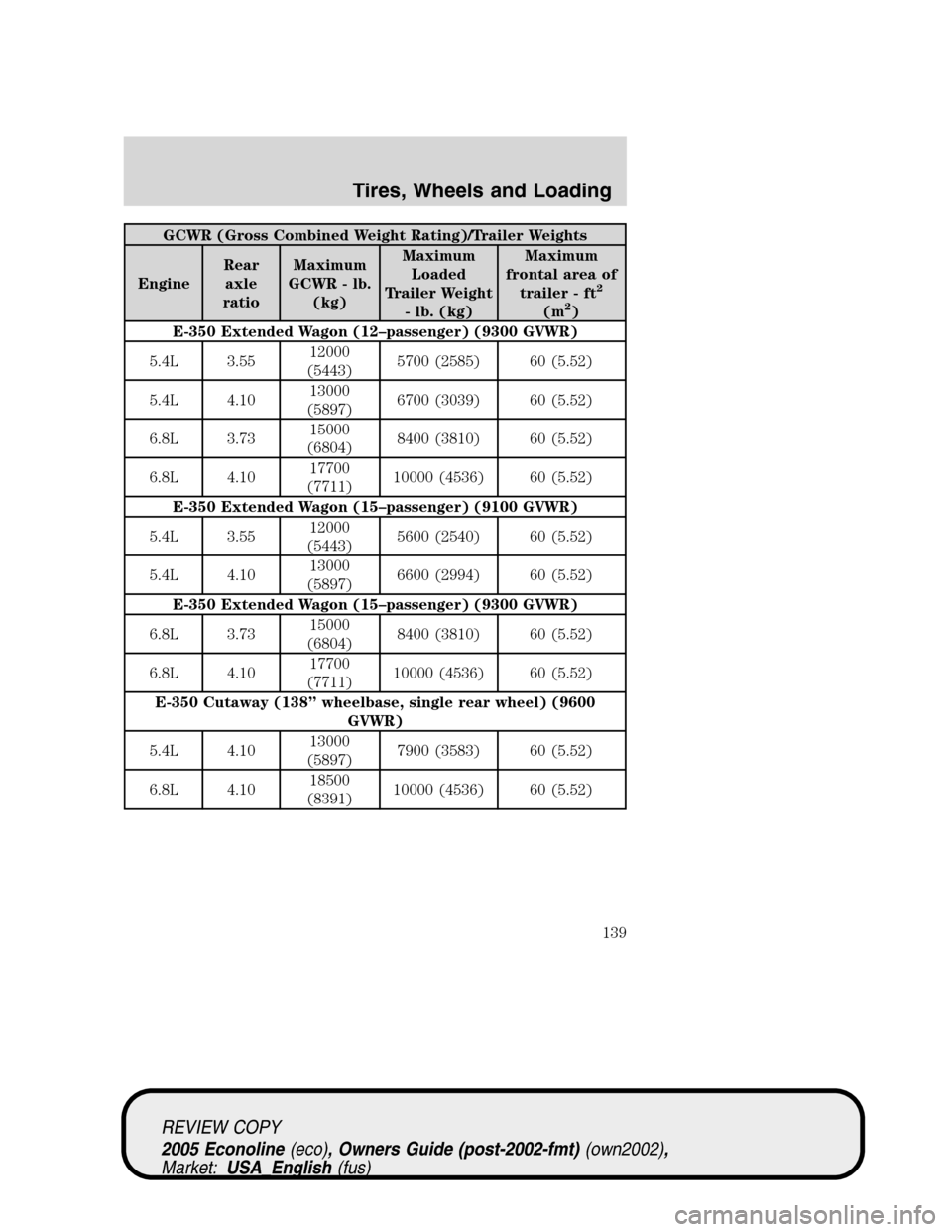
GCWR (Gross Combined Weight Rating)/Trailer Weights
EngineRear
axle
ratioMaximum
GCWR - lb.
(kg)Maximum
Loaded
Trailer Weight
- lb. (kg)Maximum
frontal area of
trailer - ft
2
(m2)
E-350 Extended Wagon (12–passenger) (9300 GVWR)
5.4L 3.5512000
(5443)5700 (2585) 60 (5.52)
5.4L 4.1013000
(5897)6700 (3039) 60 (5.52)
6.8L 3.7315000
(6804)8400 (3810) 60 (5.52)
6.8L 4.1017700
(7711)10000 (4536) 60 (5.52)
E-350 Extended Wagon (15–passenger) (9100 GVWR)
5.4L 3.5512000
(5443)5600 (2540) 60 (5.52)
5.4L 4.1013000
(5897)6600 (2994) 60 (5.52)
E-350 Extended Wagon (15–passenger) (9300 GVWR)
6.8L 3.7315000
(6804)8400 (3810) 60 (5.52)
6.8L 4.1017700
(7711)10000 (4536) 60 (5.52)
E-350 Cutaway (138” wheelbase, single rear wheel) (9600
GVWR)
5.4L 4.1013000
(5897)7900 (3583) 60 (5.52)
6.8L 4.1018500
(8391)10000 (4536) 60 (5.52)
REVIEW COPY
2005 Econoline(eco), Owners Guide (post-2002-fmt)(own2002),
Market:USA_English(fus)
Tires, Wheels and Loading
139
Page 140 of 248
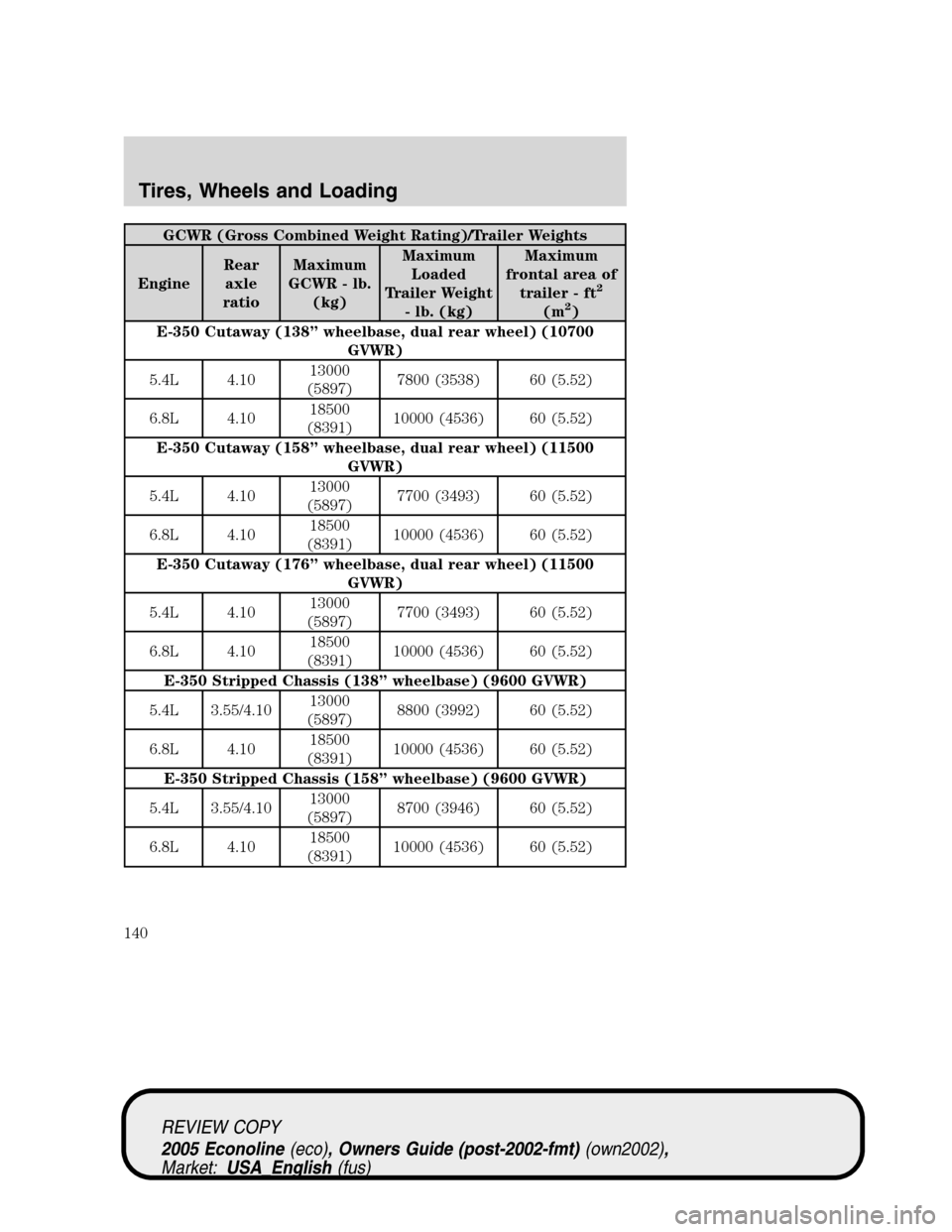
GCWR (Gross Combined Weight Rating)/Trailer Weights
EngineRear
axle
ratioMaximum
GCWR - lb.
(kg)Maximum
Loaded
Trailer Weight
- lb. (kg)Maximum
frontal area of
trailer - ft
2
(m2)
E-350 Cutaway (138” wheelbase, dual rear wheel) (10700
GVWR)
5.4L 4.1013000
(5897)7800 (3538) 60 (5.52)
6.8L 4.1018500
(8391)10000 (4536) 60 (5.52)
E-350 Cutaway (158” wheelbase, dual rear wheel) (11500
GVWR)
5.4L 4.1013000
(5897)7700 (3493) 60 (5.52)
6.8L 4.1018500
(8391)10000 (4536) 60 (5.52)
E-350 Cutaway (176” wheelbase, dual rear wheel) (11500
GVWR)
5.4L 4.1013000
(5897)7700 (3493) 60 (5.52)
6.8L 4.1018500
(8391)10000 (4536) 60 (5.52)
E-350 Stripped Chassis (138” wheelbase) (9600 GVWR)
5.4L 3.55/4.1013000
(5897)8800 (3992) 60 (5.52)
6.8L 4.1018500
(8391)10000 (4536) 60 (5.52)
E-350 Stripped Chassis (158” wheelbase) (9600 GVWR)
5.4L 3.55/4.1013000
(5897)8700 (3946) 60 (5.52)
6.8L 4.1018500
(8391)10000 (4536) 60 (5.52)
REVIEW COPY
2005 Econoline(eco), Owners Guide (post-2002-fmt)(own2002),
Market:USA_English(fus)
Tires, Wheels and Loading
140
Page 141 of 248
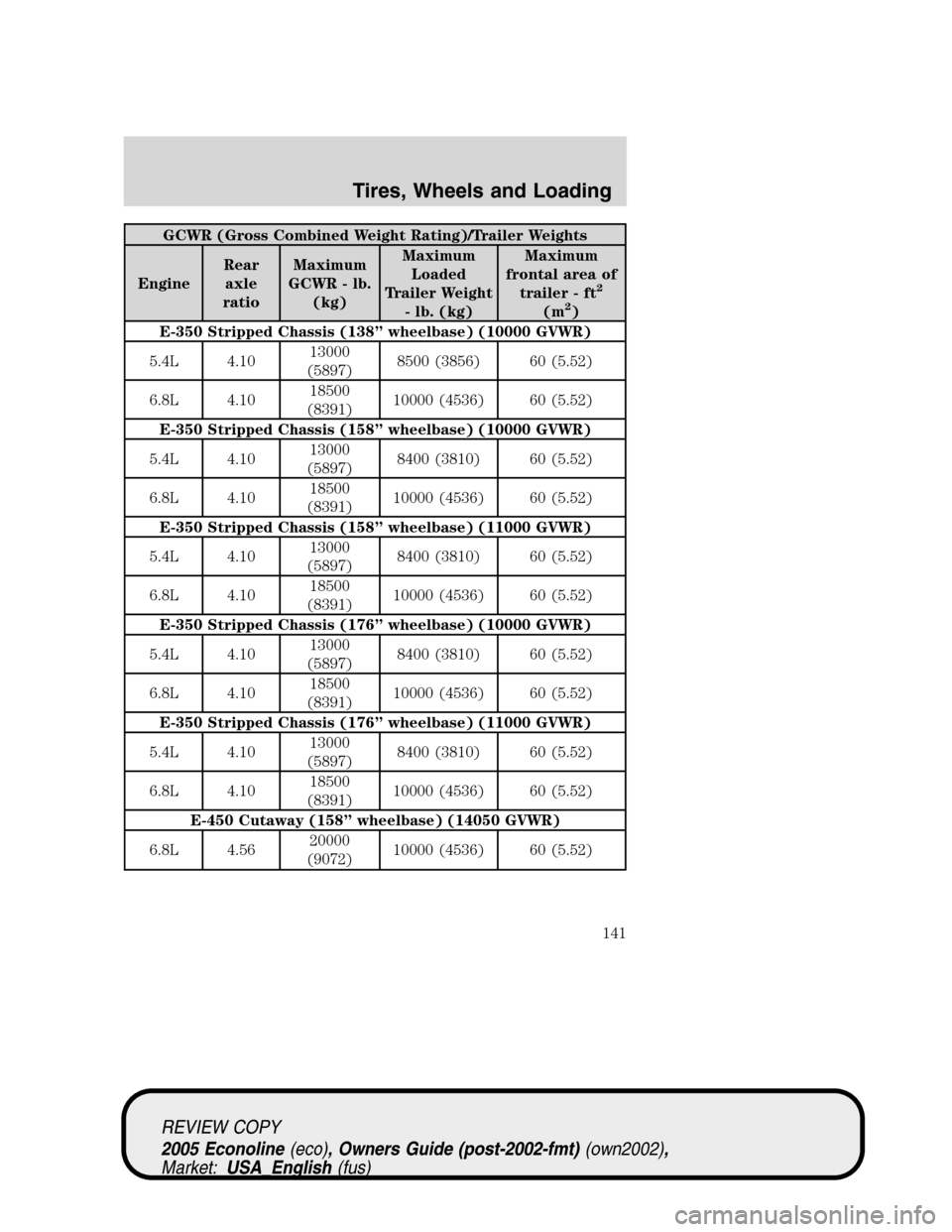
GCWR (Gross Combined Weight Rating)/Trailer Weights
EngineRear
axle
ratioMaximum
GCWR - lb.
(kg)Maximum
Loaded
Trailer Weight
- lb. (kg)Maximum
frontal area of
trailer - ft
2
(m2)
E-350 Stripped Chassis (138” wheelbase) (10000 GVWR)
5.4L 4.1013000
(5897)8500 (3856) 60 (5.52)
6.8L 4.1018500
(8391)10000 (4536) 60 (5.52)
E-350 Stripped Chassis (158” wheelbase) (10000 GVWR)
5.4L 4.1013000
(5897)8400 (3810) 60 (5.52)
6.8L 4.1018500
(8391)10000 (4536) 60 (5.52)
E-350 Stripped Chassis (158” wheelbase) (11000 GVWR)
5.4L 4.1013000
(5897)8400 (3810) 60 (5.52)
6.8L 4.1018500
(8391)10000 (4536) 60 (5.52)
E-350 Stripped Chassis (176” wheelbase) (10000 GVWR)
5.4L 4.1013000
(5897)8400 (3810) 60 (5.52)
6.8L 4.1018500
(8391)10000 (4536) 60 (5.52)
E-350 Stripped Chassis (176” wheelbase) (11000 GVWR)
5.4L 4.1013000
(5897)8400 (3810) 60 (5.52)
6.8L 4.1018500
(8391)10000 (4536) 60 (5.52)
E-450 Cutaway (158” wheelbase) (14050 GVWR)
6.8L 4.5620000
(9072)10000 (4536) 60 (5.52)
REVIEW COPY
2005 Econoline(eco), Owners Guide (post-2002-fmt)(own2002),
Market:USA_English(fus)
Tires, Wheels and Loading
141
Page 142 of 248
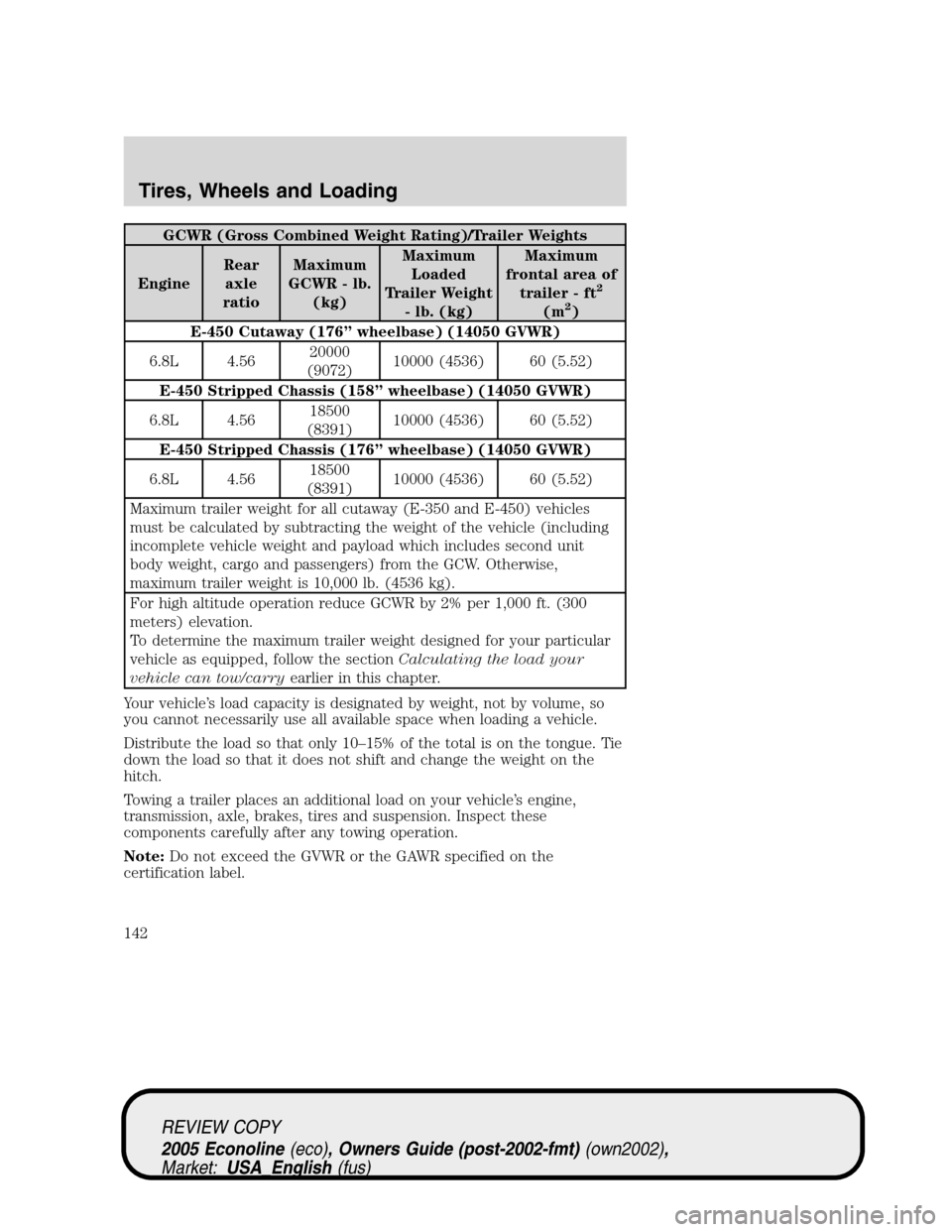
GCWR (Gross Combined Weight Rating)/Trailer Weights
EngineRear
axle
ratioMaximum
GCWR - lb.
(kg)Maximum
Loaded
Trailer Weight
- lb. (kg)Maximum
frontal area of
trailer - ft
2
(m2)
E-450 Cutaway (176” wheelbase) (14050 GVWR)
6.8L 4.5620000
(9072)10000 (4536) 60 (5.52)
E-450 Stripped Chassis (158” wheelbase) (14050 GVWR)
6.8L 4.5618500
(8391)10000 (4536) 60 (5.52)
E-450 Stripped Chassis (176” wheelbase) (14050 GVWR)
6.8L 4.5618500
(8391)10000 (4536) 60 (5.52)
Maximum trailer weight for all cutaway (E-350 and E-450) vehicles
must be calculated by subtracting the weight of the vehicle (including
incomplete vehicle weight and payload which includes second unit
body weight, cargo and passengers) from the GCW. Otherwise,
maximum trailer weight is 10,000 lb. (4536 kg).
For high altitude operation reduce GCWR by 2% per 1,000 ft. (300
meters) elevation.
To determine the maximum trailer weight designed for your particular
vehicle as equipped, follow the sectionCalculating the load your
vehicle can tow/carryearlier in this chapter.
Your vehicle’s load capacity is designated by weight, not by volume, so
you cannot necessarily use all available space when loading a vehicle.
Distribute the load so that only 10–15% of the total is on the tongue. Tie
down the load so that it does not shift and change the weight on the
hitch.
Towing a trailer places an additional load on your vehicle’s engine,
transmission, axle, brakes, tires and suspension. Inspect these
components carefully after any towing operation.
Note:Do not exceed the GVWR or the GAWR specified on the
certification label.
REVIEW COPY
2005 Econoline(eco), Owners Guide (post-2002-fmt)(own2002),
Market:USA_English(fus)
Tires, Wheels and Loading
142
Page 143 of 248
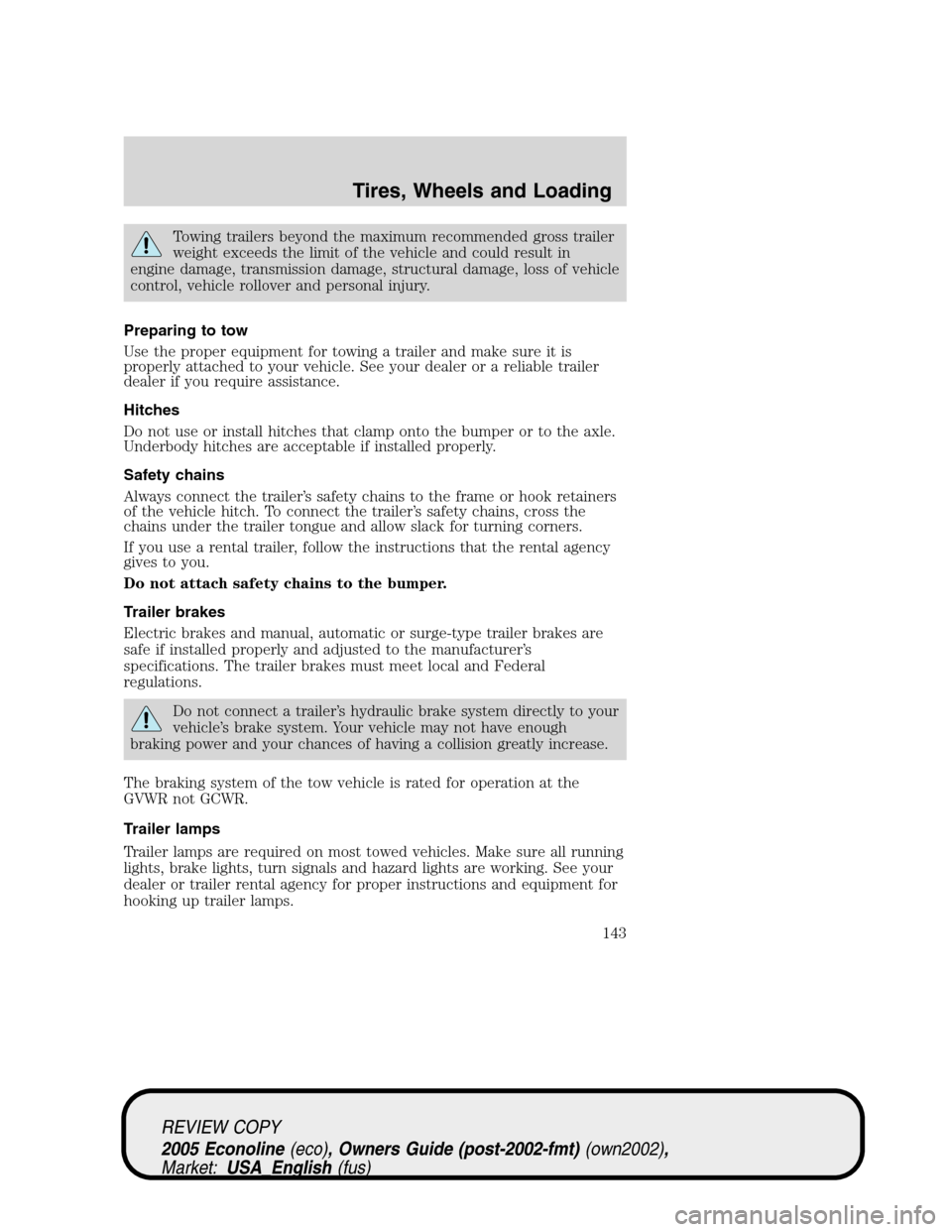
Towing trailers beyond the maximum recommended gross trailer
weight exceeds the limit of the vehicle and could result in
engine damage, transmission damage, structural damage, loss of vehicle
control, vehicle rollover and personal injury.
Preparing to tow
Use the proper equipment for towing a trailer and make sure it is
properly attached to your vehicle. See your dealer or a reliable trailer
dealer if you require assistance.
Hitches
Do not use or install hitches that clamp onto the bumper or to the axle.
Underbody hitches are acceptable if installed properly.
Safety chains
Always connect the trailer’s safety chains to the frame or hook retainers
of the vehicle hitch. To connect the trailer’s safety chains, cross the
chains under the trailer tongue and allow slack for turning corners.
If you use a rental trailer, follow the instructions that the rental agency
gives to you.
Do not attach safety chains to the bumper.
Trailer brakes
Electric brakes and manual, automatic or surge-type trailer brakes are
safe if installed properly and adjusted to the manufacturer’s
specifications. The trailer brakes must meet local and Federal
regulations.
Do not connect a trailer’s hydraulic brake system directly to your
vehicle’s brake system. Your vehicle may not have enough
braking power and your chances of having a collision greatly increase.
The braking system of the tow vehicle is rated for operation at the
GVWR not GCWR.
Trailer lamps
Trailer lamps are required on most towed vehicles. Make sure all running
lights, brake lights, turn signals and hazard lights are working. See your
dealer or trailer rental agency for proper instructions and equipment for
hooking up trailer lamps.
REVIEW COPY
2005 Econoline(eco), Owners Guide (post-2002-fmt)(own2002),
Market:USA_English(fus)
Tires, Wheels and Loading
143
Page 144 of 248
Using a step bumper (if equipped)
The rear bumper is equipped with an integral hitch and only requires a
ball with a one inch (25.4 mm) shank diameter. The bumper has a 5,000
lb. (2,270 kg) trailer weight and 500 lb. (227 kg) tongue weight capacity.
If it is necessary to relocate the trailer hitch ball position, a
frame-mounted trailer hitch must be installed.
Driving while you tow
When towing a trailer:
•Turn off the speed control. The speed control may shut off
automatically when you are towing on long, steep grades.
•Do not exceed 50 mph (80 km/h) for the first 500 miles (800 km) of
towing and do not perform fast accelerations from a stop during this
time.
•Consult your local motor vehicle speed regulations for towing a trailer.
•To eliminate excessive shifting, use a lower gear. This will also assist
in transmission cooling.
•Anticipate stops and brake gradually.
When descending long, steep downhill grades, always use a lower gear to
provide engine braking to save wear on brakes. Use Drive (Overdrive
OFF) on moderately steep hills, Second (2) on steep hills, and First (1)
on very steep hills.Do not apply your brakes continuously, as they
may overheat and become less effective.
Servicing after towing
If you tow a trailer for long distances, your vehicle will require more
frequent service intervals. Refer to yourScheduled Maintenance Guide
for more information.
Trailer towing tips
•Practice turning, stopping and backing up before starting on a trip to
get the feel of the vehicle trailer combination. When turning, make
wider turns so the trailer wheels will clear curbs and other obstacles.
•Allow more distance for stopping with a trailer attached.
•The trailer tongue weight should be 10–15% of the loaded trailer
weight.
REVIEW COPY
2005 Econoline(eco), Owners Guide (post-2002-fmt)(own2002),
Market:USA_English(fus)
Tires, Wheels and Loading
144
Page 153 of 248
A high crown in the road or high crosswinds may also make the steering
seem to wander/pull.
TRACTION-LOK AXLE (IF EQUIPPED)
This axle provides added traction on slippery surfaces, particularly when
one wheel is on a poor traction surface. Under normal conditions, the
Traction-Lok axle functions like a standard rear axle. The axle may
exhibit a slight noise or vibration in tight turns with low vehicle speed.
This is normal behavior and indicates the axle is working.
PREPARING TO DRIVE YOUR VEHICLE
Utility vehicles have a significantly higher rollover rate than
other types of vehicles.
In a rollover crash, an unbelted person is significantly more likely
to die than a person wearing a safety belt.
Your vehicle has larger tires and increased ground clearance, giving the
vehicle a higher center of gravity than a passenger car.
Vehicles with a higher center of gravity such as utility and
four-wheel drive vehicles handle differently than vehicles with a
lower center of gravity. Utility and four-wheel drive vehicles arenot
designed for cornering at speeds as high as passenger cars any more
than low-slung sports cars are designed to perform satisfactorily under
off-road conditions. Avoid sharp turns, excessive speed and abrupt
maneuvers in these vehicles. Failure to drive cautiously could result in
an increased risk of loss of vehicle control, vehicle rollover, personal
injury and death.
Loaded vehicles, with a higher center of gravity, may handle
differently than unloaded vehicles. Extra precautions such as
slower speeds and increased stopping distance should be taken when
driving a heavily loaded vehicle.
VEHICLE STABILITY AND HANDLING
The risk of a rollover crash increases as the number of people and load
in the vehicle increase. This increased risk occurs because the passenger
weight and load raises the vehicle’s center of gravity and causes it to
REVIEW COPY
2005 Econoline(eco), Owners Guide (post-2002-fmt)(own2002),
Market:USA_English(fus)
Driving
153