ignition FORD E SERIES 2009 4.G Repair Manual
[x] Cancel search | Manufacturer: FORD, Model Year: 2009, Model line: E SERIES, Model: FORD E SERIES 2009 4.GPages: 321, PDF Size: 2.31 MB
Page 288 of 321
If you have run out of fuel:
•You may need to cycle the ignition from off to on several times after
refueling to allow the fuel system to pump the fuel from the tank to
the engine. On restarting, cranking time will take a few seconds longer
than normal.
•Normally, adding 1 gallon (3.8L) of fuel is enough to restart the
engine. If the vehicle is out of fuel and on a steep grade, more than
1 gallon (3.8L) may be required.
•TheService engine soon
indicator may come on. For more
information on theService engine soon
indicator, refer to
Warning lights and chimesin theInstrument Clusterchapter.
ESSENTIALS OF GOOD FUEL ECONOMY
Measuring techniques
Your best source of information about actual fuel economy is you, the
driver. You must gather information as accurately and consistently as
possible. Fuel expense, frequency of fill-ups or fuel gauge readings are
NOT accurate as a measure of fuel economy. We do not recommend
taking fuel economy measurements during the first 1,000 miles
(1,600 km) of driving (engine break-in period). You will get a more
accurate measurement after 2,000 miles–3,000 miles (3,000 km–5,000
km).
Filling the tank
The advertised fuel capacity of the fuel tank on your vehicle is equal to
the rated refill capacity of the fuel tank as listed in theMaintenance
product specifications and capacitiessection of this chapter.
The advertised capacity is the amount of the indicated capacity and the
empty reserve combined. Indicated capacity is the difference in the
amount of fuel in a full tank and a tank when the fuel gauge indicates
empty. Empty reserve is the small amount of fuel remaining in the fuel
tank after the fuel gauge indicates empty.
The amount of usable fuel in the empty reserve varies and should
not be relied upon to increase driving range. When refueling your
vehicle after the fuel gauge indicates empty, you might not be
able to refuel the full amount of the advertised capacity of the
fuel tank due to the empty reserve still present in the tank.
For consistent results when filling the fuel tank:
•Turn the engine/ignition switch to the off position prior to refueling,
an error in the reading will result if the engine is left running.
2009 Econoline(eco)
Owners Guide, 1st Printing
USA(fus)
Maintenance and Specifications
288
Page 291 of 321
•Fuel economy may decrease with lower temperatures during the first
8–10 miles (12–16 km) of driving.
•Driving on flat terrain offers improved fuel economy as compared to
driving on hilly terrain.
•Transmissions give their best fuel economy when operated in the top
cruise gear and with steady pressure on the gas pedal.
•Close windows for high speed driving.
EPA fuel economy estimates
Every new vehicle should have a window sticker containing EPA fuel
economy estimates. Contact your authorized dealer if the window sticker
is not supplied with your vehicle. The EPA fuel economy estimates
should be your guide for the fuel economy comparisons with other
vehicles. Your fuel economy may vary depending upon the method of
operation and conditions.
Note:Vehicles over 8,500 GVW (Gross Vehicle Weight) will not have fuel
economy information printed on the window sticker.
EMISSION CONTROL SYSTEM
Your vehicle is equipped with various emission control components and a
catalytic converter which will enable your vehicle to comply with
applicable exhaust emission standards. To make sure that the catalytic
converter and other emission control components continue to work
properly:
•Use only the specified fuel listed.
•Avoid running out of fuel.
•Do not turn off the ignition while your vehicle is moving, especially at
high speeds.
•Have the items listed inscheduled maintenance information
performed according to the specified schedule.
The scheduled maintenance items listed inscheduled maintenance
informationare essential to the life and performance of your vehicle
and to its emissions system.
If other than Ford, Motorcraft or Ford-authorized parts are used for
maintenance replacements or for service of components affecting
emission control, such non-Ford parts should be equivalent to genuine
Ford Motor Company parts in performance and durability.
2009 Econoline(eco)
Owners Guide, 1st Printing
USA(fus)
Maintenance and Specifications
291
Page 293 of 321
4. Driving through deep water—the electrical system may be wet.
These temporary malfunctions can be corrected by filling the fuel tank
with good quality fuel, properly tightening the fuel cap or letting the
electrical system dry out. After three driving cycles without these or any
other temporary malfunctions present, theService engine soon
indicator should stay off the next time the engine is started. A driving
cycle consists of a cold engine startup followed by mixed city/highway
driving. No additional vehicle service is required.
If theService engine soon
indicator remains on, have your vehicle
serviced at the first available opportunity. Although some malfunctions
detected by the OBD-II may not have symptoms that are apparent,
continued driving with theService engine soon
indicator on can
result in increased emissions, lower fuel economy, reduced engine and
transmission smoothness, and lead to more costly repairs.
Readiness for Inspection/Maintenance (I/M) testing
Some state/provincial and local governments may have
Inspection/Maintenance (I/M) programs to inspect the emission control
equipment on your vehicle. Failure to pass this inspection could prevent
you from getting a vehicle registration. Your vehicle may not pass the I/M
test if theService engine soon
indicator is on or not working
properly (bulb is burned out), or if the OBD-II system has determined
that some of the emission control systems have not been properly
checked. In this case, the vehicle is considered not ready for I/M testing.
If theService engine soon
indicator is on or the bulb does not
work, the vehicle may need to be serviced. Refer to the On board
diagnostics (OBD-II) description in this chapter.
If the vehicle’s engine or transmission has just been serviced, or the
battery has recently run down or been replaced, the OBD-II system may
indicate that the vehicle is not ready for I/M testing. To determine if the
vehicle is ready for I/M testing, turn the ignition key to the on position
for 15 seconds without cranking the engine. If theService engine
soon
indicator blinks eight times, it means that the vehicle is not
ready for I/M testing; if theService engine soon
indicator stays on
solid, it means that the vehicle is ready for I/M testing.
2009 Econoline(eco)
Owners Guide, 1st Printing
USA(fus)
Maintenance and Specifications
293
Page 310 of 321
ENGINE DATA
Engine14.6L V8 engine 5.4L V8 engine 6.8L V10 engine
Cubic inches 281 330 415
Required fuel87 octane or
(E-85)
287 octane 87 octane
Firing order 1-3-7-2-6-5-4-8 1-3-7-2-6-5-4-8 1-6-5-10-2-7-3-8-4-9
Ignition system Coil on plug Coil on plug Coil on plug
Spark plug gap0.052–0.056 inch
(1.32–1.42mm)0.051–0.057 inch
(1.29–1.45mm)0.052–0.056 inch
(1.32–1.42mm)
Compression
ratio9.4:1 9.0:1 9.0:1
1Refer to the6.0 and 6.4 Liter Power Stroke Direct Injection Turbo
Diesel Owner’s Guide Supplementfor diesel engine information.
24.6L V8 FFV engines only.
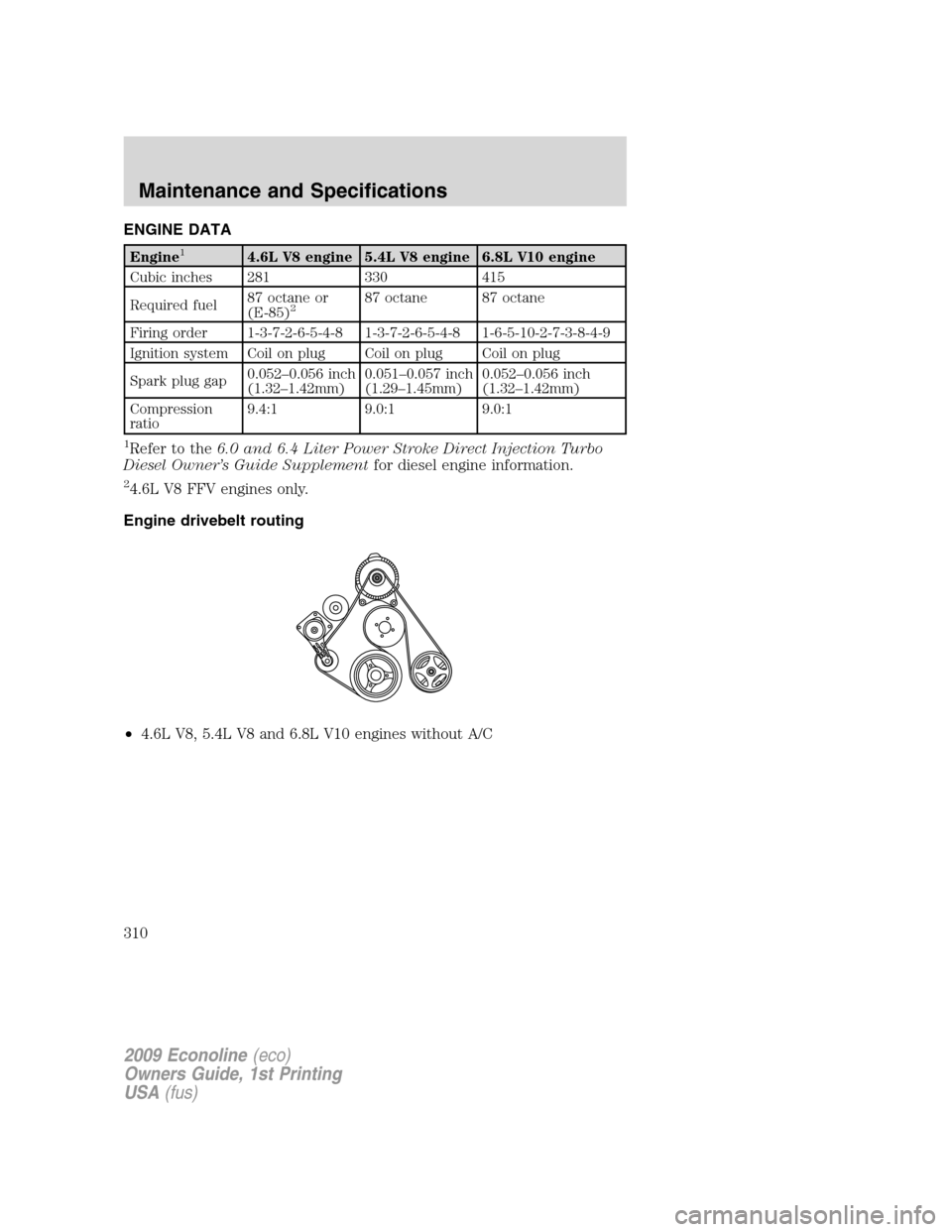
Engine drivebelt routing
•4.6L V8, 5.4L V8 and 6.8L V10 engines without A/C
2009 Econoline(eco)
Owners Guide, 1st Printing
USA(fus)
Maintenance and Specifications
310
Page 318 of 321
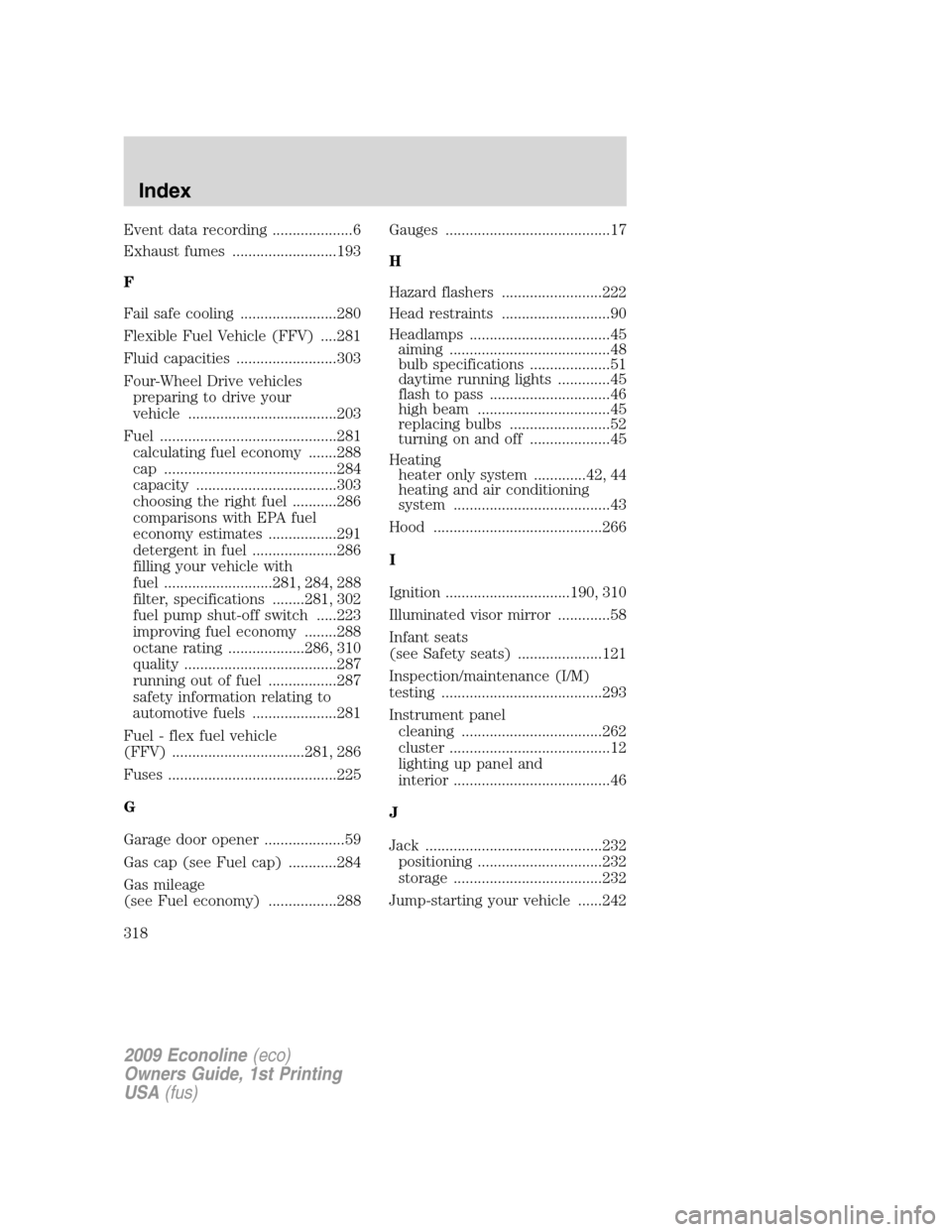
Event data recording ....................6
Exhaust fumes ..........................193
F
Fail safe cooling ........................280
Flexible Fuel Vehicle (FFV) ....281
Fluid capacities .........................303
Four-Wheel Drive vehicles
preparing to drive your
vehicle .....................................203
Fuel ............................................281
calculating fuel economy .......288
cap ...........................................284
capacity ...................................303
choosing the right fuel ...........286
comparisons with EPA fuel
economy estimates .................291
detergent in fuel .....................286
filling your vehicle with
fuel ...........................281, 284, 288
filter, specifications ........281, 302
fuel pump shut-off switch .....223
improving fuel economy ........288
octane rating ...................286, 310
quality ......................................287
running out of fuel .................287
safety information relating to
automotive fuels .....................281
Fuel - flex fuel vehicle
(FFV) .................................281, 286
Fuses ..........................................225
G
Garage door opener ....................59
Gas cap (see Fuel cap) ............284
Gas mileage
(see Fuel economy) .................288Gauges .........................................17
H
Hazard flashers .........................222
Head restraints ...........................90
Headlamps ...................................45
aiming ........................................48
bulb specifications ....................51
daytime running lights .............45
flash to pass ..............................46
high beam .................................45
replacing bulbs .........................52
turning on and off ....................45
Heating
heater only system .............42, 44
heating and air conditioning
system .......................................43
Hood ..........................................266
I
Ignition ...............................190, 310
Illuminated visor mirror .............58
Infant seats
(see Safety seats) .....................121
Inspection/maintenance (I/M)
testing ........................................293
Instrument panel
cleaning ...................................262
cluster ........................................12
lighting up panel and
interior .......................................46
J
Jack ............................................232
positioning ...............................232
storage .....................................232
Jump-starting your vehicle ......242
2009 Econoline(eco)
Owners Guide, 1st Printing
USA(fus)
Index
318
Page 319 of 321
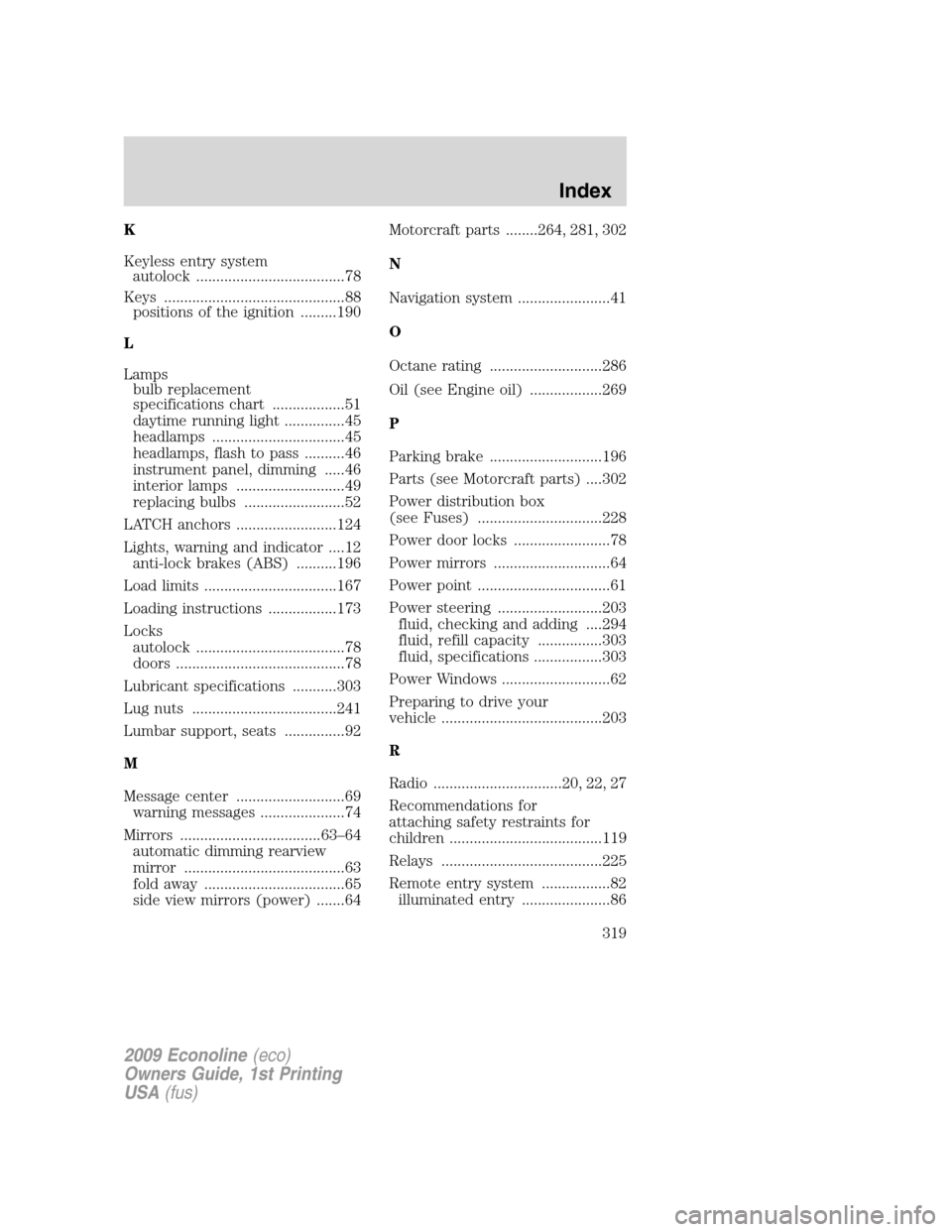
K
Keyless entry system
autolock .....................................78
Keys .............................................88
positions of the ignition .........190
L
Lamps
bulb replacement
specifications chart ..................51
daytime running light ...............45
headlamps .................................45
headlamps, flash to pass ..........46
instrument panel, dimming .....46
interior lamps ...........................49
replacing bulbs .........................52
LATCH anchors .........................124
Lights, warning and indicator ....12
anti-lock brakes (ABS) ..........196
Load limits .................................167
Loading instructions .................173
Locks
autolock .....................................78
doors ..........................................78
Lubricant specifications ...........303
Lug nuts ....................................241
Lumbar support, seats ...............92
M
Message center ...........................69
warning messages .....................74
Mirrors ...................................63–64
automatic dimming rearview
mirror ........................................63
fold away ...................................65
side view mirrors (power) .......64Motorcraft parts ........264, 281, 302
N
Navigation system .......................41
O
Octane rating ............................286
Oil (see Engine oil) ..................269
P
Parking brake ............................196
Parts (see Motorcraft parts) ....302
Power distribution box
(see Fuses) ...............................228
Power door locks ........................78
Power mirrors .............................64
Power point .................................61
Power steering ..........................203
fluid, checking and adding ....294
fluid, refill capacity ................303
fluid, specifications .................303
Power Windows ...........................62
Preparing to drive your
vehicle ........................................203
R
Radio ................................20, 22, 27
Recommendations for
attaching safety restraints for
children ......................................119
Relays ........................................225
Remote entry system .................82
illuminated entry ......................86
2009 Econoline(eco)
Owners Guide, 1st Printing
USA(fus)
Index
319