transmission FORD E SERIES 2013 4.G Owner's Guide
[x] Cancel search | Manufacturer: FORD, Model Year: 2013, Model line: E SERIES, Model: FORD E SERIES 2013 4.GPages: 416, PDF Size: 4.29 MB
Page 168 of 416
•When the vehicle is turned off, the TBC output is disabled and the display
and module are shut down. The TBC module and display turn on when the
ignition is turned from the off position to the on position.
•The TBC is only a factory-installed or dealer-installed item. Ford is not
responsible for warranty or performance of the TBC due to misuse or
customer installation.
Trailer Lamps
Trailer lamps are required on most towed vehicles. Make sure all running
lights, brake lights, turn signals and hazard lights are working. Contact
your authorized dealer or trailer rental agency for proper instructions
and equipment for hooking up the lamps.
Using a Step Bumper (If Equipped)
The rear bumper is equipped with an integral hitch and only requires a
ball with a one inch (25.4 millimeter) shank diameter. The bumper has a
5000 pound (2268 kilogram) trailer weight and 500 pound (227
kilogram) tongue weight capacity.
If it is necessary to relocate the trailer hitch ball position, a
frame-mounted trailer hitch must be installed.
Before Towing a Trailer
Practice turning, stopping and backing up to get the feel of the
vehicle-trailer combination before starting on a trip. When turning, make
wider turns so the trailer wheels will clear curbs and other obstacles.
When Towing a Trailer
•Do not drive faster than 70 mph (113 km/h) during the first 500 miles
(800 kilometers).
•Do not make full-throttle starts.
•Check your hitch, electrical connections and trailer wheel lug nuts
thoroughly after you have traveled 50 miles (80 kilometers).
•When stopped in congested or heavy traffic during hot weather, place
gearshift in positionPto aid engine and transmission cooling and to
help A/C performance.
•Turn off the speed control with heavy loads or in hilly terrain. The
speed control may turn off automatically when you are towing on
long, steep grades.
•Shift to a lower gear when driving down a long or steep hill. Do not
apply the brakes continuously, as they may overheat and become less
effective.
168Towing
2013 Econoline(eco)
Owners Guide gf, 1st Printing
USA(fus)
Page 169 of 416
•If your transmission is equipped with a Grade Assist or Tow/Haul
feature, use this feature when towing. This provides engine braking
and helps eliminate excessive transmission shifting for optimum fuel
economy and transmission cooling.
•If your vehicle is equipped with AdvanceTrac™ with RSC, you may
experience AdvanceTrac™ with RSC activations during typical
cornering maneuvers with a heavily loaded trailer; this is normal.
Cornering at a slower speed while towing reduces the tendency of the
AdvanceTrac™ stability enhancement system to activate.
•If you are towing a trailer frequently in hot weather, hilly conditions,
at GCWR (or any combination of these factors), consider refilling
your rear axle with synthetic gear lubricant, if not already so
equipped. See theCapacities and Specificationschapter for the
lubricant specification.
•Allow more distance for stopping with a trailer attached; anticipate
stops and brake gradually.
•Avoid parking on a grade. However, if you must park on a grade:
1. Turn the steering wheel to point the vehicle tires away from
traffic flow.
2. Set the vehicle parking brake.
3. Place the automatic transmission in positionPor manual
transmission in a high gear.
4. Place wheel chocks in front and back of the trailer wheels.
(Chocks not equipped with vehicle.)
Your vehicle may be equipped with a temporary or conventional spare
tire. If the spare tire is different in size (diameter and/or width), tread
type (All-Season or All-Terrain) or is from a different manufacturer other
than the road tires on your vehicle, your spare tire is considered
“temporary”. Consult information on the tire label or Safety Compliance
label for limitations when using.
Launching or Retrieving a Boat or Personal Watercraft (PWC)
Note:Disconnect the wiring to the trailerbeforebacking the trailer into
the water.
Note:Reconnect the wiring to the trailer after the trailer is removed
from the water.
When backing down a ramp during boat launching or retrieval:
•Do not allow the static water level to rise above the bottom edge of
the rear bumper.
•Do not allow waves to break higher than 6 inches (15 centimeters)
above the bottom edge of the rear bumper.
Towing169
2013 Econoline(eco)
Owners Guide gf, 1st Printing
USA(fus)
Page 171 of 416
If your vehicle is equipped with an air dam and must be towed from the
front, it is recommended that your vehicle be towed by wheel lift or
flatbed equipment to prevent damage to the air dam.
TOWING THE VEHICLE ON FOUR WHEELS
Emergency Towing
In the event your vehicle becomes disabled (without access to wheel
dollies, car-hauling trailer, or flatbed transport vehicle), it can be
flat-towed (all wheels on the ground, regardless of the
powertrain/transmission configuration) under the following conditions:
•The vehicle is facing forward so that it is towed in a forward
direction.
•The transmission is placed in positionN.SeeAutomatic
transmissionin theTransmissionchapter if you cannot move the
transmission intoN.
•Maximum speed is 35 mph (56 km/h).
•Maximum distance is 50 miles (80 kilometers).
Recreational Towing
Follow these guidelines if you have a need for recreational (RV) towing.
An example of recreational towing would be towing your vehicle behind
a motor home.
These guidelines are designed to prevent damage to your vehicle.
Do not tow your vehicle with any wheels on the ground, as vehicle or
transmission damage may occur. It is recommended to tow your vehicle
with all four (4) wheels off the ground such as when using a car-hauling
trailer. Otherwise, no recreational towing is permitted.
Towing171
2013 Econoline(eco)
Owners Guide gf, 1st Printing
USA(fus)
Page 175 of 416
There are also some things you may not want to do because they may
reduce your fuel economy:
•Sudden or hard accelerations.
•Rev the engine before turning it off.
•Idle for periods longer than one minute.
•Warm up your vehicle on cold mornings.
•Use the air conditioner or front defroster.
•Use the speed control in hilly terrain.
•Rest your foot on the brake pedal while driving.
•Drive a heavily loaded vehicle or tow a trailer.
•Carry unnecessary weight (approximately 1 mpg [0.4 km/L] is lost for
every 400 lb [180 kg] of weight carried).
•Add particular accessories to your vehicle (e.g.; bug deflectors,
rollbars or light bars, running boards, ski racks).
•Drive with the wheels out of alignment.
DRIVING THROUGH WATER
Note:Driving through deep water may allow water into the transmission
and engine causing internal damage. Have the fluid checked and, if water
is found, replace the fluid.
Do not drive quickly through standing water, especially if the depth is
unknown. Traction or brake capability may be limited and if the ignition
system gets wet, your engine may stall. Water may also enter your
engine’s air intake and severely damage your engine.
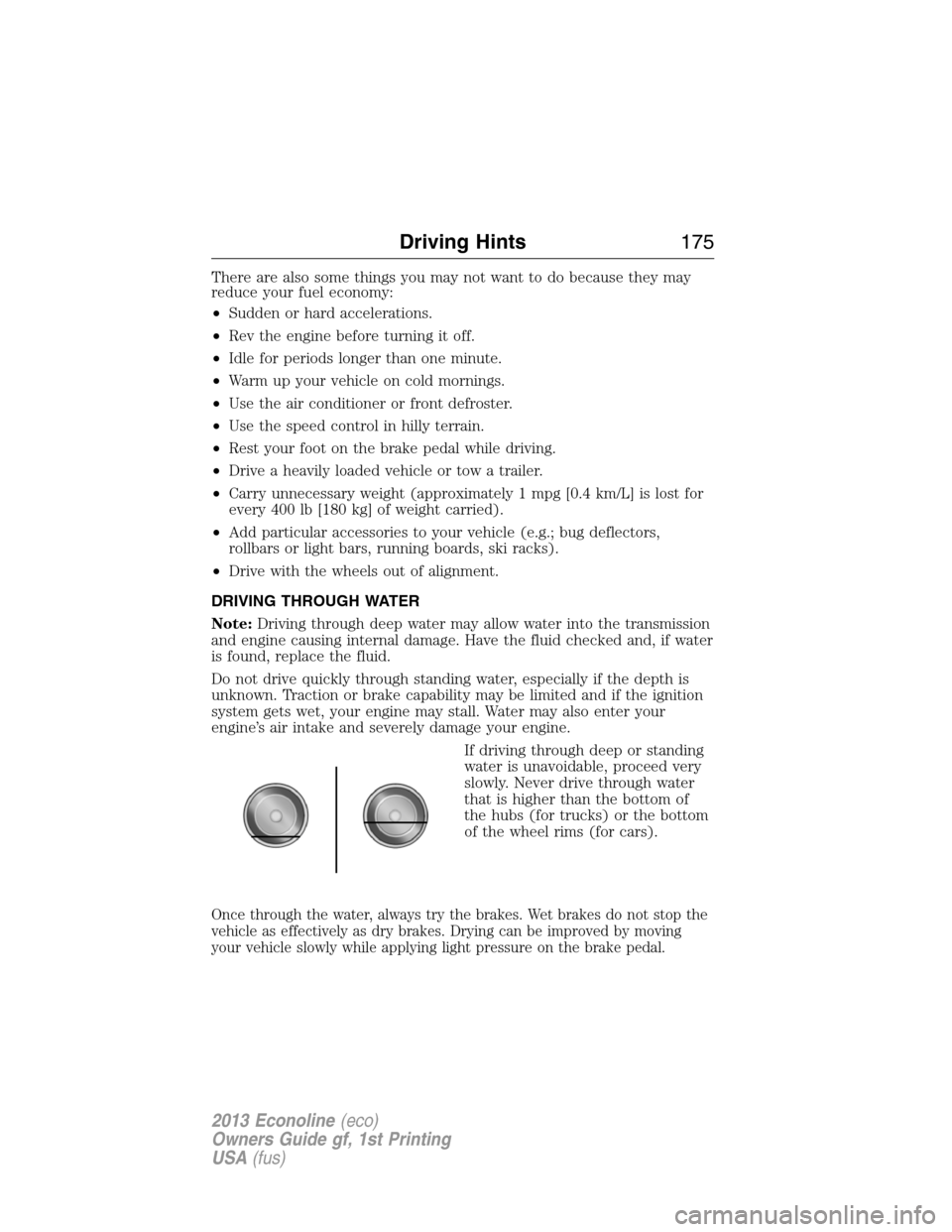
If driving through deep or standing
water is unavoidable, proceed very
slowly. Never drive through water
that is higher than the bottom of
the hubs (for trucks) or the bottom
of the wheel rims (for cars).
Once through the water, always try the brakes. Wet brakes do not stop the
vehicle as effectively as dry brakes. Drying can be improved by moving
your vehicle slowly while applying light pressure on the brake pedal.
Driving Hints175
2013 Econoline(eco)
Owners Guide gf, 1st Printing
USA(fus)
Page 181 of 416
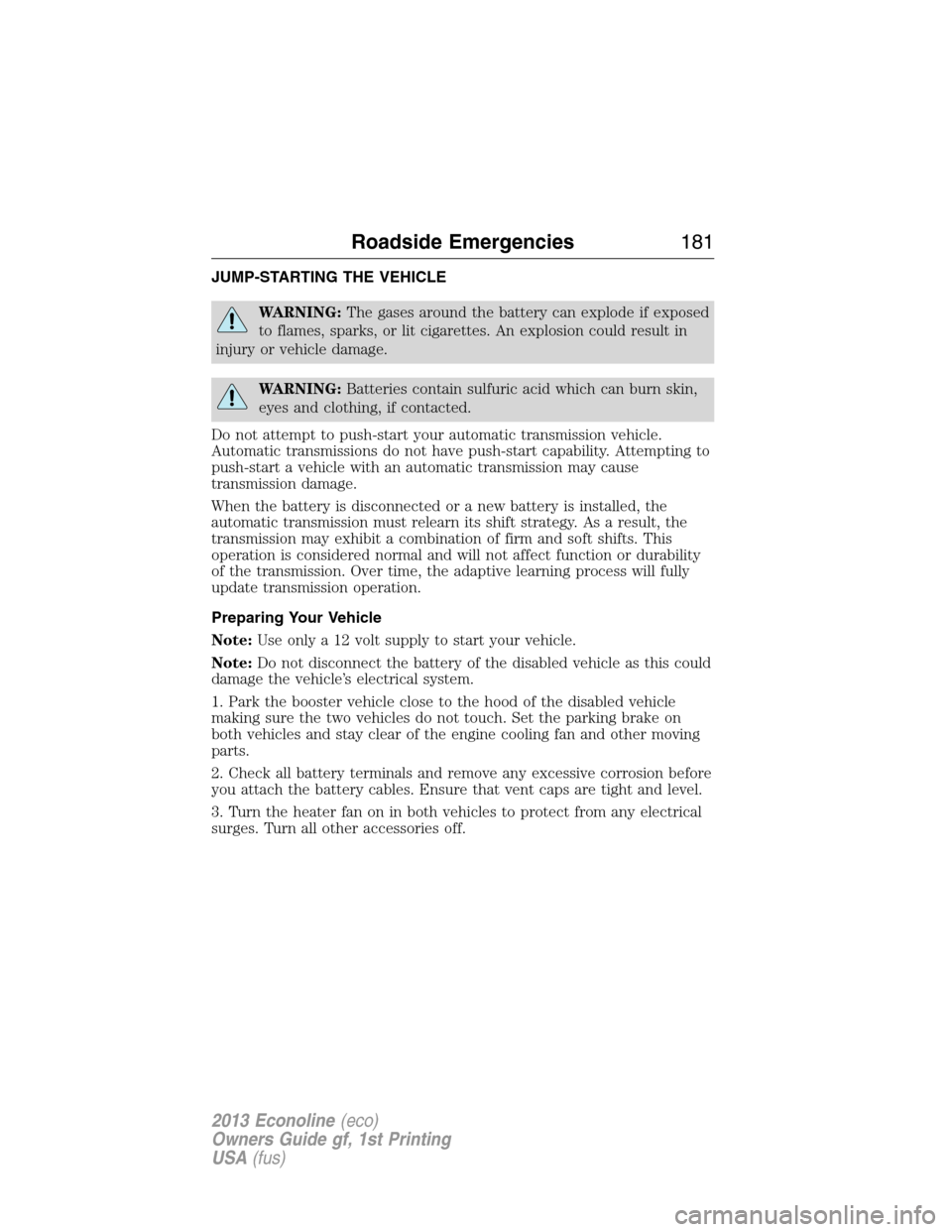
JUMP-STARTING THE VEHICLE
WARNING:The gases around the battery can explode if exposed
to flames, sparks, or lit cigarettes. An explosion could result in
injury or vehicle damage.
WARNING:Batteries contain sulfuric acid which can burn skin,
eyes and clothing, if contacted.
Do not attempt to push-start your automatic transmission vehicle.
Automatic transmissions do not have push-start capability. Attempting to
push-start a vehicle with an automatic transmission may cause
transmission damage.
When the battery is disconnected or a new battery is installed, the
automatic transmission must relearn its shift strategy. As a result, the
transmission may exhibit a combination of firm and soft shifts. This
operation is considered normal and will not affect function or durability
of the transmission. Over time, the adaptive learning process will fully
update transmission operation.
Preparing Your Vehicle
Note:Use only a 12 volt supply to start your vehicle.
Note:Do not disconnect the battery of the disabled vehicle as this could
damage the vehicle’s electrical system.
1. Park the booster vehicle close to the hood of the disabled vehicle
making sure the two vehicles do not touch. Set the parking brake on
both vehicles and stay clear of the engine cooling fan and other moving
parts.
2. Check all battery terminals and remove any excessive corrosion before
you attach the battery cables. Ensure that vent caps are tight and level.
3. Turn the heater fan on in both vehicles to protect from any electrical
surges. Turn all other accessories off.
Roadside Emergencies181
2013 Econoline(eco)
Owners Guide gf, 1st Printing
USA(fus)
Page 196 of 416
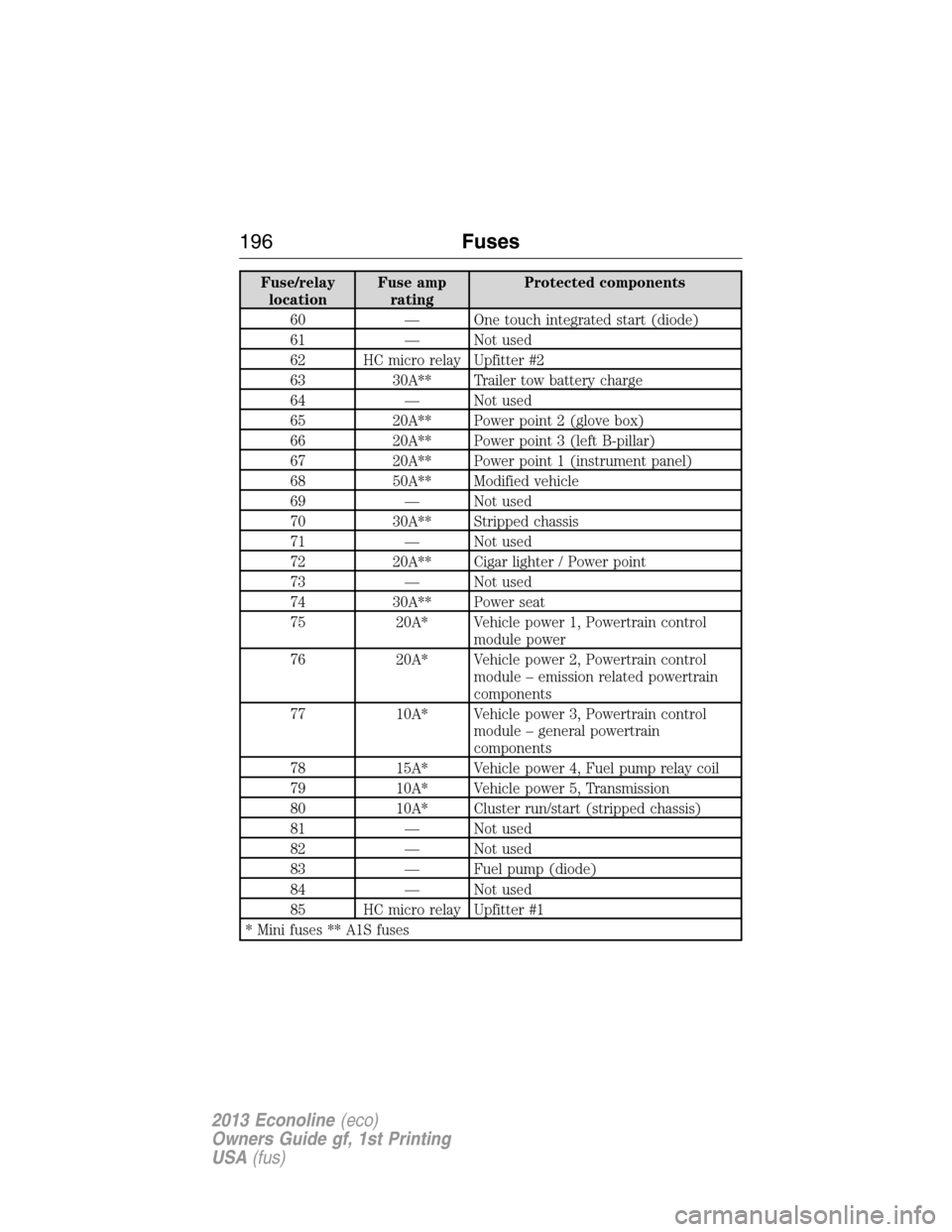
Fuse/relay
locationFuse amp
ratingProtected components
60 — One touch integrated start (diode)
61 — Not used
62 HC micro relay Upfitter #2
63 30A** Trailer tow battery charge
64 — Not used
65 20A** Power point 2 (glove box)
66 20A** Power point 3 (left B-pillar)
67 20A** Power point 1 (instrument panel)
68 50A** Modified vehicle
69 — Not used
70 30A** Stripped chassis
71 — Not used
72 20A** Cigar lighter / Power point
73 — Not used
74 30A** Power seat
75 20A* Vehicle power 1, Powertrain control
module power
76 20A* Vehicle power 2, Powertrain control
module – emission related powertrain
components
77 10A* Vehicle power 3, Powertrain control
module – general powertrain
components
78 15A* Vehicle power 4, Fuel pump relay coil
79 10A* Vehicle power 5, Transmission
80 10A* Cluster run/start (stripped chassis)
81 — Not used
82 — Not used
83 — Fuel pump (diode)
84 — Not used
85 HC micro relay Upfitter #1
* Mini fuses ** A1S fuses
196Fuses
2013 Econoline(eco)
Owners Guide gf, 1st Printing
USA(fus)
Page 203 of 416
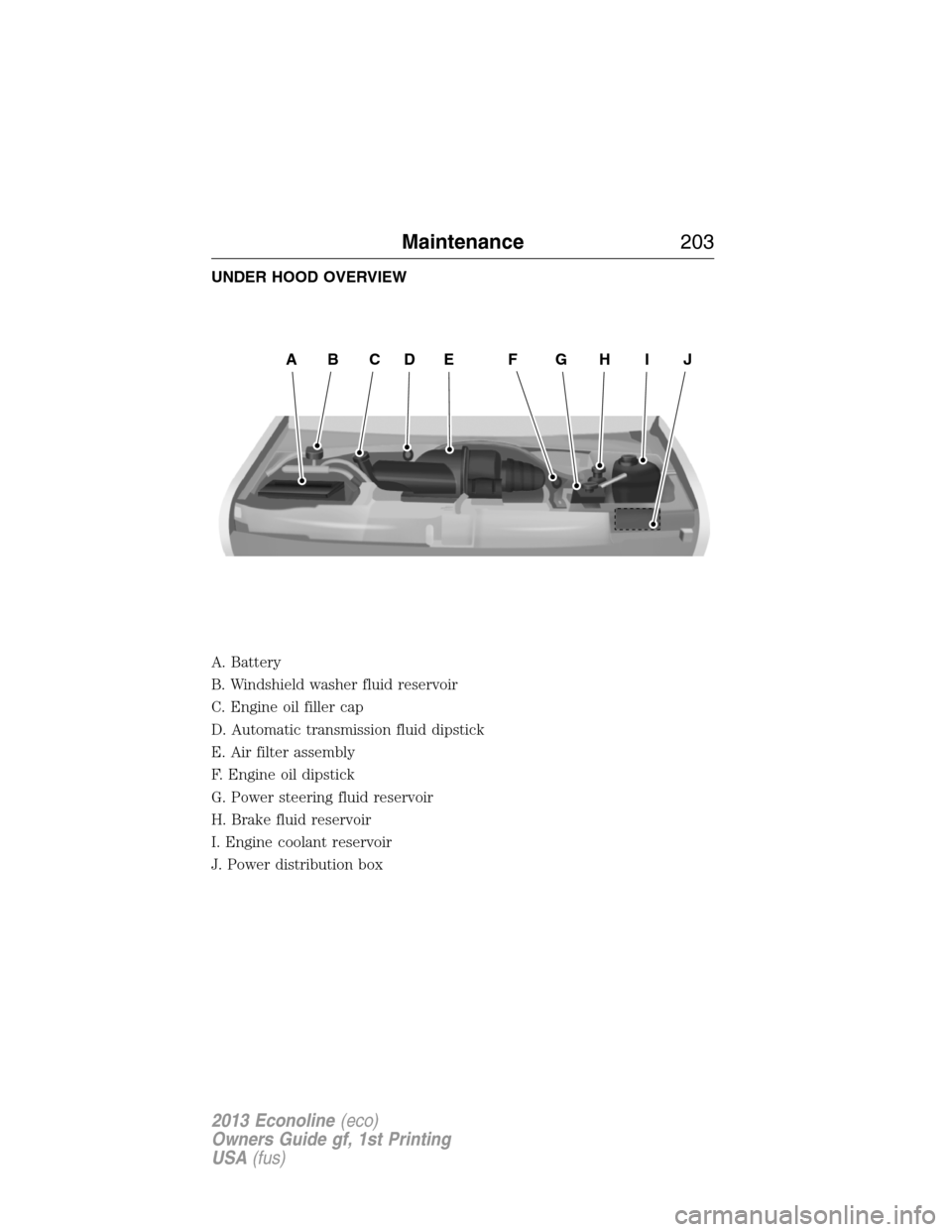
UNDER HOOD OVERVIEW
A. Battery
B. Windshield washer fluid reservoir
C. Engine oil filler cap
D. Automatic transmission fluid dipstick
E. Air filter assembly
F. Engine oil dipstick
G. Power steering fluid reservoir
H. Brake fluid reservoir
I. Engine coolant reservoir
J. Power distribution box
ABCDEFGHIJ
Maintenance203
2013 Econoline(eco)
Owners Guide gf, 1st Printing
USA(fus)
Page 210 of 416
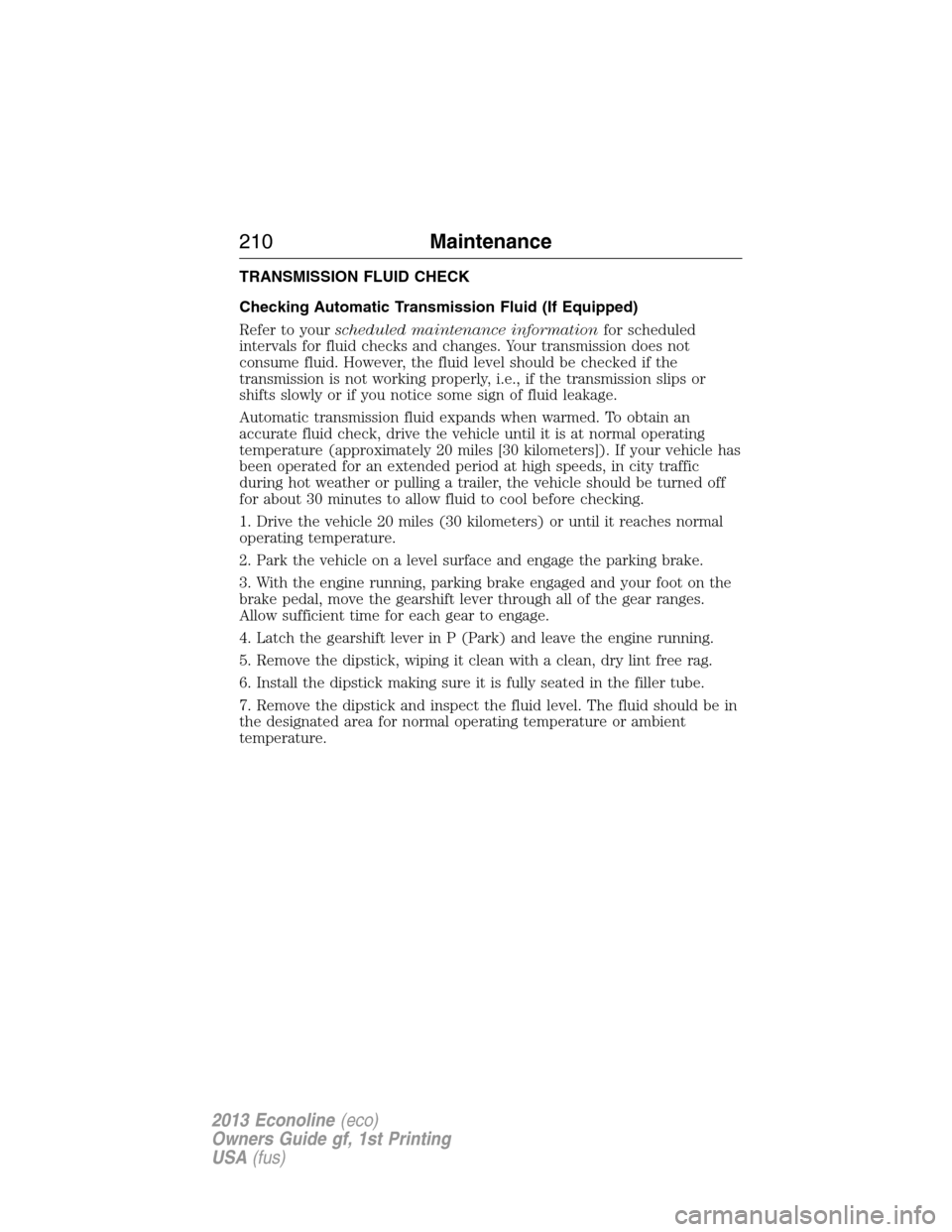
TRANSMISSION FLUID CHECK
Checking Automatic Transmission Fluid (If Equipped)
Refer to yourscheduled maintenance informationfor scheduled
intervals for fluid checks and changes. Your transmission does not
consume fluid. However, the fluid level should be checked if the
transmission is not working properly, i.e., if the transmission slips or
shifts slowly or if you notice some sign of fluid leakage.
Automatic transmission fluid expands when warmed. To obtain an
accurate fluid check, drive the vehicle until it is at normal operating
temperature (approximately 20 miles [30 kilometers]). If your vehicle has
been operated for an extended period at high speeds, in city traffic
during hot weather or pulling a trailer, the vehicle should be turned off
for about 30 minutes to allow fluid to cool before checking.
1. Drive the vehicle 20 miles (30 kilometers) or until it reaches normal
operating temperature.
2. Park the vehicle on a level surface and engage the parking brake.
3. With the engine running, parking brake engaged and your foot on the
brake pedal, move the gearshift lever through all of the gear ranges.
Allow sufficient time for each gear to engage.
4. Latch the gearshift lever in P (Park) and leave the engine running.
5. Remove the dipstick, wiping it clean with a clean, dry lint free rag.
6. Install the dipstick making sure it is fully seated in the filler tube.
7. Remove the dipstick and inspect the fluid level. The fluid should be in
the designated area for normal operating temperature or ambient
temperature.
210Maintenance
2013 Econoline(eco)
Owners Guide gf, 1st Printing
USA(fus)
Page 212 of 416
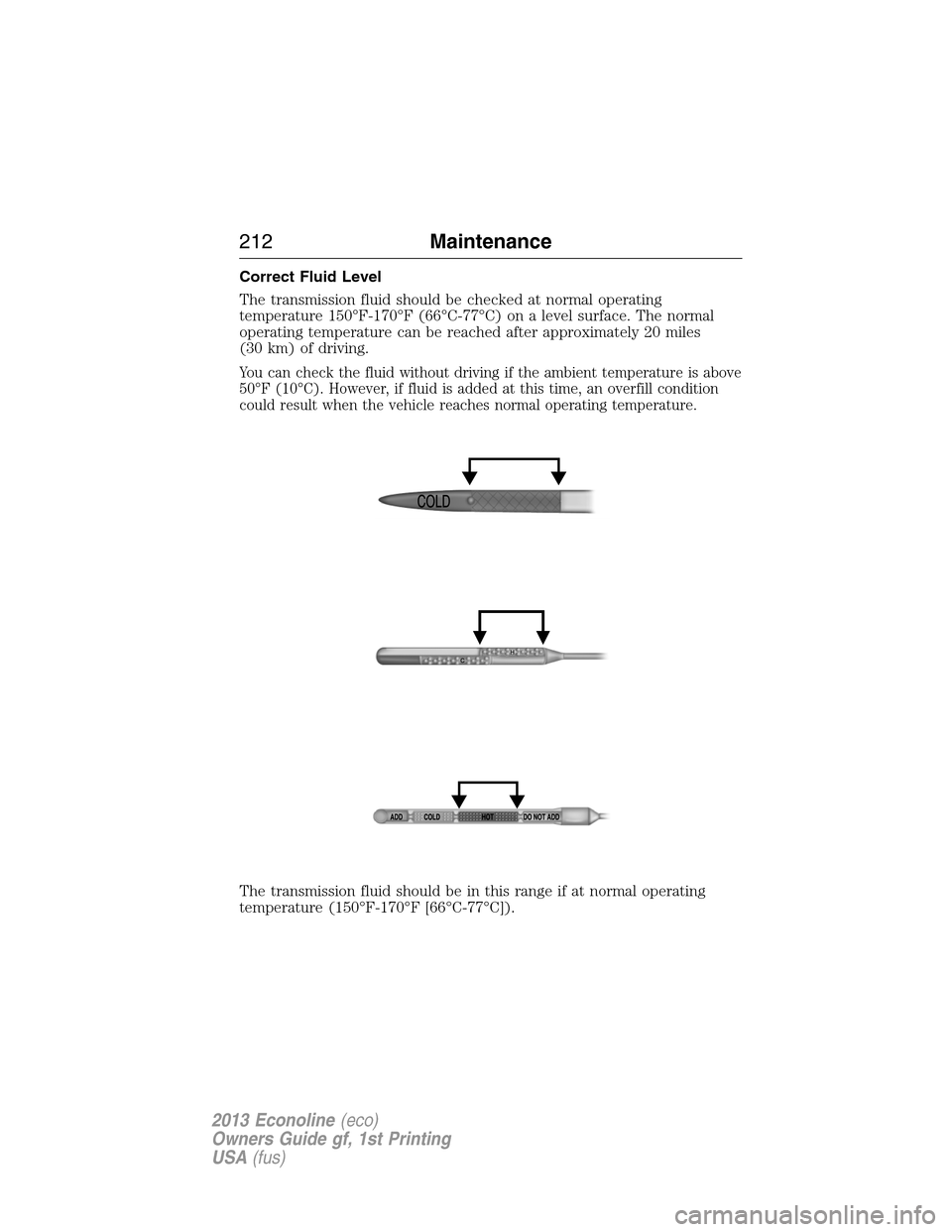
Correct Fluid Level
The transmission fluid should be checked at normal operating
temperature 150°F-170°F (66°C-77°C) on a level surface. The normal
operating temperature can be reached after approximately 20 miles
(30 km) of driving.
You can check the fluid without driving if the ambient temperature is above
50°F (10°C). However, if fluid is added at this time, an overfill condition
could result when the vehicle reaches normal operating temperature.
The transmission fluid should be in this range if at normal operating
temperature (150°F-170°F [66°C-77°C]).
212Maintenance
2013 Econoline(eco)
Owners Guide gf, 1st Printing
USA(fus)
Page 213 of 416
![FORD E SERIES 2013 4.G Owners Guide The transmission fluid should be in this range if at ambient temperature
(50°F-95°F [10°C-35°C]).
Maintenance213
2013 Econoline(eco)
Owners Guide gf, 1st Printing
USA(fus)](/img/11/4821/w960_4821-212.png "FORD E SERIES 2013 4.G Owners Guide The transmission fluid should be in this range if at ambient temperature
(50°F-95°F [10°C-35°C]).
Maintenance213
2013 Econoline(eco)
Owners Guide gf, 1st Printing
USA(fus)")
The transmission fluid should be in this range if at ambient temperature
(50°F-95°F [10°C-35°C]).
Maintenance213
2013 Econoline(eco)
Owners Guide gf, 1st Printing
USA(fus)