air condition FORD E SERIES 2014 4.G Owners Manual
[x] Cancel search | Manufacturer: FORD, Model Year: 2014, Model line: E SERIES, Model: FORD E SERIES 2014 4.GPages: 438, PDF Size: 5.12 MB
Page 3 of 438
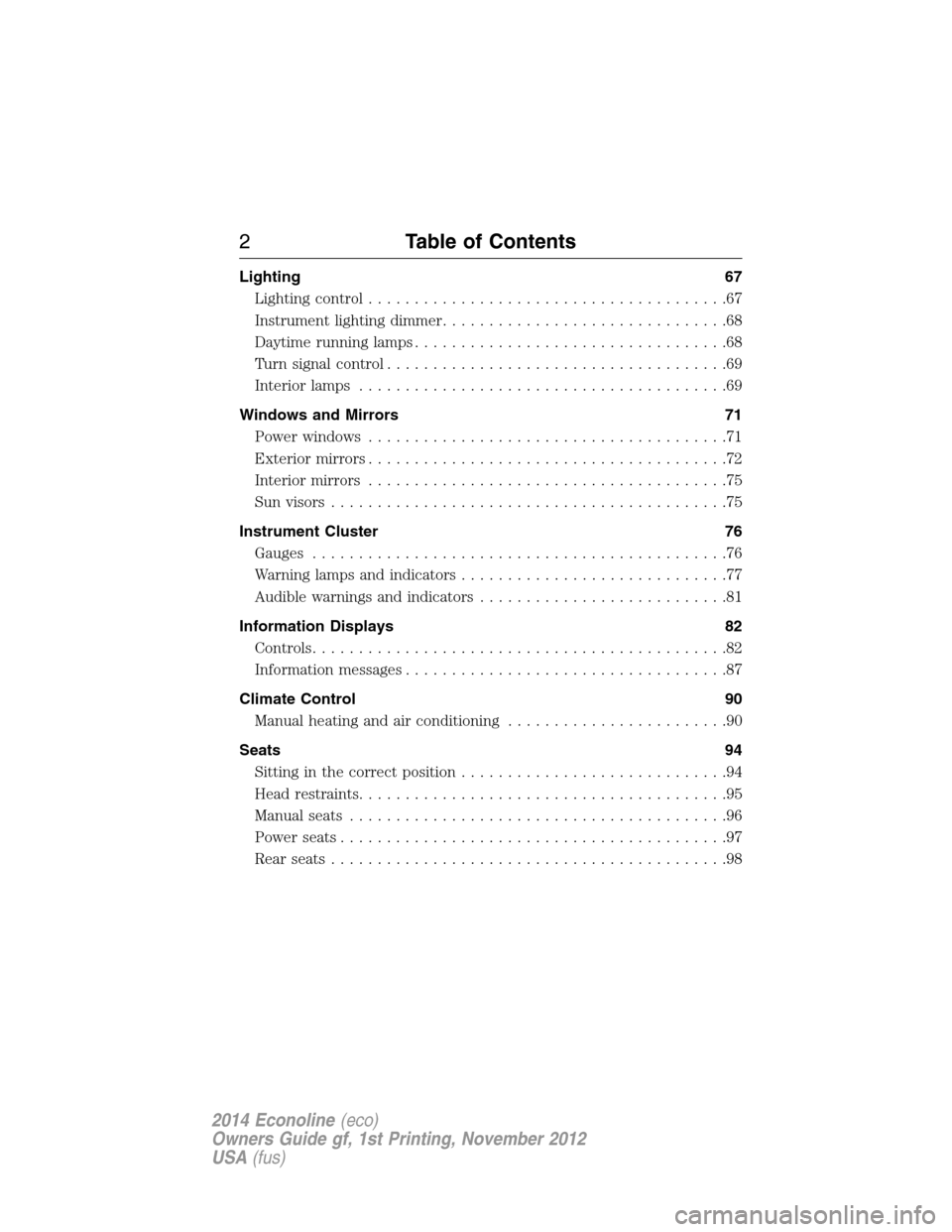
Lighting 67
Lighting control.......................................67
Instrument lighting dimmer...............................68
Daytime running lamps..................................68
Turn signal control.....................................69
Interior lamps........................................69
Windows and Mirrors 71
Power windows.......................................71
Exteriormirrors.......................................72
Interiormirrors .......................................75
Sunvisors ...........................................75
Instrument Cluster 76
Gauges.............................................76
Warning lamps and indicators.............................77
Audible warnings and indicators...........................81
Information Displays 82
Controls.............................................82
Information messages...................................87
Climate Control 90
Manual heating and air conditioning........................90
Seats 94
Sitting in the correct position.............................94
Head restraints........................................95
Manual seats.........................................96
Power seats..........................................97
Rear seats...........................................98
2Table of Contents
2014 Econoline(eco)
Owners Guide gf, 1st Printing, November 2012
USA(fus)
Page 13 of 438
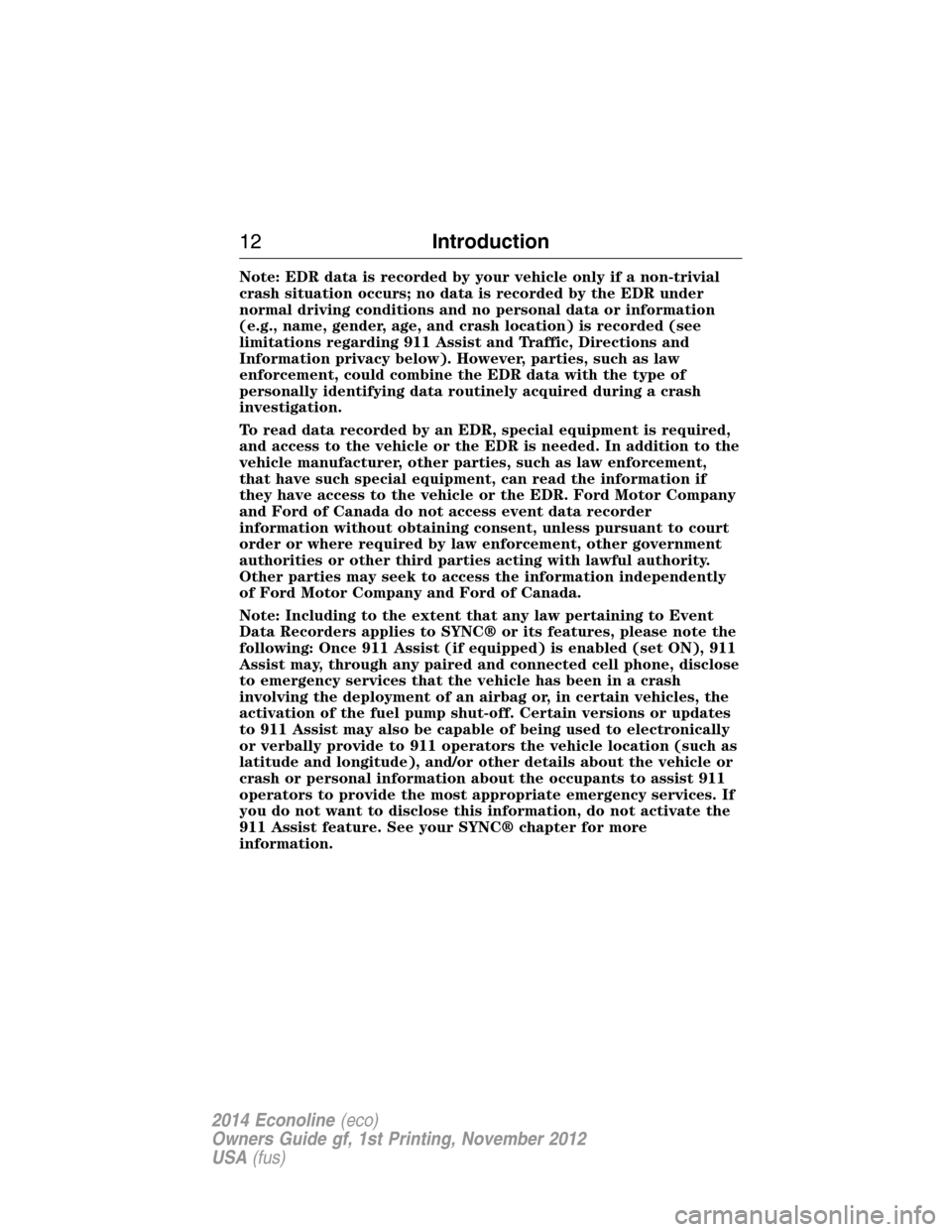
Note: EDR data is recorded by your vehicle only if a non-trivial
crash situation occurs; no data is recorded by the EDR under
normal driving conditions and no personal data or information
(e.g., name, gender, age, and crash location) is recorded (see
limitations regarding 911 Assist and Traffic, Directions and
Information privacy below). However, parties, such as law
enforcement, could combine the EDR data with the type of
personally identifying data routinely acquired during a crash
investigation.
To read data recorded by an EDR, special equipment is required,
and access to the vehicle or the EDR is needed. In addition to the
vehicle manufacturer, other parties, such as law enforcement,
that have such special equipment, can read the information if
they have access to the vehicle or the EDR. Ford Motor Company
and Ford of Canada do not access event data recorder
information without obtaining consent, unless pursuant to court
order or where required by law enforcement, other government
authorities or other third parties acting with lawful authority.
Other parties may seek to access the information independently
of Ford Motor Company and Ford of Canada.
Note: Including to the extent that any law pertaining to Event
Data Recorders applies to SYNC® or its features, please note the
following: Once 911 Assist (if equipped) is enabled (set ON), 911
Assist may, through any paired and connected cell phone, disclose
to emergency services that the vehicle has been in a crash
involving the deployment of an airbag or, in certain vehicles, the
activation of the fuel pump shut-off. Certain versions or updates
to 911 Assist may also be capable of being used to electronically
or verbally provide to 911 operators the vehicle location (such as
latitude and longitude), and/or other details about the vehicle or
crash or personal information about the occupants to assist 911
operators to provide the most appropriate emergency services. If
you do not want to disclose this information, do not activate the
911 Assist feature. See your SYNC® chapter for more
information.
12Introduction
2014 Econoline(eco)
Owners Guide gf, 1st Printing, November 2012
USA(fus)
Page 14 of 438
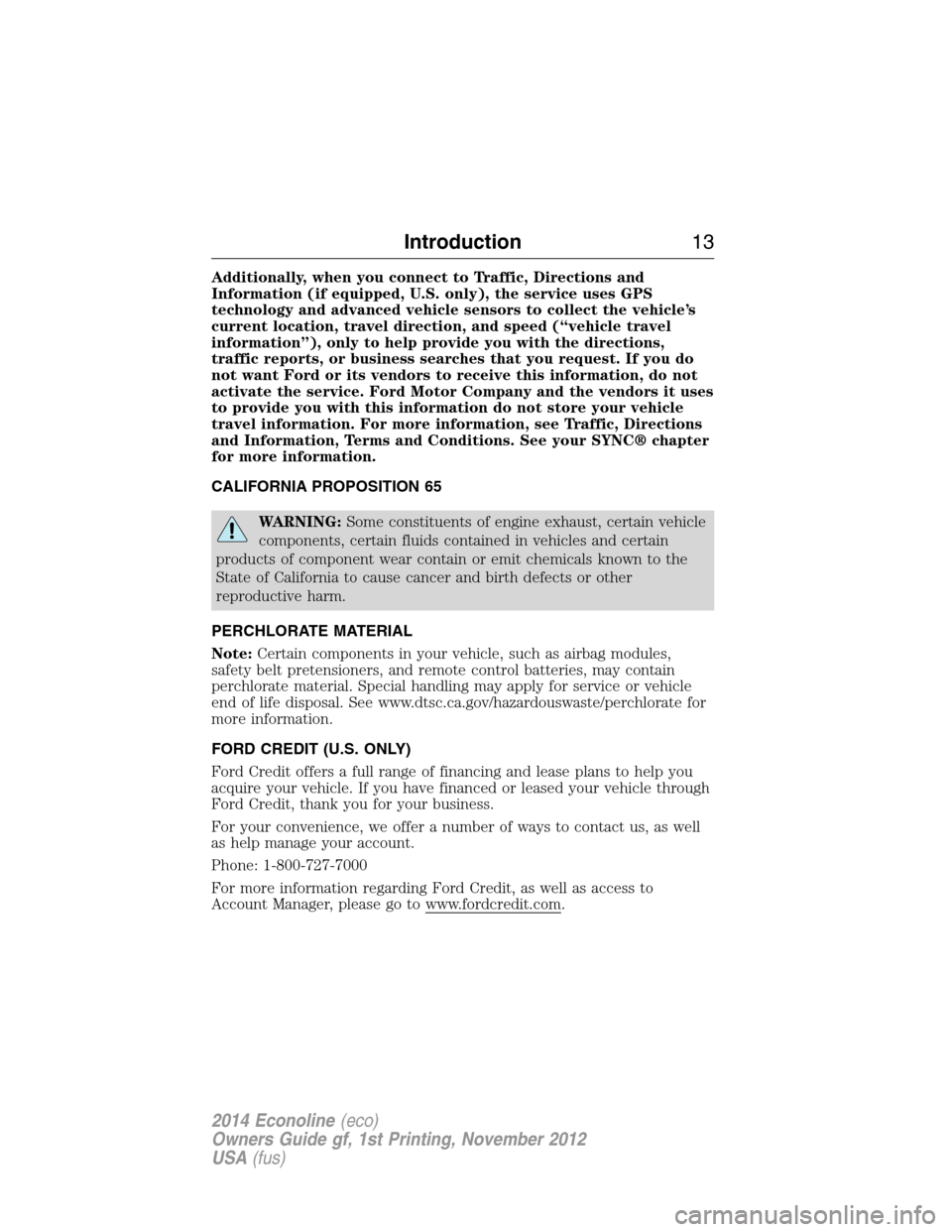
Additionally, when you connect to Traffic, Directions and
Information (if equipped, U.S. only), the service uses GPS
technology and advanced vehicle sensors to collect the vehicle’s
current location, travel direction, and speed (“vehicle travel
information”), only to help provide you with the directions,
traffic reports, or business searches that you request. If you do
not want Ford or its vendors to receive this information, do not
activate the service. Ford Motor Company and the vendors it uses
to provide you with this information do not store your vehicle
travel information. For more information, see Traffic, Directions
and Information, Terms and Conditions. See your SYNC® chapter
for more information.
CALIFORNIA PROPOSITION 65
WARNING:Some constituents of engine exhaust, certain vehicle
components, certain fluids contained in vehicles and certain
products of component wear contain or emit chemicals known to the
State of California to cause cancer and birth defects or other
reproductive harm.
PERCHLORATE MATERIAL
Note:Certain components in your vehicle, such as airbag modules,
safety belt pretensioners, and remote control batteries, may contain
perchlorate material. Special handling may apply for service or vehicle
end of life disposal. See www.dtsc.ca.gov/hazardouswaste/perchlorate for
more information.
FORD CREDIT (U.S. ONLY)
Ford Credit offers a full range of financing and lease plans to help you
acquire your vehicle. If you have financed or leased your vehicle through
Ford Credit, thank you for your business.
For your convenience, we offer a number of ways to contact us, as well
as help manage your account.
Phone: 1-800-727-7000
For more information regarding Ford Credit, as well as access to
Account Manager, please go to www.fordcredit.com.
Introduction13
2014 Econoline(eco)
Owners Guide gf, 1st Printing, November 2012
USA(fus)
Page 15 of 438
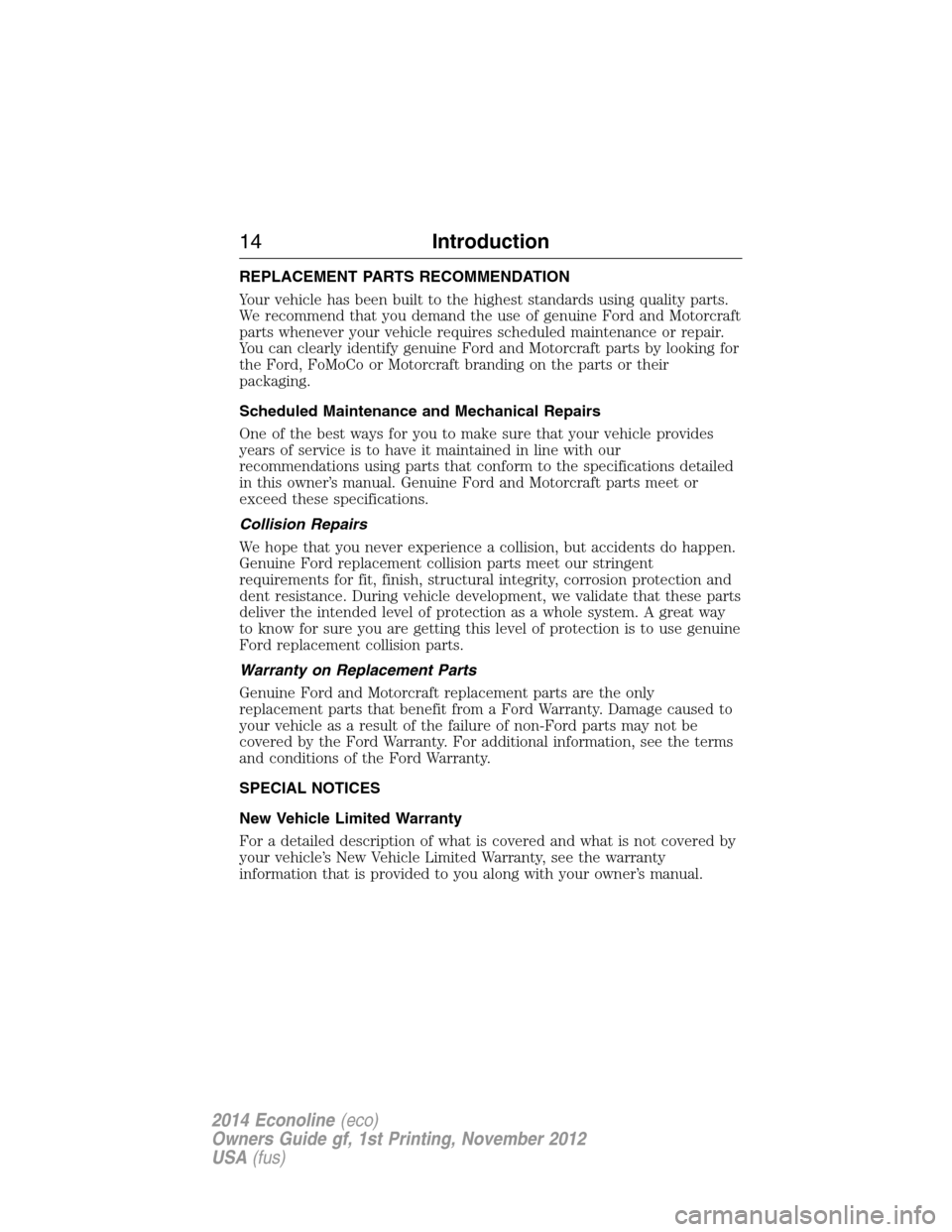
REPLACEMENT PARTS RECOMMENDATION
Your vehicle has been built to the highest standards using quality parts.
We recommend that you demand the use of genuine Ford and Motorcraft
parts whenever your vehicle requires scheduled maintenance or repair.
You can clearly identify genuine Ford and Motorcraft parts by looking for
the Ford, FoMoCo or Motorcraft branding on the parts or their
packaging.
Scheduled Maintenance and Mechanical Repairs
One of the best ways for you to make sure that your vehicle provides
years of service is to have it maintained in line with our
recommendations using parts that conform to the specifications detailed
in this owner’s manual. Genuine Ford and Motorcraft parts meet or
exceed these specifications.
Collision Repairs
We hope that you never experience a collision, but accidents do happen.
Genuine Ford replacement collision parts meet our stringent
requirements for fit, finish, structural integrity, corrosion protection and
dent resistance. During vehicle development, we validate that these parts
deliver the intended level of protection as a whole system. A great way
to know for sure you are getting this level of protection is to use genuine
Ford replacement collision parts.
Warranty on Replacement Parts
Genuine Ford and Motorcraft replacement parts are the only
replacement parts that benefit from a Ford Warranty. Damage caused to
your vehicle as a result of the failure of non-Ford parts may not be
covered by the Ford Warranty. For additional information, see the terms
and conditions of the Ford Warranty.
SPECIAL NOTICES
New Vehicle Limited Warranty
For a detailed description of what is covered and what is not covered by
your vehicle’s New Vehicle Limited Warranty, see the warranty
information that is provided to you along with your owner’s manual.
14Introduction
2014 Econoline(eco)
Owners Guide gf, 1st Printing, November 2012
USA(fus)
Page 52 of 438
•the vehicle has a rear seat too small to accommodate a rear-facing
infant seat; or
•the infant has a medical condition which, according to the infant’s
physician, makes it necessary for the infant to ride in the front so that
the driver can constantly monitor the child’s condition.
2.Child age 1 to 12.A child age 1 to 12 must ride in the front seat
because:
•the vehicle has no rear seat;
•although children ages 1 to 12 ride in the rear seat(s) whenever
possible, children ages 1 to 12 sometimes must ride in the front
because no space is available in the rear seat(s) of the vehicle; or
•the child has a medical condition which, according to the child’s
physician, makes it necessary for the child to ride in the front seat so
that the driver can constantly monitor the child’s condition.
3.Medical condition.A passenger has a medical condition which,
according to his or her physician:
•causes the passenger airbag to pose a special risk for the passenger;
and
•
makes the potential harm from the passenger airbag in a crash greater
than the potential harm from turning off the airbag and allowing the
passenger, even if belted, to hit the dashboard or windshield in a crash.
Transport Canada Deactivation Criteria (Canada Only)
WARNING:This vehicle has special energy management safety
belts for the driver and right front passenger. These particular
belts are specifically designed to work with airbags to help reduce the
risk of injury in a crash. The energy management safety belt is designed
to give or release additional belt webbing in some accidents to reduce
concentration of force on an occupant’s chest and reduce the risk of
certain bone fractures and injuries to underlying organs. In a crash, if
the airbag is turned off, this energy management safety belt might
permit the person wearing the belt to move forward enough to incur a
serious or fatal injury. The more severe the crash, and the heavier the
occupant, the greater the risk is. Be sure the airbag is turned on for
any person who does not qualify under the National Highway Traffic
Safety Administration deactivation criteria.
Supplementary Restraints System51
2014 Econoline(eco)
Owners Guide gf, 1st Printing, November 2012
USA(fus)
Page 53 of 438
1.Infant:An infant (less than 1 year old) must ride in the front seat
because:
•my vehicle has no rear seat;
•the rear seat in my vehicle cannot accommodate a rear-facing infant
seat; or
•the infant has a medical condition which, according to the infant’s
physician, makes it necessary for the infant to ride in the front seat so
that the driver can monitor the infant’s condition.
2.Child age 12 or under:A child age 12 or under must ride in the
front seat because:
•my vehicle has no rear seat;
•although children age 12 and under ride in the rear seat whenever
possible, children age 12 and under have no option but to sometimes
ride in the front seat because rear seat space is insufficient; or
•the child has a medical condition that, according to the child’s
physician, makes it necessary for the child to ride in the front seat so
that the driver can monitor the child’s condition.
3.Medical condition:A passenger has a medical condition that,
according to his or her physician:
•poses a special risk for the passenger if the airbag deploys; and
•makes the potential harm from the passenger airbag deployment
greater than the potential harm from turning off the airbag and
experiencing a crash without the protection offered by the airbag
CRASH SENSORS AND AIRBAG INDICATOR
WARNING:Modifying or adding equipment to the front end of
your vehicle (including frame, bumper, front end body structure
and tow hooks) may affect the performance of the airbag system,
increasing the risk of injury. Do not modify the front end of your
vehicle.
Your vehicle has a collection of crash and occupant sensors which
provide information to the restraints control module. The restraints
control module deploys (activates) the front safety belt pretensioners,
driver airbag and passenger airbag. Based on the type of accident, the
restraints control module will deploy the appropriate safety devices.
52Supplementary Restraints System
2014 Econoline(eco)
Owners Guide gf, 1st Printing, November 2012
USA(fus)
Page 54 of 438
The restraints control module also monitors the readiness of the above
safety devices plus the crash and occupant sensors. The readiness of the
safety system is indicated by a warning indicator light in the instrument
cluster or by a backup tone if the warning light is not working. See the
Instrument Clusterchapter. Routine maintenance of the airbag is not
required.
A difficulty with the system is indicated by one or more of the following:
•The readiness light will either flash or stay lit.
•The readiness light will not illuminate immediately after the
ignition is turned on.
•A series of five beeps will be heard. The tone pattern will repeat
periodically until the problem or light are repaired.
If any of these things happen, even intermittently, have the supplemental
restraint system serviced at an authorized dealer immediately. Unless
serviced, the system may not function properly in the event of a crash.
The safety belt pretensioners and the airbag supplemental restraint
system are designed to activate when the vehicle sustains frontal
deceleration sufficient to cause the restraints control module to deploy a
safety device.
The fact that the safety belt pretensioners or airbags did not activate in a
crash does not mean that something is wrong with the system. Rather, it
means the restraints control module determined the accident conditions
(such as crash severity, belt usage) were not appropriate to activate
these safety devices.
•The design of the front airbags is to activate only in frontal and
near-frontal crashes (not rollovers, side impacts or rear impacts)
unless the crash causes sufficient frontal deceleration.
•The design of the safety belt pretensioners is to activate in frontal or
near-frontal crashes and may deploy in rollovers if the vehicle is
equipped with roll stability control.
AIRBAG DISPOSAL
Contact your authorized dealer as soon as possible. Airbags must be
disposed of by qualified personnel.
Supplementary Restraints System53
2014 Econoline(eco)
Owners Guide gf, 1st Printing, November 2012
USA(fus)
Page 92 of 438
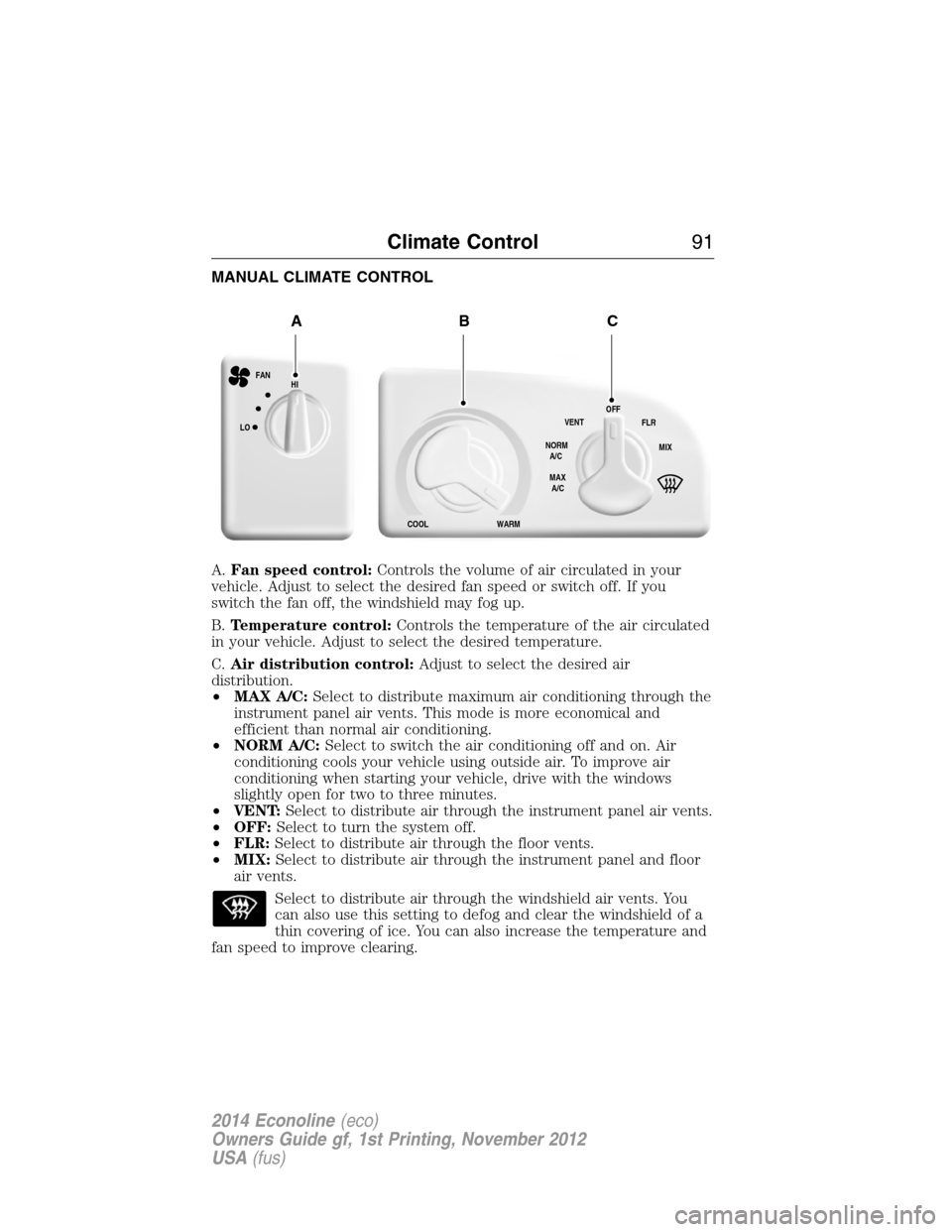
MANUAL CLIMATE CONTROL
A.Fan speed control:Controls the volume of air circulated in your
vehicle. Adjust to select the desired fan speed or switch off. If you
switch the fan off, the windshield may fog up.
B.Temperature control:Controls the temperature of the air circulated
in your vehicle. Adjust to select the desired temperature.
C.Air distribution control:Adjust to select the desired air
distribution.
•MAX A/C:Select to distribute maximum air conditioning through the
instrument panel air vents. This mode is more economical and
efficient than normal air conditioning.
•NORM A/C:Select to switch the air conditioning off and on. Air
conditioning cools your vehicle using outside air. To improve air
conditioning when starting your vehicle, drive with the windows
slightly open for two to three minutes.
•VENT:Select to distribute air through the instrument panel air vents.
•OFF:Select to turn the system off.
•FLR:Select to distribute air through the floor vents.
•MIX:Select to distribute air through the instrument panel and floor
air vents.
Select to distribute air through the windshield air vents. You
can also use this setting to defog and clear the windshield of a
thin covering of ice. You can also increase the temperature and
fan speed to improve clearing.
HI
LO
COOL WARMVENT
NORM
A/C
MAX
A/COFF
MIX FLR FAN
ABC
Climate Control91
2014 Econoline(eco)
Owners Guide gf, 1st Printing, November 2012
USA(fus)
Page 109 of 438
Cold Weather Starting (Flexible Fuel Vehicles Only)
Note:Do not crank the engine for more than 10 seconds at a time as
starter damage may occur. If the engine fails to start, turn the key to off
and wait 30 seconds before trying again.
Note:Do not use starting fluid such as ether in the air intake system.
Such fluid could cause immediate explosive damage to the engine and
possible personal injury.
Note:You may experience a decrease in peak performance when the
engine is cold when operating on E85 ethanol.
The starting characteristics of all grades of E85 ethanol make it
unsuitable for use when ambient temperatures fall below 0°F (-18°C).
Consult your fuel distributor for the availability of winter grade ethanol.
As the outside temperature approaches freezing, ethanol fuel distributors
should supply winter grade ethanol (same as with unleaded gasoline). If
summer grade ethanol is used in cold weather conditions, 0°F to 32°F
(-18°C to 0°C), you may experience increased cranking times, rough idle
or hesitation until the engine has warmed up.
If you should experience cold weather starting problems on E85 ethanol,
and neither an alternative brand of E85 ethanol nor an engine block
heater is available, adding unleaded gasoline to your tank improves cold
starting performance. Your vehicle is designed to operate on E85 ethanol
alone, unleaded gasoline alone, or any mixture of the two.
SeeChoosing the right fuelin theFuels and Refuelingchapter for
more information on ethanol.
Guarding Against Exhaust Fumes
WARNING:If you smell exhaust fumes inside your vehicle, have
this checked immediately. Do not drive your vehicle if you smell
exhaust fumes. Carbon monoxide is present in exhaust fumes. Take
precautions to avoid its dangerous effects.
Important Ventilating Information
If you stop your vehicle and leave the engine idling for long periods, we
recommend that you do one of the following:
•Open the windows at least 1 inch (2.5 centimeters).
•Set your climate control to outside air.
108Starting and Stopping the Engine
2014 Econoline(eco)
Owners Guide gf, 1st Printing, November 2012
USA(fus)
Page 114 of 438
Choosing the Right Fuel With a Flex Fuel Vehicle (If Equipped)
Use only UNLEADED gasoline or UNLEADED gasoline blended with a
maximum of 85% ethanol (E-85) in your Flex Fuel Vehicle (FFV). If
your vehicle is flex fuel capable, it will have a yellow bezel placed over
the fuel fill inlet.
Do not use:
•Fuels containing more than 85% ethanol or E-100 fuel.
•Fuels containing methanol.
•Fuels containing metallic based additives, including manganese-based
compounds.
•Fuels containing the octane booster additive, methylcyclopentadienyl
manganese tricarbonyl (MMT).
•Leaded-fuel (The use of leaded fuel is prohibited by law).
Use of any fuel other than recommended fuel can cause powertrain
damage, impair the emission control system or cause loss of vehicle
performance. Any damage to a vehicle that is caused by use of fuel not
recommended will not be covered under warranty.
Octane Recommendations
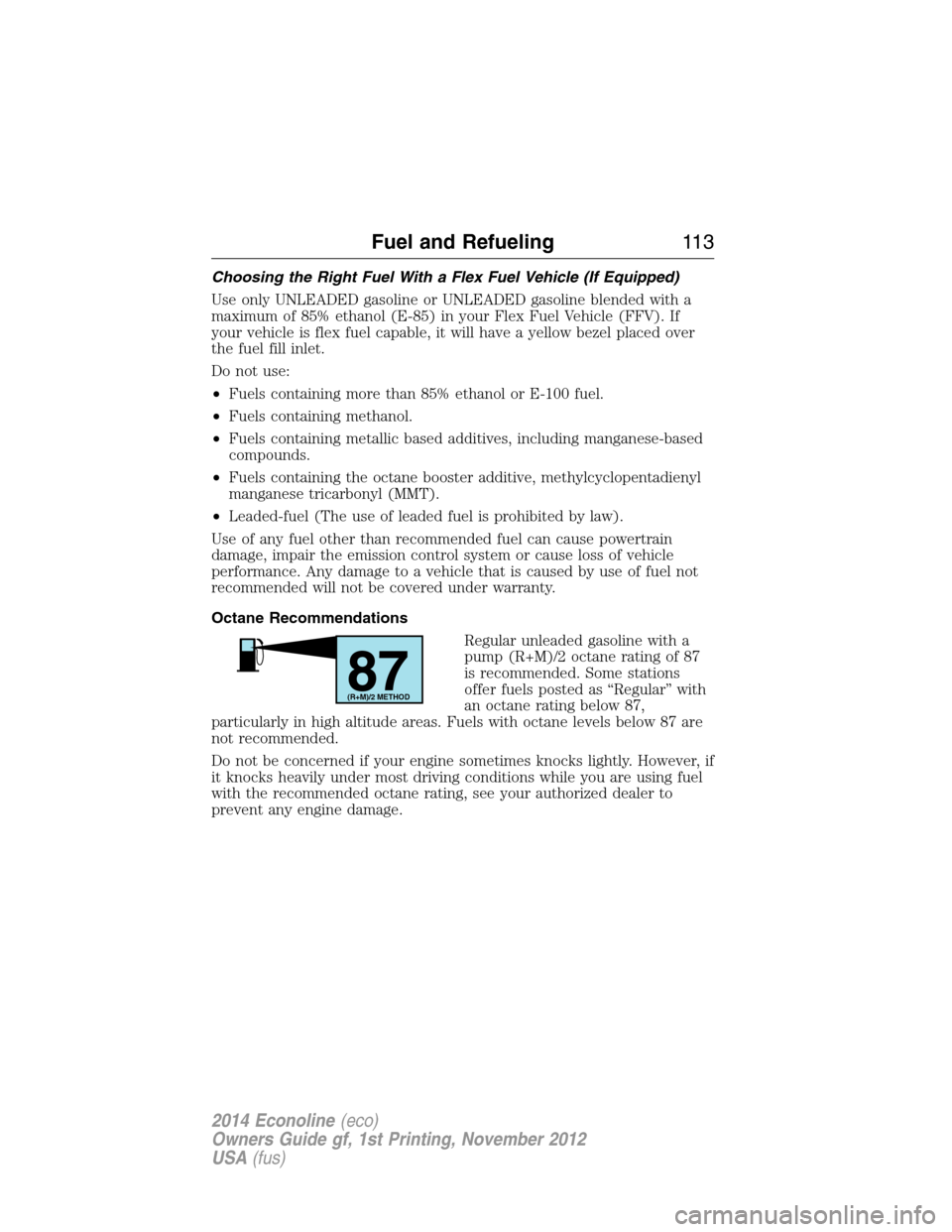
Regular unleaded gasoline with a
pump (R+M)/2 octane rating of 87
is recommended. Some stations
offer fuels posted as “Regular” with
an octane rating below 87,
particularly in high altitude areas. Fuels with octane levels below 87 are
not recommended.
Do not be concerned if your engine sometimes knocks lightly. However, if
it knocks heavily under most driving conditions while you are using fuel
with the recommended octane rating, see your authorized dealer to
prevent any engine damage.
87(R+M)/2 METHOD
Fuel and Refueling11 3
2014 Econoline(eco)
Owners Guide gf, 1st Printing, November 2012
USA(fus)