battery FORD E SERIES 2016 4.G Owner's Manual
[x] Cancel search | Manufacturer: FORD, Model Year: 2016, Model line: E SERIES, Model: FORD E SERIES 2016 4.GPages: 319, PDF Size: 6.18 MB
Page 130 of 319
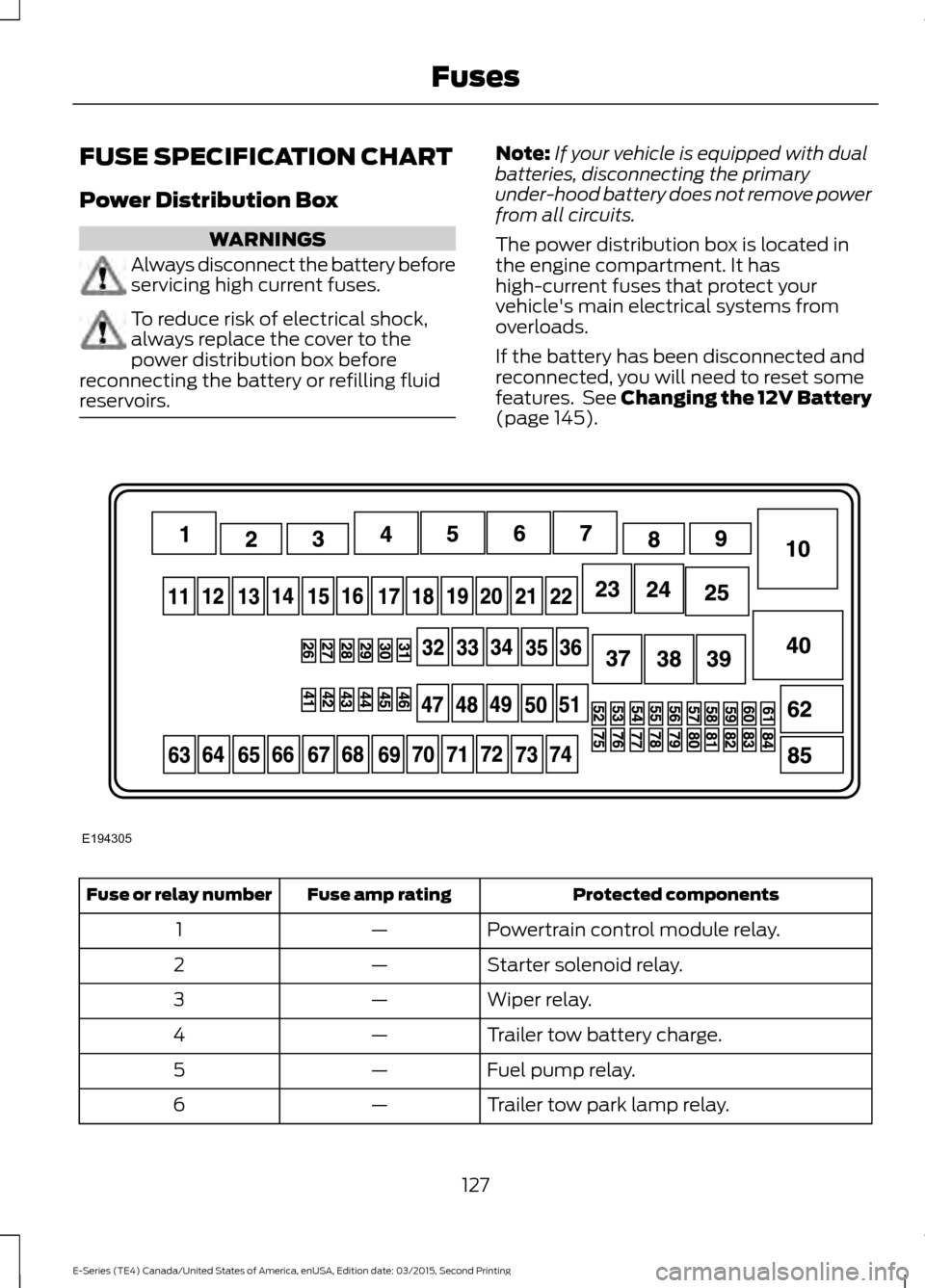
FUSE SPECIFICATION CHART
Power Distribution Box
WARNINGS
Always disconnect the battery before
servicing high current fuses.
To reduce risk of electrical shock,
always replace the cover to the
power distribution box before
reconnecting the battery or refilling fluid
reservoirs. Note:
If your vehicle is equipped with dual
batteries, disconnecting the primary
under-hood battery does not remove power
from all circuits.
The power distribution box is located in
the engine compartment. It has
high-current fuses that protect your
vehicle's main electrical systems from
overloads.
If the battery has been disconnected and
reconnected, you will need to reset some
features. See Changing the 12V Battery
(page 145). Protected components
Fuse amp rating
Fuse or relay number
Powertrain control module relay.
—
1
Starter solenoid relay.
—
2
Wiper relay.
—
3
Trailer tow battery charge.
—
4
Fuel pump relay.
—
5
Trailer tow park lamp relay.
—
6
127
E-Series (TE4) Canada/United States of America, enUSA, Edition date: 03/2015, Second Printing FusesE194305
Page 131 of 319
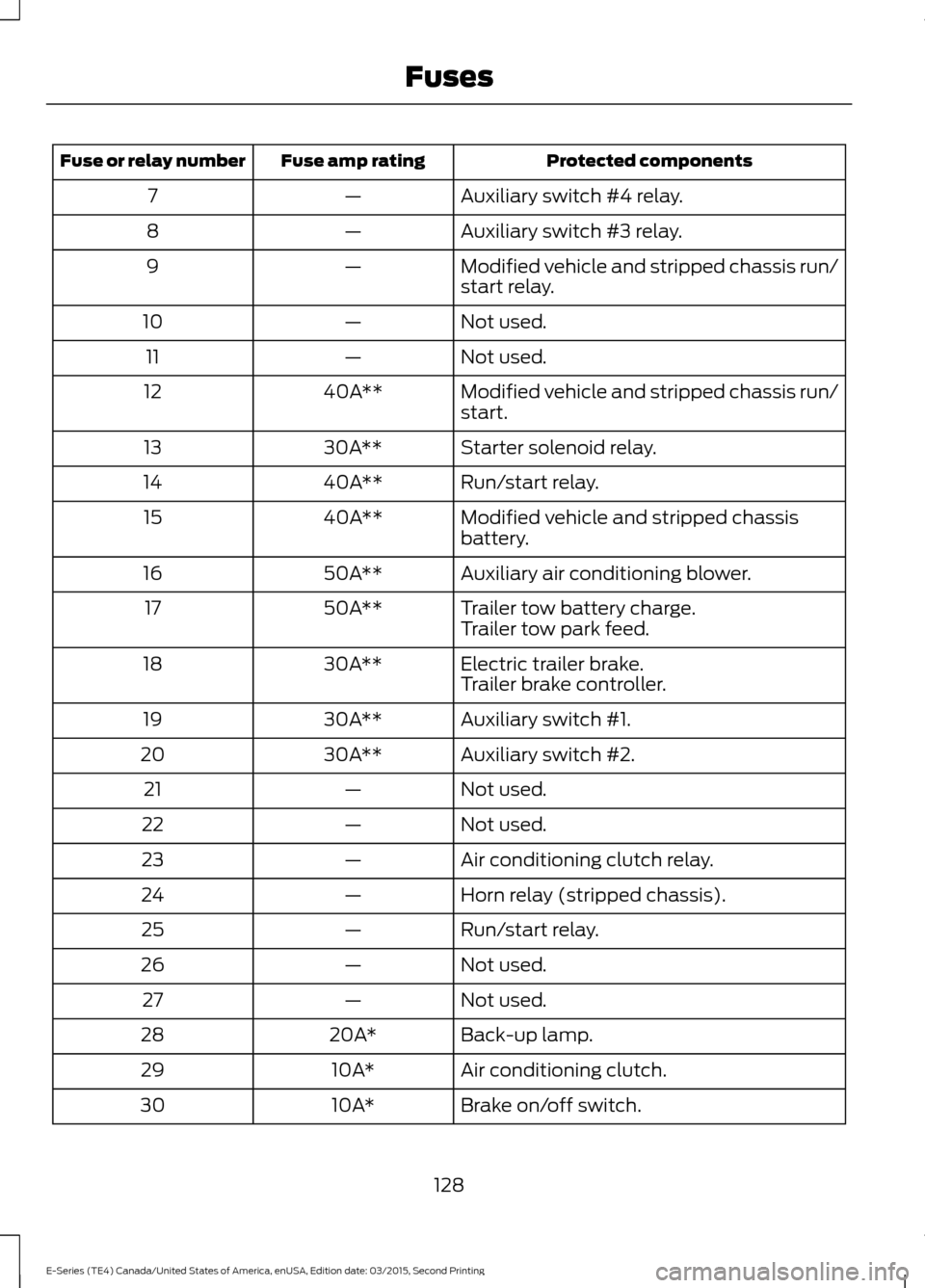
Protected components
Fuse amp rating
Fuse or relay number
Auxiliary switch #4 relay.
—
7
Auxiliary switch #3 relay.
—
8
Modified vehicle and stripped chassis run/
start relay.
—
9
Not used.
—
10
Not used.
—
11
Modified vehicle and stripped chassis run/
start.
40A**
12
Starter solenoid relay.
30A**
13
Run/start relay.
40A**
14
Modified vehicle and stripped chassis
battery.
40A**
15
Auxiliary air conditioning blower.
50A**
16
Trailer tow battery charge.
50A**
17
Trailer tow park feed.
Electric trailer brake.
30A**
18
Trailer brake controller.
Auxiliary switch #1.
30A**
19
Auxiliary switch #2.
30A**
20
Not used.
—
21
Not used.
—
22
Air conditioning clutch relay.
—
23
Horn relay (stripped chassis).
—
24
Run/start relay.
—
25
Not used.
—
26
Not used.
—
27
Back-up lamp.
20A*
28
Air conditioning clutch.
10A*
29
Brake on/off switch.
10A*
30
128
E-Series (TE4) Canada/United States of America, enUSA, Edition date: 03/2015, Second Printing Fuses
Page 132 of 319
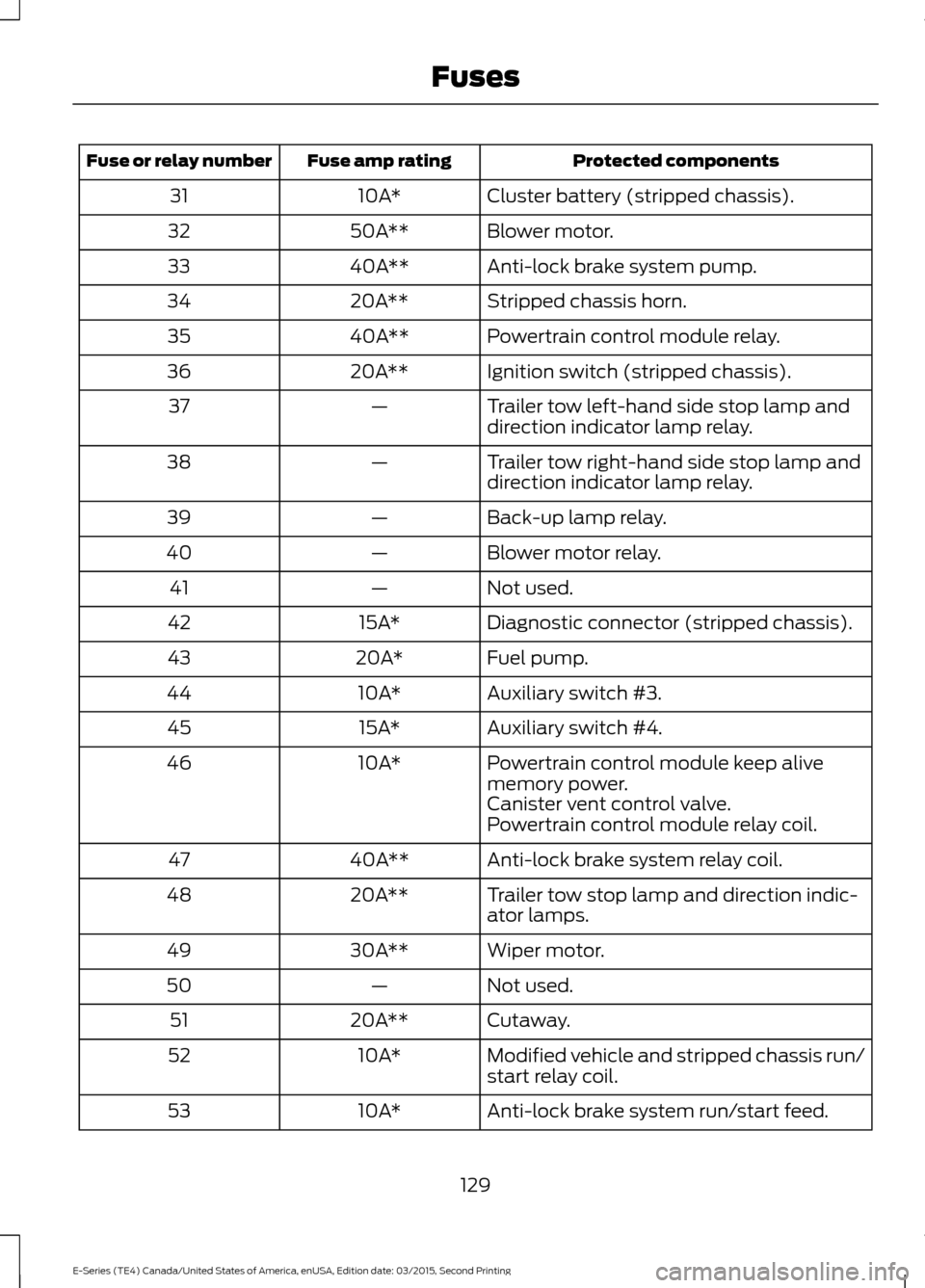
Protected components
Fuse amp rating
Fuse or relay number
Cluster battery (stripped chassis).
10A*
31
Blower motor.
50A**
32
Anti-lock brake system pump.
40A**
33
Stripped chassis horn.
20A**
34
Powertrain control module relay.
40A**
35
Ignition switch (stripped chassis).
20A**
36
Trailer tow left-hand side stop lamp and
direction indicator lamp relay.
—
37
Trailer tow right-hand side stop lamp and
direction indicator lamp relay.
—
38
Back-up lamp relay.
—
39
Blower motor relay.
—
40
Not used.
—
41
Diagnostic connector (stripped chassis).
15A*
42
Fuel pump.
20A*
43
Auxiliary switch #3.
10A*
44
Auxiliary switch #4.
15A*
45
Powertrain control module keep alive
memory power.
10A*
46
Canister vent control valve.
Powertrain control module relay coil.
Anti-lock brake system relay coil.
40A**
47
Trailer tow stop lamp and direction indic-
ator lamps.
20A**
48
Wiper motor.
30A**
49
Not used.
—
50
Cutaway.
20A**
51
Modified vehicle and stripped chassis run/
start relay coil.
10A*
52
Anti-lock brake system run/start feed.
10A*
53
129
E-Series (TE4) Canada/United States of America, enUSA, Edition date: 03/2015, Second Printing Fuses
Page 133 of 319
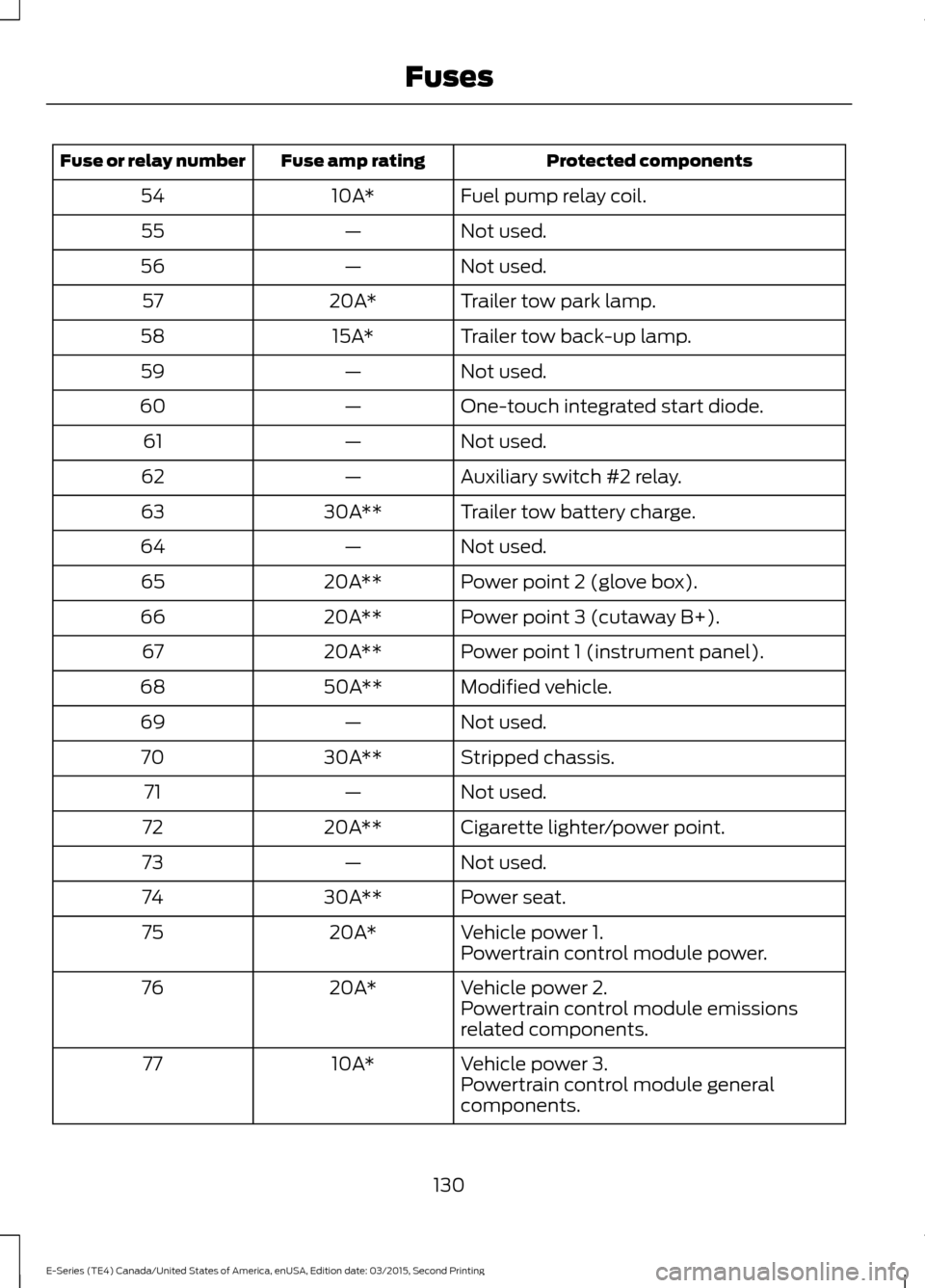
Protected components
Fuse amp rating
Fuse or relay number
Fuel pump relay coil.
10A*
54
Not used.
—
55
Not used.
—
56
Trailer tow park lamp.
20A*
57
Trailer tow back-up lamp.
15A*
58
Not used.
—
59
One-touch integrated start diode.
—
60
Not used.
—
61
Auxiliary switch #2 relay.
—
62
Trailer tow battery charge.
30A**
63
Not used.
—
64
Power point 2 (glove box).
20A**
65
Power point 3 (cutaway B+).
20A**
66
Power point 1 (instrument panel).
20A**
67
Modified vehicle.
50A**
68
Not used.
—
69
Stripped chassis.
30A**
70
Not used.
—
71
Cigarette lighter/power point.
20A**
72
Not used.
—
73
Power seat.
30A**
74
Vehicle power 1.
20A*
75
Powertrain control module power.
Vehicle power 2.
20A*
76
Powertrain control module emissions
related components.
Vehicle power 3.
10A*
77
Powertrain control module general
components.
130
E-Series (TE4) Canada/United States of America, enUSA, Edition date: 03/2015, Second Printing Fuses
Page 134 of 319
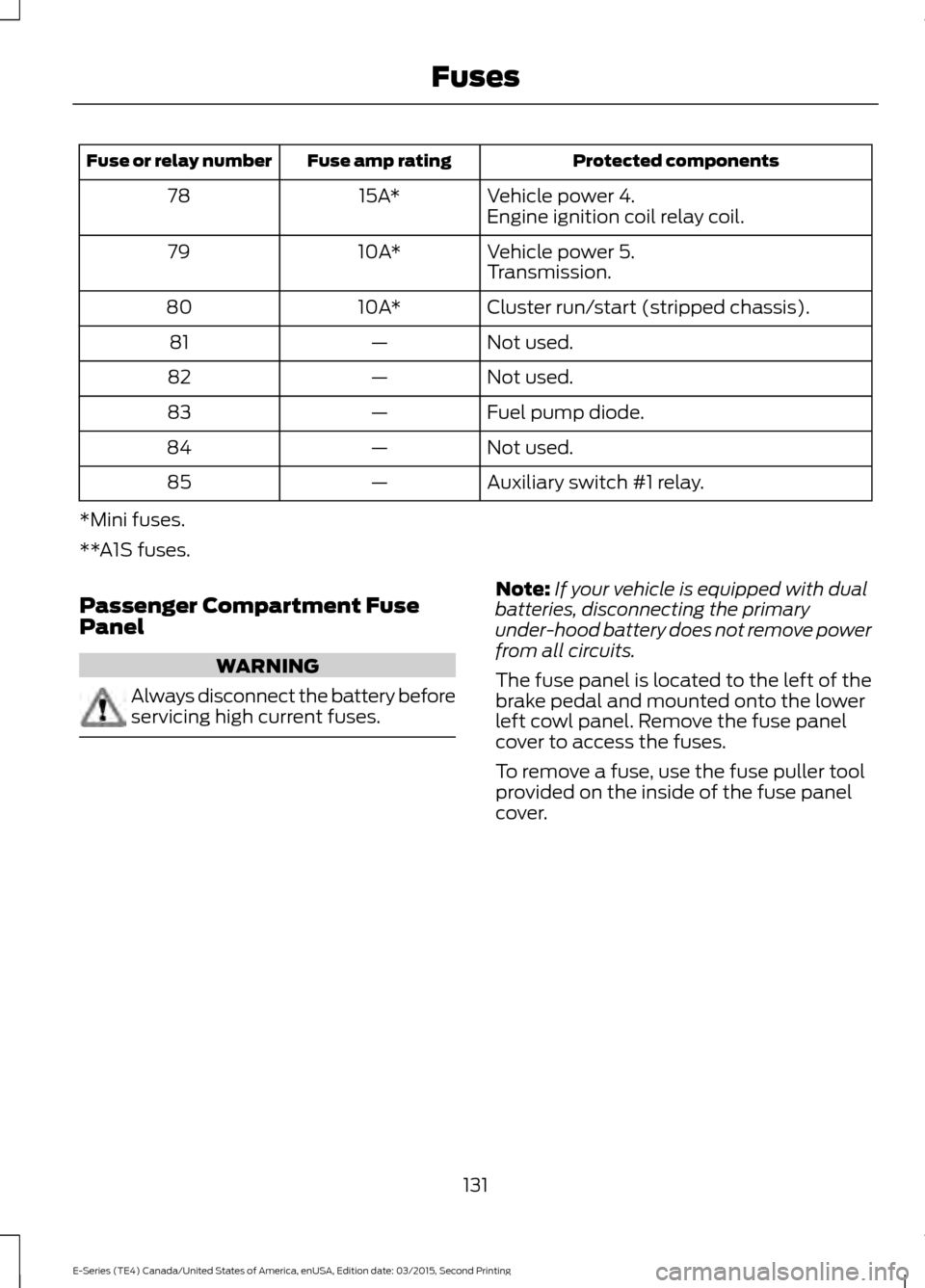
Protected components
Fuse amp rating
Fuse or relay number
Vehicle power 4.
15A*
78
Engine ignition coil relay coil.
Vehicle power 5.
10A*
79
Transmission.
Cluster run/start (stripped chassis).
10A*
80
Not used.
—
81
Not used.
—
82
Fuel pump diode.
—
83
Not used.
—
84
Auxiliary switch #1 relay.
—
85
*Mini fuses.
**A1S fuses.
Passenger Compartment Fuse
Panel WARNING
Always disconnect the battery before
servicing high current fuses. Note:
If your vehicle is equipped with dual
batteries, disconnecting the primary
under-hood battery does not remove power
from all circuits.
The fuse panel is located to the left of the
brake pedal and mounted onto the lower
left cowl panel. Remove the fuse panel
cover to access the fuses.
To remove a fuse, use the fuse puller tool
provided on the inside of the fuse panel
cover.
131
E-Series (TE4) Canada/United States of America, enUSA, Edition date: 03/2015, Second Printing Fuses
Page 137 of 319
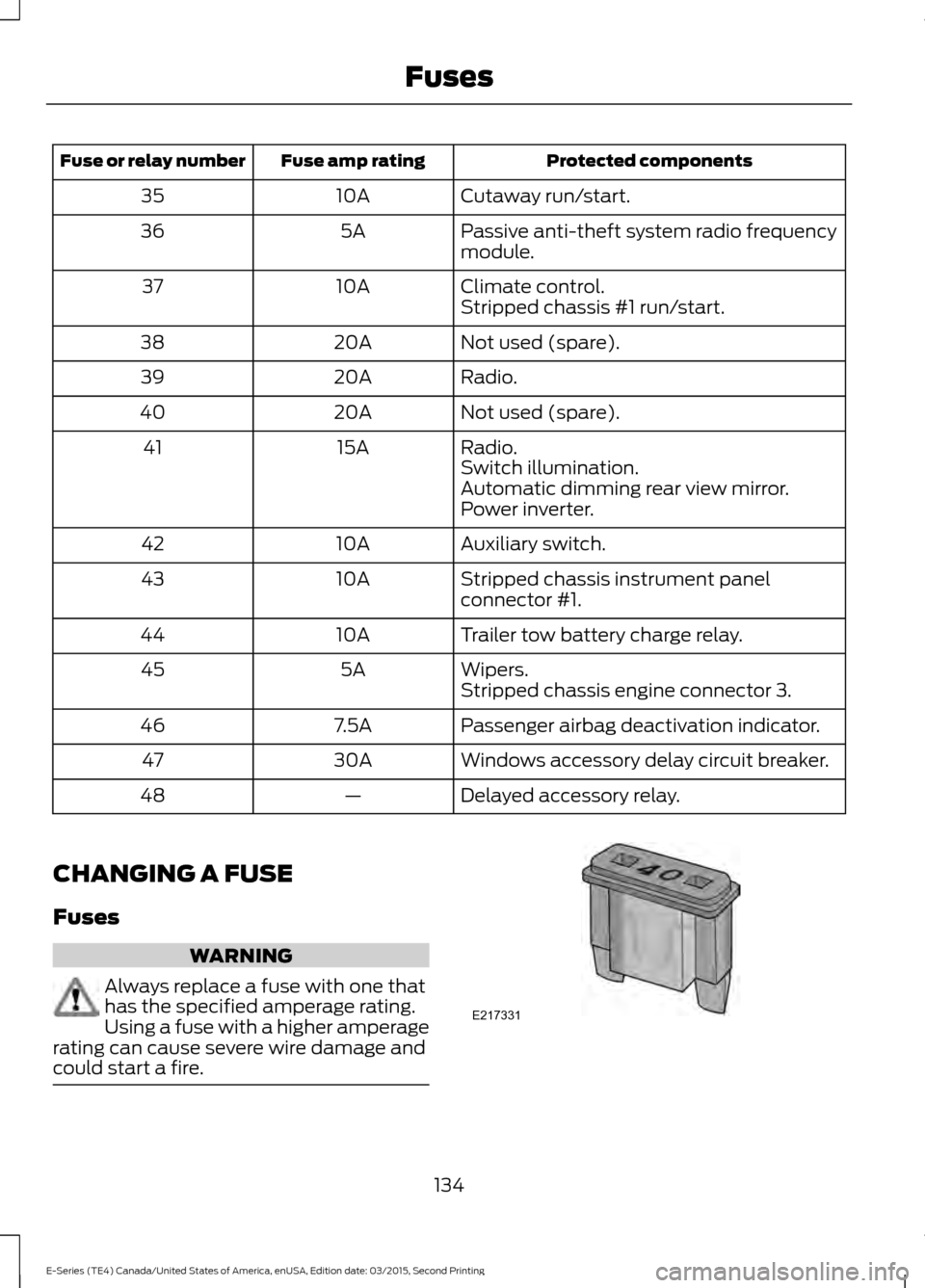
Protected components
Fuse amp rating
Fuse or relay number
Cutaway run/start.
10A
35
Passive anti-theft system radio frequency
module.
5A
36
Climate control.
10A
37
Stripped chassis #1 run/start.
Not used (spare).
20A
38
Radio.
20A
39
Not used (spare).
20A
40
Radio.
15A
41
Switch illumination.
Automatic dimming rear view mirror.
Power inverter.
Auxiliary switch.
10A
42
Stripped chassis instrument panel
connector #1.
10A
43
Trailer tow battery charge relay.
10A
44
Wipers.
5A
45
Stripped chassis engine connector 3.
Passenger airbag deactivation indicator.
7.5A
46
Windows accessory delay circuit breaker.
30A
47
Delayed accessory relay.
—
48
CHANGING A FUSE
Fuses WARNING
Always replace a fuse with one that
has the specified amperage rating.
Using a fuse with a higher amperage
rating can cause severe wire damage and
could start a fire. 134
E-Series (TE4) Canada/United States of America, enUSA, Edition date: 03/2015, Second Printing FusesE217331
Page 139 of 319
GENERAL INFORMATION
Have your vehicle serviced regularly to help
maintain its roadworthiness and resale
value. There is a large network of
authorized dealers that are there to help
you with their professional servicing
expertise. We believe that their specially
trained technicians are best qualified to
service your vehicle properly and expertly.
They are supported by a wide range of
highly specialized tools developed
specifically for servicing your vehicle.
If your vehicle requires professional service,
an authorized dealer can provide the
necessary parts and service. Check your
warranty information to find out which
parts and services are covered.
Use only recommended fuels, lubricants,
fluids and service parts conforming to
specifications. Motorcraft® parts are
designed and built to provide the best
performance in your vehicle.
Precautions
•
Do not work on a hot engine.
• Make sure that nothing gets caught in
moving parts.
• Do not work on a vehicle with the
engine running in an enclosed space,
unless you are sure you have enough
ventilation.
• Keep all open flames and other burning
material (such as cigarettes) away
from the battery and all fuel related
parts.
Working with the Engine Off
1. Set the parking brake and shift to park
(P). 2. Switch off the engine.
3. Block the wheels.
Working with the Engine On WARNING
To reduce the risk of vehicle damage
and/or personal burn injuries, do not
start your engine with the air cleaner
removed and do not remove it while the
engine is running. 1.
Set the parking brake and shift to park
(P).
2. Block the wheels.
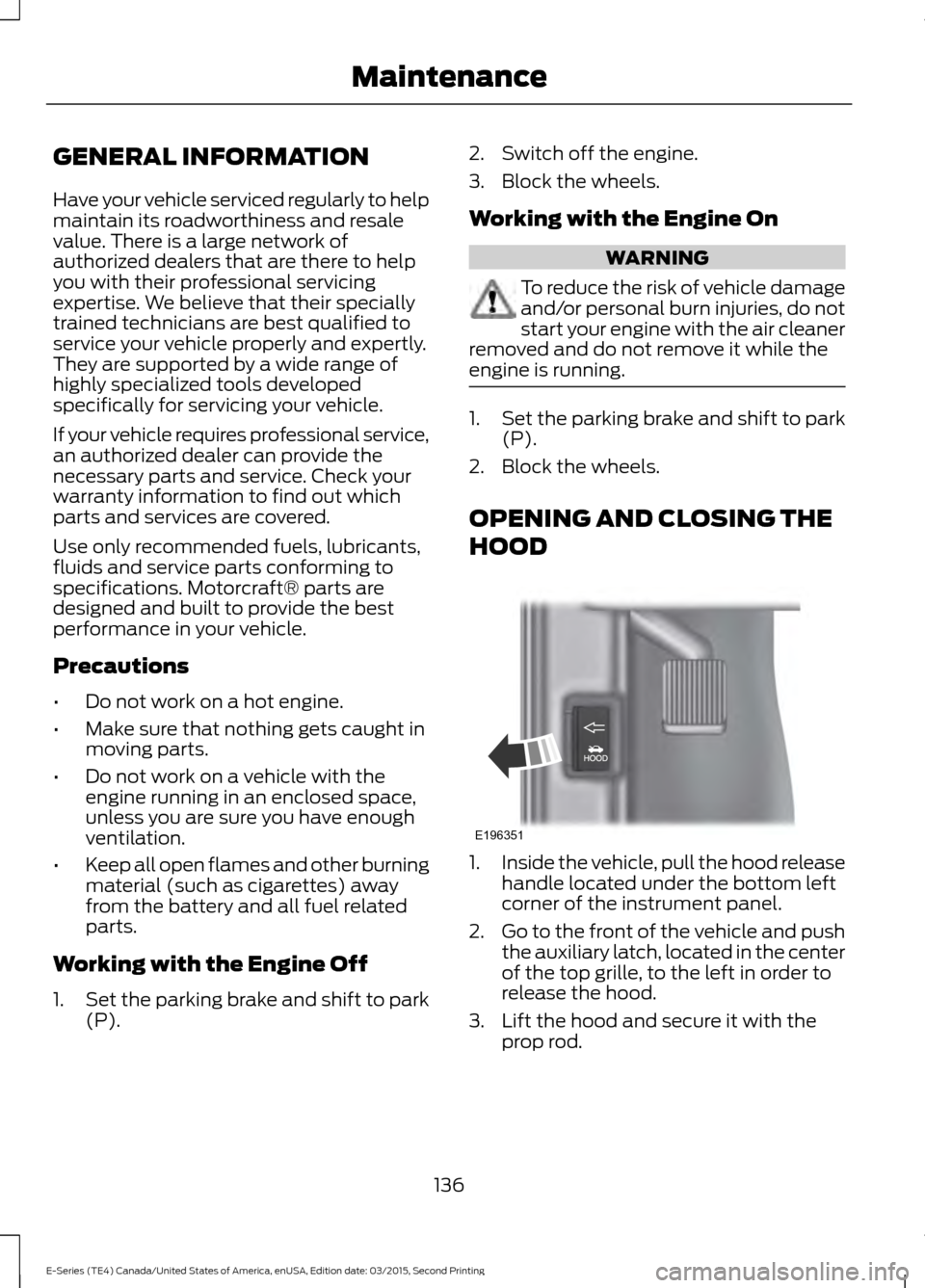
OPENING AND CLOSING THE
HOOD 1.
Inside the vehicle, pull the hood release
handle located under the bottom left
corner of the instrument panel.
2. Go to the front of the vehicle and push
the auxiliary latch, located in the center
of the top grille, to the left in order to
release the hood.
3. Lift the hood and secure it with the prop rod.
136
E-Series (TE4) Canada/United States of America, enUSA, Edition date: 03/2015, Second Printing MaintenanceE196351
Page 140 of 319
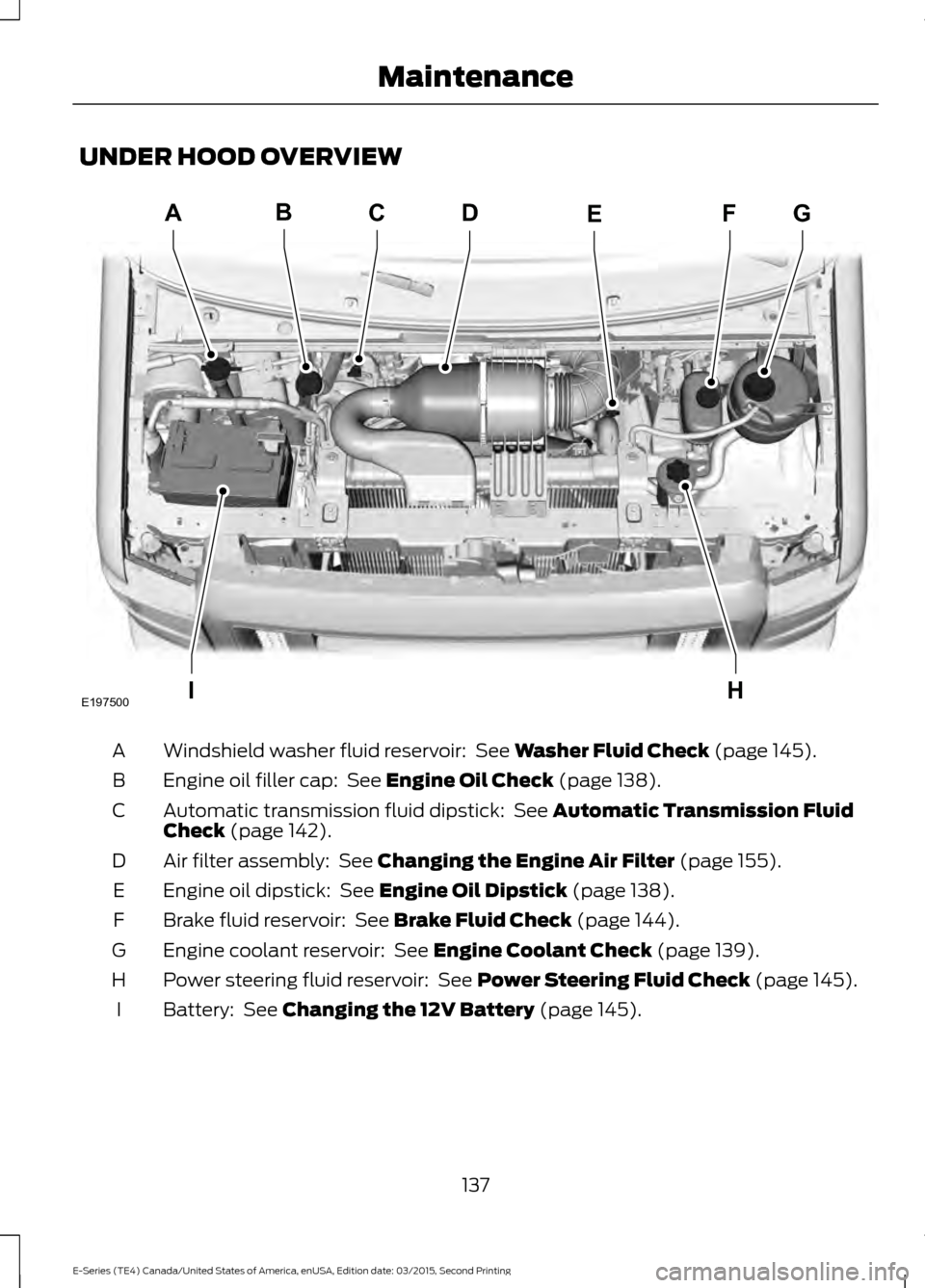
UNDER HOOD OVERVIEW
Windshield washer fluid reservoir: See Washer Fluid Check (page 145).
A
Engine oil filler cap:
See Engine Oil Check (page 138).
B
Automatic transmission fluid dipstick:
See Automatic Transmission Fluid
Check (page 142).
C
Air filter assembly:
See Changing the Engine Air Filter (page 155).
D
Engine oil dipstick:
See Engine Oil Dipstick (page 138).
E
Brake fluid reservoir:
See Brake Fluid Check (page 144).
F
Engine coolant reservoir:
See Engine Coolant Check (page 139).
G
Power steering fluid reservoir:
See Power Steering Fluid Check (page 145).
H
Battery:
See Changing the 12V Battery (page 145).
I
137
E-Series (TE4) Canada/United States of America, enUSA, Edition date: 03/2015, Second Printing MaintenanceIH
DABCEFG
E197500
Page 142 of 319
To reset the oil life monitoring system do
the following:
1.
Switch the ignition on. Do not start the
engine.
2. Fully press the accelerator and brake pedals at the same time.
3. Keep the accelerator and brake pedals
fully pressed.
4. After three seconds, a message displays confirming the reset procedure
is in progress.
5. After 25 seconds, a message displays confirming the reset procedure is
complete.
6. Release the accelerator and brake pedals.
7. Switch the ignition off.
ENGINE COOLANT CHECK WARNINGS
Do not add engine coolant when the
engine is hot. Steam and scalding
liquids released from a hot cooling
system can burn you badly. Also, spilling
coolant on hot engine parts can burn you. Do not put engine coolant in the
windshield washer fluid container. If
sprayed on the windshield, engine
coolant could make it difficult to see
through the windshield. To reduce the risk of personal injury,
make sure the engine is cool before
unscrewing the coolant pressure
relief cap. The cooling system is under
pressure. Steam and hot liquid can come
out forcefully when you loosen the cap
slightly. Do not add coolant further than the
MAX mark. Checking the Engine Coolant
When the engine is cold, check the
concentration and level of the engine
coolant at the intervals listed in the
scheduled maintenance information. See
Scheduled Maintenance (page 268).
Note: Make sure that the coolant level is
between the MIN and MAX marks on the
coolant reservoir.
Note: Coolant expands when it is hot. The
level may extend beyond the MAX mark.
Note: If the level is at the MIN mark, below
the MIN mark, or empty, add coolant
immediately. See
Adding Engine Coolant
in this chapter.
Maintain coolant concentration within
48% to 50%, which equates to a freeze
point between -30°F (-34°C) and -34°F
(-37°C).
Note: For best results, coolant
concentration should be tested with a
refractometer such as Robinair® Coolant
and Battery Refractometer 75240. We do
not recommend the use of hydrometers or
coolant test strips for measuring coolant
concentrations.
Note: Automotive fluids are not
interchangeable. Do not use engine coolant,
antifreeze or windshield washer fluid outside
of its specified function and vehicle location.
Adding Engine Coolant
Note: Do not use stop leak pellets, cooling
system sealants or additives as they can
cause damage to the engine cooling or
heating systems. Your warranty may not
cover these damages.
139
E-Series (TE4) Canada/United States of America, enUSA, Edition date: 03/2015, Second Printing Maintenance
Page 148 of 319
POWER STEERING FLUID
CHECK
WARNINGS
A fluid level between the MAX and
MIN lines is within the normal
operating range and there is no need
to add fluid. A fluid level not in the normal
operating range could compromise the
performance of the system. For E-350 and E-450 vehicles with
the Hydro-Boost Brake System, do
not press the brake pedal after the
engine has been turned off. Pressing the
brake pedal after the engine has been
turned off will give a false power steering
fluid level reading. Only use fluid that meets Ford
specifications. See Capacities and
Specifications (page 197).
To top up the power steering fluid level do
the following.
1. Start the engine and let it run until it reaches normal operating temperature.
2. Make sure the fluid is within the
MIN
and MAX range.
3. If the fluid level is low, add fluid to be within the
MIN and MAX range. Do not
overfill.
4. While the engine idles, turn the steering
wheel left and right several times.
5. Recheck the fluid level in the reservoir.
Note: Do not operate the vehicle with a low
power steering pump fluid level. WASHER FLUID CHECK WARNING
If you operate your vehicle in
temperatures below 40°F (5°C), use
washer fluid with antifreeze
protection. Failure to use washer fluid with
antifreeze protection in cold weather could
result in impaired windshield vision and
increase the risk of injury or accident. Add fluid to fill the reservoir if the level is
low. Only use a washer fluid that meets
Ford specifications. See
Capacities and
Specifications (page 191).
State or local regulations on volatile
organic compounds may restrict the use
of methanol, a common windshield washer
antifreeze additive. Washer fluids
containing non-methanol antifreeze
agents should be used only if they provide
cold weather protection without damaging
the vehicle ’s paint finish, wiper blades or
washer system.
FUEL FILTER
Your vehicle is equipped with a lifetime
fuel filter that is integrated with the fuel
tank. Regular maintenance or replacement
is not needed.
CHANGING THE 12V BATTERY WARNINGS
This vehicle may be fitted with more
than one battery, removal of cable
from only one battery does not
disconnect the vehicle electrical system.
Be sure to disconnect cables from all
batteries when disconnecting power.
Failure to do so may cause serious
personal injury or property damage.
145
E-Series (TE4) Canada/United States of America, enUSA, Edition date: 03/2015, Second Printing Maintenance