climate control FORD E SERIES 2018 Owners Manual
[x] Cancel search | Manufacturer: FORD, Model Year: 2018, Model line: E SERIES, Model: FORD E SERIES 2018Pages: 323, PDF Size: 7.09 MB
Page 5 of 323
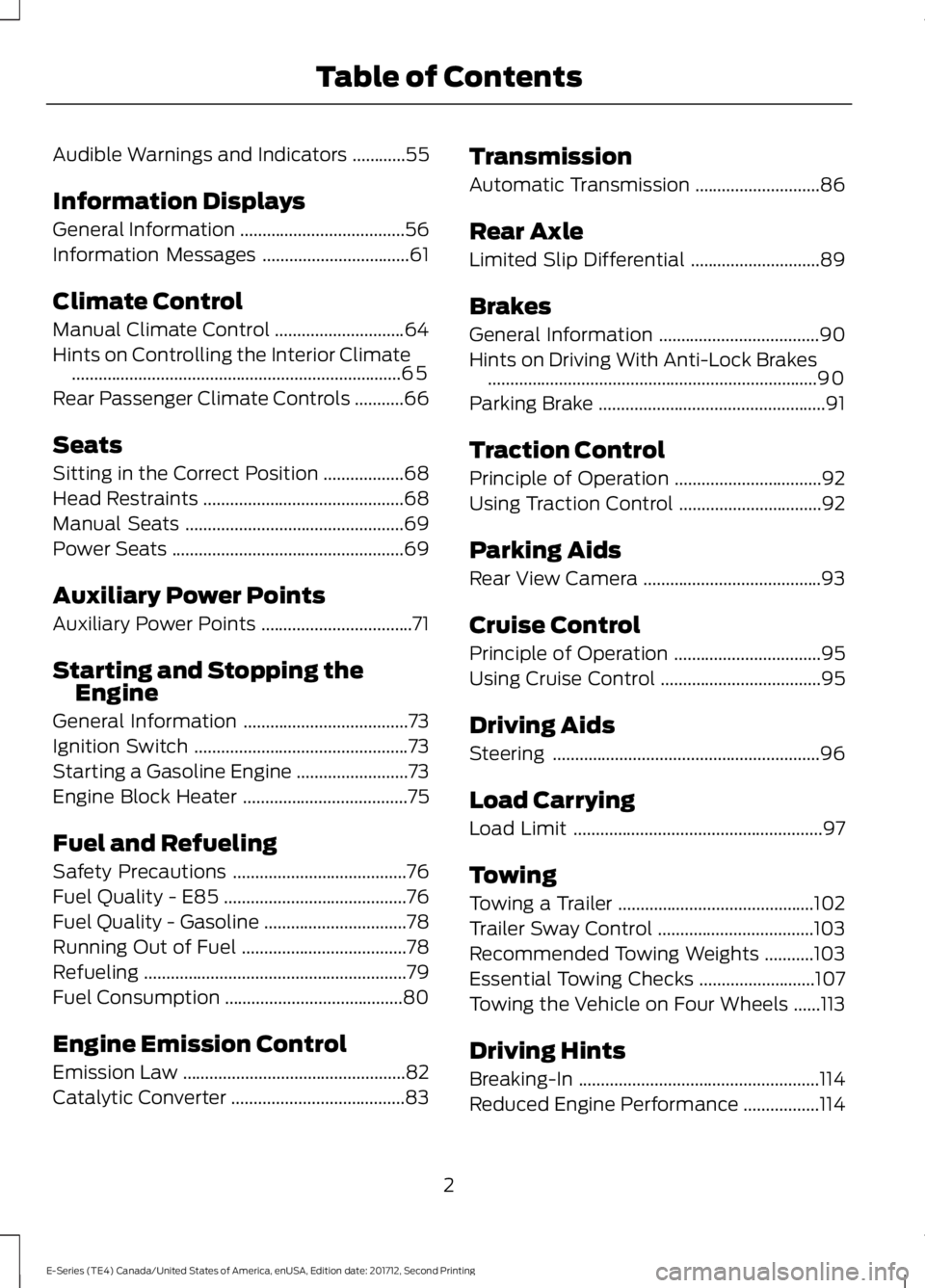
Audible Warnings and Indicators............55
Information Displays
General Information.....................................56
Information Messages.................................61
Climate Control
Manual Climate Control.............................64
Hints on Controlling the Interior Climate..........................................................................65
Rear Passenger Climate Controls...........66
Seats
Sitting in the Correct Position..................68
Head Restraints.............................................68
Manual Seats.................................................69
Power Seats....................................................69
Auxiliary Power Points
Auxiliary Power Points..................................71
Starting and Stopping theEngine
General Information.....................................73
Ignition Switch................................................73
Starting a Gasoline Engine.........................73
Engine Block Heater.....................................75
Fuel and Refueling
Safety Precautions.......................................76
Fuel Quality - E85.........................................76
Fuel Quality - Gasoline................................78
Running Out of Fuel.....................................78
Refueling...........................................................79
Fuel Consumption........................................80
Engine Emission Control
Emission Law..................................................82
Catalytic Converter.......................................83
Transmission
Automatic Transmission............................86
Rear Axle
Limited Slip Differential.............................89
Brakes
General Information....................................90
Hints on Driving With Anti-Lock Brakes..........................................................................90
Parking Brake...................................................91
Traction Control
Principle of Operation.................................92
Using Traction Control................................92
Parking Aids
Rear View Camera........................................93
Cruise Control
Principle of Operation.................................95
Using Cruise Control....................................95
Driving Aids
Steering............................................................96
Load Carrying
Load Limit........................................................97
Towing
Towing a Trailer............................................102
Trailer Sway Control...................................103
Recommended Towing Weights...........103
Essential Towing Checks..........................107
Towing the Vehicle on Four Wheels......113
Driving Hints
Breaking-In......................................................114
Reduced Engine Performance.................114
2
E-Series (TE4) Canada/United States of America, enUSA, Edition date: 201712, Second Printing
Table of Contents
Page 17 of 323
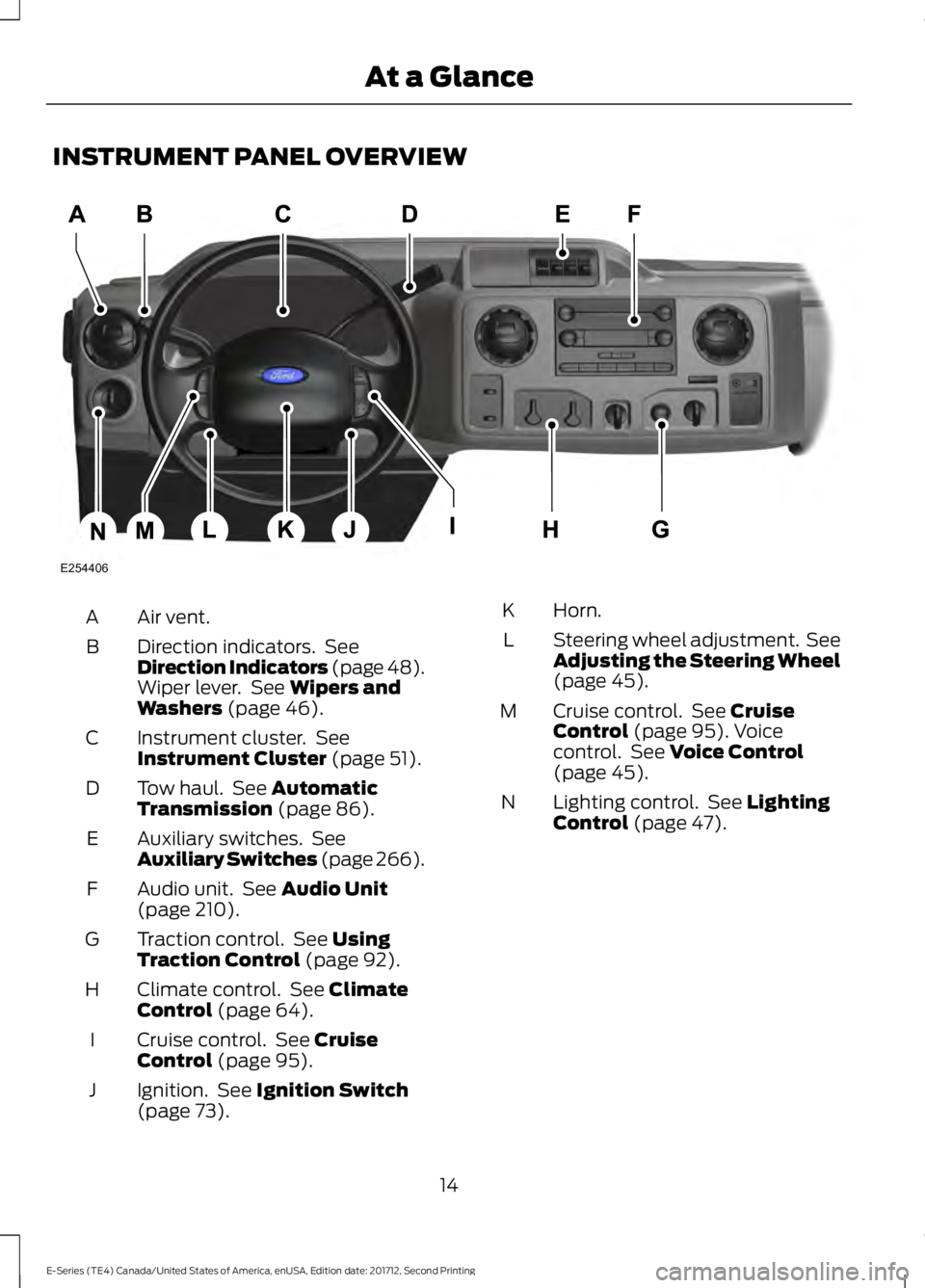
INSTRUMENT PANEL OVERVIEW
Air vent.A
Direction indicators. SeeDirection Indicators (page 48).Wiper lever. See Wipers andWashers (page 46).
B
Instrument cluster. SeeInstrument Cluster (page 51).C
Tow haul. See AutomaticTransmission (page 86).D
Auxiliary switches. SeeAuxiliary Switches (page 266).E
Audio unit. See Audio Unit(page 210).F
Traction control. See UsingTraction Control (page 92).G
Climate control. See ClimateControl (page 64).H
Cruise control. See CruiseControl (page 95).I
Ignition. See Ignition Switch(page 73).J
Horn.K
Steering wheel adjustment. SeeAdjusting the Steering Wheel(page 45).
L
Cruise control. See CruiseControl (page 95). Voicecontrol. See Voice Control(page 45).
M
Lighting control. See LightingControl (page 47).N
14
E-Series (TE4) Canada/United States of America, enUSA, Edition date: 201712, Second Printing
At a GlanceE254406
Page 67 of 323
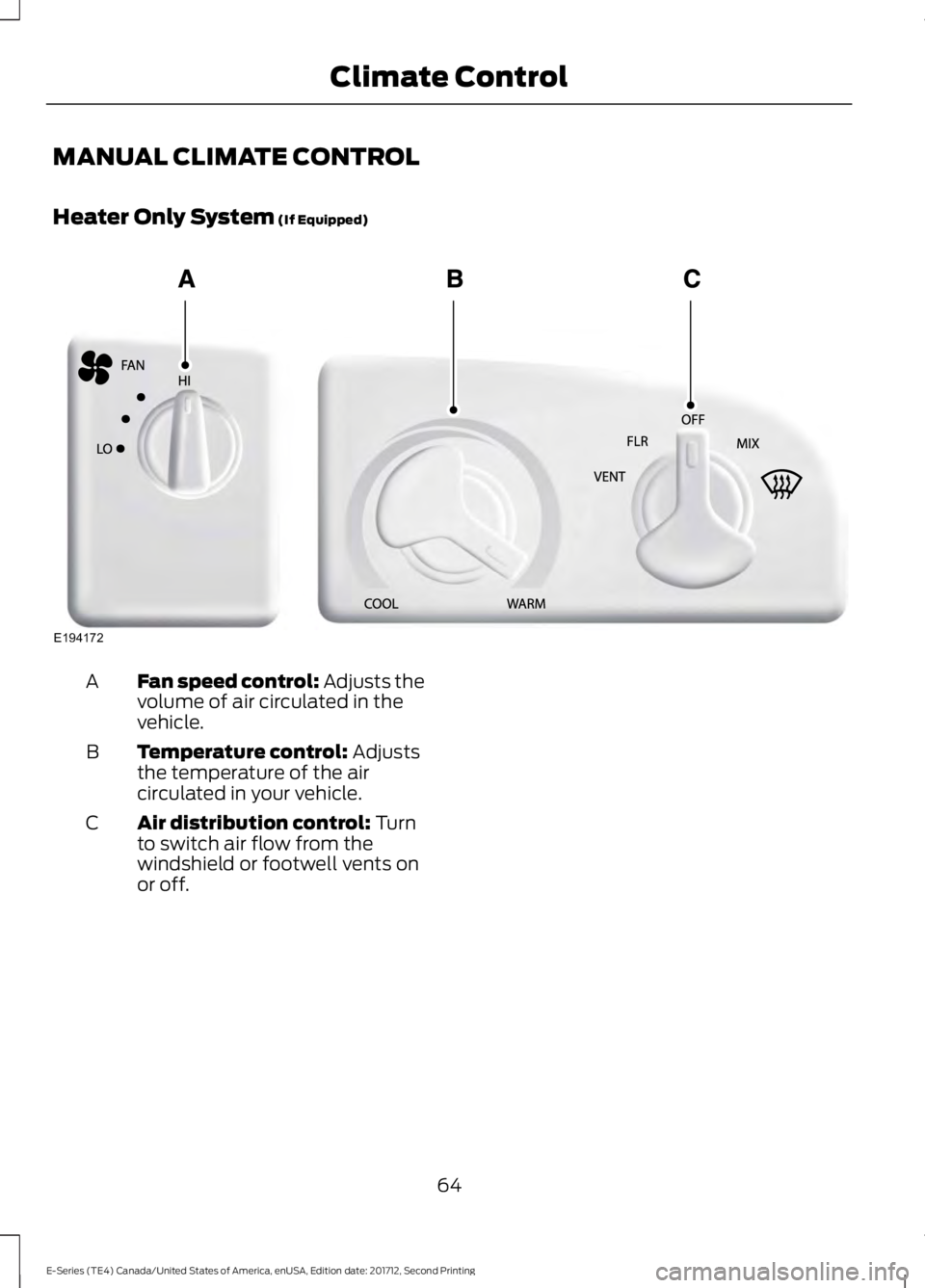
MANUAL CLIMATE CONTROL
Heater Only System (If Equipped)
Fan speed control: Adjusts thevolume of air circulated in thevehicle.
A
Temperature control: Adjuststhe temperature of the aircirculated in your vehicle.
B
Air distribution control: Turnto switch air flow from thewindshield or footwell vents onor off.
C
64
E-Series (TE4) Canada/United States of America, enUSA, Edition date: 201712, Second Printing
Climate ControlE194172
Page 68 of 323
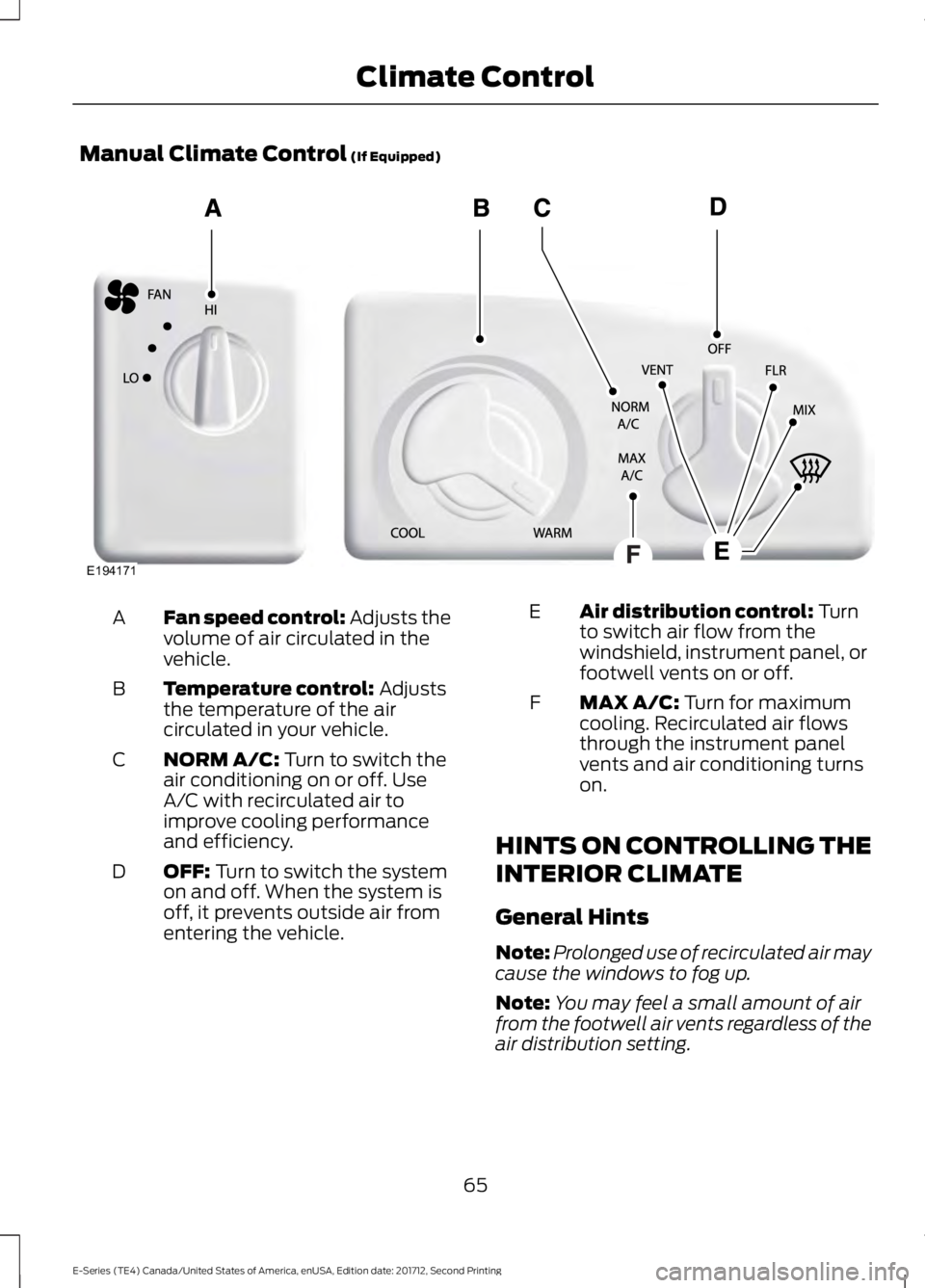
Manual Climate Control (If Equipped)
Fan speed control: Adjusts thevolume of air circulated in thevehicle.
A
Temperature control: Adjuststhe temperature of the aircirculated in your vehicle.
B
NORM A/C: Turn to switch theair conditioning on or off. UseA/C with recirculated air toimprove cooling performanceand efficiency.
C
OFF: Turn to switch the systemon and off. When the system isoff, it prevents outside air fromentering the vehicle.
D
Air distribution control: Turnto switch air flow from thewindshield, instrument panel, orfootwell vents on or off.
E
MAX A/C: Turn for maximumcooling. Recirculated air flowsthrough the instrument panelvents and air conditioning turnson.
F
HINTS ON CONTROLLING THE
INTERIOR CLIMATE
General Hints
Note:Prolonged use of recirculated air maycause the windows to fog up.
Note:You may feel a small amount of airfrom the footwell air vents regardless of theair distribution setting.
65
E-Series (TE4) Canada/United States of America, enUSA, Edition date: 201712, Second Printing
Climate ControlE194171
Page 69 of 323
Note:To reduce humidity build-up insideyour vehicle, do not drive with the systemswitched off or with recirculated air alwaysswitched on.
Note:To reduce fogging of the windshieldduring humid weather, adjust the airdistribution control to the windshield airvents position.
Note:Do not place objects under the frontseats as this may interfere with the airflowto the rear seats.
Note:Remove any snow, ice or leaves fromthe air intake area at the base of thewindshield.
Note:To improve the time to reach acomfortable temperature in hot weather,drive with the windows open until you feelcold air through the air vents.
Quickly Heating the Interior
1. Adjust the fan speed to the highestspeed setting.
2. Adjust the temperature control to thefull heat setting.
3. Direct air to the footwell air vents.
Recommended Settings forHeating
1. Adjust the fan speed to the centersetting.
2. Adjust the temperature control to themidway point of the hot settings.
3. Direct air to the footwell air vents.
Quickly Cooling the Interior
1. Turn to MAX A/C.
2. Drive with the windows open until youfeel cold air through the air vents.
Recommended Settings forCooling
1. Adjust the fan speed to the centersetting.
2. Adjust the temperature control to themidway point of the cold settings.
3. Direct air to the instrument panel airvents.
Vehicle Stationary for ExtendedPeriods During Extreme HighAmbient Temperatures
1. Apply the parking brake.
2. Place your vehicle in park (P) orneutral.
3. Turn to MAX A/C.
4. Adjust the fan speed to the lowestspeed setting.
Defogging the Side Windows inCold Weather
1. Direct air to the instrument panel andwindshield vents.
2. Turn to NORM A/C.
3. Adjust the temperature control to thedesired setting.
4. Adjust the fan speed to the highestsetting.
5. Direct air toward the side windows.
6. Close the instrument panel vents.
REAR PASSENGER CLIMATE CONTROLS (If Equipped)
66
E-Series (TE4) Canada/United States of America, enUSA, Edition date: 201712, Second Printing
Climate Control
Page 70 of 323
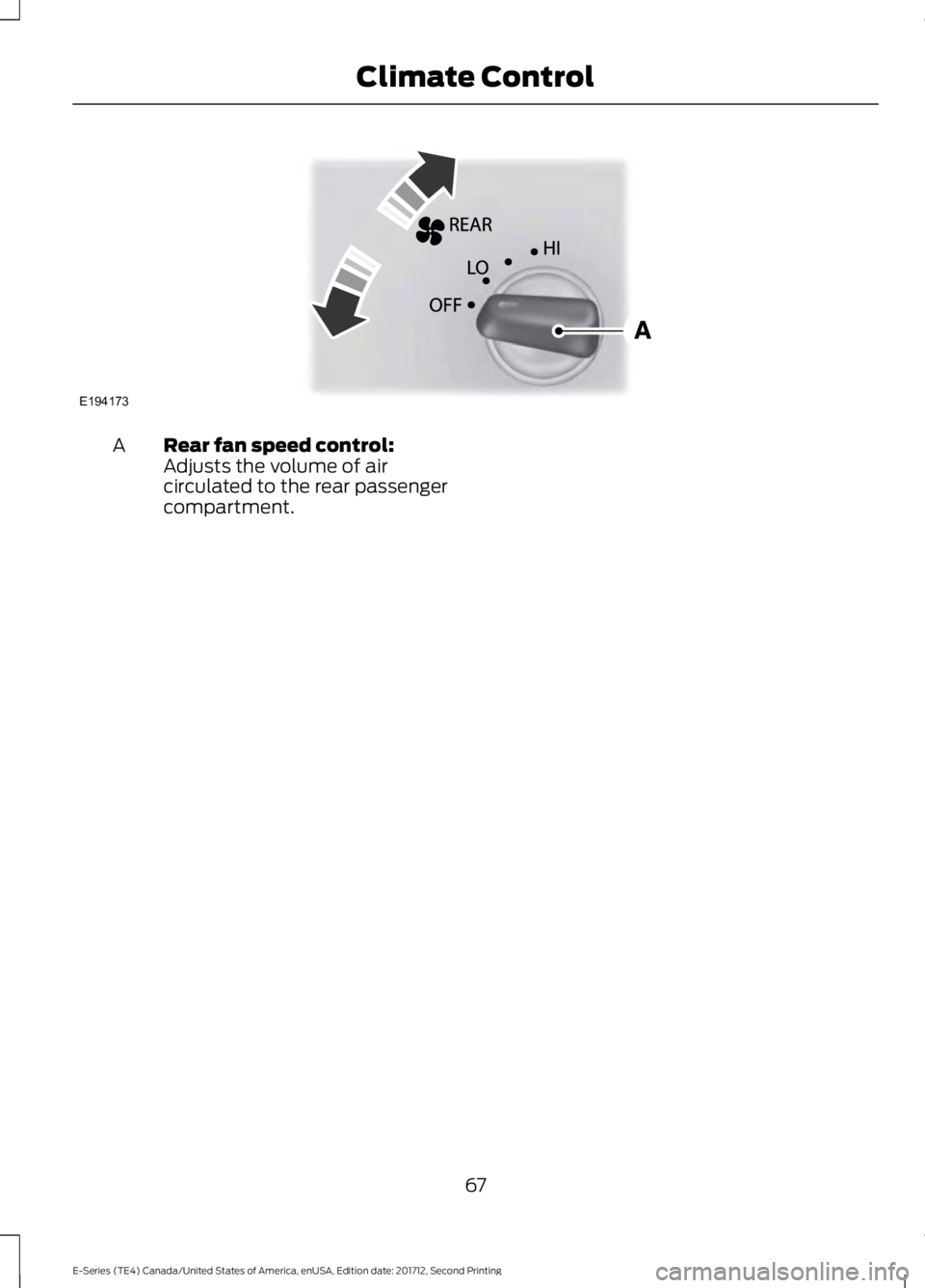
Rear fan speed control:Adjusts the volume of aircirculated to the rear passengercompartment.
A
67
E-Series (TE4) Canada/United States of America, enUSA, Edition date: 201712, Second Printing
Climate ControlE194173
Page 77 of 323
Before starting the engine check thefollowing:
•Make sure all occupants have fastenedtheir safety belts.
•Make sure the headlamps andelectrical accessories are off.
•Make sure the parking brake is on.
•Make sure the transmission is in park(P) or neutral (N).
•Turn the ignition key to the on position.
Note:Do not touch the accelerator pedal.
1. Fully press the brake pedal.
2. Turn the key to the start position tostart the engine. Release the key whenthe engine starts.
Note:The engine may continue crankingfor up to 15 seconds or until it starts.
Note:If you cannot start the engine on thefirst try, wait for a short period and try again.
Failure to Start
If you cannot start the engine after threeattempts, wait 10 seconds and follow thisprocedure:
1. Fully press the brake pedal.
2. Fully press the accelerator pedal andhold it there.
3. Start the engine.
Stopping the Engine When YourVehicle is Stationary
1. Shift into park (P) or neutral (N).
2. Turn the key to the off position.
3. Apply the parking brake.
Stopping the Engine When YourVehicle is Moving
WARNING
Switching off the engine when thevehicle is still moving will result in aloss of brake and steering assistance.The steering will not lock, but higher effortwill be required. When the ignition isswitched off, some electrical circuits,including air bags, warning lamps andindicators may also be off. If the ignitionwas turned off accidentally, you can shiftinto neutral (N) and re-start the engine.
1. Put the transmission into neutral (N)and use the brakes to bring your vehicleto a safe stop.
2. When your vehicle has stopped, shiftinto park (P) or neutral (N) and switchthe ignition off.
3. Apply the parking brake.
Guarding Against Exhaust Fumes
WARNING
If you smell exhaust fumes insideyour vehicle, have your vehiclechecked by your authorized dealerimmediately. Do not drive your vehicle ifyou smell exhaust fumes. Carbonmonoxide is present in exhaust fumes.Take precautions to avoid its dangerouseffects.
Important Ventilating Information
If you stop your vehicle and then leave theengine idling for long periods of time, werecommend that you do one of thefollowing:
•Open the windows at least 1 in (3 cm).
•Set your climate control to outside air.
74
E-Series (TE4) Canada/United States of America, enUSA, Edition date: 201712, Second Printing
Starting and Stopping the Engine
Page 78 of 323
ENGINE BLOCK HEATER (If
Equipped)
WARNINGS
Failure to follow engine block heaterinstructions could result in propertydamage or serious personal injury.
Do not use your heater withungrounded electrical systems ortwo-pronged adapters. There is a riskof electrical shock.
Do not fully close the hood, or allowit to drop under its own weight whenusing the engine block heater. Thiscould damage the power cable and maycause an electrical short resulting in fire,injury and property damage.
Note:The heater is most effective whenoutdoor temperatures are below 0°F(-18°C).
The heater acts as a starting aid bywarming the engine coolant. This allowsthe climate control system to respondquickly. The equipment includes a heaterelement (installed in the engine block) anda wire harness. You can connect thesystem to a grounded 120-volt ACelectrical source.
We recommend that you do the followingfor a safe and correct operation:
•Use a 16-gauge outdoor extension cordthat is product certified byUnderwriter’s Laboratory (UL) orCanadian Standards Association(CSA). This extension cord must besuitable for use outdoors, in cold
temperatures, and be clearly markedSuitable for Use with OutdoorAppliances. Do not use an indoorextension cord outdoors. This couldresult in an electric shock or become afire hazard.
•Use as short an extension cord aspossible.
•Do not use multiple extension cords.
•Make sure that when in operation, theextension cord plug and heater cordplug connections are free and clear ofwater. This could cause an electricshock or fire.
•Make sure your vehicle is parked in aclean area, clear of combustibles.
•Make sure the heater, heater cord andextension cord are firmly connected.
•Check for heat anywhere in theelectrical hookup once the system hasbeen operating for approximately 30minutes.
•Make sure the system is unplugged andproperly stowed before starting anddriving your vehicle. Make sure theprotective cover seals the prongs of theblock heater cord plug when not in use.
•Make sure the heater system ischecked for proper operation beforewinter.
Using the Engine Block Heater
Make sure the receptacle terminals areclean and dry prior to use. Clean them witha dry cloth if necessary.
The heater uses 0.4 to 1.0 kilowatt-hoursof energy per hour of use. The system doesnot have a thermostat. It achievesmaximum temperature afterapproximately three hours of operation.Using the heater longer than three hoursdoes not improve system performance andunnecessarily uses electricity.
75
E-Series (TE4) Canada/United States of America, enUSA, Edition date: 201712, Second Printing
Starting and Stopping the Engine
Page 116 of 323
Exceeding these limits may allow water toenter vehicle components:
•Causing internal damage to thecomponents.
•Affecting driveability, emissions andreliability.
Replace the rear axle lubricant anytimethe rear axle has been submerged in water.Water may have contaminated the rearaxle lubricant, which is not normallychecked or changed unless a leak issuspected or other axle repair is required.
TOWING THE VEHICLE ON
FOUR WHEELS
Emergency Towing
WARNING
If your vehicle has a steering wheellock make sure the ignition is in theaccessory or on position when beingtowed.
You can flat-tow (all wheels on theground, regardless of the powertrain ortransmission configuration) your disabledvehicle (without access to wheel dolliesor vehicle transport trailer) under thefollowing conditions:
•Your vehicle is facing forward so youtow it in a forward direction.
•You shift into Neutral (N). If you cannotshift into Neutral (N), you may need tooverride the transmission. SeeTransmission (page 86).
•Maximum speed is 35 mph (56 km/h).
•Maximum distance is 50 mi (80 km).
Recreational Towing
Note: Put your climate control system inrecirculated air mode to prevent exhaustfumes from entering the vehicle. SeeClimate Control (page 64).
Follow these guidelines if you have a needfor recreational (RV) towing. An exampleof recreational towing would be towingyour vehicle behind a motorhome. Theseguidelines are to make sure you do notdamage the transmission during towing.
Do not tow your vehicle with any wheelson the ground, as vehicle or transmissiondamage may occur. It is recommended totow your vehicle with all four wheels offthe ground, for example when using avehicle transport trailer. Otherwise, youcannot tow your vehicle.
113
E-Series (TE4) Canada/United States of America, enUSA, Edition date: 201712, Second Printing
Towing
Page 139 of 323
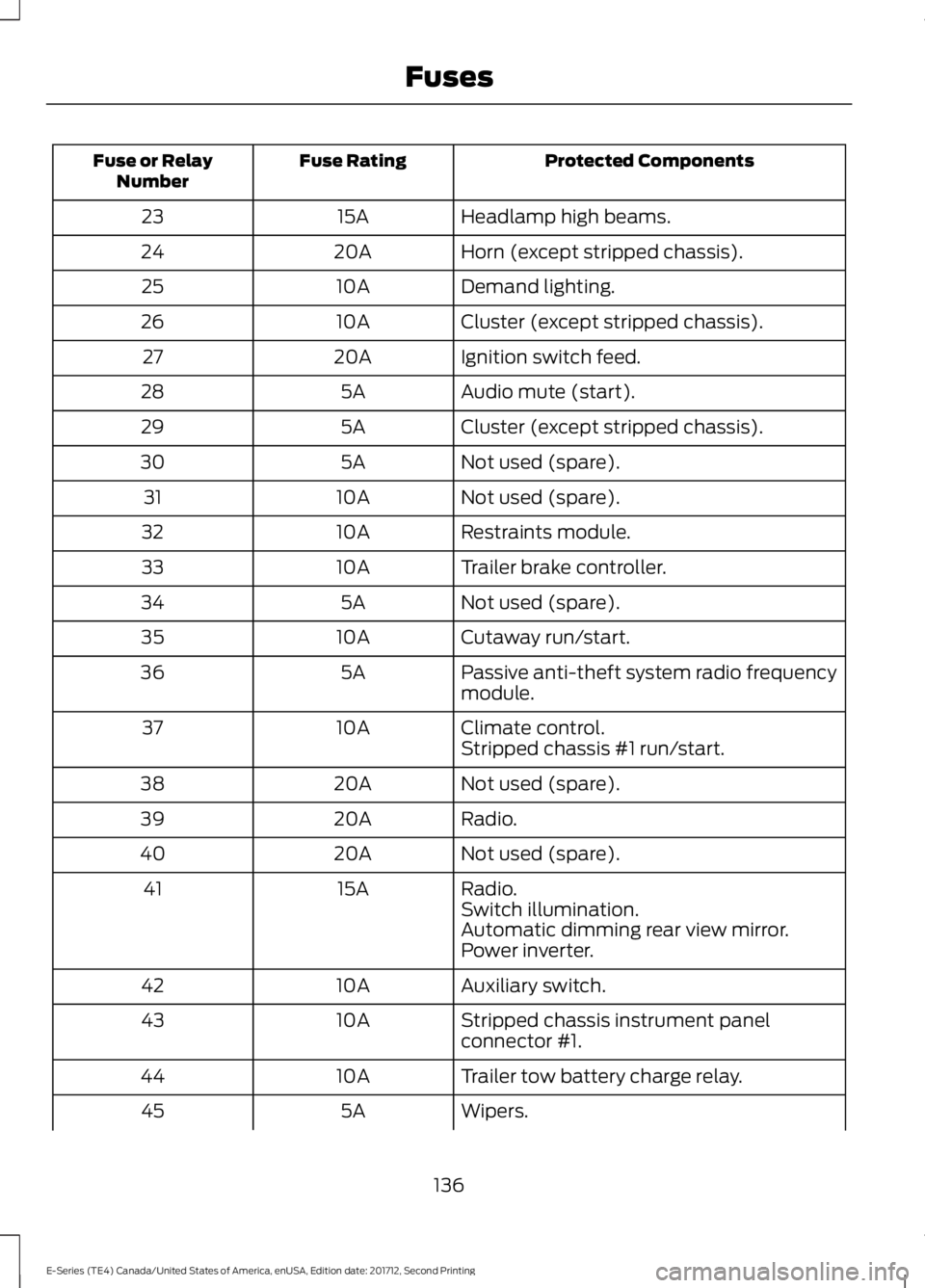
Protected ComponentsFuse RatingFuse or RelayNumber
Headlamp high beams.15A23
Horn (except stripped chassis).20A24
Demand lighting.10A25
Cluster (except stripped chassis).10A26
Ignition switch feed.20A27
Audio mute (start).5A28
Cluster (except stripped chassis).5A29
Not used (spare).5A30
Not used (spare).10A31
Restraints module.10A32
Trailer brake controller.10A33
Not used (spare).5A34
Cutaway run/start.10A35
Passive anti-theft system radio frequencymodule.5A36
Climate control.10A37Stripped chassis #1 run/start.
Not used (spare).20A38
Radio.20A39
Not used (spare).20A40
Radio.15A41Switch illumination.Automatic dimming rear view mirror.Power inverter.
Auxiliary switch.10A42
Stripped chassis instrument panelconnector #1.10A43
Trailer tow battery charge relay.10A44
Wipers.5A45
136
E-Series (TE4) Canada/United States of America, enUSA, Edition date: 201712, Second Printing
Fuses