spare wheel FORD E SERIES 2023 User Guide
[x] Cancel search | Manufacturer: FORD, Model Year: 2023, Model line: E SERIES, Model: FORD E SERIES 2023Pages: 292, PDF Size: 6.81 MB
Page 213 of 292
When the malfunction indicator isilluminated, the system may not be ableto detect or signal low tire pressure asintended. TPMS malfunctions may occurfor a variety of reasons, including theinstallation of replacement or alternatetires or wheels on the vehicle that preventthe TPMS from functioning properly.Always check the TPMS malfunctiontelltale after replacing one or more tires orwheels on your vehicle to ensure that thereplacement or alternate tires and wheelsallow the TPMS to continue to functionproperly.
This device complies with Part 15 of theFCC Rules and with License exempt RSSStandards of Industry Canada. Operationis subject to the following two conditions:
1.This device may not cause harmfulinterference.
2.This device must accept anyinterference received, includinginterference that may cause undesiredoperation.
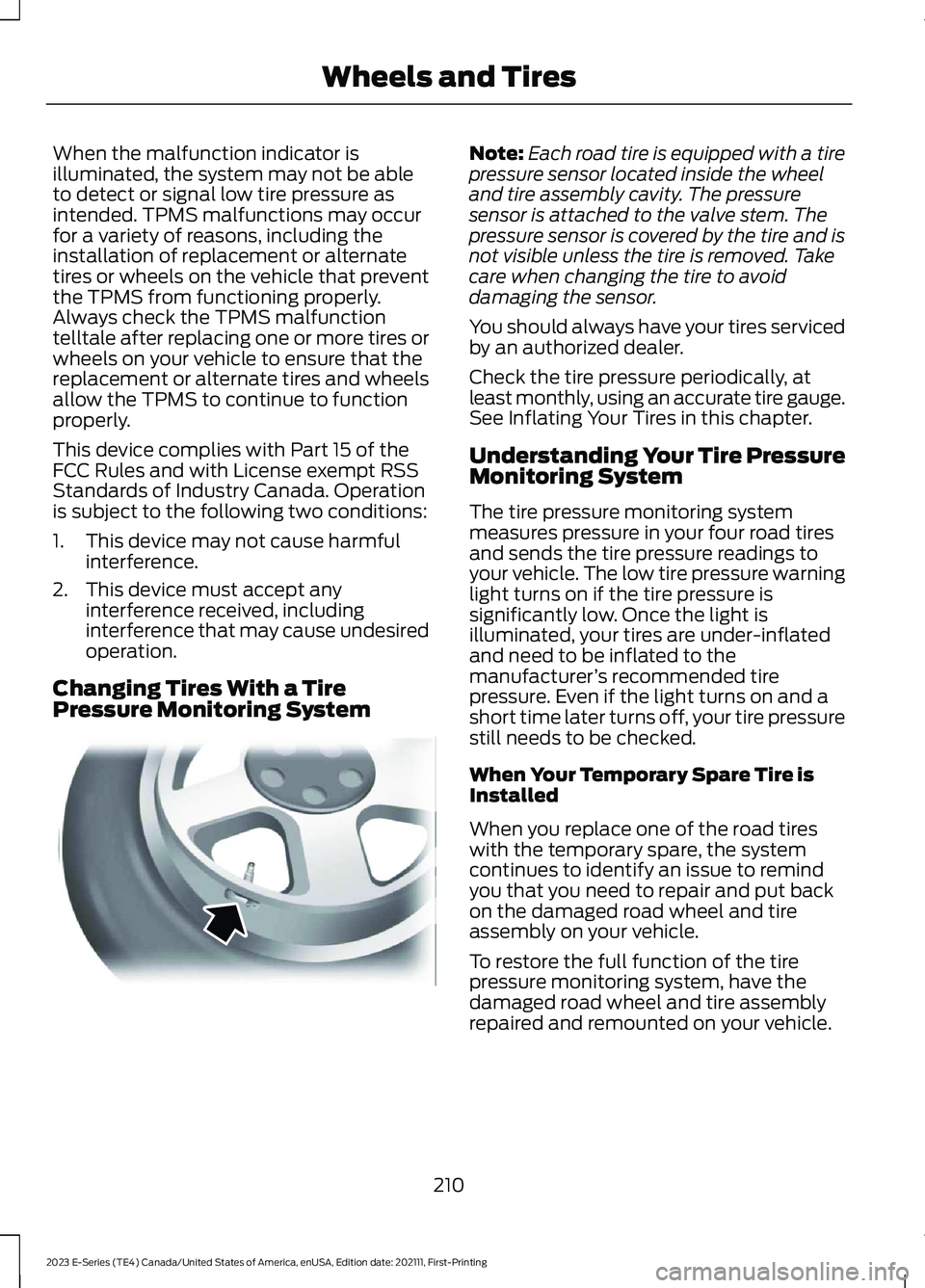
Changing Tires With a TirePressure Monitoring System
Note:Each road tire is equipped with a tirepressure sensor located inside the wheeland tire assembly cavity. The pressuresensor is attached to the valve stem. Thepressure sensor is covered by the tire and isnot visible unless the tire is removed. Takecare when changing the tire to avoiddamaging the sensor.
You should always have your tires servicedby an authorized dealer.
Check the tire pressure periodically, atleast monthly, using an accurate tire gauge.See Inflating Your Tires in this chapter.
Understanding Your Tire PressureMonitoring System
The tire pressure monitoring systemmeasures pressure in your four road tiresand sends the tire pressure readings toyour vehicle. The low tire pressure warninglight turns on if the tire pressure issignificantly low. Once the light isilluminated, your tires are under-inflatedand need to be inflated to themanufacturer’s recommended tirepressure. Even if the light turns on and ashort time later turns off, your tire pressurestill needs to be checked.
When Your Temporary Spare Tire isInstalled
When you replace one of the road tireswith the temporary spare, the systemcontinues to identify an issue to remindyou that you need to repair and put backon the damaged road wheel and tireassembly on your vehicle.
To restore the full function of the tirepressure monitoring system, have thedamaged road wheel and tire assemblyrepaired and remounted on your vehicle.
210
2023 E-Series (TE4) Canada/United States of America, enUSA, Edition date: 202111, First-PrintingWheels and TiresE142549
Page 214 of 292
When You Believe Your System is NotOperating Properly
The main function of the tire pressuremonitoring system is to warn you when
your tires need air. It can also warn you inthe event the system is no longer capableof functioning as intended. See thefollowing chart for information concerningyour tire pressure monitoring system:
Customer Action RequiredPossible CauseLow Tire PressureWarning Light
Make sure tires are at the proper pres-sure. See Inflating your tires in thischapter. After inflating your tires to themanufacturer’s recommended pressureas shown on the Tire Label, located onthe edge of driver door or the B-Pillar, thevehicle must be driven for at least twominutes over 20 mph (32 km/h) beforethe light turns off.
Tire(s) under-inflatedSolid warning light
Repair the damaged road wheel and tireassembly and reinstall it on the vehicleto restore system function. For adescription on how the system functions,see When your temporary spare tireis installed in this section.
Spare tire in use
If the tires are properly inflated and thespare tire is not in use but the lightremains on, contact your authorizeddealer as soon as possible.
TPMS malfunction
Repair the damaged road wheel and tireassembly and reinstall it on the vehicleto restore system function. For adescription on how the system functions,see When your temporary spare tireis installed in this section.
Spare tire in useFlashing warninglight
If the tires are properly inflated and thespare tire is not in use but the lightremains on, contact your authorizeddealer as soon as possible.
TPMS malfunction
211
2023 E-Series (TE4) Canada/United States of America, enUSA, Edition date: 202111, First-PrintingWheels and Tires
Page 218 of 292
12.Turn the ignition off. If two short hornbeeps are heard, the reset procedurewas unsuccessful and you mustrepeat it. If after repeating theprocedure and two short beeps areheard when the ignition is turned tooff, seek assistance from yourauthorized dealer.
13.Set all six tires to the recommendedair pressure as indicated on theSafety Compliance CertificationLabel, affixed to either the door hingepillar, door-latch post, or the dooredge that meets the door-latch post,next to the driver seating position orTire Label located on the B-Pillar orthe edge of the driver door.
CHANGING A ROAD WHEEL
WARNING: To determine therequired pressure(s) for your vehicle, seethe Safety Compliance CertificationLabel (on the door hinge pillar,door-latch post or the door edge thatmeets the door-latch post, next to thedriver seat) or the Tire Label on theB-Pillar or the edge of the driver door.
Note:You should only use tire sealants inroadside emergencies as they may causedamage to the tire pressure monitoringsystem sensor.
Note:The tire pressure monitoring systemindicator light illuminates when the sparetire is in use. To restore the full function ofthe monitoring system, all road wheelsequipped with tire pressure monitoringsensors must be mounted on the vehicle.
Note:Do not use wheels or lug nutsdifferent than the original equipment, as thismay damage the wheel or mounting system.
If you get a flat tire when driving, do notapply the brake heavily. Instead, graduallydecrease your speed. Hold the steeringwheel firmly and slowly move to a safeplace on the side of the road.
Have a flat serviced by an authorizeddealer to prevent damage to the tirepressure monitoring system sensors. SeeTire Pressure Monitoring System (page209). Replace the spare tire with a road tireas soon as possible. During repairing orreplacing of the flat tire, have theauthorized dealer inspect the tire pressuremonitoring system sensor for damage.
Dissimilar Spare Wheel and TireAssembly Information
WARNING: Failure to follow theseguidelines could result in an increasedrisk of loss of vehicle control, injury ordeath.
If you have a dissimilar spare wheel andtire, then it is intended for temporary useonly. This means that if you need to use it,you should replace it as soon as possiblewith a road wheel and tire assembly thatis the same size and type as the road tiresand wheels that were originally providedby Ford. If the dissimilar spare tire or wheelis damaged, it should be replaced ratherthan repaired.
A dissimilar spare wheel and tire assemblyis defined as a spare wheel and tireassembly that is different in brand, size orappearance from the road tires and wheelsand can be one of three types:
1.T-type mini-spare: This spare tirebegins with the letter T for tire size andmay have Temporary Use Only molded inthe sidewall.
215
2023 E-Series (TE4) Canada/United States of America, enUSA, Edition date: 202111, First-PrintingWheels and Tires
Page 219 of 292
2.Full-size dissimilar spare with labelon wheel: This spare tire has a label onthe wheel that states: THIS WHEEL ANDTIRE ASSEMBLY FOR TEMPORARY USEONLY.
When driving with one of the dissimilarspare tires listed above:
•Do not exceed 50 mph (80 km/h).
•Do not load the vehicle beyondmaximum vehicle load rating listed onthe Safety Compliance Label.
•Do not tow a trailer.
•Do not use snow chains on the end ofthe vehicle with the dissimilar sparetire.
•Do not use more than one dissimilarspare tire at a time.
•Do not use commercial car washingequipment.
•Do not try to repair the dissimilar sparetire.
Using a dissimilar spare wheel and tireassembly can compromise theeffectiveness of the following:
•Handling, stability and brakingperformance.
•Comfort and noise.
•Ground clearance and parking at curbs.
•Winter weather driving capability.
•Wet weather driving capability.
•All-wheel driving capability.
3.Full-size dissimilar spare withoutlabel on wheel
When driving with the full-size dissimilarspare wheel and tire assembly:
•Do not exceed 70 mph (113 km/h).
•Do not use more than one dissimilarspare wheel and tire assembly at atime.
•Do not use commercial car washingequipment.
•Do not use snow chains on the end ofthe vehicle with the dissimilar sparewheel and tire assembly.
Using a dissimilar spare wheel and tireassembly can compromise theeffectiveness of the following :
•Handling, stability and brakingperformance.
•Comfort and noise.
•Ground clearance and parking at curbs.
•Winter weather driving capability.
•Wet weather driving capability.
•All-wheel driving capability.
When driving with the full-size dissimilarspare wheel and tire assembly additionalcaution should be given to:
•Towing a trailer.
•Driving vehicles equipped with acamper body.
•Driving vehicles with a load on thecargo rack.
Drive cautiously when using a full-sizedissimilar spare wheel and tire assemblyand seek service as soon as possible.
Tire Change Procedure
WARNING: The jack supplied withthis vehicle is only intended for changinga flat tire in an emergency. Do notattempt to do any other work on yourvehicle when it is supported by the jack,as your vehicle could slip off the jack.Failure to follow this instruction couldresult in personal injury or death.
216
2023 E-Series (TE4) Canada/United States of America, enUSA, Edition date: 202111, First-PrintingWheels and Tires
Page 220 of 292
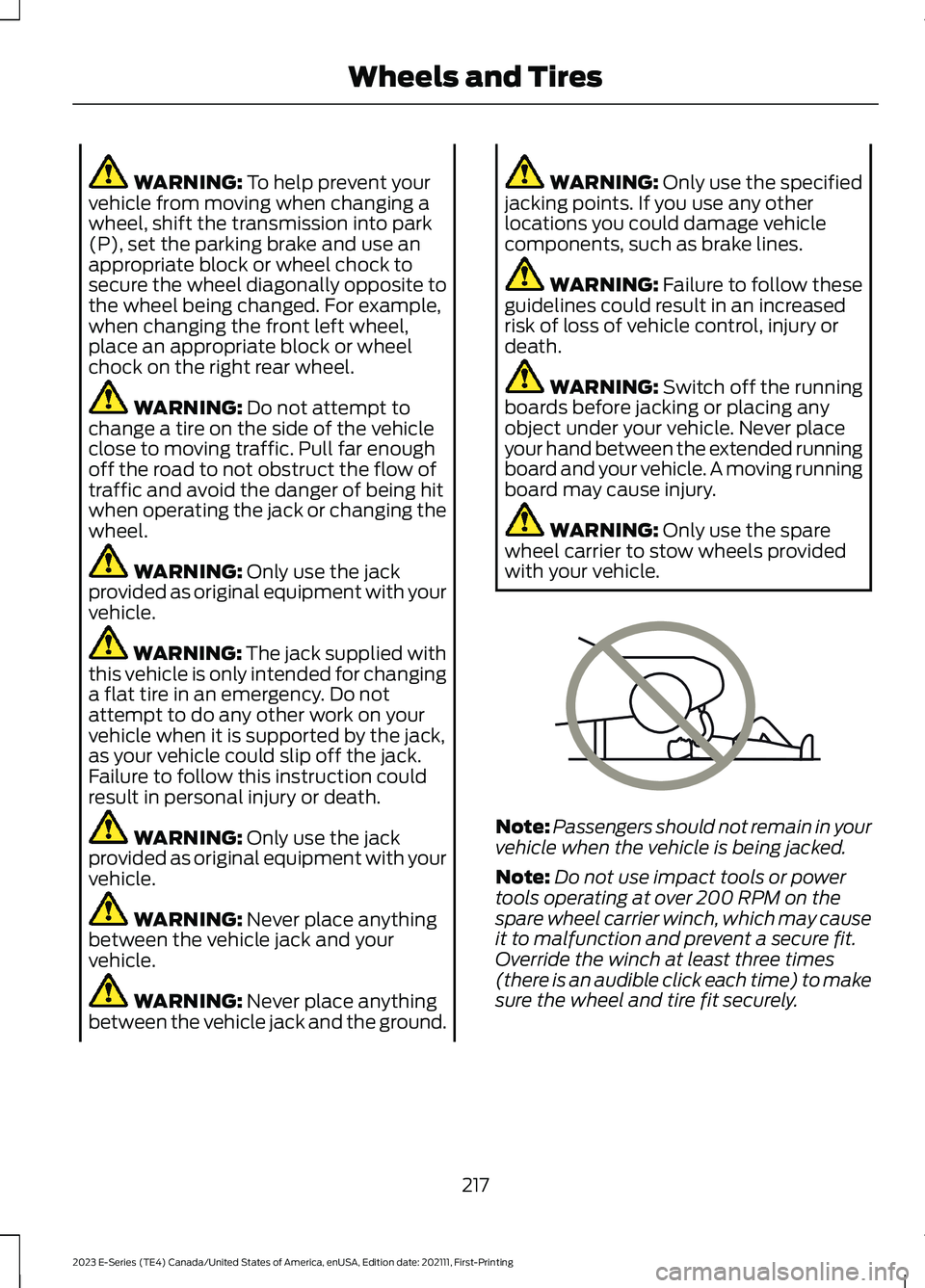
WARNING: To help prevent yourvehicle from moving when changing awheel, shift the transmission into park(P), set the parking brake and use anappropriate block or wheel chock tosecure the wheel diagonally opposite tothe wheel being changed. For example,when changing the front left wheel,place an appropriate block or wheelchock on the right rear wheel.
WARNING: Do not attempt tochange a tire on the side of the vehicleclose to moving traffic. Pull far enoughoff the road to not obstruct the flow oftraffic and avoid the danger of being hitwhen operating the jack or changing thewheel.
WARNING: Only use the jackprovided as original equipment with yourvehicle.
WARNING: The jack supplied withthis vehicle is only intended for changinga flat tire in an emergency. Do notattempt to do any other work on yourvehicle when it is supported by the jack,as your vehicle could slip off the jack.Failure to follow this instruction couldresult in personal injury or death.
WARNING: Only use the jackprovided as original equipment with yourvehicle.
WARNING: Never place anythingbetween the vehicle jack and yourvehicle.
WARNING: Never place anythingbetween the vehicle jack and the ground.
WARNING: Only use the specifiedjacking points. If you use any otherlocations you could damage vehiclecomponents, such as brake lines.
WARNING: Failure to follow theseguidelines could result in an increasedrisk of loss of vehicle control, injury ordeath.
WARNING: Switch off the runningboards before jacking or placing anyobject under your vehicle. Never placeyour hand between the extended runningboard and your vehicle. A moving runningboard may cause injury.
WARNING: Only use the sparewheel carrier to stow wheels providedwith your vehicle.
Note:Passengers should not remain in yourvehicle when the vehicle is being jacked.
Note:Do not use impact tools or powertools operating at over 200 RPM on thespare wheel carrier winch, which may causeit to malfunction and prevent a secure fit.Override the winch at least three times(there is an audible click each time) to makesure the wheel and tire fit securely.
217
2023 E-Series (TE4) Canada/United States of America, enUSA, Edition date: 202111, First-PrintingWheels and TiresE166722
Page 222 of 292
Removing the Spare Tire
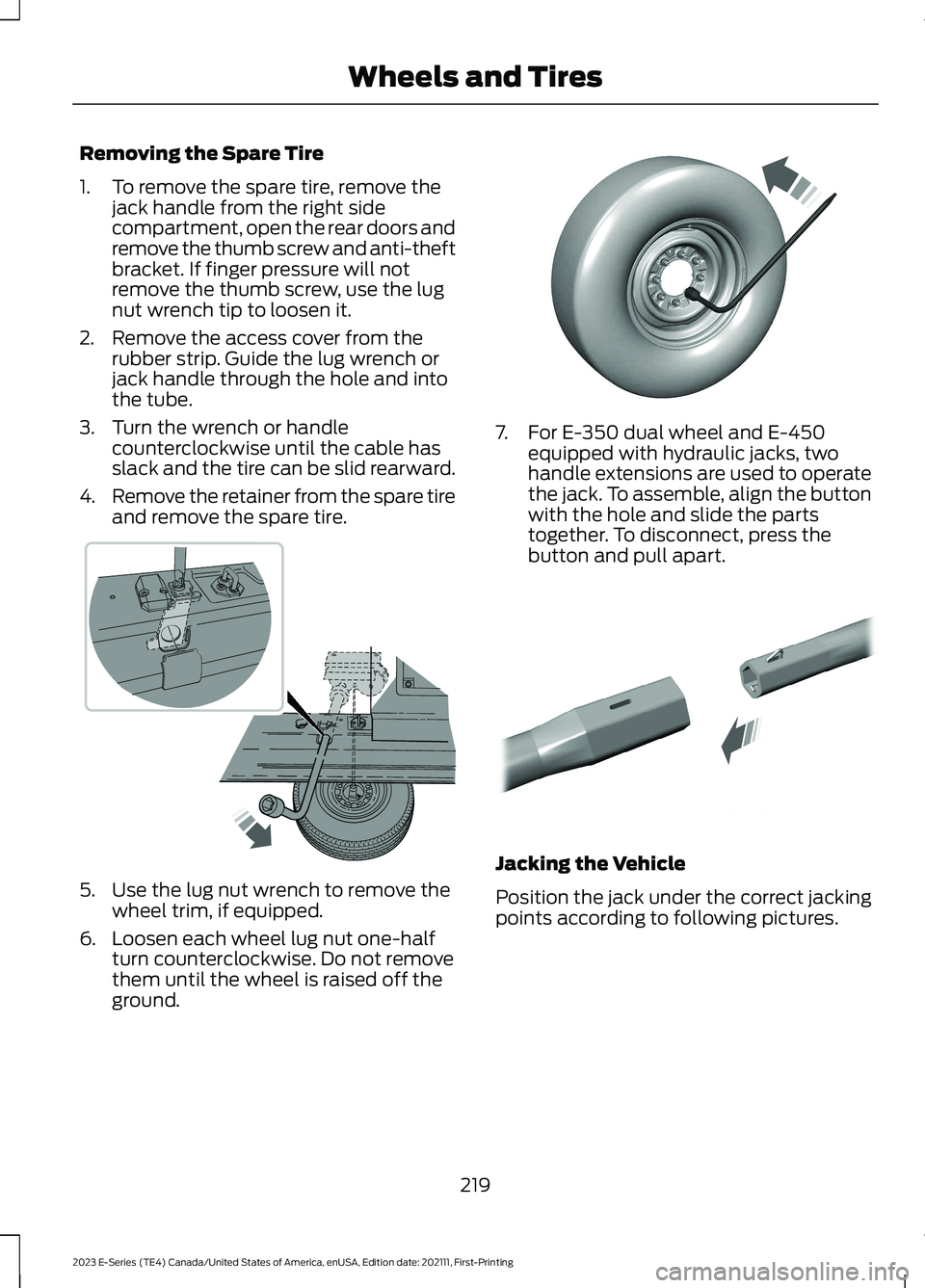
1.To remove the spare tire, remove thejack handle from the right sidecompartment, open the rear doors andremove the thumb screw and anti-theftbracket. If finger pressure will notremove the thumb screw, use the lugnut wrench tip to loosen it.
2.Remove the access cover from therubber strip. Guide the lug wrench orjack handle through the hole and intothe tube.
3.Turn the wrench or handlecounterclockwise until the cable hasslack and the tire can be slid rearward.
4.Remove the retainer from the spare tireand remove the spare tire.
5.Use the lug nut wrench to remove thewheel trim, if equipped.
6.Loosen each wheel lug nut one-halfturn counterclockwise. Do not removethem until the wheel is raised off theground.
7.For E-350 dual wheel and E-450equipped with hydraulic jacks, twohandle extensions are used to operatethe jack. To assemble, align the buttonwith the hole and slide the partstogether. To disconnect, press thebutton and pull apart.
Jacking the Vehicle
Position the jack under the correct jackingpoints according to following pictures.
219
2023 E-Series (TE4) Canada/United States of America, enUSA, Edition date: 202111, First-PrintingWheels and Tires E366770 E366771 E308882
Page 223 of 292
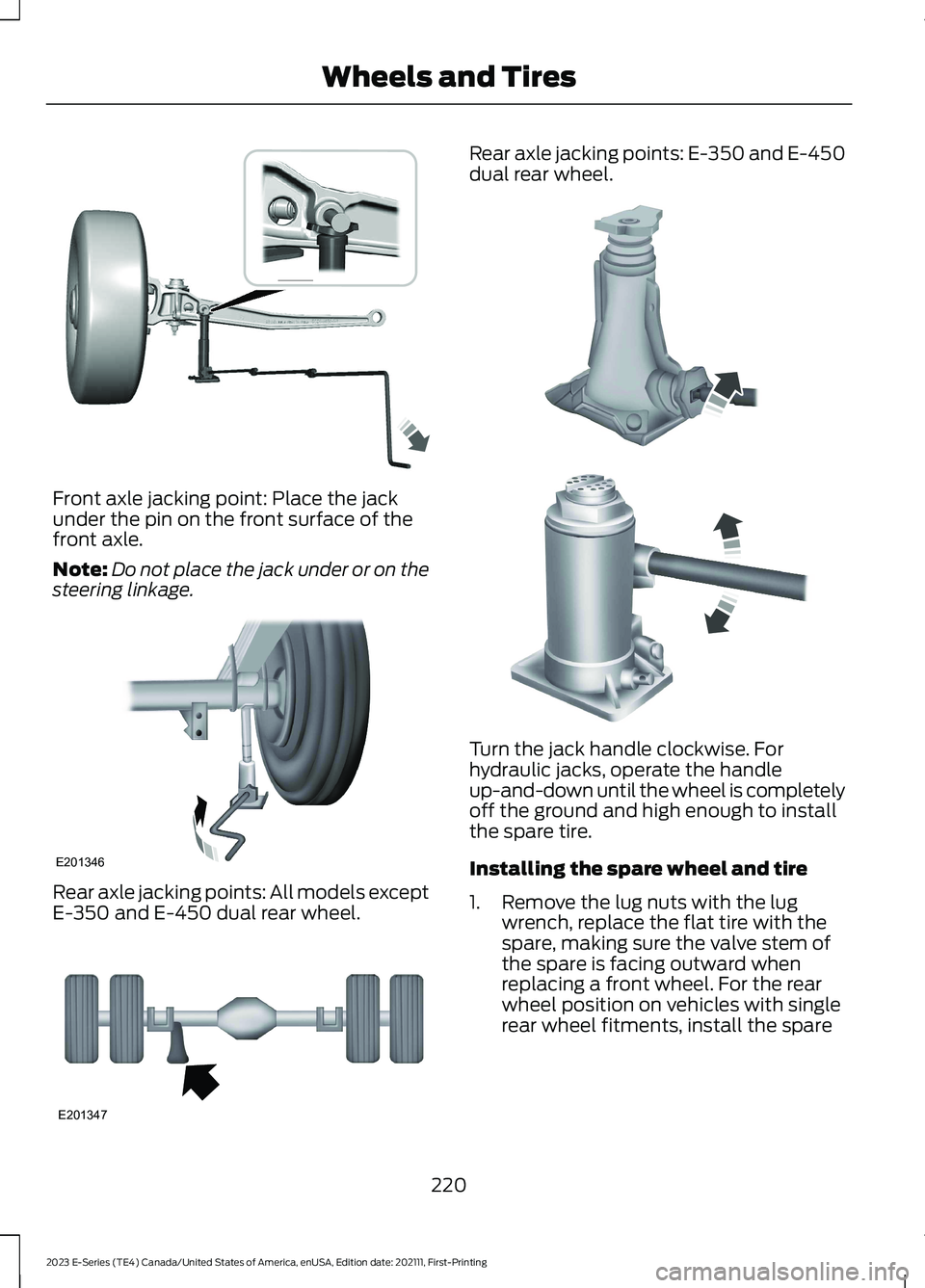
Front axle jacking point: Place the jackunder the pin on the front surface of thefront axle.
Note:Do not place the jack under or on thesteering linkage.
Rear axle jacking points: All models exceptE-350 and E-450 dual rear wheel.
Rear axle jacking points: E-350 and E-450dual rear wheel.
Turn the jack handle clockwise. Forhydraulic jacks, operate the handleup-and-down until the wheel is completelyoff the ground and high enough to installthe spare tire.
Installing the spare wheel and tire
1.Remove the lug nuts with the lugwrench, replace the flat tire with thespare, making sure the valve stem ofthe spare is facing outward whenreplacing a front wheel. For the rearwheel position on vehicles with singlerear wheel fitments, install the spare
220
2023 E-Series (TE4) Canada/United States of America, enUSA, Edition date: 202111, First-PrintingWheels and Tires E366985 E201346 E201347 E162811 E162819
Page 224 of 292
with the valve stem facing outward.For vehicles with dual rear wheels, thevalve stem of the spare must faceoutward when replacing an innerwheel, but must face inward whenreplacing an outboard wheel.
2.Install the lug nuts and finger tighten.Do not fully tighten the lug nuts untilthe wheel has been lowered.
3.Lower the vehicle completely byturning the jack handlecounterclockwise.
Note:For hydraulic jacks, insert the releasevalve, open release valve slightly by turningthe handle counterclockwise. Stop turningthe release valve when vehicle start tolower. Close the valve when the vehicle iscompletely lowered.
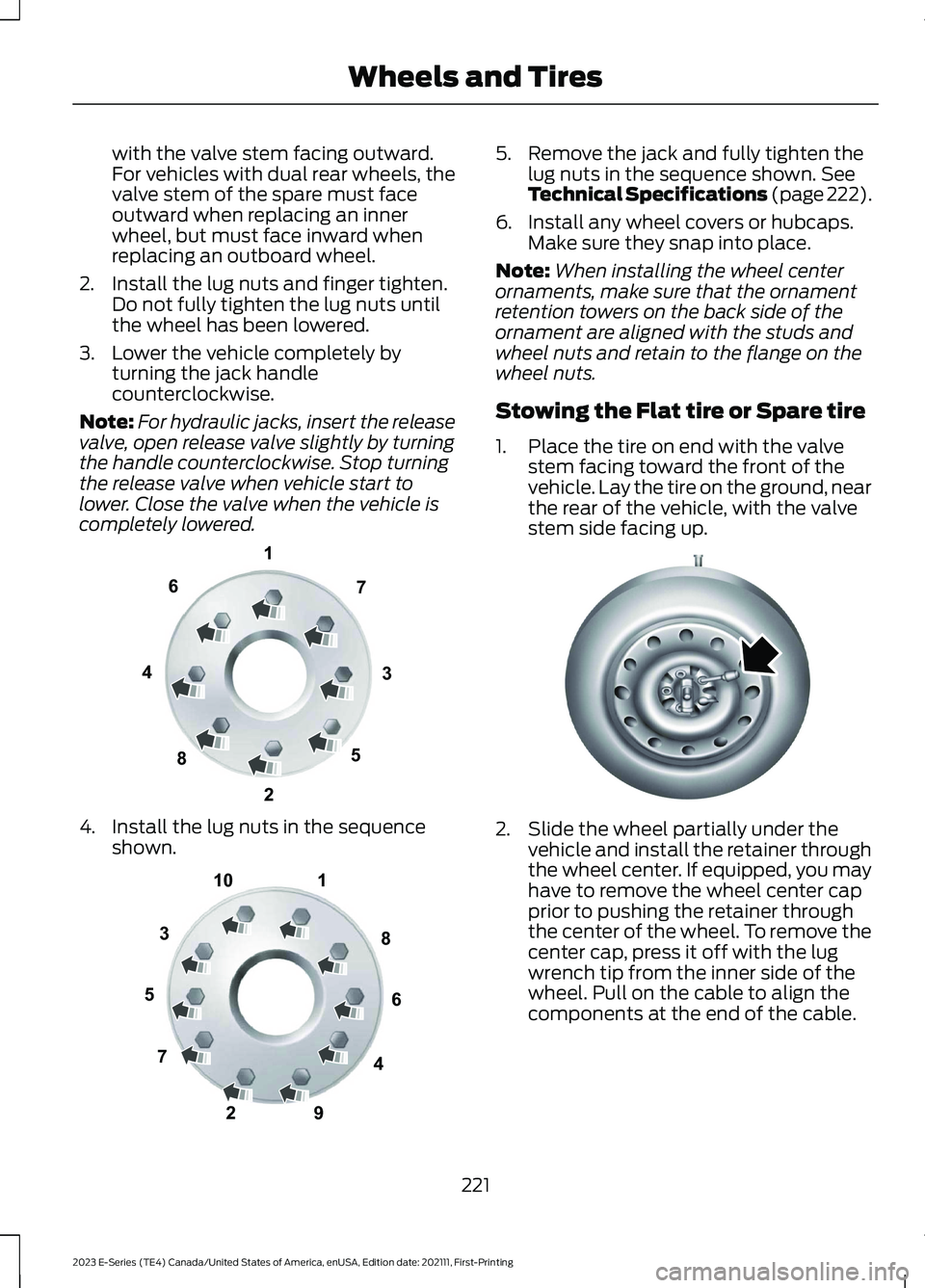
4.Install the lug nuts in the sequenceshown.
5.Remove the jack and fully tighten thelug nuts in the sequence shown. SeeTechnical Specifications (page 222).
6.Install any wheel covers or hubcaps.Make sure they snap into place.
Note:When installing the wheel centerornaments, make sure that the ornamentretention towers on the back side of theornament are aligned with the studs andwheel nuts and retain to the flange on thewheel nuts.
Stowing the Flat tire or Spare tire
1.Place the tire on end with the valvestem facing toward the front of thevehicle. Lay the tire on the ground, nearthe rear of the vehicle, with the valvestem side facing up.
2.Slide the wheel partially under thevehicle and install the retainer throughthe wheel center. If equipped, you mayhave to remove the wheel center capprior to pushing the retainer throughthe center of the wheel. To remove thecenter cap, press it off with the lugwrench tip from the inner side of thewheel. Pull on the cable to align thecomponents at the end of the cable.
221
2023 E-Series (TE4) Canada/United States of America, enUSA, Edition date: 202111, First-PrintingWheels and Tires13427658E161441 12345678910E169375 E162800
Page 225 of 292
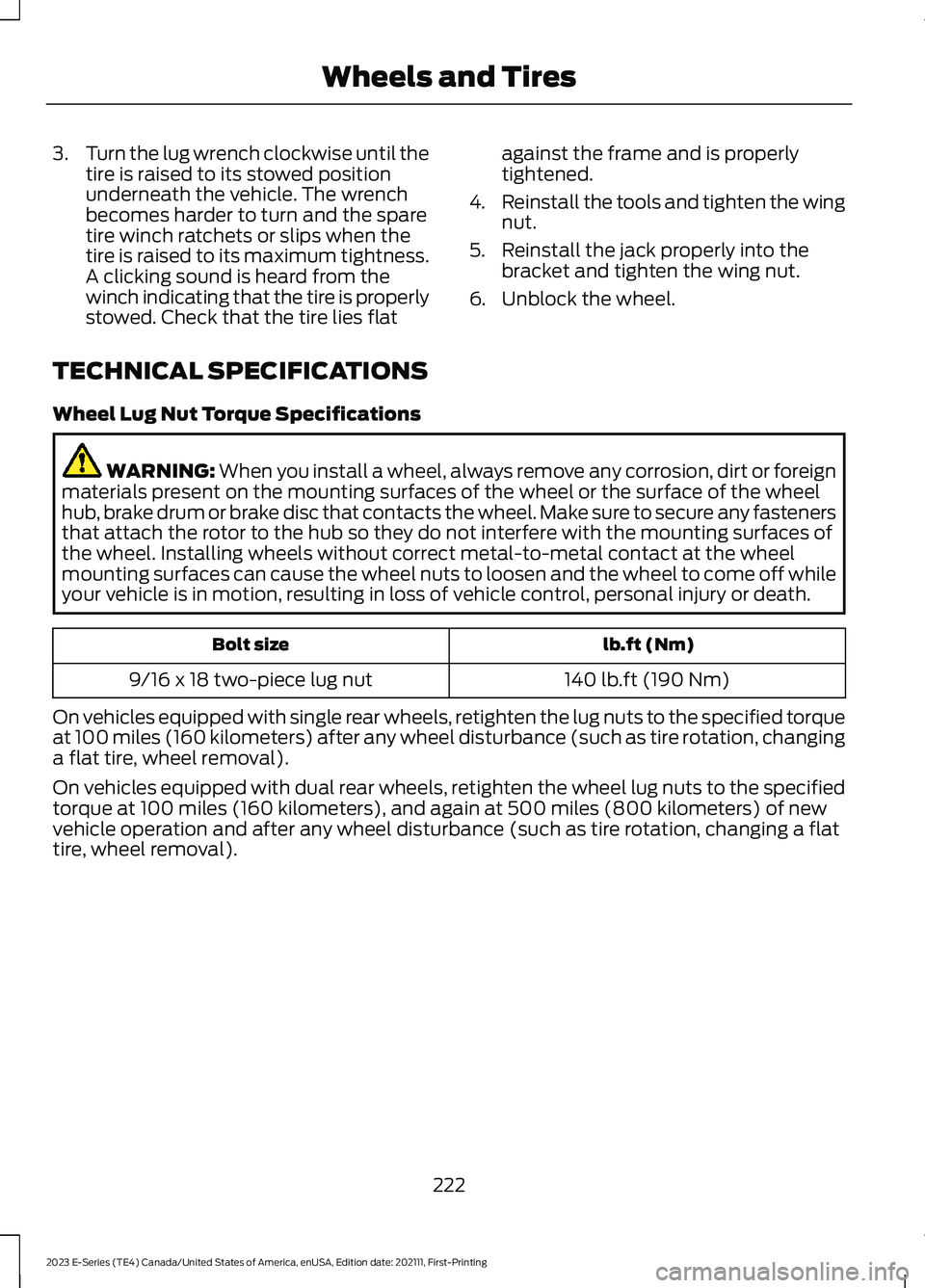
3.Turn the lug wrench clockwise until thetire is raised to its stowed positionunderneath the vehicle. The wrenchbecomes harder to turn and the sparetire winch ratchets or slips when thetire is raised to its maximum tightness.A clicking sound is heard from thewinch indicating that the tire is properlystowed. Check that the tire lies flat
against the frame and is properlytightened.
4.Reinstall the tools and tighten the wingnut.
5.Reinstall the jack properly into thebracket and tighten the wing nut.
6.Unblock the wheel.
TECHNICAL SPECIFICATIONS
Wheel Lug Nut Torque Specifications
WARNING: When you install a wheel, always remove any corrosion, dirt or foreignmaterials present on the mounting surfaces of the wheel or the surface of the wheelhub, brake drum or brake disc that contacts the wheel. Make sure to secure any fastenersthat attach the rotor to the hub so they do not interfere with the mounting surfaces ofthe wheel. Installing wheels without correct metal-to-metal contact at the wheelmounting surfaces can cause the wheel nuts to loosen and the wheel to come off whileyour vehicle is in motion, resulting in loss of vehicle control, personal injury or death.
lb.ft (Nm)Bolt size
140 lb.ft (190 Nm)9/16 x 18 two-piece lug nut
On vehicles equipped with single rear wheels, retighten the lug nuts to the specified torqueat 100 miles (160 kilometers) after any wheel disturbance (such as tire rotation, changinga flat tire, wheel removal).
On vehicles equipped with dual rear wheels, retighten the wheel lug nuts to the specifiedtorque at 100 miles (160 kilometers), and again at 500 miles (800 kilometers) of newvehicle operation and after any wheel disturbance (such as tire rotation, changing a flattire, wheel removal).
222
2023 E-Series (TE4) Canada/United States of America, enUSA, Edition date: 202111, First-PrintingWheels and Tires
Page 291 of 292
Power Seats.....................................................79Power Steering Fluid Check......................174Power Windows..............................................57Pre-Collision Assist......................................120Protecting the Environment........................17PunctureSee: Changing a Road Wheel.........................215
R
Radio Frequency CertificationLabels............................................................255Cruise Control Module.....................................255Rear Axle Fluid Capacity andSpecification...............................................232Rear Passenger Climate Controls............76Rear View Camera.......................................106Rear View CameraSee: Rear View Camera...................................106Recommended Towing Weights............130Reduced Engine Performance.................138Refueling...........................................................89Remote Control..............................................42Removing a Headlamp...............................178Repairing Minor Paint Damage...............186Replacement PartsRecommendation........................................10Replacing a Lost Key or RemoteControl............................................................44Reporting Safety Defects (CanadaOnly)................................................................151Reporting Safety Defects (U.S.Only)..............................................................150Resuming the Set Speed..........................108Roadside Assistance....................................141Roadside Emergencies................................141Running-InSee: Breaking-In..................................................139Running Out of Fuel......................................88
S
Safety Precautions........................................86Scheduled Maintenance...........................247Seatbelt Extensions......................................34Seatbelt Height Adjustment......................33Seatbelts...........................................................30Principle of Operation........................................30
Seatbelt Warning Lamp and IndicatorChime...............................................................33Seats....................................................................77Security..............................................................48Service Data......................................................14Settings Data....................................................15Setting the Cruise Control Speed...........107Sitting in the Correct Position....................77Snow ChainsSee: Using Snow Chains.................................208Spare WheelSee: Changing a Road Wheel.........................215Special Notices................................................10Special Operating Conditions ScheduledMaintenance...............................................252Speed ControlSee: Cruise Control.............................................107Stability Control............................................104Principle of Operation......................................104Starter SwitchSee: Ignition Switch.............................................82Starting a Gasoline Engine.........................82Starting and Stopping the Engine...........82General Information............................................82Steering.............................................................119Steering Wheel...............................................49Streaming Bluetooth Audio....................240Sun Visors.........................................................58Supplementary Restraints System.........35Principle of Operation.........................................35Switching Automatic High Beam ControlOn and Off.....................................................55Switching Cruise Control On andOff....................................................................107Symbols Glossary.............................................7
T
Technical SpecificationsSee: Capacities and Specifications............224The Better Business Bureau (BBB) AutoLine Program (U.S. Only).......................148Tire Care..........................................................190Tire Pressure Monitoring System..........209TiresSee: Wheels and Tires......................................189Towing a Trailer.............................................129
288
2023 E-Series (TE4) Canada/United States of America, enUSA, Edition date: 202111, First-PrintingIndex