wheel FORD E SERIES 2024 Manual PDF
[x] Cancel search | Manufacturer: FORD, Model Year: 2024, Model line: E SERIES, Model: FORD E SERIES 2024Pages: 303, PDF Size: 6.95 MB
Page 224 of 303
3.Full-size dissimilar spare withoutlabel on wheel
When driving with the full-size dissimilarspare wheel and tire assembly:
•Do not exceed 70 mph (113 km/h).
•Do not use more than one dissimilarspare wheel and tire assembly at atime.
•Do not use commercial car washingequipment.
•Do not use snow chains on the end ofthe vehicle with the dissimilar sparewheel and tire assembly.
Using a dissimilar spare wheel and tireassembly can compromise theeffectiveness of the following :
•Handling, stability and brakingperformance.
•Comfort and noise.
•Ground clearance and parking at curbs.
•Winter weather driving capability.
•Wet weather driving capability.
•All-wheel driving capability.
When driving with the full-size dissimilarspare wheel and tire assembly additionalcaution should be given to:
•Towing a trailer.
•Driving vehicles equipped with acamper body.
•Driving vehicles with a load on thecargo rack.
Drive cautiously when using a full-sizedissimilar spare wheel and tire assemblyand seek service as soon as possible.
Tire Change Procedure (If Equipped)
WARNING: The jack supplied withthis vehicle is only intended for changinga flat tire in an emergency. Do notattempt to do any other work on yourvehicle when it is supported by the jack,as your vehicle could slip off the jack.Failure to follow this instruction couldresult in personal injury or death.
WARNING: To help prevent yourvehicle from moving when changing awheel, shift the transmission into park(P), set the parking brake and use anappropriate block or wheel chock tosecure the wheel diagonally opposite tothe wheel being changed. For example,when changing the front left wheel,place an appropriate block or wheelchock on the right rear wheel.
WARNING: Do not attempt tochange a tire on the side of the vehicleclose to moving traffic. Pull far enoughoff the road to not obstruct the flow oftraffic and avoid the danger of being hitwhen operating the jack or changing thewheel.
WARNING: Only use the jackprovided as original equipment with yourvehicle.
WARNING: The jack supplied withthis vehicle is only intended for changinga flat tire in an emergency. Do notattempt to do any other work on yourvehicle when it is supported by the jack,as your vehicle could slip off the jack.Failure to follow this instruction couldresult in personal injury or death.
WARNING: Only use the jackprovided as original equipment with yourvehicle.
220
2024 E-Series (TE4) Canada/United States of America, enUSA, Edition date: 202210, First-PrintingWheels and Tires
Page 225 of 303
WARNING: Never place anythingbetween the vehicle jack and yourvehicle.
WARNING: Never place anythingbetween the vehicle jack and the ground.
WARNING: Only use the specifiedjacking points. If you use any otherlocations you could damage vehiclecomponents, such as brake lines.
WARNING: Failure to follow theseguidelines could result in an increasedrisk of loss of vehicle control, injury ordeath.
WARNING: Only use the sparewheel carrier to stow wheels providedwith your vehicle.
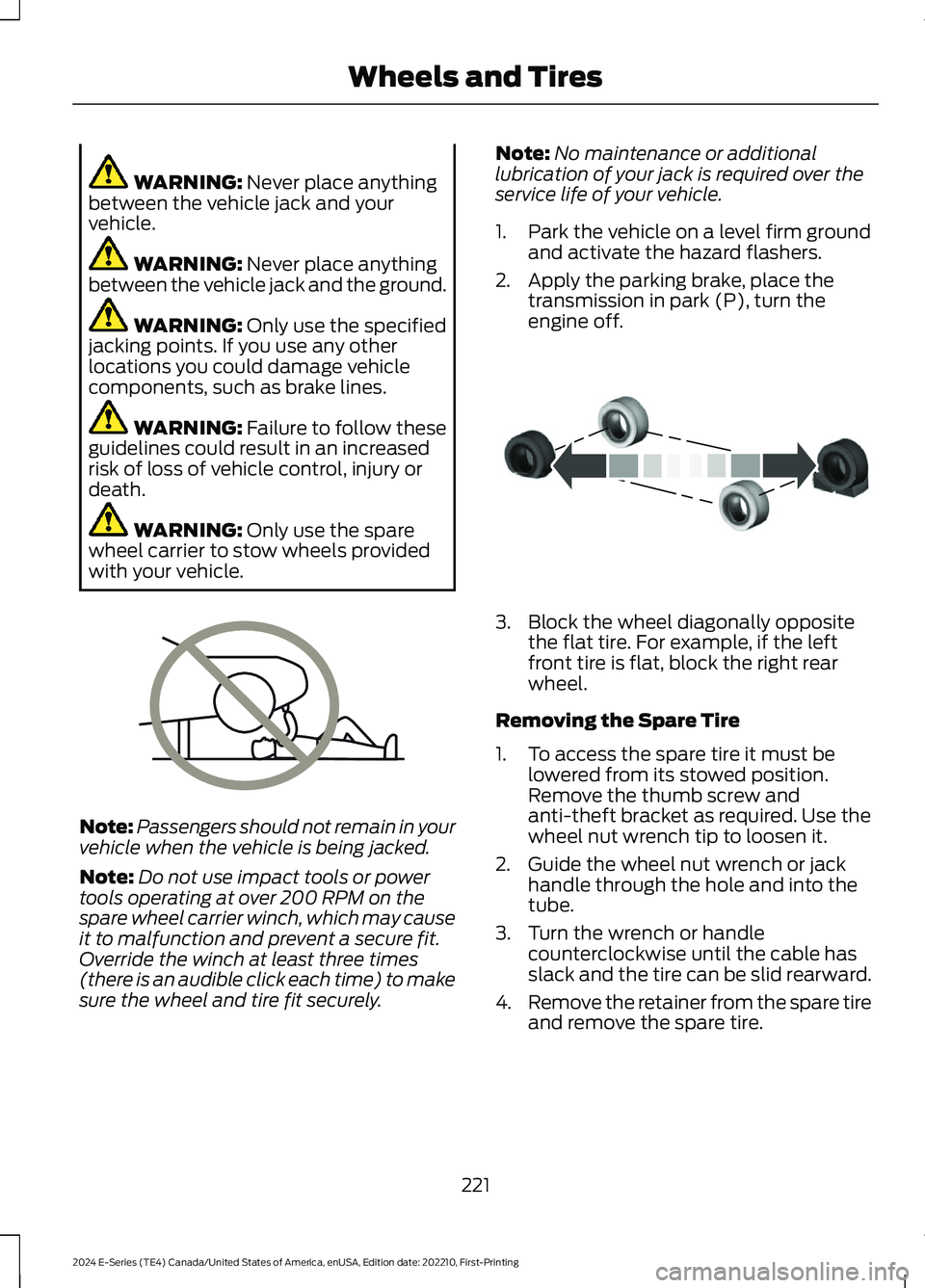
Note:Passengers should not remain in yourvehicle when the vehicle is being jacked.
Note:Do not use impact tools or powertools operating at over 200 RPM on thespare wheel carrier winch, which may causeit to malfunction and prevent a secure fit.Override the winch at least three times(there is an audible click each time) to makesure the wheel and tire fit securely.
Note:No maintenance or additionallubrication of your jack is required over theservice life of your vehicle.
1.Park the vehicle on a level firm groundand activate the hazard flashers.
2.Apply the parking brake, place thetransmission in park (P), turn theengine off.
3.Block the wheel diagonally oppositethe flat tire. For example, if the leftfront tire is flat, block the right rearwheel.
Removing the Spare Tire
1.To access the spare tire it must belowered from its stowed position.Remove the thumb screw andanti-theft bracket as required. Use thewheel nut wrench tip to loosen it.
2.Guide the wheel nut wrench or jackhandle through the hole and into thetube.
3.Turn the wrench or handlecounterclockwise until the cable hasslack and the tire can be slid rearward.
4.Remove the retainer from the spare tireand remove the spare tire.
221
2024 E-Series (TE4) Canada/United States of America, enUSA, Edition date: 202210, First-PrintingWheels and TiresE166722 E175447
Page 226 of 303
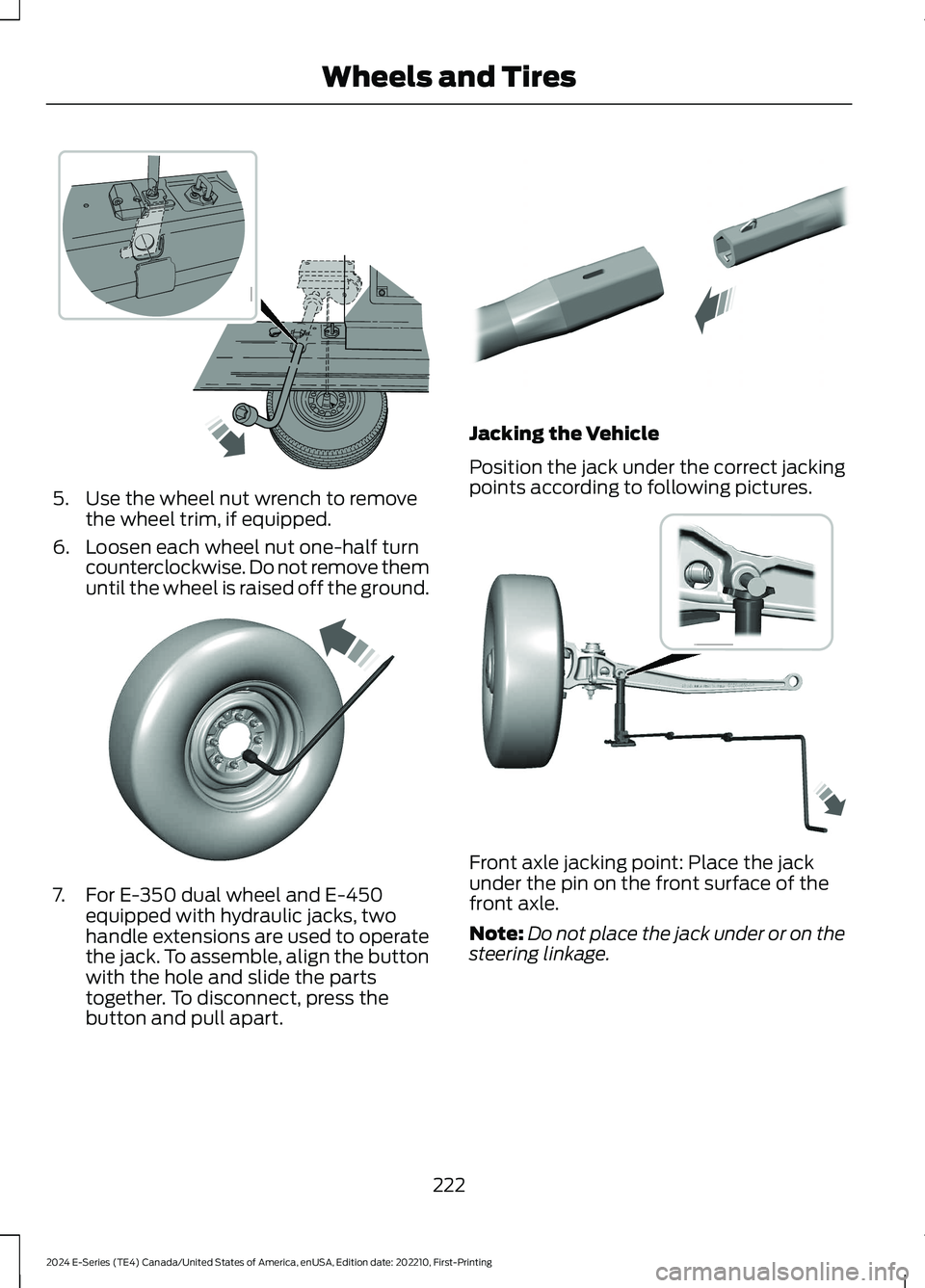
5.Use the wheel nut wrench to removethe wheel trim, if equipped.
6.Loosen each wheel nut one-half turncounterclockwise. Do not remove themuntil the wheel is raised off the ground.
7.For E-350 dual wheel and E-450equipped with hydraulic jacks, twohandle extensions are used to operatethe jack. To assemble, align the buttonwith the hole and slide the partstogether. To disconnect, press thebutton and pull apart.
Jacking the Vehicle
Position the jack under the correct jackingpoints according to following pictures.
Front axle jacking point: Place the jackunder the pin on the front surface of thefront axle.
Note:Do not place the jack under or on thesteering linkage.
222
2024 E-Series (TE4) Canada/United States of America, enUSA, Edition date: 202210, First-PrintingWheels and Tires E366770 E366771 E308882 E366985
Page 227 of 303
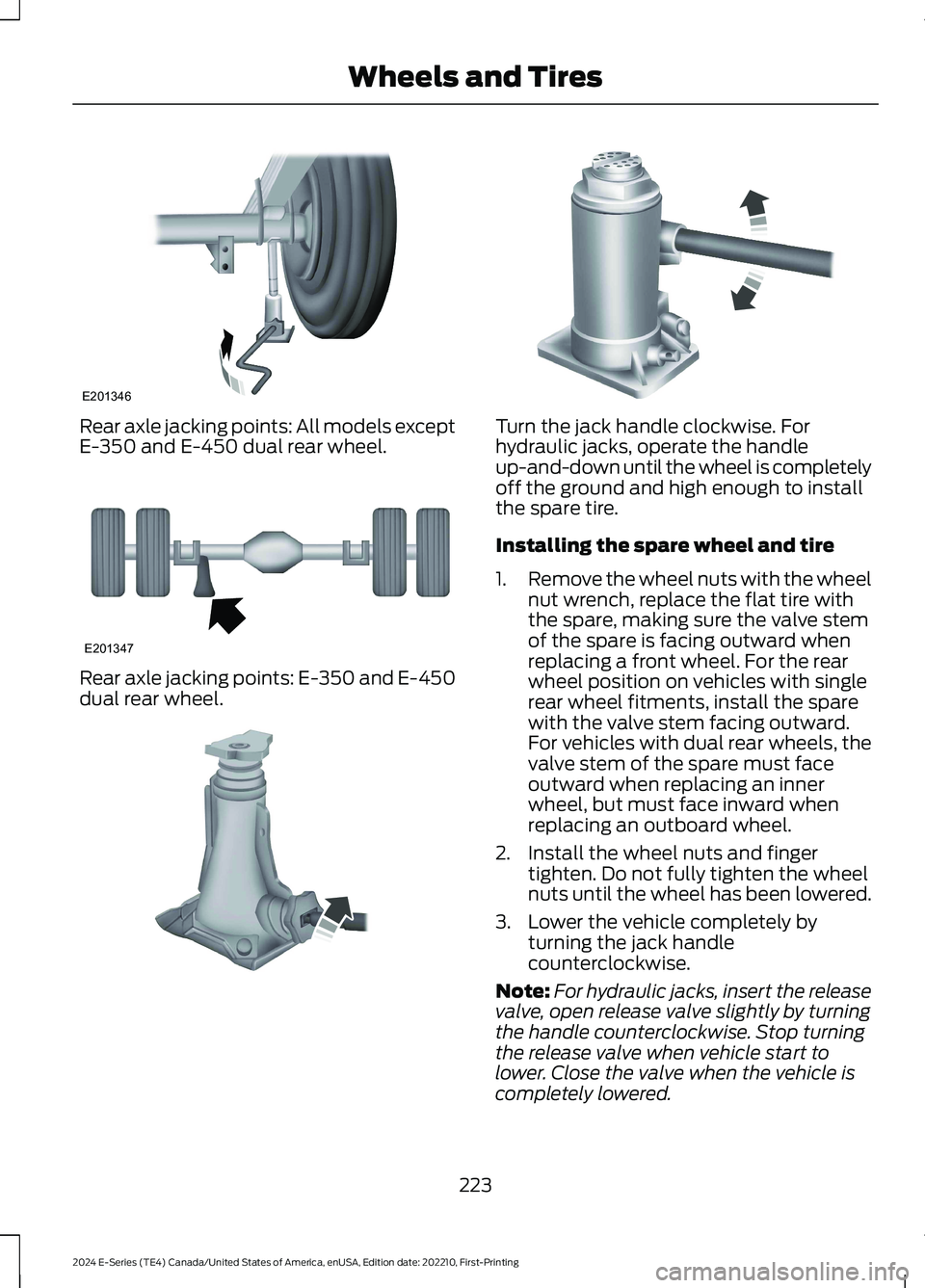
Rear axle jacking points: All models exceptE-350 and E-450 dual rear wheel.
Rear axle jacking points: E-350 and E-450dual rear wheel.
Turn the jack handle clockwise. Forhydraulic jacks, operate the handleup-and-down until the wheel is completelyoff the ground and high enough to installthe spare tire.
Installing the spare wheel and tire
1.Remove the wheel nuts with the wheelnut wrench, replace the flat tire withthe spare, making sure the valve stemof the spare is facing outward whenreplacing a front wheel. For the rearwheel position on vehicles with singlerear wheel fitments, install the sparewith the valve stem facing outward.For vehicles with dual rear wheels, thevalve stem of the spare must faceoutward when replacing an innerwheel, but must face inward whenreplacing an outboard wheel.
2.Install the wheel nuts and fingertighten. Do not fully tighten the wheelnuts until the wheel has been lowered.
3.Lower the vehicle completely byturning the jack handlecounterclockwise.
Note:For hydraulic jacks, insert the releasevalve, open release valve slightly by turningthe handle counterclockwise. Stop turningthe release valve when vehicle start tolower. Close the valve when the vehicle iscompletely lowered.
223
2024 E-Series (TE4) Canada/United States of America, enUSA, Edition date: 202210, First-PrintingWheels and TiresE201346 E201347 E162811 E162819
Page 228 of 303
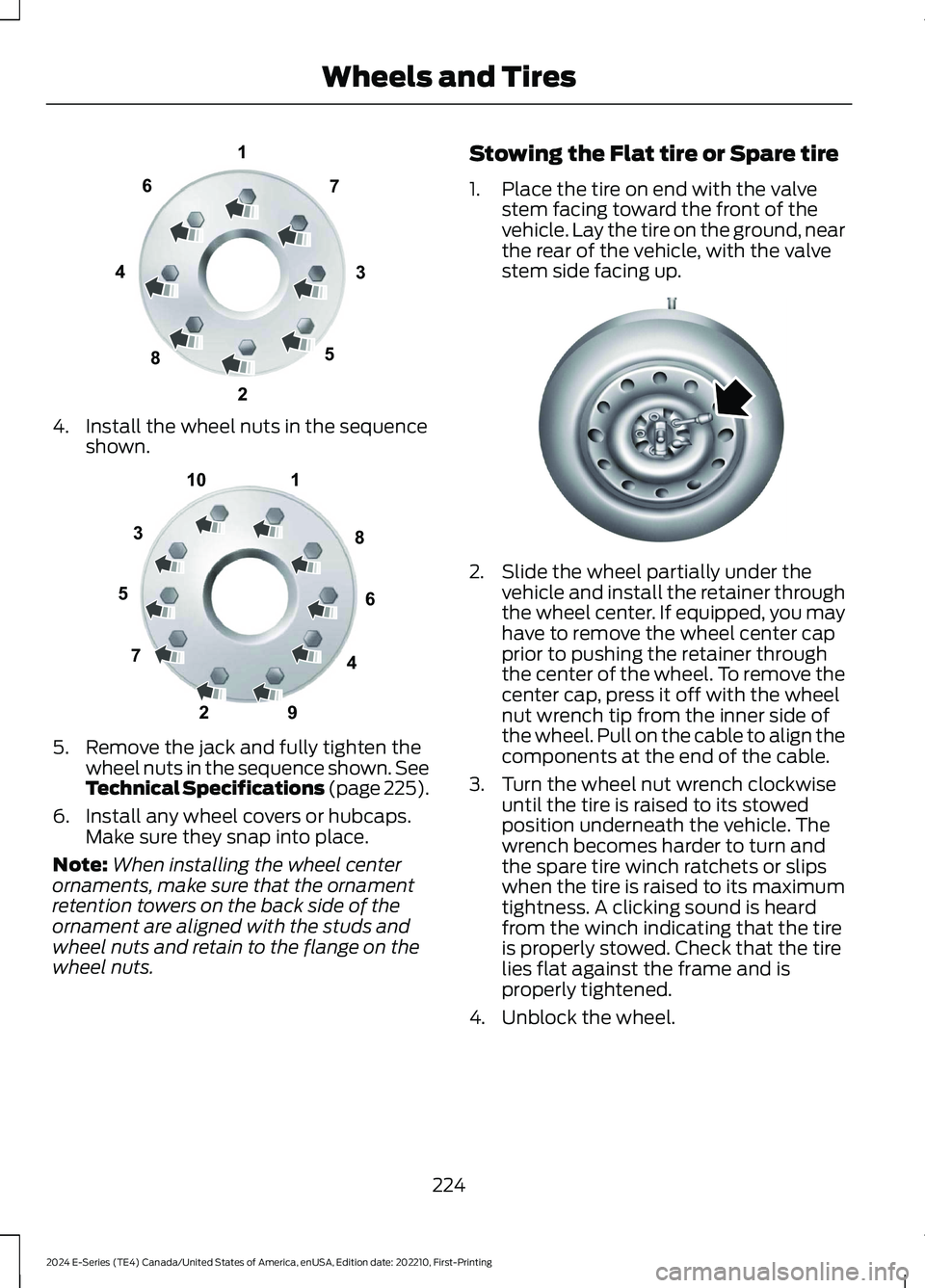
4.Install the wheel nuts in the sequenceshown.
5.Remove the jack and fully tighten thewheel nuts in the sequence shown. SeeTechnical Specifications (page 225).
6.Install any wheel covers or hubcaps.Make sure they snap into place.
Note:When installing the wheel centerornaments, make sure that the ornamentretention towers on the back side of theornament are aligned with the studs andwheel nuts and retain to the flange on thewheel nuts.
Stowing the Flat tire or Spare tire
1.Place the tire on end with the valvestem facing toward the front of thevehicle. Lay the tire on the ground, nearthe rear of the vehicle, with the valvestem side facing up.
2.Slide the wheel partially under thevehicle and install the retainer throughthe wheel center. If equipped, you mayhave to remove the wheel center capprior to pushing the retainer throughthe center of the wheel. To remove thecenter cap, press it off with the wheelnut wrench tip from the inner side ofthe wheel. Pull on the cable to align thecomponents at the end of the cable.
3.Turn the wheel nut wrench clockwiseuntil the tire is raised to its stowedposition underneath the vehicle. Thewrench becomes harder to turn andthe spare tire winch ratchets or slipswhen the tire is raised to its maximumtightness. A clicking sound is heardfrom the winch indicating that the tireis properly stowed. Check that the tirelies flat against the frame and isproperly tightened.
4.Unblock the wheel.
224
2024 E-Series (TE4) Canada/United States of America, enUSA, Edition date: 202210, First-PrintingWheels and Tires13427658E161441 12345678910E169375 E162800
Page 229 of 303
TECHNICAL SPECIFICATIONS
Wheel Lug Nut Torque Specifications
WARNING: When you install a wheel, remove any corrosion, dirt or foreign materialspresent on the mounting surfaces of the wheel or the surface of the wheel hub, brakedrum or brake disc that contacts the wheel. Make sure to secure any fasteners thatattach the rotor to the hub so they do not interfere with the mounting surfaces of thewheel. Installing wheels without following these steps can cause the wheel nuts toloosen and the wheel to come off while your vehicle is in motion, resulting in loss ofvehicle control, personal injury or death.
lb.ft (Nm)1Bolt size
140 lb.ft (190 Nm)9/16 x 18 two-piece lug nut
1 Torque specifications are for nut and bolt threads free of dirt and rust. Use only Fordrecommended replacement fasteners.
On vehicles equipped with single rear wheels, retighten the lug nuts to the specified torqueat 100 miles (160 kilometers) after any wheel disturbance (such as tire rotation, changinga flat tire, wheel removal).
On vehicles equipped with dual rear wheels, retighten the wheel lug nuts to the specifiedtorque at 100 miles (160 kilometers), and again at 500 miles (800 kilometers) of newvehicle operation and after any wheel disturbance (such as tire rotation, changing a flattire, wheel removal).
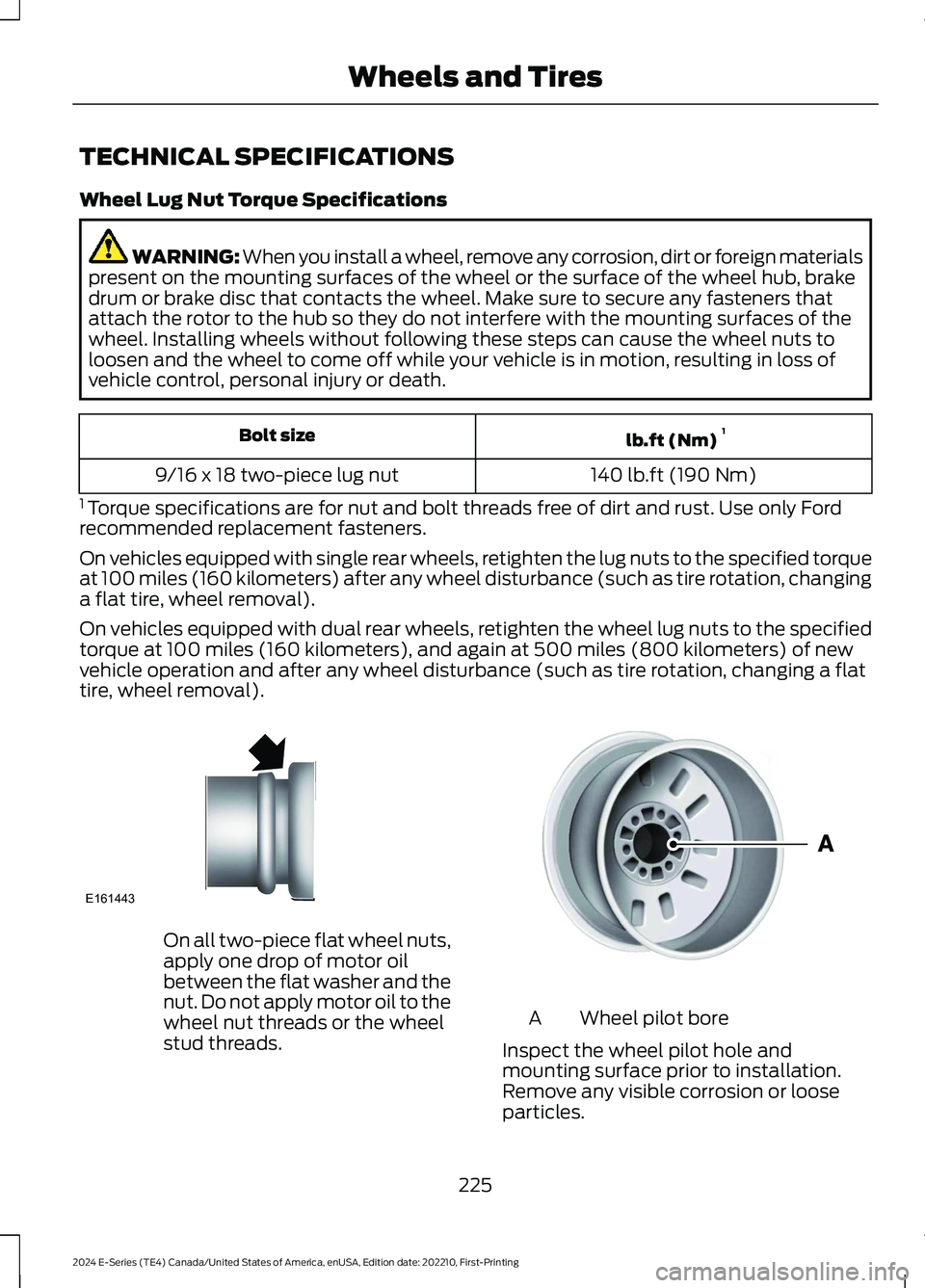
On all two-piece flat wheel nuts,apply one drop of motor oilbetween the flat washer and thenut. Do not apply motor oil to thewheel nut threads or the wheelstud threads.
Wheel pilot boreA
Inspect the wheel pilot hole andmounting surface prior to installation.Remove any visible corrosion or looseparticles.
225
2024 E-Series (TE4) Canada/United States of America, enUSA, Edition date: 202210, First-PrintingWheels and TiresE161443 E145950
Page 256 of 303
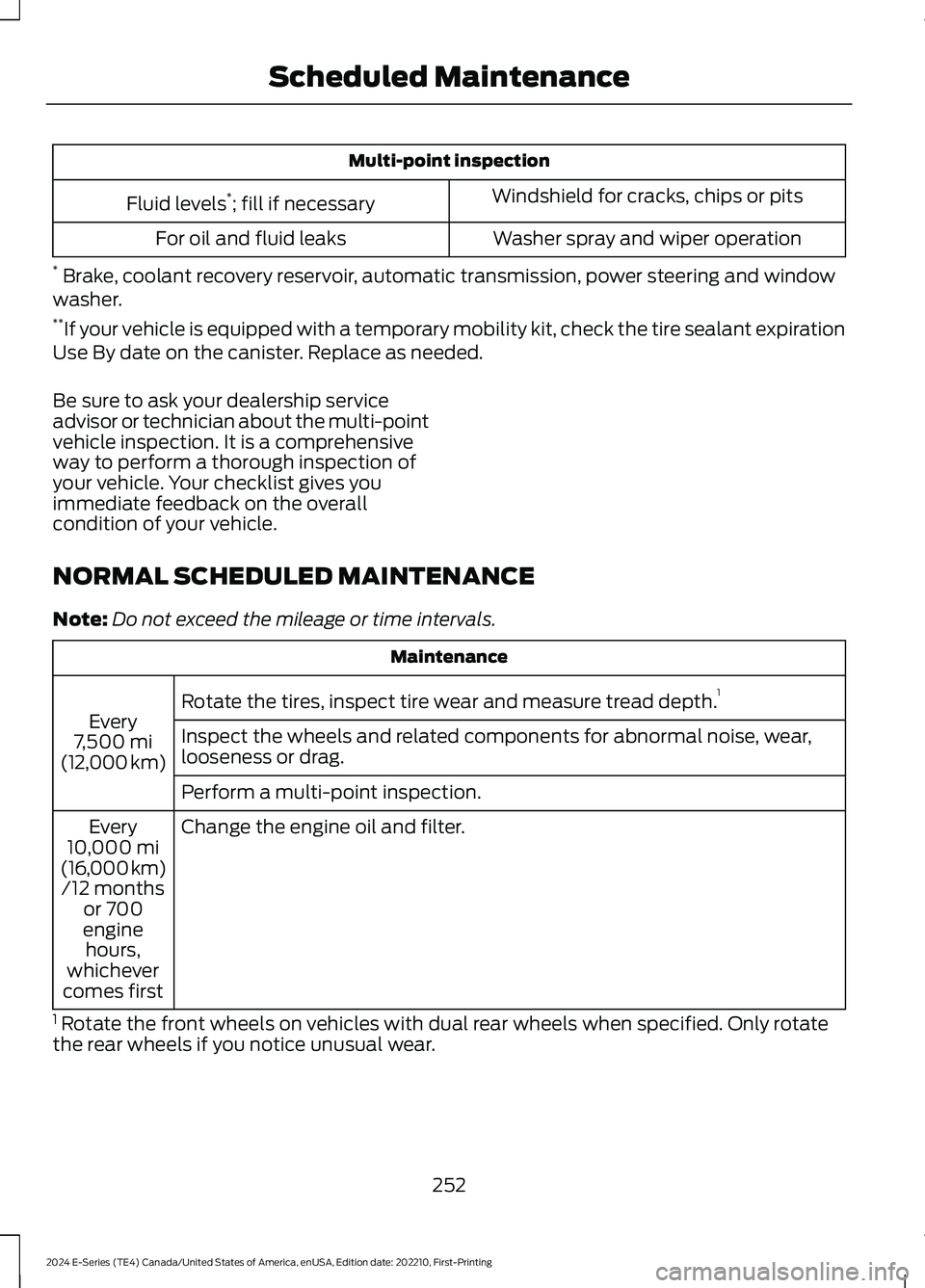
Multi-point inspection
Windshield for cracks, chips or pitsFluid levels*; fill if necessary
Washer spray and wiper operationFor oil and fluid leaks
* Brake, coolant recovery reservoir, automatic transmission, power steering and windowwasher.**If your vehicle is equipped with a temporary mobility kit, check the tire sealant expirationUse By date on the canister. Replace as needed.
Be sure to ask your dealership serviceadvisor or technician about the multi-pointvehicle inspection. It is a comprehensiveway to perform a thorough inspection ofyour vehicle. Your checklist gives youimmediate feedback on the overallcondition of your vehicle.
NORMAL SCHEDULED MAINTENANCE
Note:Do not exceed the mileage or time intervals.
Maintenance
Rotate the tires, inspect tire wear and measure tread depth.1
Every7,500 mi(12,000 km)
Inspect the wheels and related components for abnormal noise, wear,looseness or drag.
Perform a multi-point inspection.
Change the engine oil and filter.Every10,000 mi(16,000 km)/12 monthsor 700enginehours,whichevercomes first
1 Rotate the front wheels on vehicles with dual rear wheels when specified. Only rotatethe rear wheels if you notice unusual wear.
252
2024 E-Series (TE4) Canada/United States of America, enUSA, Edition date: 202210, First-PrintingScheduled Maintenance
Page 257 of 303
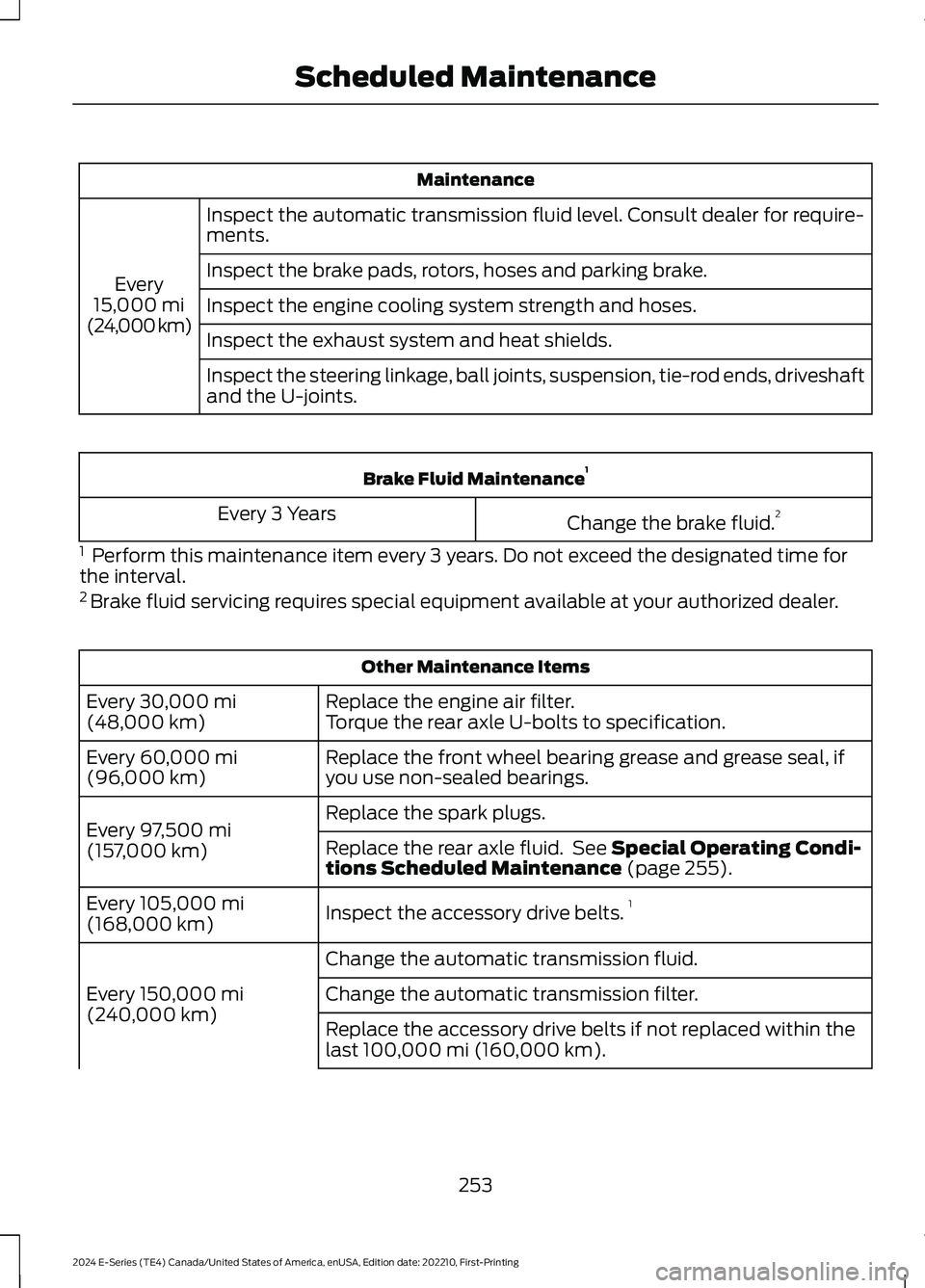
Maintenance
Inspect the automatic transmission fluid level. Consult dealer for require-ments.
Every15,000 mi(24,000 km)
Inspect the brake pads, rotors, hoses and parking brake.
Inspect the engine cooling system strength and hoses.
Inspect the exhaust system and heat shields.
Inspect the steering linkage, ball joints, suspension, tie-rod ends, driveshaftand the U-joints.
Brake Fluid Maintenance1
Change the brake fluid.2Every 3 Years
1 Perform this maintenance item every 3 years. Do not exceed the designated time forthe interval.2 Brake fluid servicing requires special equipment available at your authorized dealer.
Other Maintenance Items
Replace the engine air filter.Every 30,000 mi(48,000 km)Torque the rear axle U-bolts to specification.
Replace the front wheel bearing grease and grease seal, ifyou use non-sealed bearings.Every 60,000 mi(96,000 km)
Replace the spark plugs.Every 97,500 mi(157,000 km)Replace the rear axle fluid. See Special Operating Condi-tions Scheduled Maintenance (page 255).
Inspect the accessory drive belts.1Every 105,000 mi(168,000 km)
Change the automatic transmission fluid.
Every 150,000 mi(240,000 km)Change the automatic transmission filter.
Replace the accessory drive belts if not replaced within thelast 100,000 mi (160,000 km).
253
2024 E-Series (TE4) Canada/United States of America, enUSA, Edition date: 202210, First-PrintingScheduled Maintenance
Page 258 of 303
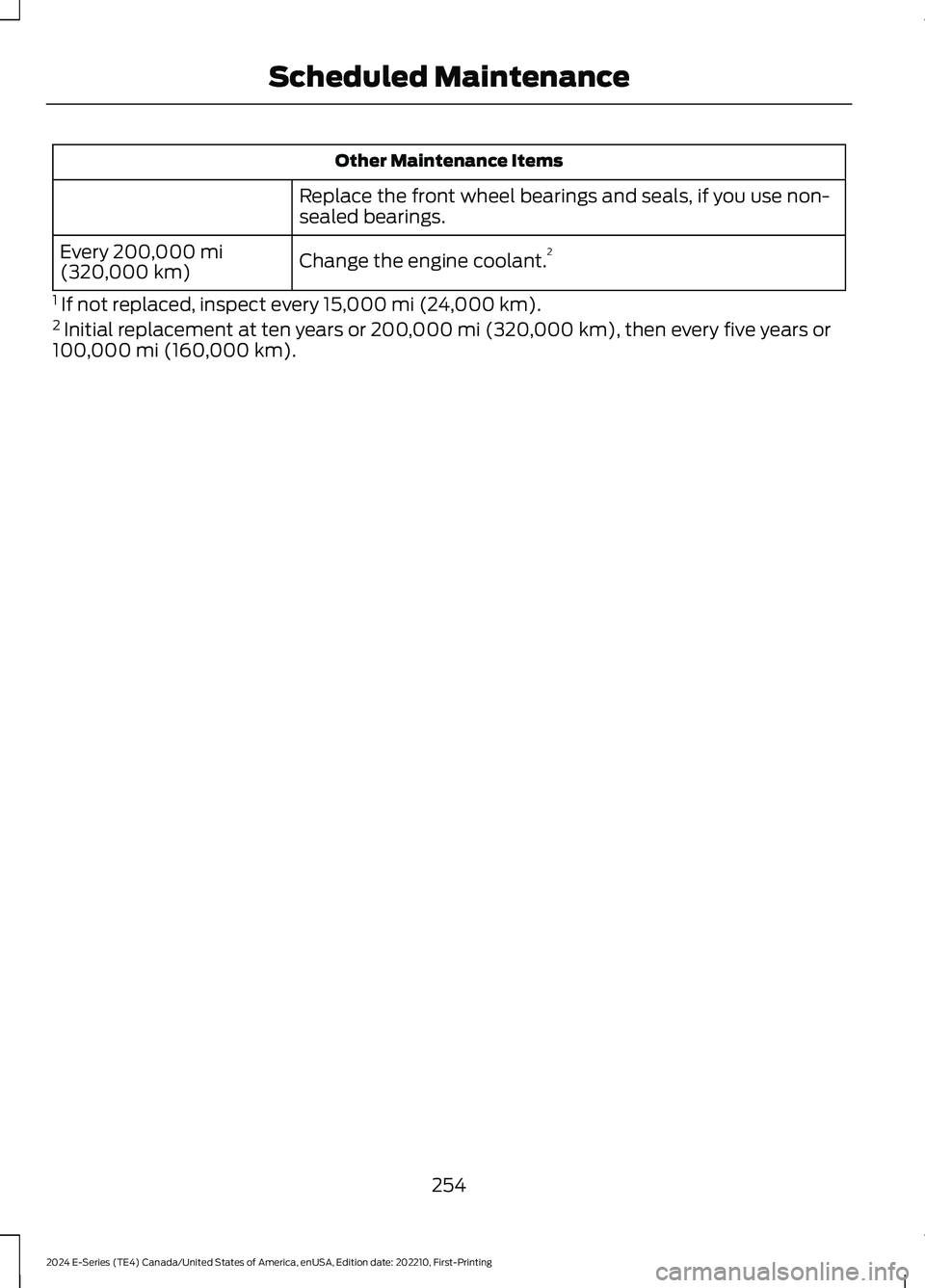
Other Maintenance Items
Replace the front wheel bearings and seals, if you use non-sealed bearings.
Change the engine coolant.2Every 200,000 mi(320,000 km)
1 If not replaced, inspect every 15,000 mi (24,000 km).2 Initial replacement at ten years or 200,000 mi (320,000 km), then every five years or100,000 mi (160,000 km).
254
2024 E-Series (TE4) Canada/United States of America, enUSA, Edition date: 202210, First-PrintingScheduled Maintenance
Page 260 of 303
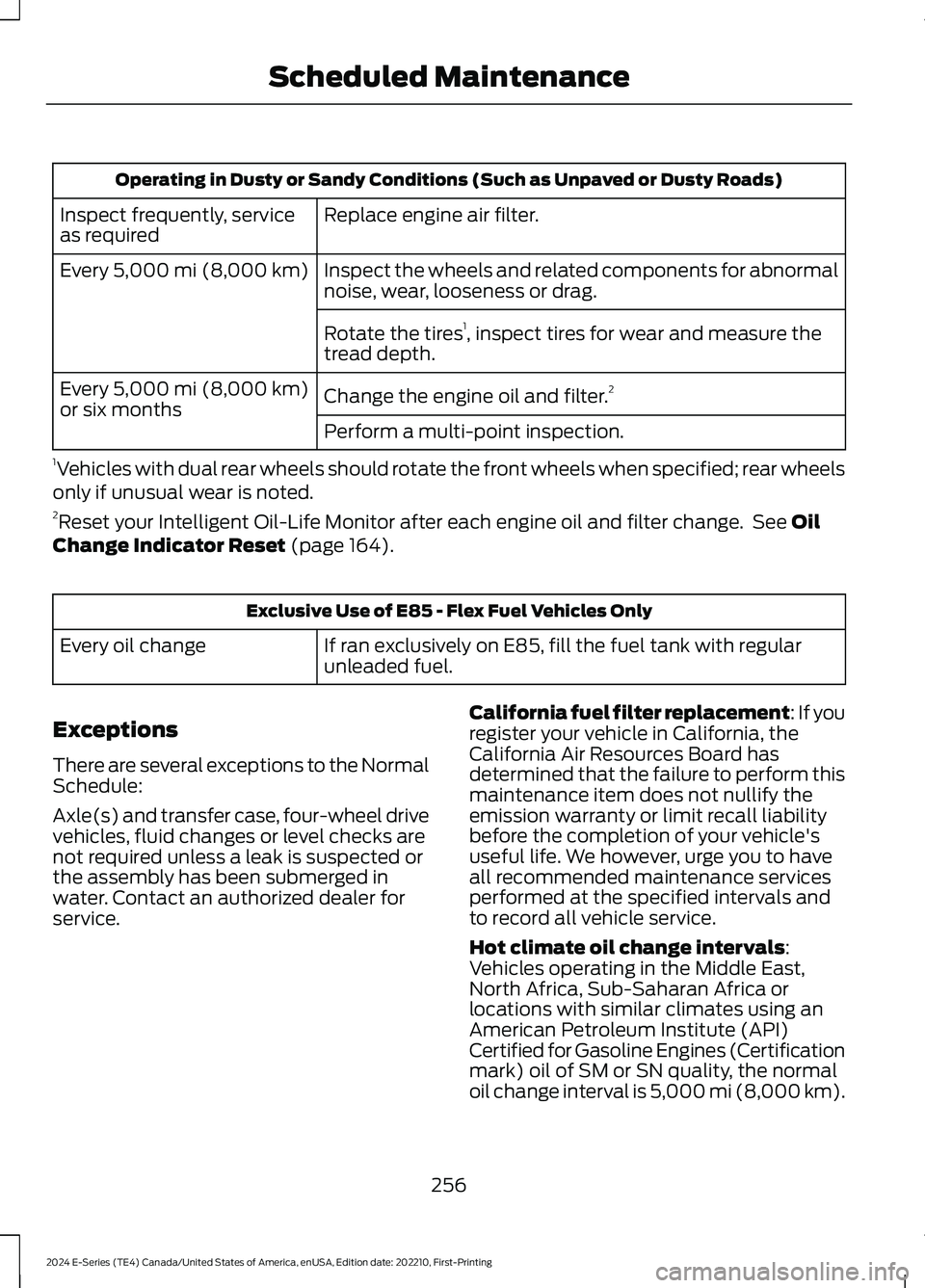
Operating in Dusty or Sandy Conditions (Such as Unpaved or Dusty Roads)
Replace engine air filter.Inspect frequently, serviceas required
Inspect the wheels and related components for abnormalnoise, wear, looseness or drag.Every 5,000 mi (8,000 km)
Rotate the tires1, inspect tires for wear and measure thetread depth.
Change the engine oil and filter.2Every 5,000 mi (8,000 km)or six monthsPerform a multi-point inspection.
1Vehicles with dual rear wheels should rotate the front wheels when specified; rear wheelsonly if unusual wear is noted.2Reset your Intelligent Oil-Life Monitor after each engine oil and filter change. See OilChange Indicator Reset (page 164).
Exclusive Use of E85 - Flex Fuel Vehicles Only
If ran exclusively on E85, fill the fuel tank with regularunleaded fuel.Every oil change
Exceptions
There are several exceptions to the NormalSchedule:
Axle(s) and transfer case, four-wheel drivevehicles, fluid changes or level checks arenot required unless a leak is suspected orthe assembly has been submerged inwater. Contact an authorized dealer forservice.
California fuel filter replacement: If youregister your vehicle in California, theCalifornia Air Resources Board hasdetermined that the failure to perform thismaintenance item does not nullify theemission warranty or limit recall liabilitybefore the completion of your vehicle'suseful life. We however, urge you to haveall recommended maintenance servicesperformed at the specified intervals andto record all vehicle service.
Hot climate oil change intervals:Vehicles operating in the Middle East,North Africa, Sub-Saharan Africa orlocations with similar climates using anAmerican Petroleum Institute (API)Certified for Gasoline Engines (Certificationmark) oil of SM or SN quality, the normaloil change interval is 5,000 mi (8,000 km).
256
2024 E-Series (TE4) Canada/United States of America, enUSA, Edition date: 202210, First-PrintingScheduled Maintenance