ignition FORD EDGE 2010 1.G Repair Manual
[x] Cancel search | Manufacturer: FORD, Model Year: 2010, Model line: EDGE, Model: FORD EDGE 2010 1.GPages: 328, PDF Size: 2.29 MB
Page 247 of 328
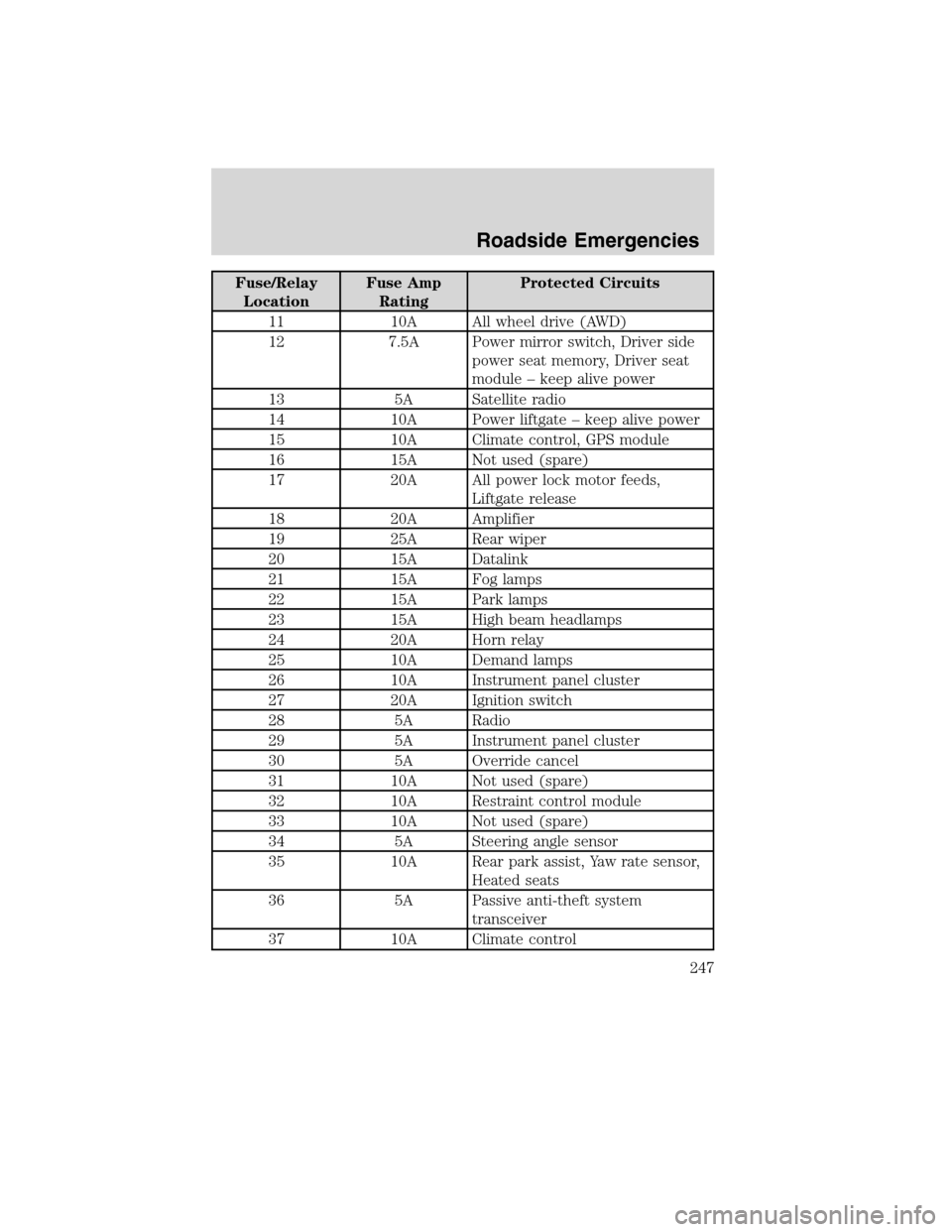
Fuse/Relay
LocationFuse Amp
RatingProtected Circuits
11 10A All wheel drive (AWD)
12 7.5A Power mirror switch, Driver side
power seat memory, Driver seat
module – keep alive power
13 5A Satellite radio
14 10A Power liftgate – keep alive power
15 10A Climate control, GPS module
16 15A Not used (spare)
17 20A All power lock motor feeds,
Liftgate release
18 20A Amplifier
19 25A Rear wiper
20 15A Datalink
21 15A Fog lamps
22 15A Park lamps
23 15A High beam headlamps
24 20A Horn relay
25 10A Demand lamps
26 10A Instrument panel cluster
27 20A Ignition switch
28 5A Radio
29 5A Instrument panel cluster
30 5A Override cancel
31 10A Not used (spare)
32 10A Restraint control module
33 10A Not used (spare)
34 5A Steering angle sensor
35 10A Rear park assist, Yaw rate sensor,
Heated seats
36 5A Passive anti-theft system
transceiver
37 10A Climate control
Roadside Emergencies
247
2010 Edge(edg)
Owners Guide(own2002), 1st Printing
USA(fus)
Page 275 of 328
ENGINE
Engines are more efficient when they are clean because grease and dirt
buildup keep the engine warmer than normal. When washing:
•Take care when using a power washer to clean the engine. The
high-pressure fluid could penetrate the sealed parts and cause
damage.
•Do not spray a hot engine with cold water to avoid cracking the
engine block or other engine components.
•Spray Motorcraft Engine Shampoo and Degreaser (ZC-20) on all parts
that require cleaning and pressure rinse clean. In Canada use
Motorcraft Engine Shampoo (CXC-66-A).
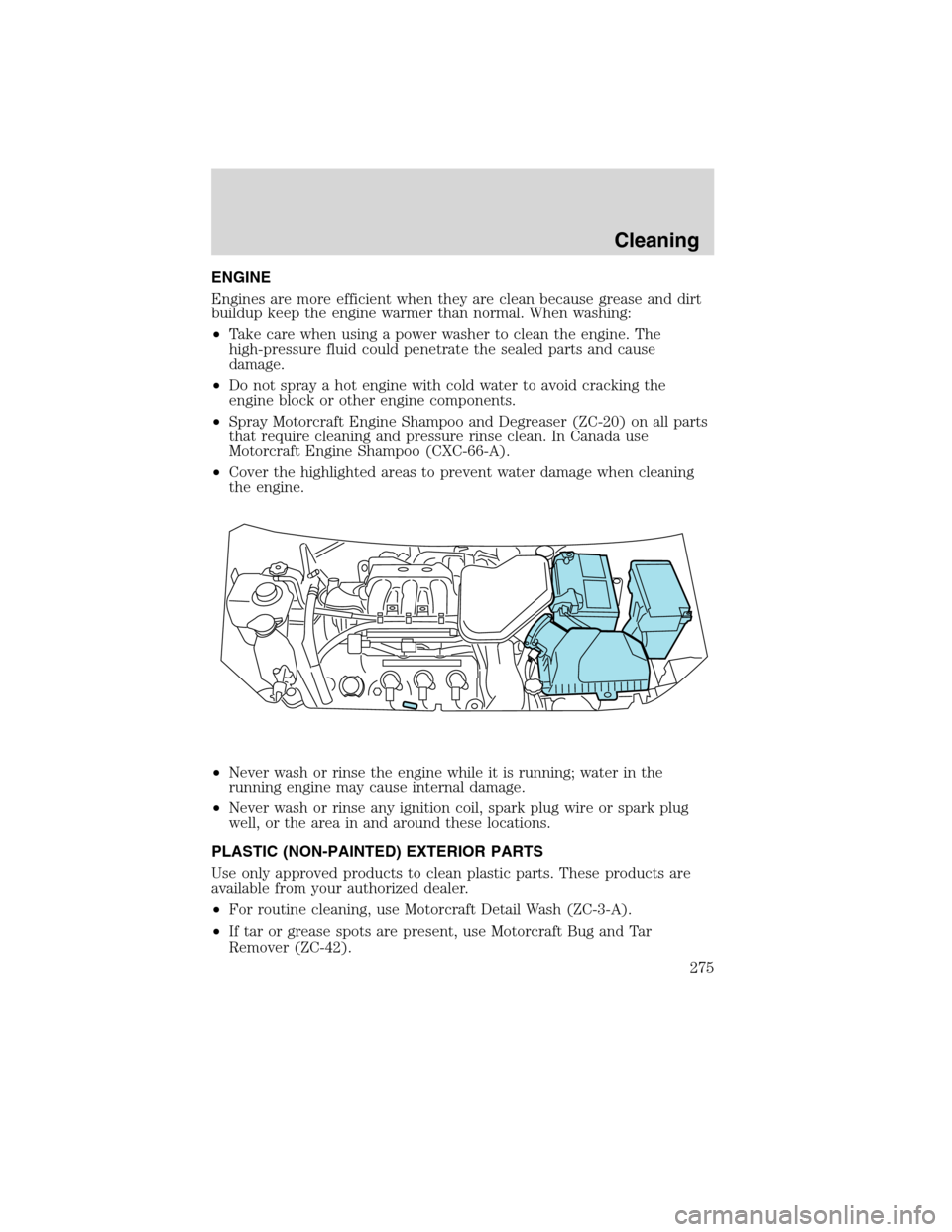
•Cover the highlighted areas to prevent water damage when cleaning
the engine.
•Never wash or rinse the engine while it is running; water in the
running engine may cause internal damage.
•Never wash or rinse any ignition coil, spark plug wire or spark plug
well, or the area in and around these locations.
PLASTIC (NON-PAINTED) EXTERIOR PARTS
Use only approved products to clean plastic parts. These products are
available from your authorized dealer.
•For routine cleaning, use Motorcraft Detail Wash (ZC-3-A).
•If tar or grease spots are present, use Motorcraft Bug and Tar
Remover (ZC-42).
Cleaning
275
2010 Edge(edg)
Owners Guide(own2002), 1st Printing
USA(fus)
Page 300 of 328
Fuel quality
If you are experiencing starting, rough idle or hesitation driveability
problems, try a different brand of unleaded gasoline. If the problems
persist, see your authorized dealer.
Do not add aftermarket fuel additive products to your fuel tank. It
should not be necessary to add any aftermarket products to your fuel
tank if you continue to use high quality fuel of the recommended octane
rating. These products have not been approved for your engine and
could cause damage to the fuel system. Repairs to correct the effects of
using an aftermarket product in your fuel may not be covered by your
warranty.
Many of the world’s automakers approved the World-Wide Fuel Charter
that recommends gasoline specifications to provide improved
performance and emission control system protection for your vehicle.
Gasolines that meet the World-Wide Fuel Charter should be used when
available. Ask your fuel supplier about gasolines that meet the
World-Wide Fuel Charter.
Cleaner air
Ford endorses the use of reformulated “cleaner-burning” gasolines to
improve air quality, per the recommendations in theChoosing the right
fuelsection.
Running out of fuel
Avoid running out of fuel because this situation may have an adverse
effect on powertrain components.
If you have run out of fuel:
•You may need to cycle the ignition from off to on several times after
refueling to allow the fuel system to pump the fuel from the tank to
the engine. On restarting, cranking time will take a few seconds longer
than normal.
•Normally, adding 1 gallon (3.8L) of fuel is enough to restart the
engine. If the vehicle is out of fuel and on a steep grade, more than
1 gallon (3.8L) may be required.
•The service engine soon
indicator may come on. For more
information on the service engine soon
indicator, refer to
Warning lights and chimesin theInstrument Clusterchapter.
Maintenance and Specifications
300
2010 Edge(edg)
Owners Guide(own2002), 1st Printing
USA(fus)
Page 301 of 328
ESSENTIALS OF GOOD FUEL ECONOMY
Measuring techniques
Your best source of information about actual fuel economy is you, the
driver. You must gather information as accurately and consistently as
possible. Fuel expense, frequency of fill-ups or fuel gauge readings are
NOT accurate as a measure of fuel economy. We do not recommend
taking fuel economy measurements during the first 1,000 miles
(1,600 km) of driving (engine break-in period). You will get a more
accurate measurement after 2,000 miles–3,000 miles (3,000 km–5,000
km).
Filling the tank
The advertised fuel capacity of the fuel tank on your vehicle is equal to
the rated refill capacity of the fuel tank as listed in theMaintenance
product specifications and capacitiessection of this chapter.
The advertised capacity is the amount of the indicated capacity and the
empty reserve combined. Indicated capacity is the difference in the
amount of fuel in a full tank and a tank when the fuel gauge indicates
empty. Empty reserve is the small amount of fuel remaining in the fuel
tank after the fuel gauge indicates empty.
The amount of usable fuel in the empty reserve varies and should
not be relied upon to increase driving range. When refueling your
vehicle after the fuel gauge indicates empty, you might not be
able to refuel the full amount of the advertised capacity of the
fuel tank due to the empty reserve still present in the tank.
For consistent results when filling the fuel tank:
•Turn the engine/ignition switch to the off position prior to refueling,
an error in the reading will result if the engine is left running.
•Use the same filling rate setting (low — medium — high) each time
the tank is filled.
•Allow no more than two automatic click-offs when filling.
•Always use fuel with the recommended octane rating.
•Use a known quality gasoline, preferably a national brand.
•Use the same side of the same pump and have the vehicle facing the
same direction each time you fill up.
•Have the vehicle loading and distribution the same every time.
Your results will be most accurate if your filling method is consistent.
Maintenance and Specifications
301
2010 Edge(edg)
Owners Guide(own2002), 1st Printing
USA(fus)
Page 304 of 328
EPA fuel economy estimates
Every new vehicle should have a sticker on the window called the
Monroney Label which contains EPA fuel economy estimates. Contact
your authorized dealer if the Monroney Label is not supplied with your
vehicle. The EPA fuel economy estimates should be your guide for the
fuel economy comparisons with other vehicles. Your fuel economy may
vary depending upon the method of operation and conditions.
EMISSION CONTROL SYSTEM
Your vehicle is equipped with various emission control components and a
catalytic converter which will enable your vehicle to comply with
applicable exhaust emission standards. To make sure that the catalytic
converter and other emission control components continue to work
properly:
•Use only the specified fuel listed.
•Avoid running out of fuel.
•Do not turn off the ignition while your vehicle is moving, especially at
high speeds.
•Have the items listed inscheduled maintenance information
performed according to the specified schedule.
The scheduled maintenance items listed inscheduled maintenance
informationare essential to the life and performance of your vehicle
and to its emissions system.
If other than Ford, Motorcraft or Ford-authorized parts are used for
maintenance replacements or for service of components affecting
emission control, such non-Ford parts should be equivalent to genuine
Ford Motor Company parts in performance and durability.
WARNING:Do not park, idle, or drive your vehicle in dry grass
or other dry ground cover. The emission system heats up the
engine compartment and exhaust system, which can start a fire.
Illumination of the service engine soon
indicator, charging system
warning light or the temperature warning light, fluid leaks, strange odors,
smoke or loss of engine power could indicate that the emission control
system is not working properly.
An improperly operating or damaged exhaust system may allow exhaust
to enter the vehicle. Have a damaged or improperly operating exhaust
system inspected and repaired immediately.
Maintenance and Specifications
304
2010 Edge(edg)
Owners Guide(own2002), 1st Printing
USA(fus)
Page 306 of 328
detected by the OBD-II may not have symptoms that are apparent,
continued driving with the service engine soon
indicator on can
result in increased emissions, lower fuel economy, reduced engine and
transmission smoothness, and lead to more costly repairs.
Readiness for Inspection/Maintenance (I/M) testing
Some state/provincial and local governments may have
Inspection/Maintenance (I/M) programs to inspect the emission control
equipment on your vehicle. Failure to pass this inspection could prevent
you from getting a vehicle registration. Your vehicle may not pass the I/M
test if the service engine soon
indicator is on or not working
properly (bulb is burned out), or if the OBD-II system has determined
that some of the emission control systems have not been properly
checked. In this case, the vehicle is considered not ready for I/M testing.
If the service engine soon
indicator is on or the bulb does not
work, the vehicle may need to be serviced. Refer to the On board
diagnostics (OBD-II) description in this chapter.
If the vehicle’s engine or transmission has just been serviced, or the
battery has recently run down or been replaced, the OBD-II system may
indicate that the vehicle is not ready for I/M testing. To determine if the
vehicle is ready for I/M testing, turn the ignition key to the on position
for 15 seconds without cranking the engine. If the service engine
soon
indicator blinks eight times, it means that the vehicle is not
ready for I/M testing; if the service engine soon
indicator stays on
solid, it means that the vehicle is ready for I/M testing.
The OBD-II system is designed to check the emission control system
during normal driving. A complete check may take several days. If the
vehicle is not ready for I/M testing, the following driving cycle consisting
of mixed city and highway driving may be performed:
15 minutes of steady driving on an expressway/highway followed by
20 minutes of stop-and-go driving with at least four 30-second idle
periods.
Allow the vehicle to sit for at least eight hours without starting the
engine. Then, start the engine and complete the above driving cycle. The
engine must warm up to its normal operating temperature. Once started,
do not turn off the engine until the above driving cycle is complete. If
the vehicle is still not ready for I/M testing, the above driving cycle will
have to be repeated.
Maintenance and Specifications
306
2010 Edge(edg)
Owners Guide(own2002), 1st Printing
USA(fus)
Page 315 of 328
ENGINE DATA
Engine 3.5L-DOHC V6 engine
Cubic inches 214
Required fuel 87 octane
Firing order 1–4–2–5–3–6
Spark plug gap 0.050–0.057 inch (1.29–1.45 mm)
Ignition system Coil on plug
Compression ratio 10.3:1
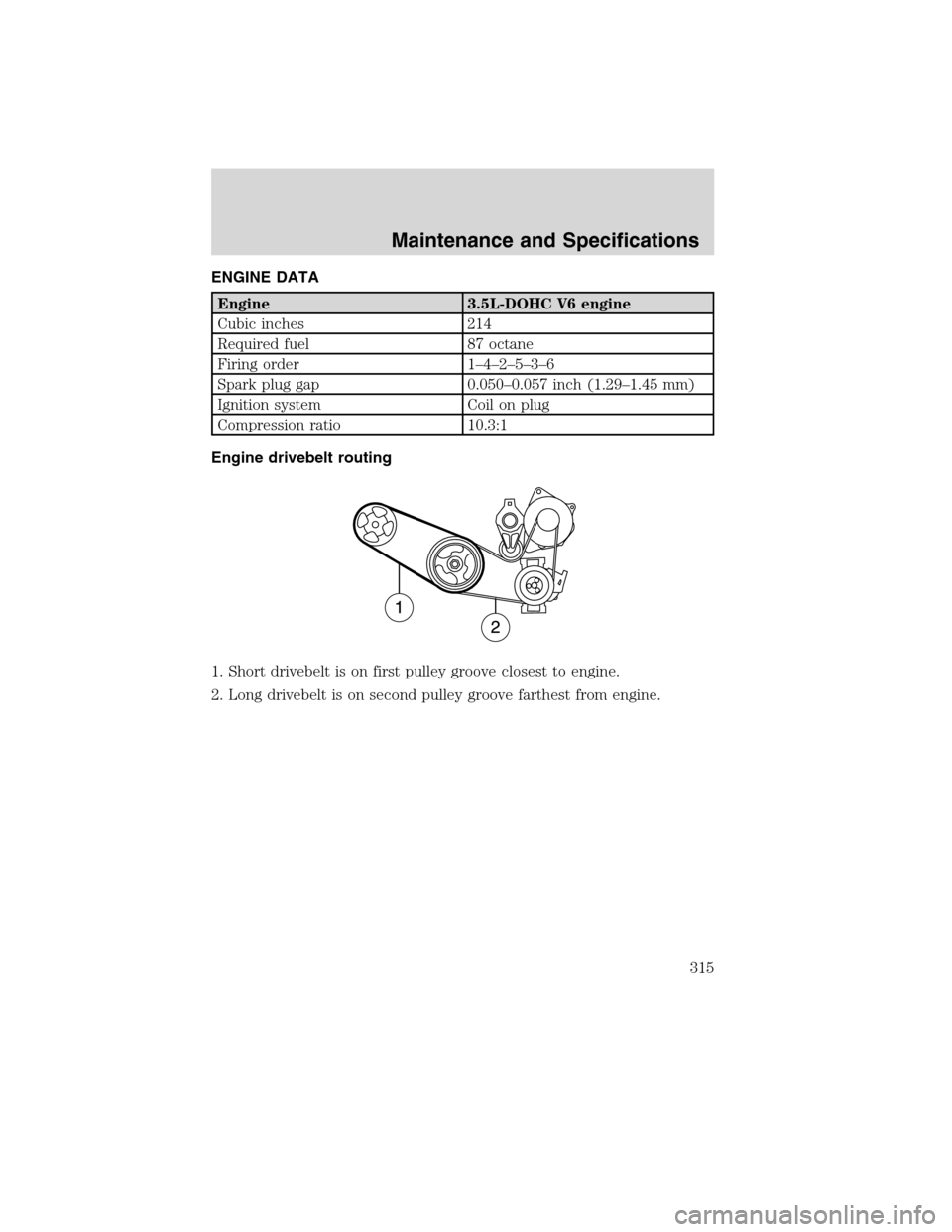
Engine drivebelt routing
1. Short drivebelt is on first pulley groove closest to engine.
2. Long drivebelt is on second pulley groove farthest from engine.
Maintenance and Specifications
315
2010 Edge(edg)
Owners Guide(own2002), 1st Printing
USA(fus)
Page 325 of 328
change oil soon warning,
message center .......................285
checking and adding ..............285
dipstick ....................................285
filter, specifications ........287, 311
recommendations ...................287
refill capacities ........................312
specifications ..........................312
Event data recording ....................7
Exhaust fumes ..........................218
F
Fail safe cooling ........................294
Fluid capacities .........................312
Fog lamps ....................................63
Four-Wheel Drive vehicles
driving off road .......................235
Fuel ............................................295
calculating fuel
economy ............................23, 301
cap ...........................................298
capacity ...................................312
choosing the right fuel ...........299
comparisons with EPA fuel
economy estimates .................304
detergent in fuel .....................300
filling your vehicle
with fuel ..................295, 298, 301
filter, specifications ........295, 311
fuel pump shut-off switch .....244
improving fuel economy ........301
octane rating ...................299, 315
quality ......................................300
running out of fuel .................300
safety information relating to
automotive fuels .....................295
Fuses ..................................244–245G
Garage door opener ....................84
Gas cap (see Fuel cap) ............298
Gas mileage (see Fuel
economy) ...................................301
Gauges .........................................17
H
Hazard flashers .........................243
Head restraints .........................129
Headlamps ...................................62
aiming ........................................64
autolamp system .......................62
bulb specifications ....................68
daytime running lights .............63
flash to pass ..............................63
high beam .................................63
replacing bulbs .........................69
turning on and off ....................62
Heating
heating and air conditioning
system .................................56, 58
Homelink wireless control
system ..........................................85
Hood ..........................................281
How to get going ........................27
I
Ignition ...............................215, 315
Illuminated visor mirror .............74
Infant seats
(see Safety seats) .....................167
Inspection/maintenance (I/M)
testing ........................................306
Index
325
2010 Edge(edg)
Owners Guide(own2002), 1st Printing
USA(fus)
Page 326 of 328
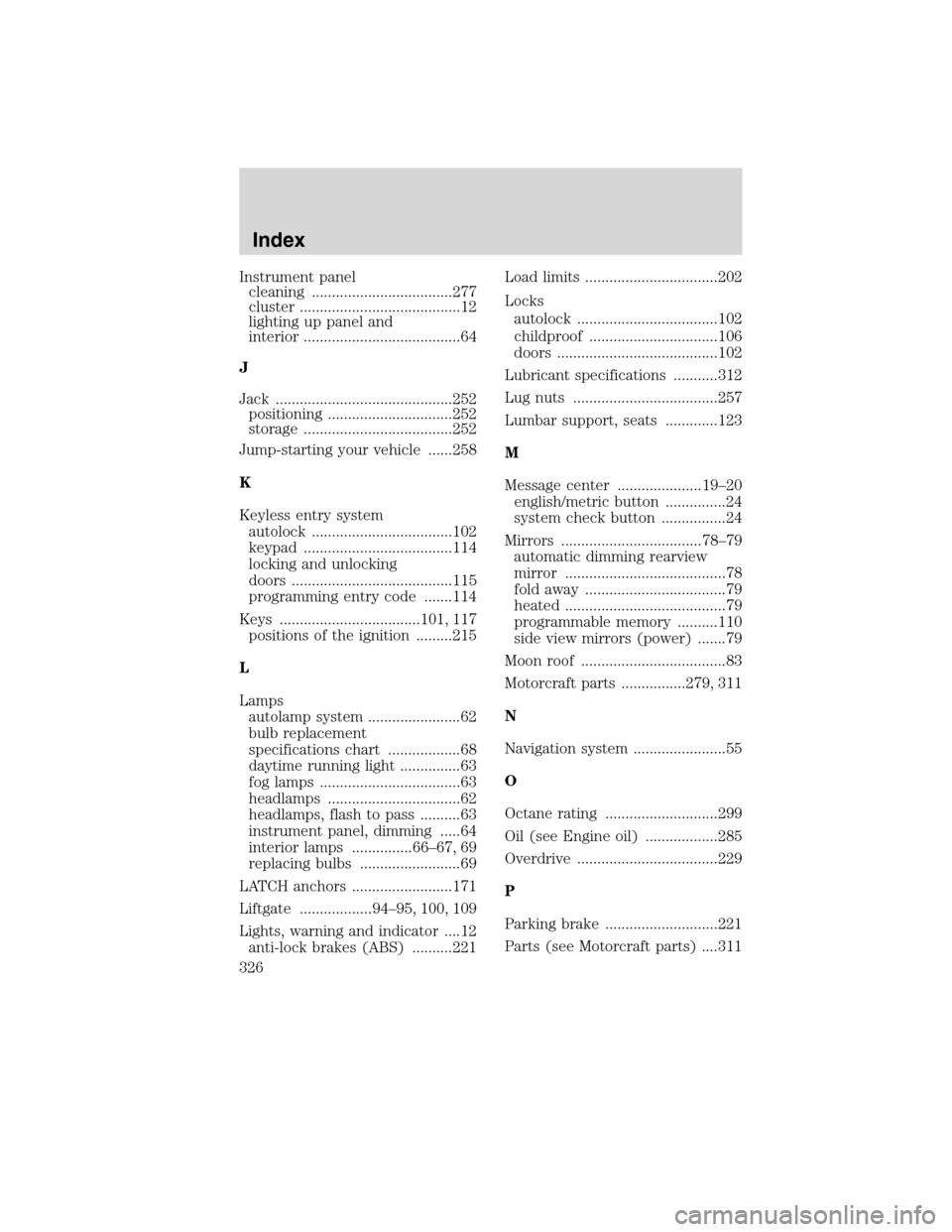
Instrument panel
cleaning ...................................277
cluster ........................................12
lighting up panel and
interior .......................................64
J
Jack ............................................252
positioning ...............................252
storage .....................................252
Jump-starting your vehicle ......258
K
Keyless entry system
autolock ...................................102
keypad .....................................114
locking and unlocking
doors ........................................115
programming entry code .......114
Keys ...................................101, 117
positions of the ignition .........215
L
Lamps
autolamp system .......................62
bulb replacement
specifications chart ..................68
daytime running light ...............63
fog lamps ...................................63
headlamps .................................62
headlamps, flash to pass ..........63
instrument panel, dimming .....64
interior lamps ...............66–67, 69
replacing bulbs .........................69
LATCH anchors .........................171
Liftgate ..................94–95, 100, 109
Lights, warning and indicator ....12
anti-lock brakes (ABS) ..........221Load limits .................................202
Locks
autolock ...................................102
childproof ................................106
doors ........................................102
Lubricant specifications ...........312
Lug nuts ....................................257
Lumbar support, seats .............123
M
Message center .....................19–20
english/metric button ...............24
system check button ................24
Mirrors ...................................78–79
automatic dimming rearview
mirror ........................................78
fold away ...................................79
heated ........................................79
programmable memory ..........110
side view mirrors (power) .......79
Moon roof ....................................83
Motorcraft parts ................279, 311
N
Navigation system .......................55
O
Octane rating ............................299
Oil (see Engine oil) ..................285
Overdrive ...................................229
P
Parking brake ............................221
Parts (see Motorcraft parts) ....311
Index
326
2010 Edge(edg)
Owners Guide(own2002), 1st Printing
USA(fus)