steering FORD ESCAPE 2011 2.G Owner's Manual
[x] Cancel search | Manufacturer: FORD, Model Year: 2011, Model line: ESCAPE, Model: FORD ESCAPE 2011 2.GPages: 367, PDF Size: 2.61 MB
Page 242 of 367
Driving on snow and ice
4WD vehicles have advantages over 2WD vehicles in snow and ice but
can skid like any other vehicle.
Should you start to slide while driving on snowy or icy roads, turn the
steering wheel in the direction of the slide until you regain control.
Avoid sudden applications of power and quick changes of direction on
snow and ice. Apply the accelerator slowly and steadily when starting
from a full stop.
Avoid sudden braking as well. Although a 4WD vehicle may accelerate
better than a two-wheel drive vehicle in snow and ice, it won’t stop any
faster, because as in other vehicles, braking occurs at all four wheels. Do
not become overconfident as to road conditions.
Make sure you allow sufficient distance between you and other vehicles
for stopping. Drive slower than usual and consider using one of the lower
gears. In emergency stopping situations, avoid locking of the wheels. Use
a “squeeze” technique, push on the brake pedal with a steadily increasing
force which allows the wheels to brake yet continue to roll so that you
may steer in the direction you want to travel. If you lock the wheels,
release the brake pedal and repeat the squeeze technique. Since your
vehicle is equipped with a Four Wheel Anti-Lock Brake System (ABS),
apply the brake steadily. Do not “pump” the brakes. Refer to theBrakes
section of this chapter for additional information on the operation of the
anti-lock brake system.
WARNING:If you are driving in slippery conditions that require
tire chains or cables, then it is critical that you drive cautiously.
Keep speeds down, allow for longer stopping distances and avoid
aggressive steering to reduce the chances of a loss of vehicle control
which can lead to serious injury or death. If the rear end of the vehicle
slides while cornering, steer in the direction of the slide until you
regain control of the vehicle.
Maintenance and modifications
The suspension and steering systems on your vehicle have been designed
and tested to provide predictable performance whether loaded or empty
and durable load carrying capability. For this reason, Ford Motor
Company strongly recommends that you do not make modifications such
as adding or removing parts (such as lift kits or stabilizer bars) or by
using replacement parts not equivalent to the original factory equipment.
Driving
242
2011 Escape(204)
Owners Guide, 1st Printing
USA(fus)
Page 245 of 367
Owner Guide portfolio in the glove compartment. In Canada, the card is
found in theWarranty Guidein the glove compartment.
U.S. Ford, Mercury and Lincoln vehicle customers who require Roadside
Assistance, call 1-800-241-3673.
Canadian customers who require roadside assistance, call
1-800-665-2006.
If you need to arrange roadside assistance for yourself, Ford Motor
Company will reimburse a reasonable amount for towing to the nearest
dealership within 35 miles (56 km). To obtain reimbursement
information, U.S. Ford, Mercury and Lincoln vehicle customers call
1-800-241-3673. Customers will be asked to submit their original
receipts.
Canadian customers who need to obtain reimbursement information, call
1-800-665-2006 or visit our website at www.ford.ca.
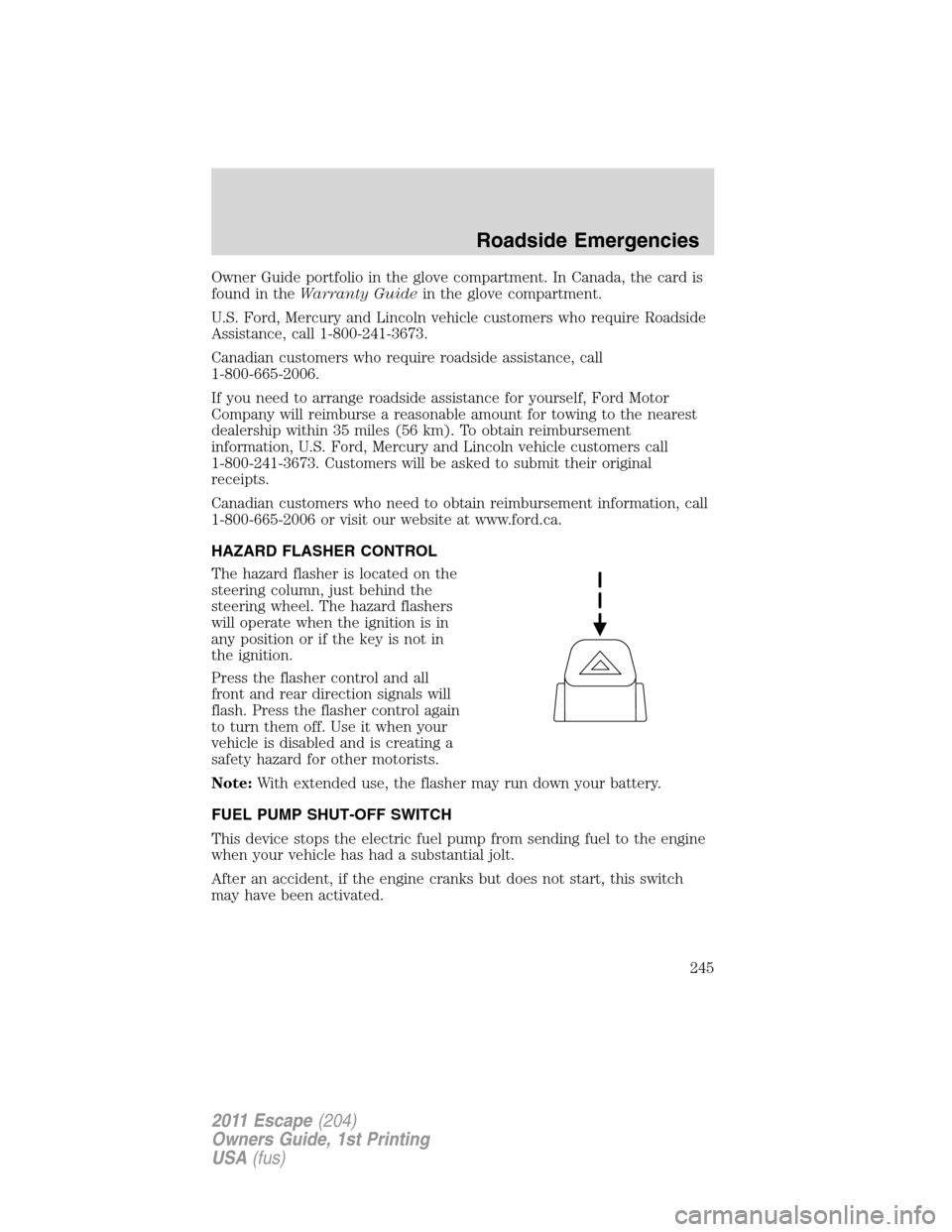
HAZARD FLASHER CONTROL
The hazard flasher is located on the
steering column, just behind the
steering wheel. The hazard flashers
will operate when the ignition is in
any position or if the key is not in
the ignition.
Press the flasher control and all
front and rear direction signals will
flash. Press the flasher control again
to turn them off. Use it when your
vehicle is disabled and is creating a
safety hazard for other motorists.
Note:With extended use, the flasher may run down your battery.
FUEL PUMP SHUT-OFF SWITCH
This device stops the electric fuel pump from sending fuel to the engine
when your vehicle has had a substantial jolt.
After an accident, if the engine cranks but does not start, this switch
may have been activated.
Roadside Emergencies
245
2011 Escape(204)
Owners Guide, 1st Printing
USA(fus)
Page 249 of 367
Fuse/Relay
LocationFuse Amp
RatingProtected Circuits
15 10A Climate control
16 15A Not used (spare)
17 20A All lock motor feeds, Liftgate
release, Liftglass release
18 20A Heated seat
19 25A Rear wiper
20 15A Datalink
21 15A Fog lamps
22 15A Park lamps
23 15A High beam headlamps
24 20A Horn relay
25 10A Demand lamps
26 10A Instrument panel cluster
27 20A Ignition switch
28 5A Radio
29 5A Instrument panel cluster
30 5A Not used (spare)
31 10A Restraints control module
32 10A Rear video camera module
33 10A Not used (spare)
34 5A Not used (spare)
35 10A Four wheel drive, Electric power
assist steering (EPAS), Park aid
module, Active park assist module
36 5A Passive anti-theft system (PATS)
transceiver
37 10A Climate control
38 20A Subwoofer/Amp (premium radio)
39 20A Radio, Radio amplifier
(navigation only)
40 20A Front power point
Roadside Emergencies
249
2011 Escape(204)
Owners Guide, 1st Printing
USA(fus)
Page 251 of 367
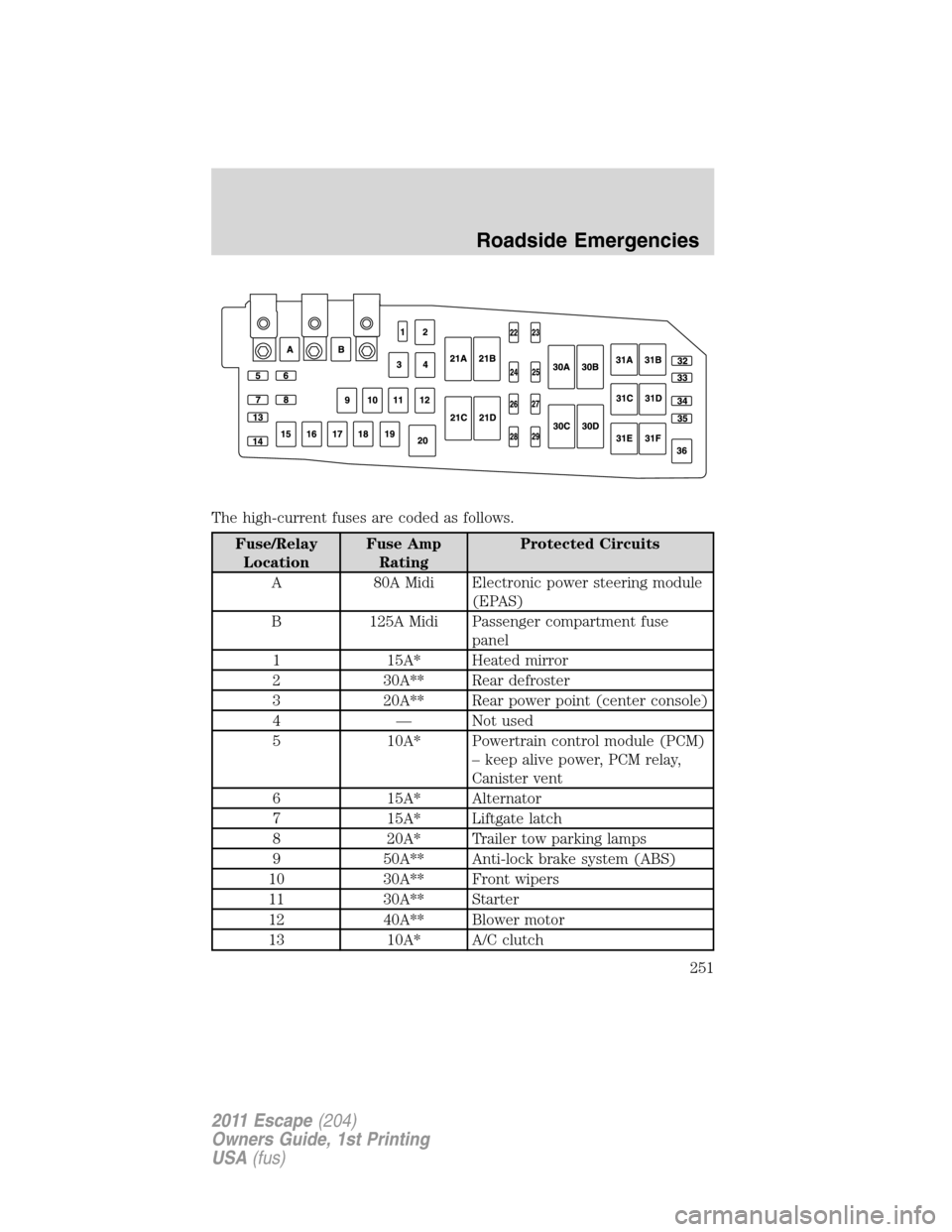
The high-current fuses are coded as follows.
Fuse/Relay
LocationFuse Amp
RatingProtected Circuits
A 80A Midi Electronic power steering module
(EPAS)
B 125A Midi Passenger compartment fuse
panel
1 15A* Heated mirror
2 30A** Rear defroster
3 20A** Rear power point (center console)
4 — Not used
5 10A* Powertrain control module (PCM)
– keep alive power, PCM relay,
Canister vent
6 15A* Alternator
7 15A* Liftgate latch
8 20A* Trailer tow parking lamps
9 50A** Anti-lock brake system (ABS)
10 30A** Front wipers
11 30A** Starter
12 40A** Blower motor
13 10A* A/C clutch
Roadside Emergencies
251
2011 Escape(204)
Owners Guide, 1st Printing
USA(fus)
Page 253 of 367
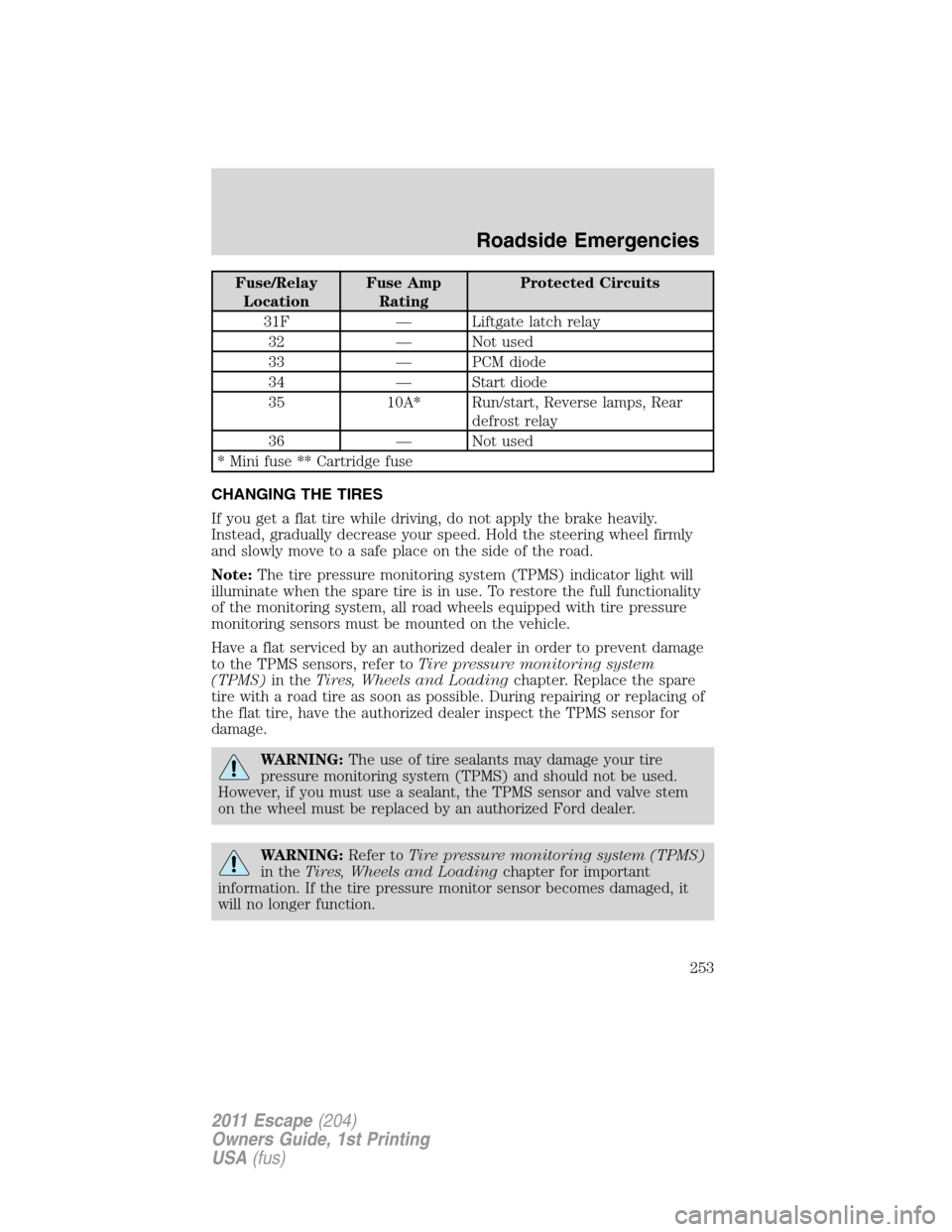
Fuse/Relay
LocationFuse Amp
RatingProtected Circuits
31F — Liftgate latch relay
32 — Not used
33 — PCM diode
34 — Start diode
35 10A* Run/start, Reverse lamps, Rear
defrost relay
36 — Not used
* Mini fuse ** Cartridge fuse
CHANGING THE TIRES
If you get a flat tire while driving, do not apply the brake heavily.
Instead, gradually decrease your speed. Hold the steering wheel firmly
and slowly move to a safe place on the side of the road.
Note:The tire pressure monitoring system (TPMS) indicator light will
illuminate when the spare tire is in use. To restore the full functionality
of the monitoring system, all road wheels equipped with tire pressure
monitoring sensors must be mounted on the vehicle.
Have a flat serviced by an authorized dealer in order to prevent damage
to the TPMS sensors, refer toTire pressure monitoring system
(TPMS)in theTires, Wheels and Loadingchapter. Replace the spare
tire with a road tire as soon as possible. During repairing or replacing of
the flat tire, have the authorized dealer inspect the TPMS sensor for
damage.
WARNING:The use of tire sealants may damage your tire
pressure monitoring system (TPMS) and should not be used.
However, if you must use a sealant, the TPMS sensor and valve stem
on the wheel must be replaced by an authorized Ford dealer.
WARNING:Refer toTire pressure monitoring system (TPMS)
in theTires, Wheels and Loadingchapter for important
information. If the tire pressure monitor sensor becomes damaged, it
will no longer function.
Roadside Emergencies
253
2011 Escape(204)
Owners Guide, 1st Printing
USA(fus)
Page 283 of 367
INSTRUMENT PANEL/INTERIOR TRIM AND CLUSTER LENS
Clean the instrument panel, interior trim areas and cluster lens with a
clean, damp, white cotton cloth, then use a clean and dry white cotton
cloth to dry these areas.
•Avoid cleaners or polishes that increase the gloss of the upper portion
of the instrument panel. The dull finish in this area helps protect the
driver from undesirable windshield reflection.
•Be certain to wash or wipe your hands clean if you have been in
contact with certain products such as insect repellent and suntan
lotion in order to avoid possible damage to the interior painted
surfaces.
•Do not use household or glass cleaners as these may damage the
finish of the instrument panel, interior trim and cluster lens.
•Do not allow air fresheners and hand sanitizers to spill on interior
surfaces. If a spill occurs,wipe off immediately.Damage may not be
covered by your warranty.
WARNING:Do not use chemical solvents or strong detergents
when cleaning the steering wheel or instrument panel to avoid
contamination of the airbag system.
If a staining liquid like coffee/juice has been spilled on the instrument
panel or on interior trim surfaces, clean as follows:
1. Wipe up spilled liquid using a clean, white, cotton cloth.
2. Wipe the surface with a damp, clean, white cotton cloth. For more
thorough cleaning, use a mild soap and water solution. If the spot cannot
be completely cleaned by this method, the area may be cleaned using a
commercially available cleaning product designed for automotive
interiors.
3. If necessary, apply more soap and water solution or cleaning product
to a clean, white, cotton cloth and press the cloth onto the soiled
area–allow this to set at room temperature for 30 minutes.
4. Remove the soaked cloth, and if it is not soiled badly, use this cloth to
clean the area by using a rubbing motion for 60 seconds.
5. Following this, wipe area dry with a clean, white, cotton cloth.
Cleaning
283
2011 Escape(204)
Owners Guide, 1st Printing
USA(fus)
Page 303 of 367
If you drive in extremely hot climates:
•It is still necessary to maintain the coolant concentration
above 40%.
•NEVER decrease the coolant concentration below 40%.
•A coolant concentration of 40% will provide freeze point
protection down to -12°F [-24°C]. Decreased engine coolant
concentrations below 40% will decrease the corrosion/freeze
protection characteristics of the engine coolant and may cause
engine damage.
•If available, refer to the chart on the coolant container to
ensure the coolant concentration in your vehicle will provide
adequate protection at the temperatures in which you drive.
Vehicles driven year-round in non-extreme climates should use a 50/50
mixture of engine coolant and distilled water for optimum cooling system
and engine protection.
What you should know about fail-safe cooling
If the engine coolant supply is depleted, this feature allows the vehicle to
be driven temporarily before incremental component damage is incurred.
The “fail-safe” distance depends on ambient temperatures, vehicle load
and terrain.
How fail-safe cooling works
If the engine begins to overheat:
•The engine coolant temperature gauge will move to the red (hot)
area.
•The service engine soon
indicator light will illuminate.
If the engine reaches a preset over-temperature condition, the engine
will automatically switch to alternating cylinder operation. Each disabled
cylinder acts as an air pump and cools the engine.
When this occurs the vehicle will still operate. However:
•The engine power will be limited.
•The air conditioning system will be disabled.
Continued operation will increase the engine temperature and the engine
will completely shut down, causing steering and braking effort to
increase.
Once the engine temperature cools, the engine can be re-started. Take
your vehicle to an authorized dealer as soon as possible to minimize
engine damage.
Maintenance and Specifications
303
2011 Escape(204)
Owners Guide, 1st Printing
USA(fus)
Page 304 of 367
When fail-safe mode is activated
You have limited engine power when in the fail-safe mode, so drive the
vehicle with caution. The vehicle will not be able to maintain high-speed
operation and the engine will run rough. Remember that the engine is
capable of completely shutting down automatically to prevent engine
damage, therefore:
1. Pull off the road as soon as safely possible and turn off the engine.
2. Arrange for the vehicle to be taken to an authorized dealer.
3. If this is not possible, wait a short period for the engine to cool.
4. Check the coolant level and replenish if low.
WARNING:Fail-safe mode is for use during emergencies only.
Operate the vehicle in fail-safe mode only as long as necessary to
bring the vehicle to rest in a safe location and seek immediate repairs.
When in fail-safe mode, the vehicle will have limited power, will not be
able to maintain high-speed operation, and may completely shut down
without warning, potentially losing engine power, power steering assist,
and power brake assist, which may increase the possibility of a crash
resulting in serious injury.
WARNING:Never remove the coolant reservoir cap while the
engine is running or hot.
5. Re-start the engine and take your vehicle to an authorized dealer.
Driving the vehicle without repairing the engine problem
increases the chance of engine damage. Take your vehicle to an
authorized dealer as soon as possible.
FUEL FILTER
Your vehicle is equipped with a lifetime fuel filter that is integrated with
the fuel tank. Regular maintenance or replacement is not needed.
WHAT YOU SHOULD KNOW ABOUT AUTOMOTIVE FUELS
Important safety precautions
WARNING:Do not overfill the fuel tank. The pressure in an
overfilled tank may cause leakage and lead to fuel spray and fire.
Maintenance and Specifications
304
2011 Escape(204)
Owners Guide, 1st Printing
USA(fus)
Page 343 of 367
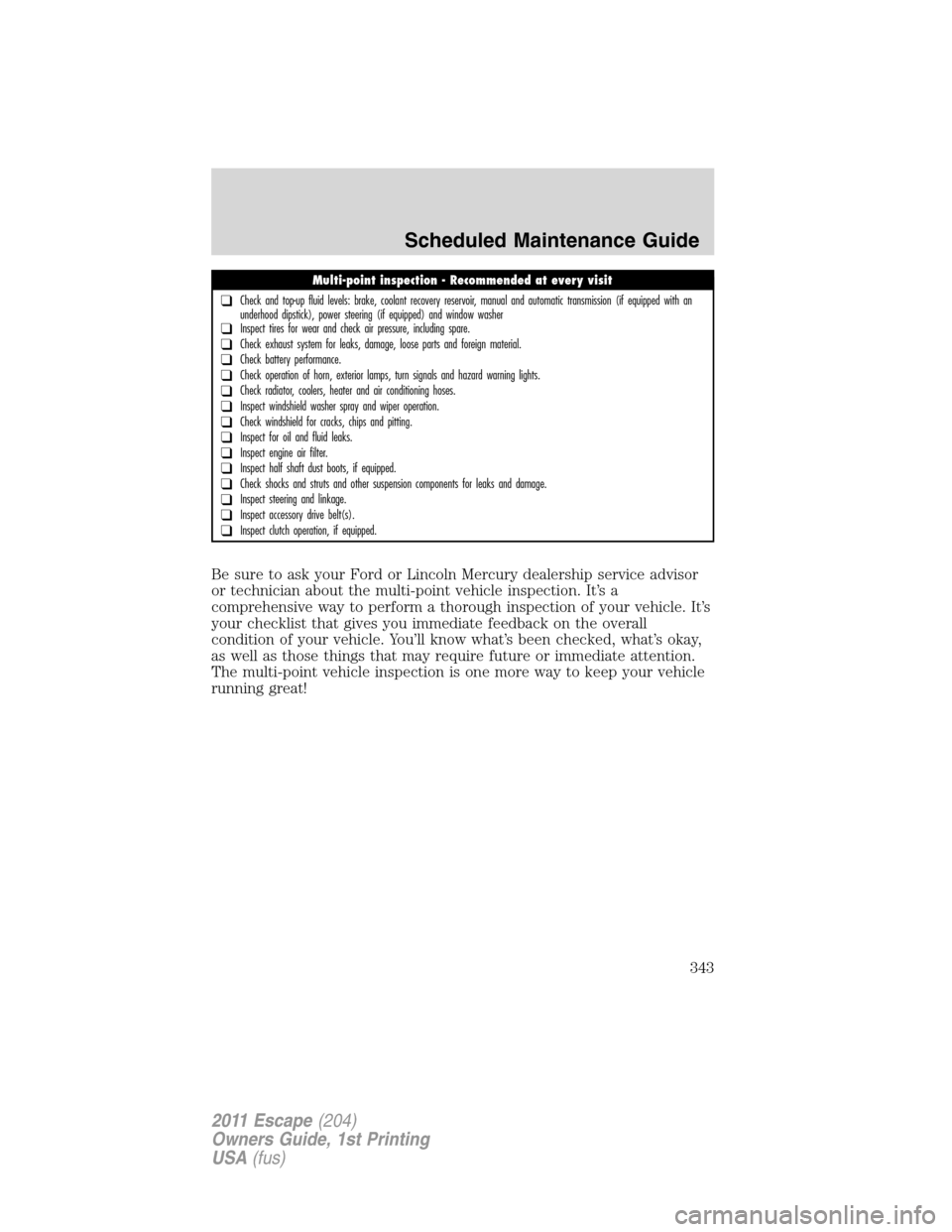
Be sure to ask your Ford or Lincoln Mercury dealership service advisor
or technician about the multi-point vehicle inspection. It’s a
comprehensive way to perform a thorough inspection of your vehicle. It’s
your checklist that gives you immediate feedback on the overall
condition of your vehicle. You’ll know what’s been checked, what’s okay,
as well as those things that may require future or immediate attention.
The multi-point vehicle inspection is one more way to keep your vehicle
running great!
Multi-point inspection - Recommended at every visit
❑Check and top-up fluid levels: brake, coolant recovery reservoir, manual and automatic transmission (if equipped with an
underhood dipstick), power steering (if equipped) and window washer
❑Inspect tires for wear and check air pressure, including spare.
❑Check exhaust system for leaks, damage, loose parts and foreign material.
❑Check battery performance.
❑Check operation of horn, exterior lamps, turn signals and hazard warning lights.
❑Check radiator, coolers, heater and air conditioning hoses.
❑Inspect windshield washer spray and wiper operation.
❑Check windshield for cracks, chips and pitting.
❑Inspect for oil and fluid leaks.
❑Inspect engine air filter.
❑Inspect half shaft dust boots, if equipped.
❑Check shocks and struts and other suspension components for leaks and damage.
❑Inspect steering and linkage.
❑Inspect accessory drive belt(s).
❑Inspect clutch operation, if equipped.
Scheduled Maintenance Guide
343
2011 Escape(204)
Owners Guide, 1st Printing
USA(fus)
Page 346 of 367
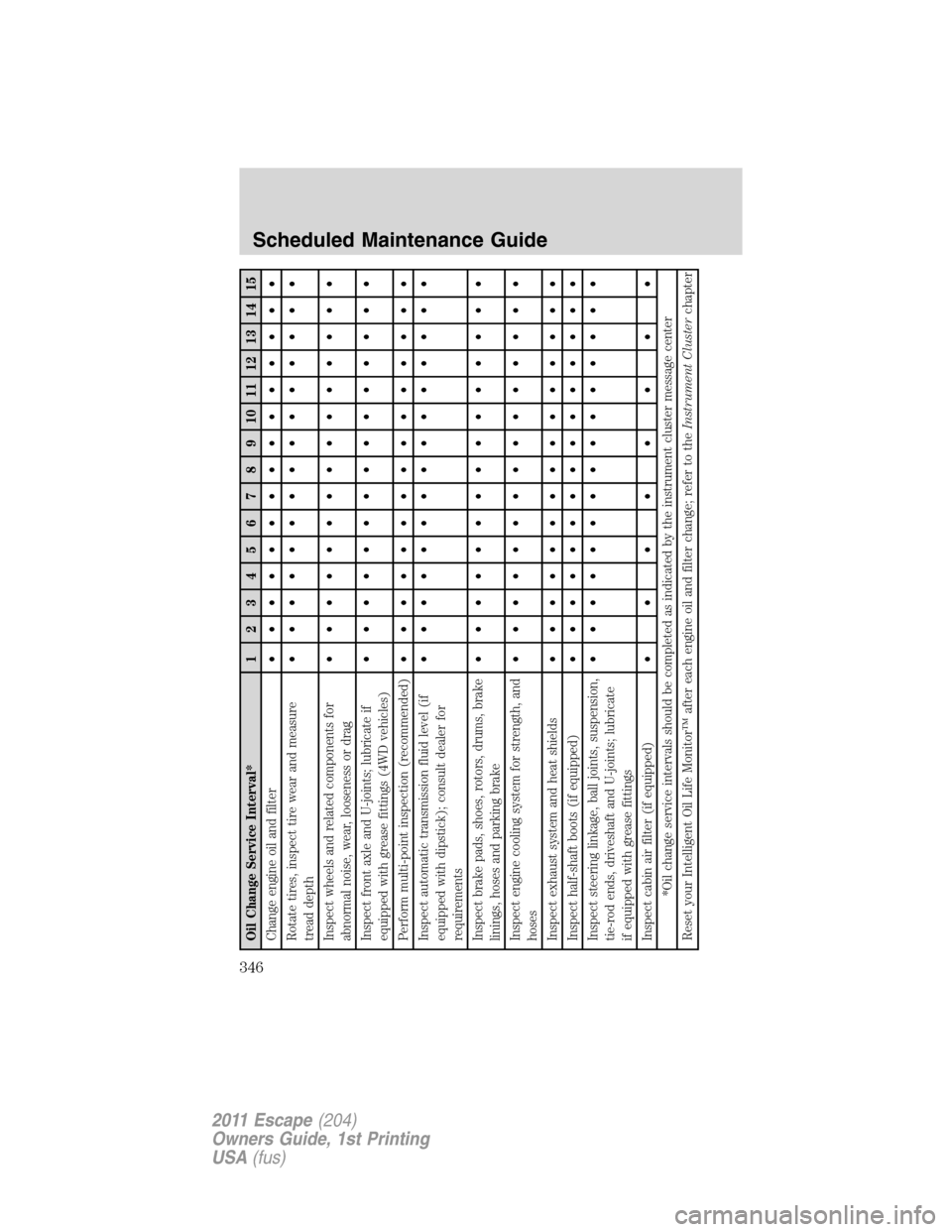
Oil Change Service Interval* 123456789101112131415
Change engine oil and filter• ••••••••••••••
Rotate tires, inspect tire wear and measure
tread depth• ••••••••••••••
Inspect wheels and related components for
abnormal noise, wear, looseness or drag• ••••••••••••••
Inspect front axle and U-joints; lubricate if
equipped with grease fittings (4WD vehicles)• ••••••••••••••
Perform multi-point inspection (recommended)• ••••••••••••••
Inspect automatic transmission fluid level (if
equipped with dipstick); consult dealer for
requirements• ••••••••••••••
Inspect brake pads, shoes, rotors, drums, brake
linings, hoses and parking brake• ••••••••••••••
Inspect engine cooling system for strength, and
hoses• ••••••••••••••
Inspect exhaust system and heat shields• ••••••••••••••
Inspect half-shaft boots (if equipped)• ••••••••••••••
Inspect steering linkage, ball joints, suspension,
tie-rod ends, driveshaft and U-joints; lubricate
if equipped with grease fittings• ••••••••••••••
Inspect cabin air filter (if equipped)• •••••••
*Oil change service intervals should be completed as indicated by the instrument cluster message center
Reset your Intelligent Oil Life Monitor™ after each engine oil and filter change; refer to theInstrument Clusterchapter
Scheduled Maintenance Guide
346
2011 Escape(204)
Owners Guide, 1st Printing
USA(fus)