stop start FORD ESCAPE 2013 3.G Owner's Manual
[x] Cancel search | Manufacturer: FORD, Model Year: 2013, Model line: ESCAPE, Model: FORD ESCAPE 2013 3.GPages: 423, PDF Size: 4.59 MB
Page 176 of 423
STEERING
Electric Power Steering
WARNINGS
The electric power steering system
has diagnostic checks that
continuously monitor the system to
ensure proper operation. When a system
error is detected a steering message will
appear in the information display.
The electric power steering system
has diagnostic checks that
continuously monitor the system to
ensure proper operation of the electronic
system. When an electronic error is
detected, a message will be displayed in
the information display. If this happens,
stop the vehicle in a safe place, and turn
off the engine. After at least 10 seconds,
reset the system by restarting the engine,
and watch the information display for a
steering message. If a steering message
returns, or returns while driving, take the
vehicle to your dealer to have it checked.
Obtain immediate service if a system
error is detected. You may not notice
any difference in the feel of your
steering, but a serious condition may exist.
Failure to do so may result in loss of
steering control.
Your vehicle is equipped with an electric
power-assisted steering system. There is
no fluid reservoir to check or fill. If your vehicle loses electrical power while
you are driving (or if the ignition is turned
off), you can steer the vehicle manually,
but it takes more effort. Extreme
continuous steering may increase the effort
it takes for you to steer. This occurs to
prevent internal overheating and
permanent damage to your steering
system. If this should occur, you will neither
lose the ability to steer the vehicle
manually nor will it cause permanent
damage. Typical steering and driving
maneuvers will allow the system to cool
and steering assist will return to normal.
Steering Tips
If the steering wanders or pulls, check for:
•
an improperly inflated tire
• uneven tire wear
• loose or worn suspension components
• loose or worn steering components
• improper vehicle alignment
A high crown in the road or high crosswinds
may also make the steering seem to
wander or pull.
176
Driving Aids
Page 190 of 423
ESSENTIAL TOWING CHECKS
Follow these guidelines to ensure safe
towing:
•Do not tow a trailer until your vehicle
has been driven at least 1000 miles
(1600 kilometers).
• Consult your local motor vehicle laws
for towing a trailer.
• Refer to the instructions included with
towing accessories for the proper
installation and adjustment
specifications.
• Service your vehicle more frequently if
you tow a trailer. Refer to your
scheduled maintenance information.
Load specification terms are found on the
tire label and Safety Compliance
Certification Label. Instructions on
calculating your vehicle's load can be
found earlier in this manual. See Load
Limit (page 179). Remember to account
for the trailer tongue weight as part of the
vehicle load when calculating the total
vehicle weight.
Hitches
Do not use a hitch that either clamps onto
the bumper or attaches to the axle.
Distribute the trailer load so 10-15% of the
total trailer weight is on the tongue.
Safety Chains
Note: Never attach safety chains to the
bumper.
Always connect the safety chains to the
vehicle's hook retainers. To connect the
safety chains, cross them under the trailer
tongue and allow slack for turning corners.
If you use a rental trailer, follow the rental
agency's instructions. Trailer Brakes
WARNING
Do not connect a trailer's hydraulic
brake system directly to your
vehicle's brake system. Your vehicle
may not have enough braking power and
your chances of having a collision greatly
increase.
Electric brakes and manual, automatic or
surge-type trailer brakes are safe if
installed properly and adjusted to the
manufacturer's specifications. The trailer
brakes must meet local and Federal
regulations.
The braking system of the tow vehicle is
rated for operation at the GVWR not
GCWR.
Trailer Lamps
Trailer lamps are required on most towed
vehicles. Ensure all running lights, brake
lights, turn signals and hazard lights are
working. Contact your authorized dealer
or trailer rental agency for proper
instructions and equipment for hooking up
the lamps.
Before Towing a Trailer
Practice turning, stopping and backing-up
to get the feel of the vehicle-trailer
combination before starting on a trip.
When turning, make wider turns so the
trailer wheels will clear curbs and other
obstacles.
190
Towing
Page 191 of 423
When Towing a Trailer
•Do not drive faster than 70 mph (113
km/h) during the first 500 miles (800
kilometers) and do not make
full-throttle starts.
• Check your hitch, electrical connections
and trailer wheel lug nuts thoroughly
after you have traveled 50 miles (80
km).
• Place the gearshift lever in position P
to aid in engine and transmission
cooling and A/C efficiency during hot
weather while stopped in traffic.
• Turn off the speed control. The speed
control may turn off automatically
when you are towing on long, steep
grades.
• Shift to a lower gear when driving down
a long or steep hill. Do not apply the
brakes continuously, as they may
overheat and become less effective.
• If your transmission is equipped with
the grade assist feature, use this
feature when towing. This provides
engine braking and helps eliminate
excessive transmission shifting for
optimum fuel economy and
transmission cooling.
• Allow more distance for stopping with
a trailer attached; anticipate stops and
brake gradually.
• Avoid parking on a grade. However, if
you must park on a grade, place wheel
chocks under the trailer's wheels.
TOWING POINTS (IF EQUIPPED)
Towing Eye Location
The screw-in towing eye is located in the
spare wheel well.
The towing eye must always be carried in
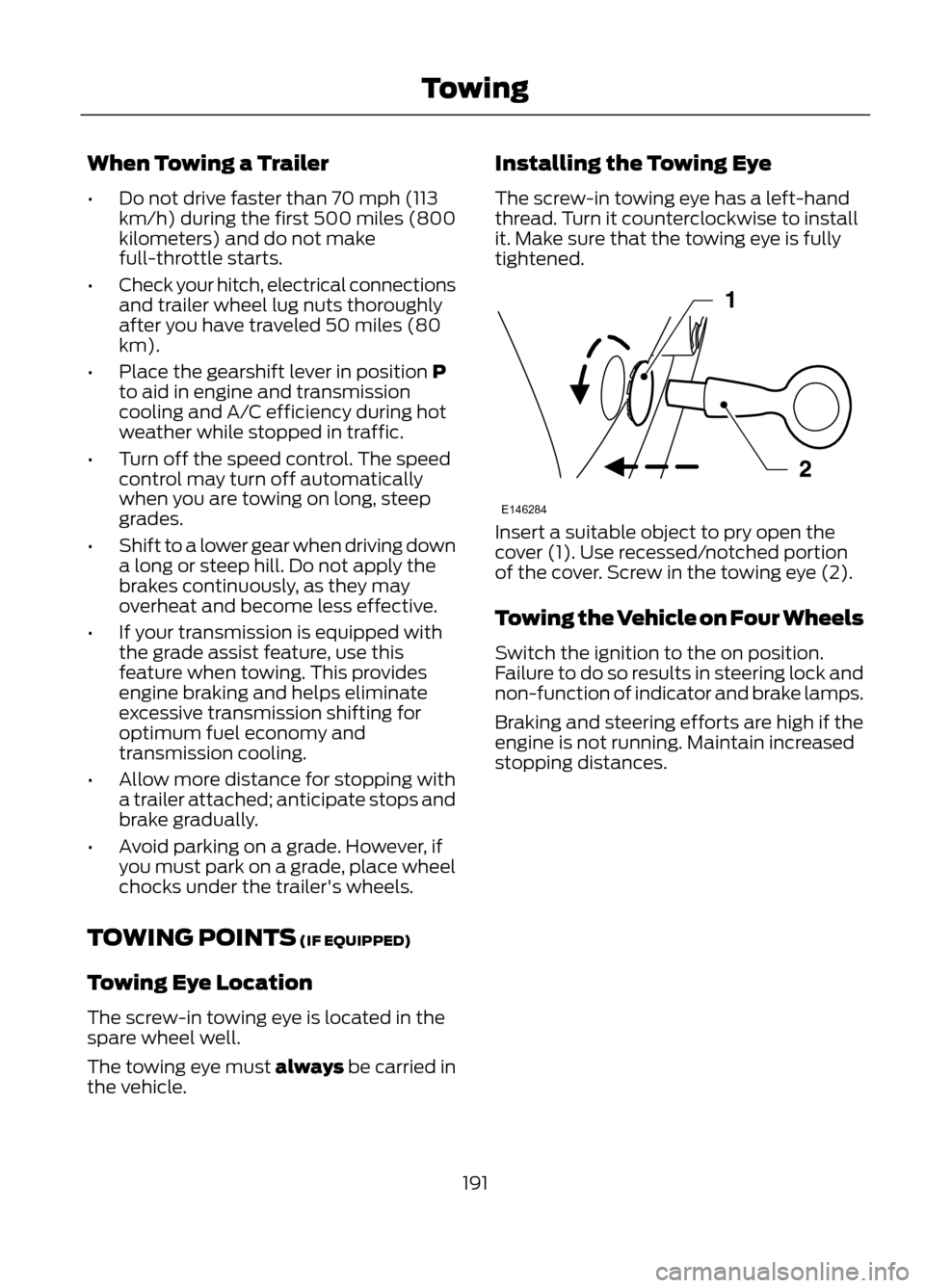
the vehicle. Installing the Towing Eye
The screw-in towing eye has a left-hand
thread. Turn it counterclockwise to install
it. Make sure that the towing eye is fully
tightened.
Insert a suitable object to pry open the
cover (1). Use recessed/notched portion
of the cover. Screw in the towing eye (2).
Towing the Vehicle on Four Wheels
Switch the ignition to the on position.
Failure to do so results in steering lock and
non-function of indicator and brake lamps.
Braking and steering efforts are high if the
engine is not running. Maintain increased
stopping distances.
191
Towing
E146284
Page 198 of 423
Canadian customers who need to obtain
roadside information, call
1-800-665-2006 or visit our website at
www.ford.ca.
HAZARD WARNING FLASHERS
Note:With extended use, the flashers may
run down your battery.
The hazard flasher control is
located on the instrument panel
by the radio. Use it when your
vehicle is disabled and is creating a safety
hazard for other motorists.
• Press the flasher control and all front
and rear direction signals will flash.
• Press the flasher control again to turn
them off.
FUEL CUT-OFF SWITCH
WARNING
Failure to inspect and if necessary
repair fuel leaks after a collision may
increase the risk of fire and serious
injury. Ford Motor Company recommends
that the fuel system be inspected by an
authorized dealer after any collision.
In the event of a moderate to severe
collision, this vehicle is equipped with a
fuel pump shut-off feature that stops the
flow of fuel to the engine. Not every impact
will cause a shut-off.
Should your vehicle shut off after a
collision, you may restart your vehicle by
doing the following:
1. Turn the ignition off.
2. Turn the ignition on.
3. Repeat steps 1 and 2 to re-enable fuel pump. Note:
If your vehicle has the push button
start system, press the stop/start button
twice to reactivate the fuel system.
JUMP-STARTING THE VEHICLE
WARNINGS
The gases around the battery can
explode if exposed to flames, sparks,
or lit cigarettes. An explosion could
result in injury or vehicle damage.
Batteries contain sulfuric acid which
can burn skin, eyes and clothing, if
contacted.
Do not attempt to push-start your
automatic transmission vehicle. Automatic
transmissions do not have push-start
capability. Attempting to push-start a
vehicle with an automatic transmission
may cause transmission damage.
Preparing Your Vehicle
Note: Use only a 12-volt supply to start your
vehicle.
Note: Do not disconnect the battery of the
disabled vehicle as this could damage the
vehicle's electrical system.
1. Park the booster vehicle close to the hood of the disabled vehicle making
sure the two vehicles do not touch. Set
the parking brake on both vehicles and
stay clear of the engine cooling fan and
other moving parts.
2. Check all battery terminals and remove
any excessive corrosion before you
attach the battery cables. Ensure that
vent caps are tight and level.
3. Turn the heater fan on in both vehicles
to protect from any electrical surges.
Turn all other accessories off.
198
Roadside Emergencies
Page 209 of 423
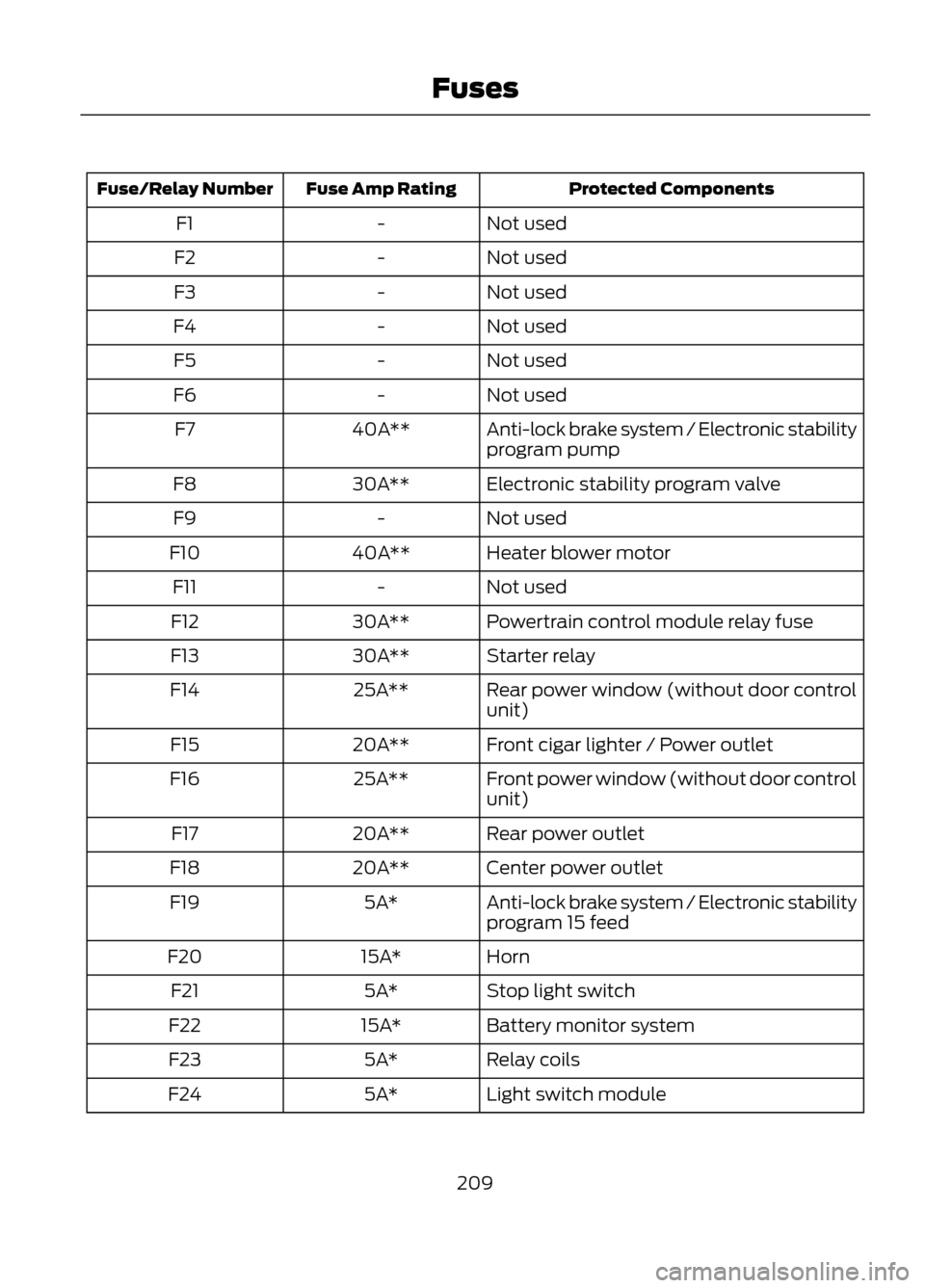
Protected Components
Fuse Amp Rating
Fuse/Relay Number
Not used
-
F1
Not used
-
F2
Not used
-
F3
Not used
-
F4
Not used
-
F5
Not used
-
F6
Anti-lock brake system / Electronic stability
program pump
40A**
F7
Electronic stability program valve
30A**
F8
Not used
-
F9
Heater blower motor
40A**
F10
Not used
-
F11
Powertrain control module relay fuse
30A**
F12
Starter relay
30A**
F13
Rear power window (without door control
unit)
25A**
F14
Front cigar lighter / Power outlet
20A**
F15
Front power window (without door control
unit)
25A**
F16
Rear power outlet
20A**
F17
Center power outlet
20A**
F18
Anti-lock brake system / Electronic stability
program 15 feed
5A*
F19
Horn
15A*
F20
Stop light switch
5A*
F21
Battery monitor system
15A*
F22
Relay coils
5A*
F23
Light switch module
5A*
F24
209
Fuses
Page 254 of 423
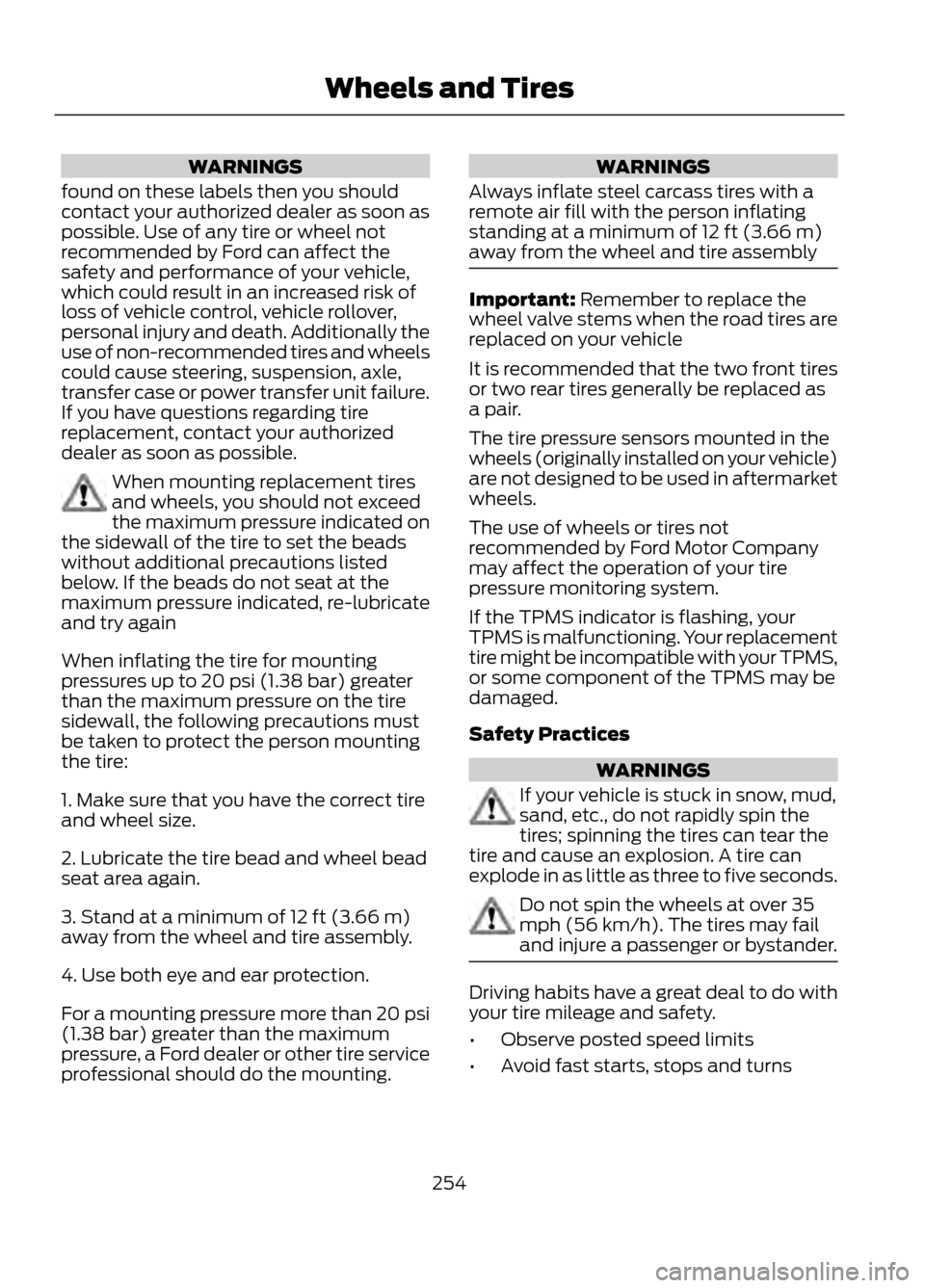
WARNINGS
found on these labels then you should
contact your authorized dealer as soon as
possible. Use of any tire or wheel not
recommended by Ford can affect the
safety and performance of your vehicle,
which could result in an increased risk of
loss of vehicle control, vehicle rollover,
personal injury and death. Additionally the
use of non-recommended tires and wheels
could cause steering, suspension, axle,
transfer case or power transfer unit failure.
If you have questions regarding tire
replacement, contact your authorized
dealer as soon as possible.
When mounting replacement tires
and wheels, you should not exceed
the maximum pressure indicated on
the sidewall of the tire to set the beads
without additional precautions listed
below. If the beads do not seat at the
maximum pressure indicated, re-lubricate
and try again
When inflating the tire for mounting
pressures up to 20 psi (1.38 bar) greater
than the maximum pressure on the tire
sidewall, the following precautions must
be taken to protect the person mounting
the tire:
1. Make sure that you have the correct tire
and wheel size.
2. Lubricate the tire bead and wheel bead
seat area again.
3. Stand at a minimum of 12 ft (3.66 m)
away from the wheel and tire assembly.
4. Use both eye and ear protection.
For a mounting pressure more than 20 psi
(1.38 bar) greater than the maximum
pressure, a Ford dealer or other tire service
professional should do the mounting.
WARNINGS
Always inflate steel carcass tires with a
remote air fill with the person inflating
standing at a minimum of 12 ft (3.66 m)
away from the wheel and tire assembly
Important: Remember to replace the
wheel valve stems when the road tires are
replaced on your vehicle
It is recommended that the two front tires
or two rear tires generally be replaced as
a pair.
The tire pressure sensors mounted in the
wheels (originally installed on your vehicle)
are not designed to be used in aftermarket
wheels.
The use of wheels or tires not
recommended by Ford Motor Company
may affect the operation of your tire
pressure monitoring system.
If the TPMS indicator is flashing, your
TPMS is malfunctioning. Your replacement
tire might be incompatible with your TPMS,
or some component of the TPMS may be
damaged.
Safety Practices
WARNINGS
If your vehicle is stuck in snow, mud,
sand, etc., do not rapidly spin the
tires; spinning the tires can tear the
tire and cause an explosion. A tire can
explode in as little as three to five seconds.
Do not spin the wheels at over 35
mph (56 km/h). The tires may fail
and injure a passenger or bystander.
Driving habits have a great deal to do with
your tire mileage and safety.
• Observe posted speed limits
• Avoid fast starts, stops and turns
254
Wheels and Tires
Page 257 of 423
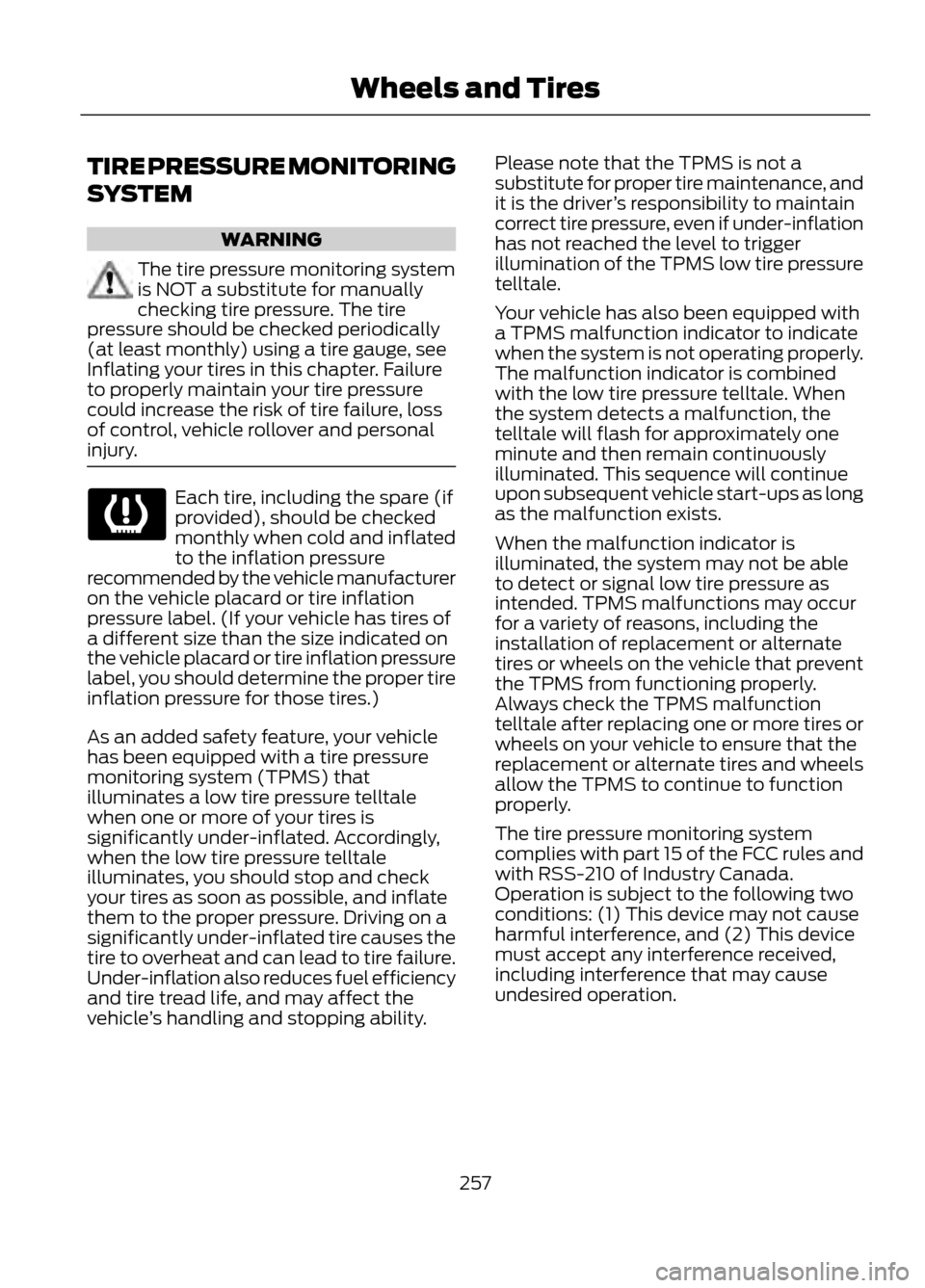
TIRE PRESSURE MONITORING
SYSTEM
WARNING
The tire pressure monitoring system
is NOT a substitute for manually
checking tire pressure. The tire
pressure should be checked periodically
(at least monthly) using a tire gauge, see
Inflating your tires in this chapter. Failure
to properly maintain your tire pressure
could increase the risk of tire failure, loss
of control, vehicle rollover and personal
injury.
Each tire, including the spare (if
provided), should be checked
monthly when cold and inflated
to the inflation pressure
recommended by the vehicle manufacturer
on the vehicle placard or tire inflation
pressure label. (If your vehicle has tires of
a different size than the size indicated on
the vehicle placard or tire inflation pressure
label, you should determine the proper tire
inflation pressure for those tires.)
As an added safety feature, your vehicle
has been equipped with a tire pressure
monitoring system (TPMS) that
illuminates a low tire pressure telltale
when one or more of your tires is
significantly under-inflated. Accordingly,
when the low tire pressure telltale
illuminates, you should stop and check
your tires as soon as possible, and inflate
them to the proper pressure. Driving on a
significantly under-inflated tire causes the
tire to overheat and can lead to tire failure.
Under-inflation also reduces fuel efficiency
and tire tread life, and may affect the
vehicle ’s handling and stopping ability. Please note that the TPMS is not a
substitute for proper tire maintenance, and
it is the driver
’s responsibility to maintain
correct tire pressure, even if under-inflation
has not reached the level to trigger
illumination of the TPMS low tire pressure
telltale.
Your vehicle has also been equipped with
a TPMS malfunction indicator to indicate
when the system is not operating properly.
The malfunction indicator is combined
with the low tire pressure telltale. When
the system detects a malfunction, the
telltale will flash for approximately one
minute and then remain continuously
illuminated. This sequence will continue
upon subsequent vehicle start-ups as long
as the malfunction exists.
When the malfunction indicator is
illuminated, the system may not be able
to detect or signal low tire pressure as
intended. TPMS malfunctions may occur
for a variety of reasons, including the
installation of replacement or alternate
tires or wheels on the vehicle that prevent
the TPMS from functioning properly.
Always check the TPMS malfunction
telltale after replacing one or more tires or
wheels on your vehicle to ensure that the
replacement or alternate tires and wheels
allow the TPMS to continue to function
properly.
The tire pressure monitoring system
complies with part 15 of the FCC rules and
with RSS-210 of Industry Canada.
Operation is subject to the following two
conditions: (1) This device may not cause
harmful interference, and (2) This device
must accept any interference received,
including interference that may cause
undesired operation.
257
Wheels and Tires
Page 417 of 423

Information Messages..................................87Airbag........................................................................\
87
Alarm........................................................................\
88
Battery and Charging System......................... 88
Blind Spot Information and Cross Traffic Alert System..................................................... 88
Doors........................................................................\
89
Engine...................................................................... 90
Hill Start Assist..................................................... 90
Keyless Vehicle..................................................... 90
Lighting..................................................................... 91
Maintenance.......................................................... 92
Message indicator................................................ 87
MyKey....................................................................... 92
Park Aid.................................................................... 93
Park Brake............................................................... 93
Power Steering...................................................... 94
Starting System ................................................... 94
Tire Pressure Monitoring System................... 96
Traction Control................................................... 96
Transmission and Four-Wheel Drive............94
Installing Child Seats.....................................19 Using LAP AND SHOULDER BELTS...............19
Using Lower Anchors AND Tethers FOR
CHildren (LATCH)............................................ 22
Using Tether Straps............................................. 23
Instrument Cluster.........................................79
Instrument Lighting Dimmer.......................71 Vehicles With Front Fog Lamps....................... 71
Vehicles Without Front Fog Lamps................71
Interior Lamps..................................................72 Front Interior Lamp.............................................. 72
Rear Interior Lamp................................................ 73
Interior Mirror....................................................76 Auto-Dimming Mirror.......................................... 76
Introduction.........................................................7
J
Jump-Starting the Vehicle........................198 Connecting the Jumper Cables..................... 199
Jump Starting...................................................... 199
Preparing Your Vehicle..................................... 198
Removing the Jumper Cables........................ 199K
Keyless Entry...................................................60
SECURICODE™ KEYLESS ENTRY
KEYPAD.............................................................. 60
Keyless Starting.............................................135 Fast Restart........................................................... 137
Stopping the Engine When Your Vehicle is Moving................................................................ 137
Stopping the Engine When Your Vehicle is Stationary......................................................... 136
Keys and Remote Controls.........................44 Principle of Operation........................................ 44
Knee Airbag.......................................................37
L
Lighting Control..............................................70 Headlamp Flasher............................................... 70
High Beams............................................................ 70
Lighting..............................................................70
Load Carriers See: Roof Racks and Load Carriers..............178
Load Carrying..................................................177
Load Limit........................................................179 Vehicle loading - with and without a
trailer................................................................... 179
Locking and Unlocking.................................54 Activating Intelligent Access ........................... 55
Autolock and Autounlock ................................ 56
Battery Saver......................................................... 56
Illuminated Entry.................................................. 56
Illuminated Exit..................................................... 56
Power Door Locks................................................ 54
Remote Control.................................................... 54
Smart Unlocks For Integrated Keyhead Transmitter........................................................ 55
Smart Unlocks For Intelligent Access Keys ........................................................................\
........ 55
Locks...................................................................54
Luggage Covers..............................................177
M
Maintenance...................................................217 General Information........................................... 217
Manual Climate Control..............................113
Manual Liftgate...............................................57
417
Index
Page 420 of 423

Scheduled Maintenance..........................396Engine Coolant Change Record.................... 410
Exceptions........................................................... 409
General Maintenance Information.............396
Normal Scheduled Maintenance................399
Special Operating Conditions...................... 405
Seats...................................................................121
Security..............................................................62
Side Airbags.....................................................40
Sitting in the Correct Position...................121
Snow Chains See: Using Snow Chains................................. 256
Special Notices.................................................11 New Vehicle Limited Warranty.......................... 11
Notice to Owners of Pickup Trucks and Utility Type Vehicles........................................ 12
Special Instructions............................................... 11
Using Your Vehicle as an Ambulance............12
Using Your Vehicle With a Snowplow............12
Speed Control See: Cruise Control............................................. 170
Stability Control............................................159 Principle of Operation....................................... 159
Starter Switch See: Ignition Switch........................................... 135
Starting a Gasoline Engine........................137 Guarding Against Exhaust Fumes................138
Important Ventilating Information...............138
Starting and Stopping the Engine..........135 General Information.......................................... 135
Steering............................................................176 Electric Power Steering..................................... 176
Steering Wheel...............................................64
Storage Compartments.............................134
Sun Visors..........................................................77 Illuminated Vanity Mirror.................................... 77
Supplementary Restraints System.........35 Principle of Operation......................................... 35
Symbols Glossary.............................................7
SYNC® Applications and Services.......295 911 Assist............................................................... 295
SYNC Services: Traffic, Directions & Information (TDI)......................................... 298
Vehicle Health Report...................................... 297
SYNC®.............................................................279 General Information.......................................... 279
SYNC® Troubleshooting..........................308 T
Technical Specifications
See: Capacities and Specifications.............267
The Better Business Bureau (BBB) Auto Line Program (U.S. Only).......................203
Tire Care..........................................................245 Glossary of Tire Terminology........................ 246
Information About Uniform Tire Quality Grading............................................................. 245
Information Contained on the Tire Sidewall........................................................... 246
Temperature A B C............................................ 245
Traction AA A B C............................................... 245
Treadwear............................................................. 245
Tire Pressure Monitoring System...........257 Changing Tires with a Tire Pressure
Monitoring System....................................... 258
Understanding Your Tire Pressure Monitoring System ...................................... 258
Tire Pressures See: Technical Specifications....................... 265
Tires See: Wheels and Tires..................................... 243
Towing a Trailer.............................................188
Towing Points.................................................191 Installing the Towing Eye.................................. 191
Towing Eye Location........................................... 191
Towing the Vehicle on Four Wheels.............191
Towing the Vehicle on Four Wheels...........................................................192
Emergency Towing............................................. 192
Recreational Towing.......................................... 193
Towing..............................................................188
Traction Control............................................158 Principle of Operation....................................... 158
Trailer Sway Control....................................188
Transmission Code Designation............270
Transmission ...................................................147
Transporting the Vehicle............................192
Trip Computer.................................................86 All Value................................................................... 87
Average Fuel........................................................... 87
Fuel Used................................................................. 87
Resetting the Trip Computer........................... 86
Trip Odometer....................................................... 86
Trip Timer................................................................ 86
420
Index