Exhaust FORD ESCAPE 2014 3.G User Guide
[x] Cancel search | Manufacturer: FORD, Model Year: 2014, Model line: ESCAPE, Model: FORD ESCAPE 2014 3.GPages: 428, PDF Size: 16.6 MB
Page 185 of 428
Ford Motor Company produces a towing
manual for all authorized tow truck
operators. Have your tow truck operator
refer to this manual for proper hook-up
and towing procedures for your vehicle.
It is acceptable to have your front-wheel
drive vehicle towed from the front if using
proper wheel lift equipment to raise the
front wheels off the ground. When towing
in this manner, the rear wheels can remain
on the ground.
Front-wheel drive vehicles must have the
front wheels placed on a tow dolly when
towing your vehicle from the rear using
wheel lift equipment. This prevents
damage to the transmission.
Towing a four-wheel drive vehicle requires
that all wheels be off the ground, such as
using a wheel lift and dollies or flatbed
equipment. This prevents damage to the
transmission, four-wheel drive system and
vehicle.
TOWING THE VEHICLE ON
FOUR WHEELS
Emergency Towing
If your vehicle becomes inoperable
(without access to wheel dollies,
car-hauling trailer, or flatbed transport
vehicle), it can be flat-towed (all wheels
on the ground, regardless of the powertrain
and transmission configuration) under the
following conditions:
• Your vehicle is facing forward for
towing in a forward direction.
• Place the transmission in position N. If
you cannot move the transmission into
N, you may need to override it. See
Transmission (page 136).
• Maximum speed is 35 mph (56 km/h).
• Maximum distance is 50 miles (80
kilometers).
Recreational Towing
Note:Put your climate control system in
recirculated air mode to prevent exhaust
fumes from entering the vehicle. See
Climate Control (page 101).
Follow these guidelines if you have a need
for recreational (RV) towing. An example
of recreational towing would be towing
your vehicle behind a motorhome. We
designed these guidelines to prevent
damage to your transmission.
Front-wheel drive vehicles CANNOT be
flat-towed (all wheels on the ground) as
vehicle or transmission damage may occur.
You must place the front wheels on a
two-wheel tow dolly. If you are using a tow
dolly, follow the instructions specified by
the equipment provider.
Four-wheel drive vehicles CANNOT be
flat-towed (all wheels on the ground), as
vehicle or transmission damage may occur.
It is recommended to tow your vehicle with
all four (4) wheels off the ground such as
when using a car-hauling trailer. Otherwise,
you cannot recreational tow your vehicle.
182
Towing
Page 236 of 428
Note:If battery cables are disconnected, it
will be necessary to reset memory features.
Brakes
• Make sure brakes and parking brake
are fully released.
Tires
• Maintain recommended air pressure.
Miscellaneous
• Make sure all linkages, cables, levers
and pins under your vehicle are covered
with grease to prevent rust.
• Move vehicles at least 25 feet (8
meters) every 15 days to lubricate
working parts and prevent corrosion.
Removing Vehicle From Storage
When your vehicle is ready to come out of
storage, do the following:
• Wash your vehicle to remove any dirt
or grease film build-up on window
surfaces.
• Check windshield wipers for any
deterioration.
• Check under the hood for any foreign
material that may have collected
during storage (mice/squirrel nests).
• Check the exhaust for any foreign
material that may have collected
during storage.
• Check tire pressures and set tire
inflation per the Tire Label.
• Check brake pedal operation. Drive
your vehicle 15 feet (4.5 meters) back
and forth to remove rust build-up.
• Check fluid levels (including coolant,
oil and gas) to make sure there are no
leaks, and fluids are at recommended
levels.
• If the battery was removed, clean the
battery cable ends and inspect.Contact your authorized dealer if you have
any concerns or issues.
233
Vehicle Care
Page 401 of 428
Avoid the Rising Cost of Properly
Maintaining Your Vehicle!
Ford Extended Service Plan also offers a
Premium Maintenance Plan that covers all
scheduled maintenance, and select items
that routinely wear out.
The coverage is prepaid, so you never have
to worry about affording your vehicle
maintenance. It covers regular checkups,
routine inspections, preventive care and
replacement of select items that require
periodic attention for normal wear:
• Windshield Wiper Blades
• Spark Plugs (except in California)
• The Clutch Disc
• Brake Pads and Linings
• Shock Absorbers
• Belts and Hoses
• Diesel Exhaust Fluid ReplenishmentContact your selling authorized Ford or
Lincoln dealership today so they can
customize a Ford Extended Service Plan
that fits your driving lifestyle and budget.
Interest Free Finance Options
Available
Take advantage of our interest free
installment payment plan. Just a 10%
down payment will provide you with an
affordable, no interest, no fee payment
program.
To learn more, call our Ford ESP specialists
at 800-367-3377. Don’t forget to ask about
our interest free payment program,
allowing you all the security and benefits
Ford ESP has to offer while paying over
time. You are pre-approved with no credit
checks, no hassles!
Complete the information below and mail
to:
Ford ESP
P.O. Box 8072
Royal Oak, MI 48068-0039
Name (PLEASE PRINT)
APT.# ADDRESS
ZIP STATE CITY
E-MAIL
398
Ford Extended Service Plan (ESP)
Page 406 of 428
Multi-Point inspection
Hazard warning system operation Accessory drive belt(s)
Horn operation Battery performance
Radiator, cooler, heater and air conditioning
hoses Engine air filter
Suspension components for leaks or
damage Exhaust system
Steering and linkage Exterior lamps operation
Tires (including spare) for wear and proper
pressure
**Fluid levels*; fill if necessary
Windshield for cracks, chips or pits For oil and fluid leaks
Washer spray and wiper operation Half-shaft dust boots
* Brake, coolant recovery reservoir, automatic transmission and window washer**If your vehicle is equipped with a temporary mobility kit, check the tire sealant expiration
Use By date on the canister. Replace as needed.
Be sure to ask your dealership service
advisor or technician about the multi-point
vehicle inspection. It is a comprehensive
way to perform a thorough inspection of
your vehicle. Your checklist gives you
immediate feedback on the overall
condition of your vehicle.
NORMAL SCHEDULED
MAINTENANCE
Intelligent Oil-Life Monitor®
Your vehicle is equipped with an Intelligent
Oil-Life Monitor that determines when you
should change the engine oil based on how
your vehicle is used. By using several
important factors in its calculations, the
monitor helps reduce the cost of owning
your vehicle and reduces environmental
waste at the same time.This means you do not have to remember
to change the oil on a mileage-based
schedule. Your vehicle lets you know when
an oil change is due by displaying ENGINE
OIL CHANGE DUE or OIL CHANGE
REQUIRED in the information display.
The following table provides examples of
vehicle use and its impact on oil change
intervals. It is a guideline only. Actual oil
change intervals depend on several factors
and generally decrease with severity of
use.
403
Scheduled Maintenance
Page 407 of 428
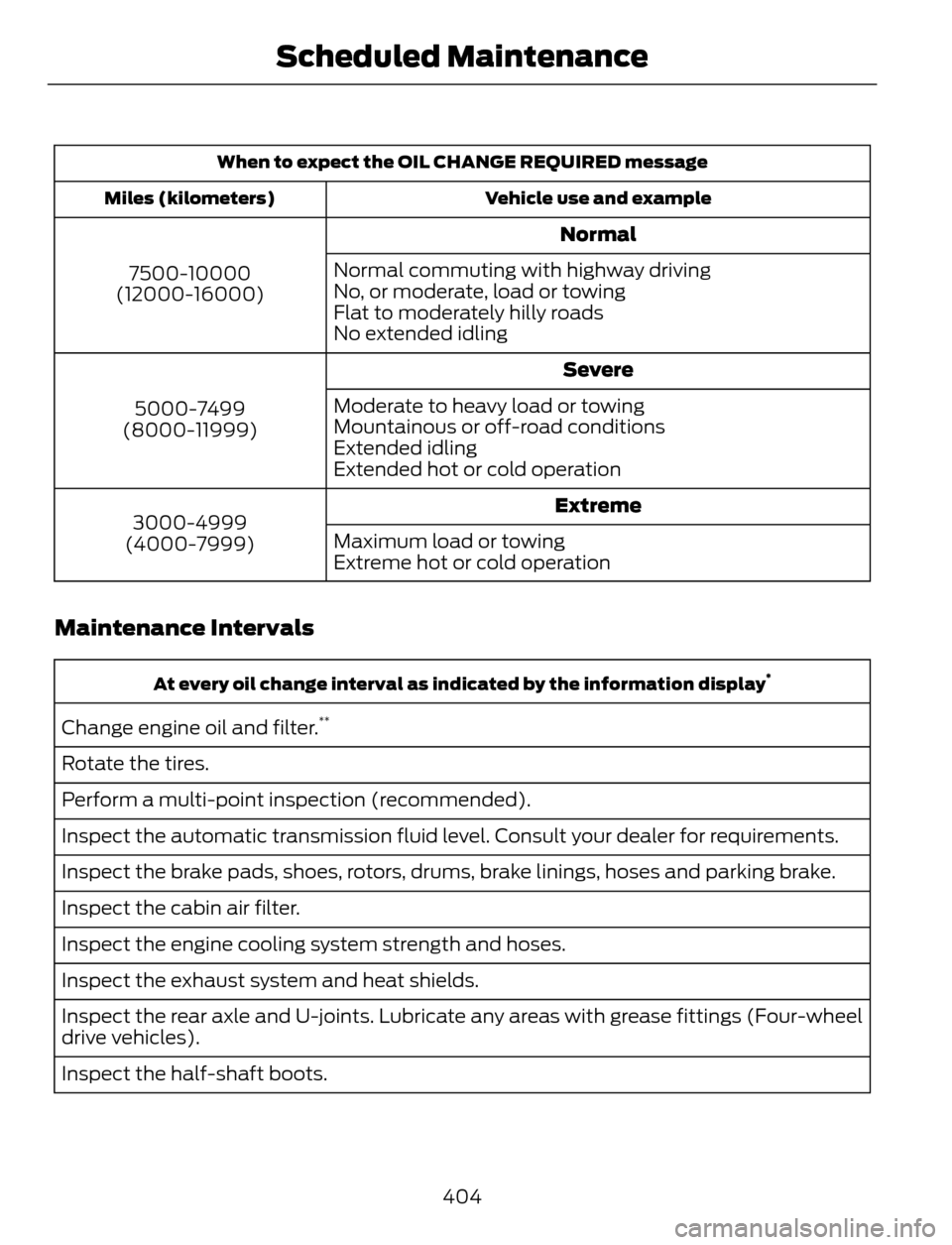
When to expect the OIL CHANGE REQUIRED message
Vehicle use and example Miles (kilometers)
Normal
7500-10000
(12000-16000)Normal commuting with highway driving
No, or moderate, load or towing
Flat to moderately hilly roads
No extended idling
Severe
5000-7499
(8000-11999)Moderate to heavy load or towing
Mountainous or off-road conditions
Extended idling
Extended hot or cold operation
Extreme
3000-4999
(4000-7999)Maximum load or towing
Extreme hot or cold operation
Maintenance Intervals
At every oil change interval as indicated by the information display*
Change engine oil and filter.**
Rotate the tires.
Perform a multi-point inspection (recommended).
Inspect the automatic transmission fluid level. Consult your dealer for requirements.
Inspect the brake pads, shoes, rotors, drums, brake linings, hoses and parking brake.
Inspect the cabin air filter.
Inspect the engine cooling system strength and hoses.
Inspect the exhaust system and heat shields.
Inspect the rear axle and U-joints. Lubricate any areas with grease fittings (Four-wheel
drive vehicles).
Inspect the half-shaft boots.
404
Scheduled Maintenance
Page 425 of 428
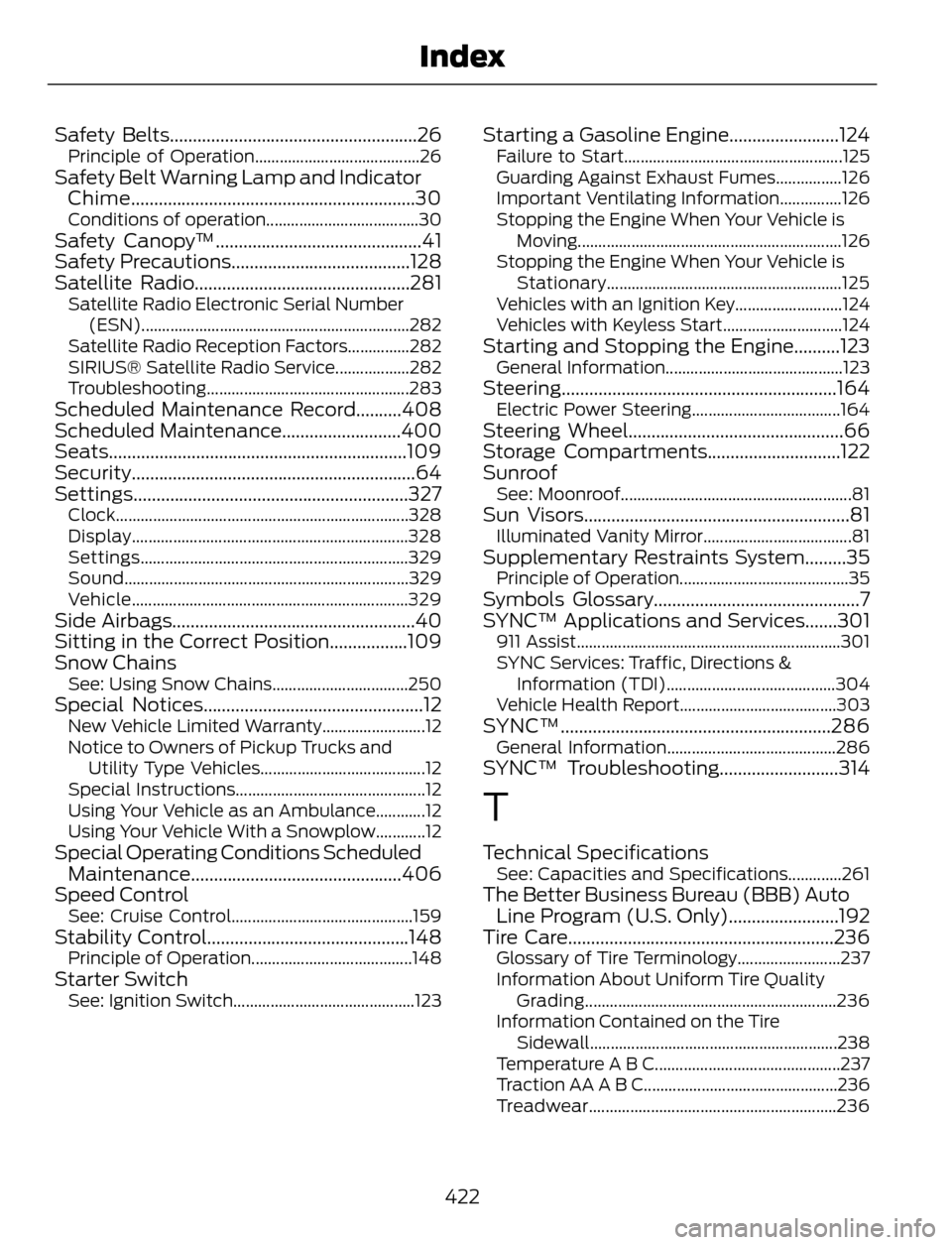
Safety Belts......................................................26Principle of Operation........................................26Safety Belt Warning Lamp and Indicator
Chime..............................................................30
Conditions of operation.....................................30Safety Canopy™.............................................41
Safety Precautions.......................................128
Satellite Radio...............................................281
Satellite Radio Electronic Serial Number
(ESN).................................................................282
Satellite Radio Reception Factors...............282
SIRIUS® Satellite Radio Service..................282
Troubleshooting.................................................283
Scheduled Maintenance Record..........408
Scheduled Maintenance..........................400
Seats.................................................................109
Security..............................................................64
Settings............................................................327
Clock.......................................................................328
Display...................................................................328
Settings.................................................................329
Sound.....................................................................329
Vehicle...................................................................329
Side Airbags.....................................................40
Sitting in the Correct Position.................109
Snow Chains
See: Using Snow Chains.................................250Special Notices................................................12New Vehicle Limited Warranty.........................12
Notice to Owners of Pickup Trucks and
Utility Type Vehicles........................................12
Special Instructions..............................................12
Using Your Vehicle as an Ambulance............12
Using Your Vehicle With a Snowplow............12
Special Operating Conditions Scheduled
Maintenance..............................................406
Speed Control
See: Cruise Control............................................159Stability Control............................................148Principle of Operation.......................................148Starter SwitchSee: Ignition Switch............................................123
Starting a Gasoline Engine........................124Failure to Start.....................................................125
Guarding Against Exhaust Fumes................126
Important Ventilating Information...............126
Stopping the Engine When Your Vehicle is
Moving................................................................126
Stopping the Engine When Your Vehicle is
Stationary.........................................................125
Vehicles with an Ignition Key..........................124
Vehicles with Keyless Start.............................124
Starting and Stopping the Engine..........123General Information...........................................123Steering............................................................164Electric Power Steering....................................164Steering Wheel...............................................66
Storage Compartments.............................122
Sunroof
See: Moonroof........................................................81Sun Visors..........................................................81Illuminated Vanity Mirror....................................81Supplementary Restraints System.........35Principle of Operation.........................................35Symbols Glossary.............................................7
SYNC™ Applications and Services.......301
911 Assist................................................................301
SYNC Services: Traffic, Directions &
Information (TDI).........................................304
Vehicle Health Report......................................303
SYNC™...........................................................286General Information.........................................286SYNC™ Troubleshooting..........................314
T
Technical SpecificationsSee: Capacities and Specifications.............261The Better Business Bureau (BBB) Auto
Line Program (U.S. Only)........................192
Tire Care..........................................................236
Glossary of Tire Terminology.........................237
Information About Uniform Tire Quality
Grading.............................................................236
Information Contained on the Tire
Sidewall............................................................238
Temperature A B C.............................................237
Traction AA A B C...............................................236
Treadwear............................................................236
422
Index