battery location FORD ESCAPE 2020 User Guide
[x] Cancel search | Manufacturer: FORD, Model Year: 2020, Model line: ESCAPE, Model: FORD ESCAPE 2020Pages: 553, PDF Size: 7.73 MB
Page 310 of 553
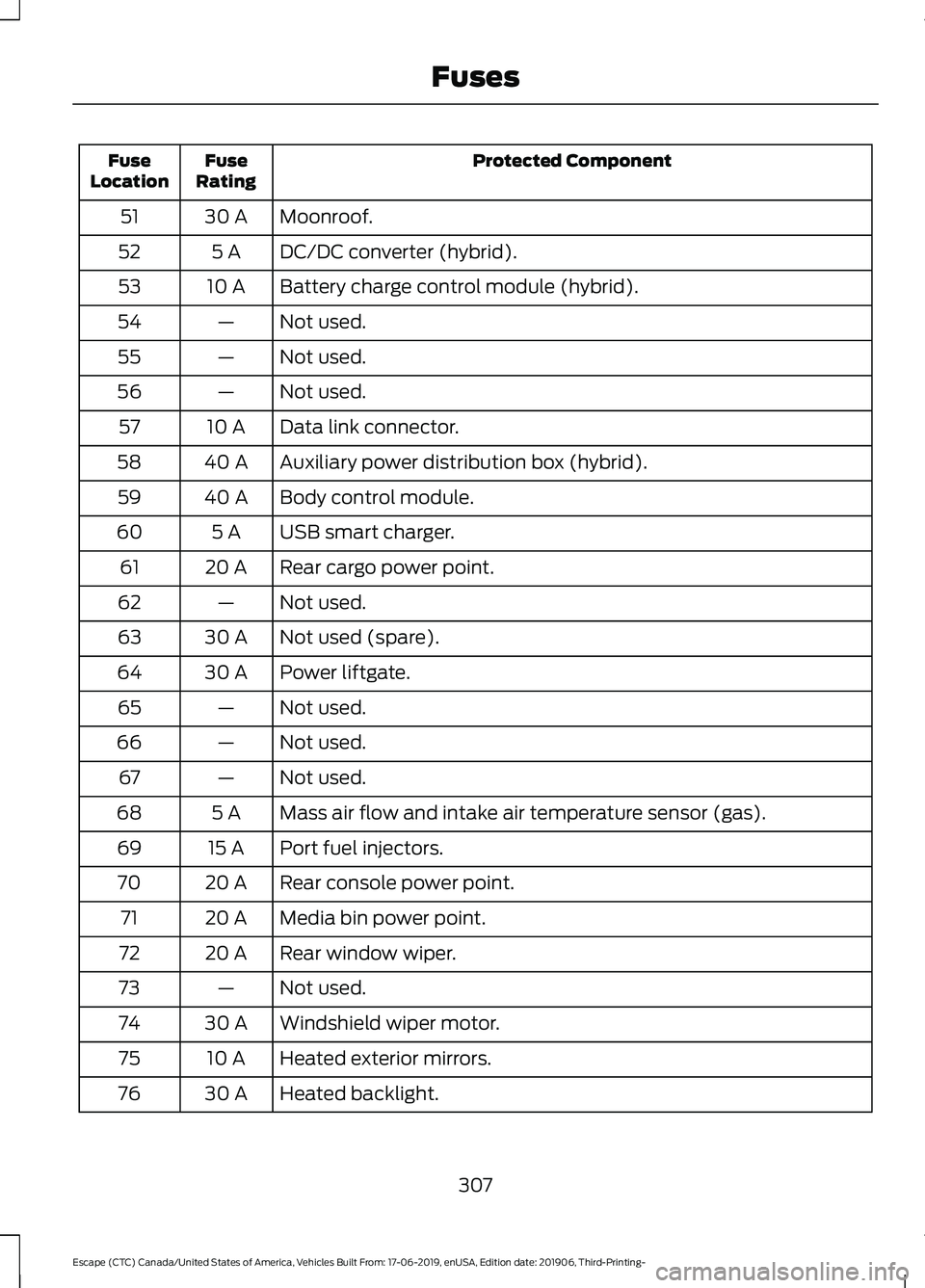
Protected Component
Fuse
Rating
Fuse
Location
Moonroof.
30 A
51
DC/DC converter (hybrid).
5 A
52
Battery charge control module (hybrid).
10 A
53
Not used.
—
54
Not used.
—
55
Not used.
—
56
Data link connector.
10 A
57
Auxiliary power distribution box (hybrid).
40 A
58
Body control module.
40 A
59
USB smart charger.
5 A
60
Rear cargo power point.
20 A
61
Not used.
—
62
Not used (spare).
30 A
63
Power liftgate.
30 A
64
Not used.
—
65
Not used.
—
66
Not used.
—
67
Mass air flow and intake air temperature sensor (gas).
5 A
68
Port fuel injectors.
15 A
69
Rear console power point.
20 A
70
Media bin power point.
20 A
71
Rear window wiper.
20 A
72
Not used.
—
73
Windshield wiper motor.
30 A
74
Heated exterior mirrors.
10 A
75
Heated backlight.
30 A
76
307
Escape (CTC) Canada/United States of America, Vehicles Built From: 17-06-2019, enUSA, Edition date: 201906, Third-Printing- Fuses
Page 340 of 553
Underbody
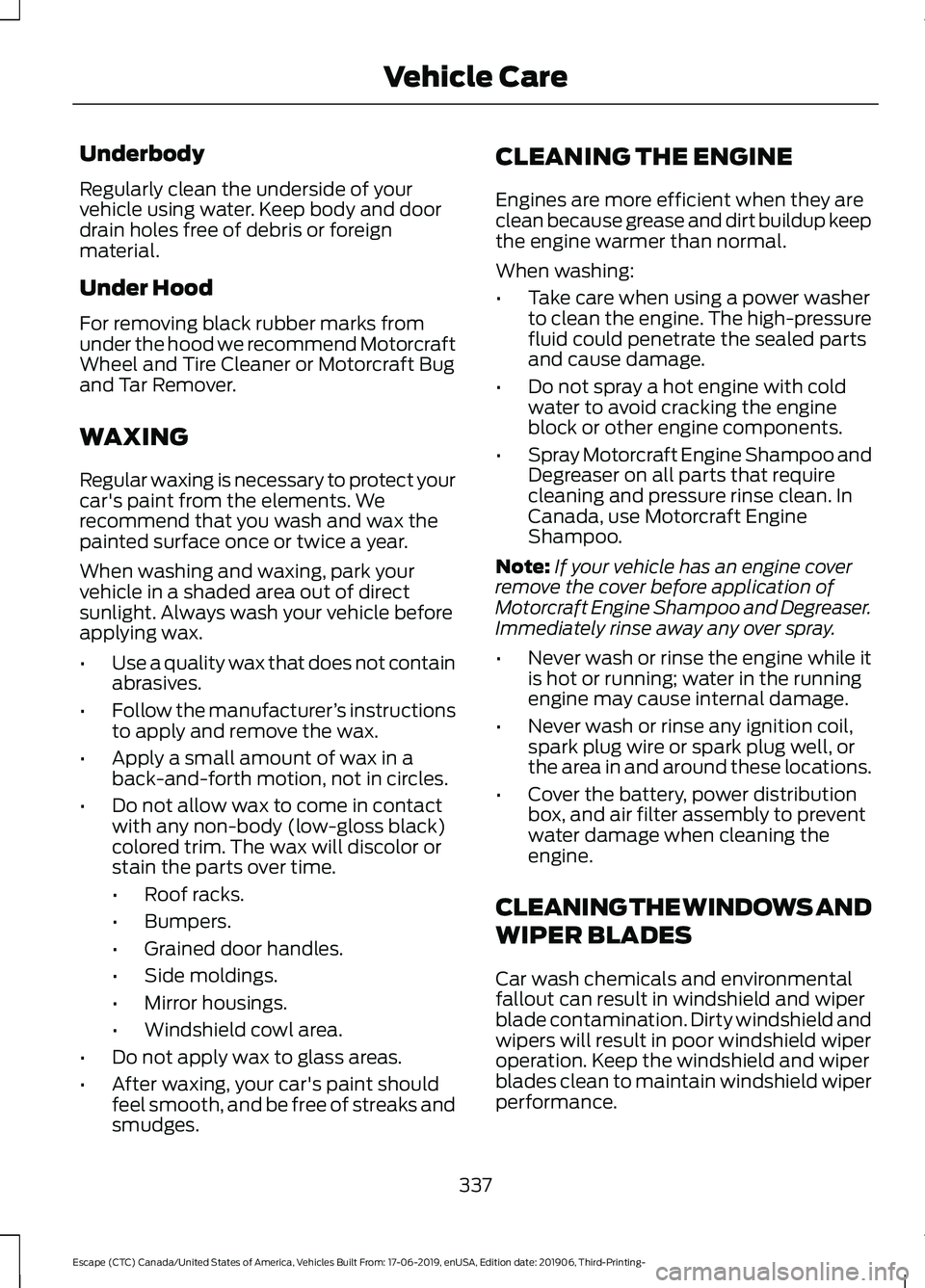
Regularly clean the underside of your
vehicle using water. Keep body and door
drain holes free of debris or foreign
material.
Under Hood
For removing black rubber marks from
under the hood we recommend Motorcraft
Wheel and Tire Cleaner or Motorcraft Bug
and Tar Remover.
WAXING
Regular waxing is necessary to protect your
car's paint from the elements. We
recommend that you wash and wax the
painted surface once or twice a year.
When washing and waxing, park your
vehicle in a shaded area out of direct
sunlight. Always wash your vehicle before
applying wax.
•
Use a quality wax that does not contain
abrasives.
• Follow the manufacturer ’s instructions
to apply and remove the wax.
• Apply a small amount of wax in a
back-and-forth motion, not in circles.
• Do not allow wax to come in contact
with any non-body (low-gloss black)
colored trim. The wax will discolor or
stain the parts over time.
•Roof racks.
• Bumpers.
• Grained door handles.
• Side moldings.
• Mirror housings.
• Windshield cowl area.
• Do not apply wax to glass areas.
• After waxing, your car's paint should
feel smooth, and be free of streaks and
smudges. CLEANING THE ENGINE
Engines are more efficient when they are
clean because grease and dirt buildup keep
the engine warmer than normal.
When washing:
•
Take care when using a power washer
to clean the engine. The high-pressure
fluid could penetrate the sealed parts
and cause damage.
• Do not spray a hot engine with cold
water to avoid cracking the engine
block or other engine components.
• Spray Motorcraft Engine Shampoo and
Degreaser on all parts that require
cleaning and pressure rinse clean. In
Canada, use Motorcraft Engine
Shampoo.
Note: If your vehicle has an engine cover
remove the cover before application of
Motorcraft Engine Shampoo and Degreaser.
Immediately rinse away any over spray.
• Never wash or rinse the engine while it
is hot or running; water in the running
engine may cause internal damage.
• Never wash or rinse any ignition coil,
spark plug wire or spark plug well, or
the area in and around these locations.
• Cover the battery, power distribution
box, and air filter assembly to prevent
water damage when cleaning the
engine.
CLEANING THE WINDOWS AND
WIPER BLADES
Car wash chemicals and environmental
fallout can result in windshield and wiper
blade contamination. Dirty windshield and
wipers will result in poor windshield wiper
operation. Keep the windshield and wiper
blades clean to maintain windshield wiper
performance.
337
Escape (CTC) Canada/United States of America, Vehicles Built From: 17-06-2019, enUSA, Edition date: 201906, Third-Printing- Vehicle Care
Page 344 of 553
•
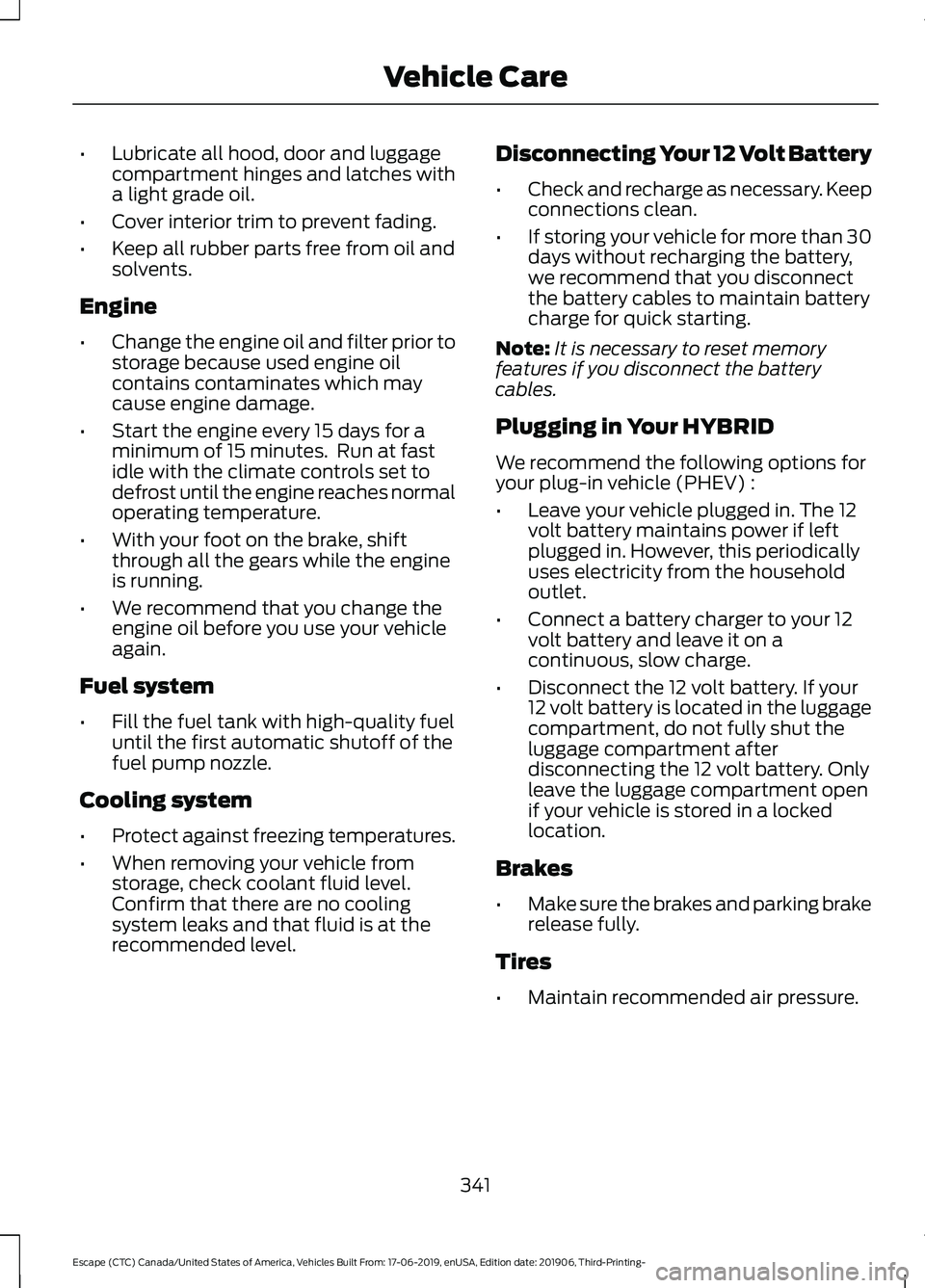
Lubricate all hood, door and luggage
compartment hinges and latches with
a light grade oil.
• Cover interior trim to prevent fading.
• Keep all rubber parts free from oil and
solvents.
Engine
• Change the engine oil and filter prior to
storage because used engine oil
contains contaminates which may
cause engine damage.
• Start the engine every 15 days for a
minimum of 15 minutes. Run at fast
idle with the climate controls set to
defrost until the engine reaches normal
operating temperature.
• With your foot on the brake, shift
through all the gears while the engine
is running.
• We recommend that you change the
engine oil before you use your vehicle
again.
Fuel system
• Fill the fuel tank with high-quality fuel
until the first automatic shutoff of the
fuel pump nozzle.
Cooling system
• Protect against freezing temperatures.
• When removing your vehicle from
storage, check coolant fluid level.
Confirm that there are no cooling
system leaks and that fluid is at the
recommended level. Disconnecting Your 12 Volt Battery
•
Check and recharge as necessary. Keep
connections clean.
• If storing your vehicle for more than 30
days without recharging the battery,
we recommend that you disconnect
the battery cables to maintain battery
charge for quick starting.
Note: It is necessary to reset memory
features if you disconnect the battery
cables.
Plugging in Your HYBRID
We recommend the following options for
your plug-in vehicle (PHEV) :
• Leave your vehicle plugged in. The 12
volt battery maintains power if left
plugged in. However, this periodically
uses electricity from the household
outlet.
• Connect a battery charger to your 12
volt battery and leave it on a
continuous, slow charge.
• Disconnect the 12 volt battery. If your
12 volt battery is located in the luggage
compartment, do not fully shut the
luggage compartment after
disconnecting the 12 volt battery. Only
leave the luggage compartment open
if your vehicle is stored in a locked
location.
Brakes
• Make sure the brakes and parking brake
release fully.
Tires
• Maintain recommended air pressure.
341
Escape (CTC) Canada/United States of America, Vehicles Built From: 17-06-2019, enUSA, Edition date: 201906, Third-Printing- Vehicle Care
Page 349 of 553
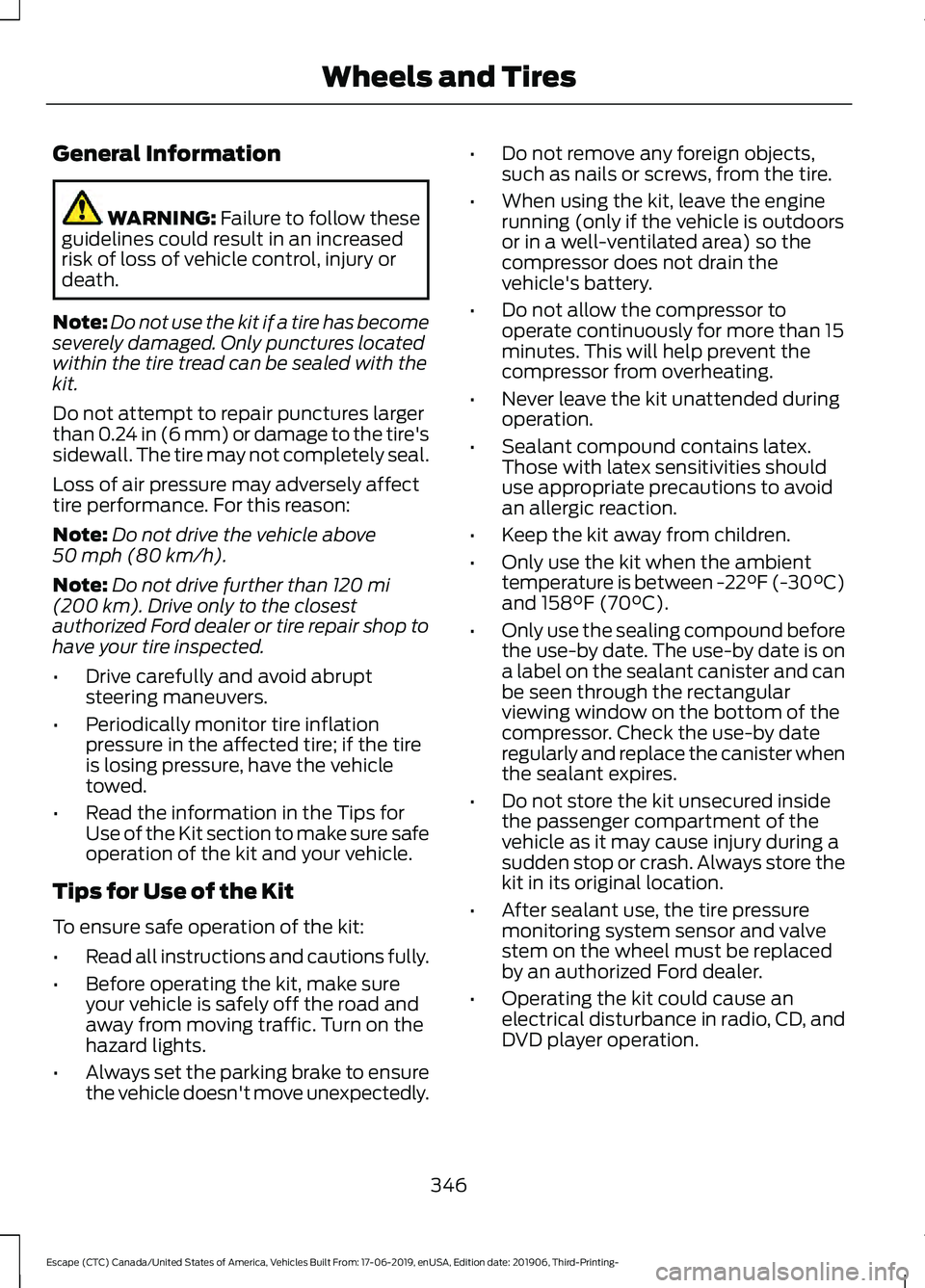
General Information
WARNING: Failure to follow these
guidelines could result in an increased
risk of loss of vehicle control, injury or
death.
Note: Do not use the kit if a tire has become
severely damaged. Only punctures located
within the tire tread can be sealed with the
kit.
Do not attempt to repair punctures larger
than 0.24 in (6 mm) or damage to the tire's
sidewall. The tire may not completely seal.
Loss of air pressure may adversely affect
tire performance. For this reason:
Note: Do not drive the vehicle above
50 mph (80 km/h)
.
Note: Do not drive further than
120 mi
(200 km). Drive only to the closest
authorized Ford dealer or tire repair shop to
have your tire inspected.
• Drive carefully and avoid abrupt
steering maneuvers.
• Periodically monitor tire inflation
pressure in the affected tire; if the tire
is losing pressure, have the vehicle
towed.
• Read the information in the Tips for
Use of the Kit section to make sure safe
operation of the kit and your vehicle.
Tips for Use of the Kit
To ensure safe operation of the kit:
• Read all instructions and cautions fully.
• Before operating the kit, make sure
your vehicle is safely off the road and
away from moving traffic. Turn on the
hazard lights.
• Always set the parking brake to ensure
the vehicle doesn't move unexpectedly. •
Do not remove any foreign objects,
such as nails or screws, from the tire.
• When using the kit, leave the engine
running (only if the vehicle is outdoors
or in a well-ventilated area) so the
compressor does not drain the
vehicle's battery.
• Do not allow the compressor to
operate continuously for more than 15
minutes. This will help prevent the
compressor from overheating.
• Never leave the kit unattended during
operation.
• Sealant compound contains latex.
Those with latex sensitivities should
use appropriate precautions to avoid
an allergic reaction.
• Keep the kit away from children.
• Only use the kit when the ambient
temperature is between -22°F (-30°C)
and 158°F (70°C).
• Only use the sealing compound before
the use-by date. The use-by date is on
a label on the sealant canister and can
be seen through the rectangular
viewing window on the bottom of the
compressor. Check the use-by date
regularly and replace the canister when
the sealant expires.
• Do not store the kit unsecured inside
the passenger compartment of the
vehicle as it may cause injury during a
sudden stop or crash. Always store the
kit in its original location.
• After sealant use, the tire pressure
monitoring system sensor and valve
stem on the wheel must be replaced
by an authorized Ford dealer.
• Operating the kit could cause an
electrical disturbance in radio, CD, and
DVD player operation.
346
Escape (CTC) Canada/United States of America, Vehicles Built From: 17-06-2019, enUSA, Edition date: 201906, Third-Printing- Wheels and Tires
Page 426 of 553
![FORD ESCAPE 2020 User Guide If a crash deploys an airbag (excluding
knee airbags and rear inflatable safety
belts [if equipped]) or activates the fuel
pump shut-off, your SYNC-equipped
vehicle may be able to contact emergency
se](/img/11/40786/w960_40786-425.png "FORD ESCAPE 2020 User Guide If a crash deploys an airbag (excluding
knee airbags and rear inflatable safety
belts [if equipped]) or activates the fuel
pump shut-off, your SYNC-equipped
vehicle may be able to contact emergency
se")
If a crash deploys an airbag (excluding
knee airbags and rear inflatable safety
belts [if equipped]) or activates the fuel
pump shut-off, your SYNC-equipped
vehicle may be able to contact emergency
services by dialing 911 through a paired and
connected Bluetooth-enabled phone.
See Supplementary Restraints System
(page 44). Important information about
airbag deployment is in this chapter.
See
Roadside Emergencies (page 287).
Important information about the fuel pump
shut-off is in this chapter.
Setting 911 Assist On or Off
Press the Settings button then select: Action and Description
Menu
Item
Select the desired option, on
or off.
911 Assist
To make sure that 911 Assist works
properly:
• SYNC must be powered and working
properly at the time of the incident and
throughout feature activation and use.
• The 911 Assist feature must be set on
before the incident.
• You must pair and connect a Bluetooth
enabled and compatible cell phone to
SYNC.
• A connected Bluetooth enabled phone
must have the ability to make and
maintain an outgoing call at the time
of the incident.
• A connected Bluetooth enabled phone
must have adequate network coverage,
battery power and signal strength.
• The vehicle must have battery power
and be located in the U.S., Canada or
in a territory in which 911 is the
emergency number. In the Event of a Crash
Not all crashes deploy an airbag or activate
the fuel pump shut-off (the triggers for 911
Assist). If a connected cell phone sustains
damage or loses its connection to SYNC
during a crash, SYNC searches for and tries
to connect to a previously paired cell
phone; SYNC then attempts to call the
emergency services.
Before making the call:
•
SYNC provides a short window of time
(about 10 seconds) to cancel the call.
If you fail to cancel the call, SYNC
attempts to dial 911.
• SYNC says the following, or a similar
message: "SYNC will attempt to call
911, to cancel the call, press Cancel on
your screen or press and hold the
phone button on your steering wheel".
If you do not cancel the call, and SYNC
makes a successful call, a pre-recorded
message plays for the 911 operator, and
then the occupant(s) in your vehicle are
able to talk with the operator. Be prepared
to provide your name, phone number and
location immediately, because not all 911
systems are capable of receiving this
information electronically.
911 Assist May Not Work If
• Your cellular phone or 911 Assist
hardware sustains damage in a crash.
• The vehicle's battery or the SYNC
system has no power.
• The phone(s) thrown from your vehicle
are the ones paired and connected to
the system.
423
Escape (CTC) Canada/United States of America, Vehicles Built From: 17-06-2019, enUSA, Edition date: 201906, Third-Printing- SYNC™
(If Equipped)
Page 465 of 553
•
Drive Power: The engine is on due to
accelerator pedal pressure or speed
control activation. Reduce pressure on
the accelerator pedal or switch off the
speed control to return to full electric
mode.
• High Speed: The engine is on because
the vehicle speed exceeds the level for
full electric operation. Reduce the
speed to return to electric operation.
• Heater Setting: The engine is on
because of the heater setting. Reduce
or turn off the heater setting to return
to electric operation.
• Neutral Gear: The engine is on because
the vehicle is in Neutral (N). Shift out
of neutral gear to return to electric
operation.
• Engine Cold: The engine is on because
it is cold. The vehicle returns to electric
operation once the engine is sufficiently
warm.
• Battery Charging: The engine is on to
charge the high-voltage battery. The
vehicle returns to electric operation
once the battery is charged.
• Low Gear: The engine is on because
the vehicle is in low gear. Shift out of
low gear to return to electric operation.
• Normal Operation: The engine is on to
optimize vehicle operation. The vehicle
returns to electric operation when
possible.
• Low Use: The engine is on to maintain
engine oil quality. The vehicle returns
to electric operation when low engine
use mode is complete. See Plug-In
Hybrid Vehicle Operation (page 178). •
Engine Braking Active: The engine is on
to provide increased powertrain
braking. This can occur when you turn
on the grade assist feature, when
speed control is on or when driving with
your foot off the accelerator pedal.
Turning off grade assist or speed
control may allow the vehicle to return
to electric operation.
• Battery Temperature: The engine is on
due to high or low high-voltage battery
temperature. This is a normal operating
condition. The vehicle returns to
electric operation when possible.
• Drive Mode: The engine is on due to the
drive mode selection. Select an
appropriate drive mode for electric only
operation.
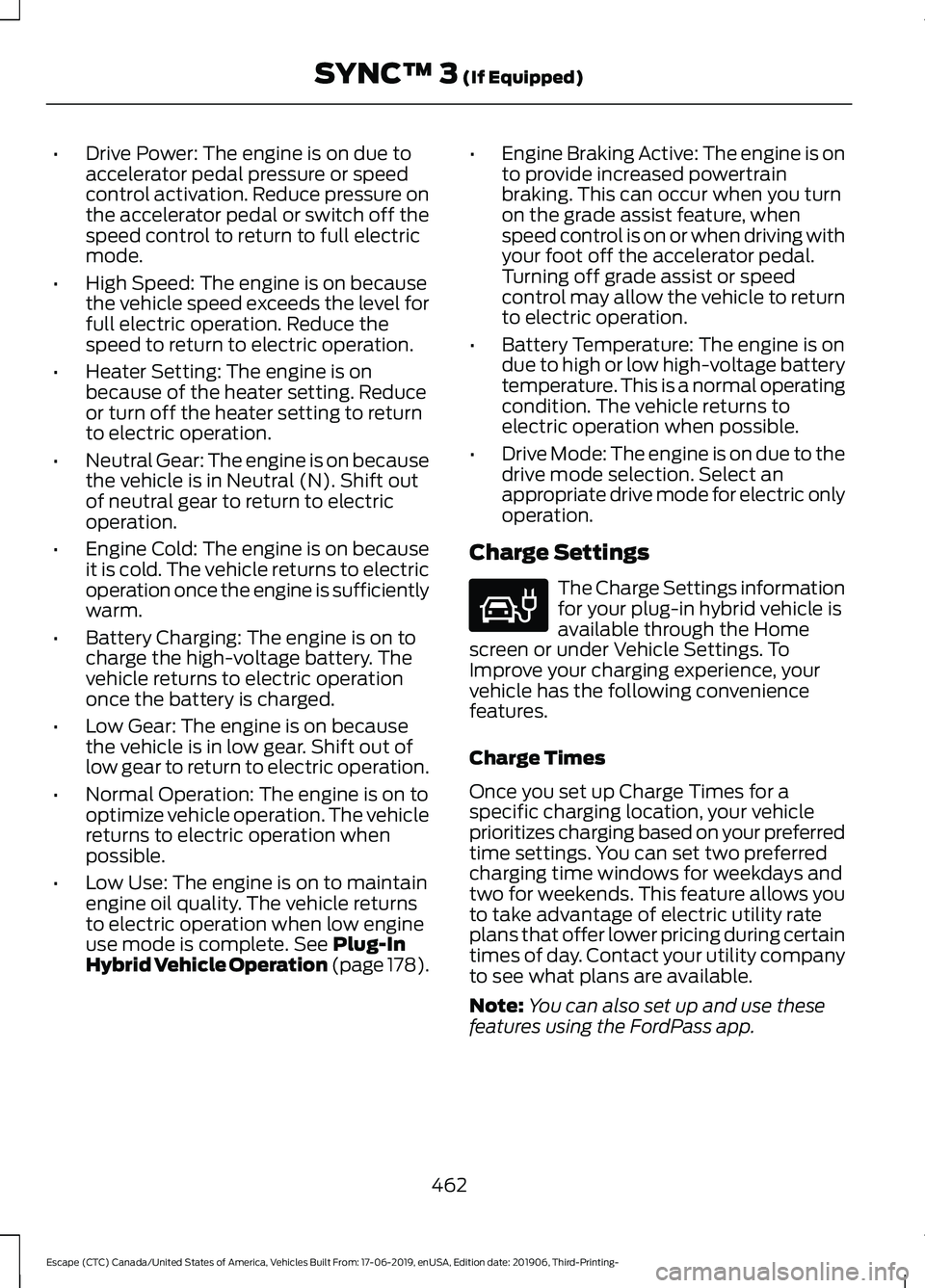
Charge Settings The Charge Settings information
for your plug-in hybrid vehicle is
available through the Home
screen or under Vehicle Settings. To
Improve your charging experience, your
vehicle has the following convenience
features.
Charge Times
Once you set up Charge Times for a
specific charging location, your vehicle
prioritizes charging based on your preferred
time settings. You can set two preferred
charging time windows for weekdays and
two for weekends. This feature allows you
to take advantage of electric utility rate
plans that offer lower pricing during certain
times of day. Contact your utility company
to see what plans are available.
Note: You can also set up and use these
features using the FordPass app.
462
Escape (CTC) Canada/United States of America, Vehicles Built From: 17-06-2019, enUSA, Edition date: 201906, Third-Printing- SYNC™ 3
(If Equipped)E304452
Page 467 of 553
Description and Action
Charging Status
A charging coupler is plugged into the
vehicle but there is no connection with a charging power source.
Charge station not detected.
Your vehicle is plugged in but cannot
communicate with the charging station. Contact the station provider.
Incompatible charge station.
Your vehicle is plugged in and charging ispaused at the charge station.
Charge station paused.
Charging Time Information
Displays estimates of how long your
vehicle will take to fully charge when
plugged into a high or low power charger.
• High power estimate: The minimum
time to a 100% charge using a high
power charger.
• Low power estimate: The longest time
to a 100% charge using a low power
charger.
When charging, the start and estimated
end time are displayed. When your vehicle
is not plugged in and at a location with
Charge Times enabled, the start and end
times display based on known charging
power.
Note: Charging durations and end times are
only estimates. Certain conditions may
result in longer charging times. See
Charging the High Voltage Battery (page
196
).
High Voltage Battery State of Charge
Displays the remaining charge percentage
with 100% representing the total amount
of energy you can get from an external
charge.
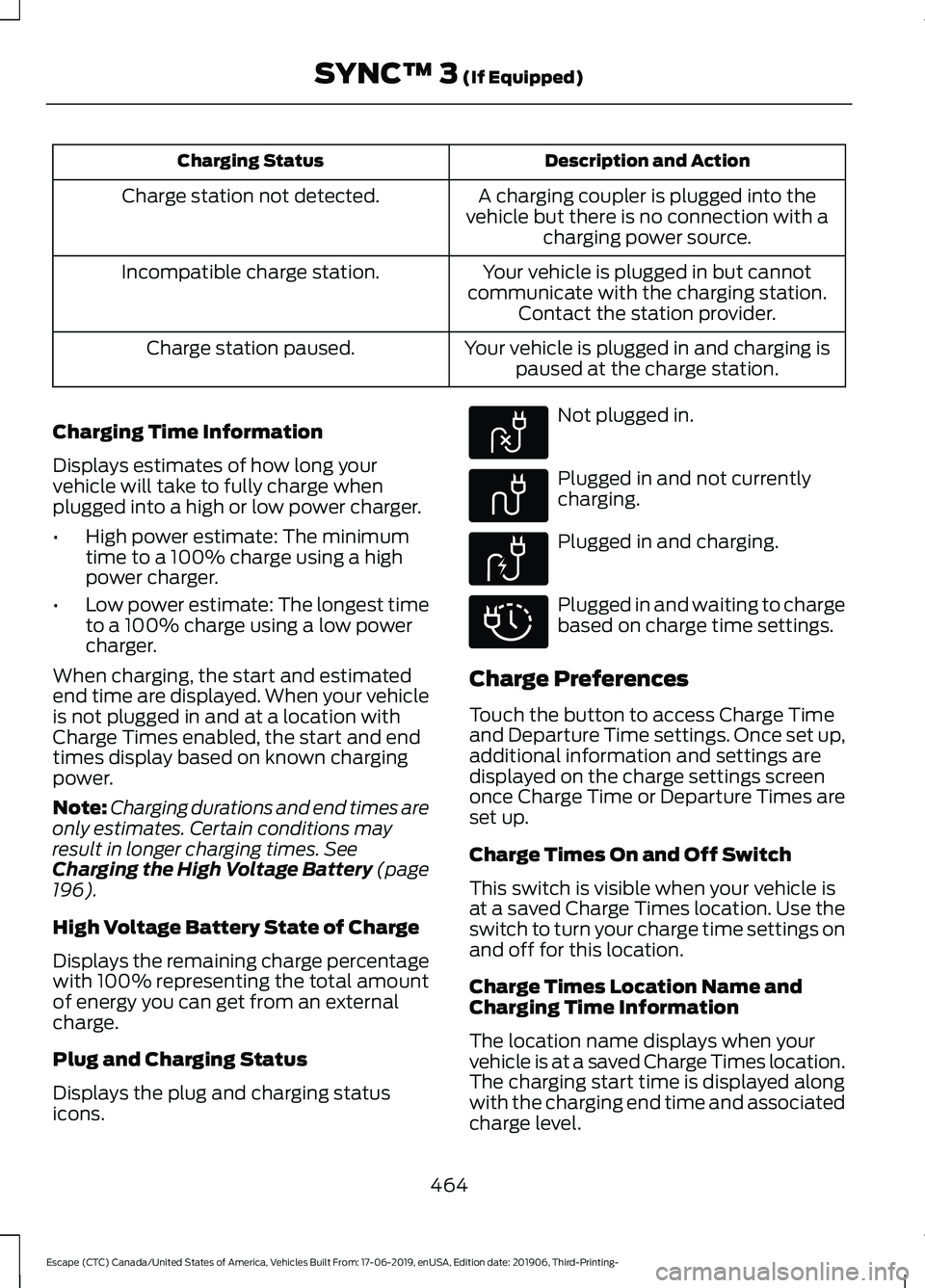
Plug and Charging Status
Displays the plug and charging status
icons. Not plugged in.
Plugged in and not currently
charging.
Plugged in and charging.
Plugged in and waiting to charge
based on charge time settings.
Charge Preferences
Touch the button to access Charge Time
and Departure Time settings. Once set up,
additional information and settings are
displayed on the charge settings screen
once Charge Time or Departure Times are
set up.
Charge Times On and Off Switch
This switch is visible when your vehicle is
at a saved Charge Times location. Use the
switch to turn your charge time settings on
and off for this location.
Charge Times Location Name and
Charging Time Information
The location name displays when your
vehicle is at a saved Charge Times location.
The charging start time is displayed along
with the charging end time and associated
charge level.
464
Escape (CTC) Canada/United States of America, Vehicles Built From: 17-06-2019, enUSA, Edition date: 201906, Third-Printing- SYNC™ 3
(If Equipped)E304458 E304459 E304460 E304461
Page 540 of 553
Auto-Start-Stop............................................175
Disabling Auto-Start-Stop.............................. 176
Enabling Auto-Start-Stop............................... 175
Autowipers.......................................................83 Autowipers Settings........................................... 84
Auxiliary Power Points................................163 110 Volt AC Power Point................................... 163
12 Volt DC Power Point..................................... 163
Locations............................................................... 163
AWD See: All-Wheel Drive.......................................... 212
B
Battery See: Changing the 12V Battery..................... 326
Blind Spot Information System..............255
Switching the System On and Off...............257
System Errors....................................................... 257
Using the Blind Spot Information System.............................................................. 256
BLIS See: Blind Spot Information System..........255
Body Styling Kits
..........................................342
Bonnet Lock See: Opening and Closing the Hood...........312
Booster Seats
..................................................29
Types of Booster Seats...................................... 30
Brake Fluid Check........................................325 Brake Fluid Service Interval............................ 326
Brakes................................................................217 General Information........................................... 217
Breaking-In....................................................284
Bulb Specification Chart..........................402
C
Cabin Air Filter...............................................146
Canceling the Set Speed..........................238
Capacities and Specifications - 1.5L EcoBoost™.................................................383
Air Conditioning System................................. 383
Alternative Engine Oil for Extremely Cold Climates........................................................... 386
Automatic Transmission................................. 383
Engine Coolant................................................... 384
Engine Oil............................................................. 385
Fuel Tank.............................................................. 386Grease....................................................................386
Hydraulic Brake System..................................
387
Locks....................................................................... 387
Power Transfer Unit.......................................... 388
Rear Axle.............................................................. 388
Washer Reservoir...............................................389
Capacities and Specifications - 2.0L EcoBoost™
.................................................389
Air Conditioning System................................. 389
Alternative Engine Oil for Extremely Cold Climates........................................................... 392
Automatic Transmission................................ 390
Engine Coolant.................................................... 391
Engine Oil............................................................... 391
Fuel Tank............................................................... 393
Grease.................................................................... 393
Hydraulic Brake System.................................. 393
Locks...................................................................... 394
Power Transfer Unit.......................................... 394
Rear Axle............................................................... 395
Washer Reservoir............................................... 395
Capacities and Specifications - 2.5L, Hybrid Electric Vehicle (HEV)/Plug-In
Hybrid Electric Vehicle (PHEV)...........396
Air Conditioning System................................. 396
Automatic Transmission................................. 397
Engine Coolant................................................... 398
Engine Oil............................................................. 398
Fuel Tank.............................................................. 399
Grease.................................................................... 399
Hydraulic Brake System.................................. 399
Locks..................................................................... 400
Power Transfer Unit......................................... 400
Rear Axle............................................................... 401
Washer Reservoir............................................... 401
Capacities and Specifications
................376
Car Wash See: Cleaning the Exterior.............................. 336
Catalytic Converter......................................193 On-Board Diagnostics (OBD-II)................... 194
Readiness for Inspection and Maintenance (I/M) Testing................................................... 194
Changing a Bulb
............................................331
LED Bulbs (If Equipped)................................. 332
Replacing Direction Indicator Bulbs...........333
Replacing Fog Lamp Bulbs............................ 332
Replacing Headlamp Bulbs............................ 331
537
Escape (CTC) Canada/United States of America, Vehicles Built From: 17-06-2019, enUSA, Edition date: 201906, Third-Printing- Index
Page 544 of 553
Front Fog Lamps............................................88
Front Fog Lamp Indicator................................. 89
Switching the Front Fog Lamps On or Off........................................................................\
. 88
Front Parking Aid..........................................227 Object Distance Indicator............................... 228
Front Passenger Sensing System............46
Fuel and Refueling.......................................182
Fuel Consumption.......................................190 Advertised Capacity.......................................... 190
Calculating Fuel Economy.............................. 190
Filling the Fuel Tank.......................................... 190
Fuel Filler Funnel Location........................183
Fuel Filter
........................................................329
Fuel Quality.....................................................182
Choosing the Right Fuel................................... 182
Fuel Shutoff..................................................288
Fuses................................................................304
Fuse Specification Chart..........................304 Engine Compartment Fuse Box.................. 304
Passenger Compartment Fuse Box...........308
G
Garage Door Opener...................................159
Garage Door Opener See: Universal Garage Door Opener...........159
Gauges - Plug-In Hybrid Electric Vehicle (PHEV), Vehicles With: 12.3 Inch
Instrument Cluster Display
Screen............................................................102
Battery Gauge...................................................... 103
Engine Coolant Temperature Gauge..........103
Fuel Gauge............................................................ 103
Information Bar................................................... 102
Information Display........................................... 102
Low Fuel Reminder............................................ 103
Power Gauge........................................................ 104
Vehicle Driving Range....................................... 103
Gauges - Plug-In Hybrid Electric Vehicle (PHEV), Vehicles With: 6.5 Inch
Instrument Cluster Display
Screen.............................................................99
Battery Gauge....................................................... 101
Engine Coolant Temperature Gauge...........101
Fuel Gauge........................................................... 100
Information Bar.................................................. 100
Information Display............................................ 101Low Fuel Reminder.............................................
101
Power Gauge....................................................... 100
Vehicle Driving Range........................................ 101
Gauges - Vehicles With: 12.3 Inch Instrument Cluster Display
Screen.............................................................98
Distance to Empty............................................... 99
Engine Coolant Temperature Gauge............99
Fuel Gauge............................................................. 98
Information Bar.................................................... 98
Information Display............................................. 98
Low Fuel Reminder............................................. 99
Gauges - Vehicles With: 4.2 Inch Instrument Cluster Display
Screen...........................................................104
Engine Coolant Temperature Gauge..........105
Fuel Gauge............................................................ 105
Information Display........................................... 105
Gearbox See: Transmission............................................. 204
General Information on Radio Frequencies...................................................54
Intelligent Access................................................. 54
General Maintenance Information
.......486
Multi-Point Inspection.................................... 488
Owner Checks and Services.......................... 487
Protecting Your Investment.......................... 486
Why Maintain Your Vehicle?......................... 486
Why Maintain Your Vehicle at Your Dealership?.................................................... 486
Getting Assistance Outside the U.S. and Canada........................................................300
Getting the Services You Need...............297 Away From Home.............................................. 297
H
Hazard Flashers
...........................................288
Headlamp Adjusting See: Adjusting the Headlamps..................... 328
Headlamp Exit Delay....................................87
Headrest See: Head Restraints........................................ 148
Head Restraints
............................................148
Folding the Head Restraint............................. 150
Front Seat Head Restraints............................ 149
Installing the Head Restraint......................... 150
Lowering the Head Restraint......................... 149
541
Escape (CTC) Canada/United States of America, Vehicles Built From: 17-06-2019, enUSA, Edition date: 201906, Third-Printing- Index