fuel FORD ESCAPE 2022 Service Manual
[x] Cancel search | Manufacturer: FORD, Model Year: 2022, Model line: ESCAPE, Model: FORD ESCAPE 2022Pages: 585, PDF Size: 6.15 MB
Page 196 of 585
WARNING: The fuel system may
be under pressure. If you hear a hissing
sound near the fuel filler inlet, do not
refuel until the sound stops. Otherwise,
fuel may spray out, which could cause
serious personal injury.
WARNING: Do not pry open the
fuel tank filler valve. This could damage
the fuel system. Failure to follow this
instruction could result in fire, personal
injury or death.
WARNING: Do not remove the fuel
pump nozzle from its fully inserted
position when refueling.
WARNING: Stop refueling when
the fuel pump nozzle automatically
shuts off for the first time. Failure to
follow this will fill the expansion space
in the fuel tank and could lead to fuel
overflowing.
WARNING: Do not overfill the fuel
tank. The pressure in an overfilled tank
may cause leakage and lead to fuel spray
and fire.
WARNING: Wait at least five
seconds before removing the fuel pump
nozzle to allow any residual fuel to drain
into the fuel tank.
WARNING: Read and follow all the
instructions on the pump island.
1. When you stop your vehicle, shift into park (P) and switch the ignition off.
E293006E293006
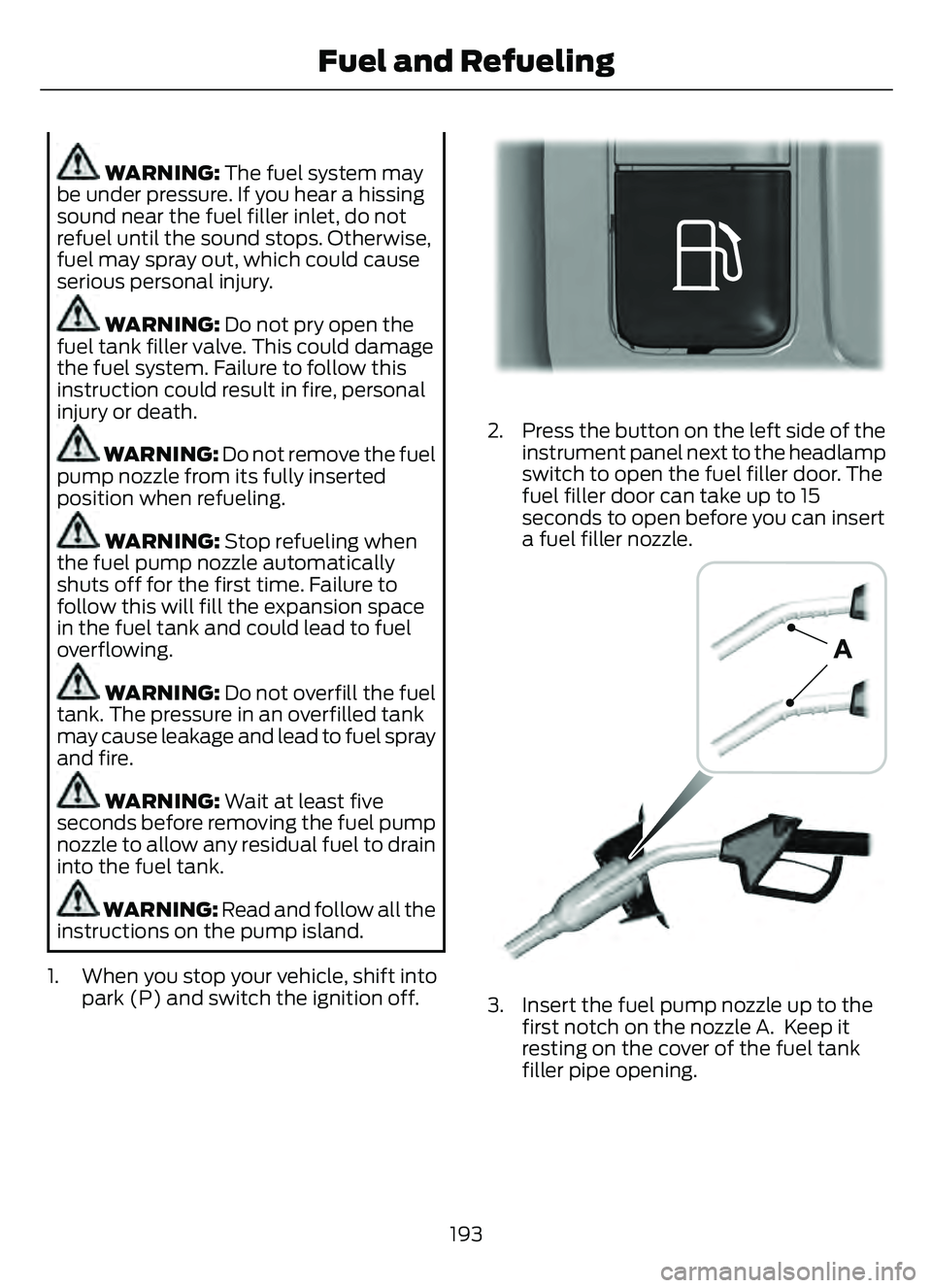
2. Press the button on the left side of theinstrument panel next to the headlamp
switch to open the fuel filler door. The
fuel filler door can take up to 15
seconds to open before you can insert
a fuel filler nozzle.
39 0E139202E139202
3. Insert the fuel pump nozzle up to thefirst notch on the nozzle A. Keep it
resting on the cover of the fuel tank
filler pipe opening.
193
Fuel and Refueling
Page 197 of 585
E139203
A
B
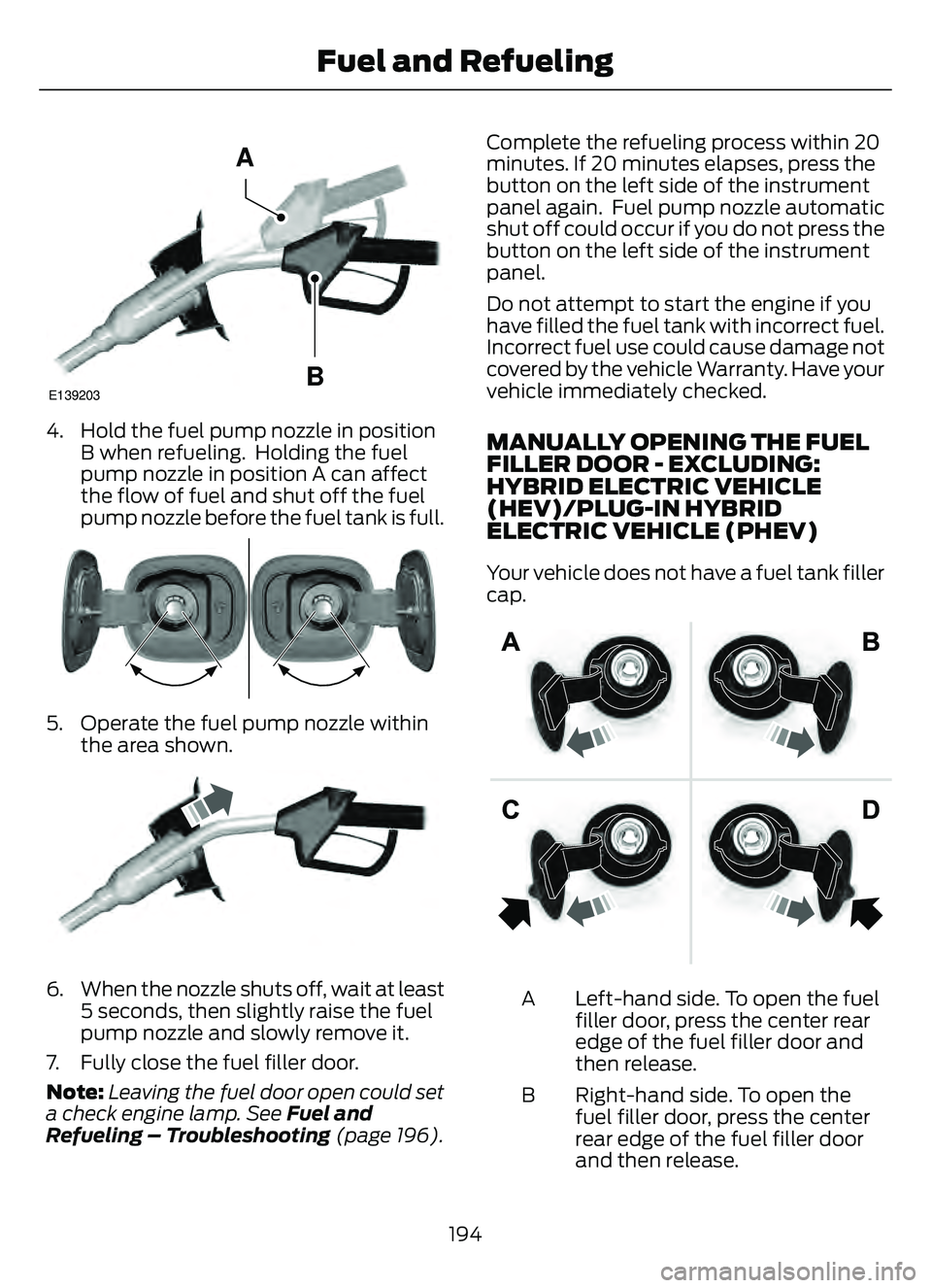
4. Hold the fuel pump nozzle in positionB when refueling. Holding the fuel
pump nozzle in position A can affect
the flow of fuel and shut off the fuel
pump nozzle before the fuel tank is full.
E337454E337454
5. Operate the fuel pump nozzle withinthe area shown.
E190819081
6. When the nozzle shuts off, wait at least5 seconds, then slightly raise the fuel
pump nozzle and slowly remove it.
7. Fully close the fuel filler door.
Note: Leaving the fuel door open could set
a check engine lamp. See Fuel and
Refueling – Troubleshooting (page 196). Complete the refueling process within 20
minutes. If 20 minutes elapses, press the
button on the left side of the instrument
panel again. Fuel pump nozzle automatic
shut off could occur if you do not press the
button on the left side of the instrument
panel.
Do not attempt to start the engine if you
have filled the fuel tank with incorrect fuel.
Incorrect fuel use could cause damage not
covered by
the vehicle Warranty. Have your
vehicle immediately checked.
MANUALLY OPENING THE FUEL
FILLER DOOR - EXCLUDING:
HYBRID ELECTRIC VEHICLE
(HEV)/PLUG-IN HYBRID
ELECTRIC VEHICLE (PHEV)
Your vehicle does not have a fuel tank filler
cap.
1
Left-hand side. To open the fuel
filler door, press the center rear
edge of the fuel filler door and
then release.
A
Right-hand side. To open the
fuel filler door, press the center
rear edge of the fuel filler door
and then release.
B
194
Fuel and Refueling
Page 198 of 585

Left-hand side. Pull the rear of
the fuel filler door to open it.
C
Right-hand side. Pull the rear of
the fuel filler door to open it.
D
MANUALLY OPENING THE FUEL
FILLER DOOR
WARNING: The fuel system may
be under pressure. If you hear a hissing
sound near the fuel filler inlet, do not
refuel until the sound stops. Otherwise,
fuel may spray out, which could cause
serious personal injury.
Note: The transmission must be in park (P)
or neutral (N).
When using the manual override lever do
the following:
1. Switch the ignition on.
E297793E297793
Note: The manual override lever is in the
driver side rear wheel well area.
2. Pull the manual override lever.
3. Switch the ignition off.
4. Complete the refueling process within 20 minutes.
Note: Only follow this procedure if the fuel
filler door fails to open. If the problem
remains, have your vehicle checked as soon
as possible.
FUEL TANK CAPACITY
Advertised Capacity
The advertised capacity is the maximum
amount of fuel that you can add to the fuel
tank when the fuel gauge indicates empty.
195
Fuel and Refueling
Page 199 of 585
In addition, the fuel tank contains an empty
reserve. The empty reserve is an
unspecified amount of fuel that remains
in the fuel tank when the fuel gauge
indicates empty.
Note:The amount of fuel in the empty
reserve varies and should not be relied upon
to increase driving range.FUEL AND REFUELING –
TROUBLESHOOTING
FUEL AND REFUELING –
WARNING LAMPS
If it illuminates when you are
driving, refuel as soon as
possible.
FUEL AND REFUELING – INFORMATION MESSAGES - EXCLUDING:
HYBRID ELECTRIC VEHICLE (HEV)/PLUG-IN HYBRID ELECTRIC VEHICLE
(PHEV)
Action
Message
An early reminder of a low fuel condition.
Fuel Level Low
The fuel fill inlet may not be properly closed.
Check Fuel Fill Inlet
A reminder to close the fuel door. Failure to follow this
instruction can cause the check engine light to illuminate.
Fuel door ajar Close fully
to avoid ""CheckEngine"" light
There is an error in attempting to refill your vehicle.
Refuel Error See Manual
196
Fuel and Refueling
Page 200 of 585
FUEL AND REFUELING – INFORMATION MESSAGES - HYBRID ELECTRIC
VEHICLE (HEV)/PLUG-IN HYBRID ELECTRIC VEHICLE (PHEV)
Action
Message
An early reminder of a low fuel condition.
Fuel Level Low
The fuel fill inlet may not be properly closed.
Check Fuel Fill Inlet
The information message appears while the fuel system is
depressurizing with the fuel filler door closed. Wait for the fuel
system to depressurize and for the fuel filler door to unlatch.
Please wait for fuel door
to open
The information message appears when the fuel system has
depressurized and opened the fuel filler door. Fully open the
fuel filler door to refuel and fully close the fuel filler door when
refueling is complete.
Fuel Door Open
Your vehicle is equipped with a sealed fuel system that
requires the fuel filler door to be fully closed after refueling.
This warning message appears when the fuel filler door is ajar.
Please fully close the fuel filler door to avoid a "Check Engine"
Light.
Fuel door ajar Close fully
to avoid ""CheckEngine"" light
If you see this message and a "Check Engine" lamp illumin-
ates, please fully close the fuel filler door. The "Check Engine"
Light should clear within five seconds. If the "Check Engine"
light persists, please see your dealer.
The information message appears when the fuel system fails
to depressurize, or the fuel filler door fails to open. You could
have to use the fuel filler door manual override lever when
opening the fuel door.
Refuel Error See Manual
197
Fuel and Refueling
Page 201 of 585
WHAT IS THE CATALYTIC
CONVERTER
The catalytic converter is part of your
vehicle's emissions system and filters
harmful pollutants from the exhaust gas.
CATALYTIC CONVERTER
PRECAUTIONS
WARNING: Do not park, idle or
drive your vehicle on dry grass or other
dry ground cover. The emission system
heats up the engine compartment and
exhaust system, creating the risk of fire.
WARNING: The normal operating
temperature of the exhaust system is
very high. Never work around or attempt
to repair any part of the exhaust system
until it has cooled. Use special care when
working around the catalytic converter.
The catalytic converter heats up to a very
high temperature after only a short
period of engine operation and stays hot
after the engine is switched off.
WARNING: Exhaust leaks may
result in entry of harmful and potentially
lethal fumes into the passenger
compartment. If you smell exhaust
fumes inside your vehicle, have your
vehicle inspected immediately. Do not
drive if you smell exhaust fumes.
To avoid damaging the catalytic converter:
• Do not crank the engine for more than 10 seconds at a time.
• Do not run the engine with a spark plug lead disconnected.
• Do not push-start or tow-start your vehicle. Use booster cables. See Jump
Starting the Vehicle (page 311). • Use the correct fuel. See Fuel and
Refueling (page 187).
• Do not switch the ignition off when your vehicle is moving.
• Avoid running out of fuel.
• Have the items listed in scheduled maintenance information performed
according to the specified schedule.
Note: Do not make any unauthorized
changes to your vehicle or engine. By law,
vehicle owners and anyone who
manufactures, repairs, or services a fleet of
vehicles are not permitted to intentionally
remove an emission control device or
prevent it from working.
CATALYTIC CONVERTER –
TROUBLESHOOTING
CATALYTIC CONVERTER –
WARNING LAMPS
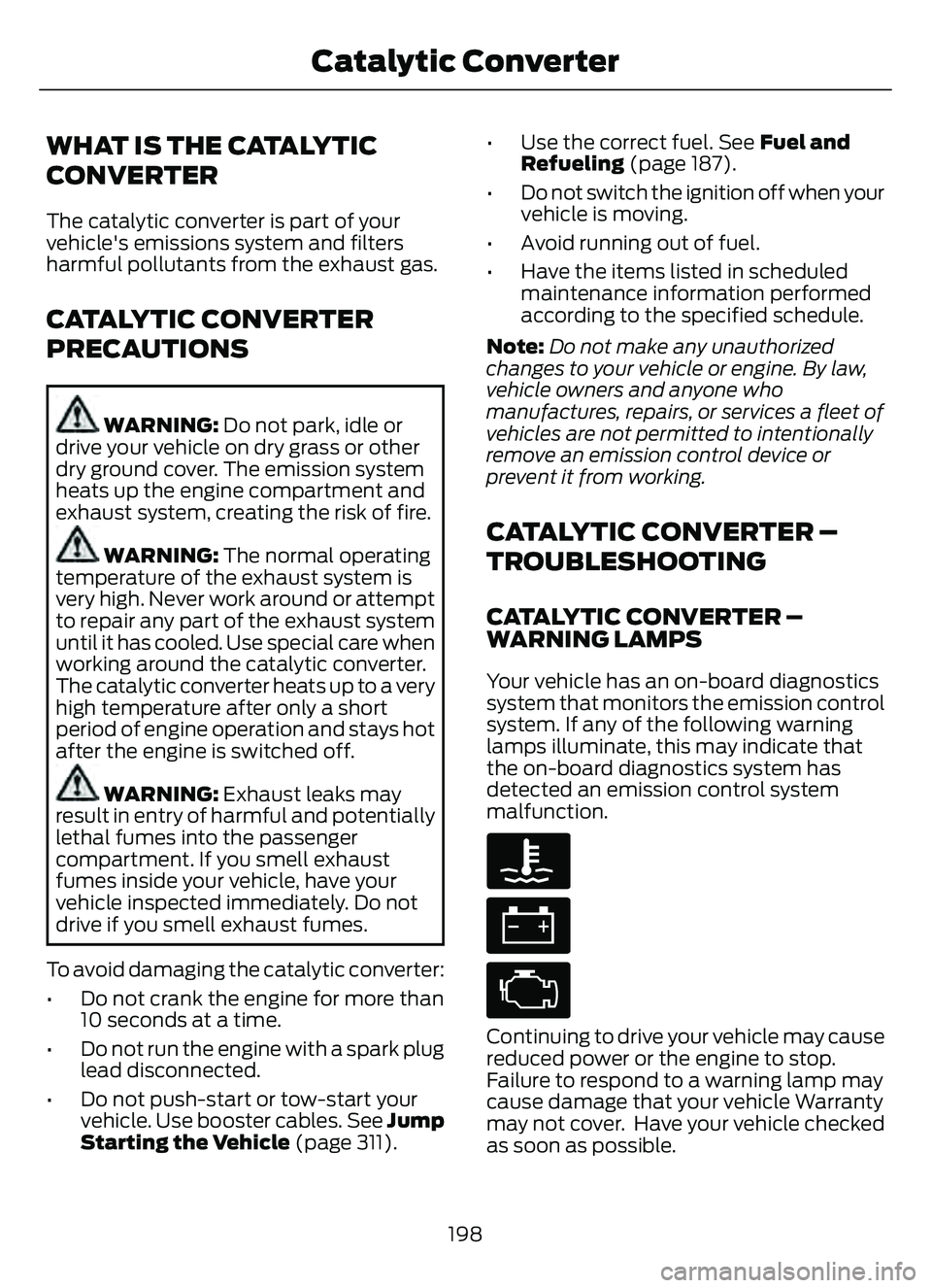
Your vehicle has an on-board diagnostics
system that monitors the emission control
system. If any of the following warning
lamps illuminate, this may indicate that
the on-board diagnostics system has
detected an emission control system
malfunction.
Continuing to drive your vehicle may cause
reduced power or the engine to stop.
Failure to respond to a warning lamp may
cause damage that your vehicle Warranty
may not cover. Have y our vehicle checked
as soon as possible.
198
Catalytic Converter
Page 213 of 585
This position allows your vehicle to move
backward. Come to a complete stop
before shifting into and out of reverse (R).
NEUTRAL (N)
WARNING: In neutral (N) your
vehicle is free to roll.
In neutral (N) power is not transmitted to
the driven wheels.
DRIVE (D)
This position, drive (D), is the normal
driving position, and allows your vehicle to
move forward.
LOW (L)
This mode is for driving on steep slopes.
The transmission will hold low gear for
maximum torque driving uphill and
maximum engine braking driving downhill.
You can enter this mode at any vehicle
speed.
Note: Prolonged use of this mode could
lower fuel economy. With your vehicle in
drive (D), press the L button to enter this
mode.
SHIFTING YOUR VEHICLE INTO
GEAR
E224178
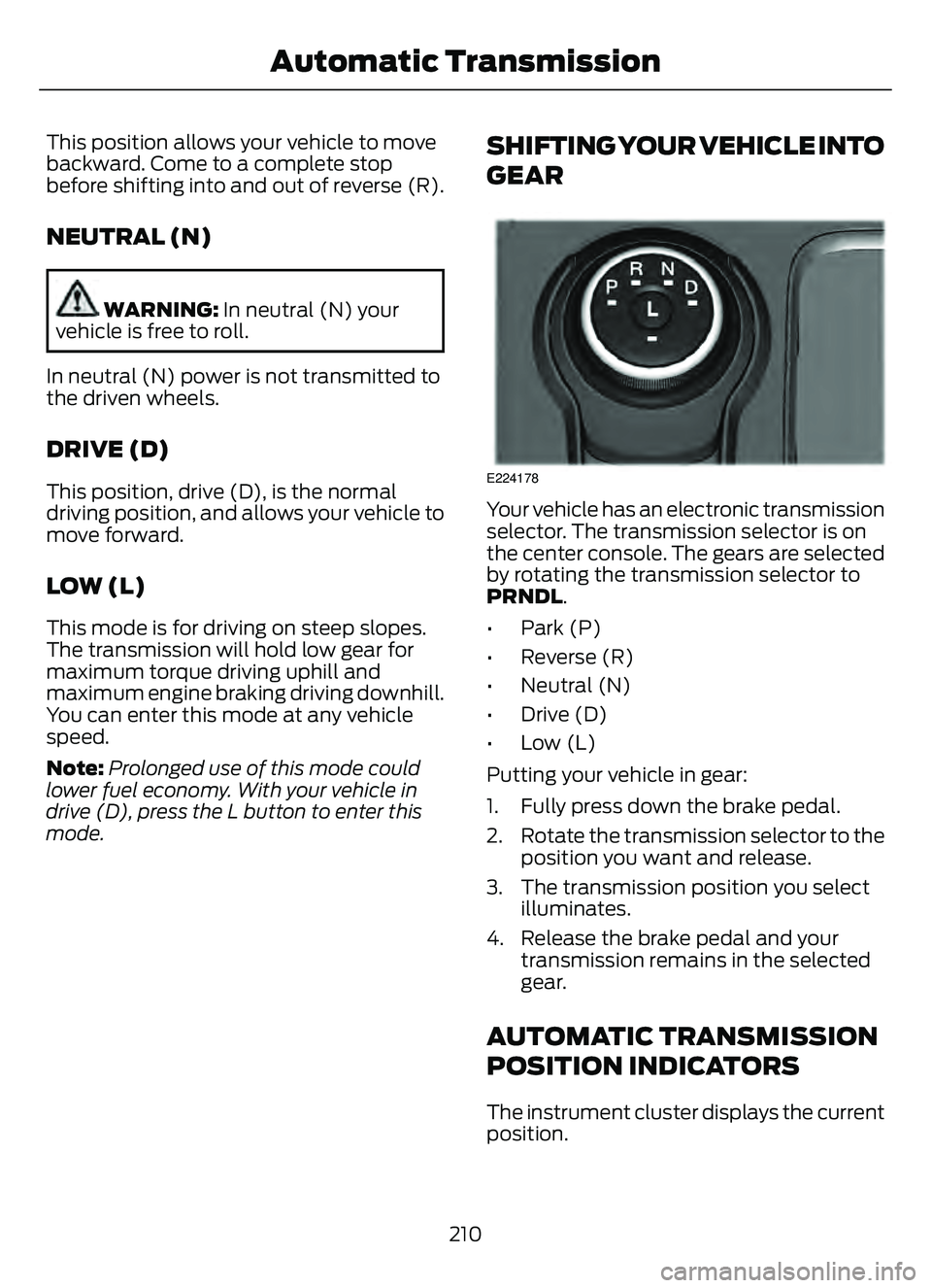
Your vehicle has an electronic transmission
selector. The transmission selector is on
the center console. The gears are selected
by rotating the transmission selector to
PRNDL.
• Park (P)
• Reverse (R)
• Neutral (N)
• Drive (D)
• Low (L)
Putting your vehicle in gear:
1. Fully press down the brake pedal.
2. Rotate the transmission selector to the position you want and release.
3. The transmission position you select illuminates.
4. Release the brake pedal and your transmission remains in the selected
gear.
AUTOMATIC TRANSMISSION
POSITION INDICATORS
The instrument cluster displays the current
position.
210
Automatic Transmission
Page 261 of 585
Note:Drive mode changes may not be
available when the ignition is off.
Note: Button icon shown may vary from
your vehicle.
Note: Selected drive mode displays in the
information cluster display.
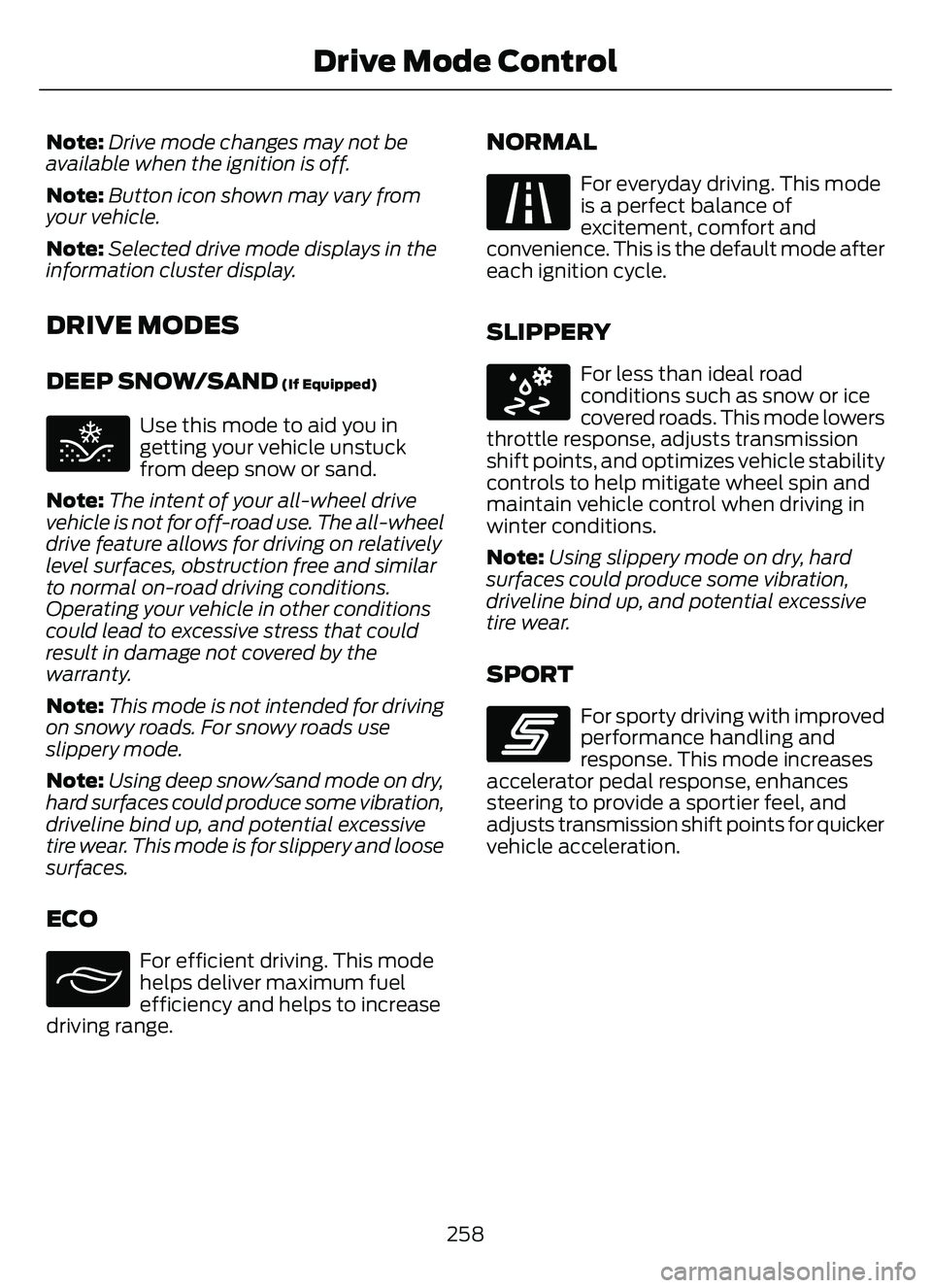
DRIVE MODES
DEEP SNOW/SAND (If Equipped)
E295420
Use this mode to aid you in
getting your vehicle unstuck
from deep snow or sand.
Note: The intent of your all-wheel drive
vehicle is not for off-road use. The all-wheel
drive feature allows for driving on relatively
level surfaces, obstruction free and similar
to normal on-road driving conditions.
Operating your vehicle in other conditions
could lead to excessive stress that could
result in damage not covered by the
warranty.
Note: This mode is not intended for driving
on snowy roads. For snowy roads use
slippery mode.
Note: Using deep snow/sand mode on dry,
hard surfaces could produce some vibration,
driveline bind up, and potential excessive
tire wear. This mode is for slippery and loose
surfaces.
ECO
E295413
For efficient driving. This mode
helps deliver maximum fuel
efficiency and helps to increase
driving range.
NORMAL
E225310
For everyday driving. This mode
is a perfect balance of
excitement, comfort and
convenience. This is the default mode after
each ignition cycle.
SLIPPERY
E295414
For less than ideal road
conditions such as snow or ice
covered roads. T his mode lowers
throttle response, adjusts transmission
shift points, and optimizes vehicle stability
controls to help mitigate wheel spin and
maintain vehicle control when driving in
winter conditions.
Note: Using slippery mode on dry, hard
surfaces could produce some vibration,
driveline bind up, and potential excessive
tire wear.
SPORT
E246593
For sporty driving with improved
performance handling and
response. This mode increases
accelerator pedal response, enhances
steering to provide a sportier feel, and
adjusts transmission shift points for quicker
vehicle acceleration.
258
Drive Mode Control
Page 295 of 585
The above calculations also
assume that the loads are
positioned in your vehicle in a
manner that does not overload
the front or the rear gross axle
weight rating specified for your
vehicle on the Safety Compliance
Certification label.
ROOF RACK
(IF EQUIPPED)
ROOF RACK PRECAUTIONS
WARNING: Read and follow the
manufacturer's instructions when you
are fitting a roof rack.
WARNING: When loading the roof
racks, we recommend you evenly
distribute the load, as well as maintain
a low center of gravity. Loaded vehicles,
with higher centers of gravity, may
handle differently than unloaded
vehicles. Take extra precautions, such
as slower speeds and increased stopping
distance, when driving a heavily loaded
vehicle.
Note: If you use a roof rack, the fuel
consumption of your vehicle will be higher
and you may experience different driving
characteristics.
Note: Never place loads directly on the roof
panel. The roof panel is not designed to
directly carry a load.
You must place loads directly on the
crossbars fitted to the roof rack side rails.
When using the roof rack system, we
recommend that you use genuine Ford
accessory crossbars specifically designed
for your vehicle. Make sure that you securely fasten the
load. Check the tightness of the load
before driving and at each fuel stop.
REMOVING AND INSTALLING
ROOF RACK CROSSBARS
Note:
For less wind noise and better
aerodynamics, only install the crossbars
when you need them for carrying cargo.
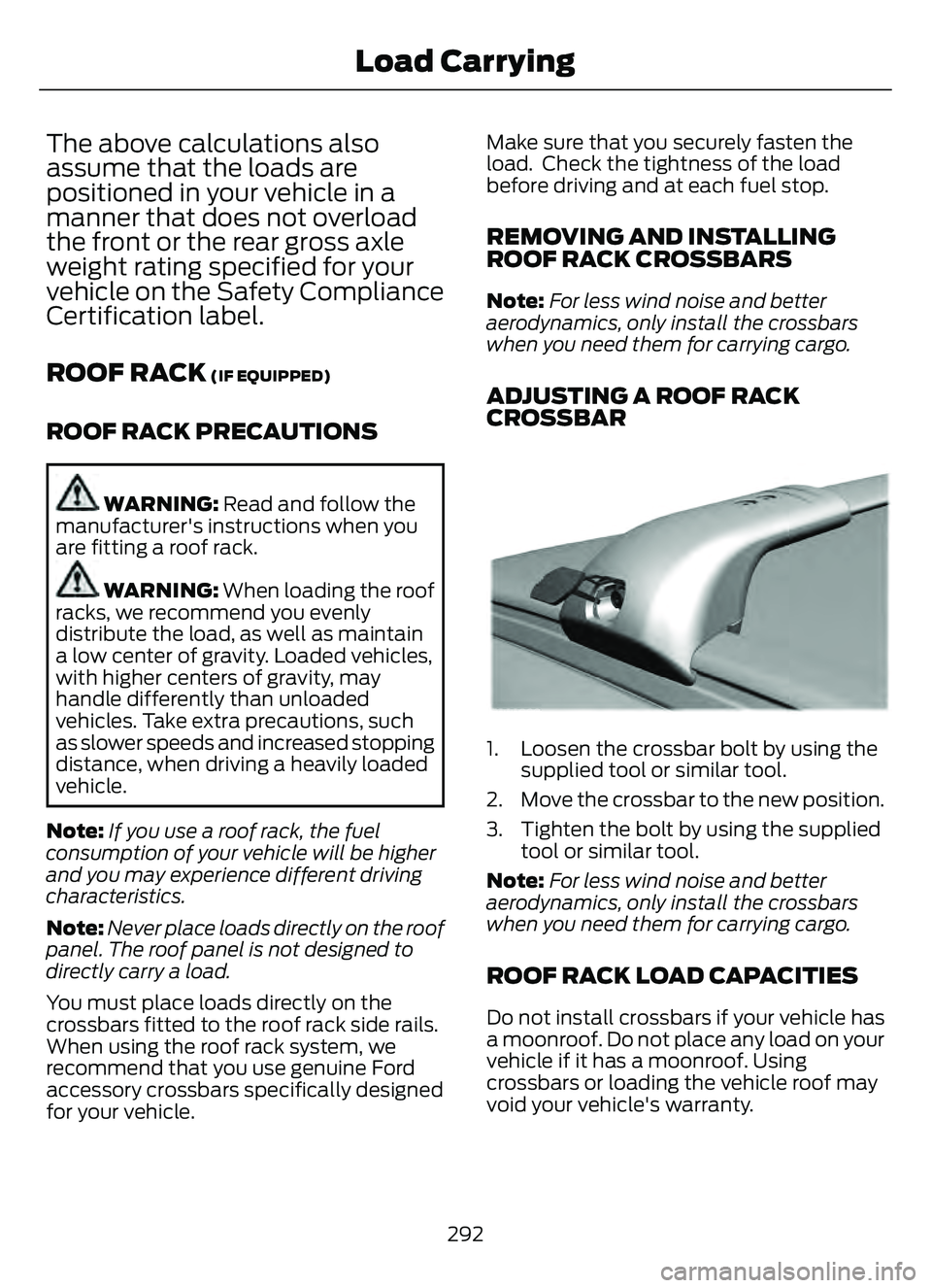
ADJUSTING A ROOF RACK
CROSSBAR
993 9E299329E299E299E2E299E299E29E299E2999999EEE329329299322993299329
1. Loosen the crossbar bolt by using the supplied tool or similar tool.
2. Move the crossbar to the new position.
3. Tighten the bolt by using the supplied tool or similar tool.
Note: For less wind noise and better
aerodynamics, only install the crossbars
when you need them for carrying cargo.
ROOF RACK LOAD CAPACITIES
Do not install crossbars if your vehicle has
a moonroof. Do not place any load on your
vehicle if it has a moonroof. Using
crossbars or loading the vehicle roof may
void your vehicle's warranty.
292
Load Carrying
Page 303 of 585
When towing a trailer:
• Obey country specific regulations fortowing a trailer.
• Do not drive faster than 70 mph (113 km/h) during the first 500 mi
(800 km).
• Do not make full-throttle starts.
• Check your hitch, electrical connections and trailer wheel lug nuts thoroughly
after you have traveled 50 mi (80 km).
• When stopped in congested or heavy traffic during hot weather, place the
transmission in park (P) to aid engine
and transmission cooling and to help
A/C performance.
• Turn off the speed control with heavy loads or in hilly terrain. The speed
control may turn off when you are
towing on long, steep slopes.
• Shift to a lower gear when driving down a long or steep hill. Do not continuously
apply the brakes, as they may overheat
and become less effective.
• If your transmission has Grade Assist or Tow/Haul, use this feature when
towing. This provides engine braking
and helps eliminate excessive
transmission shifting for optimum fuel
economy and transmission cooling.
• Your vehicle has AdvanceTrac with roll stability control. When towing a trailer,
additional loads could cause the
AdvanceTrac system to engage during
cornering maneuvers. Reduce cornering
speeds to make sure that you can
maintain control of the vehicle and
trailer if the AdvanceTrac system
engages. • Allow more distance for stopping with
a trailer attached. Anticipate stops and
gradually brake.
• Avoid parking on a slope. However, if you must park on a slope, turn the
steering wheel to point your vehicle
tires away from traffic flow, set the
parking brake, place the transmission
in park (P) and place wheel chocks in
front and back of the trailer wheels.
Note: Chocks are not included with your
vehicle.
LAUNCHING OR RETRIEVING
A BOAT OR PERSONAL
WATERCRAFT
When backing down a ramp during boat
launching or retrieval:
• Do not allow the static water level to rise above the bottom edge of the rear
bumper.
• Do not allow waves to break higher than 6 in (15 cm) above the bottom
edge of the rear bumper.
Exceeding 6 in (15 cm) could allow water
to enter vehicle components, causing
internal damage to the components and
affecting driveability, emissions and
reliability.
Note: Replace the rear axle lubricant
anytime the rear axle has been submerged
in water.
Note: Disconnect the trailer wiring
connector before backing the trailer into the
water.
Note: Reconnect the trailer wiring
connector after removing the trailer from
the water.
300
Towing a Trailer