tire pressure FORD ESCAPE 2022 Owners Manual
[x] Cancel search | Manufacturer: FORD, Model Year: 2022, Model line: ESCAPE, Model: FORD ESCAPE 2022Pages: 585, PDF Size: 6.15 MB
Page 14 of 585
Towing Your Vehicle
Towing Your Vehicle Precautions ..........316
Recreationally Towing Your Vehicle -Gasoline, AWD ..........................................316
Recreationally Towing Your Vehicle - Gasoline, FWD ..........................................316
Recreationally Towing Your Vehicle - Hybrid Electric Vehicle (HEV)/Plug-In
Hybrid Electric Vehicle (PHEV) ..........316
Emergency Towing - Hybrid Electric Vehicle (HEV)/Plug-In Hybrid Electric
Vehicle (PHEV) .........................................317
Emergency Towing - 8-Speed Automatic Transmission – 8F24 ..............................317
Emergency Towing - 8-Speed Automatic Transmission – 8F35 .............................318
Towing Your Vehicle – Troubleshooting ........................................................................\
.318
Fuses
Fuse Precautions .........................................319
Under Hood Fuse Box ................................319
Body Control Module Fuse Box .............325
Identifying Fuse Types ..............................327
Fuses – Troubleshooting ..........................327
Maintenance
Maintenance Precautions .......................328
Opening and Closing the Hood .............328
Under Hood Overview - 1.5L EcoBoost™........................................................................\
330
Under Hood Overview - 2.0L EcoBoost™ ........................................................................\
.3 3 1
Under Hood Overview - Hybrid Electric Vehicle (HEV) ...........................................332
Engine Oil .......................................................333
Checking the Coolant ...............................334
Changing the Engine Air Filter - 1.5L EcoBoost™/2.0L EcoBoost™ ..........338
Changing the Engine Air Filter - 2.5L, Hybrid Electric Vehicle (HEV)/Plug-In
Hybrid Electric Vehicle (PHEV) .........339 Changing the Fuel Filter - Gasoline,
Hybrid Electric Vehicle (HEV) ...........340
Drive Belt Routing Overview - 1.5L EcoBoost™ ..............................................340
Drive Belt Routing Overview - 2.0L EcoBoost™ ................................................341
12V Battery .....................................................341
Changing the 12V Battery ........................343
Adjusting the Headlamps .......................344
Exterior Bulbs ...............................................345
Interior Bulbs ................................................348
Vehicle Care
Cleaning Products ......................................349
Cleaning the Exterior .................................349
Cleaning the Interior ...................................351
Repairing Minor Paint Damage ..............353
Waxing Your Vehicle ..................................353
Body Styling Kits
Body Styling Kit Precautions ..................354
Storing Your Vehicle
Preparing Your Vehicle for Storage ......355
Removing Your Vehicle From Storage ........................................................................\
356
Wheel and Tire Information
Locating the Tire label ..............................357
Department of Transportation UniformTire Quality Grades ................................357
Information on the Tire Sidewall ..........358
Glossary of Tire Terminology .................363
Tire Replacement Requirements .........364
Using Snow Chains ....................................366
Tire Care
Checking the Tire Pressures ...................368
Inflating the Tires .......................................368
Inspecting the Tire for Wear ...................369
11
Table of Contents
Page 15 of 585
Inspecting the Tire for Damage ............369
Inspecting the Wheel Valve Stems ......370
Tire Rotation .................................................370
Tire Sealant and Inflator Kit
What Is the Tire Sealant and Inflator Kit........................................................................\
.372
Tire Sealant and Inflator Kit Precautions ........................................................................\
.372
Locating the Tire Sealant and Inflator Kit ........................................................................\
.372
Tire Sealant and Inflator Kit Components ........................................................................\
.372
Using the Tire Sealant and Inflator Kit ........................................................................\
3 7 3
Tire Pressure MonitoringSystem
What Is the Tire Pressure MonitoringSystem ........................................................378
Tire Pressure Monitoring System Overview ....................................................378
Tire Pressure Monitoring System Precautions ...............................................379
Tire Pressure Monitoring System Limitations ................................................379
Viewing the Tire Pressures .....................380
Tire Pressure Monitoring System – Troubleshooting .....................................380
Changing a Road Wheel
Changing a Flat Tire ...................................382
Wheel Nuts ...................................................386
Capacities and Specifications
Engine Specifications - 1.5L EcoBoost™........................................................................\
387
Engine Specifications - 2.0L EcoBoost™ .......................................................................3\
8 8
Engine Specifications - 2.5L, Hybrid Electric Vehicle (HEV)/Plug-In Hybrid
Electric Vehicle (PHEV) .......................389 Motorcraft Parts - 1.5L EcoBoost™ .....390
Motorcraft Parts - 2.0L EcoBoost™ ....390
Motorcraft Parts - 2.5L, Hybrid Electric
Vehicle (HEV)/Plug-In Hybrid Electric
Vehicle (PHEV) ........................................391
Engine Oil Capacity and Specification - 1.5L EcoBoost™ ......................................392
Engine Oil Capacity and Specification - 2.0L EcoBoost™ .....................................393
Engine Oil Capacity and Specification - 2.5L, Hybrid Electric Vehicle (HEV)/
Plug-In Hybrid Electric Vehicle (PHEV)
........................................................................\
395
Cooling System Capacity and Specification - 1.5L EcoBoost™ .......396
Cooling System Capacity and Specification - 2.0L EcoBoost™ .......397
Cooling System Capacity and Specification - 2.5L, Hybrid Electric
Vehicle (HEV)/Plug-In Hybrid Electric
Vehicle (PHEV) ........................................397
Fuel Tank Capacity - Excluding: Hybrid Electric Vehicle (HEV)/Plug-In Hybrid
Electric Vehicle (PHEV) .......................398
Fuel Tank Capacity - Hybrid Electric Vehicle (HEV)/Plug-In Hybrid Electric
Vehicle (PHEV) .......................................399
Air Conditioning System Capacity and Specification - 1.5L EcoBoost™ .......400
Air Conditioning System Capacity and Specification - 2.0L EcoBoost™ .......401
Air Conditioning System Capacity and Specification - 2.5L, Hybrid Electric
Vehicle (HEV)/Plug-In Hybrid Electric
Vehicle (PHEV) .......................................402
Washer Fluid Specification .....................402
Brake Fluid Specification ........................403Vehicle Identification
Vehicle Identification Number ..............404
Connected Vehicle
Connected Vehicle Requirements .......405
Connected Vehicle Limitations .............405
12
Table of Contents
Page 23 of 585
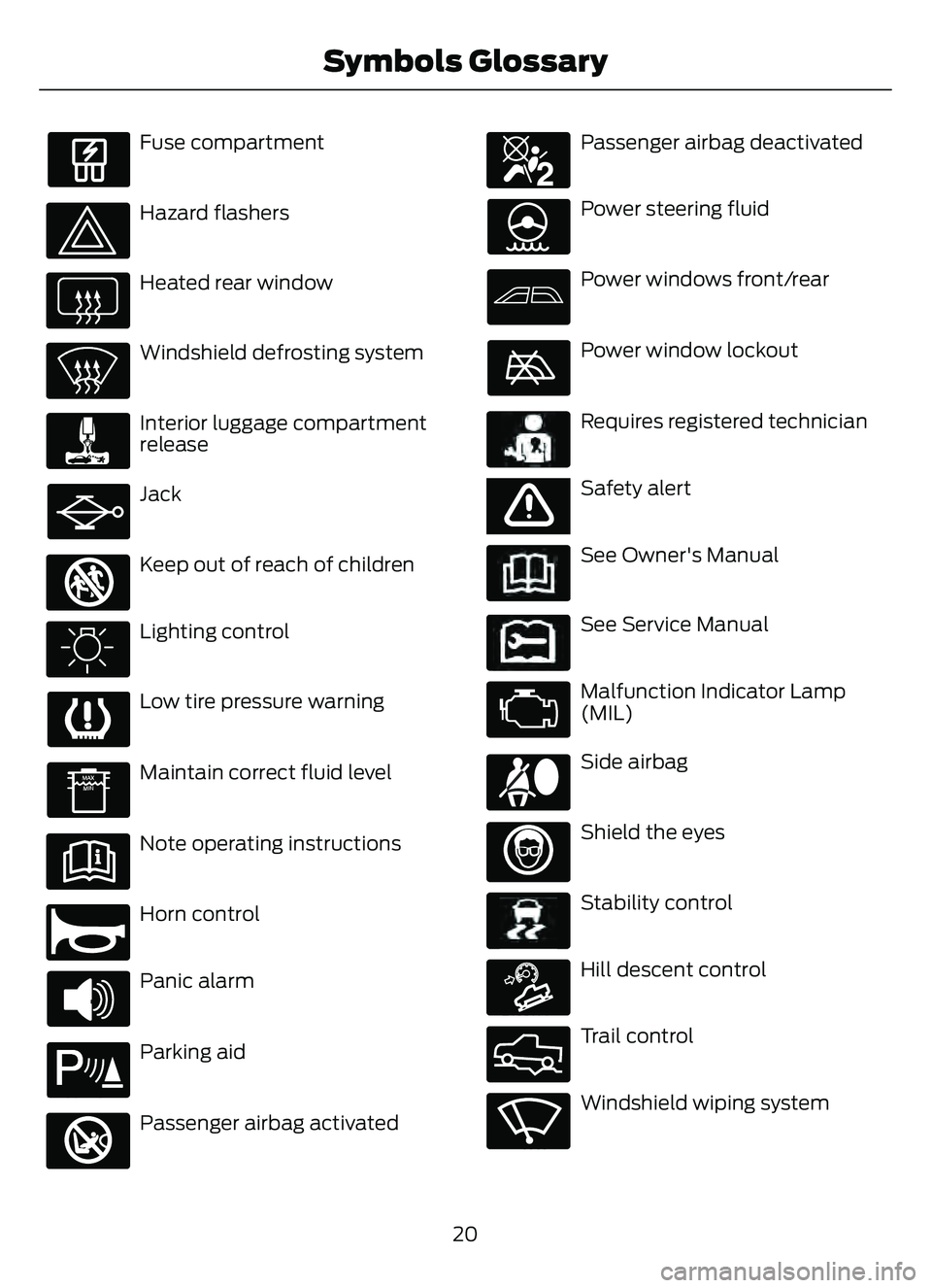
Fuse compartment
Hazard flashers
Heated rear window
Windshield defrosting system
Interior luggage compartment
release
Jack
E161353
Keep out of reach of children
Lighting control
Low tire pressure warning
Maintain correct fluid level
Note operating instructions
E270945
Horn control
Panic alarm
E139213
Parking aid
E270849
Passenger airbag activated
E270850
Passenger airbag deactivated
Power steering fluid
Power windows front/rear
Power window lockout
E231159
Requires registered technician
E65963E65963Safety alert
See Owner's Manual
E231158
See Service Manual
Malfunction Indicator Lamp
(MIL)
Side airbag
Shield the eyes
E138639
Stability control
E163171
Hill descent control
E332910
Trail control
E270969
Windshield wiping system
20
Symbols Glossary
Page 25 of 585
WARNING: Do not connect
wireless plug-in devices to the data link
connector. Unauthorized third parties
could gain access to vehicle data and
impair the performance of safety related
systems. Only allow repair facilities that
follow our service and repair instructions
to connect their equipment to the data
link connector.
We respect your privacy and are
committed to protecting it. The
information contained in this publication
was correct at the time of release, but as
technology rapidly changes, we
recommend that you visit the local Ford
website for the latest information.
Your vehicle has electronic control units
that have data recording functionality and
the ability to permanently or temporarily
store data. This data could include
information on the condition and status of
your vehicle, vehicle maintenance
requirements, events and malfunctions.
The types of data that can be recorded are
described in this section. Some of the data
recorded is stored in event logs or error
logs.
Note: Error logs are reset following a service
or repair.
Note: We may provide information in
response to requests from law enforcement,
other government authorities and third
parties acting with lawful authority or
through a legal process. Such information
could be used by them in legal proceedings.
Data recorded includes, for example:
• Operating states of system components, for example fuel level,
tire pressure and battery charge level.
• Vehicle and component status, for example wheel speed, deceleration,
lateral acceleration and seatbelt
status. • Events or errors in essential systems,
for example headlamps and brakes.
• System responses to driving situations, for example airbag deployment and
stability control.
• Environmental conditions, for example temperature.
Some of this data, when used in
combination with other information, for
example an accident report, damage to a
vehicle or eyewitness statements, could
be associated with a specific person.
Services That We Provide
If you use our services, we collect and use
data, for example account information,
vehicle location and driving characteristics,
that could identify you. We transmit this
data through a dedicated, protected
connection. We only collect and use data
to enable your use of our services to which
you have subscribed, with your consent or
where permitted by law. For additional
information, see the terms and conditions
of the services to which you have
subscribed.
For additional information about our
privacy policy, refer to the local Ford
website.
Services That Third Parties
Provide
We recommend that you review the terms
and conditions and data privacy
information for any services equipped with
your vehicle or to which you subscribe. We
take no responsibility for services that third
parties provide.
22
Data Privacy
Page 124 of 585
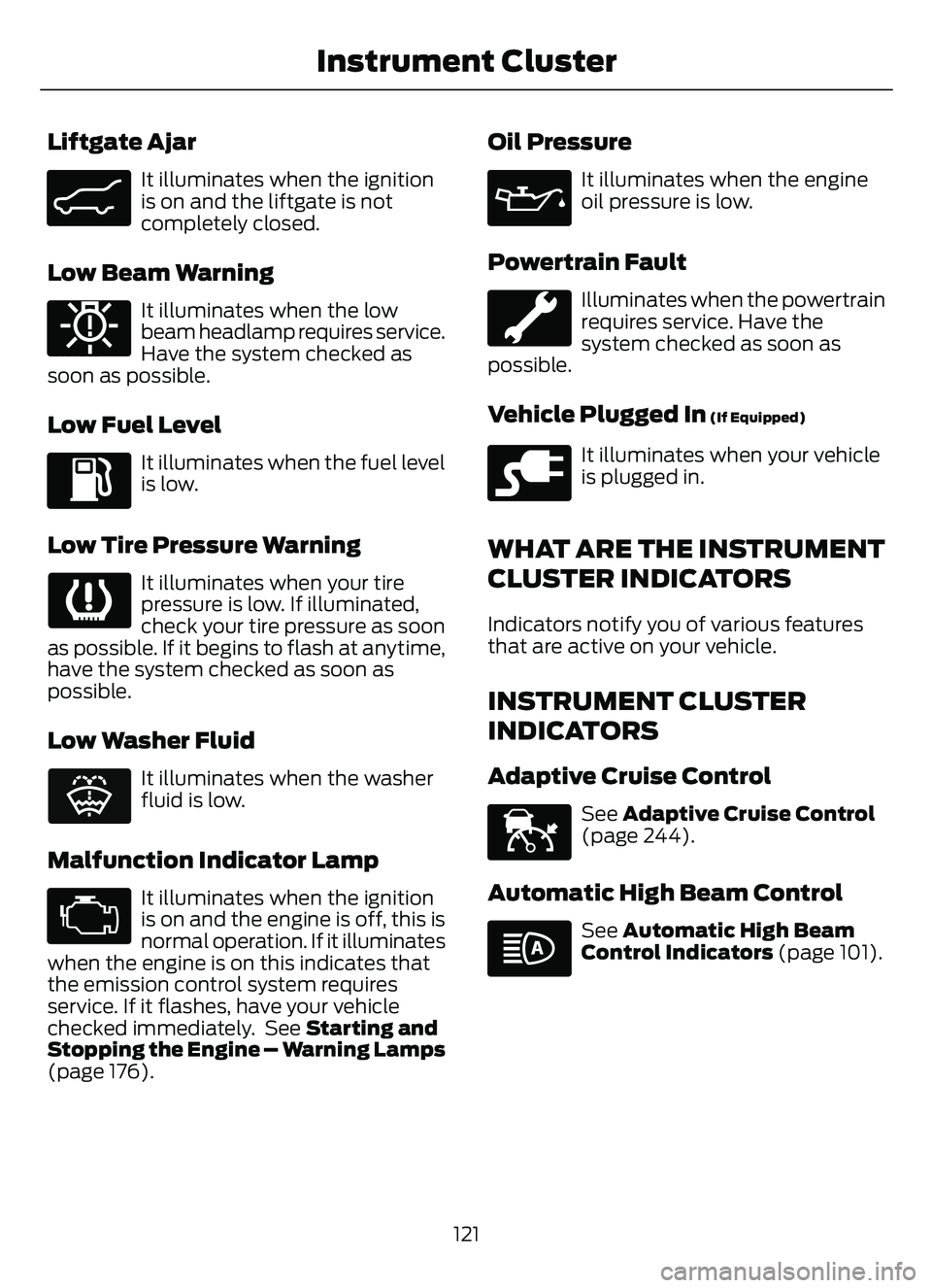
Liftgate Ajar
E162453
It illuminates when the ignition
is on and the liftgate is not
completely closed.
Low Beam Warning
E181350
It illuminates when the low
beam headlamp requires service.
Have the system checked as
soon as possible.
Low Fuel Level
It illuminates when the fuel level
is low.
Low Tire Pressure Warning
It illuminates when your tire
pressure is low. If illuminated,
check your tire pressure as soon
as possible. If it begins to flash at anytime,
have the system checked as soon as
possible.
Low Washer Fluid
E132353
It illuminates when the washer
fluid is low.
Malfunction Indicator Lamp
It illuminates when the ignition
is on and the engine is off, this is
normal operation. If it illuminates
when the engine is on this indicates that
the emission control system requires
service. If it flashes, have your vehicle
checked immediately. See Starting and
Stopping the Engine – Warning Lamps
(page 176).
Oil Pressure
It illuminates when the engine
oil pressure is low.
Powertrain Fault
Illuminates when the powertrain
requires service. Have the
system checked as soon as
possible.
Vehicle Plugged In (If Equipped)
E228962
It illuminates when your vehicle
is plugged in.
WHAT ARE THE INSTRUMENT
CLUSTER INDICATORS
Indicators notify you of various features
that are active on your vehicle.
INSTRUMENT CLUSTER
INDICATORS
Adaptive Cruise Control
E144524
See Adaptive Cruise Control
(page 244).
Automatic High Beam Control
See Automatic High Beam
Control Indicators (page 101).
121
Instrument Cluster
Page 128 of 585
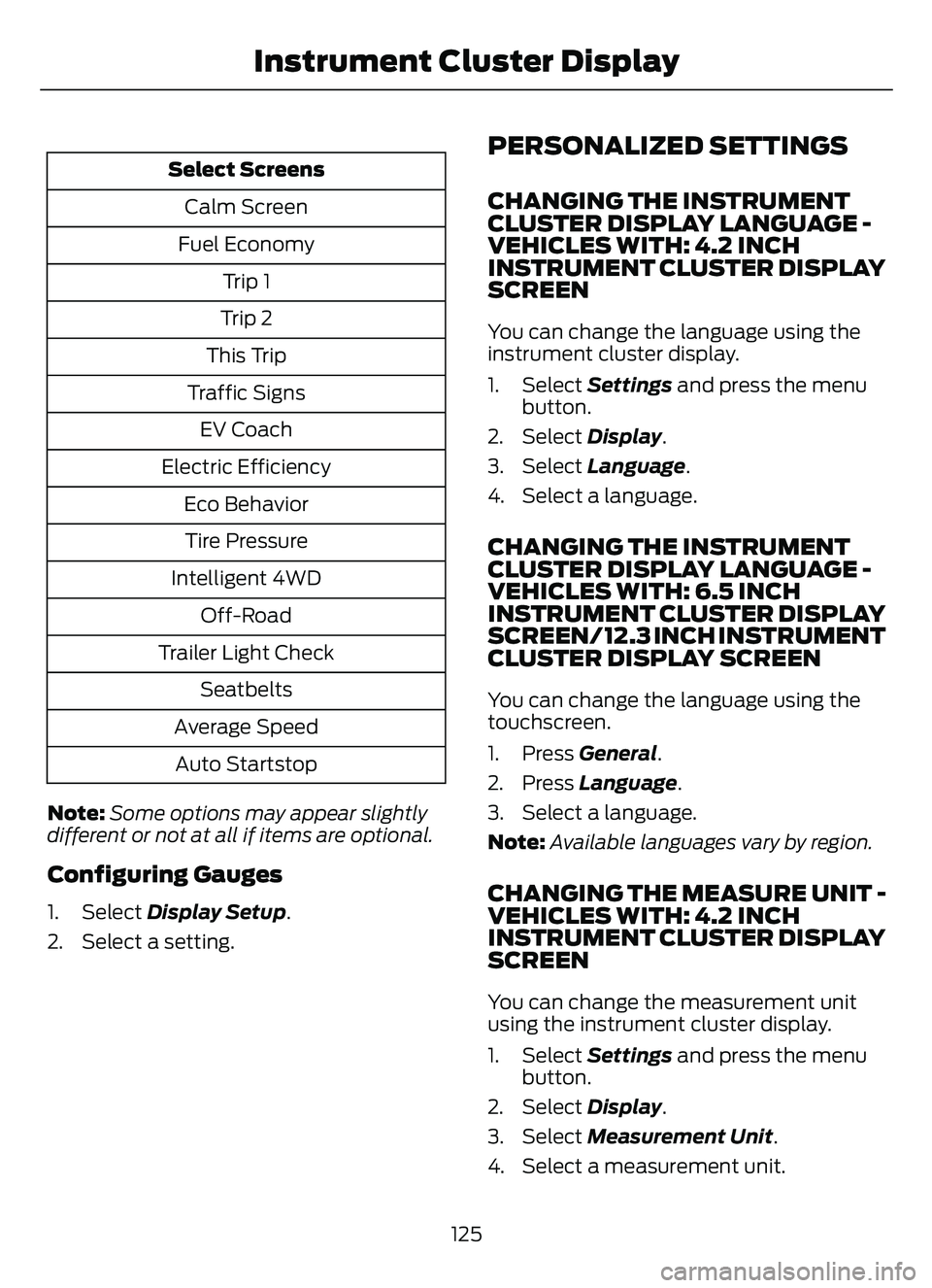
Select ScreensCalm Screen
Fuel Economy Trip 1
Trip 2
This Trip
Traffic Signs EV Coach
Electric Efficiency Eco BehaviorTire Pressure
Intelligent 4WD Off-Road
Trailer Light Check Seatbelts
Average Speed Auto Startstop
Note: Some options may appear slightly
different or not at all if items are optional.
Configuring Gauges
1. Select Display Setup .
2. Select a setting.
PERSONALIZED SETTINGS
CHANGING THE INSTRUMENT
CLUSTER DISPLAY LANGUAGE -
VEHICLES WITH: 4.2 INCH
INSTRUMENT CLUSTER DISPLAY
SCREEN
You can change the language using the
instrument cluster display.
1. Select Settings and press the menu
button.
2. Select Display.
3. Select Language.
4. Select a language.
CHANGING THE INSTRUMENT
CLUSTER DISPLAY LANGUAGE -
VEHICLES WITH: 6.5 INCH
INSTRUMENT CLUSTER DISPLAY
SCREEN/ 12.3 INCH INSTRUMENT
CLUSTER DISPLAY SCREEN
You can change the language using the
touchscreen.
1. Press General.
2. Press Language .
3. Select a language.
Note: Available languages vary by region.
CHANGING THE MEASURE UNIT -
VEHICLES WITH: 4.2 INCH
INSTRUMENT CLUSTER DISPLAY
SCREEN
You can change the measurement unit
using the instrument cluster display.
1. Select Settings and press the menu
button.
2. Select Display.
3. Select Measurement Unit .
4. Select a measurement unit.
125
Instrument Cluster Display
Page 129 of 585
CHANGING THE MEASURE UNIT -
VEHICLES WITH: 6.5 INCH
INSTRUMENT CLUSTER DISPLAY
SCREEN/ 12.3 INCH INSTRUMENT
CLUSTER DISPLAY SCREEN
You can change the measurement unit
using the touchscreen.
1. Press General.
2. Press Measurement Units.
3. Select a measurement unit.
CHANGING THE TEMPERATURE
UNIT - VEHICLES WITH: 4.2 INCH
INSTRUMENT CLUSTER DISPLAY
SCREEN
You can change the temperature unit using
the instrument cluster display.
1. Select Settings and press the menu
button.
2. Select Display.
3. Select Temperature Unit.
4. Select a temperature unit.
CHANGING THE TEMPERATURE
UNIT - VEHICLES WITH: 6.5 INCH
INSTRUMENT CLUSTER DISPLAY
SCREEN/ 12.3 INCH INSTRUMENT
CLUSTER DISPLAY SCREEN
You can change the temperature unit using
the touchscreen.
1. Press General.
2. Press Temperature Units .
3. Select a temperature unit.
CHANGING THE TIRE PRESSURE
UNIT - VEHICLES WITH: 4.2 INCH
INSTRUMENT CLUSTER DISPLAY
SCREEN
You can change the tire pressure unit using
the instrument cluster display.
1. Select Settings and press the menu
button.
2. Select Display.
3. Select Tire Pressure.
4. Select a tire pressure unit.
CHANGING THE TIRE PRESSURE
UNIT - VEHICLES WITH: 6.5 INCH
INSTRUMENT CLUSTER DISPLAY
SCREEN/ 12.3 INCH INSTRUMENT
CLUSTER DISPLAY SCREEN
You can change the tire pressure unit using
the touchscreen.
1. Press General.
2. Press Tire Pressure Units .
3. Select a pressure unit.
FUEL ECONOMY DISPLAY
An instant fuel economy gauge is provided
along with average fuel economy. Average
fuel economy is continuously averaged
since the last reset.
When the gasoline engine is off the instant
fuel economy gauges is replaced with an
electric driving message.
Note: Press and hold the OK button on the
controls on the steering wheel to reset your
average fuel economy.
126
Instrument Cluster Display
Page 265 of 585
• You apply direct steering, acceleratefast or brake hard.
• The vehicle speed is less than 40 mph (64 km/h).
• The anti-lock brake, stability control or traction control system activates.
• The lane is too narrow.
• Something is obscuring the camera or it is unable to detect the lane markings
due to environment, traffic or vehicle
conditions.
The lane keeping system may not correct
lane positioning in any of the following
conditions:
• High winds.
• Uneven road surfaces.
• Heavy or uneven loads.
• Incorrect tire pressure.
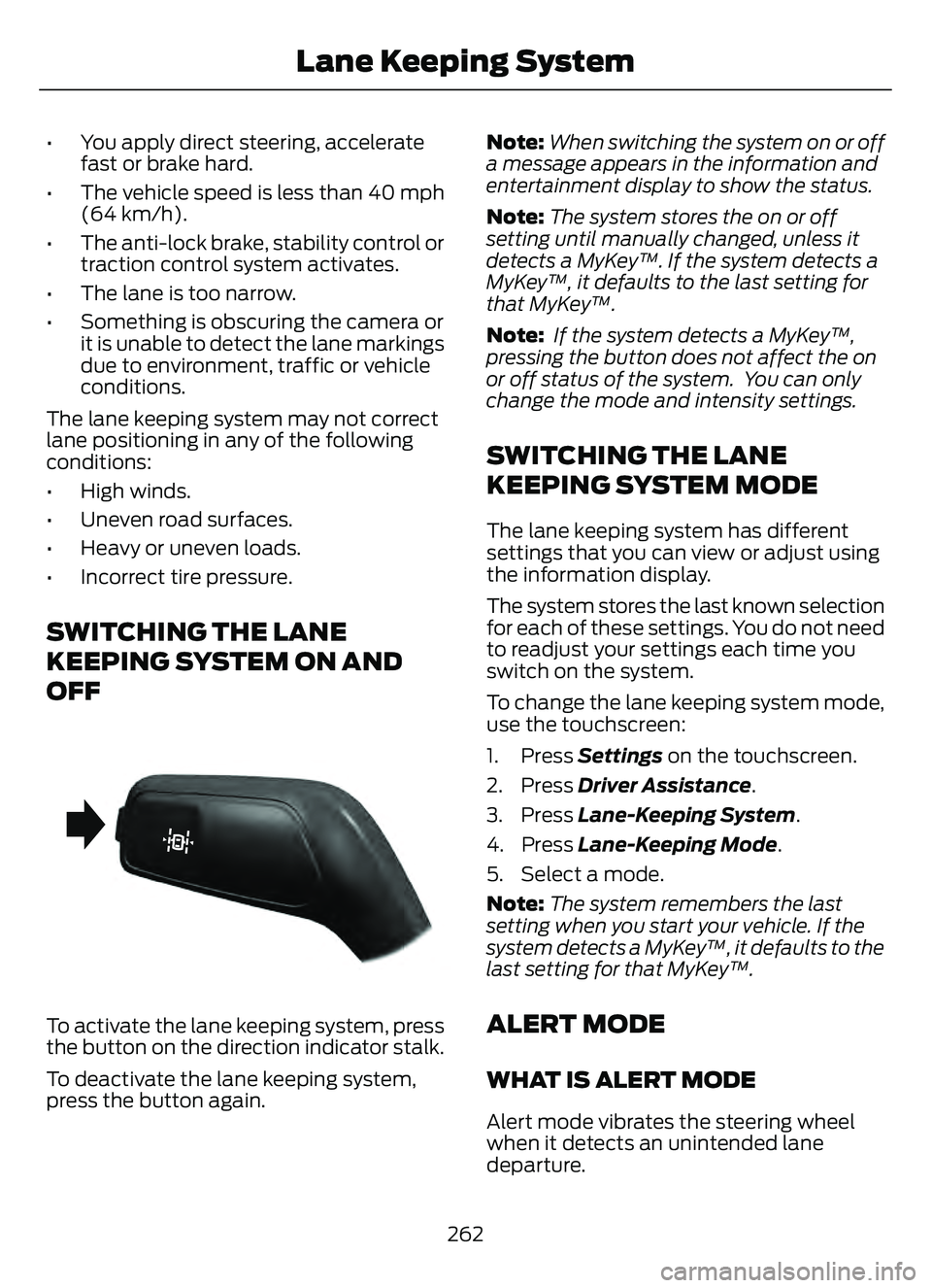
SWITCHING THE LANE
KEEPING SYSTEM ON AND
OFF
E288067
To activate the lane keeping system, press
the button on the direction indicator stalk.
To deactivate the lane keeping system,
press the button again. Note:
When switching the system on or off
a message appears in the information and
entertainment display to show the status.
Note: The system stores the on or off
setting until manually changed, unless it
detects a MyKey™. If the system detects a
MyKey™, it defaults to the last setting for
that MyKey™.
Note: If the system detects a MyKey™,
pressing the button does not affect the on
or off status of the system. You can only
change the mode and intensity settings.
SWITCHING THE LANE
KEEPING SYSTEM MODE
The lane keeping system has different
settings that you can view or adjust using
the information display.
The system stores the last known selection
for each of these settings. You do not need
to readjust your settings each time you
switch on the system.
To change the lane keeping system mode,
use the touchscreen:
1. Press Settings on the touchscreen.
2. Press Driver Assistance.
3. Press Lane-Keeping System .
4. Press Lane-Keeping Mode .
5. Select a mode.
Note: The system remembers the last
setting when you start your vehicle. If the
system detects a MyKey™, it defaults to the
last setting for that MyKey™.
ALERT MODE
WHAT IS ALERT MODE
Alert mode vibrates the steering wheel
when it detects an unintended lane
departure.
262
Lane Keeping System
Page 270 of 585
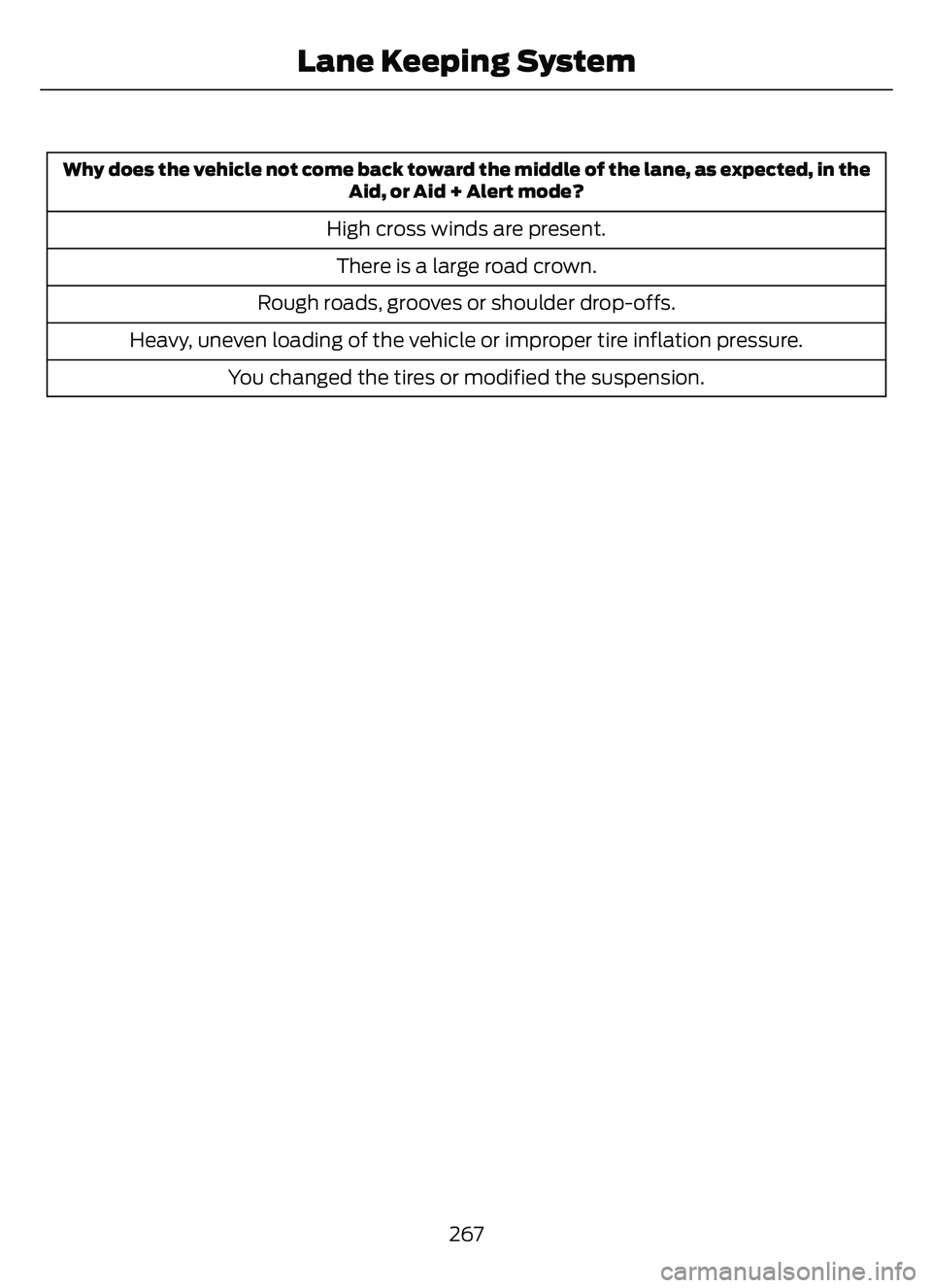
Why does the vehicle not come back toward the middle of the lane, as expected, in theAid, or Aid + Alert mode?
High cross winds are present.
There is a large road crown.
Rough roads, grooves or shoulder drop-offs.
Heavy, uneven loading of the vehicle or improper tire inflation pressure. You changed the tires or modified the suspension.
267
Lane Keeping System
Page 307 of 585
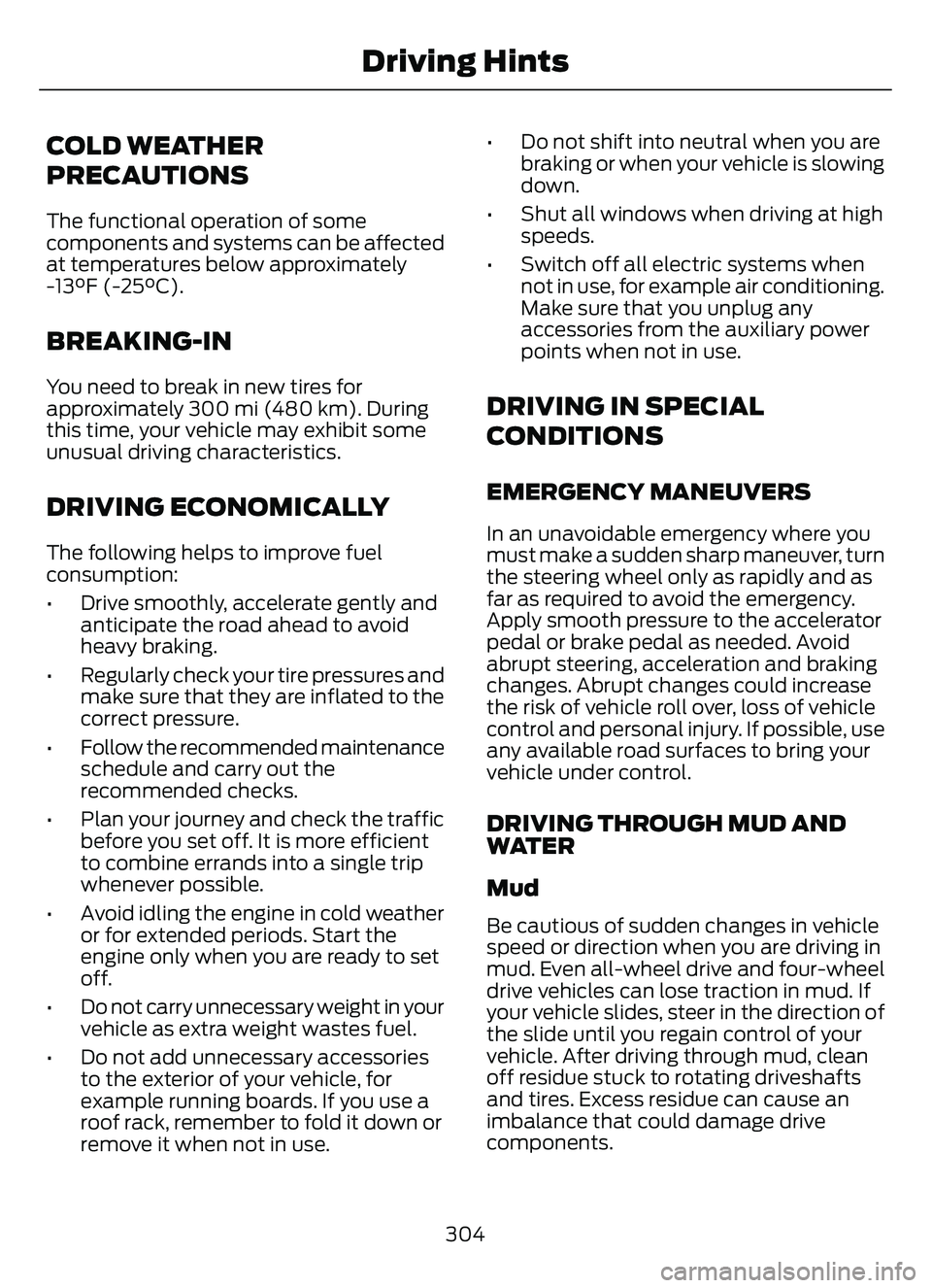
COLD WEATHER
PRECAUTIONS
The functional operation of some
components and systems can be affected
at temperatures below approximately
-13°F (-25°C).
BREAKING-IN
You need to break in new tires for
approximately 300 mi (480 km). During
this time, your vehicle may exhibit some
unusual driving characteristics.
DRIVING ECONOMICALLY
The following helps to improve fuel
consumption:
• Drive smoothly, accelerate gently andanticipate the road ahead to avoid
heavy braking.
• Regularly check your tire pressures and make sure that they are inflated to the
correct pressure.
• Follow the recommended maintenance schedule and carry out the
recommended checks.
• Plan your journey and check the traffic before you set off. It is more efficient
to combine errands into a single trip
whenever possible.
• Avoid idling the engine in cold weather or for extended periods. Start the
engine only when you are ready to set
off.
• Do not carry unnecessary weight in your vehicle as extra weight wastes fuel.
• Do not add unnecessary accessories to the exterior of your vehicle, for
example running boards. If you use a
roof rack, remember to fold it down or
remove it when not in use. • Do not shift into neutral when you are
braking or when your vehicle is slowing
down.
• Shut all windows when driving at high speeds.
• Switch off all electric systems when not in use, for example air conditioning.
Make sure that you unplug any
accessories from the auxiliary power
points when not in use.
DRIVING IN SPECIAL
CONDITIONS
EMERGENCY MANEUVERS
In an unavoidable emergency where you
must make a sudden sharp maneuver, turn
the steering wheel only as rapidly and as
far as required to avoid the emergency.
Apply smooth pressure to the accelerator
pedal or brake pedal as needed. Avoid
abrupt steering, acceleration and braking
changes. Abrupt changes could increase
the risk of vehicle roll over, loss of vehicle
control and personal injury. If possible, use
any available road surfaces to bring your
vehicle under control.
DRIVING THROUGH MUD AND
WATER
Mud
Be cautious of sudden changes in vehicle
speed or direction when you are driving in
mud. Even all-wheel drive and four-wheel
drive vehicles can lose traction in mud. If
your vehicle slides, steer in the direction of
the slide until you regain control of your
vehicle. After driving through mud, clean
off residue stuck to rotating driveshafts
and tires. Excess residue can cause an
imbalance that could damage drive
components.
304
Driving Hints