ignition FORD ESCAPE HYBRID 2011 2.G Workshop Manual
[x] Cancel search | Manufacturer: FORD, Model Year: 2011, Model line: ESCAPE HYBRID, Model: FORD ESCAPE HYBRID 2011 2.GPages: 363, PDF Size: 3.38 MB
Page 210 of 363
RECREATIONAL TOWING
An example of “recreational towing” is towing your vehicle behind a
motorhome.
Note:Put your climate control system in recirculated air mode to
prevent exhaust fumes from entering the vehicle. Refer to theClimate
Controlschapter for more information.
Note:If you tow your vehicle with all four wheels on the ground, follow
these instructions:
•Tow only in the forward direction.
•Release the parking brake.
•Place the transmission shift lever in N (Neutral).
•Place the ignition to the accessory position (refer toStartingin the
Drivingchapter).
•Your vehicle may be towed up to a speed of 75 mph (120 km/h), but
you should always obey local speed limits.
You also have the option of trailering the vehicle with its front wheels on
a dolly (FWD only), or trailering with all four wheels off the ground.Do
not tow your four–wheel drive (4WD) vehicle with the front
wheels off the ground and the rear wheels on the ground (such as
with the use of a tow dolly).This will cause damage to your 4WD
system.
For other towing requirements, refer toWrecker towingin theRoadside
Emergencieschapter.
Tires, Wheels and Loading
210
2011 Escape Hybrid(ehv)
Owners Guide, 2nd Printing
USA(fus)
Page 211 of 363
STARTING
Positions of the ignition
1. Off— locks the gearshift lever
and allows key removal.
2. Accessory— allows the electrical
accessories such as the radio to
operate while the vehicle is not
running.
3. On— all electrical circuits
operational and warning lights will
illuminate. This is the position the
key is in when you’re driving.
4. Start— starts the vehicle and electrical power systems.
Preparing to start your vehicle
Engine starting is controlled by the electronically-controlled
Continuously Variable Transaxle (eCVT). For more information on
starting the vehicle, refer toStarting the vehiclein this chapter.
WARNING:Extended idling at high engine speeds can produce
very high temperatures in the engine and exhaust system,
creating the risk of fire or other damage.
WARNING:Do not park, idle, or drive your vehicle in dry grass
or other dry ground cover. The emission system heats up the
engine compartment and exhaust system, which can start a fire.
WARNING:Do not start your vehicle in a closed garage or in
other enclosed areas. Exhaust fumes can be toxic. Always open
the garage door before you start the engine. SeeGuarding against
exhaust fumesin this chapter for more instructions.
WARNING:If you smell exhaust fumes inside your vehicle, have
your dealer inspect your vehicle immediately. Do not drive if you
smell exhaust fumes.
Driving
211
2011 Escape Hybrid(ehv)
Owners Guide, 2nd Printing
USA(fus)
Page 214 of 363
Note:If the engine fails to start when it should, which is indicated by
the service engine soon
light , put the gearshift lever into P (Park),
turn the ignition off, then attempt to start the vehicle again. If the
vehicle still does not start, it may require refueling, jump starting,
resetting of the fuel pump/high voltage shut-off switches or service. For
information on jump starting the vehicle and resetting the fuel
pump/high voltage shut-off switches, refer to theJump starting (low
voltage [underhood] battery only)section and theFuel pump/High
voltage shut-off switchessection found in theRoadside Emergencies
chapter.
Guarding against exhaust fumes
Carbon monoxide is present in exhaust fumes. Take precautions to avoid
its dangerous effects.
WARNING:If you smell exhaust fumes inside your vehicle, have
your dealer inspect your vehicle immediately. Do not drive if you
smell exhaust fumes.
Important ventilating information
If the engine is idling while the vehicle is stopped for a long period of
time, open the windows at least 1 inch (2.5 cm) or adjust the heating or
air conditioning to bring in fresh air.
ENGINE BLOCK HEATER (IF EQUIPPED)
An engine block heater warms the engine coolant which aids in starting
and allows the heater/defroster system to respond quickly. If your vehicle
is equipped with this system, your equipment includes a heater element
which is installed in your engine block and a wire harness which allows
the user to connect the system to a grounded 120 volt A/C electrical
source. The block heater system is most effective when outdoor
temperatures reach below 0°F (-18°C).
WARNING:Failure to follow engine block heater instructions
could result in property damage or physical injury.
WARNING:To reduce the risk of electrical shock, do not use
your heater with ungrounded electrical systems or two-pronged
(cheater) adapters.
Driving
214
2011 Escape Hybrid(ehv)
Owners Guide, 2nd Printing
USA(fus)
Page 217 of 363
distance. The ABS will be activated immediately, allowing you to retain
steering control during hard braking and on slippery surfaces. However,
the ABS does not decrease stopping distance.
ABS warning lamp
The ABS lamp in the instrument
cluster momentarily illuminates
when the ignition is turned on. If
the light does not illuminate during
start up, remains on or flashes, the
ABS may be disabled and may need to be serviced.
Even when the ABS is disabled,
normal braking is still effective. If
your BRAKE warning lamp
illuminates with the parking brake
released, have your brake system
serviced immediately by an authorized dealer.
Regenerative Braking System (RBS)
Your vehicle uses a feature known as regenerative braking. This is used
to simulate the engine braking of an internal combustion engine and
assist the standard brake system while recovering some of the energy of
motion and storing it in the battery to improve fuel economy. The
standard brake system is designed to fully stop the car if regenerative
braking is not available. During regenerative braking, the motor is spun
as a generator to create electrical current. This recharges the high
voltage battery and slows the vehicle. In effect, once the accelerator
pedal is released, the motor changes from an energy user to an energy
producer.
When the accelerator pedal is released or the brake pedal is applied, the
brake controller automatically detects the amount of deceleration
requested and optimizes how much of the deceleration will be produced
by regenerative braking. The remaining portion is generated by standard
friction braking. When the battery is almost fully charged, the amount of
regenerative braking is limited to avoid overcharging, and the requested
deceleration is produced by standard friction braking alone.
Regenerative braking does not take the place of the standard friction
brakes; it only assists them. Regenerative braking has also been designed
to interact with the anti-lock brake system (ABS). Regenerative braking
is disabled when the ABS is activated or the battery is fully charged.
ABS
P!
BRAKE
Driving
217
2011 Escape Hybrid(ehv)
Owners Guide, 2nd Printing
USA(fus)
Page 218 of 363
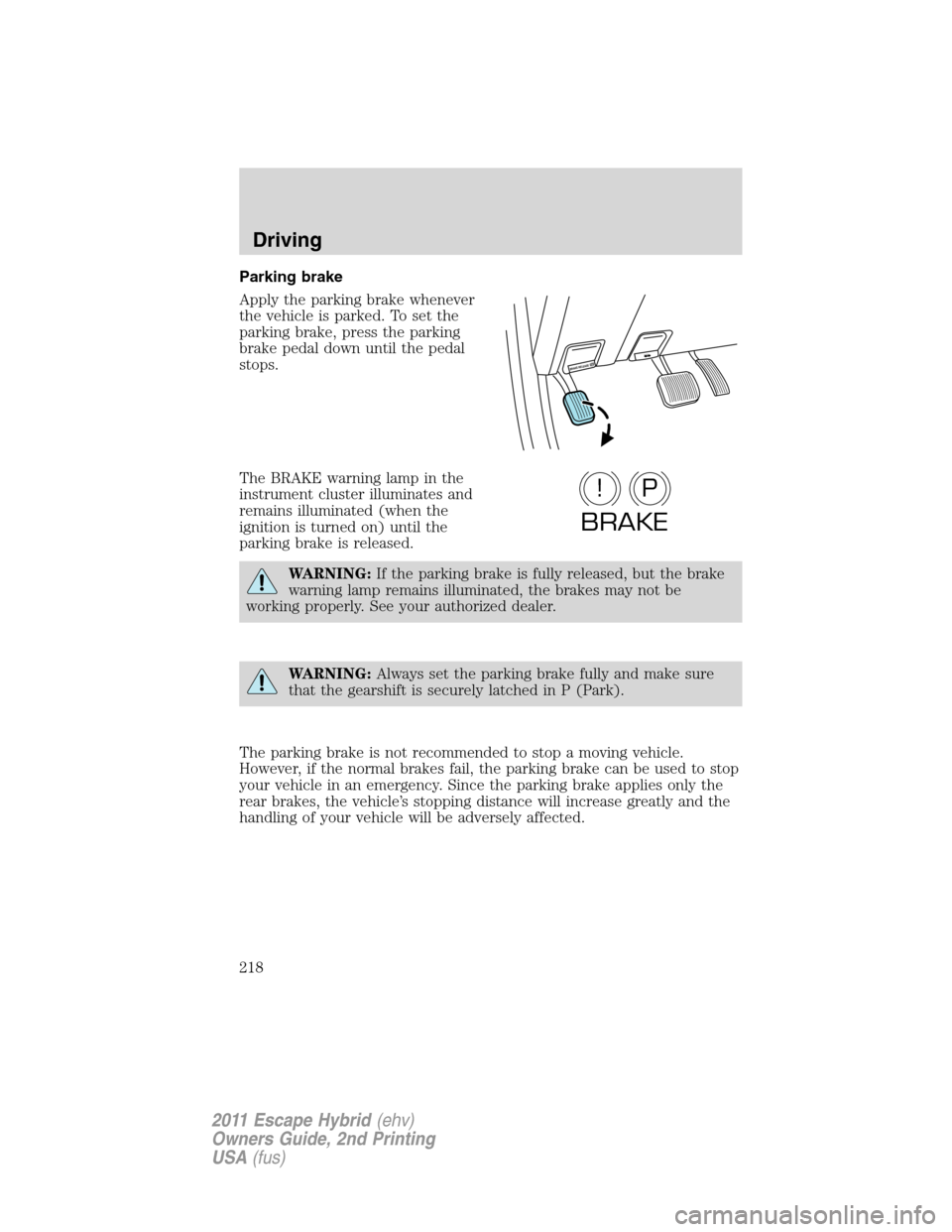
Parking brake
Apply the parking brake whenever
the vehicle is parked. To set the
parking brake, press the parking
brake pedal down until the pedal
stops.
The BRAKE warning lamp in the
instrument cluster illuminates and
remains illuminated (when the
ignition is turned on) until the
parking brake is released.
WARNING:If the parking brake is fully released, but the brake
warning lamp remains illuminated, the brakes may not be
working properly. See your authorized dealer.
WARNING:Always set the parking brake fully and make sure
that the gearshift is securely latched in P (Park).
The parking brake is not recommended to stop a moving vehicle.
However, if the normal brakes fail, the parking brake can be used to stop
your vehicle in an emergency. Since the parking brake applies only the
rear brakes, the vehicle’s stopping distance will increase greatly and the
handling of your vehicle will be adversely affected.
BRAKE RELEASE P
P!
BRAKE
Driving
218
2011 Escape Hybrid(ehv)
Owners Guide, 2nd Printing
USA(fus)
Page 224 of 363
WARNING:Trailer sway control does not prevent a trailer from
swaying, it mitigates the sway from increasing once it has
occurred. TSC cannot stop all trailers from swaying. If you are
experiencing trailer sway, it is likely that the trailer is improperly
loaded for the correct tongue weight or the speed of the vehicle and
trailer is too high. Pull the vehicle-trailer over to a safe location to
check the trailer weight distribution and tongue load and reduce speed
to a safe level while towing. If trailer sway is experienced, SLOW
DOWN. Always use caution when towing a trailer and follow the
tongue weight recommendations. Refer to theTrailer towingsection
in theTires Wheels and Loadingchapter of this owner’s guide for
more information on towing a trailer with your vehicle.
During trailer sway control events, the stability control light in the
instrument cluster will flash momentarily. In some cases, when trailer
sway is detected, the vehicle speed is too high and may be at or above a
speed at which trailer sway will grow continuously. This may cause the
system to activate multiple times, and you may experience a slight
deceleration of the vehicle.
Disabling trailer sway control
Trailer sway control can be disabled during any key cycle. Pressing and
holding the stability control button for more than five seconds will
disable the trailer sway control feature and the stability control light will
flash momentarily and then illuminate solid for that ignition cycle. Trailer
sway control can be re-enabled by momentarily pressing the stability
control button. Trailer sway control will also be re-enabled at each new
key cycle.
WARNING:Turning off trailer sway control increases the risk of
loss of vehicle control, serious injury, or death. Ford does not
recommend disabling this feature except in situations where speed
reduction may be detrimental (e.g., hill climbing), the driver has
significant trailer towing experience, and can control trailer sway and
maintain safe operation.
STEERING
Your vehicle is equipped with an electric power-assisted steering (EPAS)
system. There is no fluid reservoir to check or fill.
If your vehicle loses electrical power while you are driving (or if the
ignition is turned off), you can steer the vehicle manually, but it takes
Driving
224
2011 Escape Hybrid(ehv)
Owners Guide, 2nd Printing
USA(fus)
Page 226 of 363
WARNING:Loaded vehicles, with a higher center of gravity,
may handle differently than unloaded vehicles. Do not overload
your vehicle and use extra precautions, such as driving at slower
speeds, avoiding abrupt steering changes and allowing for increased
stopping distance, when driving a heavily loaded vehicle. Over-loading
or loading the vehicle improperly can deteriorate handling capability
and contribute to loss of vehicle control and vehicle rollover.
BRAKE-SHIFT INTERLOCK
This vehicle is equipped with a brake-shift interlock feature that prevents
the gearshift lever from being moved from P (Park) when the ignition is
in the on position unless brake pedal is pressed.
If you cannot move the gearshift lever out of P (Park) with ignition in
the on position and the brake pedal pressed, it is possible that a fuse has
blown or the vehicle’s brake lamps are not operating properly. Refer to
Fuses and relaysin theRoadside Emergencieschapter.
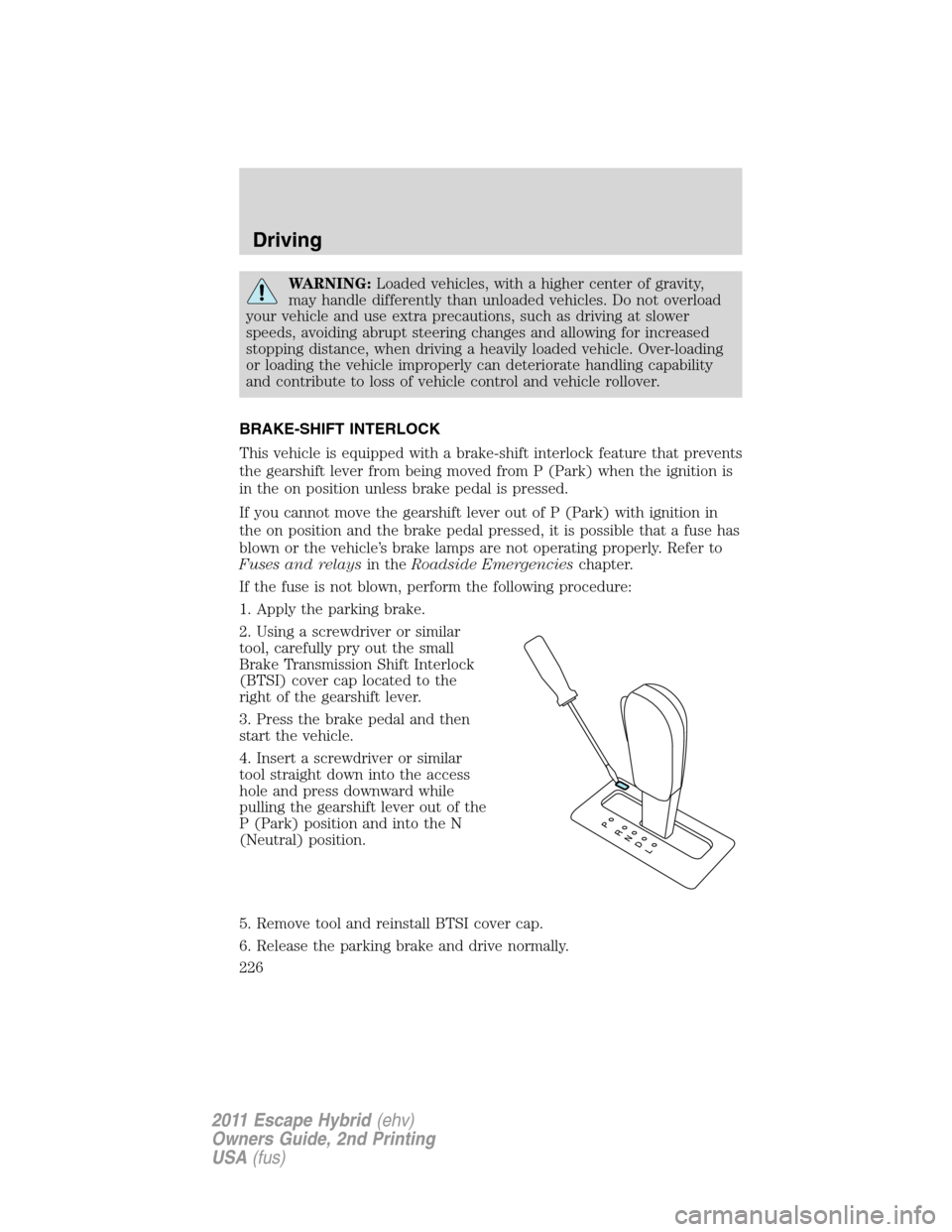
If the fuse is not blown, perform the following procedure:
1. Apply the parking brake.
2. Using a screwdriver or similar
tool, carefully pry out the small
Brake Transmission Shift Interlock
(BTSI) cover cap located to the
right of the gearshift lever.
3. Press the brake pedal and then
start the vehicle.
4. Insert a screwdriver or similar
tool straight down into the access
hole and press downward while
pulling the gearshift lever out of the
P (Park) position and into the N
(Neutral) position.
5. Remove tool and reinstall BTSI cover cap.
6. Release the parking brake and drive normally.
Driving
226
2011 Escape Hybrid(ehv)
Owners Guide, 2nd Printing
USA(fus)
Page 227 of 363
WARNING:Do not drive your vehicle until you verify that the
brake lamps are working.
WARNING:Always set the parking brake fully and make sure
the gearshift is latched in P (Park). Turn the ignition to the off
position and remove the key whenever you leave your vehicle.
WARNING:If the parking brake is fully released, but the brake
warning lamp remains illuminated, the brakes may not be
working properly. See your authorized dealer as soon as possible.
AUTOMATIC TRANSMISSION OPERATION
Understanding the gearshift positions of the
electronically-controlled Continuously Variable Transmission
(eCVT)
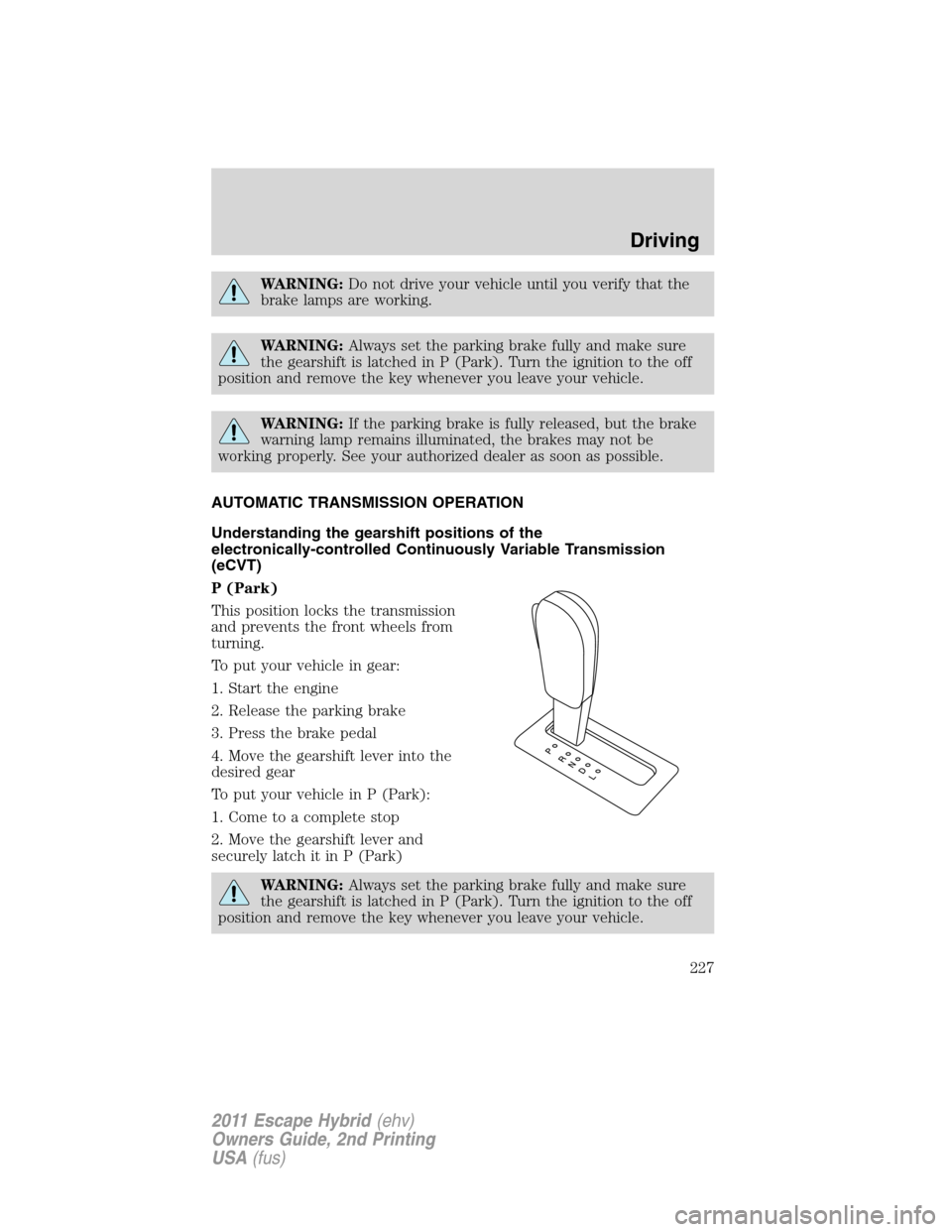
P (Park)
This position locks the transmission
and prevents the front wheels from
turning.
To put your vehicle in gear:
1. Start the engine
2. Release the parking brake
3. Press the brake pedal
4. Move the gearshift lever into the
desired gear
To put your vehicle in P (Park):
1. Come to a complete stop
2. Move the gearshift lever and
securely latch it in P (Park)
WARNING:Always set the parking brake fully and make sure
the gearshift is latched in P (Park). Turn the ignition to the off
position and remove the key whenever you leave your vehicle.
Driving
227
2011 Escape Hybrid(ehv)
Owners Guide, 2nd Printing
USA(fus)
Page 228 of 363
R (Reverse)
With the gearshift lever in R (Reverse), the vehicle will move backward.
Always come to a complete stop before shifting into and out of R
(Reverse).
N (Neutral)
With the gearshift lever in N (Neutral), the vehicle is free to roll; hold
the brake pedal down while in this position. Because of the unique
nature of the hybrid vehicle, the engine will not start in the N (Neutral)
position.
The vehicle does not charge the high voltage battery in the N (Neutral)
position. Do not idle the vehicle in N (Neutral) for extended periods as
this will discharge your high voltage battery.
D (Drive)
The normal driving position for the best fuel economy.
L (Low)
•Provides maximum engine braking.
•The transmission may be shifted into L (Low) at any vehicle speed.
WARNING:When parking, do not use the gearshift in place of
the parking brake. Always set the parking brake fully and make
sure that the gearshift is securely latched in P (Park). Turn off the
ignition whenever you leave your vehicle. Never leave your vehicle
unattended while it is running. If you do not take these precautions,
your vehicle may move unexpectedly and injure someone.
If your vehicle gets stuck in mud or snow
If your vehicle gets stuck in mud or snow, it may be rocked out by
shifting between forward and reverse gears, stopping between shifts in a
steady pattern. Press lightly on the accelerator in each gear.
Do not rock the vehicle if the engine is not at normal operating
temperature or damage to the transmission may occur.
Do not rock the vehicle for more than a minute or damage to the
transmission and tires may occur, or the engine may overheat.
Driving
228
2011 Escape Hybrid(ehv)
Owners Guide, 2nd Printing
USA(fus)
Page 230 of 363
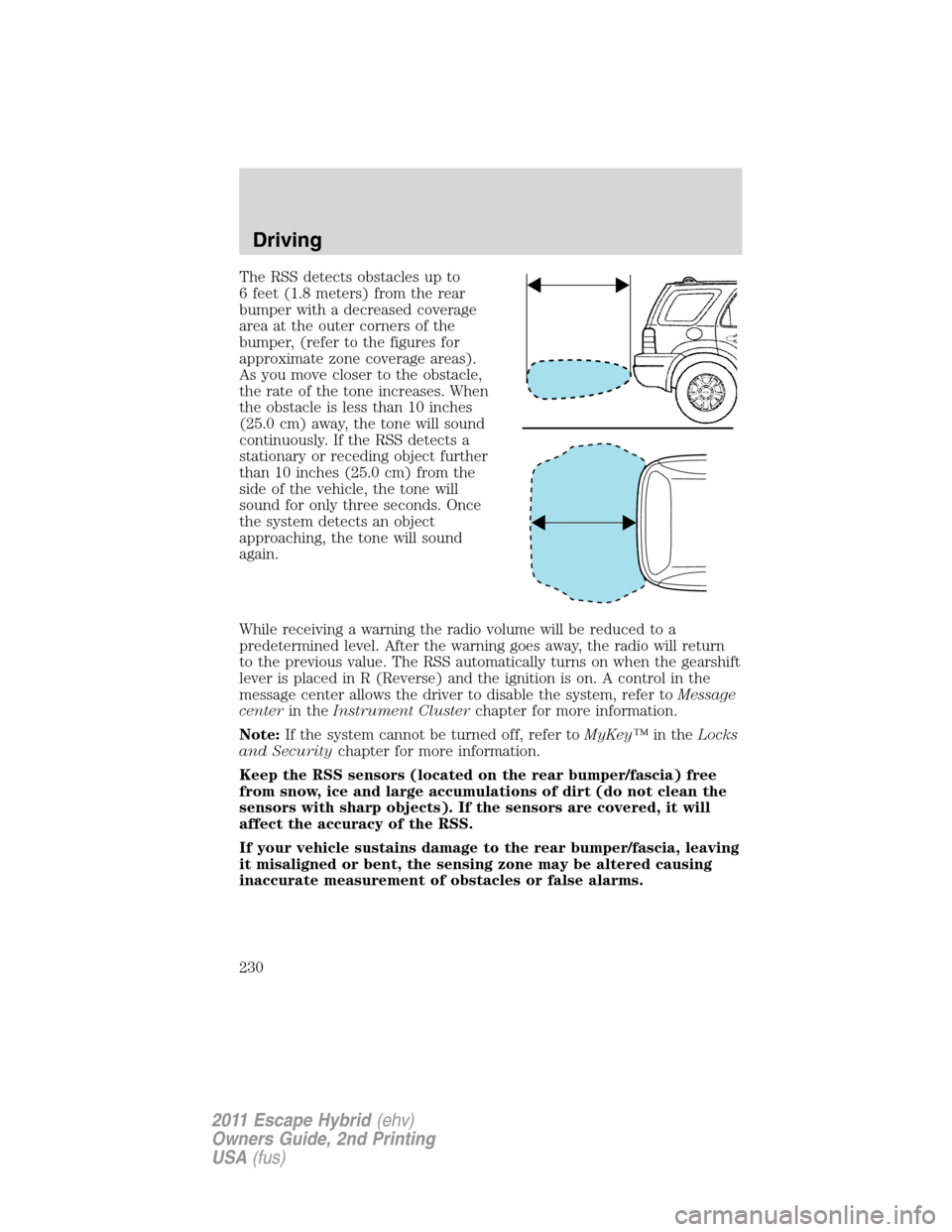
The RSS detects obstacles up to
6 feet (1.8 meters) from the rear
bumper with a decreased coverage
area at the outer corners of the
bumper, (refer to the figures for
approximate zone coverage areas).
As you move closer to the obstacle,
the rate of the tone increases. When
the obstacle is less than 10 inches
(25.0 cm) away, the tone will sound
continuously. If the RSS detects a
stationary or receding object further
than 10 inches (25.0 cm) from the
side of the vehicle, the tone will
sound for only three seconds. Once
the system detects an object
approaching, the tone will sound
again.
While receiving a warning the radio volume will be reduced to a
predetermined level. After the warning goes away, the radio will return
to the previous value. The RSS automatically turns on when the gearshift
lever is placed in R (Reverse) and the ignition is on. A control in the
message center allows the driver to disable the system, refer toMessage
centerin theInstrument Clusterchapter for more information.
Note:If the system cannot be turned off, refer toMyKey™in theLocks
and Securitychapter for more information.
Keep the RSS sensors (located on the rear bumper/fascia) free
from snow, ice and large accumulations of dirt (do not clean the
sensors with sharp objects). If the sensors are covered, it will
affect the accuracy of the RSS.
If your vehicle sustains damage to the rear bumper/fascia, leaving
it misaligned or bent, the sensing zone may be altered causing
inaccurate measurement of obstacles or false alarms.
Driving
230
2011 Escape Hybrid(ehv)
Owners Guide, 2nd Printing
USA(fus)