cooling FORD ESCAPE HYBRID 2011 2.G Owners Manual
[x] Cancel search | Manufacturer: FORD, Model Year: 2011, Model line: ESCAPE HYBRID, Model: FORD ESCAPE HYBRID 2011 2.GPages: 363, PDF Size: 3.38 MB
Page 7 of 363
•Charge level of high voltage battery is low
•Very high or low outside temperature (to provide system
cooling/heating)
•Engine not warm enough to provide passenger requested cabin
temperature
Stopping:The gas engine may shut off to conserve fuel as you come to
a stop. Restarting the vehicle is not required. Simply step on the
accelerator when you are ready to drive.
Transmission Operation:Due to the technologically advanced,
electronically-controlled Continuously Variable Transaxle (eCVT) you will
not feel shift changes like those of a non-hybrid vehicle. Your hybrid’s
transmission is designed to do its work seamlessly.
Since engine speed is controlled by the transmission, it may seem
elevated at times. This is normal hybrid operation and helps
deliver fuel efficiency and performance.
Neutral:It is not recommended to idle the vehicle in N (Neutral) for
extended periods of time because this will discharge your high voltage
battery and decrease fuel economy. Because of the unique nature of the
hybrid vehicle, the engine will not start in the N (Neutral) position. Also,
the engine cannot provide power to the hybrid system in N (Neutral).
Low Gear:L (Low gear) is designed to mimic the enhanced engine
braking available in non-hybrid vehicles. L (Low gear) will produce high
engine speeds to provide necessary engine braking. This is normal and
will not damage your vehicle.
Reverse:(R) Reverse Gear vehicle speed is limited to 22 mph
(35 km/h).
Unique Hybrid operating characteristics
Your Hybrid, with its new technology, behaves differently compared to a
non-hybrid. Here is a description of the major differences:
Battery:Your Hybrid is equipped with a high voltage battery. A cool
battery ensures battery life and provides the best possible performance.
Your hybrid high voltage battery may periodically re-condition itself to
ensure maximum efficiency. You may notice slight changes in drivability
during this process, but it’s an important part of your hybrid’s high
voltage battery optimization features.
The high voltage battery is cooled by cabin air drawn from vent holes in
the driver-side cargo trim panel. Avoid placing objects over the vent
holes which block air flow to the high voltage battery.
Introduction
7
2011 Escape Hybrid(ehv)
Owners Guide, 2nd Printing
USA(fus)
Page 11 of 363
Question Answer
What is the fan noise I hear
from the rear of my hybrid?The fan noise comes from two fans
located inside the high voltage battery.
These fans turn on when the battery
requires cooling air. The fan speed, and
associated noise level, will change
according to both the amount of cooling
required and the speed of the vehicle to
maintain good performance.
How far can I go in Electric
Drive if I run out of gas?Running out of gas is not recommended.
However, you may be able to go about
one mile, driving at 30 mph (48 km/h), if
the battery has a normal state of charge.
What is the engine oil
change service interval?The engine oil should be changed every
10,000 miles (16,000 km) under normal
operating conditions. See theScheduled
Maintenance Guidechapter.
Can I put E10 or E85 in my
vehicle, and how will it
affect my fuel economy?Your hybrid vehicle can use E10 (10%
ethanol, 90% gasoline) fuel, but you may
notice slightly reduced fuel economy
because ethanol contains less energy per
gallon than gasoline. Your hybrid vehicle
is not designed to use E85 (85% ethanol).
How long will my high
voltage battery last? Does it
need maintenance?The high voltage battery system is
designed to last the life of the vehicle and
requires no maintenance.
Can you charge the battery
with a plug into an A/C
outlet?There are no provisions for charging the
high voltage battery from a power supply
external to the vehicle.
Can I tow the hybrid
behind my motor home
with all four wheels down?Yes. Your hybrid vehicle can be
“flat-towed” without modification. See the
Recreational towingsection in theTires,
Wheels and Loadingchapter for more
information.
Introduction
11
2011 Escape Hybrid(ehv)
Owners Guide, 2nd Printing
USA(fus)
Page 30 of 363
Note:If the vehicle is still running, it may soon shut down without
further warning and should be stopped safely. Contact your authorized
dealer as soon as possible.
HIGH ENGINE TEMPERATURE— Displayed when the engine
coolant is overheating. Engine coolant temperature warning lamp will
illuminate indicating coolant temperature is high. Stop the vehicle as
soon as safely possible, turn off the engine and let it cool. Check the
coolant level. Refer toEngine coolantin theMaintenance and
Specificationschapter. If the warning stays on or continues to come on,
contact your authorized dealer as soon as possible.
WARNING:When the engine and radiator are hot, scalding
coolant and steam may shoot out under pressure and cause
serious injury. Do not remove the cooling system cap when the engine
and radiator are hot.
HIGH MOTOR TEMPERATURE— Displayed when the motor
electronics are overheating. Stop the vehicle as soon as safely possible,
turn off the engine and let it cool. Refer toEngine coolant and
motor/electronics coolantin theMaintenance and Specifications
chapter. If the warning stays on or continues to come on, contact your
authorized dealer as soon as possible.
READY TO DRIVE— Momentarily displayed once the vehicle has
successfully started. Indicates the vehicle is ready to drive even when
you don’t hear the gasoline engine running.
PARK BRAKE ENGAGED— Displayed when the manual park brake is
set, the engine is running and the vehicle is driven more than 3 mph
(5 km/h). If the warning stays on after the park brake is released,
contact your authorized dealer as soon as possible.
XXX MILES TO E FUEL LEVEL LOW— Displayed as an early
reminder of a low fuel condition.
LIFTGATE / GLASS AJAR— Displayed when the liftgate or liftgate
glass is not completely closed. Press RESET to reset display.
CHECK BRAKE SYSTEM— Displayed when the braking system is not
operating properly. If the warning stays on or continues to come on,
contact your authorized dealer as soon as possible.
CHECK FUEL FILL INLET— Displayed when the fuel fill inlet may
not be properly closed. Refer toEasy Fuel™ “no cap” fuel systemin
theMaintenance and Specificationschapter.
Instrument Cluster
30
2011 Escape Hybrid(ehv)
Owners Guide, 2nd Printing
USA(fus)
Page 54 of 363
11.Recirculated air:Press to activate/deactivate air recirculation
in the vehicle. Recirculated air may reduce the amount of time needed to
cool down the interior of the vehicle, may reduce the energy needed to
keep the interior of the vehicle cool, and may also help reduce undesired
outside odors from reaching the interior of the vehicle. Recirculated air
is controlled automatically when AUTO is selected or can be engaged
manually in any airflow mode except
(defrost). Recirculated air
may turn off automatically in some airflow modes to reduce window
fogging potential. When the ignition switch is turned off and back on, the
climate system will return to the recirculated air mode only if the A/C
button LED is illuminated and the air distribution selection is either
AUTO,
(panel) or(panel/floor).
12.MAX A/C:Activates air conditioning and distributes recirculated,
conditioned air through the instrument panel vents to provide maximum
cooling performance. Maximum cooling performance, however, may
decrease fuel efficiency in order to fully maintain interior cabin comfort.
13.A/C:Press to activate/deactivate air conditioning. Use with
recirculated air to improve cooling performance and efficiency. Engages
automatically in AUTO,
(defrost) and(floor/defrost).
14.
Driver heated seat control (if equipped):Press to
activate/deactivate the driver heated seat. SeeHeated seatsin the
Seating and Safety Restraintschapter.
Outside temperature:The outside temperature will appear in the
display and is labeled EXT TEMP.
Temperature conversion:To switch between Fahrenheit and Celsius,
refer toMessage centerin theDriver Controlschapter.
Operating tips
•To reduce fog build-up on the windshield during humid weather,
select
(defrost) or(floor/defrost).
•To reduce humidity build-up inside the vehicle, do not drive with the
system OFF or with
(recirculated air) engaged and A/C off.
•Do not put objects under the front seats that will interfere with the
airflow to the back seats.
•Remove any snow, ice or leaves from the air intake area at the base of
the windshield.
•To improve the A/C cool down, drive with the windows slightly open
for 2-3 minutes after start up or until the vehicle has been “aired out.”
Climate Controls
54
2011 Escape Hybrid(ehv)
Owners Guide, 2nd Printing
USA(fus)
Page 55 of 363
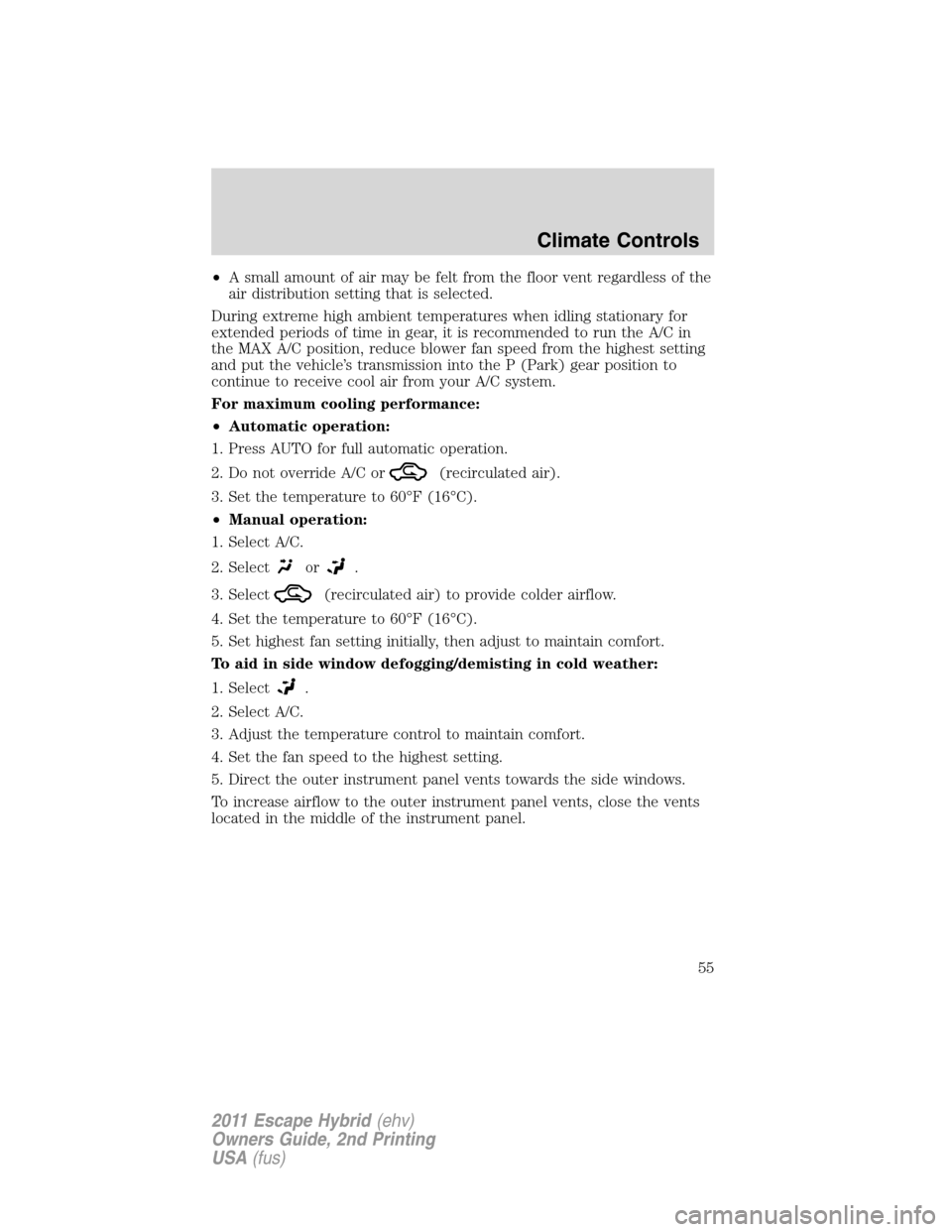
•A small amount of air may be felt from the floor vent regardless of the
air distribution setting that is selected.
During extreme high ambient temperatures when idling stationary for
extended periods of time in gear, it is recommended to run the A/C in
the MAX A/C position, reduce blower fan speed from the highest setting
and put the vehicle’s transmission into the P (Park) gear position to
continue to receive cool air from your A/C system.
For maximum cooling performance:
•Automatic operation:
1. Press AUTO for full automatic operation.
2. Do not override A/C or
(recirculated air).
3. Set the temperature to 60°F (16°C).
•Manual operation:
1. Select A/C.
2. Select
or.
3. Select
(recirculated air) to provide colder airflow.
4. Set the temperature to 60°F (16°C).
5. Set highest fan setting initially, then adjust to maintain comfort.
To aid in side window defogging/demisting in cold weather:
1. Select
.
2. Select A/C.
3. Adjust the temperature control to maintain comfort.
4. Set the fan speed to the highest setting.
5. Direct the outer instrument panel vents towards the side windows.
To increase airflow to the outer instrument panel vents, close the vents
located in the middle of the instrument panel.
Climate Controls
55
2011 Escape Hybrid(ehv)
Owners Guide, 2nd Printing
USA(fus)
Page 209 of 363
Trailer towing tips
•Practice turning, stopping and backing-up before starting on a trip to
get the feel of the vehicle-trailer combination. When turning, make
wider turns so the trailer wheels will clear curbs and other obstacles.
•To aid in engine/transmission cooling and A/C efficiency during hot
weather while stopped in traffic, place the gearshift lever in P (Park).
•After you have traveled 50 miles (80 km), thoroughly check your
hitch, electrical connections and trailer wheel lug nuts.
•If you are driving down a long or steep hill, shift to a lower gear. Do
not apply the brakes continuously, as they may overheat and become
less effective.
•Vehicles with trailers should not be parked on a grade. If you must
park on a grade, place wheel chocks under the trailer’s wheels.
Launching or retrieving a boat
Disconnect the wiring to the trailer before backing the trailer
into the water. Reconnect the wiring to the trailer after the
trailer is removed from the water.
When backing down a ramp during boat launching or retrieval:
•Do not allow the static water level to rise above the bottom edge of
the rear bumper.
•Do not allow waves to break higher than 6 in (15 cm) above the
bottom edge of the rear bumper.
Exceeding these limits may allow water to enter vehicle components:
•Causing internal damage to the components.
•Affecting driveability, emissions and reliability.
Replace the rear axle lubricant any time the axle has been submerged in
water. Rear axle lubricant quantities are not to be checked or changed
unless a leak is suspected or repair required.
Tires, Wheels and Loading
209
2011 Escape Hybrid(ehv)
Owners Guide, 2nd Printing
USA(fus)
Page 255 of 363
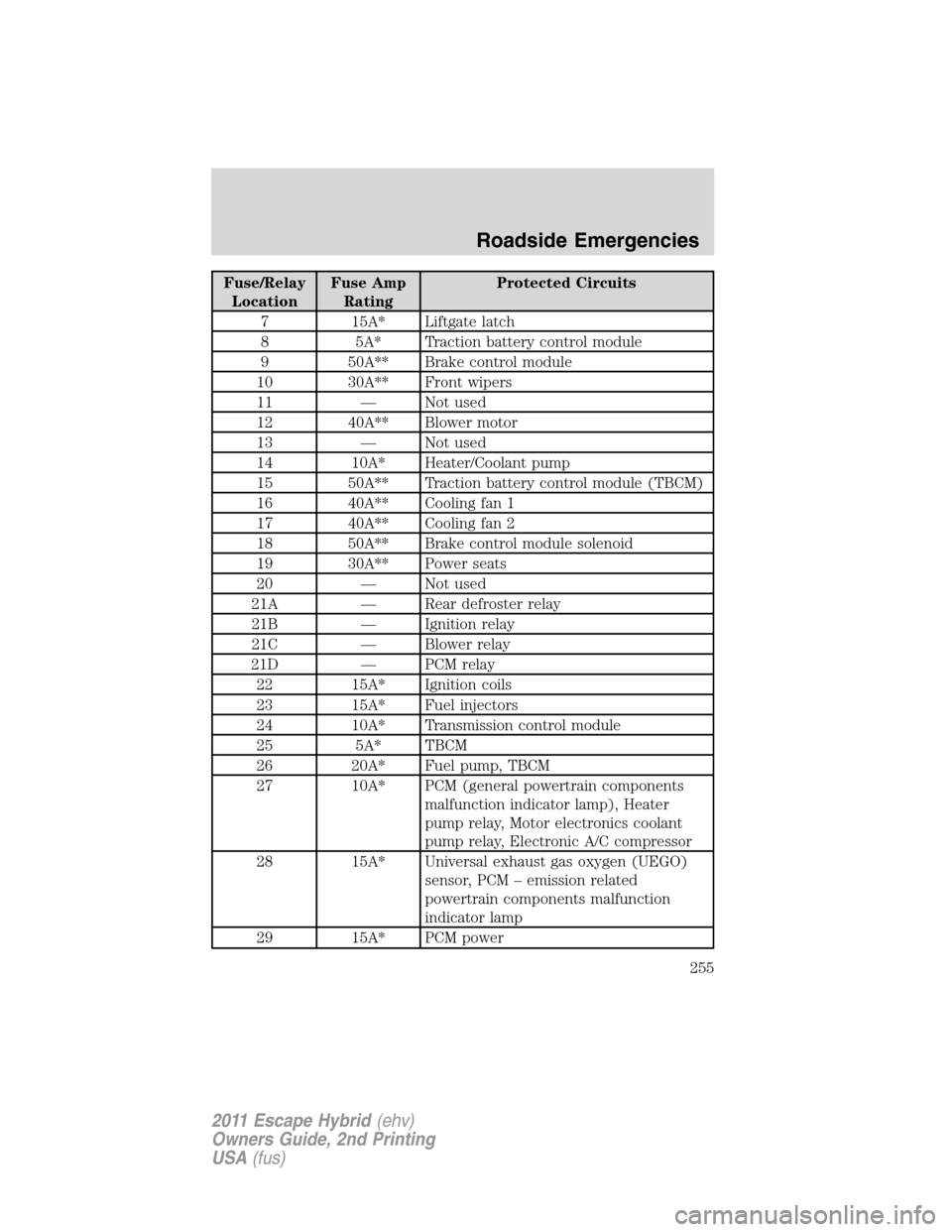
Fuse/Relay
LocationFuse Amp
RatingProtected Circuits
7 15A* Liftgate latch
8 5A* Traction battery control module
9 50A** Brake control module
10 30A** Front wipers
11 — Not used
12 40A** Blower motor
13 — Not used
14 10A* Heater/Coolant pump
15 50A** Traction battery control module (TBCM)
16 40A** Cooling fan 1
17 40A** Cooling fan 2
18 50A** Brake control module solenoid
19 30A** Power seats
20 — Not used
21A — Rear defroster relay
21B — Ignition relay
21C — Blower relay
21D — PCM relay
22 15A* Ignition coils
23 15A* Fuel injectors
24 10A* Transmission control module
25 5A* TBCM
26 20A* Fuel pump, TBCM
27 10A* PCM (general powertrain components
malfunction indicator lamp), Heater
pump relay, Motor electronics coolant
pump relay, Electronic A/C compressor
28 15A* Universal exhaust gas oxygen (UEGO)
sensor, PCM – emission related
powertrain components malfunction
indicator lamp
29 15A* PCM power
Roadside Emergencies
255
2011 Escape Hybrid(ehv)
Owners Guide, 2nd Printing
USA(fus)
Page 256 of 363
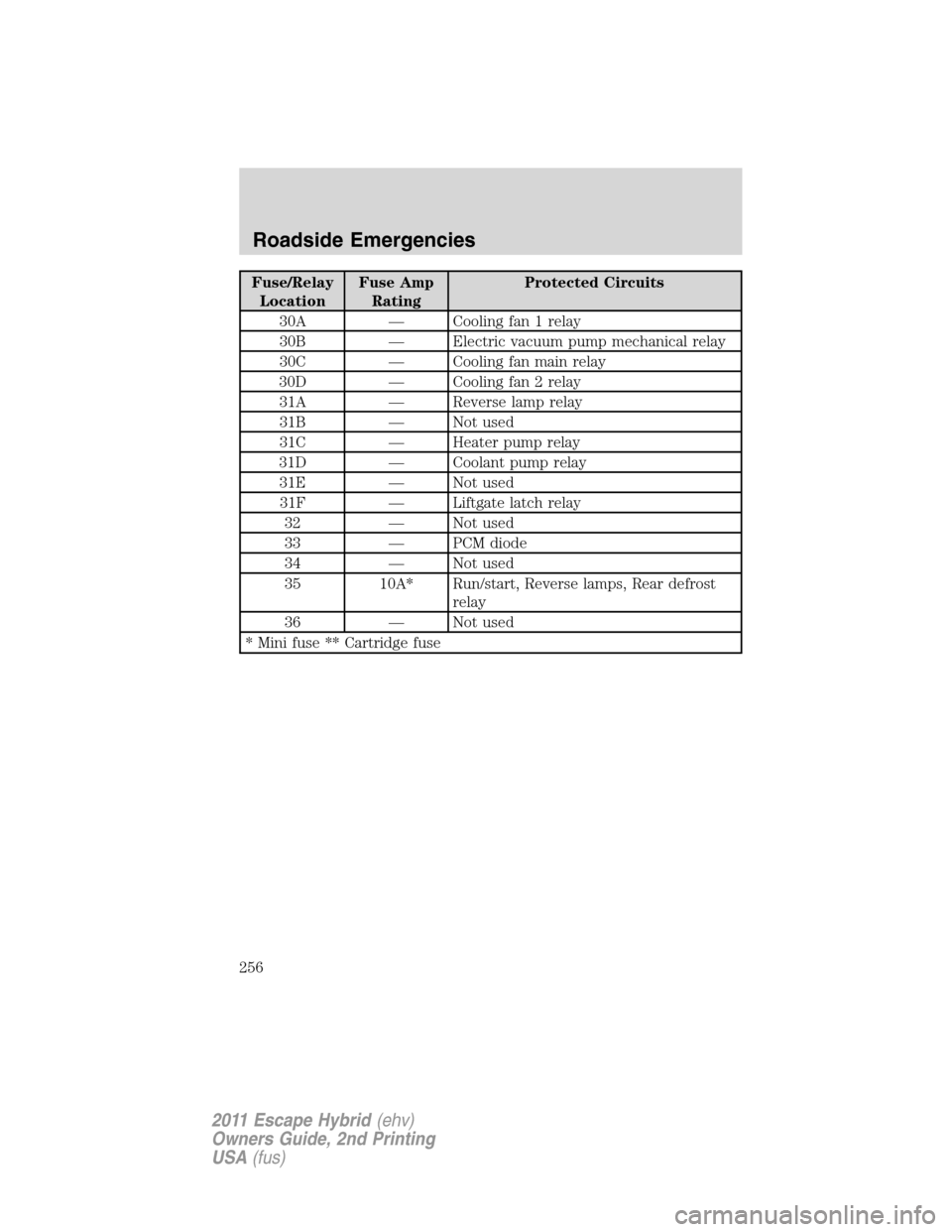
Fuse/Relay
LocationFuse Amp
RatingProtected Circuits
30A — Cooling fan 1 relay
30B — Electric vacuum pump mechanical relay
30C — Cooling fan main relay
30D — Cooling fan 2 relay
31A — Reverse lamp relay
31B — Not used
31C — Heater pump relay
31D — Coolant pump relay
31E — Not used
31F — Liftgate latch relay
32 — Not used
33 — PCM diode
34 — Not used
35 10A* Run/start, Reverse lamps, Rear defrost
relay
36 — Not used
* Mini fuse ** Cartridge fuse
Roadside Emergencies
256
2011 Escape Hybrid(ehv)
Owners Guide, 2nd Printing
USA(fus)
Page 270 of 363
Preparing your vehicle
If your low voltage (underhood) battery becomes disconnected or
disabled for any reason, the vehicle controller must relearn the engine’s
operating characteristics in order to operate it at maximum efficiency.
This relearning process occurs the first time the vehicle is driven after
reconnecting the low voltage battery. If the learning procedure does not
have time to complete during the drive, the engine will continue to
operate for 3-5 seconds after you turn the ignition off to complete the
relearning process. This is a normal condition and will not re-occur until
the low voltage battery is disconnected again. Refer toLow voltage
(underhood) batteryin theMaintenance and Specificationchapter
for more information.
1.Use only a 12–volt supply to start your vehicle.
2. Do not disconnect the battery of the disabled vehicle as this could
damage the vehicle’s electrical system.
3. Park the booster vehicle close to the hood of the disabled vehicle
making sure the two vehiclesdo nottouch. Set the parking brake on
both vehicles and stay clear of the engine cooling fan and other moving
parts.
4. Check all battery terminals and remove any excessive corrosion before
you attach the battery cables. Ensure that vent caps are tight and level.
5. Turn the heater fan on in both vehicles to protect from any electrical
surges. Turn all other accessories off.
Connecting the jumper cables
Note:In the illustration, the vehicle on the bottom is used to designate
the assisting (boosting) battery.
Roadside Emergencies
270
2011 Escape Hybrid(ehv)
Owners Guide, 2nd Printing
USA(fus)
Page 295 of 363
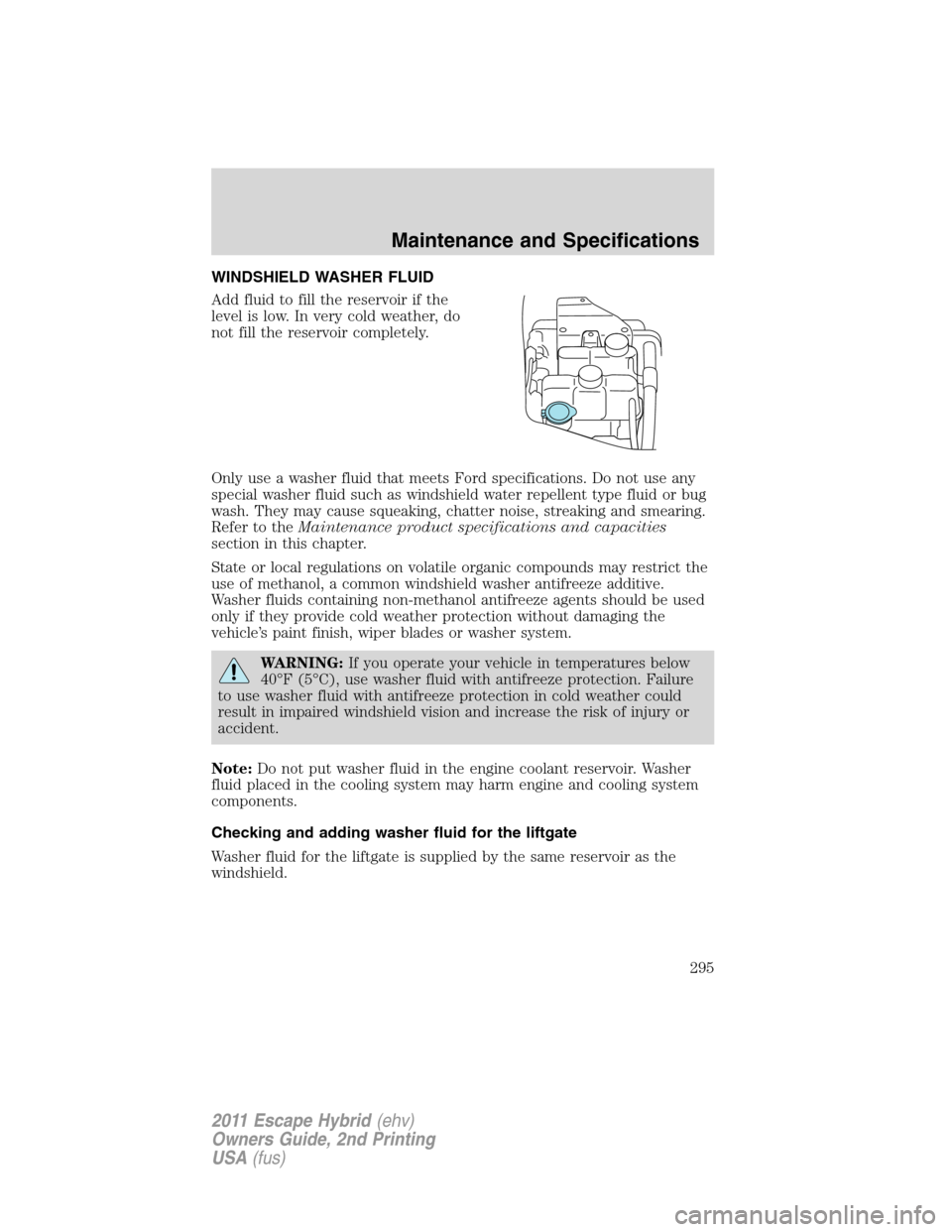
WINDSHIELD WASHER FLUID
Add fluid to fill the reservoir if the
level is low. In very cold weather, do
not fill the reservoir completely.
Only use a washer fluid that meets Ford specifications. Do not use any
special washer fluid such as windshield water repellent type fluid or bug
wash. They may cause squeaking, chatter noise, streaking and smearing.
Refer to theMaintenance product specifications and capacities
section in this chapter.
State or local regulations on volatile organic compounds may restrict the
use of methanol, a common windshield washer antifreeze additive.
Washer fluids containing non-methanol antifreeze agents should be used
only if they provide cold weather protection without damaging the
vehicle’s paint finish, wiper blades or washer system.
WARNING:If you operate your vehicle in temperatures below
40°F (5°C), use washer fluid with antifreeze protection. Failure
to use washer fluid with antifreeze protection in cold weather could
result in impaired windshield vision and increase the risk of injury or
accident.
Note:Do not put washer fluid in the engine coolant reservoir. Washer
fluid placed in the cooling system may harm engine and cooling system
components.
Checking and adding washer fluid for the liftgate
Washer fluid for the liftgate is supplied by the same reservoir as the
windshield.
Maintenance and Specifications
295
2011 Escape Hybrid(ehv)
Owners Guide, 2nd Printing
USA(fus)