light FORD ESCORT 1997 7.G User Guide
[x] Cancel search | Manufacturer: FORD, Model Year: 1997, Model line: ESCORT, Model: FORD ESCORT 1997 7.GPages: 191, PDF Size: 2.02 MB
Page 27 of 191
The daytime running light
(DRL) system will not
illuminate the tail lamps and
parking lamps. Turn on your
headlamps at dusk. Failure to do
so may result in a collision.
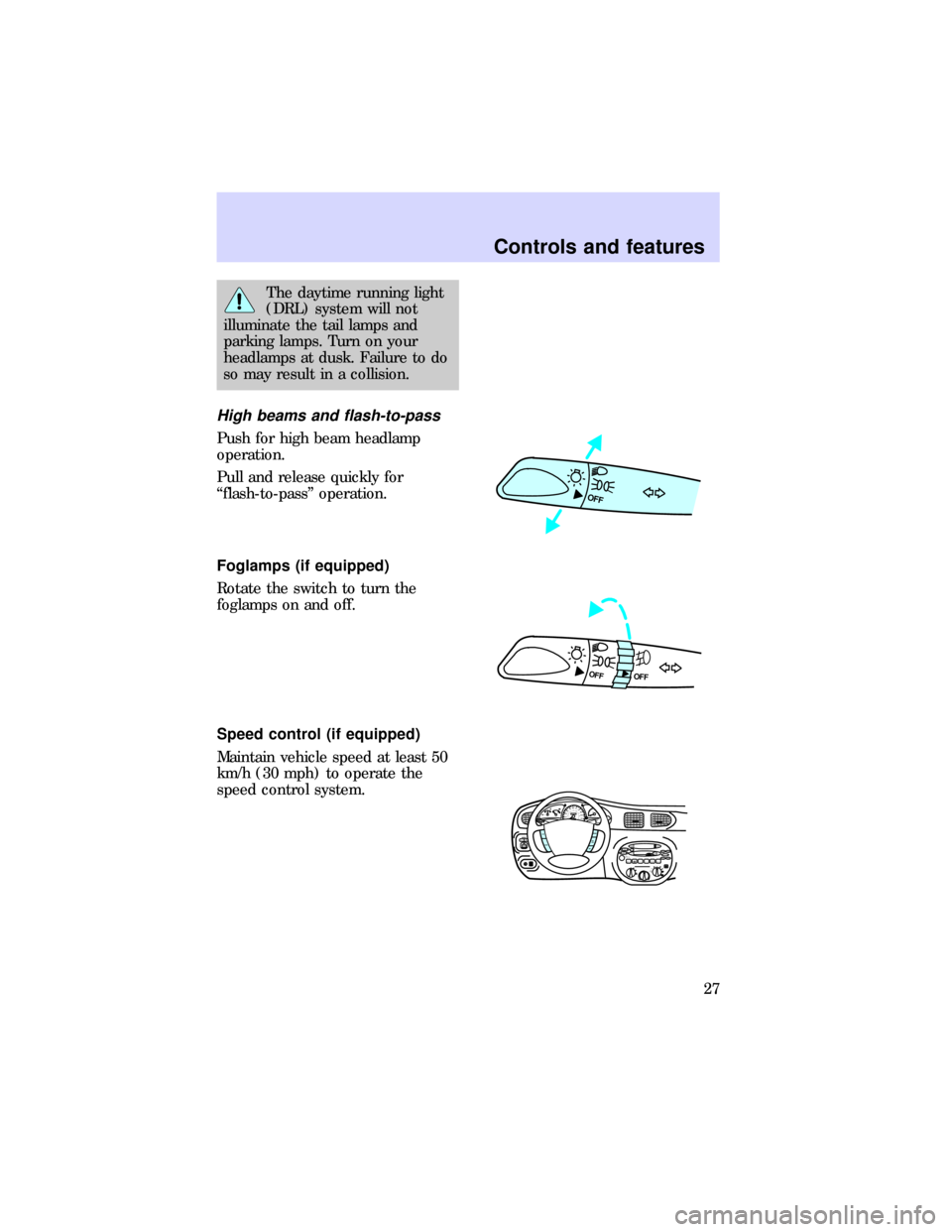
High beams and flash-to-pass
Push for high beam headlamp
operation.
Pull and release quickly for
ªflash-to-passº operation.
Foglamps (if equipped)
Rotate the switch to turn the
foglamps on and off.
Speed control (if equipped)
Maintain vehicle speed at least 50
km/h (30 mph) to operate the
speed control system.
OFF
OFFOFF
HI LOOFF*A/C*MAX
A/C
TUNE
DISCS
SEEK
TUNE
SCAN
EJ REW FF
BAL BASSTREBFADE TAPE
CD AM
FM
–+1
SIDE 1-22
345
COMP1
SIDE 1-2VOL–
PUSH ON
LMIRRORR
0000000002030405060
70
80
90
10 0
11 020 40608010 0
12 0
16 0
18 0 140FUEL FILLCHEF1/22
13RPM x 1000
RESET
SET
ACC
SET XXXX XXXOFF2INT
1 OFF MIST
Controls and features
27
Page 50 of 191

illuminated entry system to
activate.
Anti-theft system (if equipped)
The anti-theft system protects
against unauthorized entry into an
armed and locked vehicle. When
an unauthorized entry occurs, the
system activates and:
²flashes the parking lamps and
anti-theft indicator light
²sounds the horn
The horn and parking lamps shut
off after approximately three
minutes. The lights and horn will
remain off unless another
unauthorized entry is attempted.
Arming the system
The anti-theft system can be
armed when:
²the ignition is in the LOCK
position and the key is removed
²the panic alarm is off
²all doors are closed
Controls and features
50
Page 51 of 191
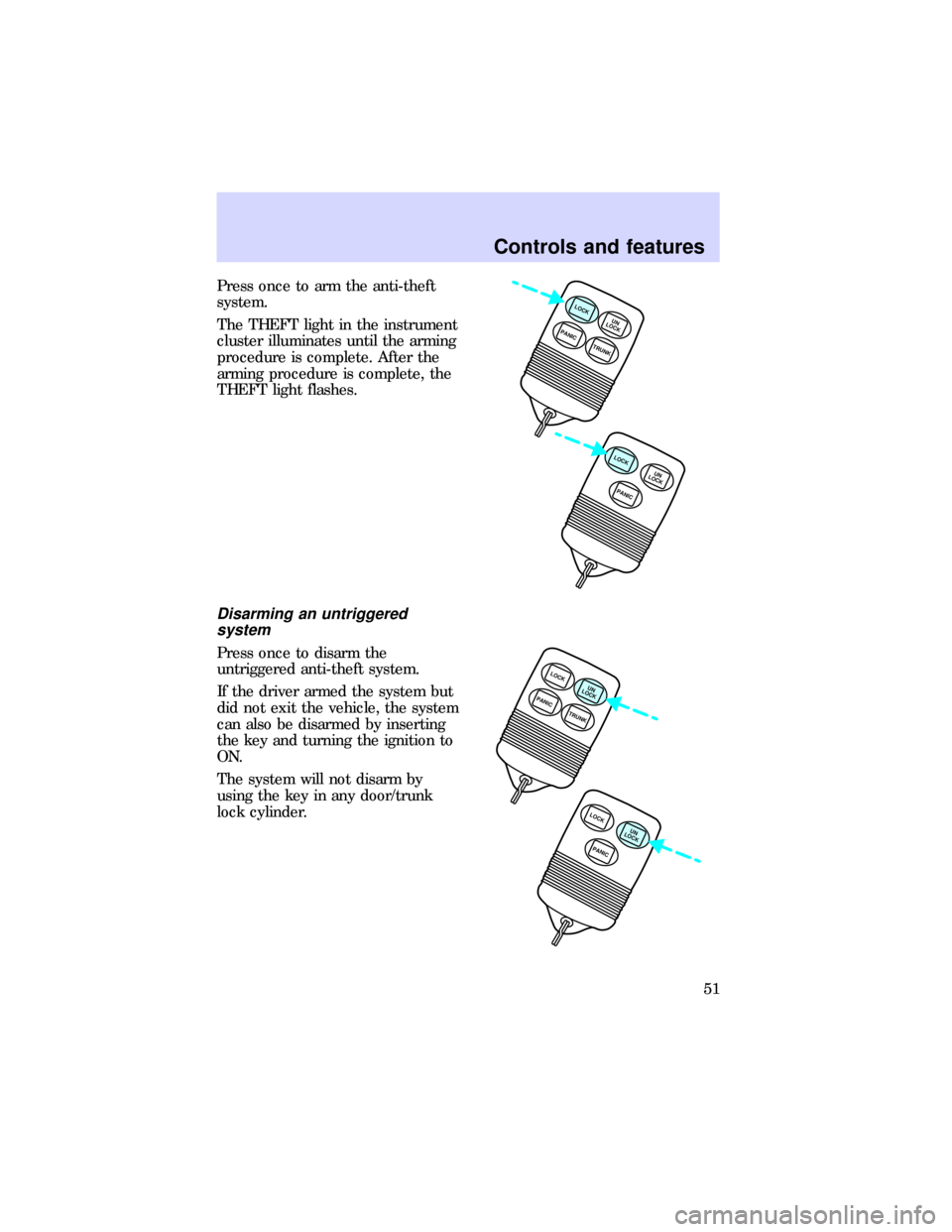
Press once to arm the anti-theft
system.
The THEFT light in the instrument
cluster illuminates until the arming
procedure is complete. After the
arming procedure is complete, the
THEFT light flashes.
Disarming an untriggered
system
Press once to disarm the
untriggered anti-theft system.
If the driver armed the system but
did not exit the vehicle, the system
can also be disarmed by inserting
the key and turning the ignition to
ON.
The system will not disarm by
using the key in any door/trunk
lock cylinder.
UN
LOCK
LOCK
PANIC
UN
LOCKLOCK
TRUNK
PANIC
UN
LOCK
LOCK
PANIC
UN
LOCKLOCK
TRUNK
PANIC
Controls and features
51
Page 62 of 191
SAFETY BELT INDICATOR
LIGHT AND WARNING CHIME
illuminates in the instrument
cluster and a chime sounds to
remind the occupants to fasten
their safety belts.
Conditions of operation
If...Then...
The driver's safety belt is not
buckled before the ignition key is
turned to ON...The safety belt indicator
illuminates for one to two minutes
and the warning chime sounds for
4-8 seconds.
The driver's side safety belt is
buckled while the indicator light is
illuminated and the warning
chime is sounding...The safety belt indicator light and
the warning chime turn off.
The driver's safety belt is buckled
before the ignition key is turned
to ON...The safety belt indicator light and
warning chime remain off.
AIR BAG PRECAUTIONS
Your vehicle is equipped with an
air bag supplemental restraint
system (SRS) designed to work
with the safety belts to help
protect you and your right front
seat passenger in the event of a
collision.
All occupants of the
vehicle, including the
driver, should always wear their
safety belts, even when an air
bag SRS is provided.
Seating and safety restraints
62
Page 64 of 191
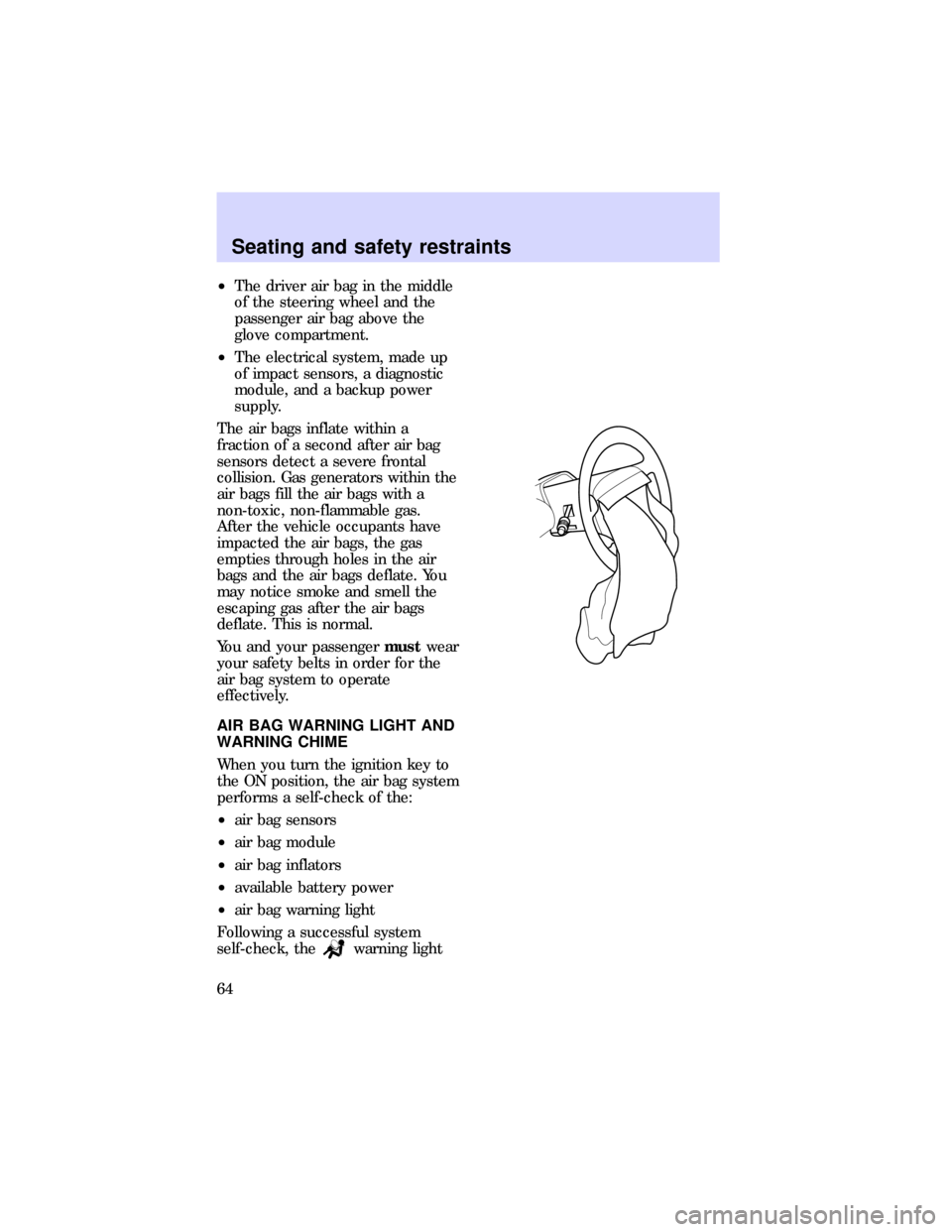
²The driver air bag in the middle
of the steering wheel and the
passenger air bag above the
glove compartment.
²The electrical system, made up
of impact sensors, a diagnostic
module, and a backup power
supply.
The air bags inflate within a
fraction of a second after air bag
sensors detect a severe frontal
collision. Gas generators within the
air bags fill the air bags with a
non-toxic, non-flammable gas.
After the vehicle occupants have
impacted the air bags, the gas
empties through holes in the air
bags and the air bags deflate. You
may notice smoke and smell the
escaping gas after the air bags
deflate. This is normal.
You and your passengermustwear
your safety belts in order for the
air bag system to operate
effectively.
AIR BAG WARNING LIGHT AND
WARNING CHIME
When you turn the ignition key to
the ON position, the air bag system
performs a self-check of the:
²air bag sensors
²air bag module
²air bag inflators
²available battery power
²air bag warning light
Following a successful system
self-check, the
warning light
Seating and safety restraints
64
Page 65 of 191
in the instrument cluster
illuminates for approximately six
seconds to indicate that the
system is functional.
If you hear a group of five beeps,
or if the
warning light does
not illuminate, stays lit, or flashes,
the air bag system requires
immediate service. Have the
vehicle serviced by your dealer.
CHILD RESTRAINT
PRECAUTIONS
You are required by law to use
safety restraints for children in the
United States and Canada. If small
children ride in your vehicle
(generally children who are four
years of age or younger and who
weigh 18 kg [40 lb] or less), you
must put them in safety seats
made specially for children. Check
your local and state laws for
specific requirements regarding the
safety of your children.
Never let a passenger hold
a child on his or her lap
while the vehicle is moving. The
passenger cannot protect the
child from injury in a collision.
Always follow the instructions and
warnings that come with any infant
or child restraint you might use.
If possible, place children in the
rear seat of your vehicle. Accident
statistics suggest that children are
safer when properly restrained in
rear seating positions than when
Seating and safety restraints
65
Page 88 of 191
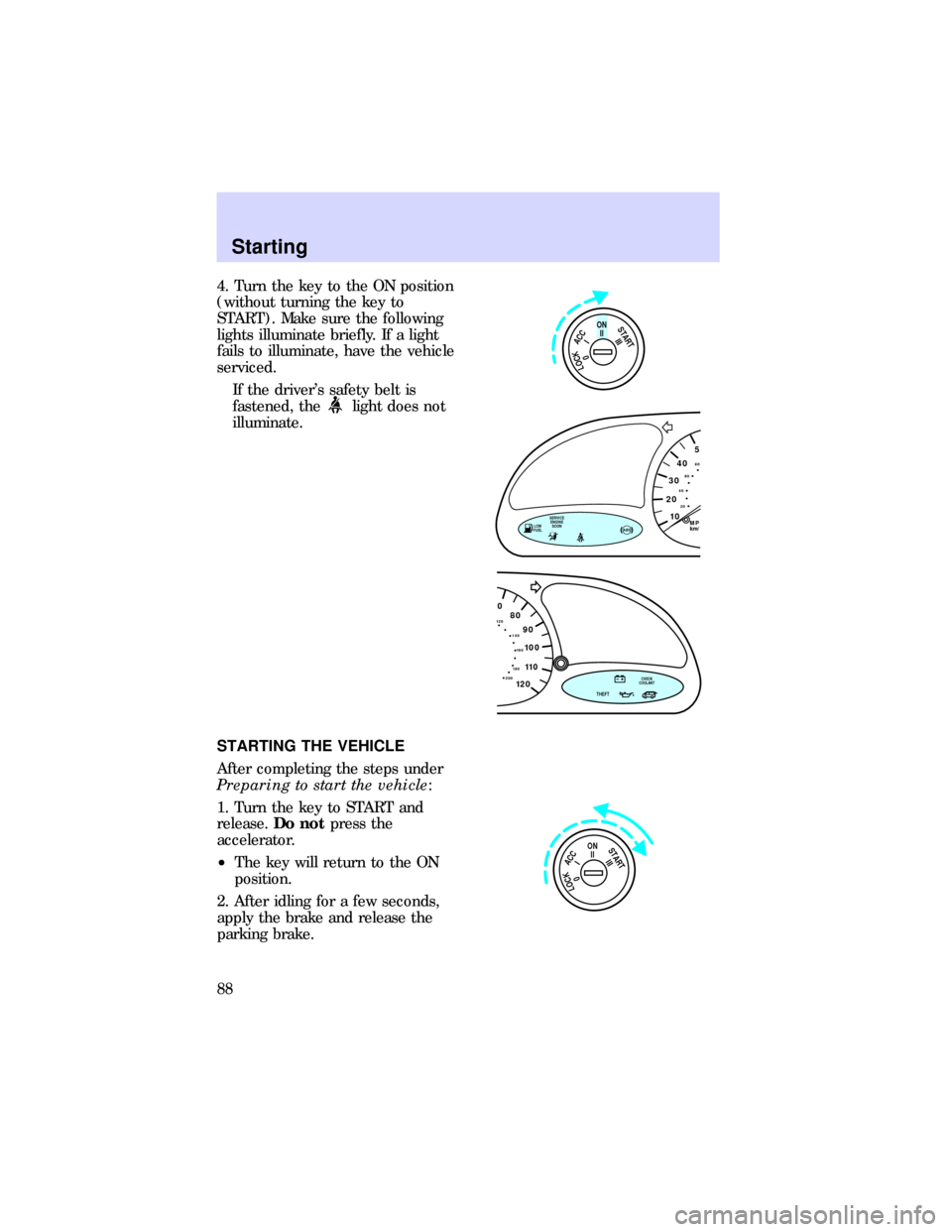
4. Turn the key to the ON position
(without turning the key to
START). Make sure the following
lights illuminate briefly. If a light
fails to illuminate, have the vehicle
serviced.
If the driver's safety belt is
fastened, the
light does not
illuminate.
STARTING THE VEHICLE
After completing the steps under
Preparing to start the vehicle:
1. Turn the key to START and
release.Do notpress the
accelerator.
²The key will return to the ON
position.
2. After idling for a few seconds,
apply the brake and release the
parking brake.
ON
II
ACC
I
LOCK
0
START
III
MP
km/10 203040520 4060
80
SERVICE
ENGINE
SOON
LOW
FUELABS
0
80
90
10 0
12 011 012 0
16 0
18 0 140
200
CHECK
COOLANTTHEFT
ON
II
ACC
I
LOCK
0
START
III
Starting
88
Page 93 of 191
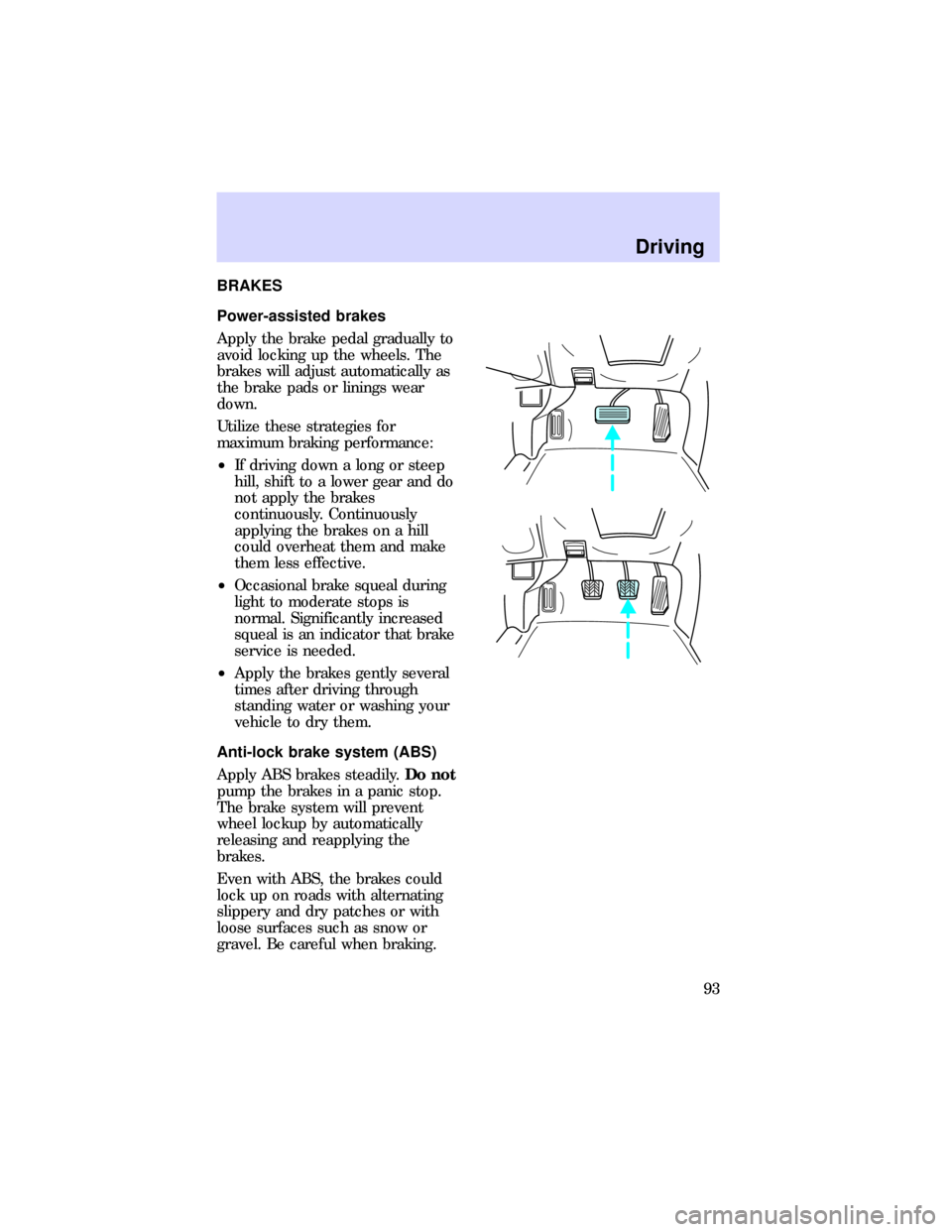
BRAKES
Power-assisted brakes
Apply the brake pedal gradually to
avoid locking up the wheels. The
brakes will adjust automatically as
the brake pads or linings wear
down.
Utilize these strategies for
maximum braking performance:
²If driving down a long or steep
hill, shift to a lower gear and do
not apply the brakes
continuously. Continuously
applying the brakes on a hill
could overheat them and make
them less effective.
²Occasional brake squeal during
light to moderate stops is
normal. Significantly increased
squeal is an indicator that brake
service is needed.
²Apply the brakes gently several
times after driving through
standing water or washing your
vehicle to dry them.
Anti-lock brake system (ABS)
Apply ABS brakes steadily.Do not
pump the brakes in a panic stop.
The brake system will prevent
wheel lockup by automatically
releasing and reapplying the
brakes.
Even with ABS, the brakes could
lock up on roads with alternating
slippery and dry patches or with
loose surfaces such as snow or
gravel. Be careful when braking.
Driving
93
Page 94 of 191
The ABS brake system conducts a
self-test each time the vehicle is
driven. A mechanical noise may be
heard while the system conducts
its self-test.
ABS warning light
TheABSlight in the instrument
cluster illuminates and remains
illuminated if an ABS fault is
detected. Have your vehicle
serviced by a qualified service
technician as soon as possible.
Normal braking operation is still
effective unless the
P!BRAKElight is
also illuminated.
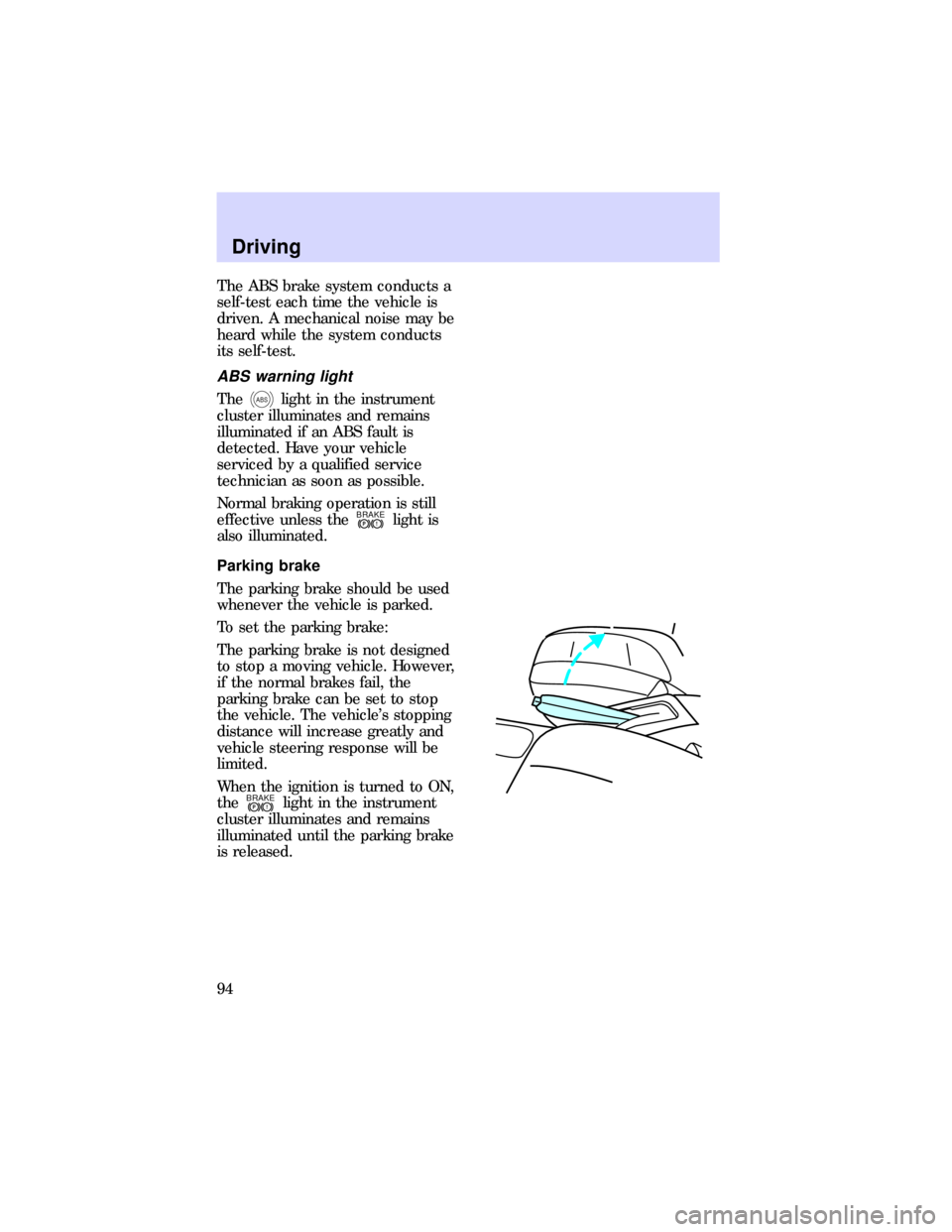
Parking brake
The parking brake should be used
whenever the vehicle is parked.
To set the parking brake:
The parking brake is not designed
to stop a moving vehicle. However,
if the normal brakes fail, the
parking brake can be set to stop
the vehicle. The vehicle's stopping
distance will increase greatly and
vehicle steering response will be
limited.
When the ignition is turned to ON,
the
P!BRAKElight in the instrument
cluster illuminates and remains
illuminated until the parking brake
is released.
Driving
94
Page 95 of 191
If the parking brake is fully
released but the
P!BRAKEwarning light remains on,
have the brakes checked
immediately. They may not be
working properly.
Always set the parking
brake fully and make sure
that the gearshift is securely
latched in P (automatic
transaxle) or first gear (manual
transaxle).
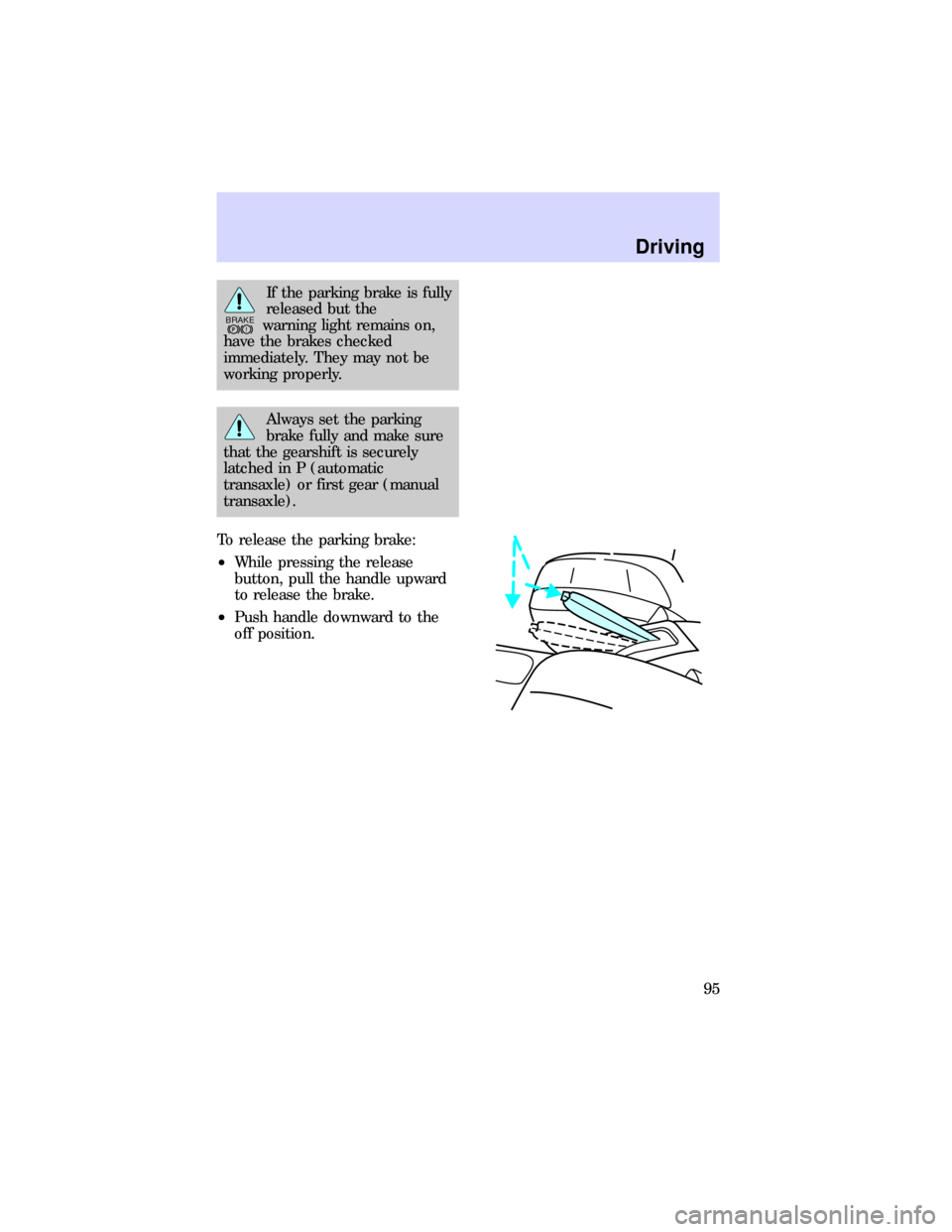
To release the parking brake:
²While pressing the release
button, pull the handle upward
to release the brake.
²Push handle downward to the
off position.
Driving
95