light FORD ESCORT 1997 7.G Owner's Manual
[x] Cancel search | Manufacturer: FORD, Model Year: 1997, Model line: ESCORT, Model: FORD ESCORT 1997 7.GPages: 191, PDF Size: 2.02 MB
Page 98 of 191
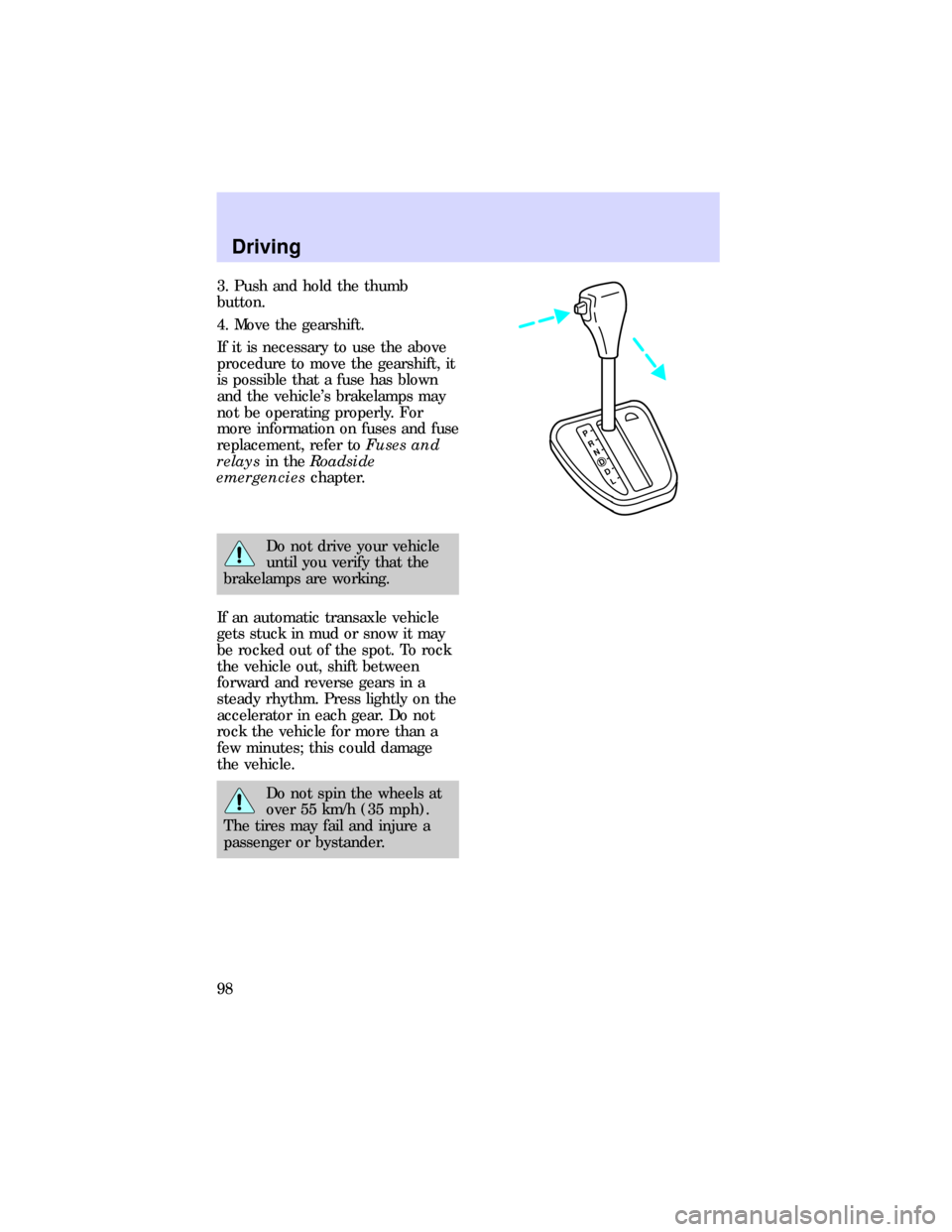
3. Push and hold the thumb
button.
4. Move the gearshift.
If it is necessary to use the above
procedure to move the gearshift, it
is possible that a fuse has blown
and the vehicle's brakelamps may
not be operating properly. For
more information on fuses and fuse
replacement, refer toFuses and
relaysin theRoadside
emergencieschapter.
Do not drive your vehicle
until you verify that the
brakelamps are working.
If an automatic transaxle vehicle
gets stuck in mud or snow it may
be rocked out of the spot. To rock
the vehicle out, shift between
forward and reverse gears in a
steady rhythm. Press lightly on the
accelerator in each gear. Do not
rock the vehicle for more than a
few minutes; this could damage
the vehicle.
Do not spin the wheels at
over 55 km/h (35 mph).
The tires may fail and injure a
passenger or bystander.
P
R
N
D
D
L
Driving
98
Page 100 of 191

Upshifting
For normal acceleration:
Upshift from... At the following speed:
1 to 2 22 km/h (14 mph)
2 to 3 40 km/h (25 mph)
3 to 4 58 km/h (36 mph)
4 to 5 72 km/h (45 mph)
For cruising:
Upshift from... At the following speed:
1 to 2 18 km/h (11 mph)
2 to 3 35 km/h (22 mph)
3 to 4 51 km/h (32 mph)
4 to 5 66 km/h (41 mph)
Upshift light (if equipped)
Thelight in the instrument
cluster illuminates to indicate
when to shift for the best fuel
economy. The vehicle will not be
harmed if the transaxle is not
shifted when the light illuminates,
but the vehicle will use more fuel.
The
light can be ignored when
you are:
²downshifting
²driving on steep hills
²using the engine to brake the
vehicle
²seeking more power for a
difficult acceleration
To maximize gearshift
performance:
Driving
100
Page 104 of 191
and change the weight on the
hitch.
Using trailer brakes
Use electric brakes or manual,
automatic, or surge-type hydraulic
brakes that meet federal and local
regulations. Install and adjust the
brakes according to the
manufacturer's instructions.
Do not connect a trailer's
hydraulic brake system
directly to your vehicle's brake
system. Your vehicle may not
have enough braking power and
your chances of having a
collision greatly increase.
Using safety chains
Always connect the trailer's safety
chains to the vehicle. To connect
the chains, cross the chains under
the trailer tongue and attach to the
vehicle frame or hook retainers
(not the bumper). Make sure there
is enough slack to allow the vehicle
to turn corners.
Using trailer lamps
See your local trailer dealer or
rental agency for the proper
instructions and equipment for
hooking up trailer lamps.
Do not hook the trailer lights
directly into the vehicle's lighting
system wiring. If the trailer lamps
are not installed properly, the
warning lights in the instrument
cluster may not work properly.
Driving
104
Page 111 of 191

Fuse rating Color
10 amp Red
15 amp Blue
20 amp Yellow
30 amp Light Green
30 amp fuse link Pink
40 amp Green
60 amp fuse link Yellow
80 amp fuse link Black
100 amp fuse link Blue
Instrument panel fuse panel
Number Fuse amperage
ratingCircuits protected
1 Stop 15 amp Brakelamps, shift lock
2 Tail 15 amp Instrument cluster
illumination, license
plate lamp, parking
lamps, side marker
lamps, tail lamps,
(radio, climate control
illumination)
3 Sun roof Ð Not used
4 ASC 10 amp Speed control
5 Ð Ð Not used
6 (Door lock) 30 amp Power door locks
7 Horn 15 amp Horn
8 (Air Conditioning) 15 amp A/C, clutch
Roadside emergencies
111
Page 112 of 191

Number Fuse amperage
ratingCircuits protected
9 Meter 10 amp Backup lamps, shift
lock, gauges, speed
control, turn signals,
key-in-ignition
reminder chime
10 Wiper 20 amp Windshield wipers
and washer
11 (Rear wiper) 10 amp Rear wiper and
washer
12 Hazard 15 amp Hazard flashers, turn
signals
13 Room 10 amp Clock, interior lamp,
luggage compartment
lamp, safety belt
warning chime, radio
power
14 Engine 15 amp Engine control system
15 Mirrors 5 amp Power mirrors
16 Ð Ð Not used
17 Ð Ð Not used
18 (Fog) 10 amp Daytime running
lamps / fog lamps
19 Ð Ð Not used
20 Cigar 20 amp Cigar lighter
21 (Radio) 15 amp Radio (Premium
sound)
Roadside emergencies
112
Page 124 of 191

SERVICE RECOMMENDATIONS
Whenever possible, Ford has
designed parts that do not require
servicing. However when servicing
is required, Ford's goal is to make
servicing your vehicle as easy as
possible. To help you:
²We highlight do-it-yourself items
in the engine compartment for
easy location.
²Often, parts (such as the
headlamp bulbs) may be
replaced without tools.
²We provide you with aService
Guidethat makes tracking
routine service of your vehicle
easy.
If your vehicle requires
professional servicing, your
dealership can provide the
necessary parts and service. Check
theWarranty Information Guide
to find out what parts and services
are covered. Use only
recommended fuels, lubricants,
fluids, and service parts
conforming to Ford specifications.
Motorcraft parts are designed and
built to provide the best
performance in your vehicle.
Precautions for servicing your
vehicle
Be particularly careful when
inspecting or servicing your
vehicle. Here are some general
precautions for your safety:
Maintenance and care
124
Page 156 of 191

Octane Recommendation
Your vehicle is designed to use regular gasoline with an (R+M)/2
octane rating of 87. We do not recommend gasolines labeled as
``regular'' in high altitude areas that are sold with octane ratings
of 86 or even less.
Do not be concerned if your
vehicle sometimes knocks lightly.
However, if it knocks heavily under
most driving conditions on the
recommended octane fuel, see
your dealer or a qualified service
technician to prevent any engine
damage.
Fuel Quality
If you are experiencing starting,
rough idle or hesitation problems,
try a different brand of fuel. If the
condition persists, see your dealer
or a qualified service technician.
The American Automobile
Manufacturers Association (AAMA)
issued a gasoline specification to
provide information on high quality
fuels that optimize the
performance of your vehicle. We
recommend the use of gasolines
that meet the AAMA specification
if they are available.
It should not be necessary to add
any aftermarket products to your
fuel tank if you continue to use a
high-quality fuel.
Cleaner Air
Ford approves the use of gasolines
to improve air quality, including
reformulated gasolines, that
contain oxygenates such as a
Maintenance and care
156
Page 157 of 191

maximum of 10% ethanol or 15%
MTBE. There should be no more
than 5% methanol with cosolvents
and additives to protect the fuel
system.
WHAT YOU SHOULD KNOW
ABOUT THE EMISSION
CONTROL SYSTEM
For more information on your
vehicle's emission control system,
see the Vehicle Emission Control
Information Decal located on the
inside left side of the engine
compartment.
The catalytic converter enables the
vehicle's emission control system
to operate properly.
Follow these guidelines to ensure
proper emission system operation:
²Use only unleaded fuel.
²Avoid running out of fuel.
²Do not turn off the ignition
while your vehicle is in motion.
²Have maintenance performed
according to the intervals in the
Service Guide.
If you notice one or more of the
following, the emission system may
not be working properly; have the
vehicle serviced as soon as
possible:
²fluid leaks
²
,,, lights
illuminate in the instrument
cluster and remain lit
²strange odors
Maintenance and care
157
Page 162 of 191
Headlamps
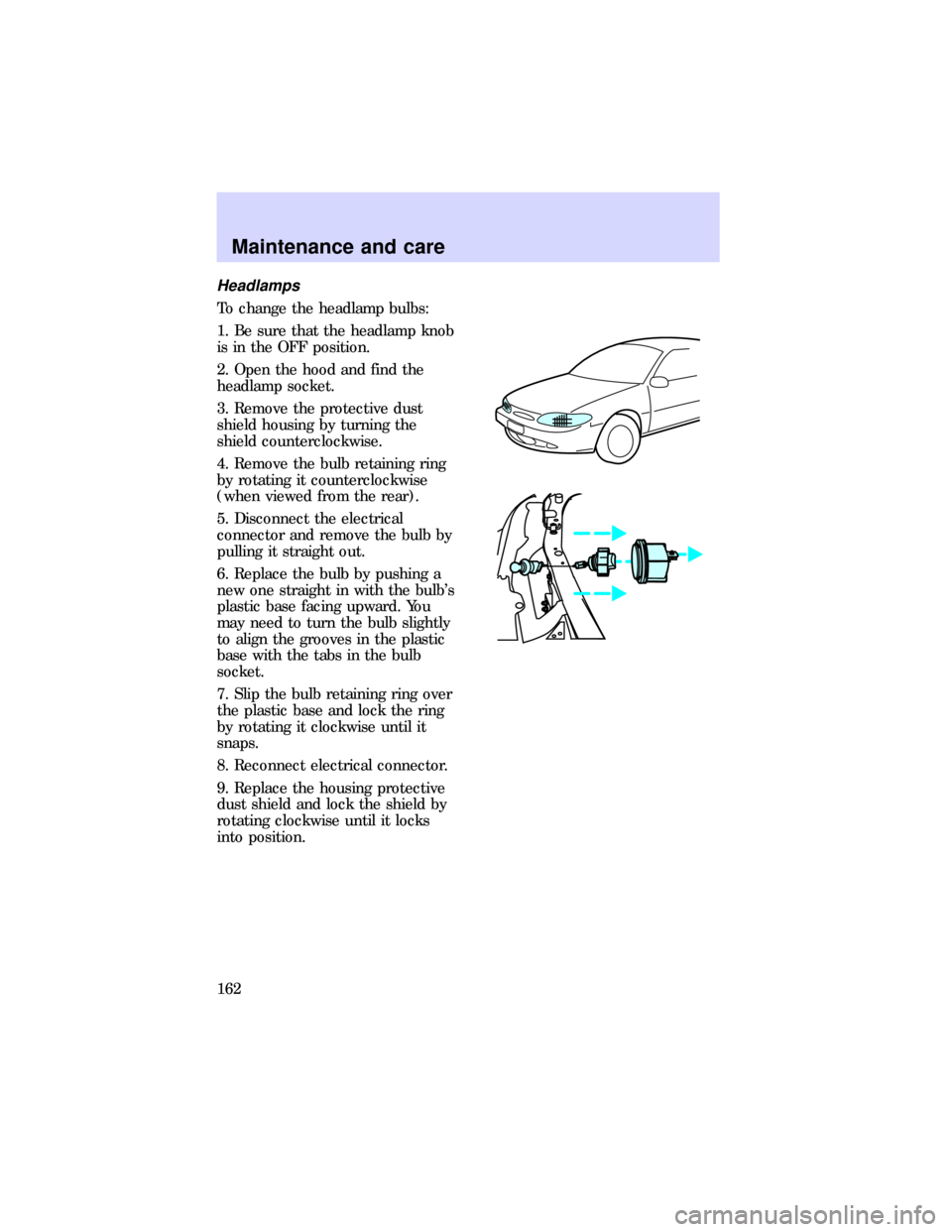
To change the headlamp bulbs:
1. Be sure that the headlamp knob
is in the OFF position.
2. Open the hood and find the
headlamp socket.
3. Remove the protective dust
shield housing by turning the
shield counterclockwise.
4. Remove the bulb retaining ring
by rotating it counterclockwise
(when viewed from the rear).
5. Disconnect the electrical
connector and remove the bulb by
pulling it straight out.
6. Replace the bulb by pushing a
new one straight in with the bulb's
plastic base facing upward. You
may need to turn the bulb slightly
to align the grooves in the plastic
base with the tabs in the bulb
socket.
7. Slip the bulb retaining ring over
the plastic base and lock the ring
by rotating it clockwise until it
snaps.
8. Reconnect electrical connector.
9. Replace the housing protective
dust shield and lock the shield by
rotating clockwise until it locks
into position.
Maintenance and care
162
Page 172 of 191

BULB SPECIFICATIONS
Function Number of
bulbsTrade number
Exterior illumination
Front park/turn lamps 2 3457
Foglamps (if equipped) 2 881
Headlamps Ð aero high and low
beam2 9007
Rear license plate lamp 2 168
High-mount brakelamp 1 921
Notchback Ð Backup lamp 2 3156
Notchback Ð Brakelamp 2 3157
Notchback Ð Rear/turn/side
marker2 3157
Liftgate wagon rear side marker
lamp2
(1 each side)168
Interior illumination
Cargo lamp liftgate (wagon) 1 12V/5W
Interior overhead lamp 2 12V/10W
Luggage compartment lamp (if
equipped)15W
PRNDL illumination 1 197
Heater control nomenclature 1 14V/3.0
High beam indicator 1 W
Instrument panel gauge (cluster) 4 194
Sport cluster w/ tachometer 2 194
Turn signal indicator 1 194
Upshift indicator (if equipped) (1 each) 194
Warning lights Ð all 194
Maintenance and care
172