ignition FORD ESCORT 1998 7.G User Guide
[x] Cancel search | Manufacturer: FORD, Model Year: 1998, Model line: ESCORT, Model: FORD ESCORT 1998 7.GPages: 191, PDF Size: 1.51 MB
Page 40 of 191
The all-door remote entry system
allows you to:
²lock or unlock all vehicle doors
without a key.
²arm and disarm the anti-theft
system. (For more information
on the anti-theft system, refer to
Anti-theft systemin this
chapter.)
²open the trunk.
²activate the panic alarm.
The driver's door only entry
system allows you to:
²lock the driver's door and
liftgate (wagons)
²unlock the driver's door only
without a key.
²activate the panic alarm.
²open the trunk or unlock liftgate
(wagons).
The remote entry features only
operate with the ignition in the
OFF position.
Unlocking the doors
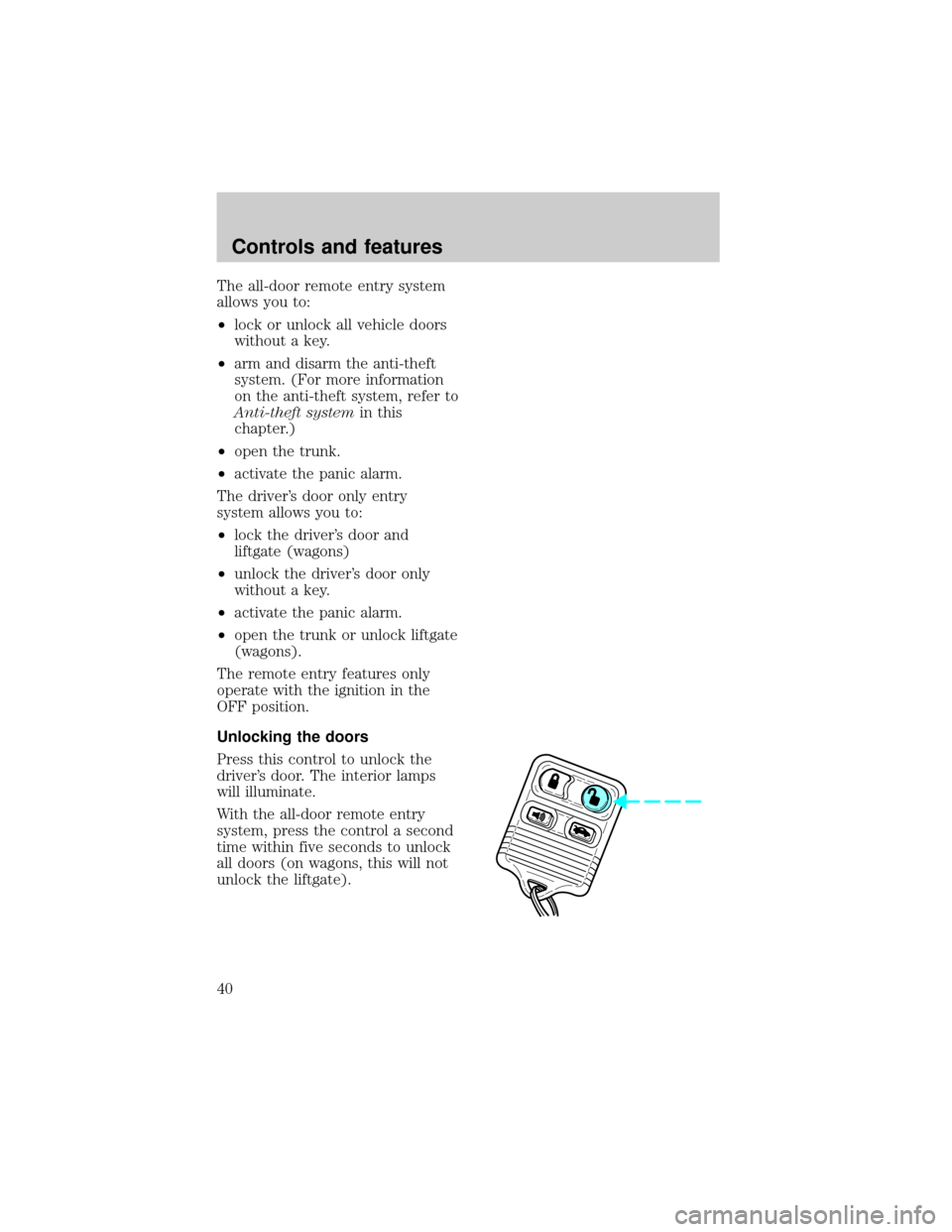
Press this control to unlock the
driver's door. The interior lamps
will illuminate.
With the all-door remote entry
system, press the control a second
time within five seconds to unlock
all doors (on wagons, this will not
unlock the liftgate).
Controls and features
40
Page 42 of 191

Sounding a panic alarm
Press this control to activate the
alarm.
To deactivate the alarm, press the
control again or turn the ignition
to ACC or ON.
This device complies with part 15
of the FCC rules and with RS-210
of Industry Canada. Operation is
subject to the following two
conditions: (1) This device may
not cause harmful interference,
and (2) This device must accept
any interference received,
including interference that may
cause undesired operation.
Changes or modifications not
expressly approved by the
party responsible for
compliance could void the
user's authority to operate the
equipment.
Replacing the batteries
The transmitter is powered by two
coin type three-volt lithium
batteries. Typical operating range
will allow you to be up to 10
meters (33 feet) away from your
vehicle. A decrease in operating
range can be caused by:
²battery failure
²weather conditions
²nearby radio towers
²structures around the vehicle
²other vehicles parked next to
the vehicle
To replace the batteries:
Controls and features
42
Page 43 of 191

1. Twist a thin coin between the
two halves of the transmitter. DO
NOT TAKE THE FRONT PART OF
THE TRANSMITTER APART.
2. Place the positive (+) side of
new batteries down. Refer to the
diagram inside the transmitter
unit.
3. Snap the two halves back
together.
Replacing lost transmitters
Take all your vehicle's transmitters
to your dealer for reprogramming
if:
²a transmitter is lost or
²you want to purchase additional
transmitters (up to four may be
programmed).
To reprogram the transmitters,
place the key in the ignition and
switch from OFF to ON eight times
in rapid succession (within 10
seconds). After doors lock/unlock,
press any button on all
transmitters (up to four). With
each button press of the
transmitters, the door should cycle
(lock/unlock) to confirm
programming. When completed,
switch the ignition to OFF. The
door locks should cycle
(lock/unlock) one last time to
confirm completion of
programming.
Controls and features
43
Page 44 of 191
All transmitters must be
programmed at the same time.
Illuminated entry
Interior lamps will illuminate when
UNLOCK is pressed. The lamps
will illuminate for approximately 20
seconds or until the key is inserted
in the ignition and turned to ON or
until LOCK is pressed. The dome
lamp must be set to the DOOR
position in order for the
illuminated entry system to
operate.
ANTI-THEFT SYSTEM
(IF EQUIPPED)
When armed, the anti-theft system
will help protect your vehicle from
unauthorized entry.
Arming the anti-theft system
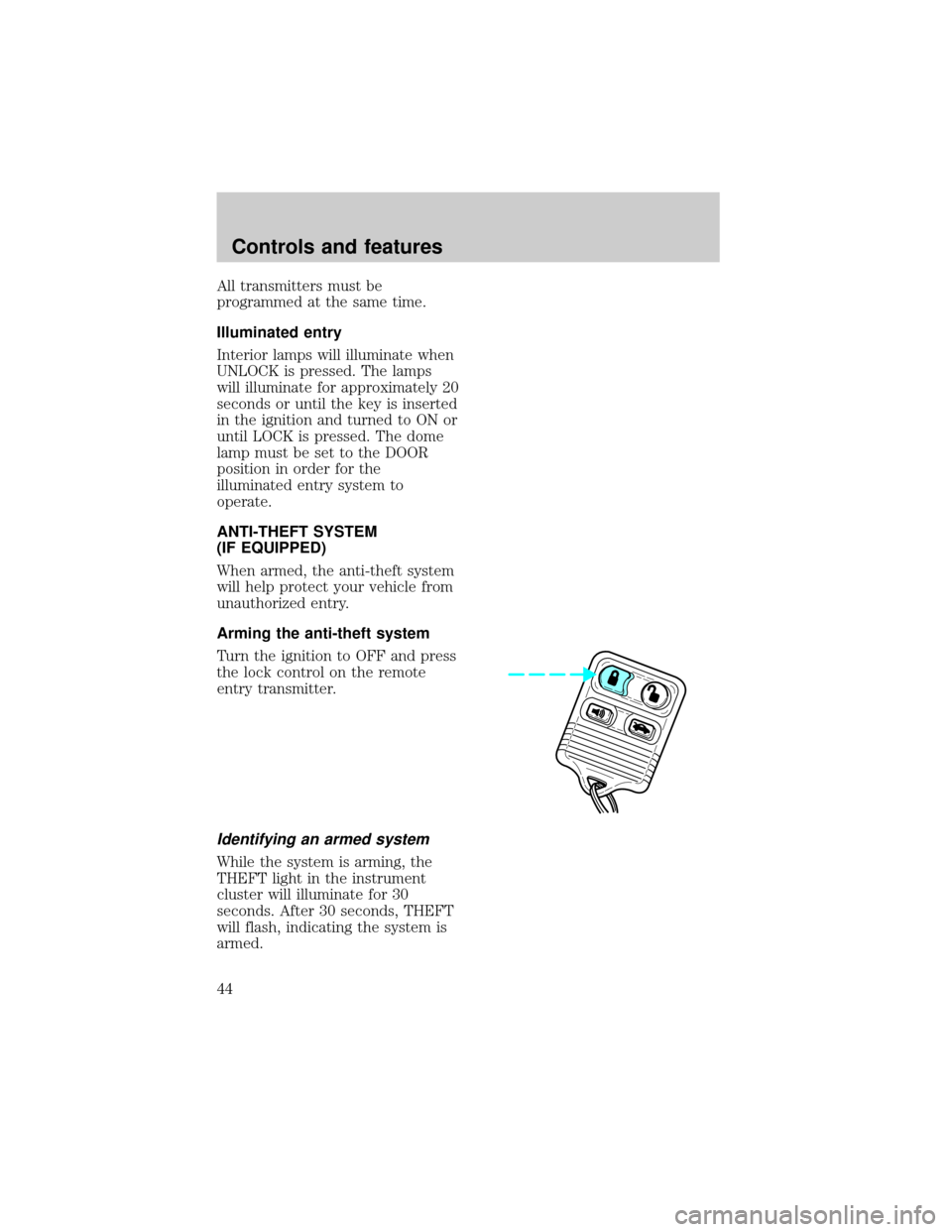
Turn the ignition to OFF and press
the lock control on the remote
entry transmitter.
Identifying an armed system
While the system is arming, the
THEFT light in the instrument
cluster will illuminate for 30
seconds. After 30 seconds, THEFT
will flash, indicating the system is
armed.
Controls and features
44
Page 45 of 191

If the system is arming with the
doors open, the THEFT light will
stay illuminated until all the doors
are closed and then illuminate for
30 seconds and begin flashing.
When an unauthorized entry
occurs, the activated system will:
²flash the parking lamps and the
THEFT light
²sound the horn
The flashing parklamps and the
honking horn automatically shut
off after about three minutes and
will remain off unless another
unauthorized entry is attempted.
Disarming the anti-theft system
Disarming an untriggered
anti-theft system
Press the unlock control to disarm
the untriggered system. If the
driver armed the system but did
not exit the vehicle, disarm the
system by inserting the key and
turning the ignition to ON/ACC.
Using the ignition key to unlock
doors/trunk/liftgate will not disarm
the anti-theft system.
Controls and features
45
Page 46 of 191

Disarming a triggered anti-theft
system
Press either the unlock or panic
control to disarm the system.
A triggered system may also be
disarmed by inserting the key and
turning the ignition to ACC or ON.
Controls and features
46
Page 57 of 191

belt extension only if the safety
belt is too short for you when fully
extended. Do not use extensions
to change the fit of the shoulder
belt across the torso.
Safety belt warning light and
indicator chime
The seat belt warning light
illuminates in the instrument
cluster and a chime sounds to
remind the occupants to fasten
their safety belts.
Conditions of operation
If... Then...
The driver's safety belt is not
buckled before the ignition key
is turned to ON...The safety belt warning light
illuminates for one to two minutes and
the warning chime sounds for four to
eight seconds.
The driver's safety belt is
buckled while the indicator
light is illuminated and the
warning chime is sounding...The safety belt warning light turns off.
The driver's safety belt is
buckled before the ignition key
is turned to ON...The safety belt warning light remains
off.
Safety belt maintenance
Check the safety belt systems
periodically to make sure they
work properly and are not
damaged. Check the safety belts to
make sure there are no nicks,
wears or cuts. All safety belt
assemblies, including retractors,
buckles, front seat belt buckle
assemblies (slide bar)(if
Seating and safety restraints
57
Page 63 of 191

A difficulty with the system is
indicated by one or more of the
following:
²The readiness light will either
flash or stay lit.
²The readiness light will not
illuminate immediately after
ignition is turned on.
²A series of five beeps will be
heard. The tone pattern will
repeat periodically until the
problem and light are repaired.
If any of these things happen, even
intermittently, have the SRS
serviced at your dealership or by a
qualified technician immediately.
Unless serviced, the system may
not function properly in the event
of a collision.
Disposal of air bags and air bag
equipped vehicles
For disposal of air bags or air bag
equipped vehicles, see your local
dealership or qualified technician.
Air bags MUST BE disposed of by
qualified personnel.
SAFETY RESTRAINTS FOR
CHILDREN
Important child restraint
precautions
You are required by law to use
safety restraints for children in the
U.S. and Canada. If small children
ride in your vehicle (generally
children who are four years old or
younger and who weigh 18 kg
[40 lbs] or less), you must put
Seating and safety restraints
63
Page 80 of 191
PREPARING TO START YOUR
VEHICLE
Engine starting is controlled by the
spark ignition system. This system
meets all Canadian
Interference-Causing Equipment
standard requirements regulating
the impulse electrical field strength
of radio noise.
When starting a fuel-injected
engine, avoid pressing the
accelerator before or during
starting. Only use the accelerator
when you have difficulty starting
the engine. For more information
on starting the vehicle, refer to
Starting the enginein this
chapter.
Extended idling at high
engine speeds can produce
very high temperatures in the
engine and exhaust system,
creating the risk of fire or other
damage.
Do not park, idle, or drive
your vehicle in dry grass
or other dry ground cover. The
emission system heats up the
engine compartment and exhaust
system, which can start a fire.
Starting
80
Page 89 of 191

enable you to avoid obstacles
and bring the vehicle to a
controlled stop.
²We recommend that you
familiarize yourself with this
braking technique. However,
avoid taking any unnecessary
risks.
Parking brake
Apply the parking brake whenever
the vehicle is parked. To set the
parking brake, pull the handle up.
The BRAKE warning lamp in the
instrument cluster illuminates and
remains illuminated (when the
ignition is turned ON) until the
parking brake is released.
The parking brake is not designed
to stop a moving vehicle. However,
if the normal brakes fail, the
parking brake can be used to stop
your vehicle in an emergency.
Since the parking brake applies
only the rear brakes, the vehicle's
stopping distance will be adversely
affected.
P!
BRAKE
Driving
89