ignition FORD ESCORT 1998 7.G Owner's Manual
[x] Cancel search | Manufacturer: FORD, Model Year: 1998, Model line: ESCORT, Model: FORD ESCORT 1998 7.GPages: 191, PDF Size: 1.51 MB
Page 91 of 191
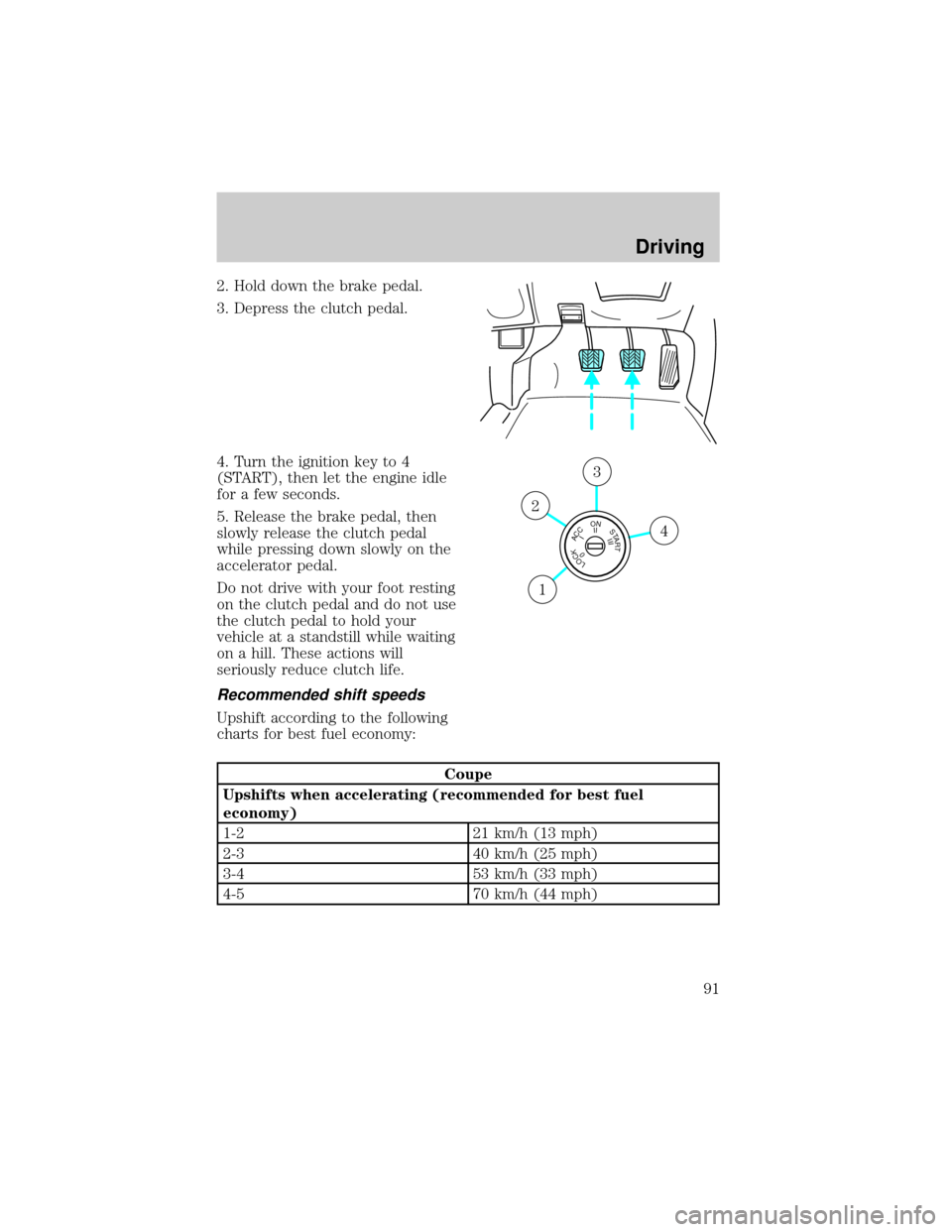
2. Hold down the brake pedal.
3. Depress the clutch pedal.
4. Turn the ignition key to 4
(START), then let the engine idle
for a few seconds.
5. Release the brake pedal, then
slowly release the clutch pedal
while pressing down slowly on the
accelerator pedal.
Do not drive with your foot resting
on the clutch pedal and do not use
the clutch pedal to hold your
vehicle at a standstill while waiting
on a hill. These actions will
seriously reduce clutch life.
Recommended shift speeds
Upshift according to the following
charts for best fuel economy:
Coupe
Upshifts when accelerating (recommended for best fuel
economy)
1-2 21 km/h (13 mph)
2-3 40 km/h (25 mph)
3-4 53 km/h (33 mph)
4-5 70 km/h (44 mph)
LOCKACCONSTART0IIIIII4
3
2
1
Driving
91
Page 97 of 191
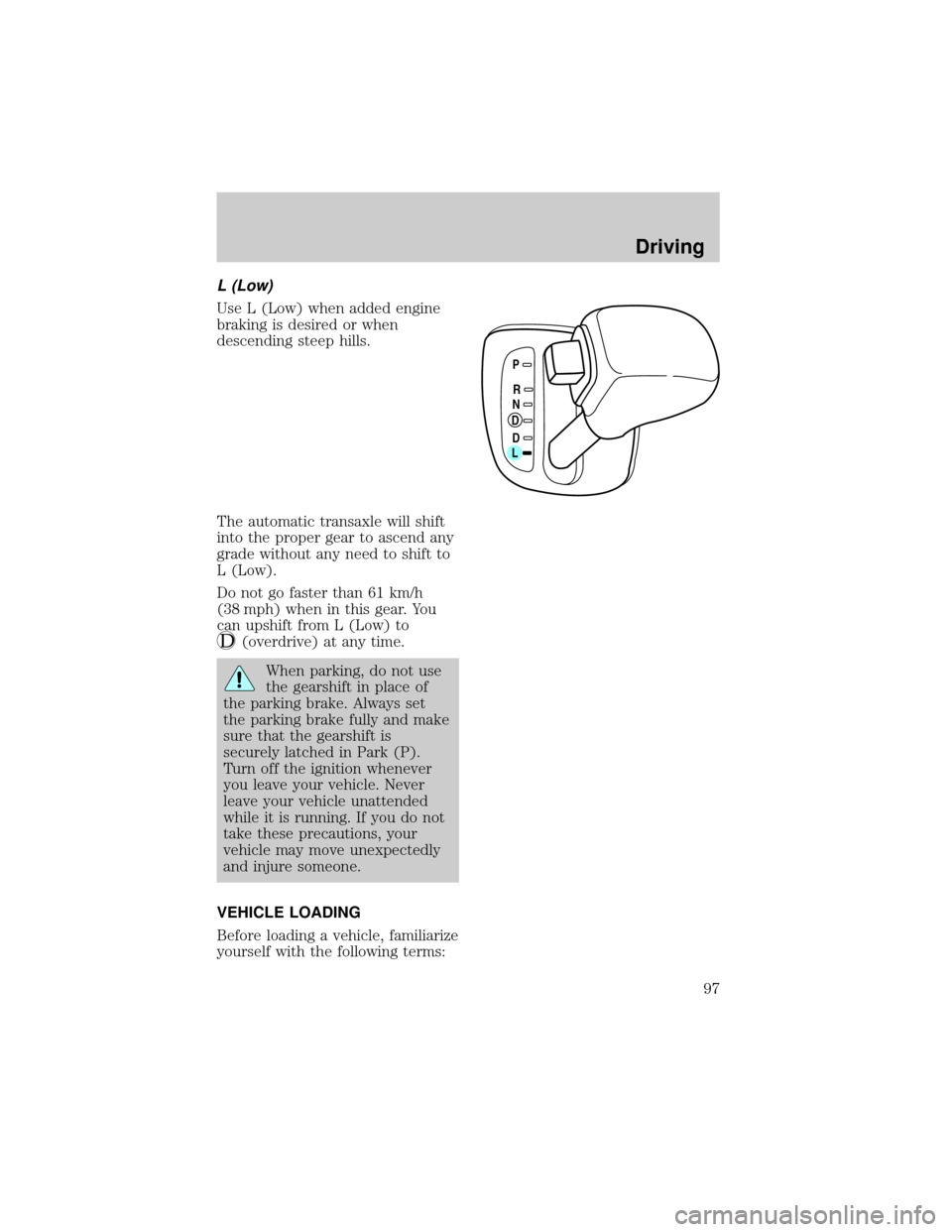
L (Low)
Use L (Low) when added engine
braking is desired or when
descending steep hills.
The automatic transaxle will shift
into the proper gear to ascend any
grade without any need to shift to
L (Low).
Do not go faster than 61 km/h
(38 mph) when in this gear. You
can upshift from L (Low) to
(overdrive) at any time.
When parking, do not use
the gearshift in place of
the parking brake. Always set
the parking brake fully and make
sure that the gearshift is
securely latched in Park (P).
Turn off the ignition whenever
you leave your vehicle. Never
leave your vehicle unattended
while it is running. If you do not
take these precautions, your
vehicle may move unexpectedly
and injure someone.
VEHICLE LOADING
Before loading a vehicle, familiarize
yourself with the following terms:
P
RN
D
DL
Driving
97
Page 104 of 191

HAZARD FLASHER
Use only in an emergency to warn
traffic of vehicle breakdown,
approaching danger, etc. The
hazard flashers can be operated
when the ignition is off.
²Slide the hazard flasher control
to the right to activate the
hazard flashers simultaneously.
²Slide the control to the left to
turn the flashers off.
FUEL PUMP SHUT-OFF SWITCH
If the engine cranks but does not
start after a collision, the fuel
pump shut-off switch may have
been activated. The shut-off switch
is a device intended to stop the
electric fuel pump when your
vehicle has been involved in a
substantial jolt.
1. Turn the ignition switch to the
OFF position.
2. Check the fuel system for leaks.
3. If no fuel leak is apparent, reset
the fuel pump shut-off switch by
pushing in the button on the
switch.
4. Turn the ignition switch to the
ON position. Pause for a few
seconds and return the key to the
OFF position.
5. Make a further check for leaks
in the fuel system.
Roadside emergencies
104
Page 107 of 191

Coupe
The fuses are coded as follows:
Fuse/Relay
LocationFuse Amp
RatingDescription
DRL 10A Daytime Running Lamps
HAZARD 15A Hazard Flasher
ROOM 10A Engine Controls, RAP System,
Radio, Shift Lock, Courtesy
Lamps, Starting System, Warning
Chime, Instrument Cluster
ENGINE 15A Electronic Automatic Transaxle,
Ignition System, Constant Control
Relay Module (PCM Relay)
RADIO 5A Power Mirrors, Radio, RAP
System
DOOR LOCK 30A Power Door Locks
HORN 15A Horn, Shift Lock
AIR COND 15A A/C-Heater, ABS
(DRL) (DOOR LK)
STOP
HAZARD HORN
TAIL
ROOM(AIR COND) (SUN ROOF)
ENGINE METER(ASC)
RADIO
WIPER
–P. Window (C.B.)
(FOG) CIGAR
(AUDIO)
AIR BAGFUEL INJ
HEATER
–
Roadside emergencies
107
Page 113 of 191

Fuse/Fuse Link
Cartridge
LocationFuse Amp
RatingDescription
MAIN 100A* Charging System, BTN, Cooling
Fan, Fuel Pump, OBD-II, ABS
Fuses, Ignition Switch, Headlamps
BTN 40A* Hazard
ABS 60A* ABS Main Relay
COOLING FAN 40A* Constant Control Relay Module
OBD-II 10A** Data Link Connector (DLC),
Instrument Cluster
FUEL PUMP 30A** Engine Controls
HEAD RH 10A** Headlamps
HEAD LH 10A** Headlamps
* Fuse Link Cartridge ** Fuse
Relays
Relays are located in the power
distribution box and should be
replaced by qualified technicians.
CHANGING THE TIRES
If you get a flat tire while driving,
do not apply the brake heavily.
Instead, gradually decrease your
speed. Hold the steering wheel
firmly and slowly move to a safe
place on the side of the road.
Roadside emergencies
113
Page 118 of 191
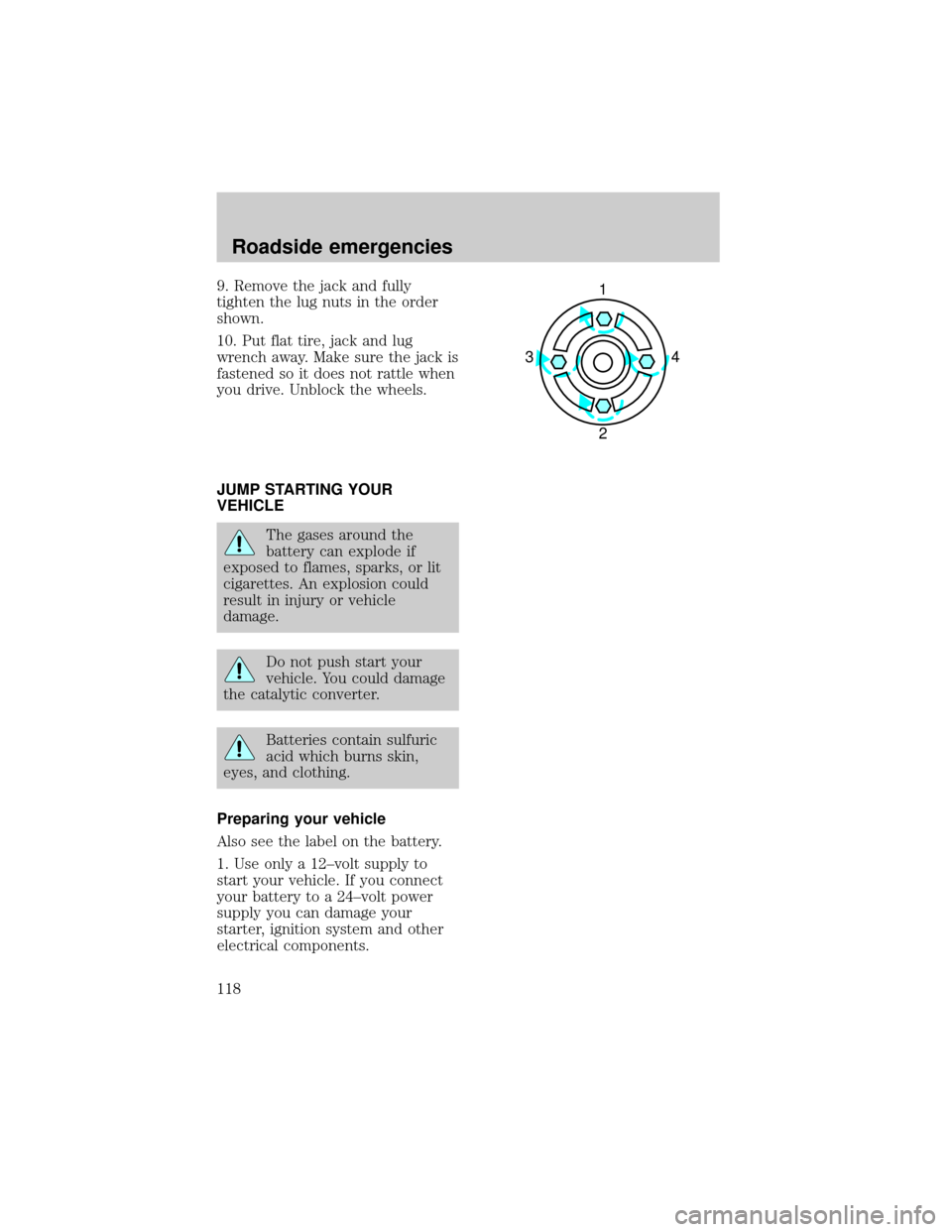
9. Remove the jack and fully
tighten the lug nuts in the order
shown.
10. Put flat tire, jack and lug
wrench away. Make sure the jack is
fastened so it does not rattle when
you drive. Unblock the wheels.
JUMP STARTING YOUR
VEHICLE
The gases around the
battery can explode if
exposed to flames, sparks, or lit
cigarettes. An explosion could
result in injury or vehicle
damage.
Do not push start your
vehicle. You could damage
the catalytic converter.
Batteries contain sulfuric
acid which burns skin,
eyes, and clothing.
Preparing your vehicle
Also see the label on the battery.
1. Use only a 12±volt supply to
start your vehicle. If you connect
your battery to a 24±volt power
supply you can damage your
starter, ignition system and other
electrical components.
1
4 3
2
Roadside emergencies
118
Page 149 of 191
make replacing the wipers easy,
turn the ignition to ACC, then turn
the wipers on. When the wipers
reach the vertical position, turn
the ignition to LOCK.
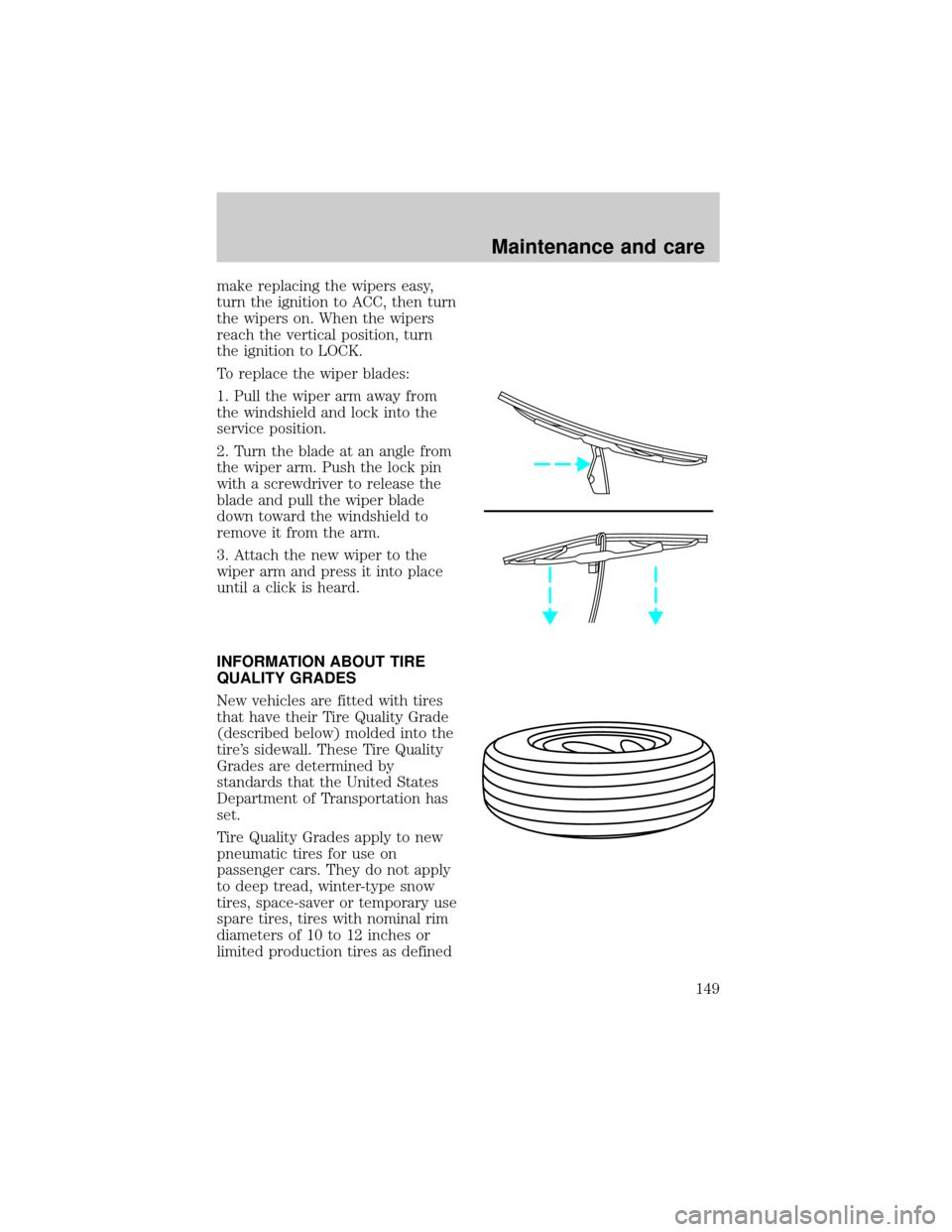
To replace the wiper blades:
1. Pull the wiper arm away from
the windshield and lock into the
service position.
2. Turn the blade at an angle from
the wiper arm. Push the lock pin
with a screwdriver to release the
blade and pull the wiper blade
down toward the windshield to
remove it from the arm.
3. Attach the new wiper to the
wiper arm and press it into place
until a click is heard.
INFORMATION ABOUT TIRE
QUALITY GRADES
New vehicles are fitted with tires
that have their Tire Quality Grade
(described below) molded into the
tire's sidewall. These Tire Quality
Grades are determined by
standards that the United States
Department of Transportation has
set.
Tire Quality Grades apply to new
pneumatic tires for use on
passenger cars. They do not apply
to deep tread, winter-type snow
tires, space-saver or temporary use
spare tires, tires with nominal rim
diameters of 10 to 12 inches or
limited production tires as defined
Maintenance and care
149
Page 160 of 191

EMISSION CONTROL SYSTEM
Your vehicle is equipped with
various emission control
components and a catalytic
converter which will enable your
vehicle to comply with applicable
exhaust emission standards. To
make sure that the catalytic
converter and other emission
control components continue to
work properly:
²Use only unleaded fuel.
²Avoid running out of fuel.
²Do not turn off the ignition
while your vehicle is moving,
especially at high speeds.
²Have the services listed in your
ªService Guideº performed
according to the specified
schedule.
The Scheduled Maintenance
Services listed in the ªService
Guideº are required because they
are considered essential to the life
and performance of your vehicle
and to its emissions system.
If other than Ford, Motorcraft or
Ford authorized parts are used for
maintenance replacements or for
service of components affecting
emission control such non-Ford
parts should be equivalent to
genuine Ford Motor Company
parts in performance and
durability.
Maintenance and care
160
Page 182 of 191

FluidFord Part
Name or
EquivalentFord Part
NumberFord
Specification
Lock cylinder Penetrating
lubricantE8AZ-19A501-B N/A
Automatic
transmissionMotorcraft
MERCONtAT FXT-2-QDX MERCONt
Manual
transmissionMotorcraft
MERCONtAT FXT-2-QDX MERCONt
Engine oil Motorcraft 5W30
Super Premium
Motor OilXO-5W30-QSP WSS-M2C153-G
and API
Certification
Mark
Constant
velocity jointsCV Joint Grease
(High Temp.)E43Z-19590-A ESP-M1C207-A
Engine coolant Ford Premium
Cooling System
FluidE2FZ-19549-AA ESE-M97B44-A
Power steering
reservoirMotorcraft
MERCONtAT FXT-2-QDX MERCONt
ENGINE DATA
Engine 2.0L-2V engine 2.0L-4V Zetec engine
Cubic inches 121 121
Horsepower 110 @ 5000 rpm 130 @ 5750 rpm
Torque 125 lb. ft. @
3750 rpm127 lb-ft. @ 4250 rpm
Required fuel grade 87 octane 87 octane
Firing order 1-3-4-2 1-3-4-2
Spark plug gap 1.3-1.4 mm
(0.052-.056 inch)1.22-1.32 mm
(0.048-.052 inch)
Ignition system DIS DIS
Capacities and specifications
182
Page 189 of 191

High beams
indicator light ...........................10
Hood
release lever ............................128
Ignition
positions of the ignition ...........26
Instrument panel
lighting up panel and
interior .......................................17
Jump-starting your
vehicle .................................118,120
attaching cables ......................119
disconnecting cables ..............120
Keys
key in ignition chime ...............12
Lamps
dome lamps ........................36,171
fog lamps .................................167
headlamps ...............................165
high-mount brakelamp ...........167
interior lamps ....................36,171
map lamps ..........................36,172
tail lamps .................................169
License plate lamps ..................171
Lights, warning and indicator
air bag ..........................................9
anti-lock brakes (ABS) ............10
anti-theft ...................................10
brake ..........................................10
charging system ........................11
check coolant ............................11
liftgate ajar ................................11
low fuel ........................................7
oil pressure ...............................11
safety belt ...................................9
service engine soon .................7,8
turn signal indicator .................10
Lubricant specifications ...........181
Luggage rack .............................103
Mirrors
side view mirrors (power) .......17
Moon roof ....................................35Odometer .....................................15
Panic alarm feature, remote
entry system ................................42
Parking brake ..............................89
Parts (see Motorcraft parts) ....180
Power steering
fluid, checking and adding ....142
Rear window
wiper ..........................................35
Refill capacities for fluids ........180
Relays .................................106,113
Remote entry system .................39
illuminated entry ......................44
locking/unlocking doors ......40,41
replacement/additional
transmitters ...............................43
replacing the batteries .............42
Reporting safety defects ..........187
Safety restraints
automatic locking mode
(retractor) ............................53,54
extension assembly ..................56
for children ...............................63
for second row bench
seats ............................73,74,78,79
lap and shoulder belts .............52
maintenance ..............................57
proper use .................................51
warning light and chime .....11,57
Safety seats for children
attaching with tether straps ....70
automatic locking mode
(retractor) .................................67
tether anchorage
hardware ..............................70,71
Seats ............................................47
adjusting the seat, manual .......47
folding rear seats ......................50
head restraints ..........................47
Servicing your vehicle ..............123
precautions when servicing ...123
Index
189