tow FORD ESCORT 1998 7.G User Guide
[x] Cancel search | Manufacturer: FORD, Model Year: 1998, Model line: ESCORT, Model: FORD ESCORT 1998 7.GPages: 191, PDF Size: 1.51 MB
Page 98 of 191

²Base Curb Weight: Weight of
the vehicle including any
standard equipment, fluids,
lubricants, etc. It does not
include passengers or
aftermarket equipment.
²Payload: Combined maximum
allowable weight of cargo,
passengers and optional
equipment. The payload equals
the gross vehicle weight rating
minus base curb weight.
²GVW (Gross Vehicle Weight):
Base curb weight plus payload
weight. The GVW is not a limit
or a specification.
²GVWR (Gross Vehicle Weight
Rating): Maximum total weight
of the base vehicle, passengers,
optional equipment and cargo.
The GVWR is specific to each
vehicle and is listed on the
Safety Compliance Label on the
driver's door pillar.
²GAWR (Gross Axle Weight
Rating): Carrying capacity for
each axle system. The GAWR is
specific to each vehicle and is
listed on the Safety Compliance
Label on the driver's door pillar.
²GCWR (Gross Combined
Weight Rating): Maximum
combined weight of towing
vehicle (including passengers
and cargo) and the trailer. The
GCWR indicates the maximum
loaded weight that the vehicle is
allowed to tow.
Driving
98
Page 99 of 191

²Maximum Trailer Weight
Rating: Maximum weight of a
trailer the vehicle is permitted
to tow. The maximum trailer
weight rating equals the vehicle
curb weight for each
engine/transmission
combination, any required
option weight for trailer towing
and the weight of the driver
from the GCWR for the towing
vehicle.
²Maximum Trailer Weight:
maximum weight of a trailer the
loaded vehicle (including
passengers and cargo) is
permitted to tow. It is
determined by subtracting the
weight of the loaded trailer
towing vehicle from the GCWR
for the towing vehicle.
²Trailer Weight Range:
Specified weight range that the
trailer must fall within that
ranges from zero to the
maximum trailer weight rating.
Remember to figure in the tongue
load of your loaded trailer when
figuring the total weight.
Do not exceed the GVWR
or the GAWR specified on
the Safety Compliance
Certification Label.
Do not use replacement tires with
lower weight capacities than the
originals because they may lower
the vehicle's GVWR and GAWR
limitations. Replacement tires with
Driving
99
Page 100 of 191
a higher weight limit than the
originals do not increase the
GVWR and GAWR limitations.
TRAILER TOWING
Your vehicle is capable of towing a
trailer up to 454 kg (1 000 lbs.)
gross trailer weight with a
maximum tongue load of 45 kg
(100 lbs.). Do not tow a trailer
until your vehicle has been driven
at least 800 km (500 miles).
Towing a trailer places an
additional load on your vehicle's
engine, transaxle, brakes, tires and
suspension. Inspect these
components carefully after towing.
Do not exceed the GVWR
or the GAWR specified on
the Safety Compliance
Certification Label.
Towing trailers beyond the
maximum recommended
gross trailer weight exceeds the
limit of the vehicle and could
result in engine damage,
transaxle damage, structural
damage, loss of control, and
personal injury.
Preparing to tow
Use the proper equipment for
towing a trailer, and make sure it
is properly attached to your
vehicle. See your dealer or a
reliable trailer dealer if you require
assistance.
Driving
100
Page 101 of 191
Hitches
Do not use hitches that clamp onto
the vehicle bumper. Use a load
carrying hitch. You must distribute
the load in your trailer so that 10 ±
15% of the total weight of the
trailer is on the tongue.
Safety chains
Always connect the trailer's safety
chains to the vehicle. To connect
the trailer's safety chains, cross the
chains under the trailer tongue and
allow slack for turning corners.
If you use a rental trailer, follow
the instructions that the rental
agency gives to you.
Trailer brakes
Electric brakes and manual,
automatic or surge-type brakes are
safe if installed properly and
adjusted to the manufacturer's
specifications. The trailer brakes
must meet local and Federal
regulations.
Do not connect a trailer's
hydraulic brake system
directly to your vehicle's brake
system. Your vehicle may not
have enough braking power and
your chances of having a
collision greatly increase.
Trailer lamps
Trailer lamps are required on most
towed vehicles. Make sure your
trailer lamps conform to local and
Federal regulations. See your
Driving
101
Page 102 of 191

dealer or trailer rental agency for
proper instructions and equipment
for hooking up trailer lamps.
Driving while you tow
Do not drive faster than 88 km/h
(55 mph) when towing a trailer.
Speed control may shut off if you
are towing on long, steep grades.
When towing a trailer:
²Use D (Drive) or a lower gear
when towing up or down steep
hills. This will eliminate
excessive downshifting and
upshifting for optimum fuel
economy and transmission
cooling.
²Anticipate stops and brake
gradually.
Servicing after towing
If you tow a trailer for long
distances, your vehicle will require
more frequent service intervals.
Refer to the Severe Duty Schedule
in your ªService Guideº for more
information.
Trailer towing tips
²Practice turning, stopping and
backing up in an area before
starting on a trip to get the feel
of the vehicle trailer
combination. When turning,
make wider turns so the trailer
wheels will clear curbs and
other obstacles.
²Allow more distance for
stopping with a trailer attached.
Driving
102
Page 114 of 191
Temporary spare tire
information
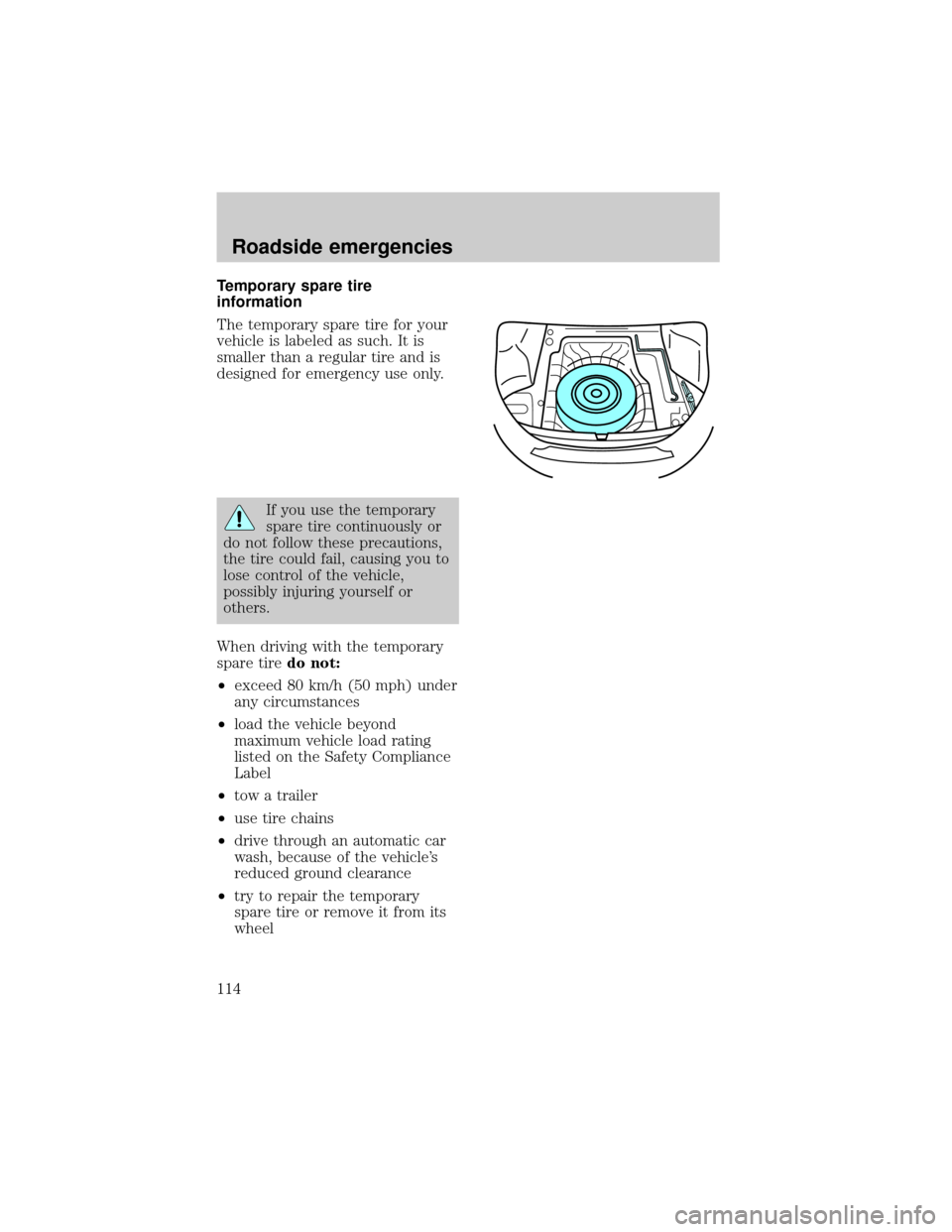
The temporary spare tire for your
vehicle is labeled as such. It is
smaller than a regular tire and is
designed for emergency use only.
If you use the temporary
spare tire continuously or
do not follow these precautions,
the tire could fail, causing you to
lose control of the vehicle,
possibly injuring yourself or
others.
When driving with the temporary
spare tiredo not:
²exceed 80 km/h (50 mph) under
any circumstances
²load the vehicle beyond
maximum vehicle load rating
listed on the Safety Compliance
Label
²tow a trailer
²use tire chains
²drive through an automatic car
wash, because of the vehicle's
reduced ground clearance
²try to repair the temporary
spare tire or remove it from its
wheel
Roadside emergencies
114
Page 121 of 191

WRECKER TOWING
If you need to have your vehicle
towed, contact a professional
towing service or, if you are a
member, your roadside assistance
center. It is recommended that
your vehicle be towed with a wheel
lift or flatbed equipment.
When calling for a tow truck, tell
the operator what kind of vehicle
you have. A towing manual is
available from Ford Motor
Company for all authorized tow
truck operators. Have your tow
truck driver refer to this manual
for proper hook-up and towing
procedures for your vehicle.
Roadside emergencies
121
Page 122 of 191

TOWING BEHIND ANOTHER
VEHICLE
Do not tow your vehicle behind
another vehicle, such as an RV,
unless front wheel dollies are used.
Your vehicle cannot be flat towed
with all wheels on the ground.
Roadside emergencies
122
Page 135 of 191

Changing the engine oil and
filter
Change your engine oil and filter
according to the following mileage
and time requirements, whichever
occurs first:
²Normal Schedule ± 8,000 km
(5,000 miles) or six months.
²Severe Duty Schedule -
5,000 km (3,000 miles) or three
months. Severe duty operation
would include extensive idling,
trailer towing, driving in severe
dust and police, taxi or delivery
service.
Ford production and aftermarket
(Motorcraft) oil filters are designed
for added engine protection and
long life. If a replacement oil filter
is used that does not meet Ford
material and design specifications,
startup engine noises or knock
may be experienced.
It is recommended you use the
appropriate Motorcraft oil filter (or
another brand meeting Ford
specifications) for your engine
application.
Maintenance and care
135
Page 149 of 191

make replacing the wipers easy,
turn the ignition to ACC, then turn
the wipers on. When the wipers
reach the vertical position, turn
the ignition to LOCK.
To replace the wiper blades:
1. Pull the wiper arm away from
the windshield and lock into the
service position.
2. Turn the blade at an angle from
the wiper arm. Push the lock pin
with a screwdriver to release the
blade and pull the wiper blade
down toward the windshield to
remove it from the arm.
3. Attach the new wiper to the
wiper arm and press it into place
until a click is heard.
INFORMATION ABOUT TIRE
QUALITY GRADES
New vehicles are fitted with tires
that have their Tire Quality Grade
(described below) molded into the
tire's sidewall. These Tire Quality
Grades are determined by
standards that the United States
Department of Transportation has
set.
Tire Quality Grades apply to new
pneumatic tires for use on
passenger cars. They do not apply
to deep tread, winter-type snow
tires, space-saver or temporary use
spare tires, tires with nominal rim
diameters of 10 to 12 inches or
limited production tires as defined
Maintenance and care
149