Window FORD EXCURSION 2000 1.G User Guide
[x] Cancel search | Manufacturer: FORD, Model Year: 2000, Model line: EXCURSION, Model: FORD EXCURSION 2000 1.GPages: 232, PDF Size: 2.01 MB
Page 73 of 232
CARGO NET (IF EQUIPPED)
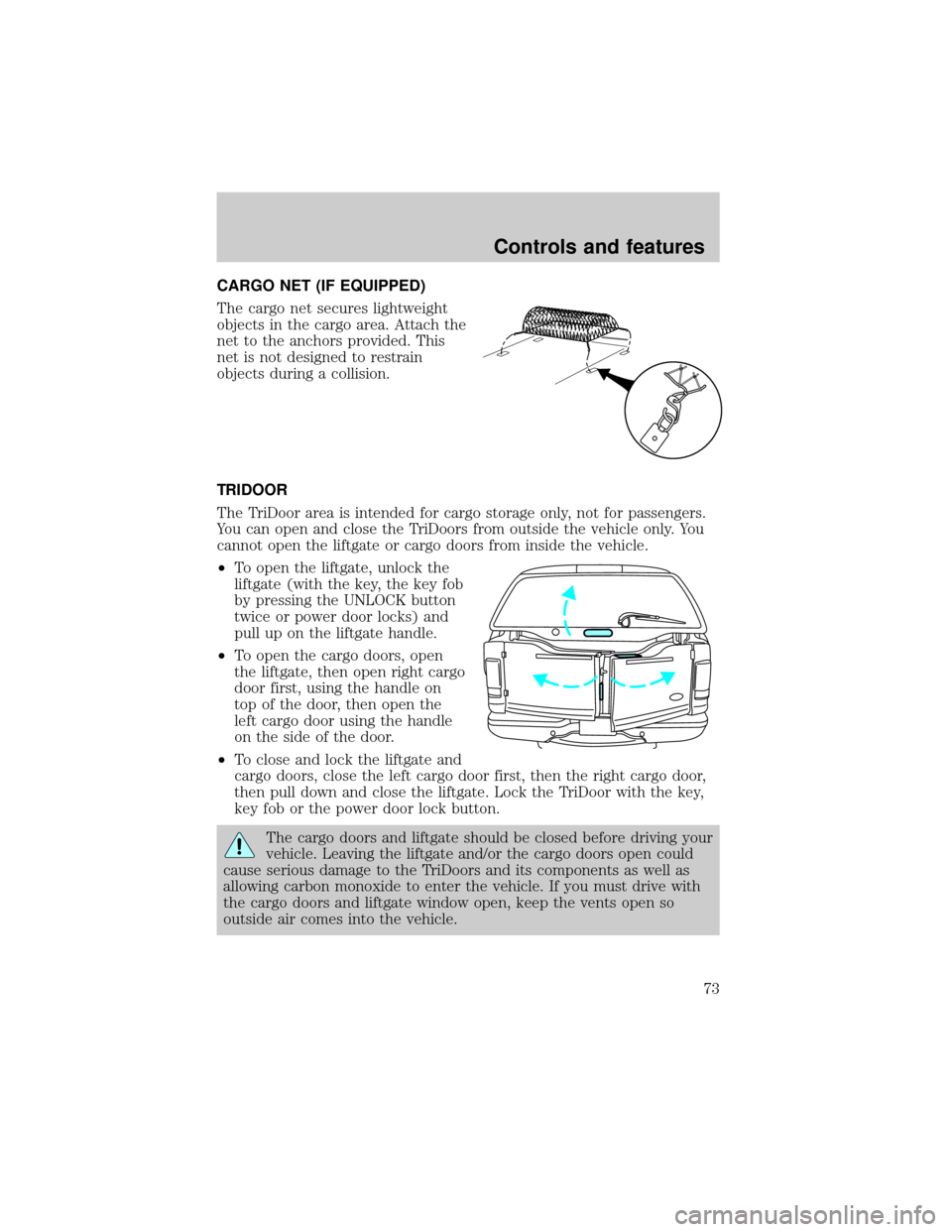
The cargo net secures lightweight
objects in the cargo area. Attach the
net to the anchors provided. This
net is not designed to restrain
objects during a collision.
TRIDOOR
The TriDoor area is intended for cargo storage only, not for passengers.
You can open and close the TriDoors from outside the vehicle only. You
cannot open the liftgate or cargo doors from inside the vehicle.
²To open the liftgate, unlock the
liftgate (with the key, the key fob
by pressing the UNLOCK button
twice or power door locks) and
pull up on the liftgate handle.
²To open the cargo doors, open
the liftgate, then open right cargo
door first, using the handle on
top of the door, then open the
left cargo door using the handle
on the side of the door.
²To close and lock the liftgate and
cargo doors, close the left cargo door first, then the right cargo door,
then pull down and close the liftgate. Lock the TriDoor with the key,
key fob or the power door lock button.
The cargo doors and liftgate should be closed before driving your
vehicle. Leaving the liftgate and/or the cargo doors open could
cause serious damage to the TriDoors and its components as well as
allowing carbon monoxide to enter the vehicle. If you must drive with
the cargo doors and liftgate window open, keep the vents open so
outside air comes into the vehicle.
Controls and features
73
Page 83 of 232
REMOVING THE THIRD ROW SEAT
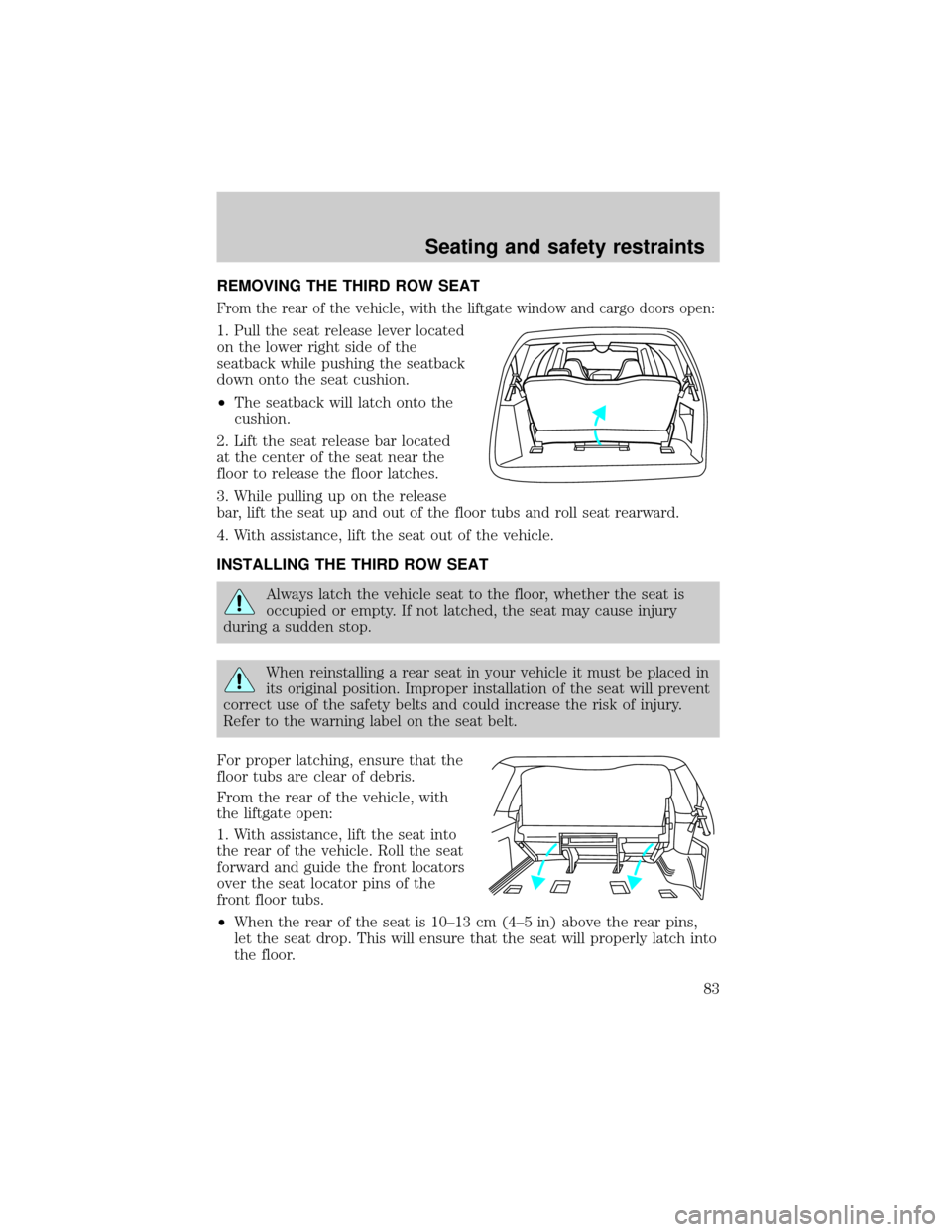
From the rear of the vehicle, with the liftgate window and cargo doors open:
1. Pull the seat release lever located
on the lower right side of the
seatback while pushing the seatback
down onto the seat cushion.
²The seatback will latch onto the
cushion.
2. Lift the seat release bar located
at the center of the seat near the
floor to release the floor latches.
3. While pulling up on the release
bar, lift the seat up and out of the floor tubs and roll seat rearward.
4. With assistance, lift the seat out of the vehicle.
INSTALLING THE THIRD ROW SEAT
Always latch the vehicle seat to the floor, whether the seat is
occupied or empty. If not latched, the seat may cause injury
during a sudden stop.
When reinstalling a rear seat in your vehicle it must be placed in
its original position. Improper installation of the seat will prevent
correct use of the safety belts and could increase the risk of injury.
Refer to the warning label on the seat belt.
For proper latching, ensure that the
floor tubs are clear of debris.
From the rear of the vehicle, with
the liftgate open:
1. With assistance, lift the seat into
the rear of the vehicle. Roll the seat
forward and guide the front locators
over the seat locator pins of the
front floor tubs.
²When the rear of the seat is 10±13 cm (4±5 in) above the rear pins,
let the seat drop. This will ensure that the seat will properly latch into
the floor.
Seating and safety restraints
83
Page 111 of 232
Guarding against exhaust fumes
Although odorless and colorless, carbon monoxide is present in exhaust
fumes. Take precautions to avoid its dangerous effects.
If you ever smell exhaust fumes of any kind inside your vehicle,
have your dealer inspect and fix your vehicle immediately. Do
not drive if you smell exhaust fumes. These fumes are harmful and
could kill you.
Have the exhaust and body ventilation systems checked whenever:
²the vehicle is raised for service.
²the sound of the exhaust system changes.
²the vehicle has been damaged in a collision.
WARNING:Engine exhaust, some of its constituents, and
certain vehicle components contain or emit chemicals known to
the State of California to cause cancer and birth defects or other
reproductive harm. In addition, certain fluids contained in vehicles and
certain products of component wear contain or emit chemicals known
to the State of California to cause cancer and birth defects or other
reproductive harm.
Important ventilating information
If the engine is idling while the vehicle is stopped in an open area for
long periods of time, open the windows at least 2.5 cm (one inch).
Adjust the heating or air conditioning (if equipped) to bring in fresh air.
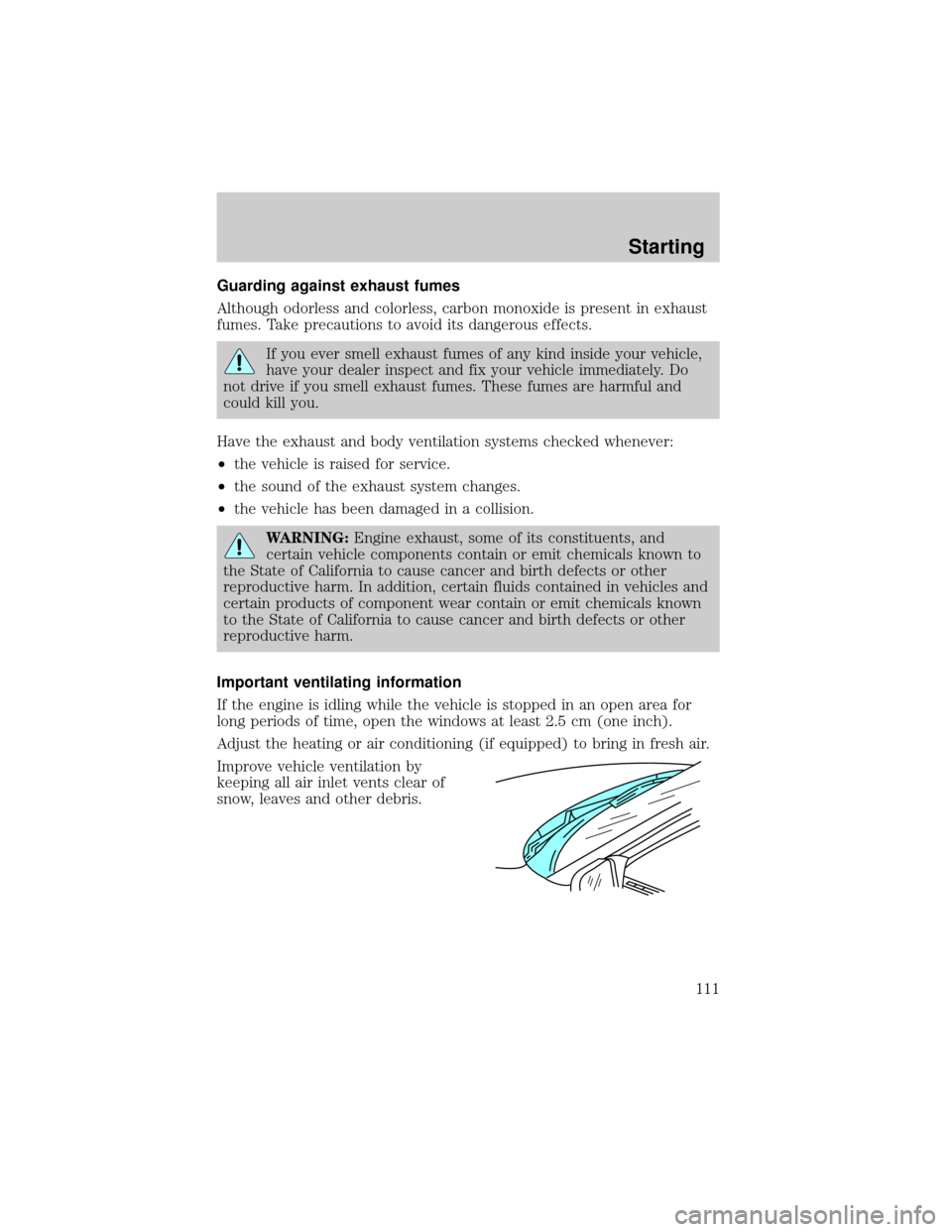
Improve vehicle ventilation by
keeping all air inlet vents clear of
snow, leaves and other debris.
Starting
111
Page 141 of 232
The fuses are coded as follows.
Fuse/Relay
LocationFuse Amp
RatingPassenger Compartment
Fuse Panel Description
1 20A Radio, Secondary Fusing for Audio Options
2 5A Instrument Cluster, Powertrain Control
Module (PCM) Keep Alive Memory, PATS
LED
3 20A Cigar Lighter, Data Link Connector
4 Ð Not Used
5 10A Ignition Run Power Feed (Customer
Access)
6 15A DRL, Brake Shift Interlock (BSI), ECM,
Overhead Trip Computer (OTC), AUX A/C
Components, Hazard Flasher, Speed
Control, Vacuum Pump, Backup Lamps,
Electronic Shift On The Fly Hublock
Solenoid, Heated Seat
7 5A Power Window/Lock Switch Illumination
8 5A Headlamp Switch, LED/Radio
9 Ð Not Used
10 Ð Not Used
11 30A Wiper Run/Park Relay Coil, Wiper Hi/LO
Relay Coil, Washer Pump Relay Coils, Front
Wiper Motor, Rear Wiper Motor Relay Coils
12 Ð Not Used
13 20A Stop Lamps, Center High-mount Stop
Lamp/Hazard, Trailer Tow Stop Lamp,
Speed Control
14 15A Dome Lamp, Cargo Lamp, Courtesy Lamps,
Running Boards, Power Mirrors, Vanity
Mirrors, Map Lamps, Underhood Lamps,
Glove Box Lamp, Power Windows (Delayed
Accessory)
15 5A Stop Lamp Switch (Logic), PATS, GEM
16 15A Hi-beam Headlamps, Instrument Cluster
(Hi-beam Indicator)
Roadside emergencies
141
Page 142 of 232
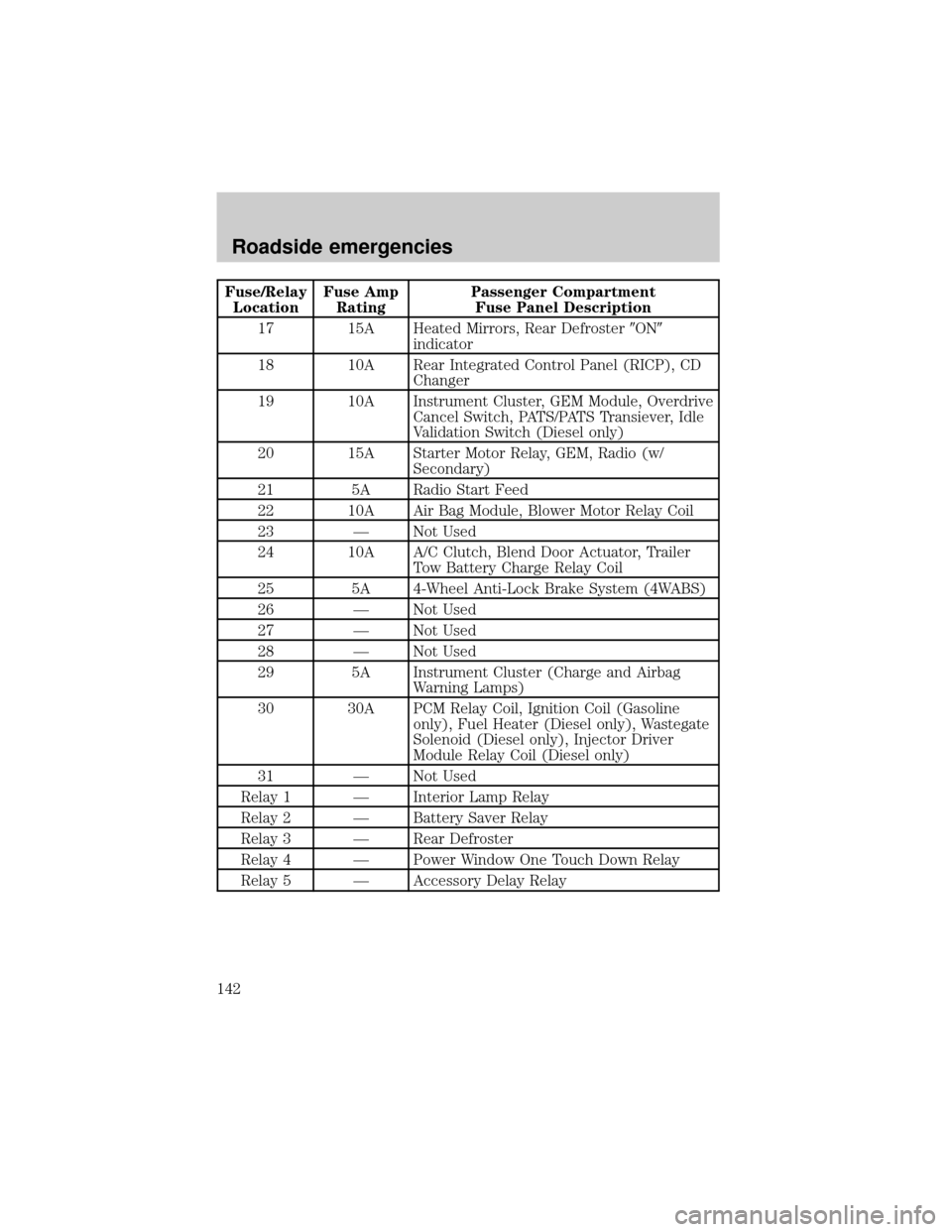
Fuse/Relay
LocationFuse Amp
RatingPassenger Compartment
Fuse Panel Description
17 15A Heated Mirrors, Rear Defroster9ON9
indicator
18 10A Rear Integrated Control Panel (RICP), CD
Changer
19 10A Instrument Cluster, GEM Module, Overdrive
Cancel Switch, PATS/PATS Transiever, Idle
Validation Switch (Diesel only)
20 15A Starter Motor Relay, GEM, Radio (w/
Secondary)
21 5A Radio Start Feed
22 10A Air Bag Module, Blower Motor Relay Coil
23 Ð Not Used
24 10A A/C Clutch, Blend Door Actuator, Trailer
Tow Battery Charge Relay Coil
25 5A 4-Wheel Anti-Lock Brake System (4WABS)
26 Ð Not Used
27 Ð Not Used
28 Ð Not Used
29 5A Instrument Cluster (Charge and Airbag
Warning Lamps)
30 30A PCM Relay Coil, Ignition Coil (Gasoline
only), Fuel Heater (Diesel only), Wastegate
Solenoid (Diesel only), Injector Driver
Module Relay Coil (Diesel only)
31 Ð Not Used
Relay 1 Ð Interior Lamp Relay
Relay 2 Ð Battery Saver Relay
Relay 3 Ð Rear Defroster
Relay 4 Ð Power Window One Touch Down Relay
Relay 5 Ð Accessory Delay Relay
Roadside emergencies
142
Page 144 of 232
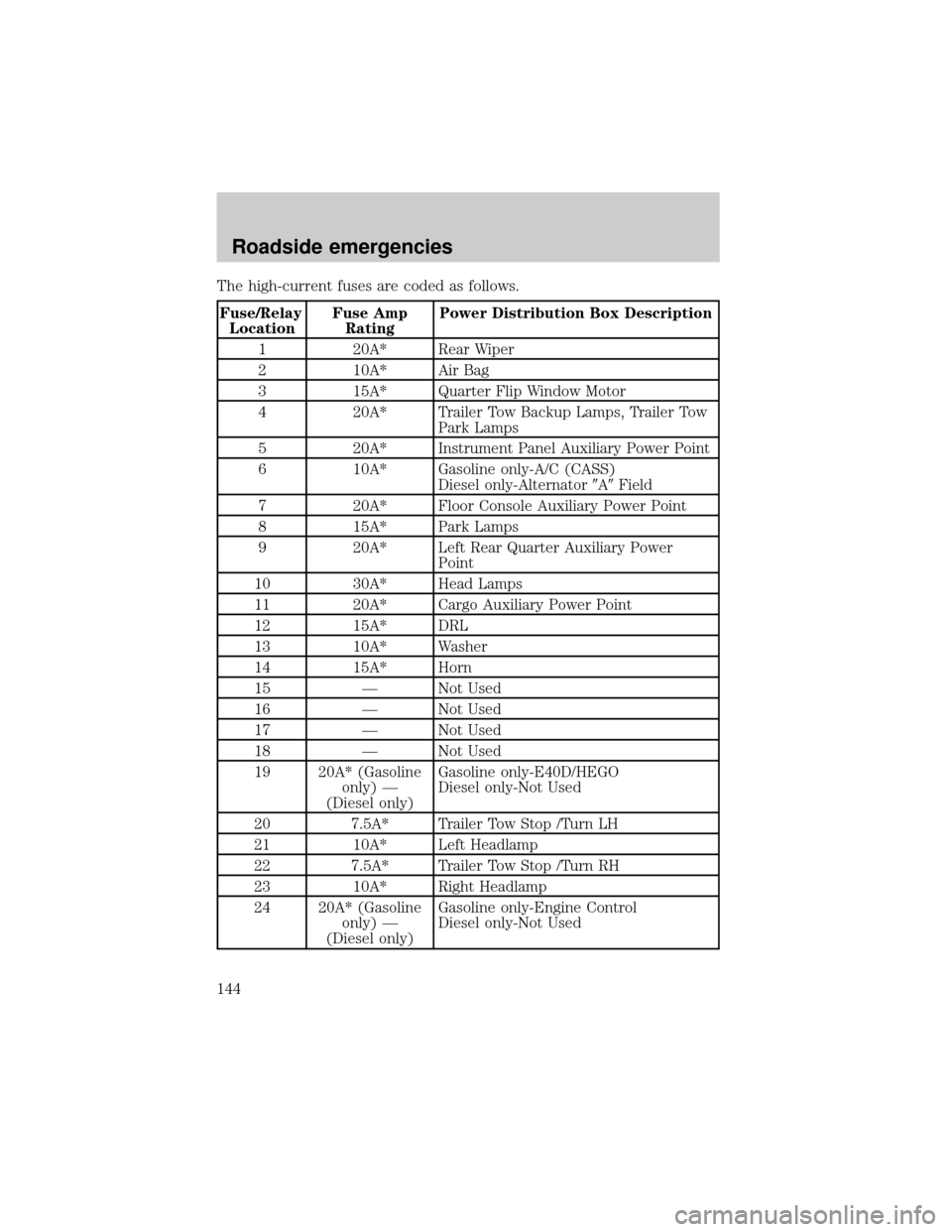
The high-current fuses are coded as follows.
Fuse/Relay
LocationFuse Amp
RatingPower Distribution Box Description
1 20A* Rear Wiper
2 10A* Air Bag
3 15A* Quarter Flip Window Motor
4 20A* Trailer Tow Backup Lamps, Trailer Tow
Park Lamps
5 20A* Instrument Panel Auxiliary Power Point
6 10A* Gasoline only-A/C (CASS)
Diesel only-Alternator9A9Field
7 20A* Floor Console Auxiliary Power Point
8 15A* Park Lamps
9 20A* Left Rear Quarter Auxiliary Power
Point
10 30A* Head Lamps
11 20A* Cargo Auxiliary Power Point
12 15A* DRL
13 10A* Washer
14 15A* Horn
15 Ð Not Used
16 Ð Not Used
17 Ð Not Used
18 Ð Not Used
19 20A* (Gasoline
only) Ð
(Diesel only)Gasoline only-E40D/HEGO
Diesel only-Not Used
20 7.5A* Trailer Tow Stop /Turn LH
21 10A* Left Headlamp
22 7.5A* Trailer Tow Stop /Turn RH
23 10A* Right Headlamp
24 20A* (Gasoline
only) Ð
(Diesel only)Gasoline only-Engine Control
Diesel only-Not Used
Roadside emergencies
144
Page 145 of 232
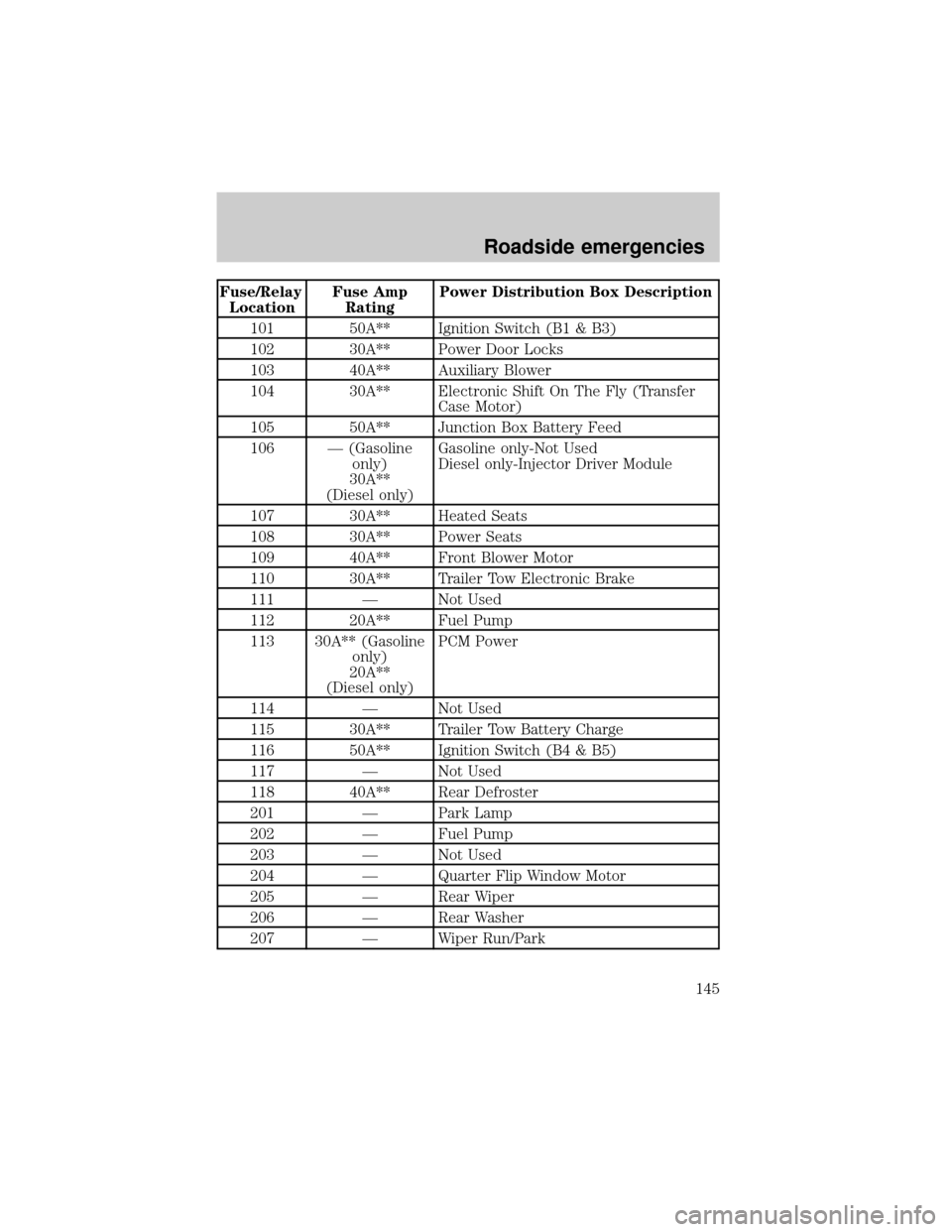
Fuse/Relay
LocationFuse Amp
RatingPower Distribution Box Description
101 50A** Ignition Switch (B1 & B3)
102 30A** Power Door Locks
103 40A** Auxiliary Blower
104 30A** Electronic Shift On The Fly (Transfer
Case Motor)
105 50A** Junction Box Battery Feed
106 Ð (Gasoline
only)
30A**
(Diesel only)Gasoline only-Not Used
Diesel only-Injector Driver Module
107 30A** Heated Seats
108 30A** Power Seats
109 40A** Front Blower Motor
110 30A** Trailer Tow Electronic Brake
111 Ð Not Used
112 20A** Fuel Pump
113 30A** (Gasoline
only)
20A**
(Diesel only)PCM Power
114 Ð Not Used
115 30A** Trailer Tow Battery Charge
116 50A** Ignition Switch (B4 & B5)
117 Ð Not Used
118 40A** Rear Defroster
201 Ð Park Lamp
202 Ð Fuel Pump
203 Ð Not Used
204 Ð Quarter Flip Window Motor
205 Ð Rear Wiper
206 Ð Rear Washer
207 Ð Wiper Run/Park
Roadside emergencies
145
Page 146 of 232
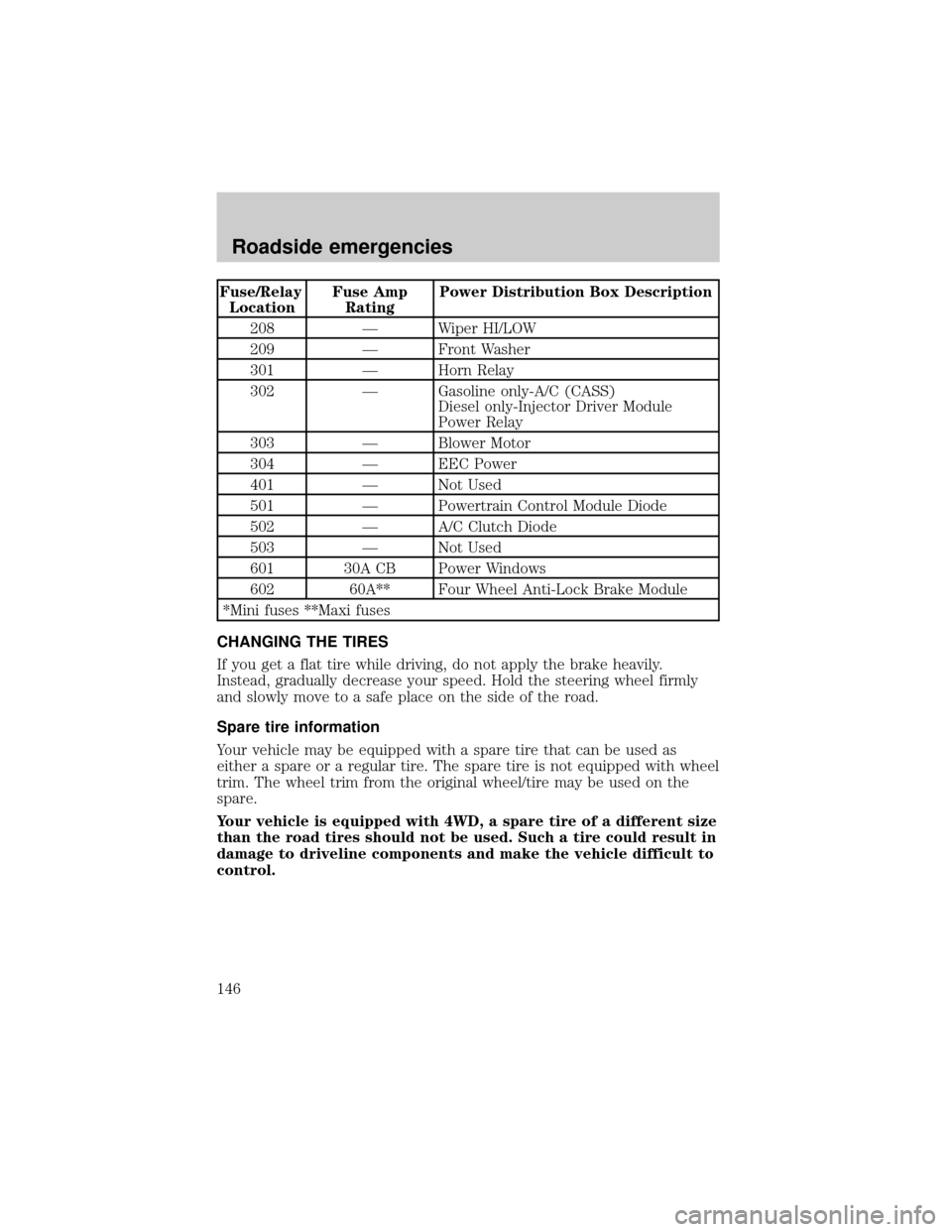
Fuse/Relay
LocationFuse Amp
RatingPower Distribution Box Description
208 Ð Wiper HI/LOW
209 Ð Front Washer
301 Ð Horn Relay
302 Ð Gasoline only-A/C (CASS)
Diesel only-Injector Driver Module
Power Relay
303 Ð Blower Motor
304 Ð EEC Power
401 Ð Not Used
501 Ð Powertrain Control Module Diode
502 Ð A/C Clutch Diode
503 Ð Not Used
601 30A CB Power Windows
602 60A** Four Wheel Anti-Lock Brake Module
*Mini fuses **Maxi fuses
CHANGING THE TIRES
If you get a flat tire while driving, do not apply the brake heavily.
Instead, gradually decrease your speed. Hold the steering wheel firmly
and slowly move to a safe place on the side of the road.
Spare tire information
Your vehicle may be equipped with a spare tire that can be used as
either a spare or a regular tire. The spare tire is not equipped with wheel
trim. The wheel trim from the original wheel/tire may be used on the
spare.
Your vehicle is equipped with 4WD, a spare tire of a different size
than the road tires should not be used. Such a tire could result in
damage to driveline components and make the vehicle difficult to
control.
Roadside emergencies
146
Page 180 of 232
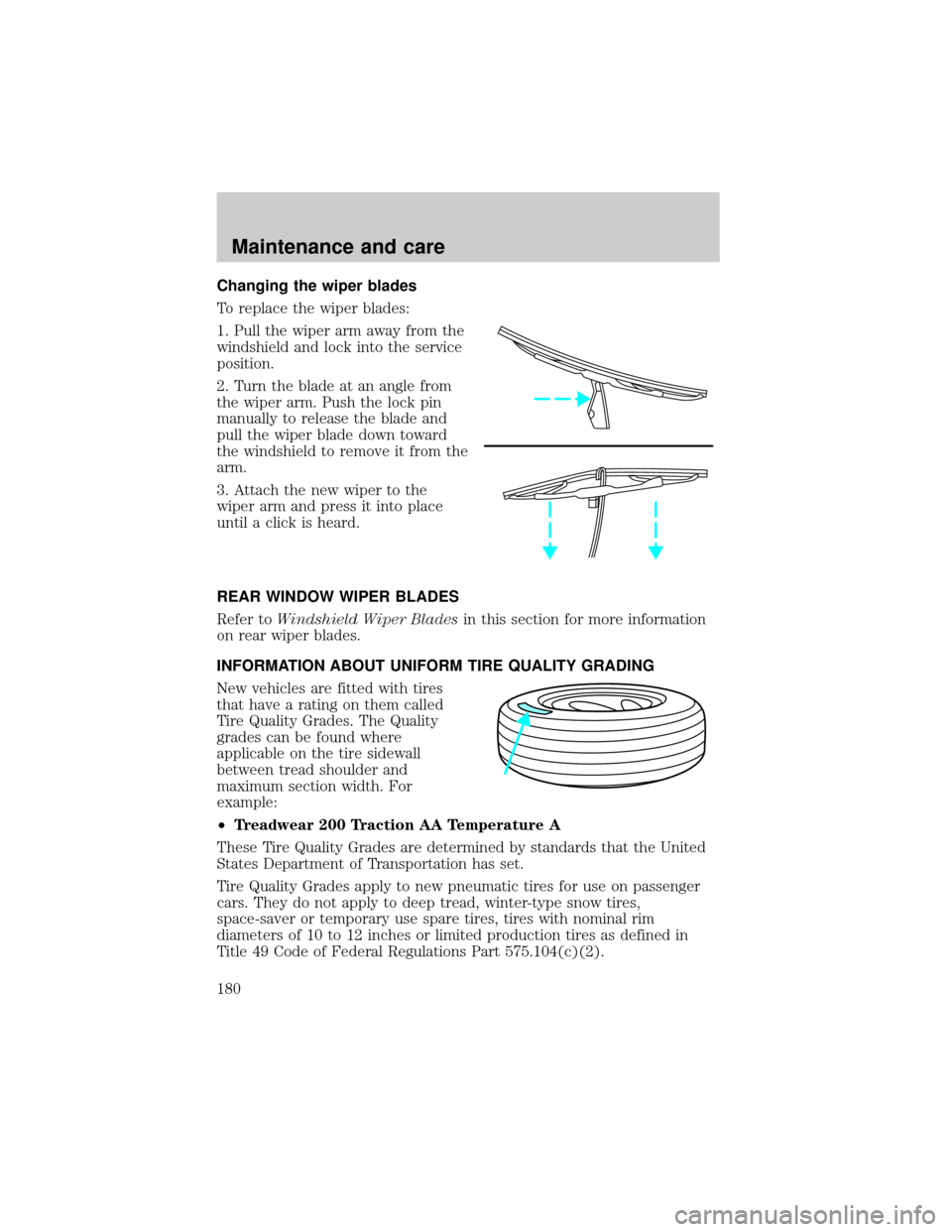
Changing the wiper blades
To replace the wiper blades:
1. Pull the wiper arm away from the
windshield and lock into the service
position.
2. Turn the blade at an angle from
the wiper arm. Push the lock pin
manually to release the blade and
pull the wiper blade down toward
the windshield to remove it from the
arm.
3. Attach the new wiper to the
wiper arm and press it into place
until a click is heard.
REAR WINDOW WIPER BLADES
Refer toWindshield Wiper Bladesin this section for more information
on rear wiper blades.
INFORMATION ABOUT UNIFORM TIRE QUALITY GRADING
New vehicles are fitted with tires
that have a rating on them called
Tire Quality Grades. The Quality
grades can be found where
applicable on the tire sidewall
between tread shoulder and
maximum section width. For
example:
²Treadwear 200 Traction AA Temperature A
These Tire Quality Grades are determined by standards that the United
States Department of Transportation has set.
Tire Quality Grades apply to new pneumatic tires for use on passenger
cars. They do not apply to deep tread, winter-type snow tires,
space-saver or temporary use spare tires, tires with nominal rim
diameters of 10 to 12 inches or limited production tires as defined in
Title 49 Code of Federal Regulations Part 575.104(c)(2).
Maintenance and care
180
Page 192 of 232
²Perform all regularly scheduled maintenance items. Follow the
recommended maintenance schedule and owner maintenance checks
found in your vehicle scheduled maintenance guide.
Conditions
²Heavily loading a vehicle or towing a trailer may reduce fuel economy
at any speed.
²Carrying unnecessary weight may reduce fuel economy (approximately
0.4 km/L [1 mpg] is lost for every 180 kg [400 lb] of weight carried).
²Adding certain accessories to your vehicle (for example bug
deflectors, rollbars/light bars, running boards, ski/luggage racks) may
reduce fuel economy.
²Using fuel blended with alcohol may lower fuel economy.
²Fuel economy may decrease with lower temperatures during the first
12±16 km (8±10 miles) of driving.
²Driving on flat terrain offers improved fuel economy as compared to
driving on hilly terrain.
²Transmissions give their best fuel economy when operated in the top
cruise gear and with steady pressure on the gas pedal.
²Four-wheel-drive operation (if equipped) is less fuel efficient than
two-wheel-drive operation.
²Close windows for high speed driving.
EPA window sticker
Every new vehicle should have the EPA window sticker. Contact your
dealer if the window sticker is not supplied with your vehicle. The EPA
window sticker should be your guide for the fuel economy comparisons
with other vehicles.
It is important to note the box in the lower left corner of the window
sticker. These numbers represent the Range of L/100 km (MPG)
expected on the vehicle under optimum conditions. Your fuel economy
may vary depending upon the method of operation and conditions.
EMISSION CONTROL SYSTEM
Your vehicle is equipped with various emission control components and a
catalytic converter which will enable your vehicle to comply with
applicable exhaust emission standards. To make sure that the catalytic
Maintenance and care
192