engine FORD EXPEDITION 1997 1.G User Guide
[x] Cancel search | Manufacturer: FORD, Model Year: 1997, Model line: EXPEDITION, Model: FORD EXPEDITION 1997 1.GPages: 224, PDF Size: 2.2 MB
Page 66 of 224

ANTI-THEFT SYSTEM
Passive anti-theft system
Your ignition key has a unique
imbedded transponder which
engages engine electronics and
allows the vehicle to be started.
Without the use of your special
ignition key, the vehicle will not
start.
During each vehicle start, the
coded key is read by the anti-theft
system. If the key's ID code
matches the code in the anti-theft
system, the vehicle is enabled to
start.
Your vehicle is equipped with two
electronically coded keys.
Additional spare keys can be
purchased through your dealer or
selected retailers. Be sure to
purchase coded keys with the Ford
logo to ensure proper functionality.
If both supplied keys are lost or
stolen, the vehicle and any other
keys must be reinitialized by the
dealer.
A theft indicator in the instrument
cluster provides operating status of
the anti-theft system. For more
information on this indicator and
its function, refer toWarning and
indicator lightsin the
Instrumentationchapter.
Programming spare keys
Use one of the two electronically
coded keys supplied with your
vehicle to program additional keys:
THEFT
com_anti-theft_passive.01
exd_passive_anti_theft
exd_programming_key
Controls and features
67
Page 99 of 224
BEFORE STARTING YOUR
VEHICLE
Important safety precautions
A computer system controls the
engine's idle revolutions per
minute (RPM). When the engine
starts, the idle RPM runs faster to
warm the engine. If the engine idle
speed does not slow down
automatically, have the vehicle
checked. Do not allow the vehicle
to idle for more than ten minutes.
Extended idling at high
engine speeds can produce
very high temperatures in the
engine and exhaust system,
creating the risk of fire or other
damage.
Do not park, idle, or drive
your vehicle in dry grass
or other dry ground cover. The
emission system heats up the
engine compartment and exhaust
system, which can start a fire.
Do not start your vehicle
in a closed garage or in
other enclosed areas. Exhaust
fumes can be toxic. Always open
the garage door before you start
the engine. SeeGuarding
against exhaust fumesin this
chapter for more instructions.
exd_title_starting
com_important_precautions.05
Starting
100
Page 100 of 224
If you smell exhaust fumes
inside your vehicle, have
your dealer inspect your vehicle
immediately. Do not drive if you
smell exhaust fumes.
Preparing to start the vehicle
Engine starting is controlled by the
spark ignition system. This system
meets all Canadian
Interference-Causing Equipment
standard requirements regulating
the impulse electrical field strength
of radio noise.
When starting a fuel-injected
engine, avoid pressing the
accelerator before or during
starting. Only use the accelerator
when you have difficulty starting
the engine. For more information
on starting the vehicle, refer to
Starting the vehiclein this
chapter.
Before starting the vehicle:
1. Make sure all vehicle occupants
have buckled their safety belts. For
more information on safety belts
and their proper usage, refer to
theSeating and safety restraints
chapter.
exd_preparing_start
Starting
101
Page 102 of 224
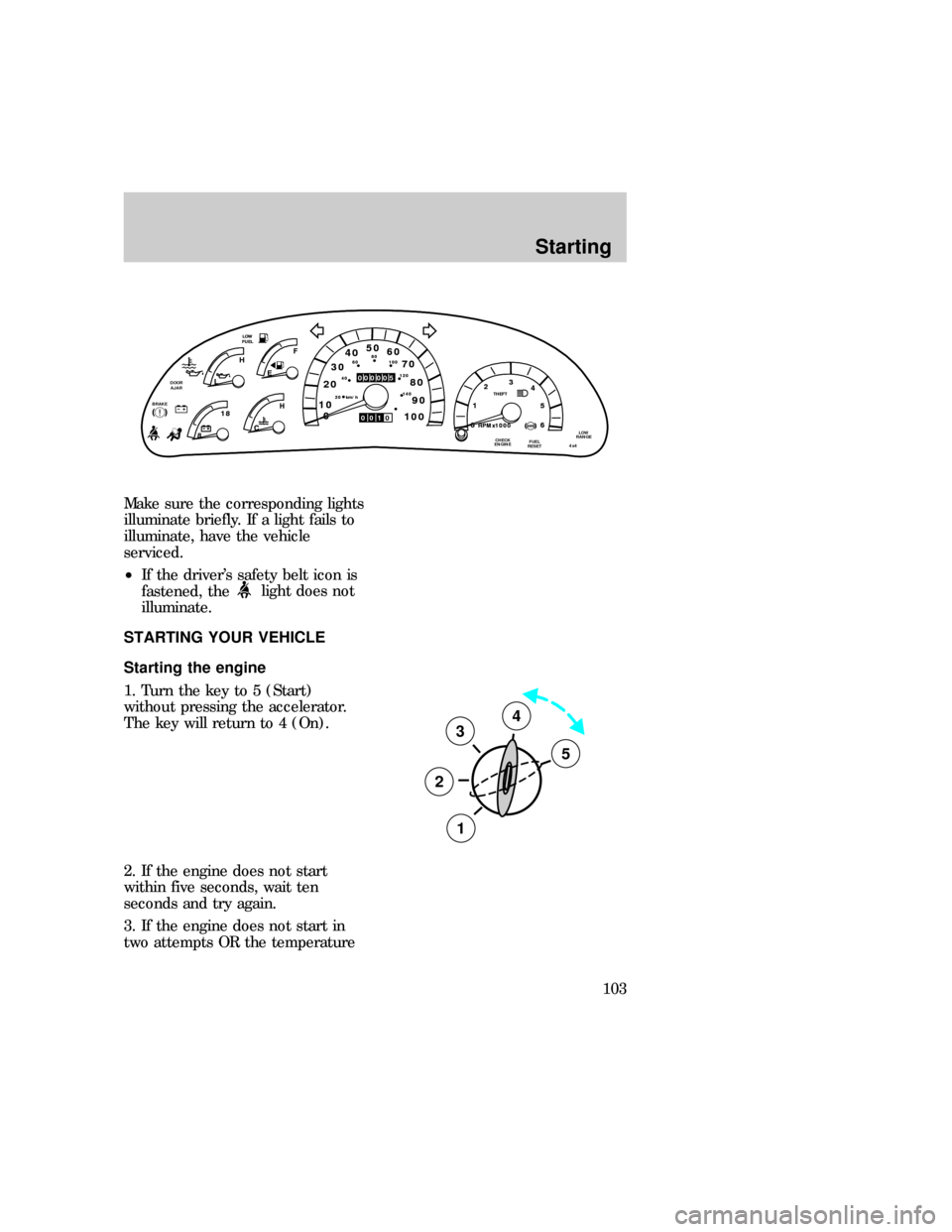
Make sure the corresponding lights
illuminate briefly. If a light fails to
illuminate, have the vehicle
serviced.
²If the driver's safety belt icon is
fastened, the
light does not
illuminate.
STARTING YOUR VEHICLE
Starting the engine
1. Turn the key to 5 (Start)
without pressing the accelerator.
The key will return to 4 (On).
2. If the engine does not start
within five seconds, wait ten
seconds and try again.
3. If the engine does not start in
two attempts OR the temperature
3
1050
3070
4080
120
140
40
20
0
10090 60
8060100
20 km/h
0010
0000052
4
5
6 01LH
CH
EF
818
THEFT
RPMx1000LOW
RANGE
4x4 FUEL
RESET CHECK
ENGINEABS
DOOR
AJARLOW
FUEL3
1050
3070
4080
120
140
40
20
0
10090 60
8060100
20 km/h
0010
0000052
4
5
6 01LH
CH
EF
818
THEFT
RPMx1000ABS
BRAKELOW
FUEL!
3
2
1
5
4
exd_starting_title_2
com_starting_vehicle.01
Starting
103
Page 103 of 224
is below Ð12ÉC (10ÉF), depress
accelerator and start the engine
while holding the accelerator
down. Release accelerator when
engine starts.
4. After idling for a few seconds,
apply the brake and release the
parking brake.
Using the engine block heater
(if equipped)
An engine block heater warms the
engine coolant, which improves
starting, warms up the engine
faster and allows the
heater-defroster system to respond
quickly. They are strongly
recommended if you live in a
region where temperatures reach
Ð23ÉC (±10ÉF) or below.
For best results, plug the heater in
at least three hours before starting
the vehicle. Using the heater for
longer than three hours will not
harm the engine, so the heater can
be plugged in the night before
starting the vehicle.
To prevent electrical
shock, do not use your
heater with ungrounded
electrical systems or
two-pronged (cheater) adapters.
com_engine_heater.01
com_ventilation_info.01
Starting
104
Page 104 of 224
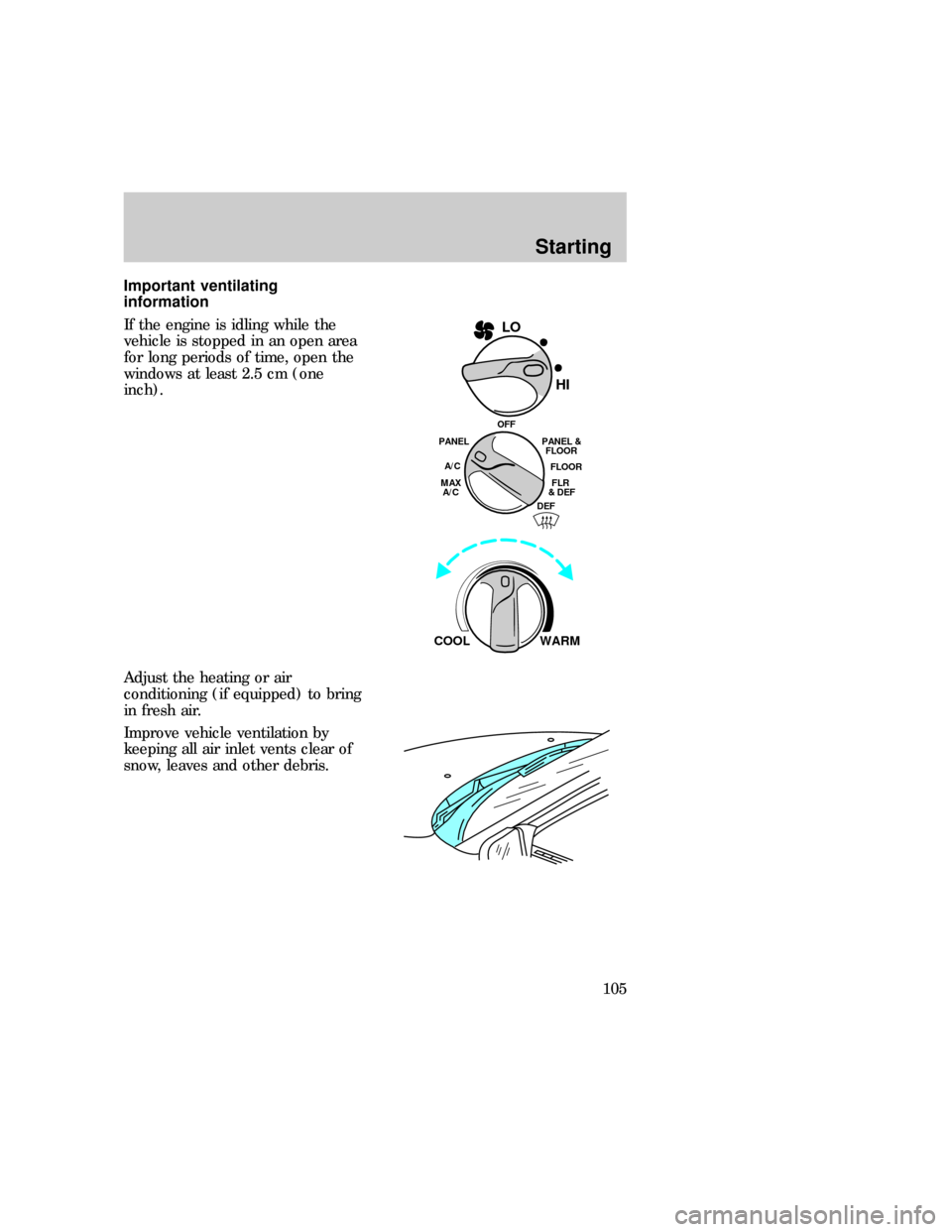
Important ventilating
information
If the engine is idling while the
vehicle is stopped in an open area
for long periods of time, open the
windows at least 2.5 cm (one
inch).
Adjust the heating or air
conditioning (if equipped) to bring
in fresh air.
Improve vehicle ventilation by
keeping all air inlet vents clear of
snow, leaves and other debris.
FLR
& DEF MAX
A/CFLOOR PANEL &
FLOOR
DEF OFF
PANEL
A/C
WARM COOL
LO
HI
com_guarding_exhaust.01
Starting
105
Page 108 of 224
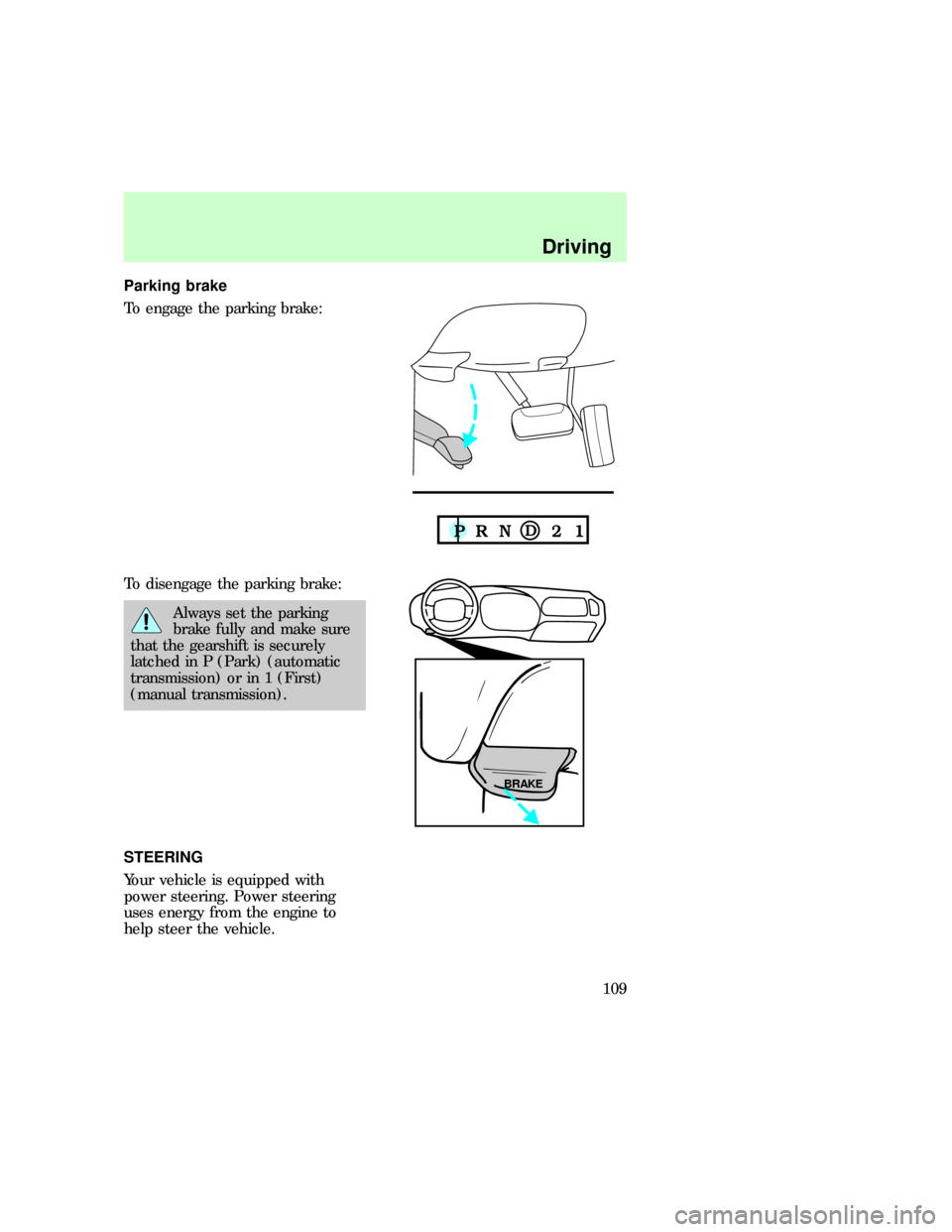
Parking brake
To engage the parking brake:
To disengage the parking brake:
Always set the parking
brake fully and make sure
that the gearshift is securely
latched in P (Park) (automatic
transmission) or in 1 (First)
(manual transmission).
STEERING
Your vehicle is equipped with
power steering. Power steering
uses energy from the engine to
help steer the vehicle.
BRAKE
exd_steering
Driving
109
Page 109 of 224

Never hold the steering wheel to
the extreme right or the extreme
left for more than a few seconds
when the engine is running. This
action could damage the power
steering pump.
Speed sensitive steering
The steering in your vehicle is
speed sensitive. At high speeds,
steering assist will decrease to
improve steering feel. At lower
speeds, maneuverability will be
increased.
If the amount of effort required to
steer your vehicle changes at a
constant vehicle speed, have the
power steering system checked by
your dealer or a qualified service
technician.
exd_speed_sensitive_steering
com_traction-lok.01
Driving
110
Page 110 of 224
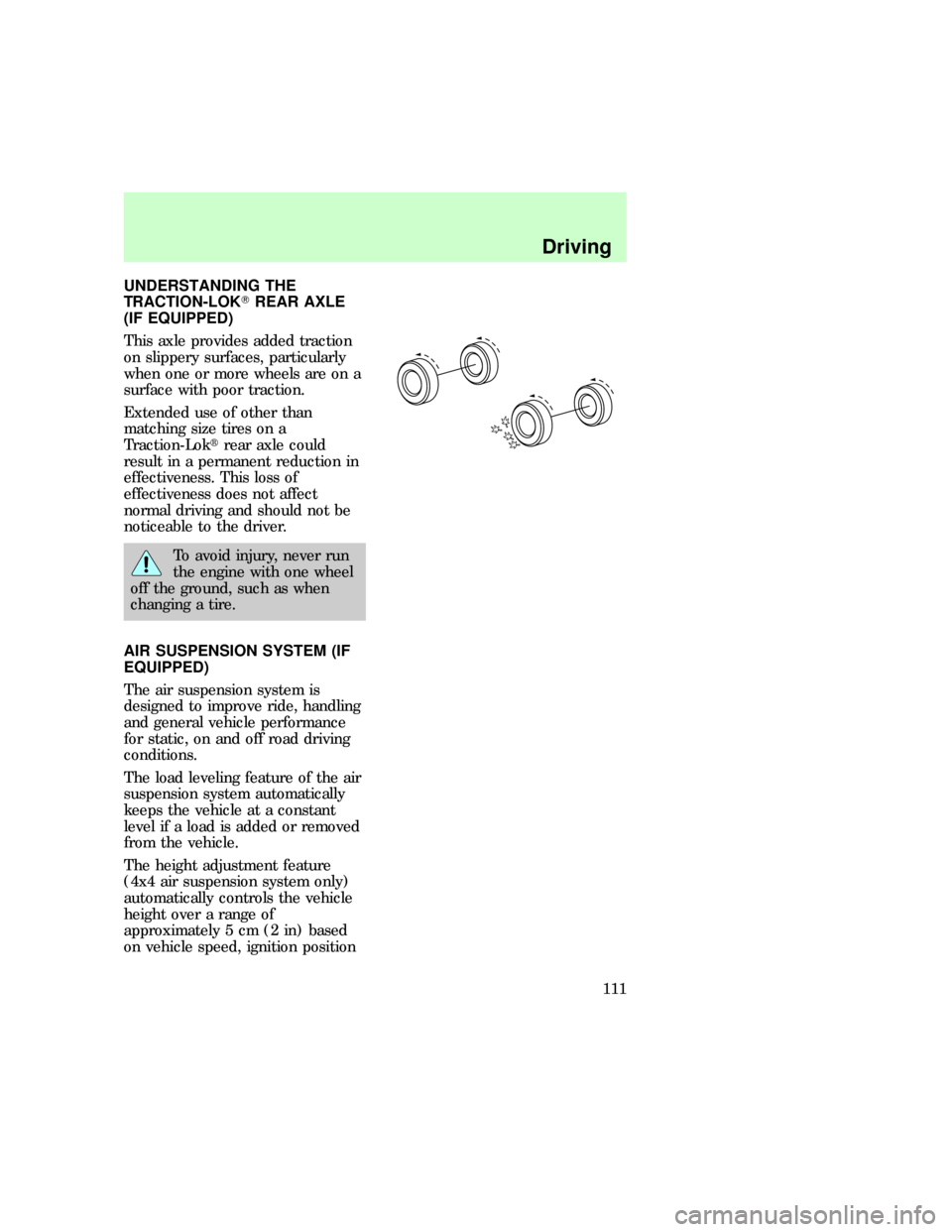
UNDERSTANDING THE
TRACTION-LOKTREAR AXLE
(IF EQUIPPED)
This axle provides added traction
on slippery surfaces, particularly
when one or more wheels are on a
surface with poor traction.
Extended use of other than
matching size tires on a
Traction-Loktrear axle could
result in a permanent reduction in
effectiveness. This loss of
effectiveness does not affect
normal driving and should not be
noticeable to the driver.
To avoid injury, never run
the engine with one wheel
off the ground, such as when
changing a tire.
AIR SUSPENSION SYSTEM (IF
EQUIPPED)
The air suspension system is
designed to improve ride, handling
and general vehicle performance
for static, on and off road driving
conditions.
The load leveling feature of the air
suspension system automatically
keeps the vehicle at a constant
level if a load is added or removed
from the vehicle.
The height adjustment feature
(4x4 air suspension system only)
automatically controls the vehicle
height over a range of
approximately 5 cm (2 in) based
on vehicle speed, ignition position
exd_air_suspension
Driving
111
Page 114 of 224
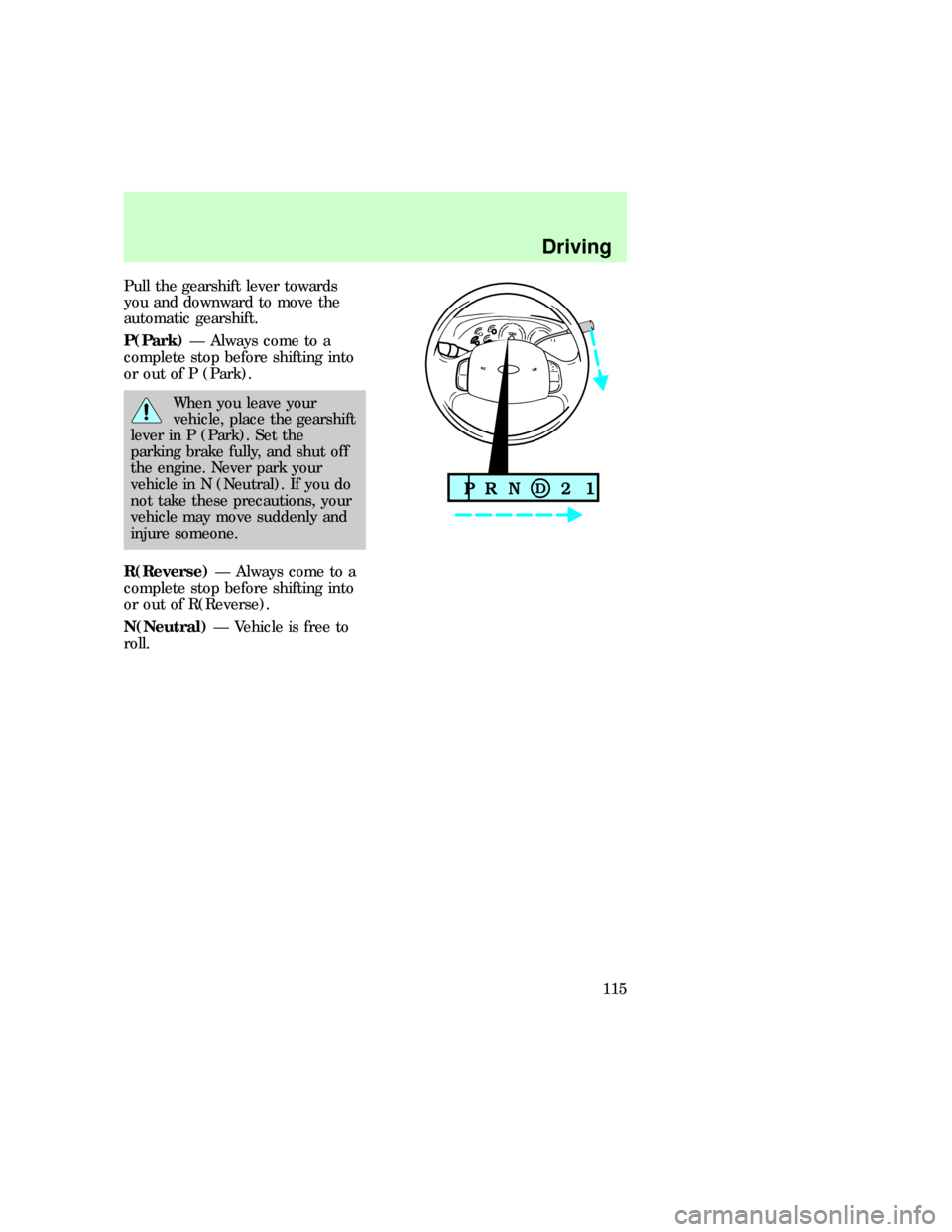
Pull the gearshift lever towards
you and downward to move the
automatic gearshift.
P(Park)Ð Always come to a
complete stop before shifting into
or out of P (Park).
When you leave your
vehicle, place the gearshift
lever in P (Park). Set the
parking brake fully, and shut off
the engine. Never park your
vehicle in N (Neutral). If you do
not take these precautions, your
vehicle may move suddenly and
injure someone.
R(Reverse)Ð Always come to a
complete stop before shifting into
or out of R(Reverse).
N(Neutral)Ð Vehicle is free to
roll.
Driving
115