key FORD EXPEDITION 1997 1.G User Guide
[x] Cancel search | Manufacturer: FORD, Model Year: 1997, Model line: EXPEDITION, Model: FORD EXPEDITION 1997 1.GPages: 224, PDF Size: 2.2 MB
Page 85 of 224
belt extensions are available at no
cost from your Ford or
Lincoln/Mercury dealer.
Use only extensions manufactured
by the same supplier as the safety
belt. Manufacturer identification is
located at the end of the webbing
on the label. Also, use the safety
belt extension only if the safety
belt is too short for you when fully
extended. Do not use extension to
change the fit of the shoulder belt
across the torso.
SAFETY BELT INDICATOR
LIGHT AND WARNING CHIME
illuminates in the instrument
cluster and a chime sounds to
remind the occupants to fasten
their safety belts:
CONDITIONS OF OPERATION
If......Then.....
The driver's safety belt is not
buckled before the ignition key
is turned to On. .The safety belt indicator illuminates for
1-2 minutes and the warning chime
sounds for 4- 8 seconds.
The driver's safety belt is
buckled while the indicator light
is illuminated and the reminder
chime is sounding...The safety belt indicator light and
reminder chime turn off.
The driver's safety belt is
buckled before the ignition key
is turned to On. . .The safety belt indicator light and
reminder chime remain off.
exd_indicator_light
Seating and safety restraints
86
Page 101 of 224
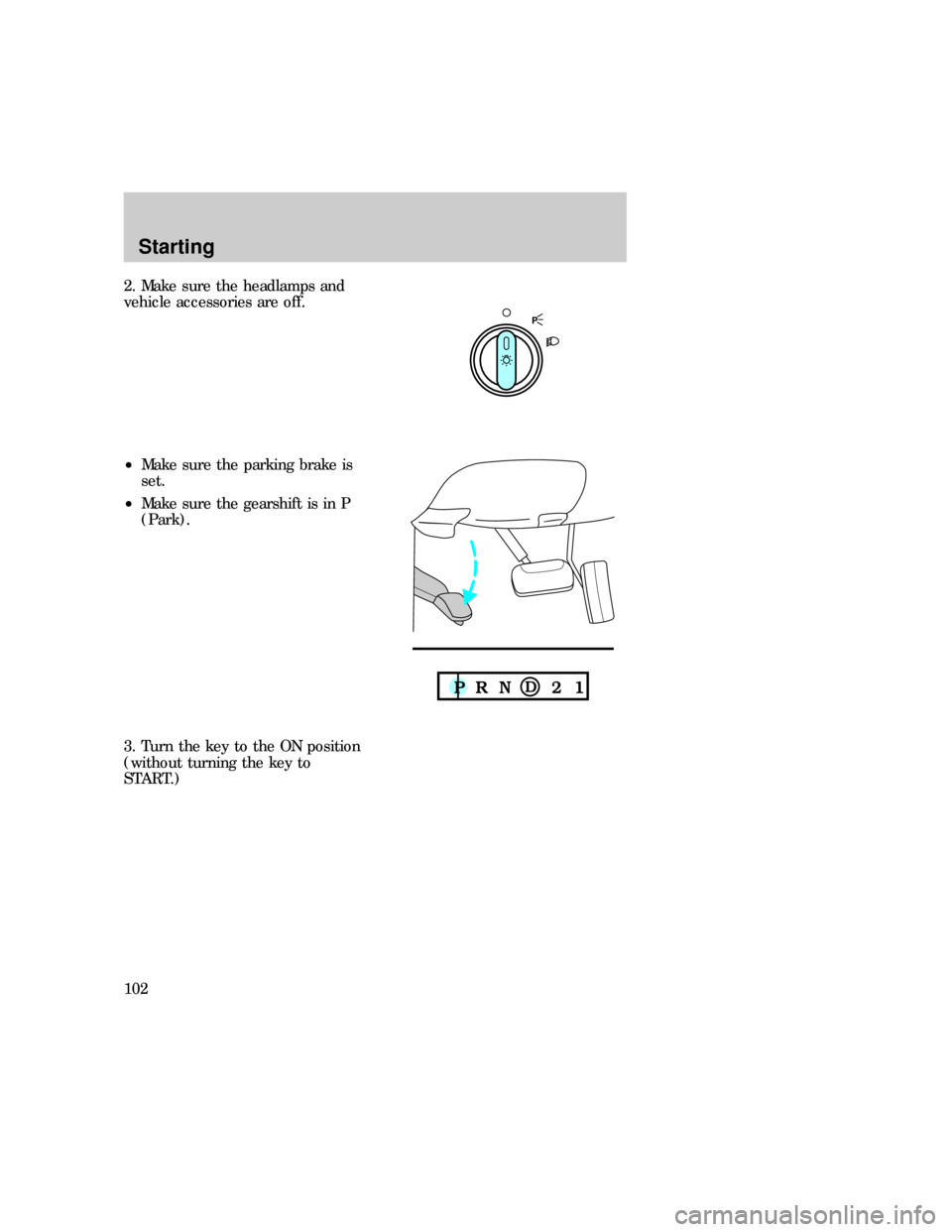
2. Make sure the headlamps and
vehicle accessories are off.
²Make sure the parking brake is
set.
²Make sure the gearshift is in P
(Park).
3. Turn the key to the ON position
(without turning the key to
START.)
P
Starting
102
Page 102 of 224
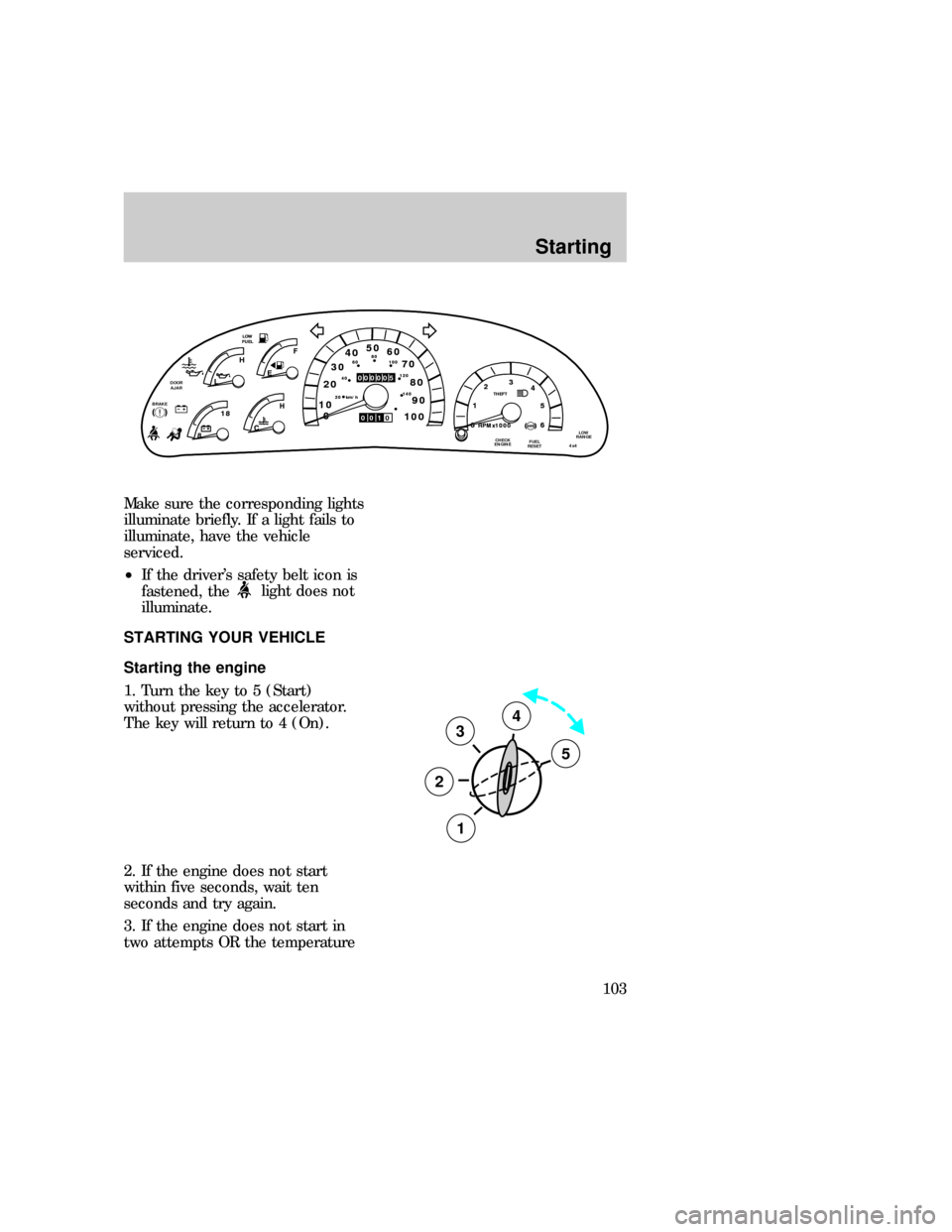
Make sure the corresponding lights
illuminate briefly. If a light fails to
illuminate, have the vehicle
serviced.
²If the driver's safety belt icon is
fastened, the
light does not
illuminate.
STARTING YOUR VEHICLE
Starting the engine
1. Turn the key to 5 (Start)
without pressing the accelerator.
The key will return to 4 (On).
2. If the engine does not start
within five seconds, wait ten
seconds and try again.
3. If the engine does not start in
two attempts OR the temperature
3
1050
3070
4080
120
140
40
20
0
10090 60
8060100
20 km/h
0010
0000052
4
5
6 01LH
CH
EF
818
THEFT
RPMx1000LOW
RANGE
4x4 FUEL
RESET CHECK
ENGINEABS
DOOR
AJARLOW
FUEL3
1050
3070
4080
120
140
40
20
0
10090 60
8060100
20 km/h
0010
0000052
4
5
6 01LH
CH
EF
818
THEFT
RPMx1000ABS
BRAKELOW
FUEL!
3
2
1
5
4
exd_starting_title_2
com_starting_vehicle.01
Starting
103
Page 116 of 224
2(Second)Ð Use 2(Second) to
start-up on slippery roads or to
provide additional engine braking
on downgrades. Transmission
operates in first and second gears.
1(Low)Ð Use 1(Low) to provide
maximum engine braking on steep
downgrades. Upshifts can be made
by shifting to 2(Second) or to
D(Overdrive). Selecting 1(Low)
at higher speeds causes a shift to
2(Second), and will shift to 1(Low)
after vehicle decelerates to the
proper speed.
Brake-shift interlock
The brake-shift interlock feature
prevents you from shifting from
P(Park) unless the brake pedal is
depressed (with the ignition in the
On position). If you cannot move
the gearshift out of P(Park) with
the brake pedal depressed:
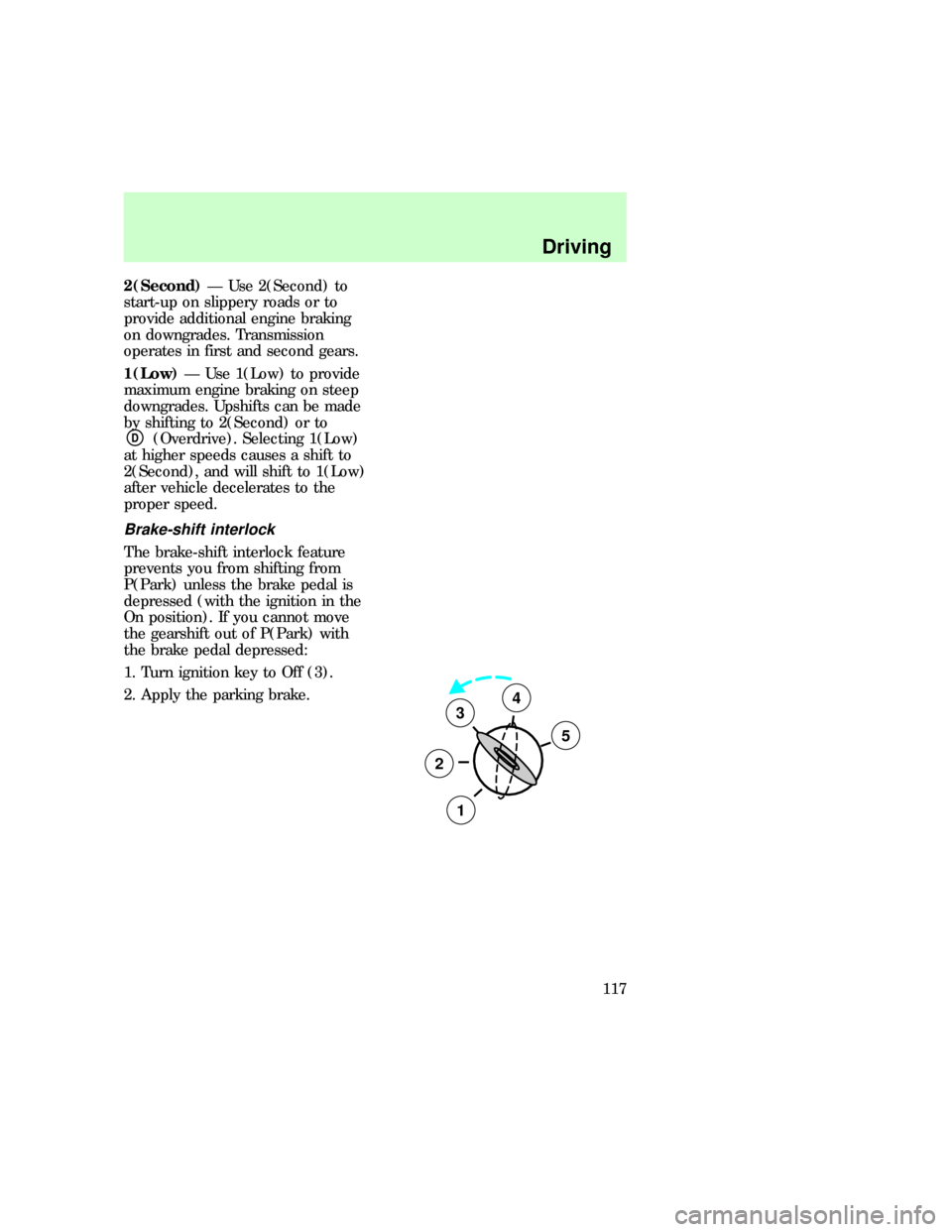
1. Turn ignition key to Off (3).
2. Apply the parking brake.
3
2
1
5
4
exd_brake_shift_interlock
Driving
117
Page 117 of 224
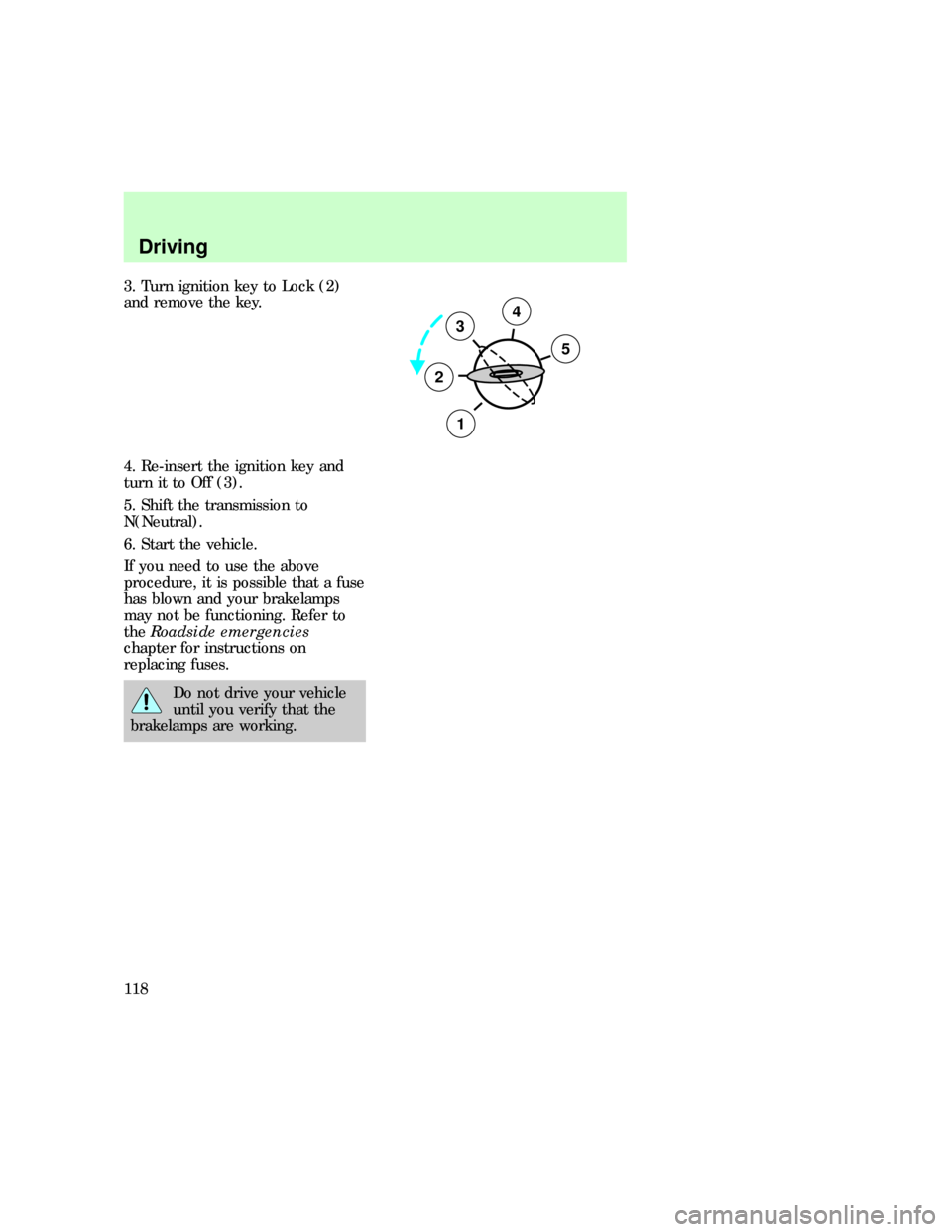
3. Turn ignition key to Lock (2)
and remove the key.
4. Re-insert the ignition key and
turn it to Off (3).
5. Shift the transmission to
N(Neutral).
6. Start the vehicle.
If you need to use the above
procedure, it is possible that a fuse
has blown and your brakelamps
may not be functioning. Refer to
theRoadside emergencies
chapter for instructions on
replacing fuses.
Do not drive your vehicle
until you verify that the
brakelamps are working.
3
2
1
5
4
exd_4wd_operation
Driving
118
Page 125 of 224
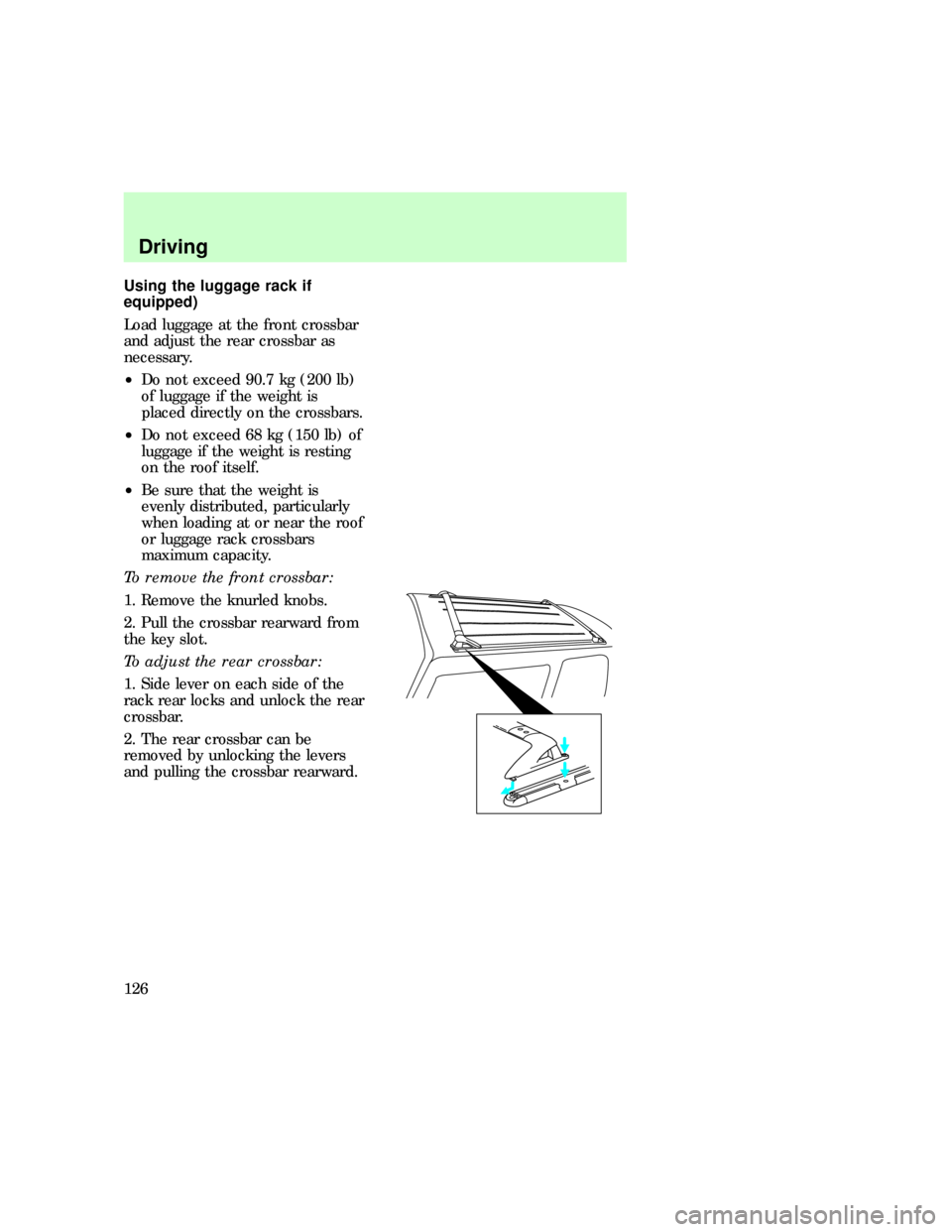
Using the luggage rack if
equipped)
Load luggage at the front crossbar
and adjust the rear crossbar as
necessary.
²Do not exceed 90.7 kg (200 lb)
of luggage if the weight is
placed directly on the crossbars.
²Do not exceed 68 kg (150 lb) of
luggage if the weight is resting
on the roof itself.
²Be sure that the weight is
evenly distributed, particularly
when loading at or near the roof
or luggage rack crossbars
maximum capacity.
To remove the front crossbar:
1. Remove the knurled knobs.
2. Pull the crossbar rearward from
the key slot.
To adjust the rear crossbar:
1. Side lever on each side of the
rack rear locks and unlock the rear
crossbar.
2. The rear crossbar can be
removed by unlocking the levers
and pulling the crossbar rearward.
exd_trailer_towing
Driving
126
Page 134 of 224
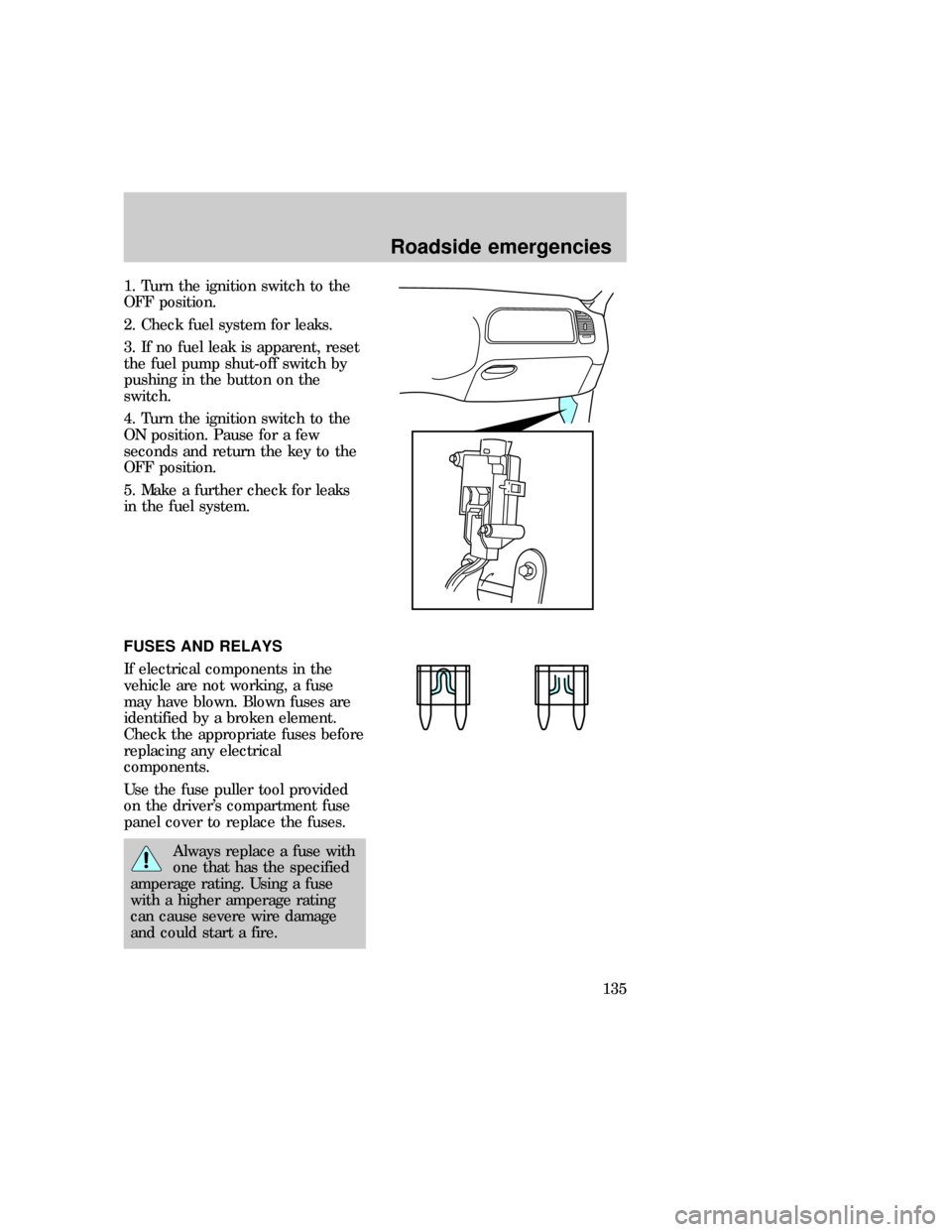
1. Turn the ignition switch to the
OFF position.
2. Check fuel system for leaks.
3. If no fuel leak is apparent, reset
the fuel pump shut-off switch by
pushing in the button on the
switch.
4. Turn the ignition switch to the
ON position. Pause for a few
seconds and return the key to the
OFF position.
5. Make a further check for leaks
in the fuel system.
FUSES AND RELAYS
If electrical components in the
vehicle are not working, a fuse
may have blown. Blown fuses are
identified by a broken element.
Check the appropriate fuses before
replacing any electrical
components.
Use the fuse puller tool provided
on the driver's compartment fuse
panel cover to replace the fuses.
Always replace a fuse with
one that has the specified
amperage rating. Using a fuse
with a higher amperage rating
can cause severe wire damage
and could start a fire.
exd_fuses_data
Roadside emergencies
135
Page 156 of 224
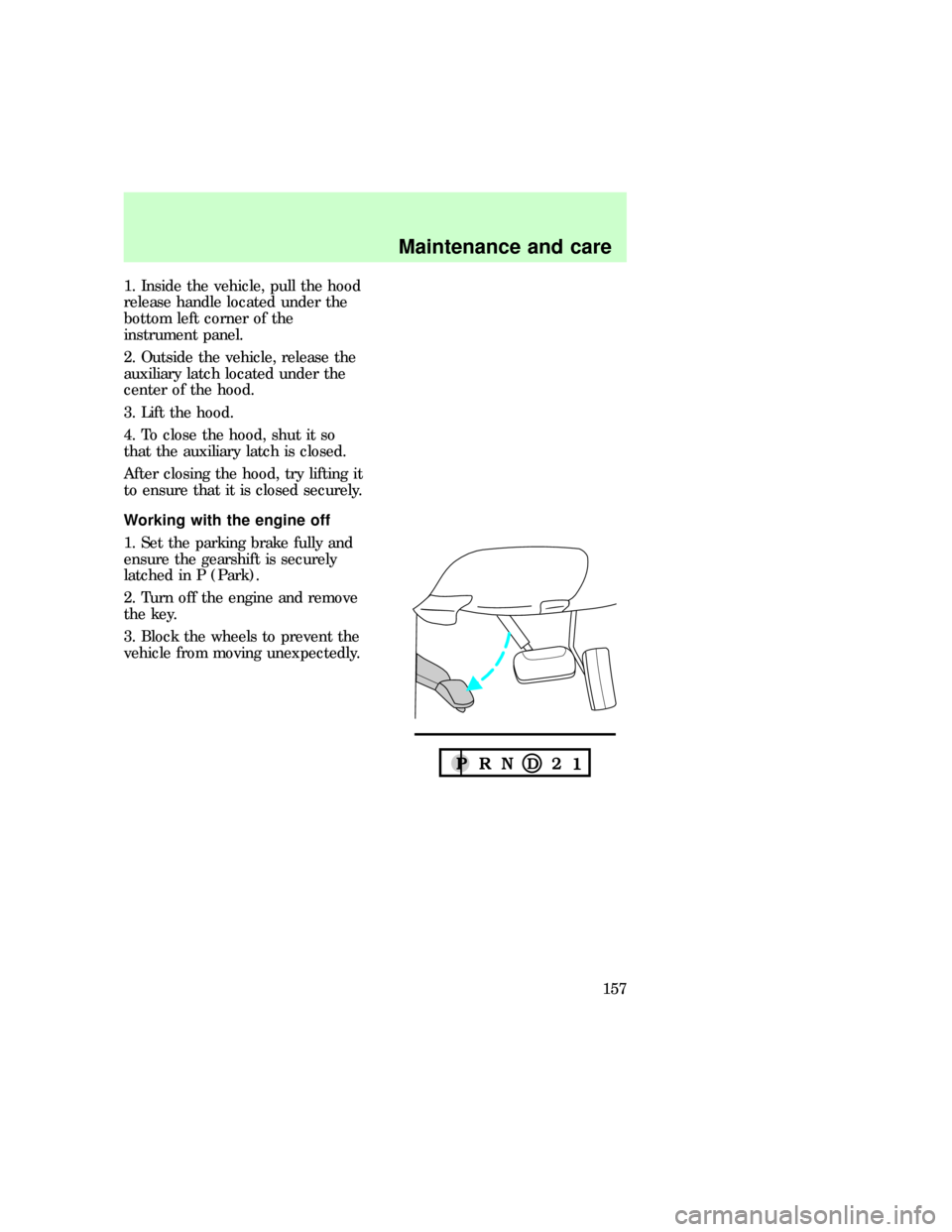
1. Inside the vehicle, pull the hood
release handle located under the
bottom left corner of the
instrument panel.
2. Outside the vehicle, release the
auxiliary latch located under the
center of the hood.
3. Lift the hood.
4. To close the hood, shut it so
that the auxiliary latch is closed.
After closing the hood, try lifting it
to ensure that it is closed securely.
Working with the engine off
1. Set the parking brake fully and
ensure the gearshift is securely
latched in P (Park).
2. Turn off the engine and remove
the key.
3. Block the wheels to prevent the
vehicle from moving unexpectedly.
exd_working_off
exd_working_on
Maintenance and care
157
Page 187 of 224

²Install cables securely, verifying
that the cables do not touch any
wiring, brake lines or fuel lines.
²Drive cautiously. If you hear the
cables rub or bang against the
vehicle, stop and retighten
them. If this does not work,
remove the cables to prevent
vehicle damage.
²Avoid overloading your vehicle.
²Remove the tire cables when
they are no longer needed.
²Do not use cables on dry roads.
²The suspension insulation and
bumpers will help prevent
vehicle damage. Do not remove
these components from the
vehicle when using snow tires
and traction devices.
²Do not exceed 48 km/h (30
mph) with tire cables on your
vehicle.
Consult your dealer for information
on other Ford approved methods
of traction control.
FUEL INFORMATION
The ignition key must be turned to
3 (Off) or 1 (Acc) during refueling
to obtain accurate fuel gauge
ratings.
exd_fuel_info
exd_important_precautions
Maintenance and care
188
Page 223 of 224

Trailer towing
calculating maximum trailer
weight ......................................127
Transfer case (see Differential
fluid) ...................................175,176
Transmission ......................114,172
Transmission control switch ......49
Trip odometer .............................17
Turn signal ..................................47
indicator lights ..........................12
Vehicle dimensions ...................218
Vehicle headlamp aiming
device (VHAD) .........................206
Ventilating your vehicle ...........105
Voltmeter (see Battery voltage
gauge) ..........................................16Warning chimes
headlamps on ............................14
key in ignition ...........................14
safety belt .................................13
Warning lights (see Lights) .8,144,
145
Windows
accessory delay .........................59
Windshield washer fluid and
wipers ........................................179
checking and adding fluid .....164
operation ..............................44,45
Wrecker towing .........................154
Index
224