belt FORD EXPEDITION 1997 1.G Owner's Manual
[x] Cancel search | Manufacturer: FORD, Model Year: 1997, Model line: EXPEDITION, Model: FORD EXPEDITION 1997 1.GPages: 224, PDF Size: 2.2 MB
Page 96 of 224
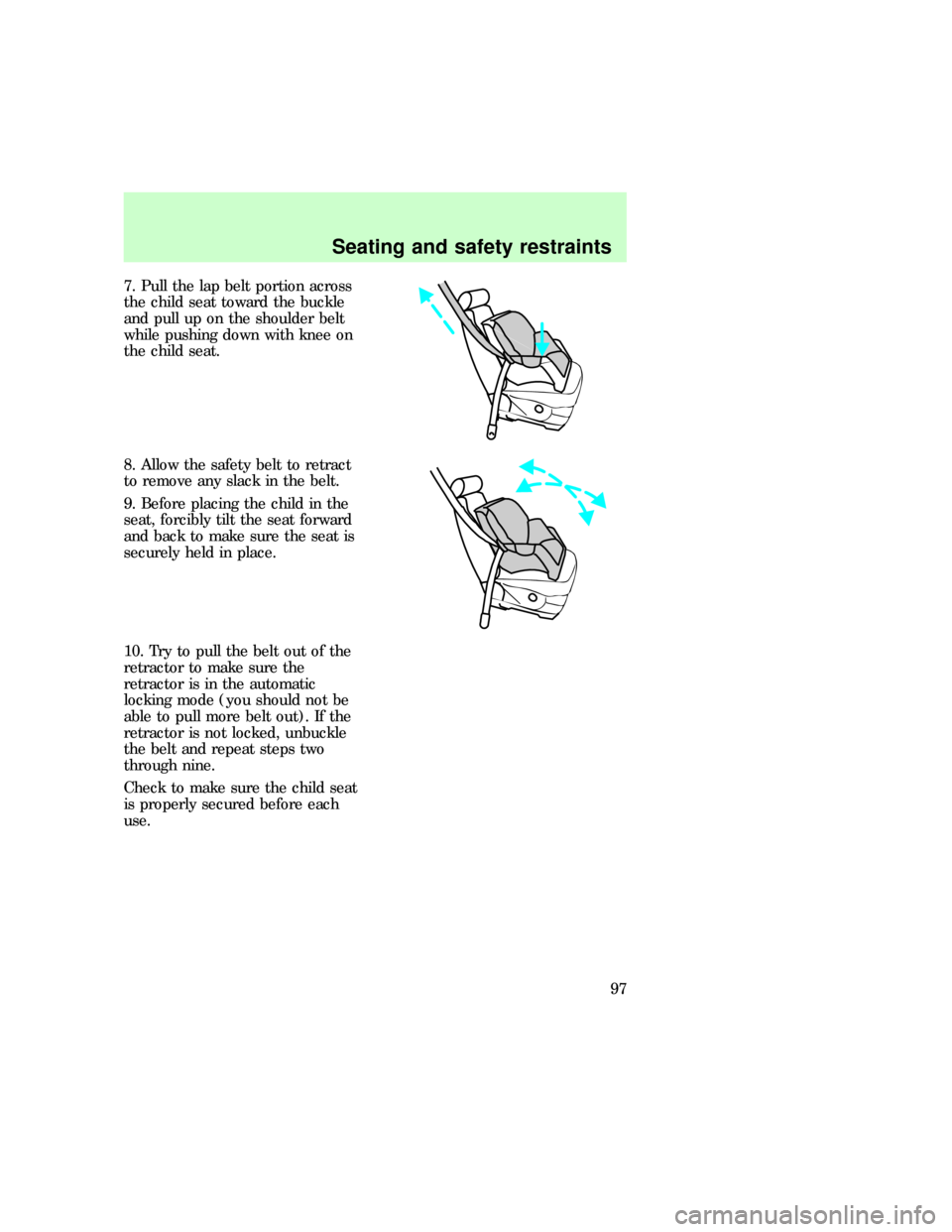
7. Pull the lap belt portion across
the child seat toward the buckle
and pull up on the shoulder belt
while pushing down with knee on
the child seat.
8. Allow the safety belt to retract
to remove any slack in the belt.
9. Before placing the child in the
seat, forcibly tilt the seat forward
and back to make sure the seat is
securely held in place.
10. Try to pull the belt out of the
retractor to make sure the
retractor is in the automatic
locking mode (you should not be
able to pull more belt out). If the
retractor is not locked, unbuckle
the belt and repeat steps two
through nine.
Check to make sure the child seat
is properly secured before each
use.
com_safety_seats.01
Seating and safety restraints
97
Page 97 of 224
Child and infant or child safety
seats
Carefully follow all of the
manufacturer's instructions
included with the safety seat you
put in your vehicle. If you do not
install and use the safety seat
properly, the child may be
injured in a sudden stop or
collision.
Ford recommends the use of a
child safety seat having a top
tether strap. Install the child safety
seat in a seating position which is
capable of providing a tether
anchorage. For more information
on top tether straps seeAttaching
safety seats with tether strapsin
this chapter.
When installing a child safety seat:
²Use the correct safety belt
buckle for that seating position.
²Make sure the tongue is
securely fastened in the buckle.
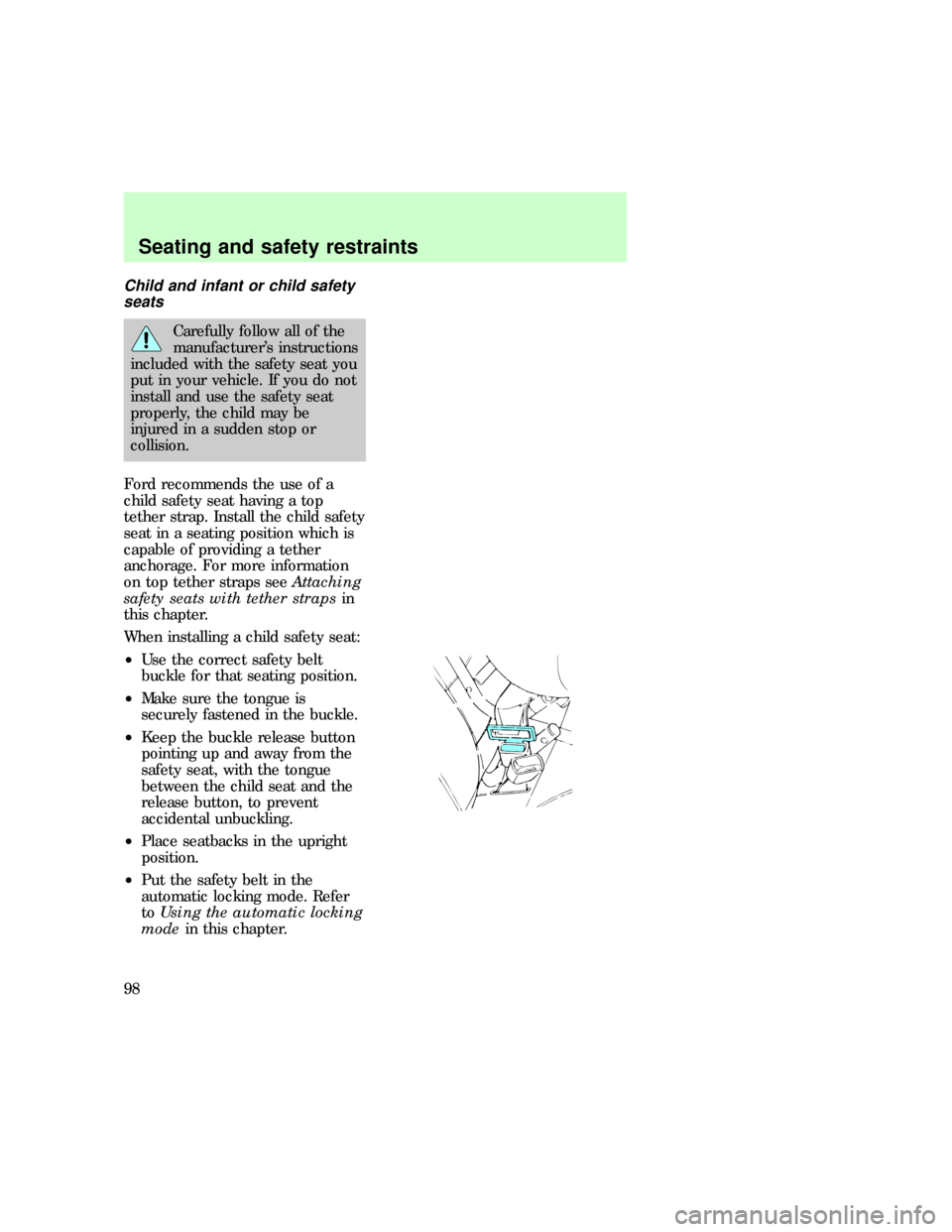
²Keep the buckle release button
pointing up and away from the
safety seat, with the tongue
between the child seat and the
release button, to prevent
accidental unbuckling.
²Place seatbacks in the upright
position.
²Put the safety belt in the
automatic locking mode. Refer
toUsing the automatic locking
modein this chapter.
exd_using_tether
Seating and safety restraints
98
Page 100 of 224
If you smell exhaust fumes
inside your vehicle, have
your dealer inspect your vehicle
immediately. Do not drive if you
smell exhaust fumes.
Preparing to start the vehicle
Engine starting is controlled by the
spark ignition system. This system
meets all Canadian
Interference-Causing Equipment
standard requirements regulating
the impulse electrical field strength
of radio noise.
When starting a fuel-injected
engine, avoid pressing the
accelerator before or during
starting. Only use the accelerator
when you have difficulty starting
the engine. For more information
on starting the vehicle, refer to
Starting the vehiclein this
chapter.
Before starting the vehicle:
1. Make sure all vehicle occupants
have buckled their safety belts. For
more information on safety belts
and their proper usage, refer to
theSeating and safety restraints
chapter.
exd_preparing_start
Starting
101
Page 102 of 224
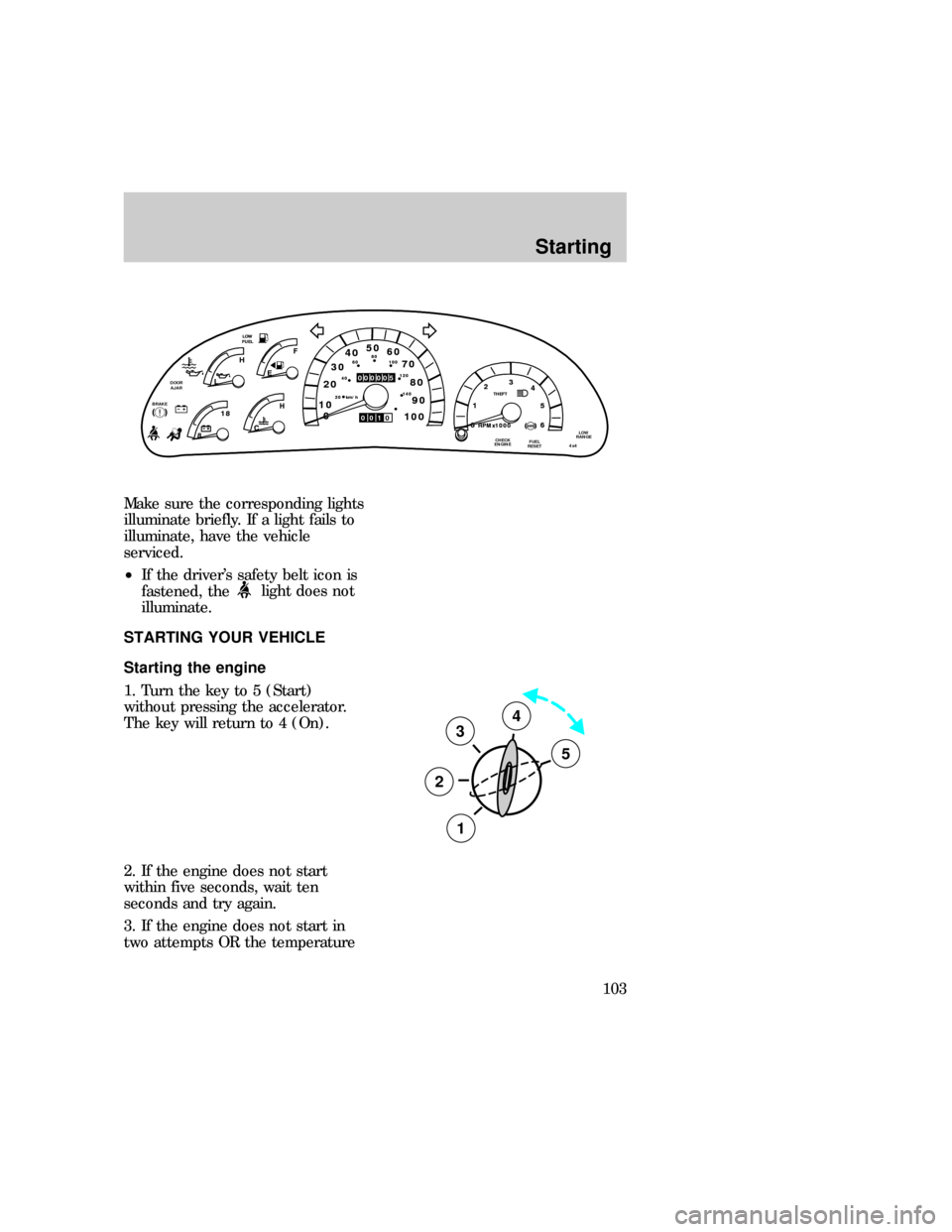
Make sure the corresponding lights
illuminate briefly. If a light fails to
illuminate, have the vehicle
serviced.
²If the driver's safety belt icon is
fastened, the
light does not
illuminate.
STARTING YOUR VEHICLE
Starting the engine
1. Turn the key to 5 (Start)
without pressing the accelerator.
The key will return to 4 (On).
2. If the engine does not start
within five seconds, wait ten
seconds and try again.
3. If the engine does not start in
two attempts OR the temperature
3
1050
3070
4080
120
140
40
20
0
10090 60
8060100
20 km/h
0010
0000052
4
5
6 01LH
CH
EF
818
THEFT
RPMx1000LOW
RANGE
4x4 FUEL
RESET CHECK
ENGINEABS
DOOR
AJARLOW
FUEL3
1050
3070
4080
120
140
40
20
0
10090 60
8060100
20 km/h
0010
0000052
4
5
6 01LH
CH
EF
818
THEFT
RPMx1000ABS
BRAKELOW
FUEL!
3
2
1
5
4
exd_starting_title_2
com_starting_vehicle.01
Starting
103
Page 122 of 224
LOADING YOUR VEHICLE
It is extremely dangerous
to ride in a cargo area,
inside or outside of a vehicle. In
a collision, people riding in these
areas are more likely to be
seriously injured or killed. Do not
allow people to ride in any area
of your vehicle that is not
equipped with seats and safety
belts. Be sure everyone in your
vehicle is in a seat and using a
safety belt properly.
Before loading your vehicle,
familiarize yourself with the
following terms:
²Base curb weight :Weight of the
vehicle including any standard
equipment, fluids, lubricants,
etc. It does not include
passengers or aftermarket
equipment.
²Payload :Combined maximum
allowable weight of passengers,
cargo and optional equipment.
²GVW (Gross Vehicle Weight) Ð
Base curb weight plus the
payload weight. The GVW is not
a limit or a specification.
²GVWR (Gross Vehicle Weight
Rating) :Maximum total weight
of the base vehicle, passengers,
optional equipment and cargo.
The GVWR is specific to each
vehicle and is listed on the
Safety Compliance Certification
Label on the driver's door pillar.
²GAWR (Gross Axle Weight
Driving
123
Page 153 of 224
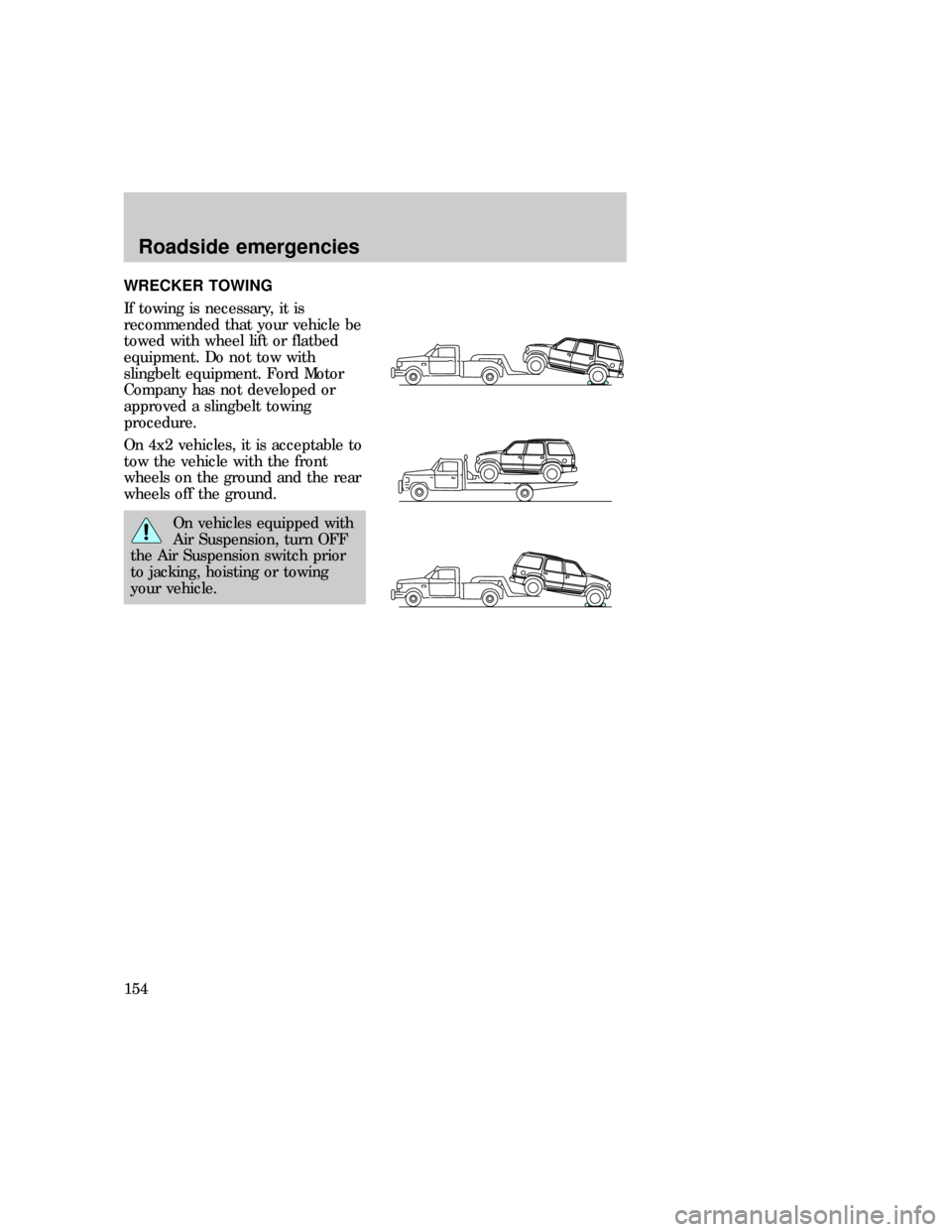
WRECKER TOWING
If towing is necessary, it is
recommended that your vehicle be
towed with wheel lift or flatbed
equipment. Do not tow with
slingbelt equipment. Ford Motor
Company has not developed or
approved a slingbelt towing
procedure.
On 4x2 vehicles, it is acceptable to
tow the vehicle with the front
wheels on the ground and the rear
wheels off the ground.
On vehicles equipped with
Air Suspension, turn OFF
the Air Suspension switch prior
to jacking, hoisting or towing
your vehicle.
Roadside emergencies
154
Page 185 of 224
When replacing full size
tires, never mix radial,
bias-belted, or bias-type tires.
Use only the tire sizes that are
listed on the tire pressure decal.
Make sure that all tires are the
same size, speed rating, and
load-carrying capacity. Use only
the tire combinations
recommended on the decal. If
you do not follow these
precautions, your vehicle may
not drive properly and safely.
Make sure that all
replacement tires are of
the same size, type, load-carrying
capacity and tread design (e.g.,
ªAll Terrainº, etc.), as originally
offered by Ford.
Do not replace your tires
with ªhigh performanceª
tires or larger size tires.
Failure to follow these
precautions may adversely
affect the handling of the vehicle
and make it easier to lose control
and roll over.
Your vehicle requires the use of
the following tire types:
²A/S BSW P255/70R 16
²A/T OWL P255/70R 16
²A/T OWL P265/70R 17
Maintenance and care
186
Page 210 of 224
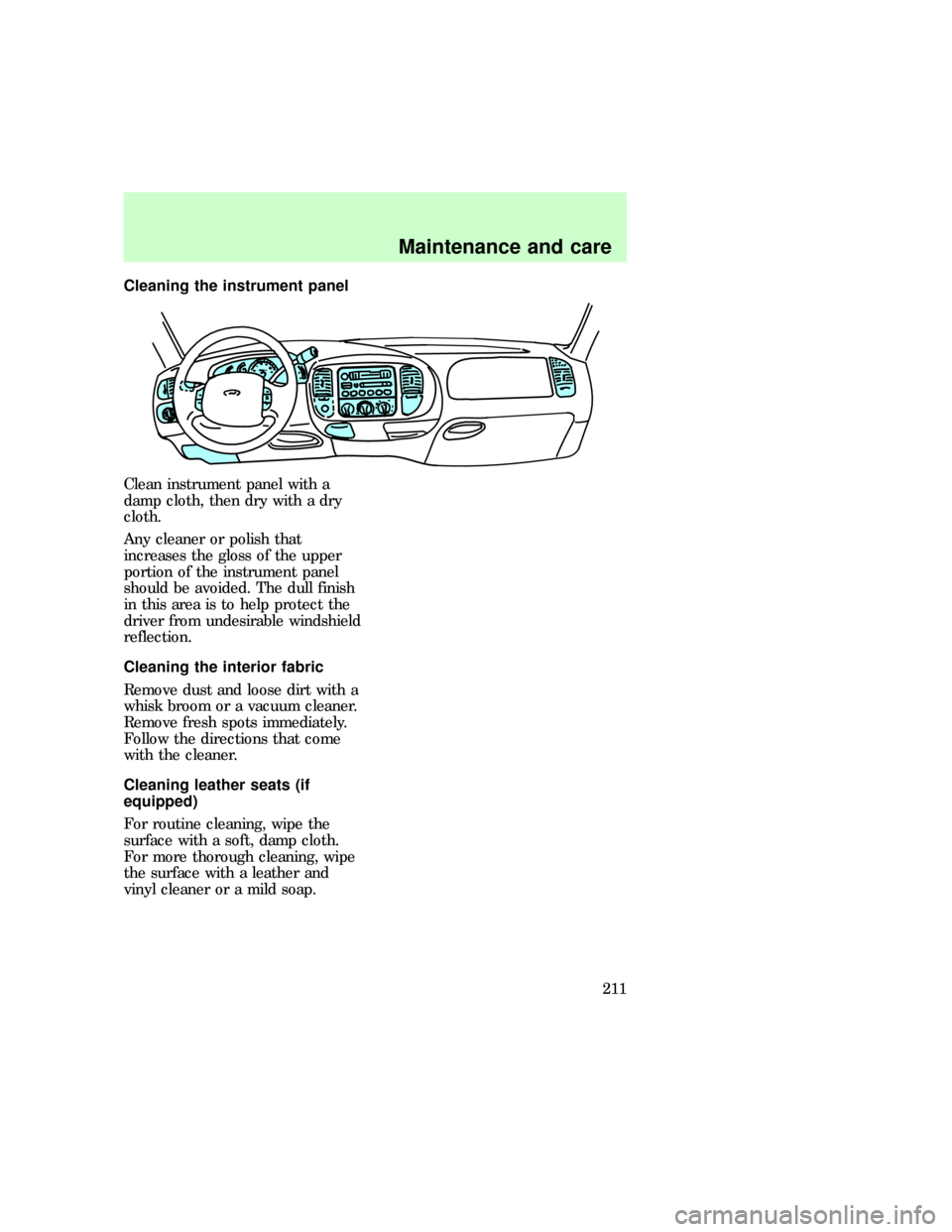
Cleaning the instrument panel
Clean instrument panel with a
damp cloth, then dry with a dry
cloth.
Any cleaner or polish that
increases the gloss of the upper
portion of the instrument panel
should be avoided. The dull finish
in this area is to help protect the
driver from undesirable windshield
reflection.
Cleaning the interior fabric
Remove dust and loose dirt with a
whisk broom or a vacuum cleaner.
Remove fresh spots immediately.
Follow the directions that come
with the cleaner.
Cleaning leather seats (if
equipped)
For routine cleaning, wipe the
surface with a soft, damp cloth.
For more thorough cleaning, wipe
the surface with a leather and
vinyl cleaner or a mild soap.
com_int_fabric_cleaning.01
com_leather_seats_cleaning.01
exd_cleaning_safety_belts
Maintenance and care
211
Page 211 of 224

Cleaning and maintaining the
safety belts
Clean the safety belts with a mild
soap solution recommended for
cleaning upholstery or carpets. Do
not bleach or dye the belts,
because these actions may weaken
the belt webbing.
Check your safety belt system
periodically to ensure that it works
properly and isn't damaged. If the
webbing shows any signs of wear,
nicks or cuts, have it inspected by
a qualified technician to determine
if replacement is necessary. Always
have your safety belt system
checked after a collision by a
qualified technician.
All safety belt assemblies,
including retractors, buckles, front
seat belt buckle support assemblies
(slide bar if equipped), child safety
seat tether bracket assemblies (if
equipped) and attaching hardware
should be inspected after any
collision. Ford recommends that all
safety belt assemblies used in
vehicles involved in a collision be
replaced. However, if the collision
was minor and a qualified
technician finds that the belts do
not show damage and continue to
operate properly, they do not need
to be replaced. Safety belt
assemblies not in use during a
collision should be inspected and
replaced if either damage or
improper operation is noted.
Maintenance and care
212
Page 222 of 224

Idle
relearning ................................178
Ignition .........................................68
Instrument panel ........................20
Jack ..............................................66
Jump-starting your vehicle 151,152
attaching cables ......................152
disconnecting cables ..............153
Lamps
interior lamps ...........................54
parking lamps .........................201
Lights, warning and indicator
anti-lock brakes (ABS) ............12
brake ..........................................10
charging system ..........................9
high beam .................................12
safety belt ............................10,86
Message center ...........................17
english/metric button ...............18
low fuel level ........................18,19
Motorcraft parts ........................213
Odometer .....................................17
Overdrive .....................................48
Overdrive lockout button ...........11
Overhead console
compass/temperature display ..50
Power features
door locks ..................................60
windows ...............................58,59
Power steering
fluid, checking and adding ....170
Rear console ................................63
Rear window
wiper ..........................................46
Relays ........................................135
Remote entry system
locking/unlocking doors ...........69
panic alarm ...............................69
replacement/additional
transmitters ...............................70
replacing the batteries .............70
Reporting safety defects ..........221Safety restraints
extension assembly ..................85
for children ...............................91
lap and shoulder belts ........82,83
proper use ............................80,81
Safety seats for children ............94
attaching with tether straps ....99
automatic locking mode
(retractor) ............................95,98
Seats ............................................72
bench (60-40 split) .............72,73
lumbar support .........................73
power seat recliner/lumbar ......74
rear flip fold seat ......................75
rear seat access ........................74
third row seat .................76,77,79
Servicing your vehicle ..............155
precautions when servicing ...155
Special notice
utility-type vehicles ....................2
Speed control ..............................41
accelerating ...............................42
resetting ....................................43
resuming a set speed ...............43
turning off .................................41
Speedometer ...............................14
Starting your vehicle ................100
preparing to start your
vehicle .....................................101
starting a warm engine ..........103
Steering, power .........................109
Steering wheel ............................40
Tachometer
mechanical cluster ...................15
Temperature control (see
Climate control) .....................28,29
Tires
changing ..................................144
inspection and maintenance ..182
tire grades ...............................182
treadwear ................................182
Traction-lok rear axle ...............111
Index
223