ignition FORD EXPEDITION 1997 1.G Owner's Manual
[x] Cancel search | Manufacturer: FORD, Model Year: 1997, Model line: EXPEDITION, Model: FORD EXPEDITION 1997 1.GPages: 224, PDF Size: 2.2 MB
Page 85 of 224

belt extensions are available at no
cost from your Ford or
Lincoln/Mercury dealer.
Use only extensions manufactured
by the same supplier as the safety
belt. Manufacturer identification is
located at the end of the webbing
on the label. Also, use the safety
belt extension only if the safety
belt is too short for you when fully
extended. Do not use extension to
change the fit of the shoulder belt
across the torso.
SAFETY BELT INDICATOR
LIGHT AND WARNING CHIME
illuminates in the instrument
cluster and a chime sounds to
remind the occupants to fasten
their safety belts:
CONDITIONS OF OPERATION
If......Then.....
The driver's safety belt is not
buckled before the ignition key
is turned to On. .The safety belt indicator illuminates for
1-2 minutes and the warning chime
sounds for 4- 8 seconds.
The driver's safety belt is
buckled while the indicator light
is illuminated and the reminder
chime is sounding...The safety belt indicator light and
reminder chime turn off.
The driver's safety belt is
buckled before the ignition key
is turned to On. . .The safety belt indicator light and
reminder chime remain off.
exd_indicator_light
Seating and safety restraints
86
Page 90 of 224

A difficulty with the system is
indicated by one or more of the
following:
²The readiness light will either
flash or stay lit.
²The readiness light will not
illuminate immediately after
ignition is turned on.
²A group of five beeps will be
heard. The tone pattern will
repeat periodically until the
problem and light are repaired.
If any of these things happen, even
intermittently, have the SRS
serviced at your dealership or by a
qualified technician immediately.
Unless serviced, the system may
not function properly in the event
of a collision.
Disposal of air bags and air bag
equipped vehicles
For disposal of air bags or air bag
equipped vehicles, see your local
dealership or qualified technician.
Air bags MUST BE disposed of by
qualified personnel.
SAFETY RESTRAINTS FOR
CHILDREN
Important child restraint
precautions
You are required by law to use
safety restraints for children in the
U.S. and Canada. If small children
ride in your vehicle (generally
children who are four years old or
younger and who weigh 18 kg [40
lbs] or less), you must put them in
com_disposal.01
exd_title_restraints
exd_precautions_child
Seating and safety restraints
91
Page 100 of 224
If you smell exhaust fumes
inside your vehicle, have
your dealer inspect your vehicle
immediately. Do not drive if you
smell exhaust fumes.
Preparing to start the vehicle
Engine starting is controlled by the
spark ignition system. This system
meets all Canadian
Interference-Causing Equipment
standard requirements regulating
the impulse electrical field strength
of radio noise.
When starting a fuel-injected
engine, avoid pressing the
accelerator before or during
starting. Only use the accelerator
when you have difficulty starting
the engine. For more information
on starting the vehicle, refer to
Starting the vehiclein this
chapter.
Before starting the vehicle:
1. Make sure all vehicle occupants
have buckled their safety belts. For
more information on safety belts
and their proper usage, refer to
theSeating and safety restraints
chapter.
exd_preparing_start
Starting
101
Page 110 of 224
UNDERSTANDING THE
TRACTION-LOKTREAR AXLE
(IF EQUIPPED)
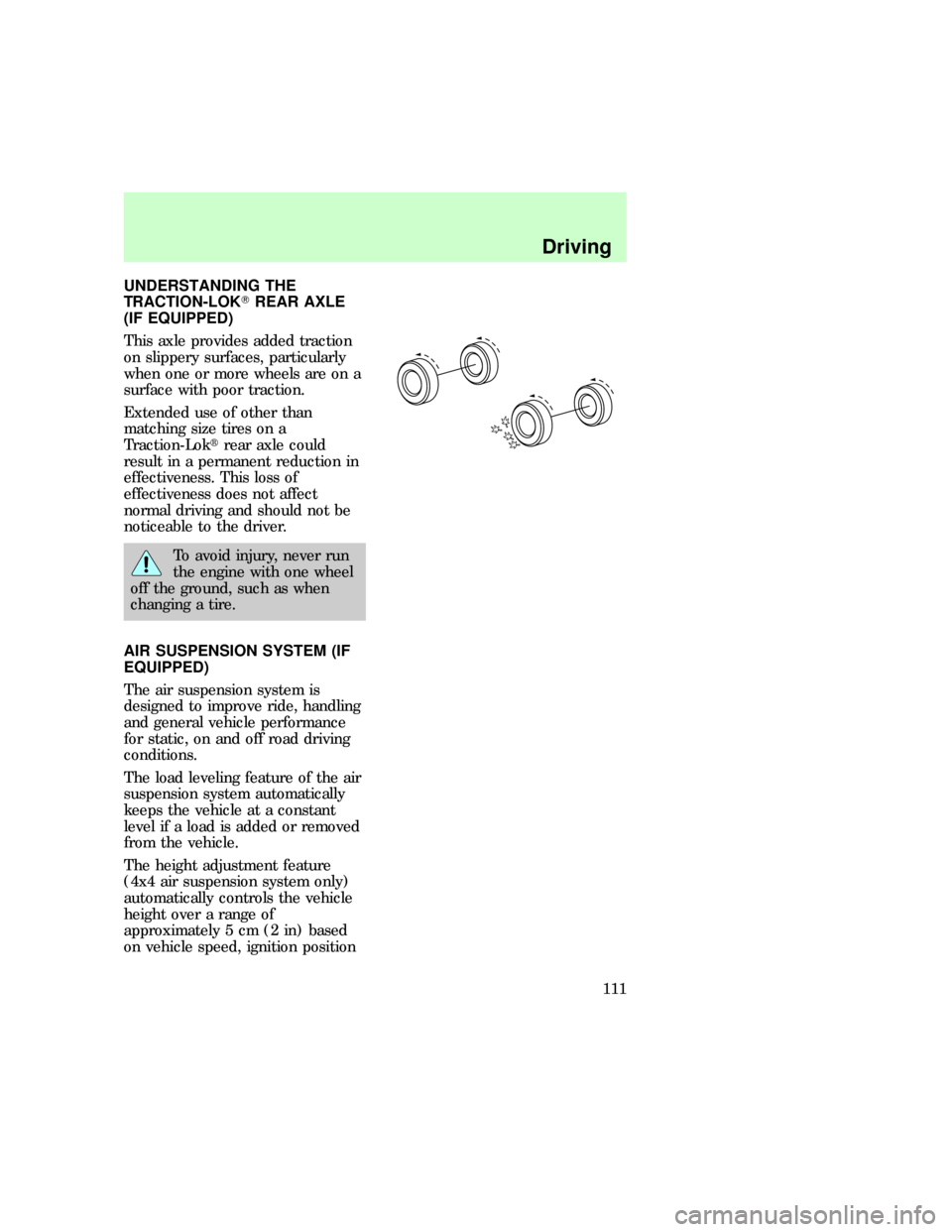
This axle provides added traction
on slippery surfaces, particularly
when one or more wheels are on a
surface with poor traction.
Extended use of other than
matching size tires on a
Traction-Loktrear axle could
result in a permanent reduction in
effectiveness. This loss of
effectiveness does not affect
normal driving and should not be
noticeable to the driver.
To avoid injury, never run
the engine with one wheel
off the ground, such as when
changing a tire.
AIR SUSPENSION SYSTEM (IF
EQUIPPED)
The air suspension system is
designed to improve ride, handling
and general vehicle performance
for static, on and off road driving
conditions.
The load leveling feature of the air
suspension system automatically
keeps the vehicle at a constant
level if a load is added or removed
from the vehicle.
The height adjustment feature
(4x4 air suspension system only)
automatically controls the vehicle
height over a range of
approximately 5 cm (2 in) based
on vehicle speed, ignition position
exd_air_suspension
Driving
111
Page 111 of 224

and selection of two or four-wheel
drive modes.
The air suspension system places
the vehicle at its lowest height to
provide easy entry and exit when
the vehicle is parked, the ignition
is turned off and all doors are
closed.
The air suspension system raises
the vehicle approximately 2.5 cm
(1 in) to its normal ride position
when the ignition is turned on, the
transmission is initially shifted into
the drive or reverse mode and all
doors are closed.
In 4WD Low, the air suspension
system raises the vehicle an
additional 2.5 cm (1 in) above the
normal ride height to improve
vehicle ground clearance. However,
if the vehicle speed exceeds 40
km/h (25 mph), the system will
lower the vehicle to its normal ride
height to maximize ride comfort.
The vehicle will raise again if
vehicle speed is less than 13 km/h
(8 mph) for one minute. In 4WD
Low, do not exceed 56 km/h (35
mph).
As a safety consideration,
whenever a door is opened
(including the liftgate and liftgate
glass) the system memorizes and
maintains the height at the
moment the door was opened. The
system will maintain this height
until all doors are closed or until
vehicle speed exceeds 16 km/h (10
mph).
Driving
112
Page 112 of 224
An on board air compressor and
solenoids are used to raise and
lower the vehicle. It is normal to
occasionally hear a buzz or clicking
from the vehicle even when the
ignition is turned off. The system
stays energized for 40 minutes
after the ignition is turned off to
compensate for any load changes
made after the vehicle is parked.
Air suspension service system
switch
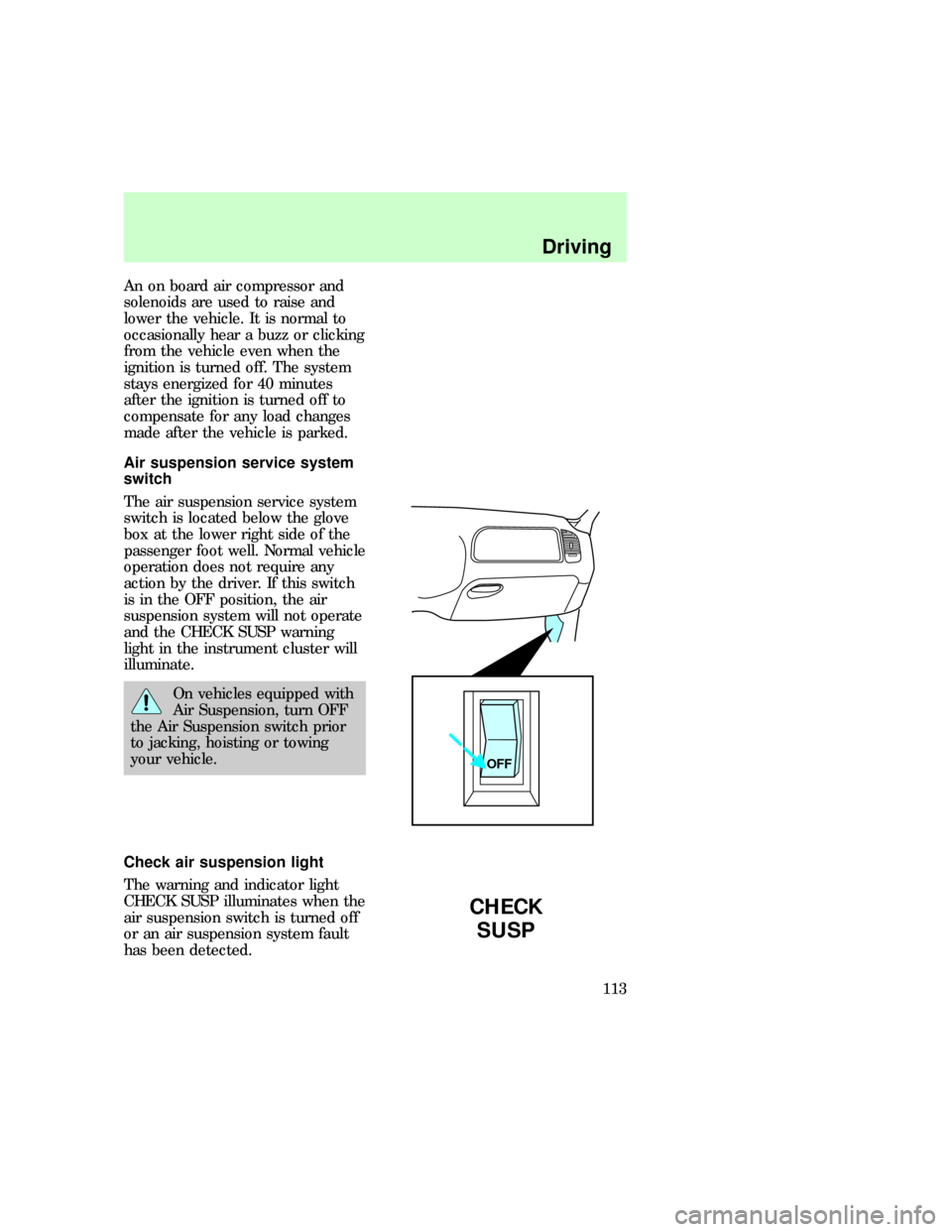
The air suspension service system
switch is located below the glove
box at the lower right side of the
passenger foot well. Normal vehicle
operation does not require any
action by the driver. If this switch
is in the OFF position, the air
suspension system will not operate
and the CHECK SUSP warning
light in the instrument cluster will
illuminate.
On vehicles equipped with
Air Suspension, turn OFF
the Air Suspension switch prior
to jacking, hoisting or towing
your vehicle.
Check air suspension light
The warning and indicator light
CHECK SUSP illuminates when the
air suspension switch is turned off
or an air suspension system fault
has been detected.
OFF
CHECK
SUSP
exd_air_susp_service_switch
exd_check_air_susp_light
Driving
113
Page 113 of 224
If the light is displayed while
driving and the air suspension
system service switch is not turned
off, safely pull off the road at your
earliest convenience. Turn the
ignition switch from 4(On) to 3
(Off) and 4(On) again. If the
warning light reappears, turn the
air suspension switch off and have
the vehicle serviced by your dealer
or qualified service technician.
If the vehicle is loaded beyond the
recommended maximum payload,
the CHECK SUSP light may
illuminate. To correct this
condition, remove or redistribute
the payload according to the
recommended requirements and
follow the procedure outlined
above.
TRANSMISSION OPERATION
Automatic transmission
operation
Hold the brake pedal down
while you move the
gearshift lever from position to
position. If you do not hold the
brake pedal down, your vehicle
may move unexpectedly and
injure someone.
exd_transmission
exd_automatic
Driving
114
Page 116 of 224
2(Second)Ð Use 2(Second) to
start-up on slippery roads or to
provide additional engine braking
on downgrades. Transmission
operates in first and second gears.
1(Low)Ð Use 1(Low) to provide
maximum engine braking on steep
downgrades. Upshifts can be made
by shifting to 2(Second) or to
D(Overdrive). Selecting 1(Low)
at higher speeds causes a shift to
2(Second), and will shift to 1(Low)
after vehicle decelerates to the
proper speed.
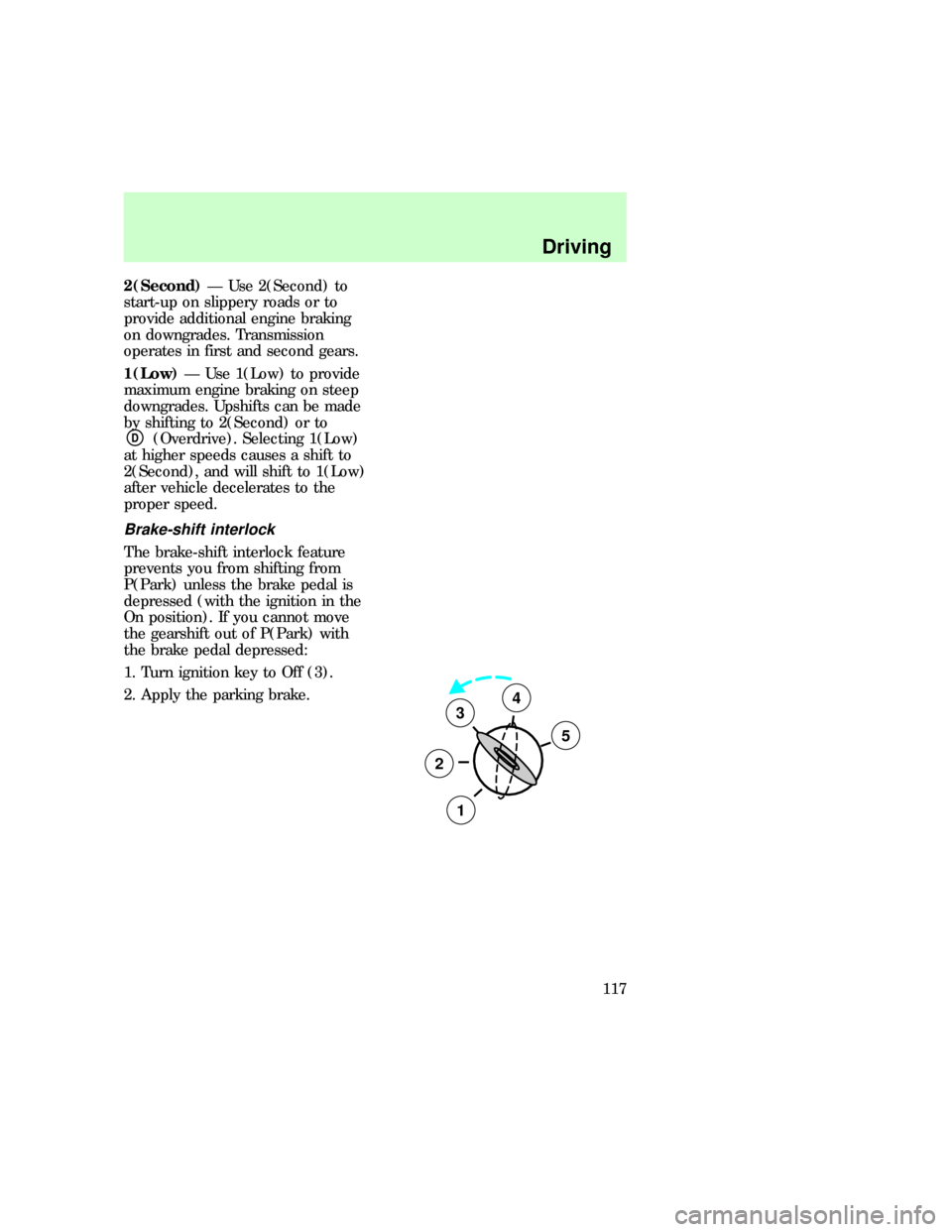
Brake-shift interlock
The brake-shift interlock feature
prevents you from shifting from
P(Park) unless the brake pedal is
depressed (with the ignition in the
On position). If you cannot move
the gearshift out of P(Park) with
the brake pedal depressed:
1. Turn ignition key to Off (3).
2. Apply the parking brake.
3
2
1
5
4
exd_brake_shift_interlock
Driving
117
Page 117 of 224
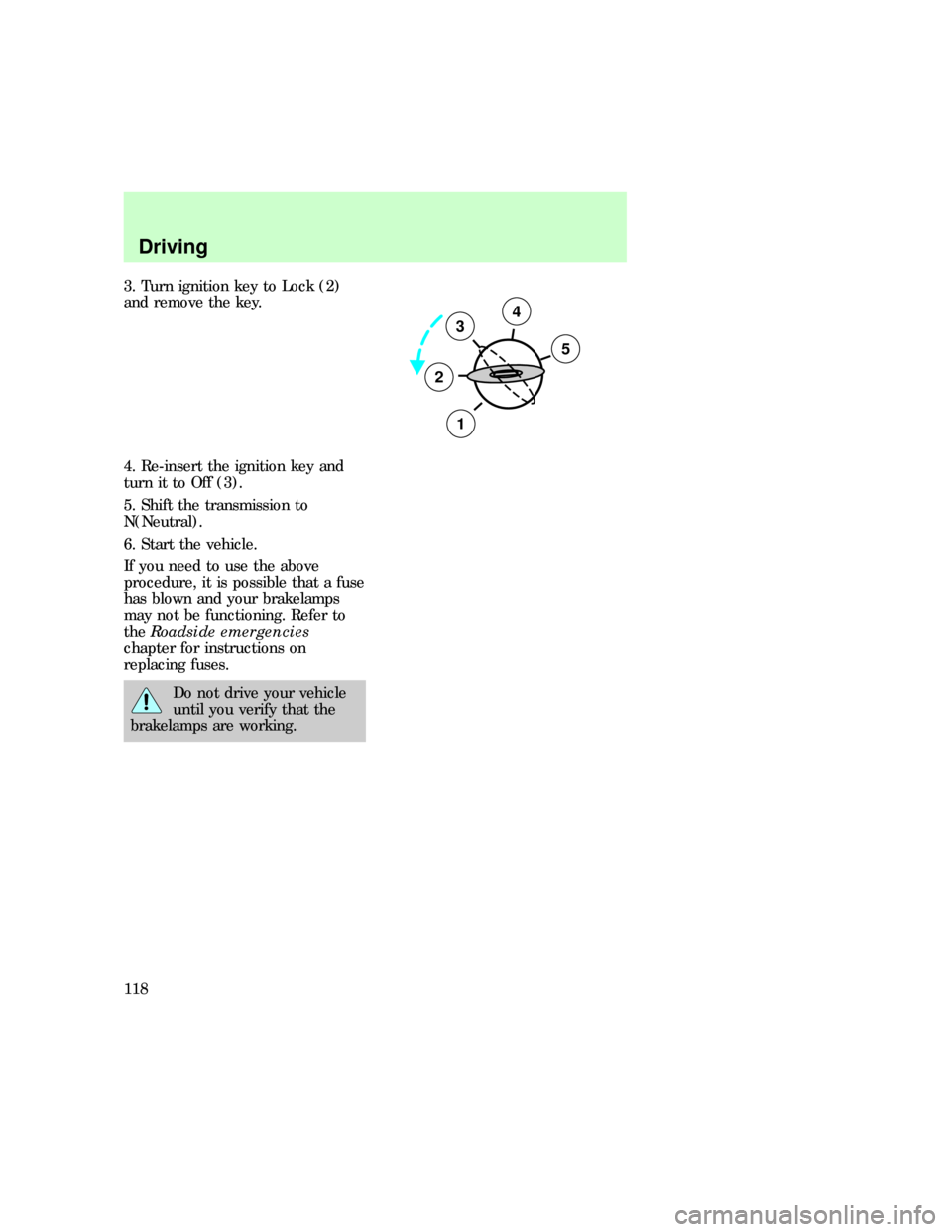
3. Turn ignition key to Lock (2)
and remove the key.
4. Re-insert the ignition key and
turn it to Off (3).
5. Shift the transmission to
N(Neutral).
6. Start the vehicle.
If you need to use the above
procedure, it is possible that a fuse
has blown and your brakelamps
may not be functioning. Refer to
theRoadside emergencies
chapter for instructions on
replacing fuses.
Do not drive your vehicle
until you verify that the
brakelamps are working.
3
2
1
5
4
exd_4wd_operation
Driving
118
Page 133 of 224
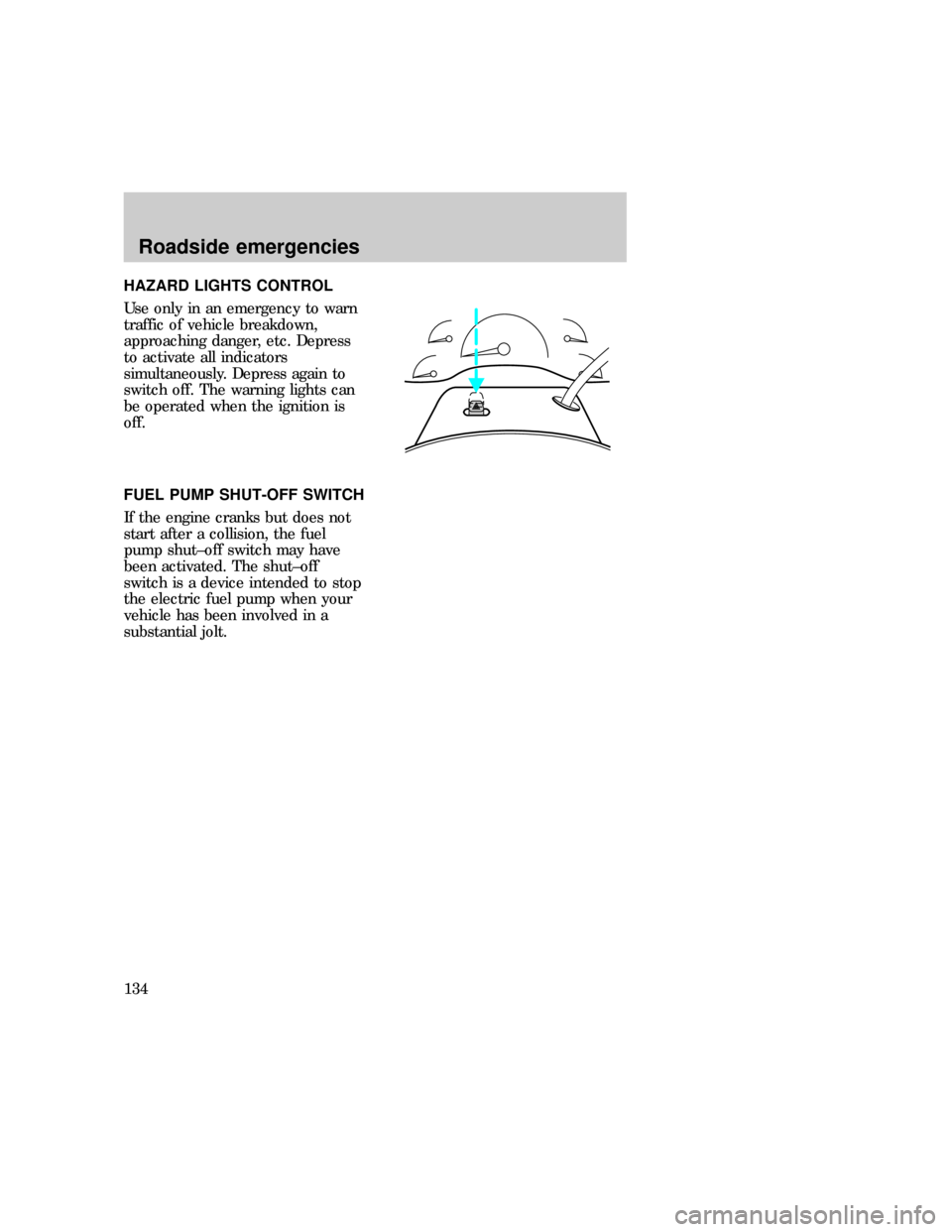
HAZARD LIGHTS CONTROL
Use only in an emergency to warn
traffic of vehicle breakdown,
approaching danger, etc. Depress
to activate all indicators
simultaneously. Depress again to
switch off. The warning lights can
be operated when the ignition is
off.
FUEL PUMP SHUT-OFF SWITCH
If the engine cranks but does not
start after a collision, the fuel
pump shut±off switch may have
been activated. The shut±off
switch is a device intended to stop
the electric fuel pump when your
vehicle has been involved in a
substantial jolt.com_hazard_switch.01
exd_fuel_shut-off
Roadside emergencies
134