lock FORD EXPEDITION 1997 1.G Owner's Manual
[x] Cancel search | Manufacturer: FORD, Model Year: 1997, Model line: EXPEDITION, Model: FORD EXPEDITION 1997 1.GPages: 224, PDF Size: 2.2 MB
Page 96 of 224
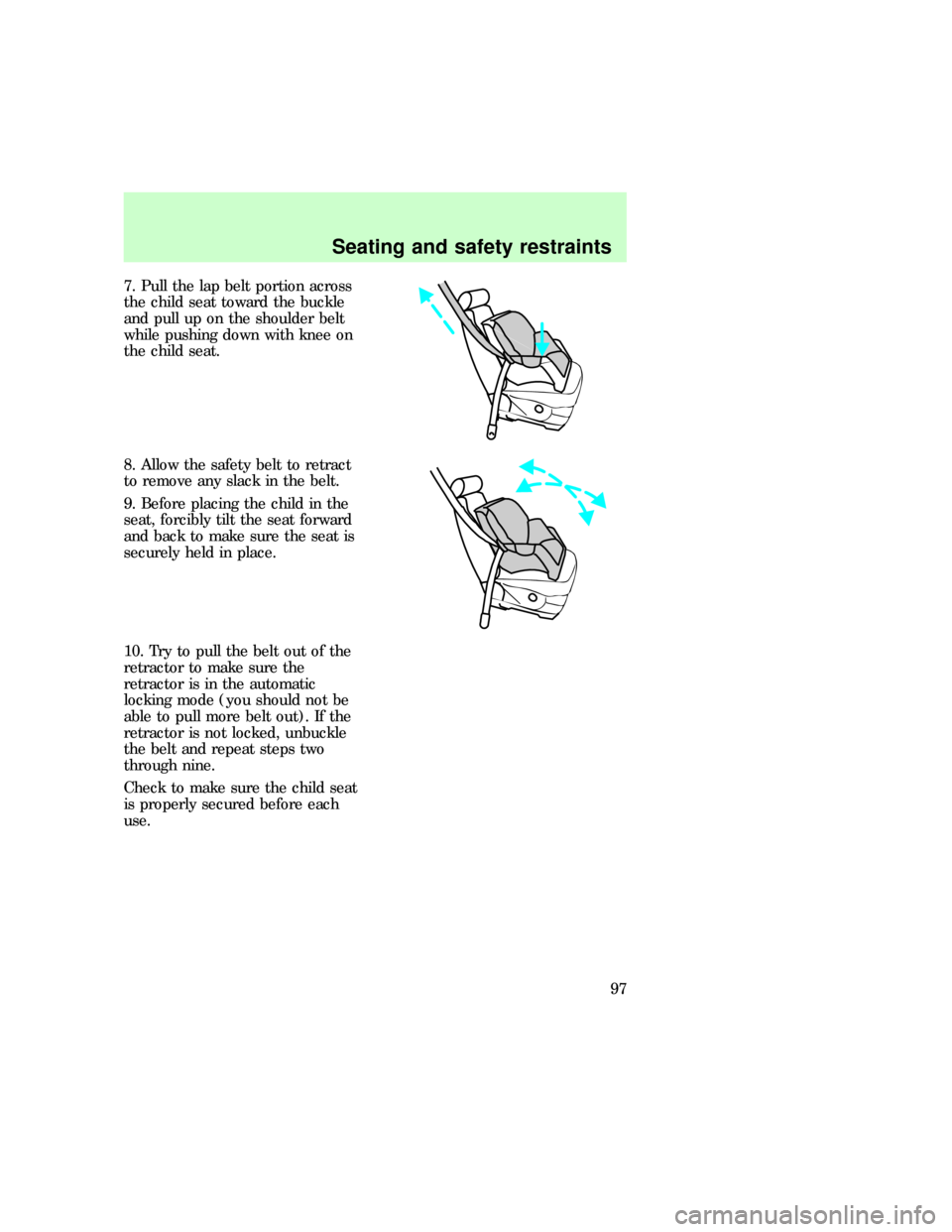
7. Pull the lap belt portion across
the child seat toward the buckle
and pull up on the shoulder belt
while pushing down with knee on
the child seat.
8. Allow the safety belt to retract
to remove any slack in the belt.
9. Before placing the child in the
seat, forcibly tilt the seat forward
and back to make sure the seat is
securely held in place.
10. Try to pull the belt out of the
retractor to make sure the
retractor is in the automatic
locking mode (you should not be
able to pull more belt out). If the
retractor is not locked, unbuckle
the belt and repeat steps two
through nine.
Check to make sure the child seat
is properly secured before each
use.
com_safety_seats.01
Seating and safety restraints
97
Page 97 of 224
Child and infant or child safety
seats
Carefully follow all of the
manufacturer's instructions
included with the safety seat you
put in your vehicle. If you do not
install and use the safety seat
properly, the child may be
injured in a sudden stop or
collision.
Ford recommends the use of a
child safety seat having a top
tether strap. Install the child safety
seat in a seating position which is
capable of providing a tether
anchorage. For more information
on top tether straps seeAttaching
safety seats with tether strapsin
this chapter.
When installing a child safety seat:
²Use the correct safety belt
buckle for that seating position.
²Make sure the tongue is
securely fastened in the buckle.
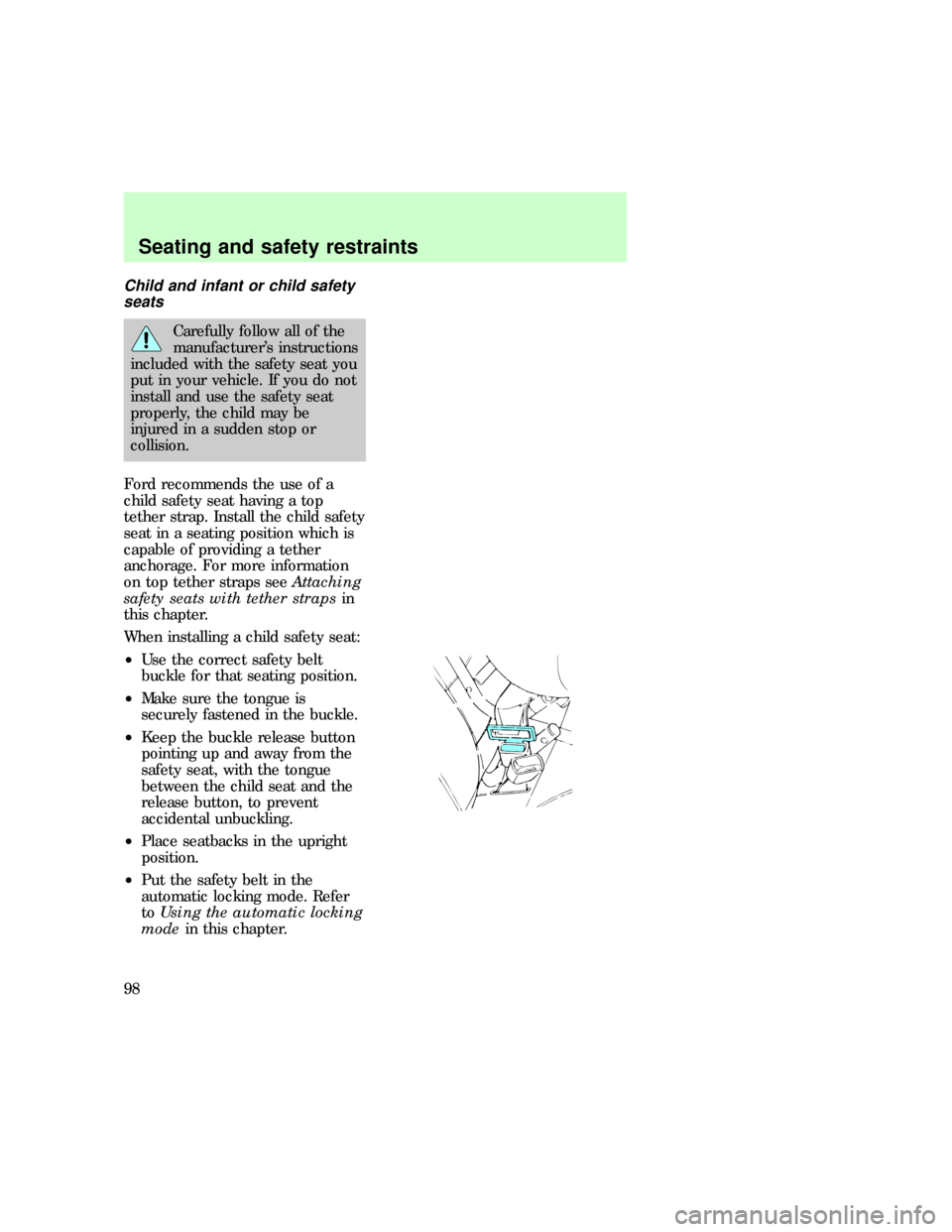
²Keep the buckle release button
pointing up and away from the
safety seat, with the tongue
between the child seat and the
release button, to prevent
accidental unbuckling.
²Place seatbacks in the upright
position.
²Put the safety belt in the
automatic locking mode. Refer
toUsing the automatic locking
modein this chapter.
exd_using_tether
Seating and safety restraints
98
Page 103 of 224
is below Ð12ÉC (10ÉF), depress
accelerator and start the engine
while holding the accelerator
down. Release accelerator when
engine starts.
4. After idling for a few seconds,
apply the brake and release the
parking brake.
Using the engine block heater
(if equipped)
An engine block heater warms the
engine coolant, which improves
starting, warms up the engine
faster and allows the
heater-defroster system to respond
quickly. They are strongly
recommended if you live in a
region where temperatures reach
Ð23ÉC (±10ÉF) or below.
For best results, plug the heater in
at least three hours before starting
the vehicle. Using the heater for
longer than three hours will not
harm the engine, so the heater can
be plugged in the night before
starting the vehicle.
To prevent electrical
shock, do not use your
heater with ungrounded
electrical systems or
two-pronged (cheater) adapters.
com_engine_heater.01
com_ventilation_info.01
Starting
104
Page 106 of 224
BRAKES
Brakes
Your brakes are self-adjusting.
Refer to the ªService Guideº for
maintenance scheduling.
Anti-lock brake system (ABS) (if
equipped)
The ABS operates by detecting the
onset of wheel lock up during
brake applications and
compensating for this tendency.
The front wheels are prevented
from locking even when the brakes
are firmly applied. The
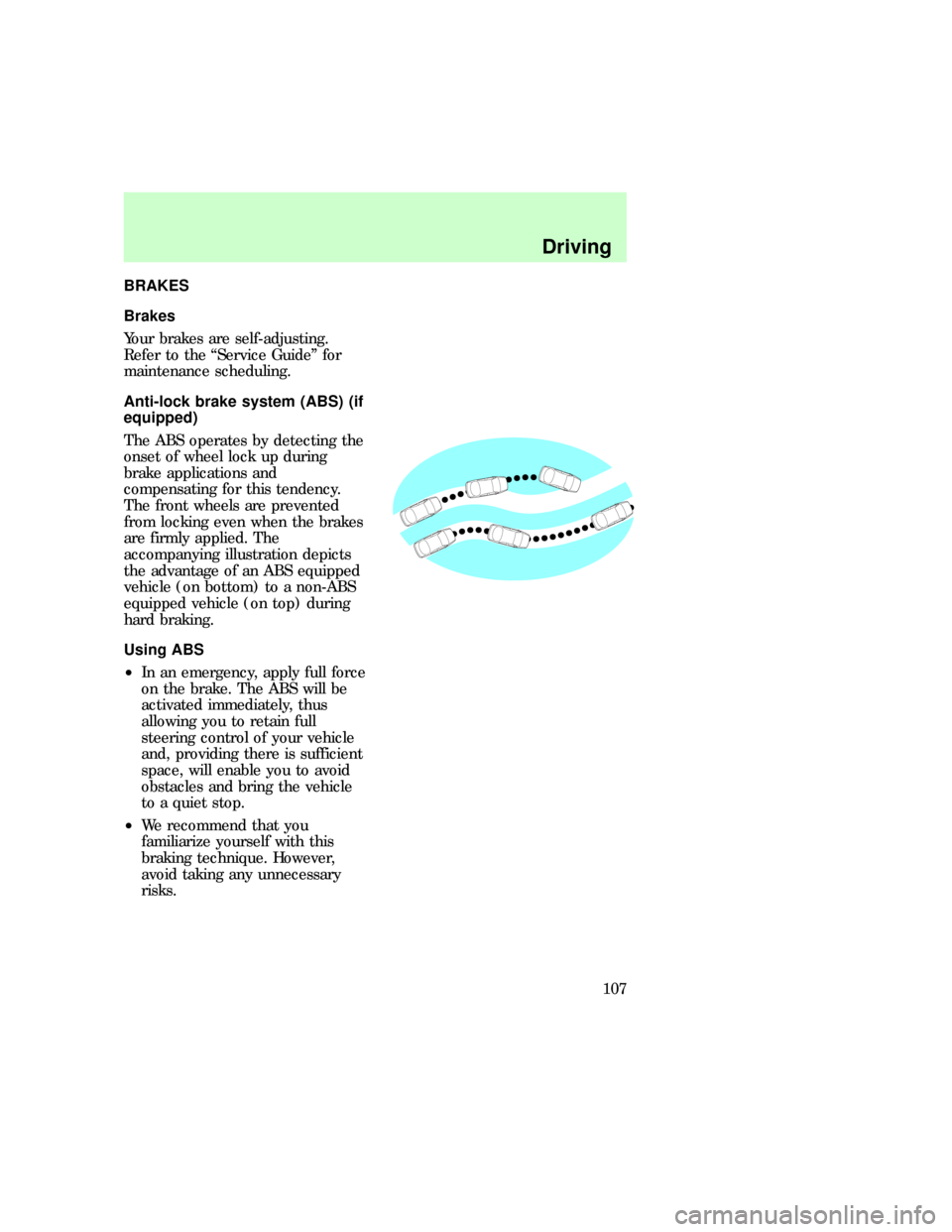
accompanying illustration depicts
the advantage of an ABS equipped
vehicle (on bottom) to a non-ABS
equipped vehicle (on top) during
hard braking.
Using ABS
²In an emergency, apply full force
on the brake. The ABS will be
activated immediately, thus
allowing you to retain full
steering control of your vehicle
and, providing there is sufficient
space, will enable you to avoid
obstacles and bring the vehicle
to a quiet stop.
²We recommend that you
familiarize yourself with this
braking technique. However,
avoid taking any unnecessary
risks.com_brakes.01
com_abs.01
com_using_abs.01
exd_braking_abs_sys
Driving
107
Page 107 of 224

Braking with ABS
On vehicles with ABS, the wheels
will not lock and slide when you
press down hard on the brake
pedal. The ABS automatically
releases and reapplies the front
and rear brakes independently
whenever the wheels start to lock.
When this happens, you will feel
the brake pedal pulse. This pulse
may be unfamiliar feeling, but it is
a normal indication that the ABS is
working as designed.
Do not ªpumpº the brake pedal of
vehicles with ABS.
exd_parking_brake
Driving
108
Page 116 of 224
2(Second)Ð Use 2(Second) to
start-up on slippery roads or to
provide additional engine braking
on downgrades. Transmission
operates in first and second gears.
1(Low)Ð Use 1(Low) to provide
maximum engine braking on steep
downgrades. Upshifts can be made
by shifting to 2(Second) or to
D(Overdrive). Selecting 1(Low)
at higher speeds causes a shift to
2(Second), and will shift to 1(Low)
after vehicle decelerates to the
proper speed.
Brake-shift interlock
The brake-shift interlock feature
prevents you from shifting from
P(Park) unless the brake pedal is
depressed (with the ignition in the
On position). If you cannot move
the gearshift out of P(Park) with
the brake pedal depressed:
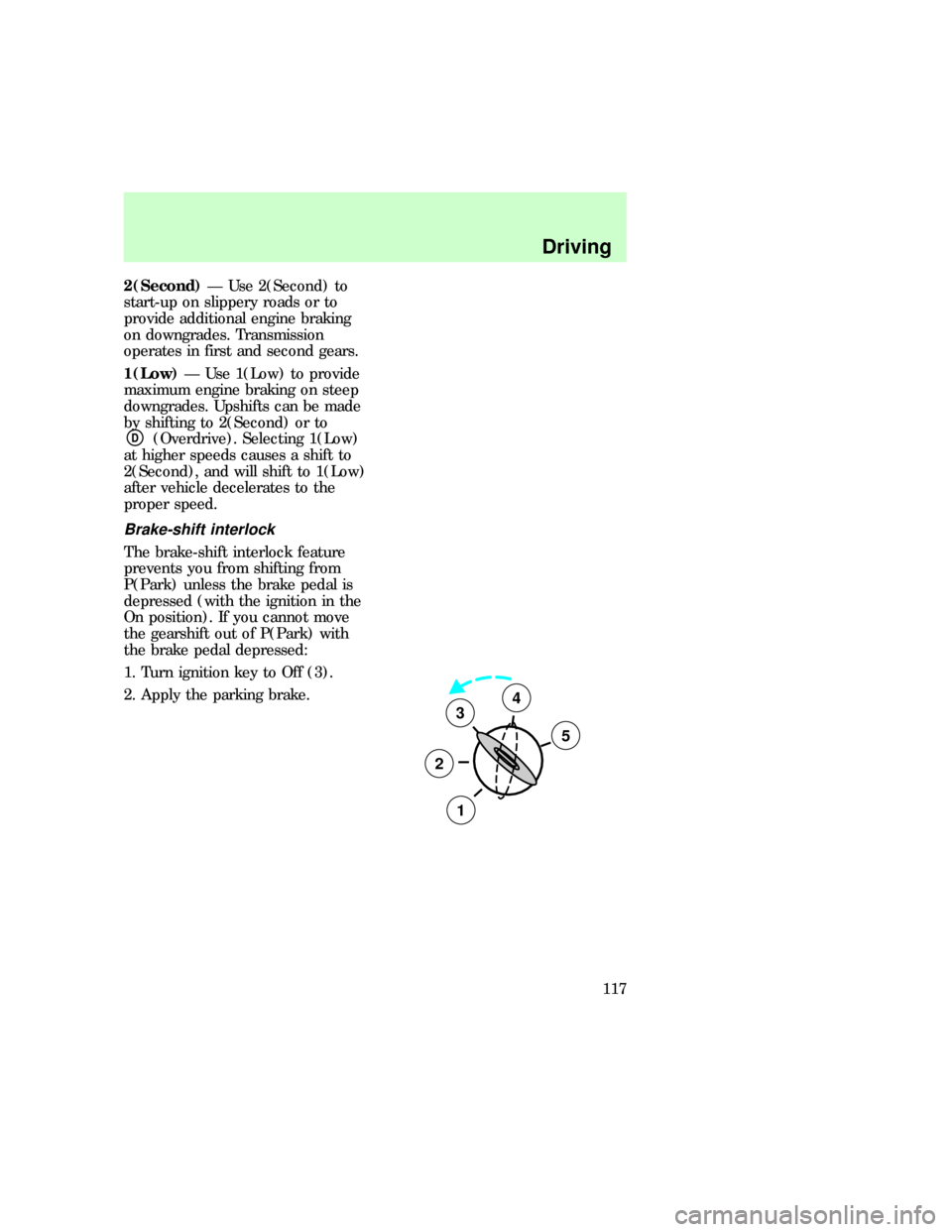
1. Turn ignition key to Off (3).
2. Apply the parking brake.
3
2
1
5
4
exd_brake_shift_interlock
Driving
117
Page 117 of 224
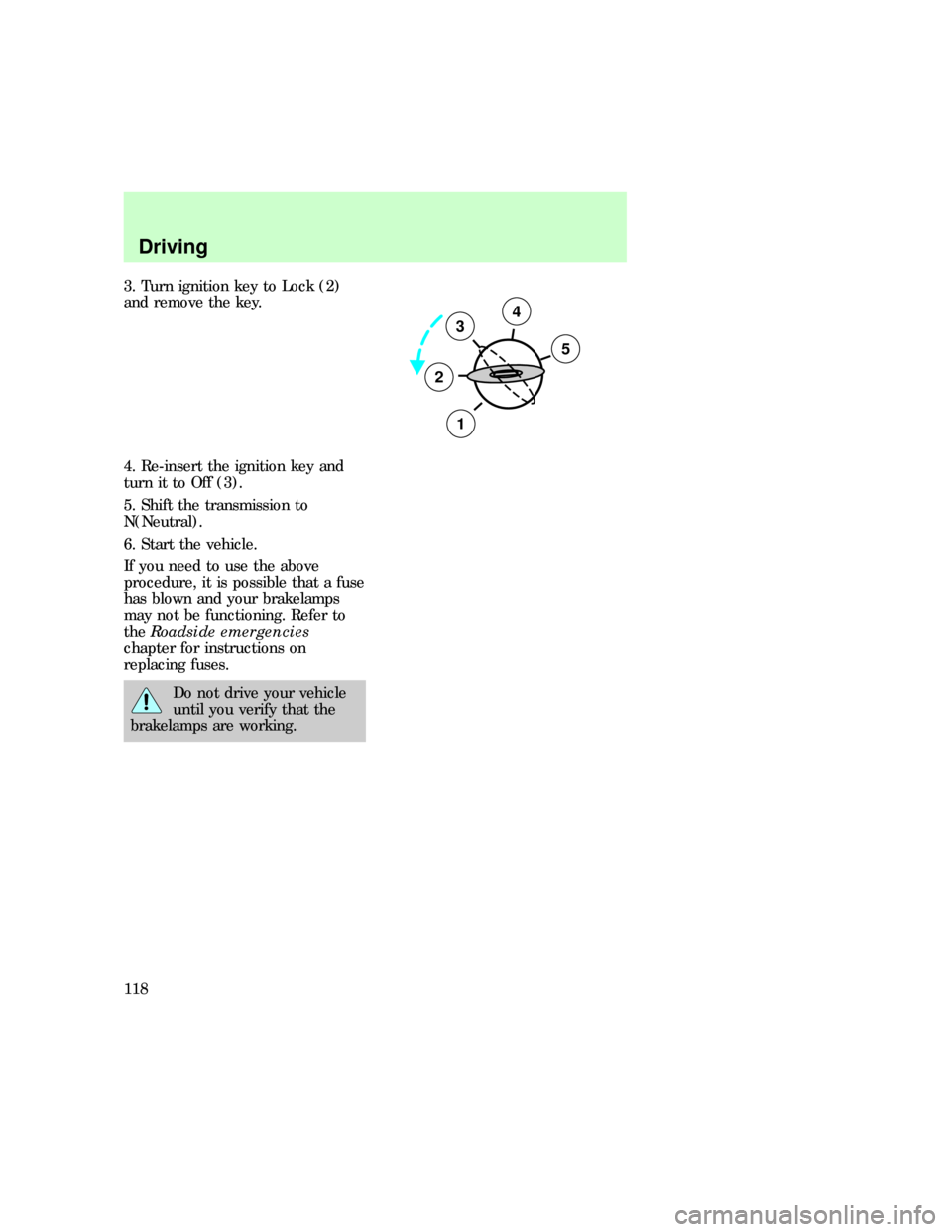
3. Turn ignition key to Lock (2)
and remove the key.
4. Re-insert the ignition key and
turn it to Off (3).
5. Shift the transmission to
N(Neutral).
6. Start the vehicle.
If you need to use the above
procedure, it is possible that a fuse
has blown and your brakelamps
may not be functioning. Refer to
theRoadside emergencies
chapter for instructions on
replacing fuses.
Do not drive your vehicle
until you verify that the
brakelamps are working.
3
2
1
5
4
exd_4wd_operation
Driving
118
Page 118 of 224
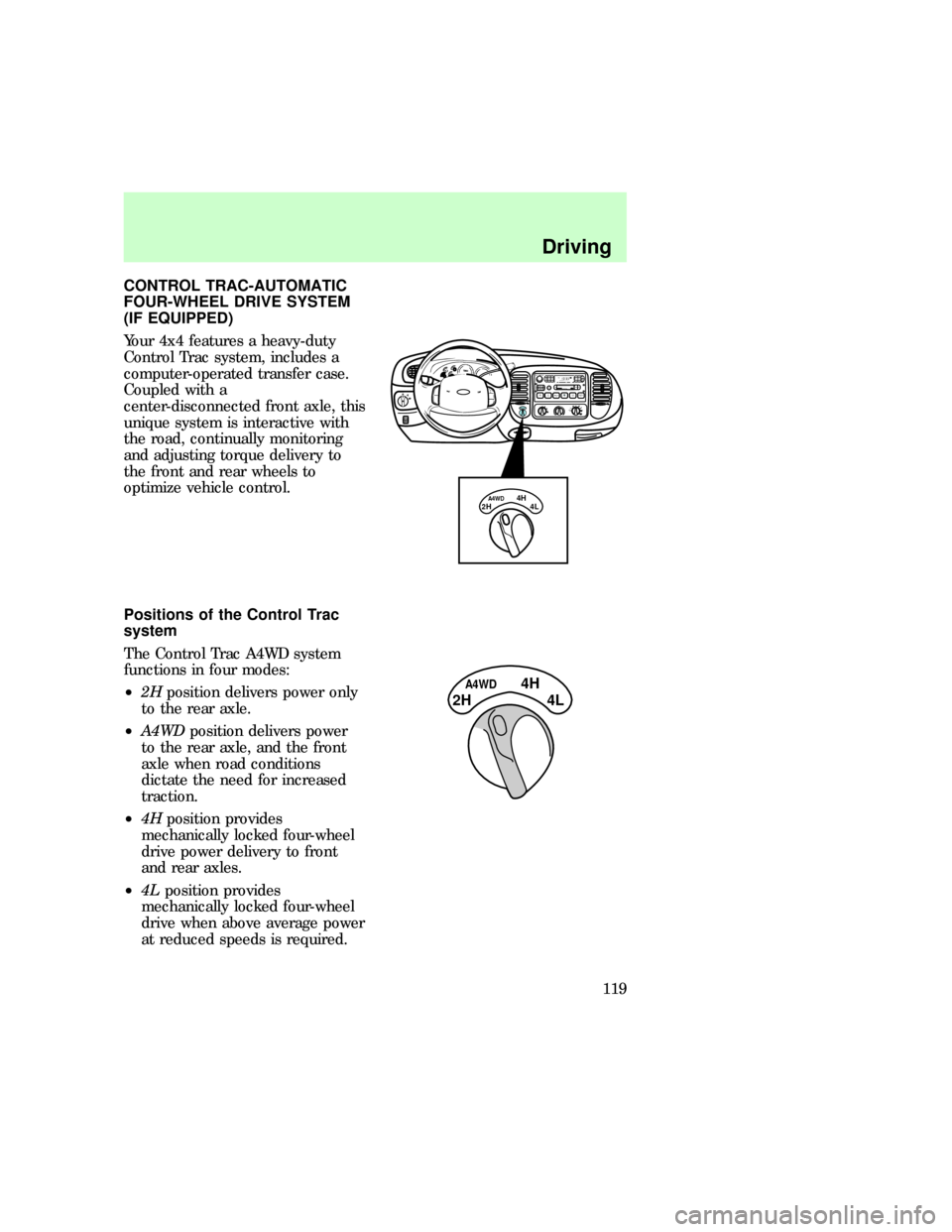
CONTROL TRAC-AUTOMATIC
FOUR-WHEEL DRIVE SYSTEM
(IF EQUIPPED)
Your 4x4 features a heavy-duty
Control Trac system, includes a
computer-operated transfer case.
Coupled with a
center-disconnected front axle, this
unique system is interactive with
the road, continually monitoring
and adjusting torque delivery to
the front and rear wheels to
optimize vehicle control.
Positions of the Control Trac
system
The Control Trac A4WD system
functions in four modes:
²2Hposition delivers power only
to the rear axle.
²A4WDposition delivers power
to the rear axle, and the front
axle when road conditions
dictate the need for increased
traction.
²4Hposition provides
mechanically locked four-wheel
drive power delivery to front
and rear axles.
²4Lposition provides
mechanically locked four-wheel
drive when above average power
at reduced speeds is required.
PHI LO
2H4LA4WD4HOFF*A/C*MAX
A/CREW
1FF
2SIDE 1-2
3
FM 1STVOL – PUSH ON
AM
FMBASS TREBBAL FADE
AUTO
SET CLKSEEKTUNE
DISCSSCAN4DOLBY SYSTEMEJTAPE CDCOMP5SHUFFLE
6
2H 4LA4WD4H
2H 4L
A4WD4H
exd_control_trac_info
Driving
119
Page 125 of 224

Using the luggage rack if
equipped)
Load luggage at the front crossbar
and adjust the rear crossbar as
necessary.
²Do not exceed 90.7 kg (200 lb)
of luggage if the weight is
placed directly on the crossbars.
²Do not exceed 68 kg (150 lb) of
luggage if the weight is resting
on the roof itself.
²Be sure that the weight is
evenly distributed, particularly
when loading at or near the roof
or luggage rack crossbars
maximum capacity.
To remove the front crossbar:
1. Remove the knurled knobs.
2. Pull the crossbar rearward from
the key slot.
To adjust the rear crossbar:
1. Side lever on each side of the
rack rear locks and unlock the rear
crossbar.
2. The rear crossbar can be
removed by unlocking the levers
and pulling the crossbar rearward.
exd_trailer_towing
Driving
126
Page 136 of 224
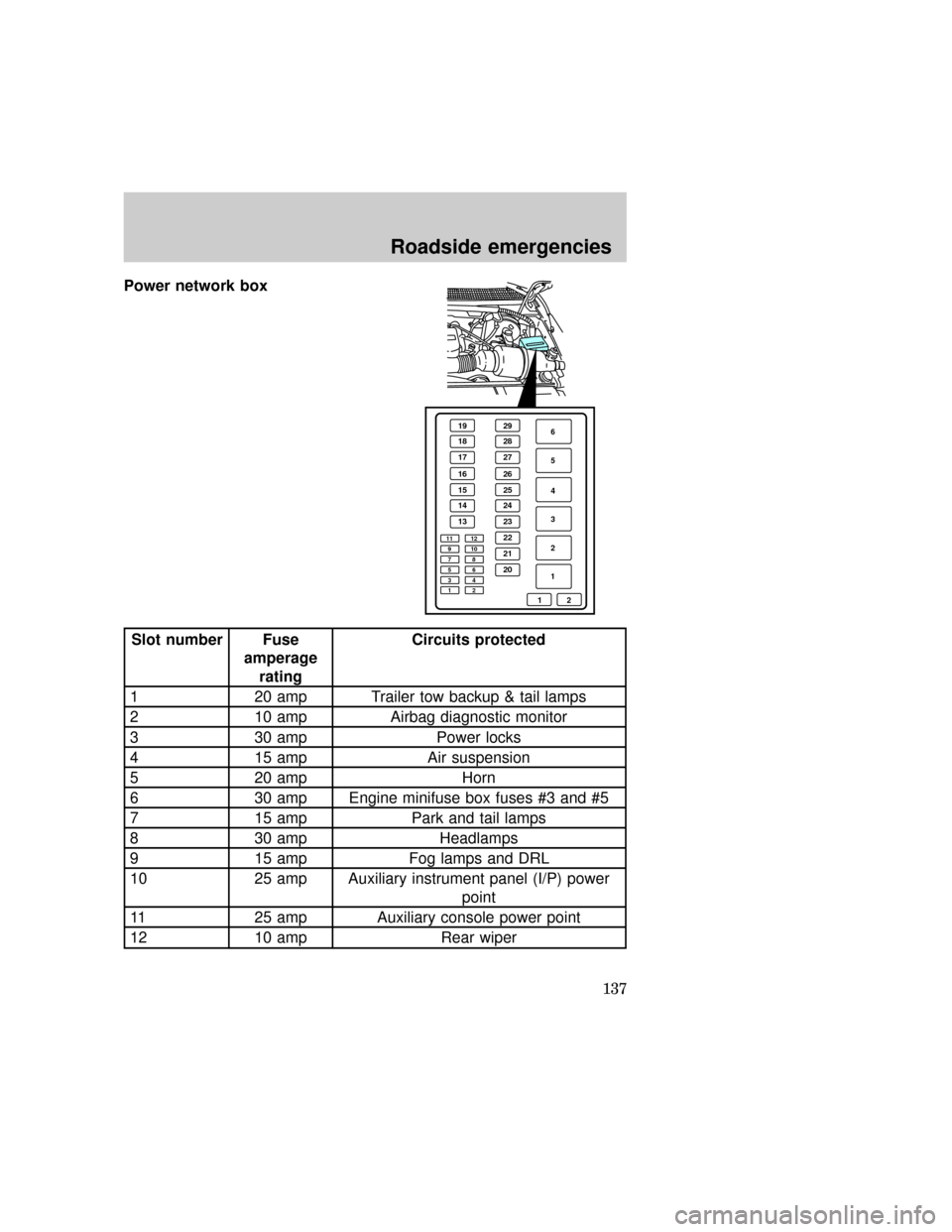
Power network box
Slot number Fuse
amperage
ratingCircuits protected
1 20 amp Trailer tow backup & tail lamps
2 10 amp Airbag diagnostic monitor
3 30 amp Power locks
4 15 amp Air suspension
5 20 amp Horn
6 30 amp Engine minifuse box fuses #3 and #5
7 15 amp Park and tail lamps
8 30 amp Headlamps
9 15 amp Fog lamps and DRL
10 25 amp Auxiliary instrument panel (I/P) power
point
11 25 amp Auxiliary console power point
12 10 amp Rear wiper
29
6
5
4
3
2
1 28
27
26
25
24
2319
18
17
16
15
14
13
22
21
20
12
1197531
12108642
exd_power_network_box
Roadside emergencies
137