service FORD EXPEDITION 1997 1.G Owner's Manual
[x] Cancel search | Manufacturer: FORD, Model Year: 1997, Model line: EXPEDITION, Model: FORD EXPEDITION 1997 1.GPages: 224, PDF Size: 2.2 MB
Page 161 of 224

Changing the engine oil and
filter
Change your engine oil and filter
according to the following
kilometers (mileage) and time
requirements, whichever occurs
first:
²Normal Schedule ± 8,000 km
(5,000 miles) or six months.
²Severe Duty Schedule ± 5,000
km (3,000 miles) or three
months. Severe duty operation
would include extensive idling,
trailer towing, driving in severe
dust and police, taxi or delivery
service.
Ford production and aftermarket
(Motorcraft) oil filters are designed
for added engine protection and
long life. If a replacement oil filter
is used that does not meet Ford
material and design specifications,
startup engine noises or knock
may be experienced.
It is recommended you use the
appropriate Motorcraft oil filter (or
another brand meeting Ford
specifications) for your engine
application.
Checking and adding brake
fluid
Brake fluid should be checked and
refilled as needed at least once
each year:
exd_fix-me
com_checking-adding_fluid.01
Maintenance and care
162
Page 169 of 224
How fail-safe cooling works
If the engine overheats, the engine
will automatically switch from
eight to alternating four cylinder
operation. Each disabled cylinder
acts as an air pump and cools the
engine.
When this occurs, the engine
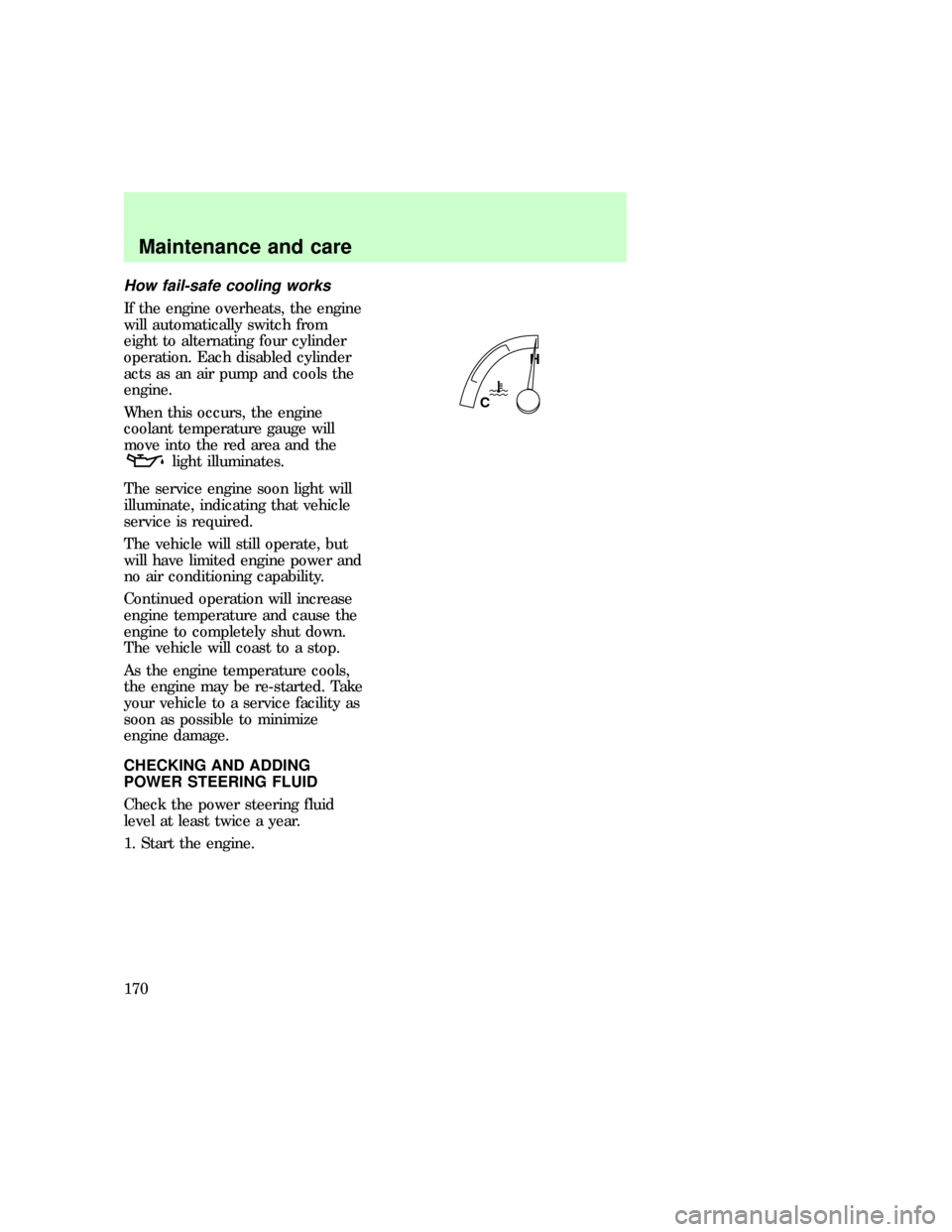
coolant temperature gauge will
move into the red area and the
light illuminates.
The service engine soon light will
illuminate, indicating that vehicle
service is required.
The vehicle will still operate, but
will have limited engine power and
no air conditioning capability.
Continued operation will increase
engine temperature and cause the
engine to completely shut down.
The vehicle will coast to a stop.
As the engine temperature cools,
the engine may be re-started. Take
your vehicle to a service facility as
soon as possible to minimize
engine damage.
CHECKING AND ADDING
POWER STEERING FLUID
Check the power steering fluid
level at least twice a year.
1. Start the engine.
CH
exd_power_steering
Maintenance and care
170
Page 171 of 224

CHECKING AND ADDING
TRANSMISSION FLUID
Checking and adding automatic
transmission fluid (if equipped)
Service the automatic transmission
according to the scheduled
intervals in the9Service Guide.9
Before adding any fluid, make sure
the correct type will be used. This
information is indicated on the
dipstick.
²4R7OW automatic transmissions
are used with 4.6 L engine
applications.
²E4OD automatic transmissions
are used with 5.4 L engine
applications.
Do not drive the vehicle if the fluid
level is below the bottom hole on
the blade type dipstick (4R70W
transmission) or below the COLD
area on the bullet type dipstick
(E4OD transmission) and outside
temperatures are above 10ÉC
(50ÉF).
Your vehicle does not use up
transmission fluid. However, it is
recommended that you check the
transmission fluid at least twice a
year. The fluid level should be
checked if the transmission is not
working properly, i.e., if the
transmission slips or shifts slowly
or if you notice some sign of fluid
leakage.
It is preferable to check the
transmission fluid level at normal
operating temperature, afterexd_checking_adding_autotrans
Maintenance and care
172
Page 178 of 224
AIR CLEANER FILTER
MAINTENANCE
Refer to the ªService Guideº for
the appropriate intervals for
changing the air cleaner filter.
Do not start your engine
with the air cleaner
removed and do not remove it
while the engine is running.
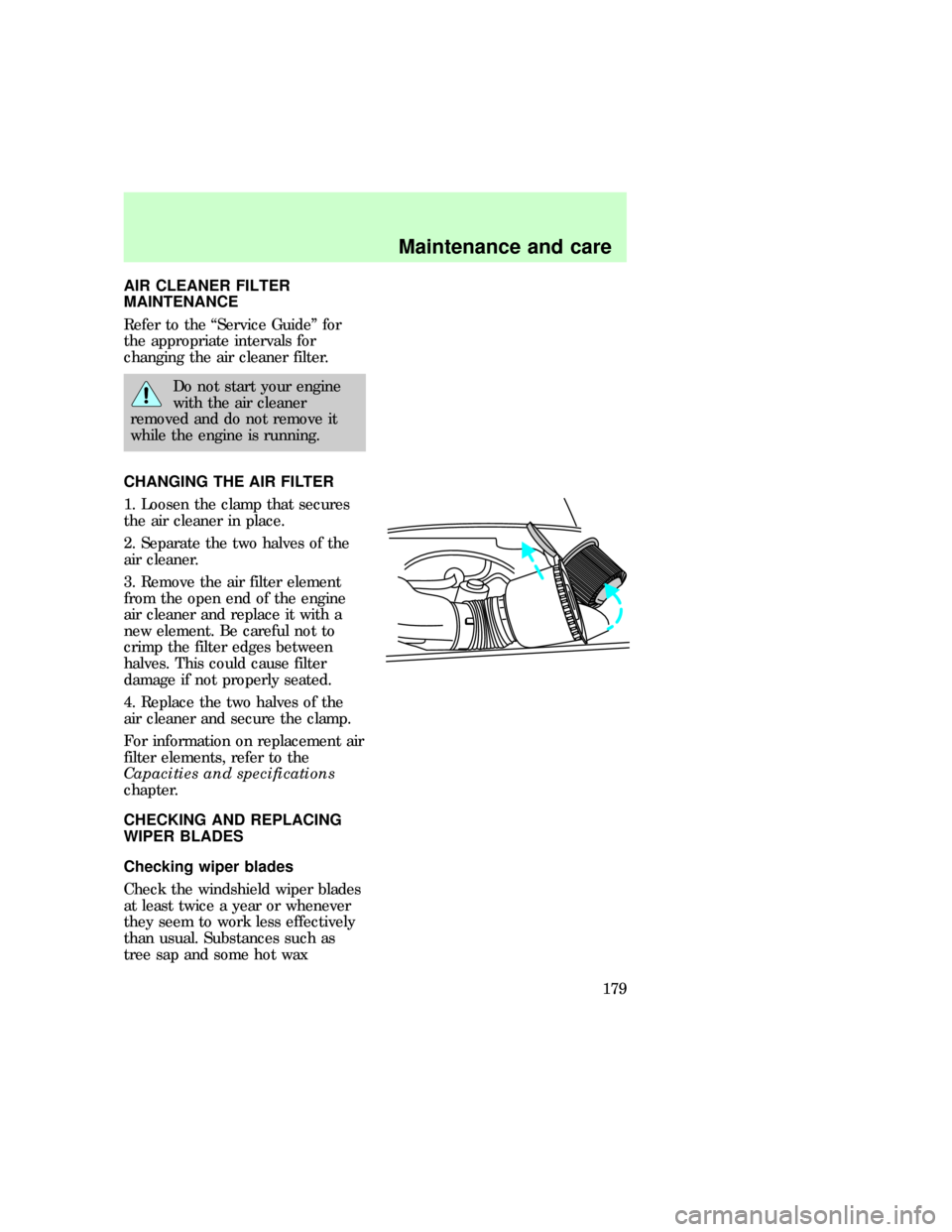
CHANGING THE AIR FILTER
1. Loosen the clamp that secures
the air cleaner in place.
2. Separate the two halves of the
air cleaner.
3. Remove the air filter element
from the open end of the engine
air cleaner and replace it with a
new element. Be careful not to
crimp the filter edges between
halves. This could cause filter
damage if not properly seated.
4. Replace the two halves of the
air cleaner and secure the clamp.
For information on replacement air
filter elements, refer to the
Capacities and specifications
chapter.
CHECKING AND REPLACING
WIPER BLADES
Checking wiper blades
Check the windshield wiper blades
at least twice a year or whenever
they seem to work less effectively
than usual. Substances such as
tree sap and some hot wax
exd_changing_air_filter
exd_wiper
exd_checking_wipers
Maintenance and care
179
Page 180 of 224
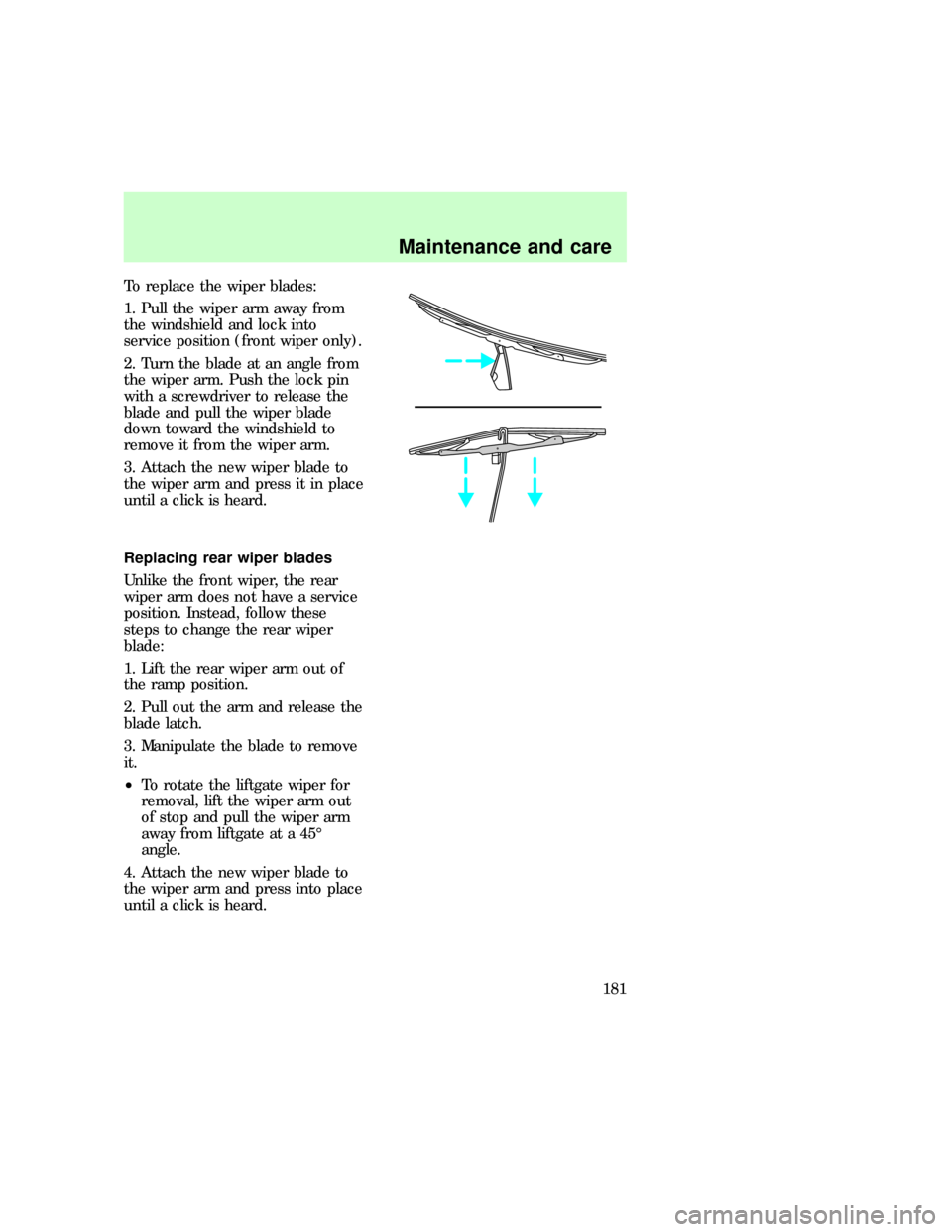
To replace the wiper blades:
1. Pull the wiper arm away from
the windshield and lock into
service position (front wiper only).
2. Turn the blade at an angle from
the wiper arm. Push the lock pin
with a screwdriver to release the
blade and pull the wiper blade
down toward the windshield to
remove it from the wiper arm.
3. Attach the new wiper blade to
the wiper arm and press it in place
until a click is heard.
Replacing rear wiper blades
Unlike the front wiper, the rear
wiper arm does not have a service
position. Instead, follow these
steps to change the rear wiper
blade:
1. Lift the rear wiper arm out of
the ramp position.
2. Pull out the arm and release the
blade latch.
3. Manipulate the blade to remove
it.
²To rotate the liftgate wiper for
removal, lift the wiper arm out
of stop and pull the wiper arm
away from liftgate at a 45É
angle.
4. Attach the new wiper blade to
the wiper arm and press into place
until a click is heard.
exd_rear_wiper_replace
exd_maint-tires
Maintenance and care
181
Page 182 of 224

100. The relative performance of
tires depends upon the actual
conditions of their use, however,
and may depart significantly from
the norm due to variations in
driving habits, service practices,
and differences in road
characteristics and climate.
Traction A B C
The traction grades, from highest
to lowest are A, B, and C, and they
represent the tire's ability to stop
on wet pavement as measured
under test surfaces of asphalt and
concrete. A tire marked C may
have poor traction performance.
Warning: The traction grade
assigned to this tire is based on
braking (straightahead) traction
tests and does not include
cornering (turning) traction.
Temperature A B C
The temperature grades are A (the
highest), B, and C, representing
the tire's resistance to the
generation of heat and its ability to
dissipate heat when tested under
controlled conditions on a
specified indoor laboratory test
wheel. Sustained high temperature
can cause the material of the tire
to degenerate and reduce tire life,
and excessive temperature can
lead to sudden tire failure. The
grade C corresponds to a level of
performance which all passenger
car tires must meet under the
Federal Motor Vehicle Safety
Standard No. 109. Grades B and A
represent higher levels of
com_traction_abc.01
com_temperature_abc.01
Maintenance and care
183
Page 183 of 224
performance on the laboratory test
wheel than the minimum required
by law.
The temperature grade for
this tire is established for a
tire that is properly inflated and
not overloaded. Excessive speed,
underinflation, or excessive
loading, either separately or in
combination, can cause heat
buildup and possible tire failure.
Checking the tire pressure
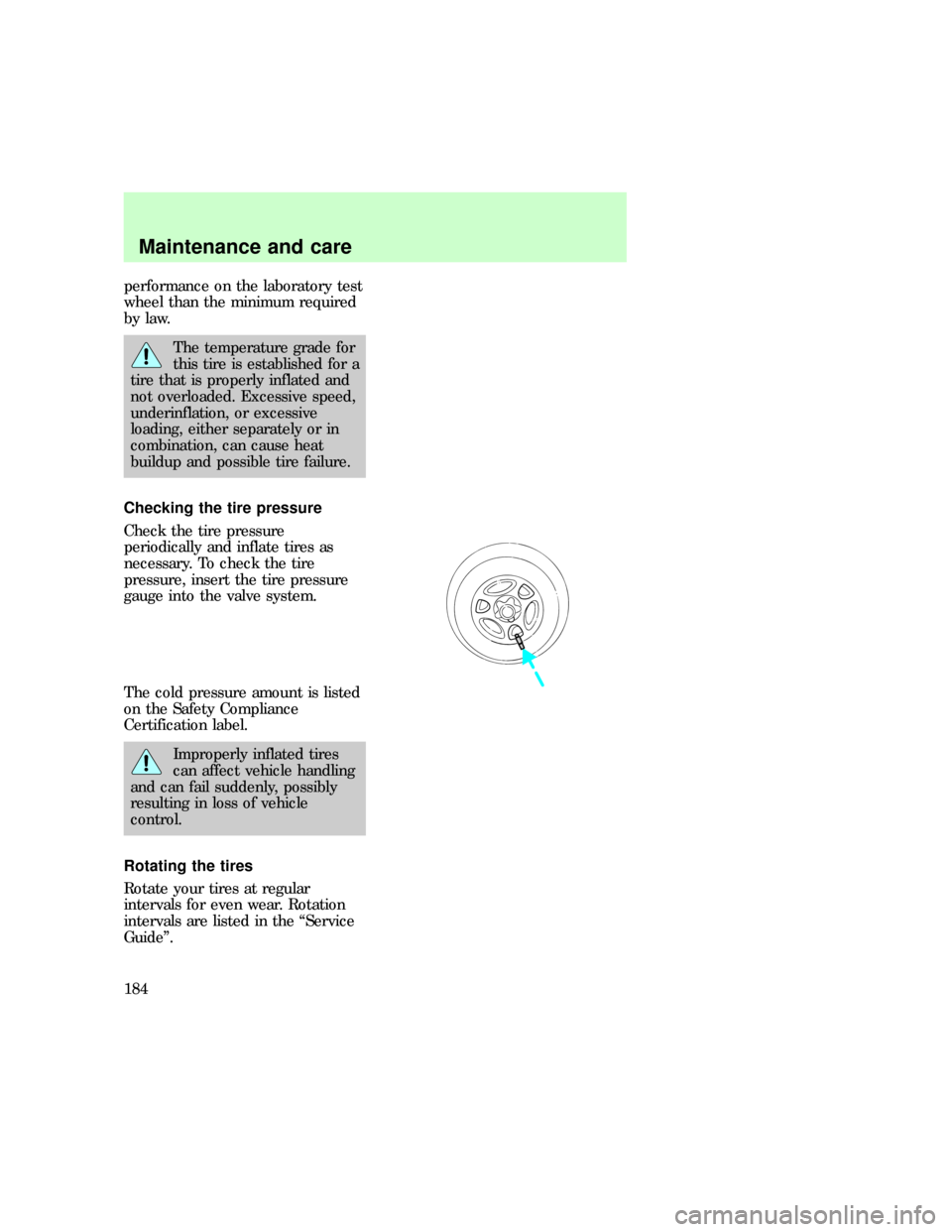
Check the tire pressure
periodically and inflate tires as
necessary. To check the tire
pressure, insert the tire pressure
gauge into the valve system.
The cold pressure amount is listed
on the Safety Compliance
Certification label.
Improperly inflated tires
can affect vehicle handling
and can fail suddenly, possibly
resulting in loss of vehicle
control.
Rotating the tires
Rotate your tires at regular
intervals for even wear. Rotation
intervals are listed in the ªService
Guideº.
exd_pressure_checking
exd_rotating_tires
Maintenance and care
184
Page 186 of 224
Ford recommends only tires of this
type and size for your vehicle.
When purchasing replacement tires
for your vehicle, consult your
dealer or qualified service
technician to ensure that the
correct tire types are used.
Using snow tires and traction
devices
Snow tires must be the
same size and grade as the
tires you currently have on your
vehicle.
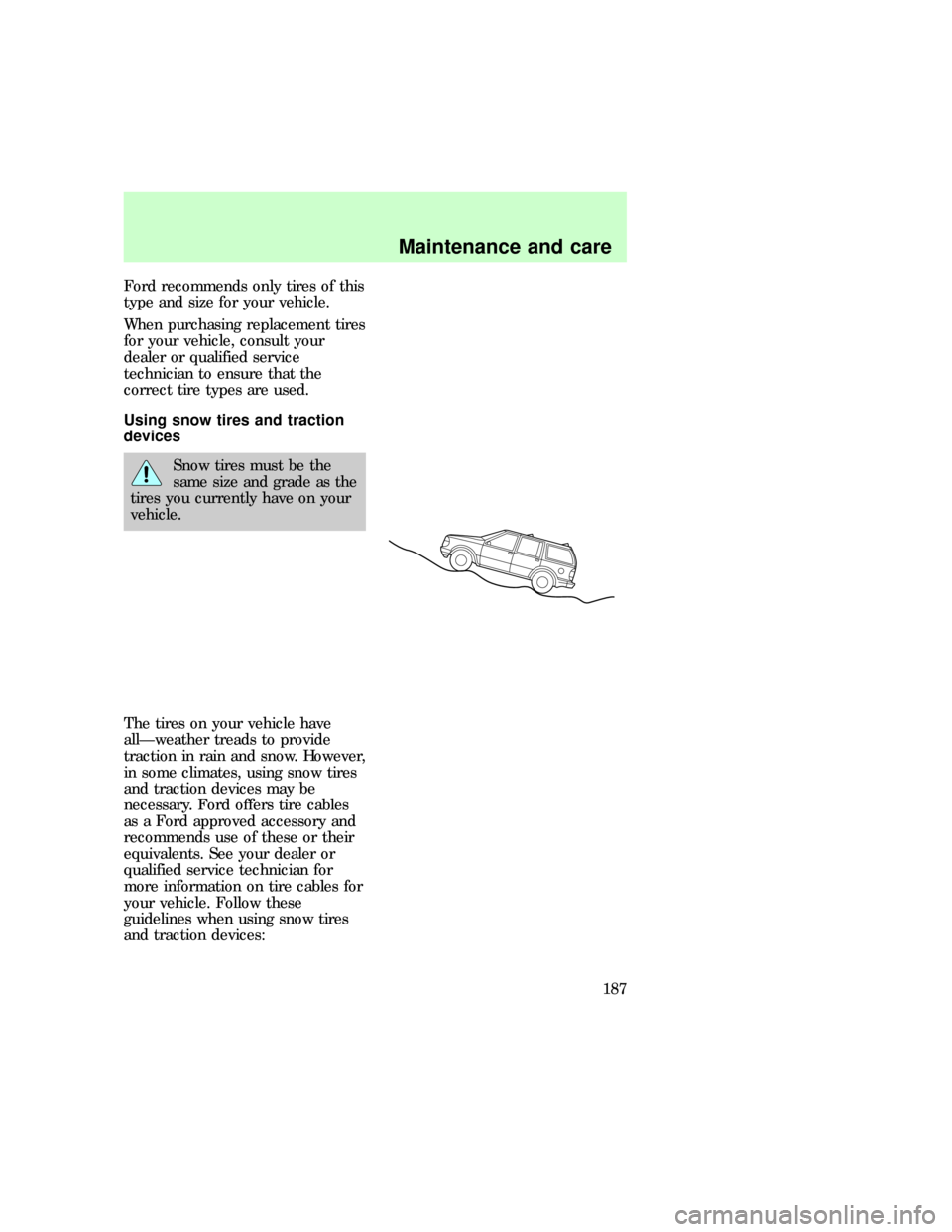
The tires on your vehicle have
allÐweather treads to provide
traction in rain and snow. However,
in some climates, using snow tires
and traction devices may be
necessary. Ford offers tire cables
as a Ford approved accessory and
recommends use of these or their
equivalents. See your dealer or
qualified service technician for
more information on tire cables for
your vehicle. Follow these
guidelines when using snow tires
and traction devices:
exd_snow_chains
Maintenance and care
187
Page 190 of 224
vehicle can be operated on
non-California fuels. However, even
though your engine will perform
adequately on other gasolines, the
performance of the emission
control devices and systems may
be adversely affected. Repair of
damage caused by using a fuel that
your vehicle was not designed for
may not be covered by your
warranty.
Octane recommendations
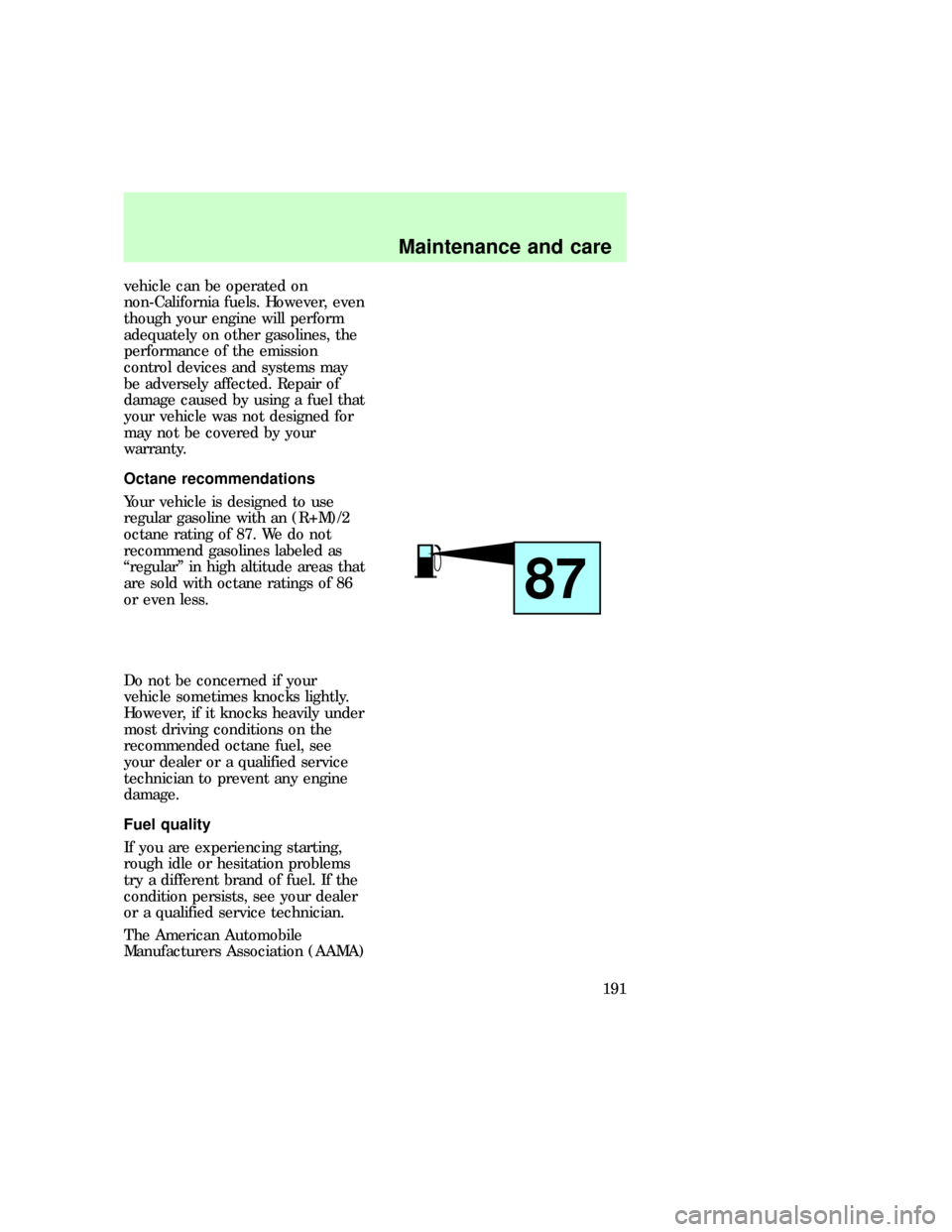
Your vehicle is designed to use
regular gasoline with an (R+M)/2
octane rating of 87. We do not
recommend gasolines labeled as
ªregularº in high altitude areas that
are sold with octane ratings of 86
or even less.
Do not be concerned if your
vehicle sometimes knocks lightly.
However, if it knocks heavily under
most driving conditions on the
recommended octane fuel, see
your dealer or a qualified service
technician to prevent any engine
damage.
Fuel quality
If you are experiencing starting,
rough idle or hesitation problems
try a different brand of fuel. If the
condition persists, see your dealer
or a qualified service technician.
The American Automobile
Manufacturers Association (AAMA)
87
com_octane_recommendations.01
com_fuel_quality.01
Maintenance and care
191
Page 194 of 224
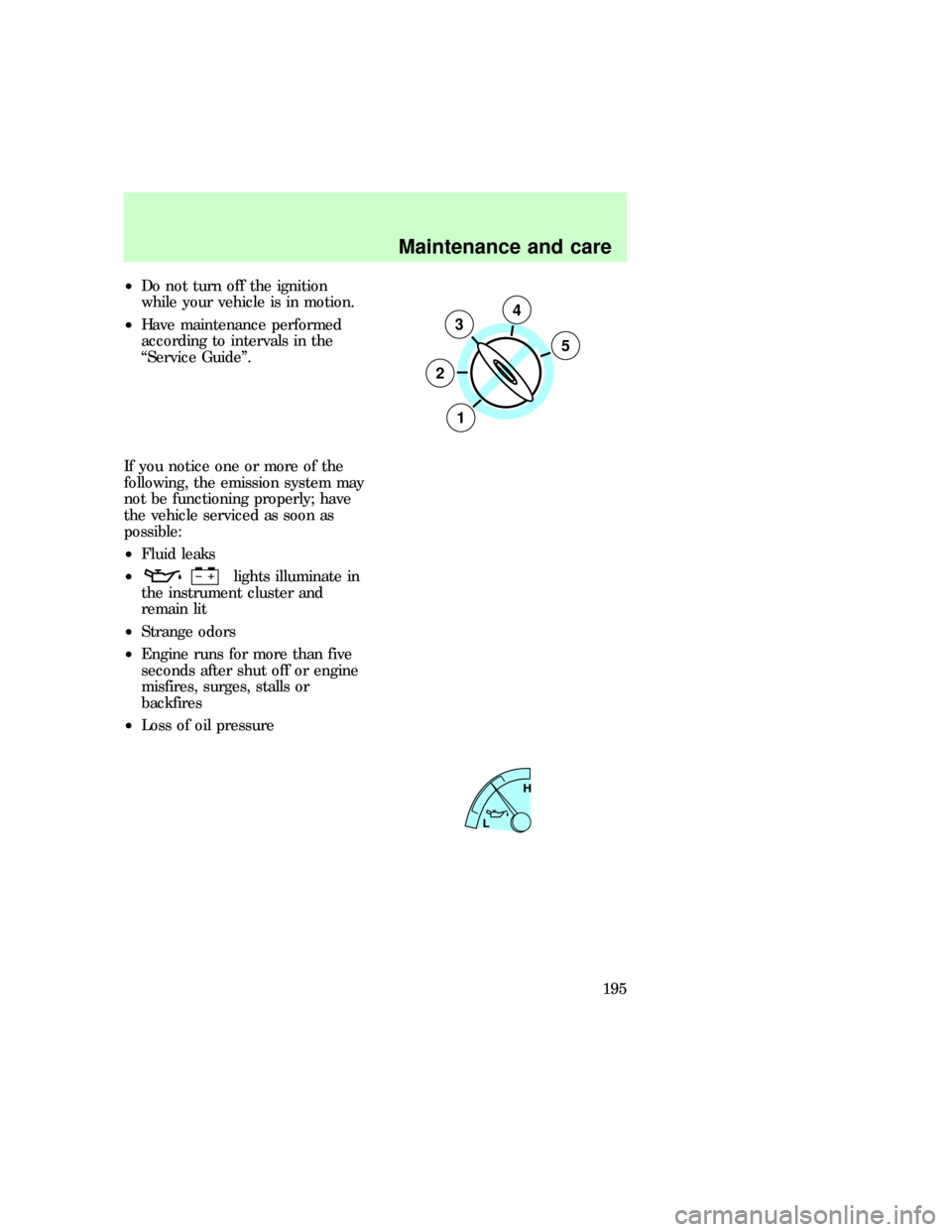
²Do not turn off the ignition
while your vehicle is in motion.
²Have maintenance performed
according to intervals in the
ªService Guideº.
If you notice one or more of the
following, the emission system may
not be functioning properly; have
the vehicle serviced as soon as
possible:
²Fluid leaks
²
lights illuminate in
the instrument cluster and
remain lit
²Strange odors
²Engine runs for more than five
seconds after shut off or engine
misfires, surges, stalls or
backfires
²Loss of oil pressure
34
5
2
1
LHLH
exd_emissions_info
Maintenance and care
195