towing FORD EXPEDITION 1997 1.G Owners Manual
[x] Cancel search | Manufacturer: FORD, Model Year: 1997, Model line: EXPEDITION, Model: FORD EXPEDITION 1997 1.GPages: 224, PDF Size: 2.2 MB
Page 17 of 224
refer to trip computer information
in theControls and features
chapter.
Selectable features
English/metric display
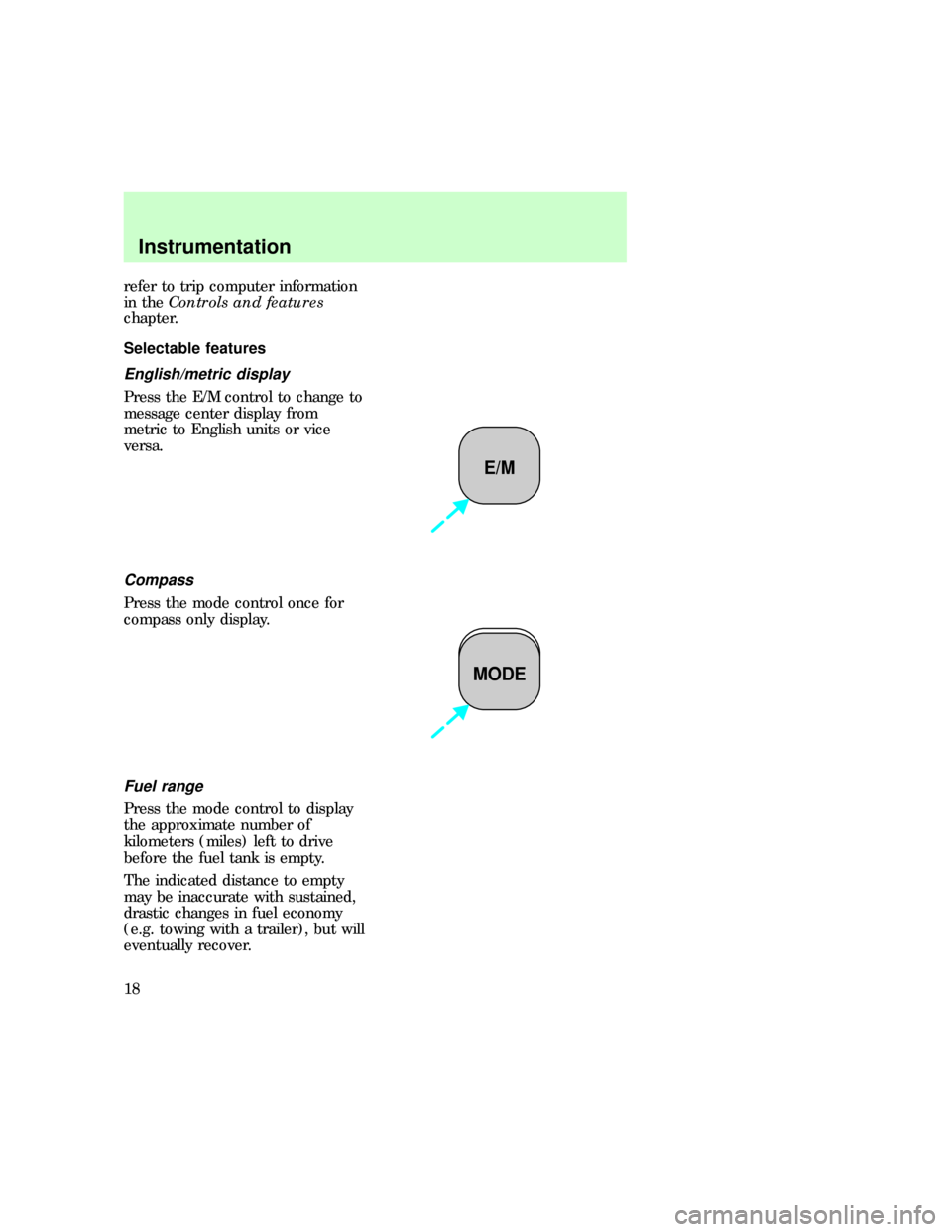
Press the E/M control to change to
message center display from
metric to English units or vice
versa.
Compass
Press the mode control once for
compass only display.
Fuel range
Press the mode control to display
the approximate number of
kilometers (miles) left to drive
before the fuel tank is empty.
The indicated distance to empty
may be inaccurate with sustained,
drastic changes in fuel economy
(e.g. towing with a trailer), but will
eventually recover.
E/M
MODE
exd_select_features_head
exd_metric_english_select exd_compass_display
exd_fuel_range_select
exd_economy_fuel_select
Instrumentation
18
Page 48 of 224
automatically return to normalD(Overdrive) mode.
Deactivate overdrive whenever
driving conditions (i.e., city traffic,
hilly terrain, etc.) cause the
transmission to shift excessively
between
D(Overdrive) and
D(Drive) ranges. Also deactivate
D(Overdrive) when:
²driving with a heavy load
²towing a trailer up or down
steep hills
²additional engine braking is
desired
Transmission control indicator
light (TCIL)
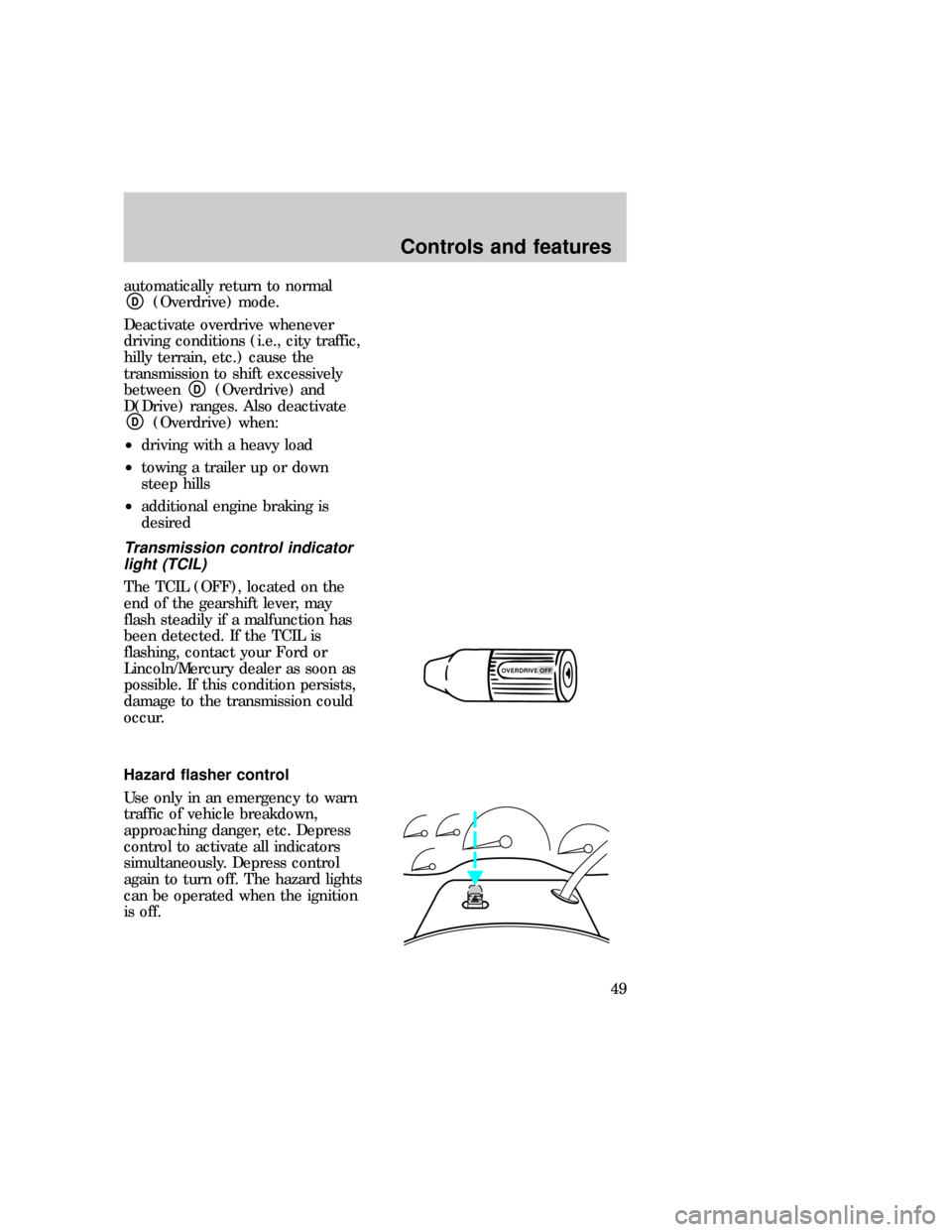
The TCIL (OFF), located on the
end of the gearshift lever, may
flash steadily if a malfunction has
been detected. If the TCIL is
flashing, contact your Ford or
Lincoln/Mercury dealer as soon as
possible. If this condition persists,
damage to the transmission could
occur.
Hazard flasher control
Use only in an emergency to warn
traffic of vehicle breakdown,
approaching danger, etc. Depress
control to activate all indicators
simultaneously. Depress control
again to turn off. The hazard lights
can be operated when the ignition
is off.
OVERDRIVE OFFexd_hazards
exd_tilt_steering
Controls and features
49
Page 112 of 224
An on board air compressor and
solenoids are used to raise and
lower the vehicle. It is normal to
occasionally hear a buzz or clicking
from the vehicle even when the
ignition is turned off. The system
stays energized for 40 minutes
after the ignition is turned off to
compensate for any load changes
made after the vehicle is parked.
Air suspension service system
switch
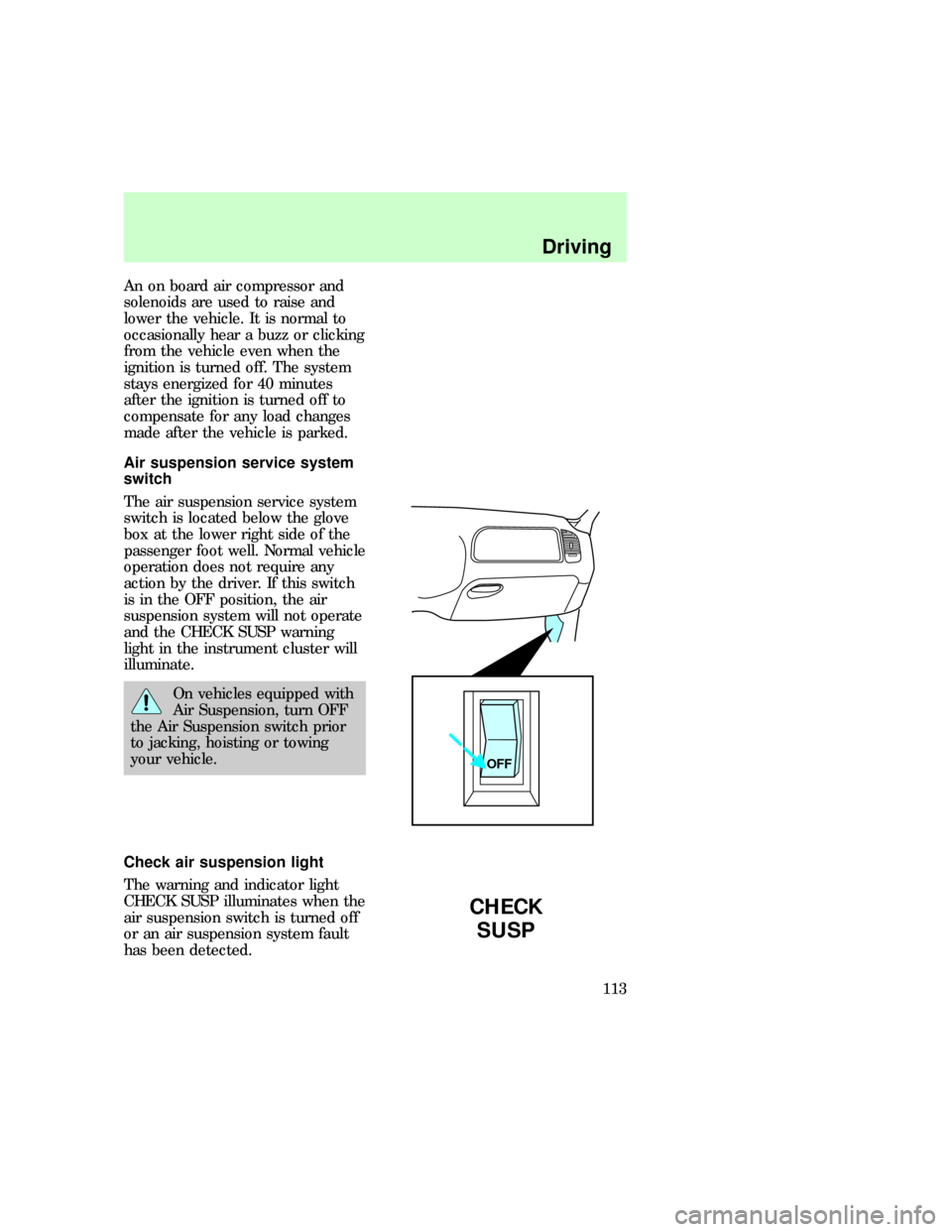
The air suspension service system
switch is located below the glove
box at the lower right side of the
passenger foot well. Normal vehicle
operation does not require any
action by the driver. If this switch
is in the OFF position, the air
suspension system will not operate
and the CHECK SUSP warning
light in the instrument cluster will
illuminate.
On vehicles equipped with
Air Suspension, turn OFF
the Air Suspension switch prior
to jacking, hoisting or towing
your vehicle.
Check air suspension light
The warning and indicator light
CHECK SUSP illuminates when the
air suspension switch is turned off
or an air suspension system fault
has been detected.
OFF
CHECK
SUSP
exd_air_susp_service_switch
exd_check_air_susp_light
Driving
113
Page 115 of 224
D(Overdrive)Ð The normal
driving position for the best fuel
economy. Transmission operates in
gears one through four.
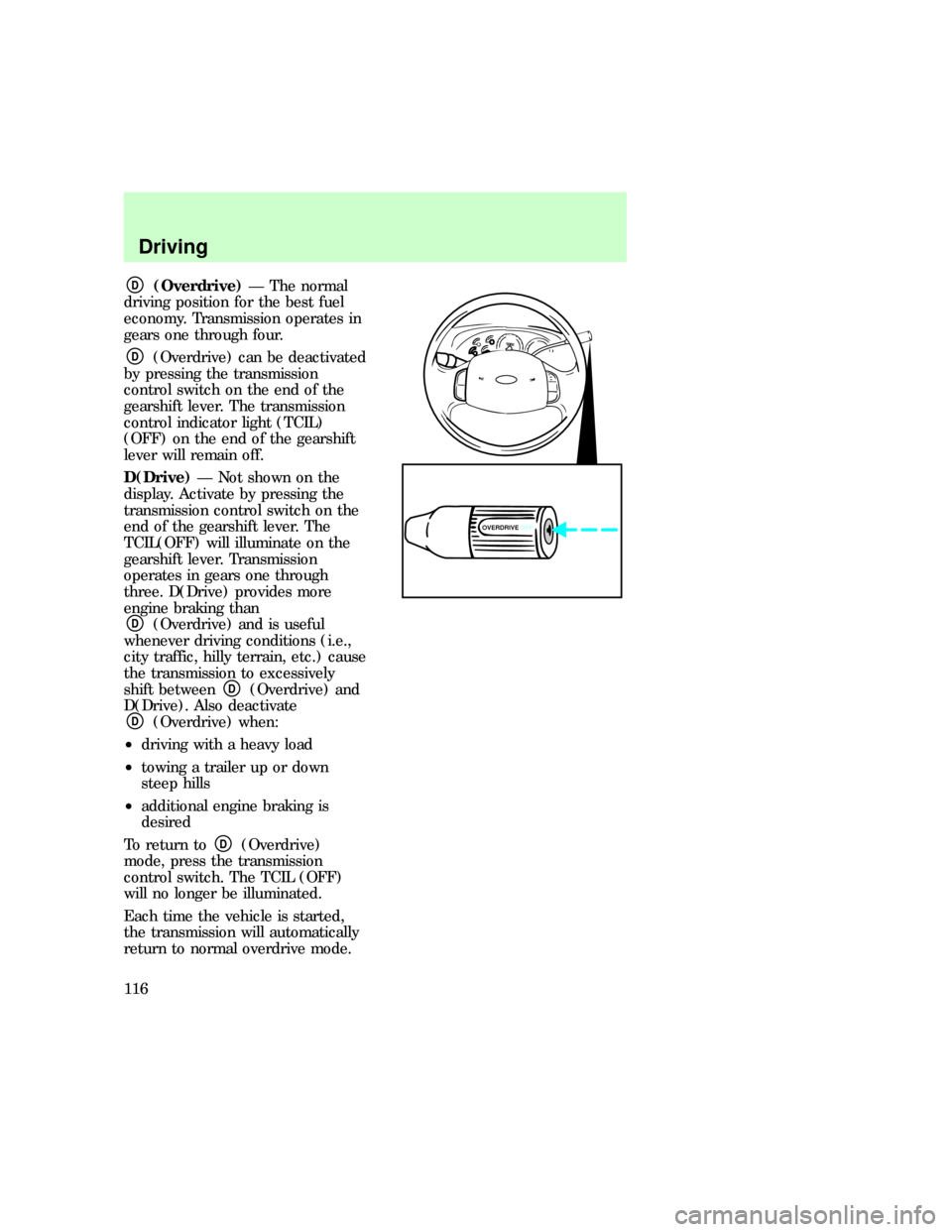
D(Overdrive) can be deactivated
by pressing the transmission
control switch on the end of the
gearshift lever. The transmission
control indicator light (TCIL)
(OFF) on the end of the gearshift
lever will remain off.
D(Drive)Ð Not shown on the
display. Activate by pressing the
transmission control switch on the
end of the gearshift lever. The
TCIL(OFF) will illuminate on the
gearshift lever. Transmission
operates in gears one through
three. D(Drive) provides more
engine braking than
D(Overdrive) and is useful
whenever driving conditions (i.e.,
city traffic, hilly terrain, etc.) cause
the transmission to excessively
shift between
D(Overdrive) and
D(Drive). Also deactivate
D(Overdrive) when:
²driving with a heavy load
²towing a trailer up or down
steep hills
²additional engine braking is
desired
To return to
D(Overdrive)
mode, press the transmission
control switch. The TCIL (OFF)
will no longer be illuminated.
Each time the vehicle is started,
the transmission will automatically
return to normal overdrive mode.
OVERDRIVE OFF
Driving
116
Page 123 of 224

Rating):Carrying capacity for
each axle system (front and
rear). The GAWR is specific to
each vehicle and is listed on the
Safety Compliance Certification
Label on the driver's door.
²GCWR (Gross combined weight
rating ):Maximum combined
weight of the towing vehicle
(including passengers and
cargo) and the trailer. The
GCWR indicates the maximum
loaded weight that the vehicle is
allowed to tow.
²Maximum trailer weight:
Maximum weight of a trailer the
loaded vehicle (including
passengers and cargo) is
permitted to tow. It is
determined by subtracting the
weight of the loaded towing
vehicle from the GCWR of the
towing vehicle.
²Trailer weight range:Specified
weight range that the trailer
must fall within that ranges from
zero to the maximum trailer
weight rating.
Payload = GVWR minus Base
curb weight
To obtain the correct weights for
your vehicle, try taking your
vehicle to a shipping company or
an inspection station for trucks.
Do not use replacement tires with
lower weight capacities than the
originals because they might lower
the vehicle's GVWR and GAWR.
Replacement tires with a higher
Driving
124
Page 125 of 224

Using the luggage rack if
equipped)
Load luggage at the front crossbar
and adjust the rear crossbar as
necessary.
²Do not exceed 90.7 kg (200 lb)
of luggage if the weight is
placed directly on the crossbars.
²Do not exceed 68 kg (150 lb) of
luggage if the weight is resting
on the roof itself.
²Be sure that the weight is
evenly distributed, particularly
when loading at or near the roof
or luggage rack crossbars
maximum capacity.
To remove the front crossbar:
1. Remove the knurled knobs.
2. Pull the crossbar rearward from
the key slot.
To adjust the rear crossbar:
1. Side lever on each side of the
rack rear locks and unlock the rear
crossbar.
2. The rear crossbar can be
removed by unlocking the levers
and pulling the crossbar rearward.
exd_trailer_towing
Driving
126
Page 126 of 224
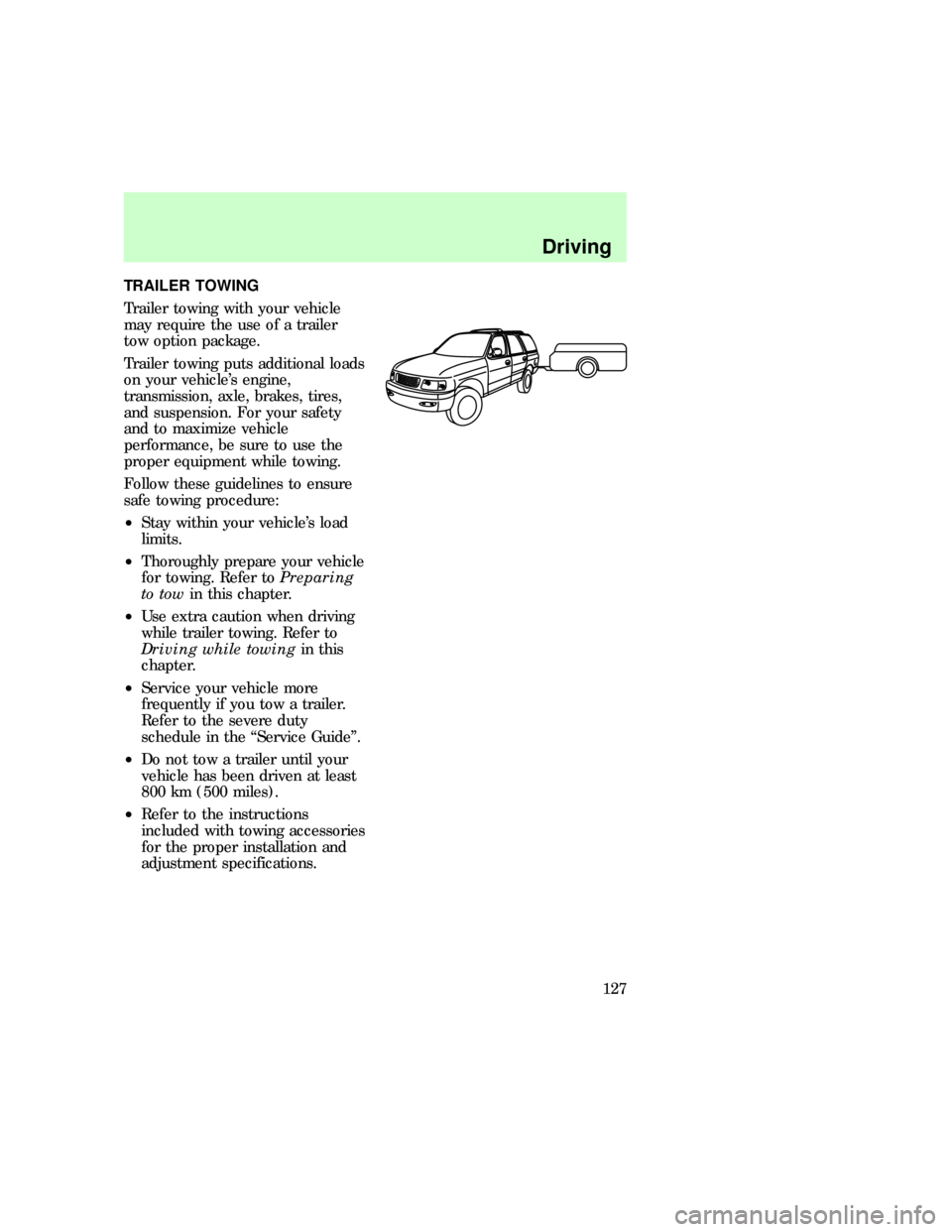
TRAILER TOWING
Trailer towing with your vehicle
may require the use of a trailer
tow option package.
Trailer towing puts additional loads
on your vehicle's engine,
transmission, axle, brakes, tires,
and suspension. For your safety
and to maximize vehicle
performance, be sure to use the
proper equipment while towing.
Follow these guidelines to ensure
safe towing procedure:
²Stay within your vehicle's load
limits.
²Thoroughly prepare your vehicle
for towing. Refer toPreparing
to towin this chapter.
²Use extra caution when driving
while trailer towing. Refer to
Driving while towingin this
chapter.
²Service your vehicle more
frequently if you tow a trailer.
Refer to the severe duty
schedule in the ªService Guideº.
²Do not tow a trailer until your
vehicle has been driven at least
800 km (500 miles).
²Refer to the instructions
included with towing accessories
for the proper installation and
adjustment specifications.
Driving
127
Page 127 of 224

Trailer towing table (with heavy duty trailer tow option)
GCWR (Gross Combined Weight Rating)/trailer weights
EngineRear axle
ratioTire sizeMaximum
GCWRTrailer weight
range (0 -
maximum)
(4x2)
4.6 L 3.3140.6 cm
(16 in)4990 kg
(11000 lb)0-2676 kg
(0-5900 lb)
5.4 L 3.3140.6 cm
(16 in)5443 kg
(12000 lb)0-3039 kg
(0-6700 lb)
5.4 L 3.7340.6 cm
(16 in)6123 kg
(13500 lb)0-3628 kg
(0-8000 lb)
(4x4)
4.6 L 3.5540.6 cm
(16 in)5216 kg
(11500 kg)0-2766 kg
(0-6100 lb)
4.6 L 3.5543.2 cm
(17 in)4990 kg
(11000 lb)0-2494 kg
(0-5500 lb)
5.4 L 3.3140.6 cm
(16 in)5443 kg
(12000 lb)0-2902 kg
(0-6400 lb)
5.4 L 3.7340.6 cm
(16 in)6123 kg
(13500 lb)0-3556 kg
(0-7900 lb)
5.4 L 3.7343.2 cm
(17 in)5897 kg
(13000 lb)0-3356 kg
(0-7400 lb)
Maximum frontal area of trailer is 5.6 square meters (60 square feet)
Do not exceed the maximum loads
listed on the Safety Compliance
Certification label. For load
specification terms found on the
label, refer toLoading your
vehiclein this chapter. Remember
to figure in the tongue load of your
loaded trailer when figuring the
total weight.
Your vehicle is not equipped with a
neutral tow kit accessory. Do not
attempt to flat tow your vehicle
Driving
128
Page 128 of 224
with all of the vehicle wheels on
the ground.
Towing trailers beyond the
maximum recommended
gross trailer weight exceeds the
limit of the vehicle and could
result in engine damage,
transmission damage, structural
damage, loss of control and
personal injury.
Preparing to tow
Use the proper equipment for
towing a trailer and make sure that
it is properly attached to your
vehicle. See your dealer or a
reliable trailer retailer if you
require assistance.
If your vehicle is not equipped
with the factory heavy duty trailer
tow option, auxiliary coolers are
recommended for the automatic
transmission system if you are
planning on:
²traveling farther than 80 km (50
miles)
²towing in hilly terrain
²towing frequently
Calculating trailer loads
To determine the amount of weight
that your vehicle can carry:
²Obtain ratings from the Safety
Compliance Certification label
and the trailer towing
specifications in this chapter.
exd_preparing_tow
exd_calculating_load
Driving
129
Page 130 of 224

vehicle frame or hook retainers
(not the bumper). Make sure there
is enough slack to allow the vehicle
to turn corners.
For more information, refer to
ªFord Recreational Vehicle and
Trailer Towing Guideº available
from your Ford dealer.
Using trailer lamps
See your local trailer retailer or
rental agency for proper
instructions and equipment for
hooking up trailer lamps.
Do not hook the trailer lights
directly into the vehicle's wiring
system. If the trailer lamps are not
connected properly, the warning
lights in the instrument cluster
may not work properly.
Using a hitch
Do not use hitches that:
²clamp onto the vehicle bumper
²attach to the axle.
Distribute the load so that only 10
to 15% of the total weight of the
trailer is on the tongue. Tie down
the load so that it does not shift
and change the weight on the
hitch. Follow the towing
instructions of a reputable rental
agency.
Using a load-equalizing hitch
Follow the hitch manufactures
guidelines for the installation and
specific use of a load equalizing
hitch on this vehicle. In no cases
exd_lamps_trailer
exd_hitch_using
exd_load_equalizing_hitch
Driving
131