tow FORD EXPEDITION 1998 1.G User Guide
[x] Cancel search | Manufacturer: FORD, Model Year: 1998, Model line: EXPEDITION, Model: FORD EXPEDITION 1998 1.GPages: 216, PDF Size: 1.51 MB
Page 69 of 216

Before installing your third row
seat, ensure that the detachable
anchor tongues are stowed into the
floor and the loose belts are stored
out of the way. For proper
latching, ensure that the floor tubs
are clear of debris.
From the rear of the vehicle, with
the liftgate open:
1. With assistance, lift the seat into
the rear of the vehicle and guide
the seat positioners over the front
pins of the floor tubs.
2. Guide the positioners around
each pin and lower the seat.
²When the rear of the seat is
10±13 cm (4±5 in) above the
rear pins, let the seat drop. This
will ensure that the seat will
properly latch into the floor.
3. Locate the seat belt anchor
tongue in the plastic housing on
the floor.
4. Disconnect the detachable
anchor from its stowage location
and connect it to the anchor
tongue (making sure that the label
on the detachable anchor is
pointing toward the outside of the
vehicle (left side) and that the
belts are not twisted or jammed).
5. Insert the seat detachable
anchor into detachable anchor
tongue until you hear a ªclickº and
feel the latch engage.
6. Push up on the seat to verify
that it is latched into the floor.
Seating and safety restraints
69
Page 89 of 216
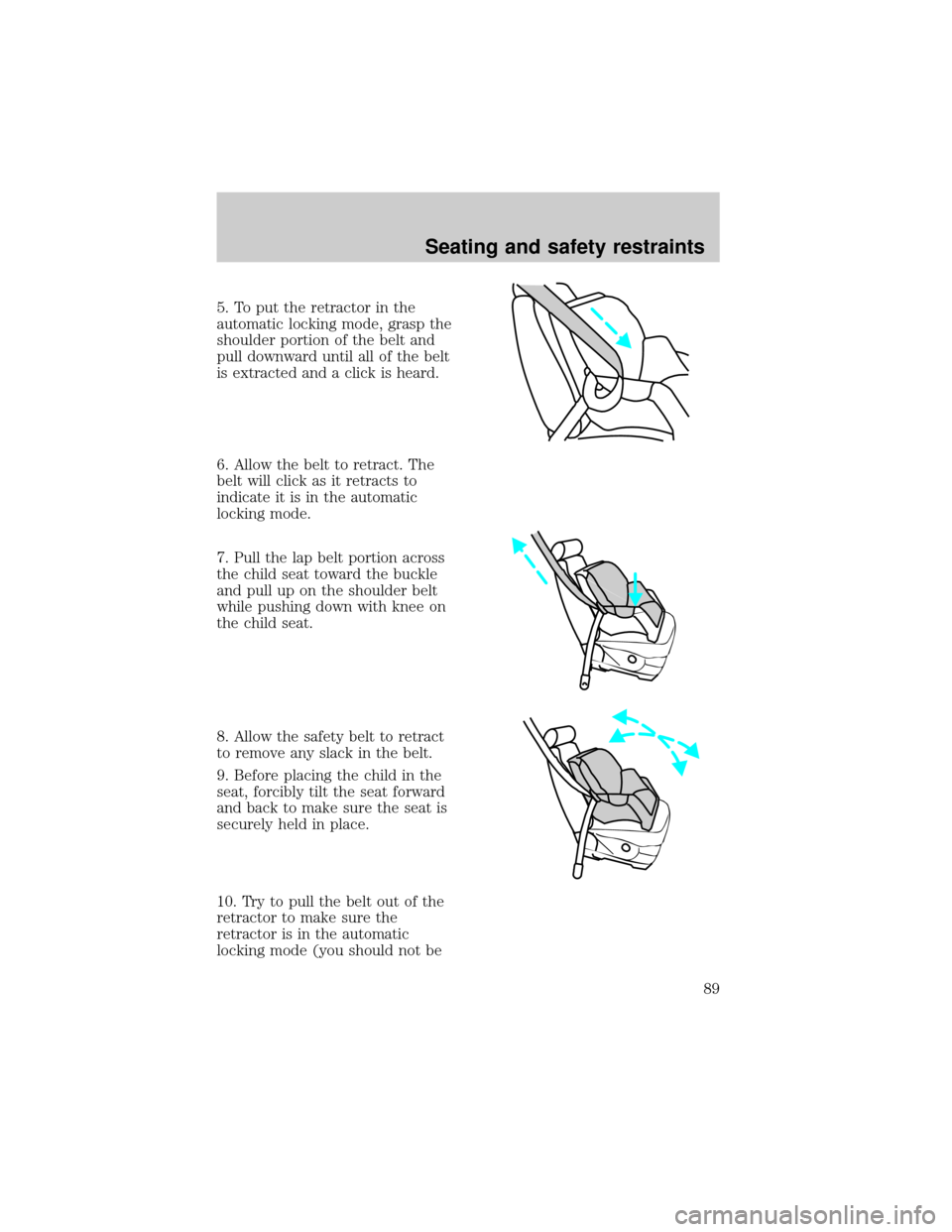
5. To put the retractor in the
automatic locking mode, grasp the
shoulder portion of the belt and
pull downward until all of the belt
is extracted and a click is heard.
6. Allow the belt to retract. The
belt will click as it retracts to
indicate it is in the automatic
locking mode.
7. Pull the lap belt portion across
the child seat toward the buckle
and pull up on the shoulder belt
while pushing down with knee on
the child seat.
8. Allow the safety belt to retract
to remove any slack in the belt.
9. Before placing the child in the
seat, forcibly tilt the seat forward
and back to make sure the seat is
securely held in place.
10. Try to pull the belt out of the
retractor to make sure the
retractor is in the automatic
locking mode (you should not be
Seating and safety restraints
89
Page 103 of 216
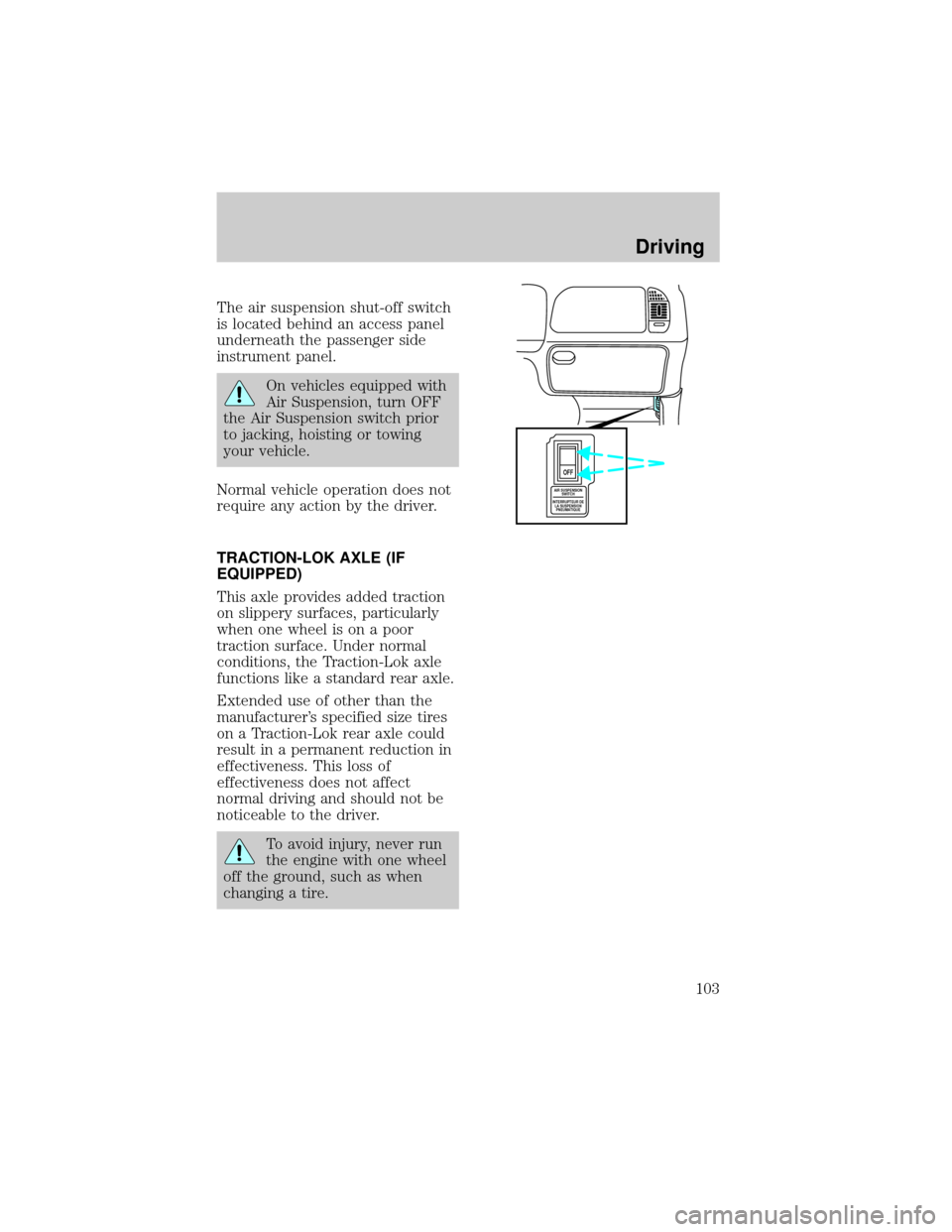
The air suspension shut-off switch
is located behind an access panel
underneath the passenger side
instrument panel.
On vehicles equipped with
Air Suspension, turn OFF
the Air Suspension switch prior
to jacking, hoisting or towing
your vehicle.
Normal vehicle operation does not
require any action by the driver.
TRACTION-LOK AXLE (IF
EQUIPPED)
This axle provides added traction
on slippery surfaces, particularly
when one wheel is on a poor
traction surface. Under normal
conditions, the Traction-Lok axle
functions like a standard rear axle.
Extended use of other than the
manufacturer's specified size tires
on a Traction-Lok rear axle could
result in a permanent reduction in
effectiveness. This loss of
effectiveness does not affect
normal driving and should not be
noticeable to the driver.
To avoid injury, never run
the engine with one wheel
off the ground, such as when
changing a tire.
AIR SUSPENSION
SWITCH
INTERRUPTEUR DE
LA SUSPENSION
PNEUMATIQUE
OFF
Driving
103
Page 105 of 216
Do not rock the vehicle for
more than a few minutes. The
transmission and tires may be
damaged or the engine may
overheat.
Always set the parking
brake fully and make sure
the gearshift is latched in P
(Park). Turn off the ignition
whenever you leave your vehicle.
Driving with a 4±speed
automatic transmission
Understanding gearshift
positions
Pull the gearshift lever towards
you and downward to move the
automatic gearshift.
Hold the brake pedal down
while you move the
gearshift lever from position to
position. If you do not hold the
brake pedal down, your vehicle
may move unexpectedly and
injure someone.
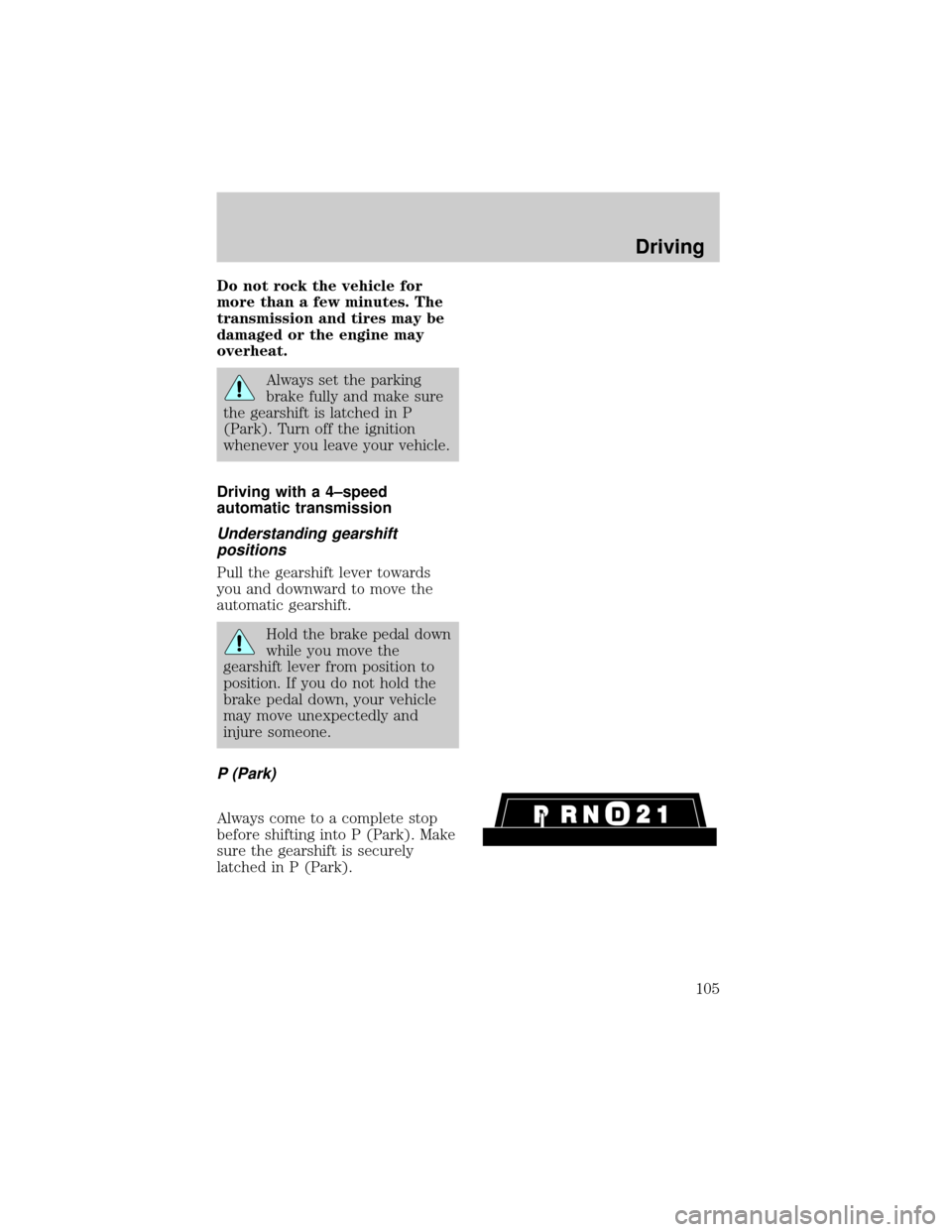
P (Park)
Always come to a complete stop
before shifting into P (Park). Make
sure the gearshift is securely
latched in P (Park).
Driving
105
Page 107 of 216
more engine braking than
(Overdrive) and is useful when:
²driving with a heavy load
²towing a trailer up or down
steep hills
²additional engine downhill
braking is desired. If towing a
trailer, refer toDriving while
you towin theTowing a trailer
chapter.
To return to
(Overdrive) mode,
press the transmission control
switch. The TCIL (the word OFF)
will no longer be illuminated.
Each time the vehicle is started,
the transmission will automatically
return to normal overdrive mode.
Every time the vehicle is shut off
and restarted, you must press the
transmission control switch to
cancel overdrive operation if
driving in overdrive is not desired.
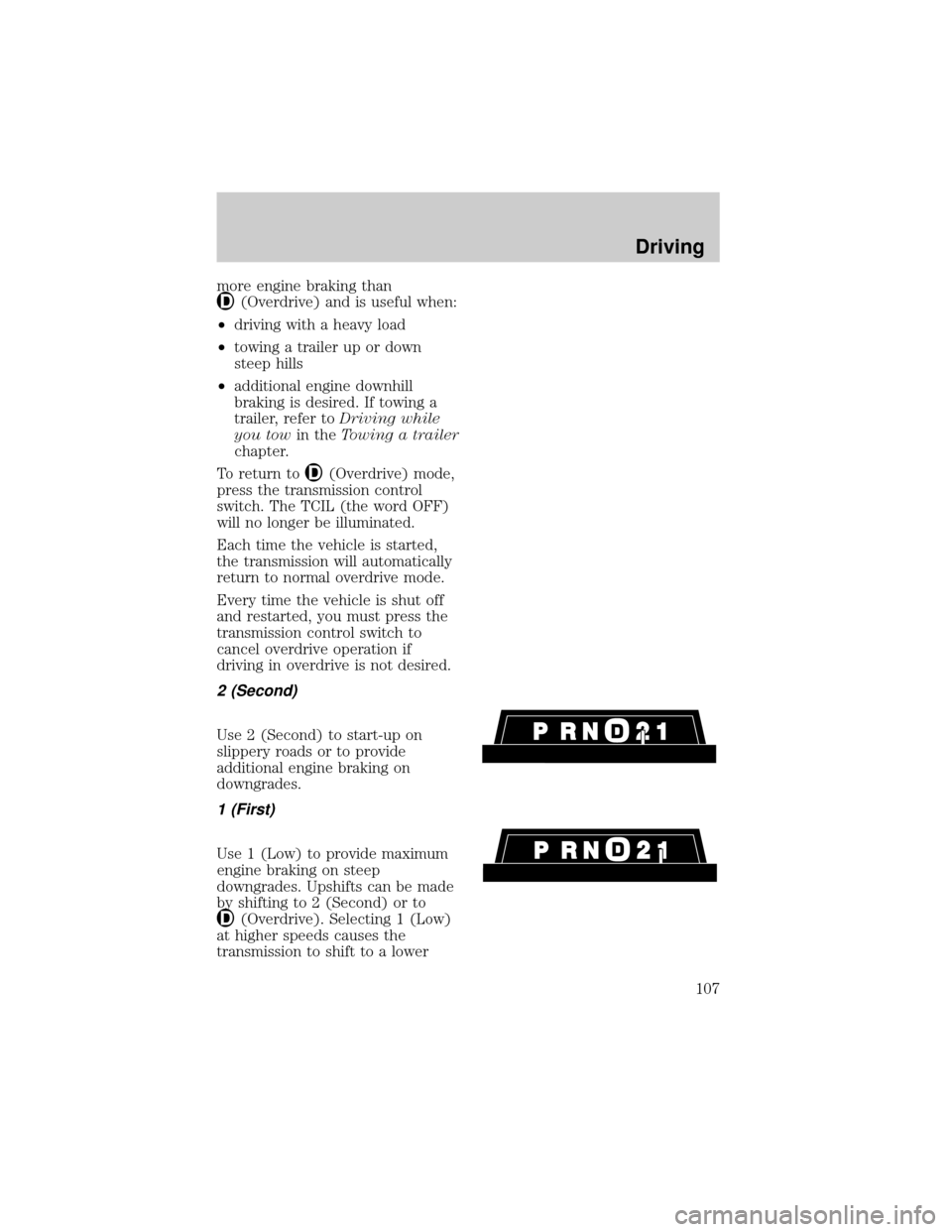
2 (Second)
Use 2 (Second) to start-up on
slippery roads or to provide
additional engine braking on
downgrades.
1 (First)
Use 1 (Low) to provide maximum
engine braking on steep
downgrades. Upshifts can be made
by shifting to 2 (Second) or to
(Overdrive). Selecting 1 (Low)
at higher speeds causes the
transmission to shift to a lower
Driving
107
Page 116 of 216

specific to each vehicle and is
listed on the Safety Compliance
Label on the driver's door pillar.
²GCWR (Gross Combined
Weight Rating): Maximum
combined weight of towing
vehicle (including passengers
and cargo) and the trailer. The
GCWR indicates the maximum
loaded weight that the vehicle is
allowed to tow.
²Maximum Trailer Weight
Rating: Maximum weight of a
trailer the vehicle is permitted
to tow. The maximum trailer
weight rating equals the vehicle
curb weight for each
engine/transmission
combination, any required
option weight for trailer towing
and the weight of the driver
from the GCWR for the towing
vehicle.
²Maximum Trailer Weight:
maximum weight of a trailer the
loaded vehicle (including
passengers and cargo) is
permitted to tow. It is
determined by subtracting the
weight of the loaded trailer
towing vehicle from the GCWR
for the towing vehicle.
²Trailer Weight Range:
Specified weight range that the
trailer must fall within that
ranges from zero to the
maximum trailer weight rating.
Remember to figure in the tongue
load of your loaded trailer when
figuring the total weight.
Driving
116
Page 117 of 216
Do not exceed the GVWR
or the GAWR specified on
the Safety Compliance
Certification Label.
Do not use replacement tires with
lower weight capacities than the
originals because they may lower
the vehicle's GVWR and GAWR
limitations. Replacement tires with
a higher weight limit than the
originals do not increase the
GVWR and GAWR limitations.
Calculating the load your
vehicle can carry/tow
1. Use the Safety Compliance
Certification Label to find the axle
code number and engine type for
your vehicle.
2. Use the appropriate maximum
gross combined weight rating
(GCWR) chart to find the
maximum GCWR for your type
engine and rear axle ratio.
3. Weigh your vehicle as you
customarily operate the vehicle
without cargo. To obtain correct
weights, try taking your vehicle to
a shipping company or an
inspection station for trucks.
4. Subtract your loaded vehicle
weight from the maximum GCWR
on the following charts. This is the
maximum trailer weight your
vehicle can tow and must fall
below the maximum shown under
maximum trailer weight on the
chart.
Driving
117
Page 118 of 216
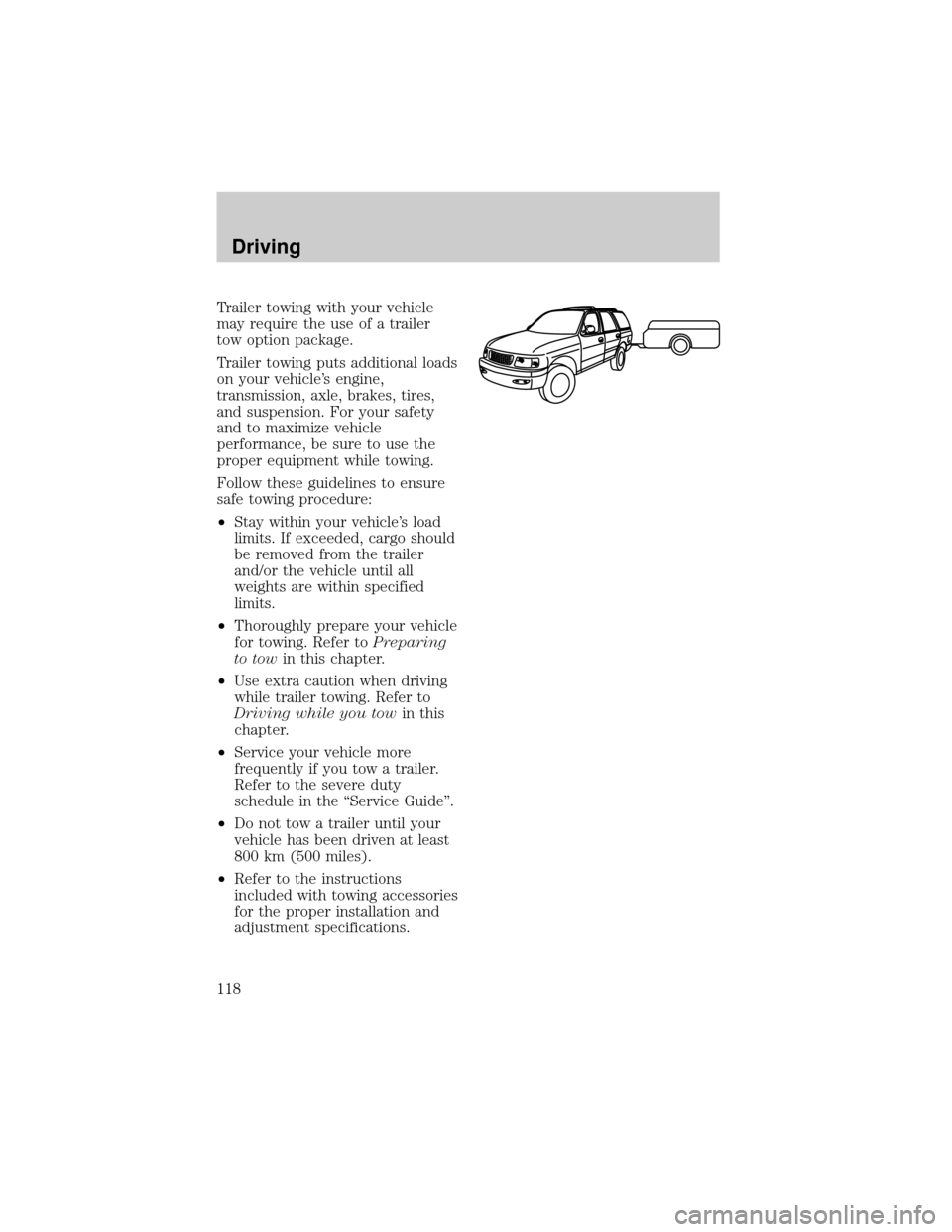
Trailer towing with your vehicle
may require the use of a trailer
tow option package.
Trailer towing puts additional loads
on your vehicle's engine,
transmission, axle, brakes, tires,
and suspension. For your safety
and to maximize vehicle
performance, be sure to use the
proper equipment while towing.
Follow these guidelines to ensure
safe towing procedure:
²Stay within your vehicle's load
limits. If exceeded, cargo should
be removed from the trailer
and/or the vehicle until all
weights are within specified
limits.
²Thoroughly prepare your vehicle
for towing. Refer toPreparing
to towin this chapter.
²Use extra caution when driving
while trailer towing. Refer to
Driving while you towin this
chapter.
²Service your vehicle more
frequently if you tow a trailer.
Refer to the severe duty
schedule in the ªService Guideº.
²Do not tow a trailer until your
vehicle has been driven at least
800 km (500 miles).
²Refer to the instructions
included with towing accessories
for the proper installation and
adjustment specifications.
Driving
118
Page 119 of 216
If your vehicle is equipped with
the optional heavy duty trailer tow
wiring, it is pre-wired for trailer
towing. An electrical connector is
provided under the instrument
panel for installing a
customer-supplied electric brake
controller. Another electrical
connector is provided at the hitch.
This connector provides power to
the trailer for taillamps, stop and
turn lamps, back up lamps, battery
charge, electric brakes (when a
customer provided controller is
installed) and ground. The kit
included with your vehicle
provides you with adaptors to
attach the brake controller and
convert the hitch connector for
Class I trailer usage.
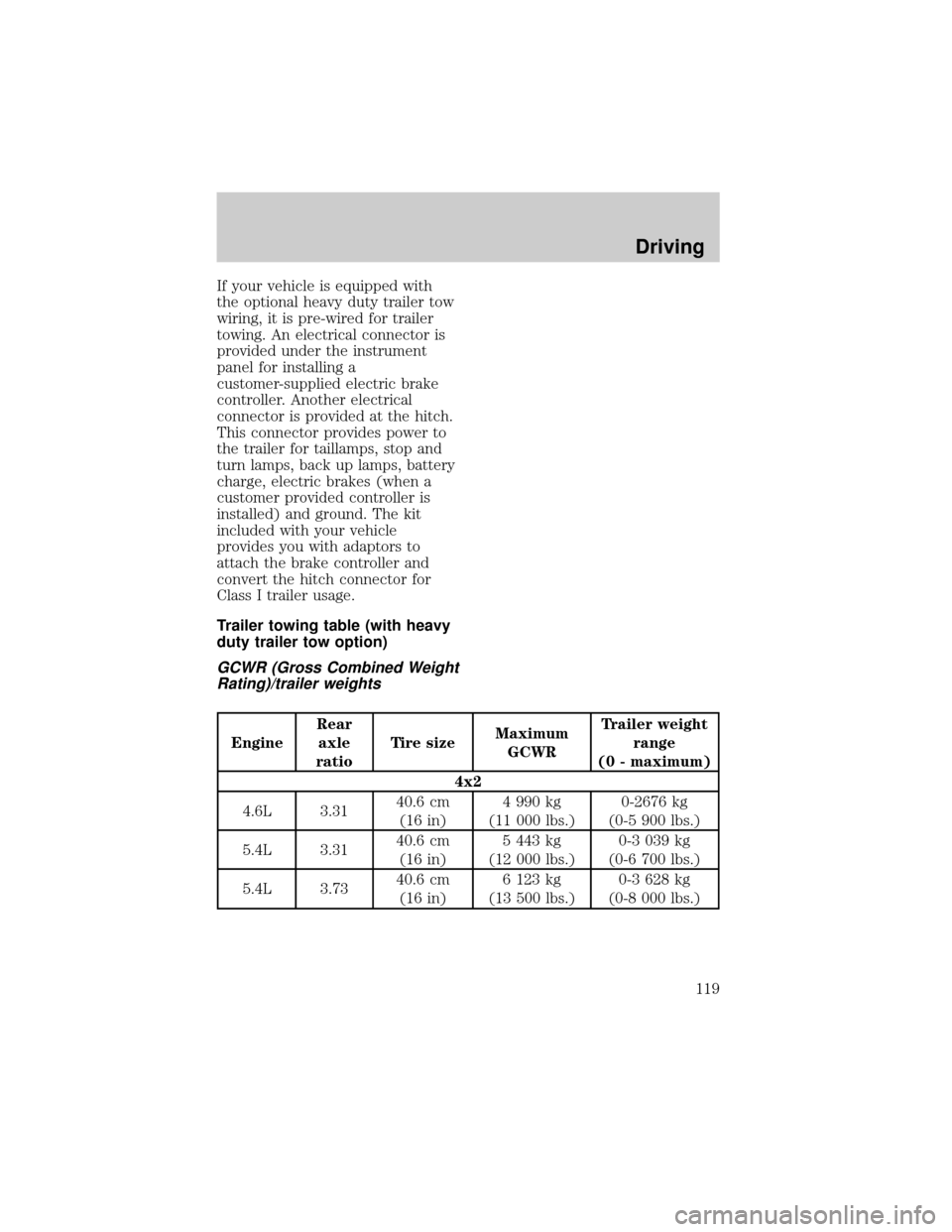
Trailer towing table (with heavy
duty trailer tow option)
GCWR (Gross Combined Weight
Rating)/trailer weights
EngineRear
axle
ratioTire sizeMaximum
GCWRTrailer weight
range
(0 - maximum)
4x2
4.6L 3.3140.6 cm
(16 in)4 990 kg
(11 000 lbs.)0-2676 kg
(0-5 900 lbs.)
5.4L 3.3140.6 cm
(16 in)5 443 kg
(12 000 lbs.)0-3 039 kg
(0-6 700 lbs.)
5.4L 3.7340.6 cm
(16 in)6 123 kg
(13 500 lbs.)0-3 628 kg
(0-8 000 lbs.)
Driving
119
Page 120 of 216
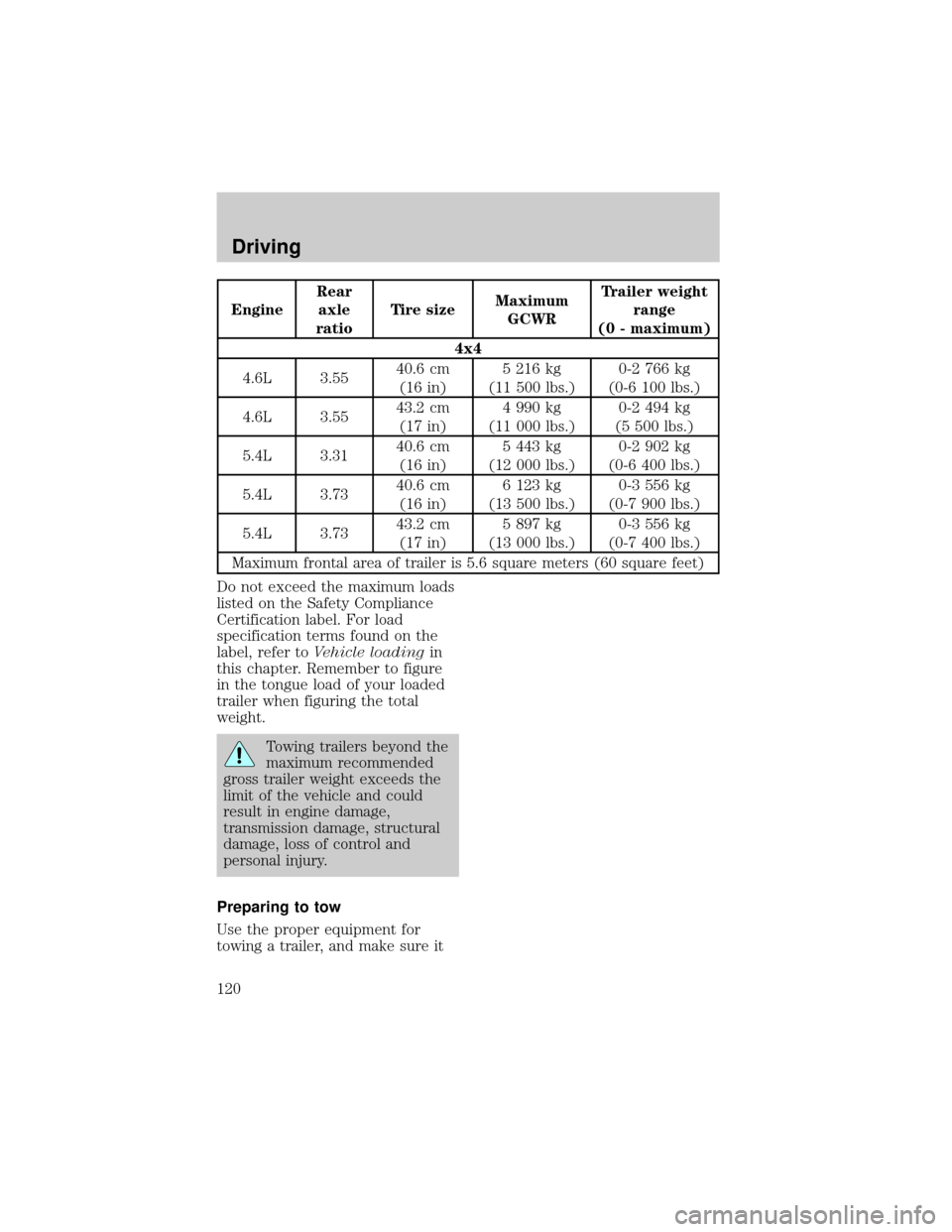
EngineRear
axle
ratioTire sizeMaximum
GCWRTrailer weight
range
(0 - maximum)
4x4
4.6L 3.5540.6 cm
(16 in)5 216 kg
(11 500 lbs.)0-2 766 kg
(0-6 100 lbs.)
4.6L 3.5543.2 cm
(17 in)4 990 kg
(11 000 lbs.)0-2 494 kg
(5 500 lbs.)
5.4L 3.3140.6 cm
(16 in)5 443 kg
(12 000 lbs.)0-2 902 kg
(0-6 400 lbs.)
5.4L 3.7340.6 cm
(16 in)6 123 kg
(13 500 lbs.)0-3 556 kg
(0-7 900 lbs.)
5.4L 3.7343.2 cm
(17 in)5 897 kg
(13 000 lbs.)0-3 556 kg
(0-7 400 lbs.)
Maximum frontal area of trailer is 5.6 square meters (60 square feet)
Do not exceed the maximum loads
listed on the Safety Compliance
Certification label. For load
specification terms found on the
label, refer toVehicle loadingin
this chapter. Remember to figure
in the tongue load of your loaded
trailer when figuring the total
weight.
Towing trailers beyond the
maximum recommended
gross trailer weight exceeds the
limit of the vehicle and could
result in engine damage,
transmission damage, structural
damage, loss of control and
personal injury.
Preparing to tow
Use the proper equipment for
towing a trailer, and make sure it
Driving
120