tow FORD EXPEDITION 1998 1.G Owner's Manual
[x] Cancel search | Manufacturer: FORD, Model Year: 1998, Model line: EXPEDITION, Model: FORD EXPEDITION 1998 1.GPages: 216, PDF Size: 1.51 MB
Page 121 of 216

is properly attached to your
vehicle. See your dealer or a
reliable trailer dealer if you require
assistance.
If your vehicle is not equipped
with the factory heavy duty trailer
tow option, auxiliary coolers are
recommended for the automatic
transmission system if you are
planning on:
²traveling farther than 80 km
(50 miles)
²towing in hilly terrain
²towing frequently
Hitches
Do not use hitches that clamp onto
the vehicle's bumper or attach to
the axle. You must distribute the
load in your trailer so that 10 to
15% of the total weight of the
trailer is on the tongue.
Load equalizing hitch
When hooking up a trailer using a
load equalizing hitch, always use
the following procedure:
1. Park the unloaded vehicle on a
level surface. With the ignition on
and all doors closed, allow the
vehicle to stand for several
minutes so that it can level.
2. Turn the air suspension (if
equipped) control to OFF.
3. Measure the height of a
reference point on the front and
rear bumpers at the center of the
vehicle.
Driving
121
Page 123 of 216
Do not connect a trailer's
hydraulic brake system
directly to your vehicle's brake
system. Your vehicle may not
have enough braking power and
your chances of having a
collision greatly increase.
Trailer lamps
Trailer lamps are required on most
towed vehicles. Make sure your
trailer lamps conform to local and
Federal regulations. See your
dealer or trailer rental agency for
proper instructions and equipment
for hooking up trailer lamps.
Using a step bumper
The rear bumper is equipped with
an integral hitch and requires only
a ball with a 25.4 mm (one inch)
shank diameter. The bumper has a
1 814 kg (4 000 lb.) trailer weight
and 181 kg (400 lb.) tongue weight
capability.
Use a frame-mounted weight
distributing hitch for trailers over
1814 kg (4 000 lb).
Driving while you tow
Do not drive faster than 88 km/h
(55 mph) when towing a trailer.
Speed control may shut off if you
are towing on long, steep grades.
When towing a trailer:
²Use D (Drive) or a lower gear
when towing up or down steep
hills. This will eliminate
excessive downshifting and
Driving
123
Page 124 of 216

upshifting for optimum fuel
economy and transmission
cooling.
²Anticipate stops and brake
gradually.
Servicing after towing
If you tow a trailer for long
distances, your vehicle will require
more frequent service intervals.
Refer to the Severe Duty Schedule
in your ªService Guideº for more
information.
Towing behind another vehicle
Do not tow your vehicle behind
another vehicle, such as an RV.
Your vehicle cannot be flat towed
with all wheels on the ground.
Trailer towing tips
²Practice turning, stopping and
backing up in an area before
starting on a trip to get the feel
of the vehicle trailer
combination. When turning,
make wider turns so the trailer
wheels will clear curbs and
other obstacles.
²Allow more distance for
stopping with a trailer attached.
²The trailer tongue weight should
be 10±15% of the loaded trailer
weight.
²After you have traveled 80 km
(50 miles), thoroughly check
your hitch, electrical
connections and trailer wheel
lug nuts.
Driving
124
Page 126 of 216
LUGGAGE RACK
Load luggage at the front crossbar
and adjust the rear crossbar as
necessary.
²Do not exceed 90.7 kg (200 lb)
of luggage if the weight is
placed directly on the crossbars.
²Do not exceed 68 kg (150 lb) if
the weight is resting directly on
the roof.
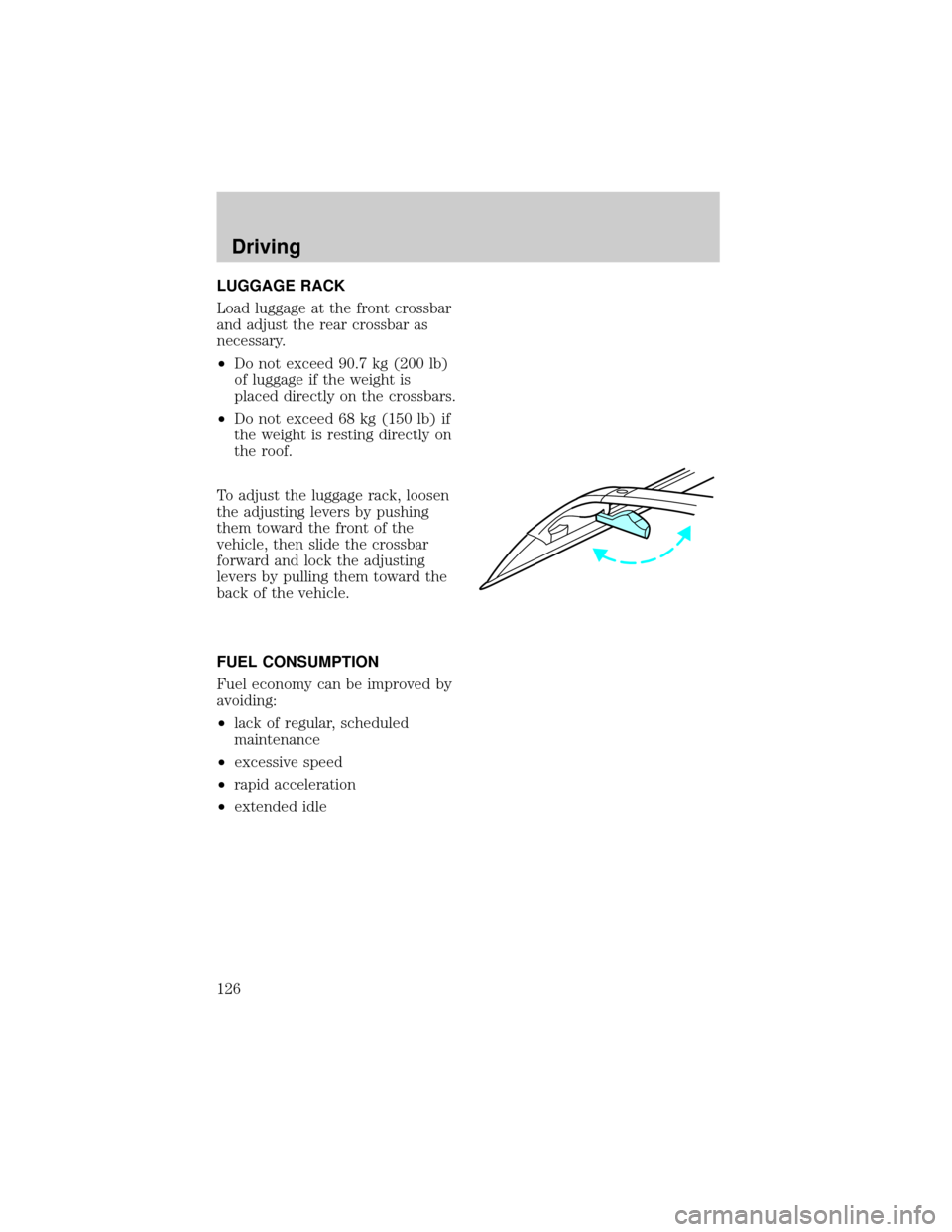
To adjust the luggage rack, loosen
the adjusting levers by pushing
them toward the front of the
vehicle, then slide the crossbar
forward and lock the adjusting
levers by pulling them toward the
back of the vehicle.
FUEL CONSUMPTION
Fuel economy can be improved by
avoiding:
²lack of regular, scheduled
maintenance
²excessive speed
²rapid acceleration
²extended idle
Driving
126
Page 132 of 216
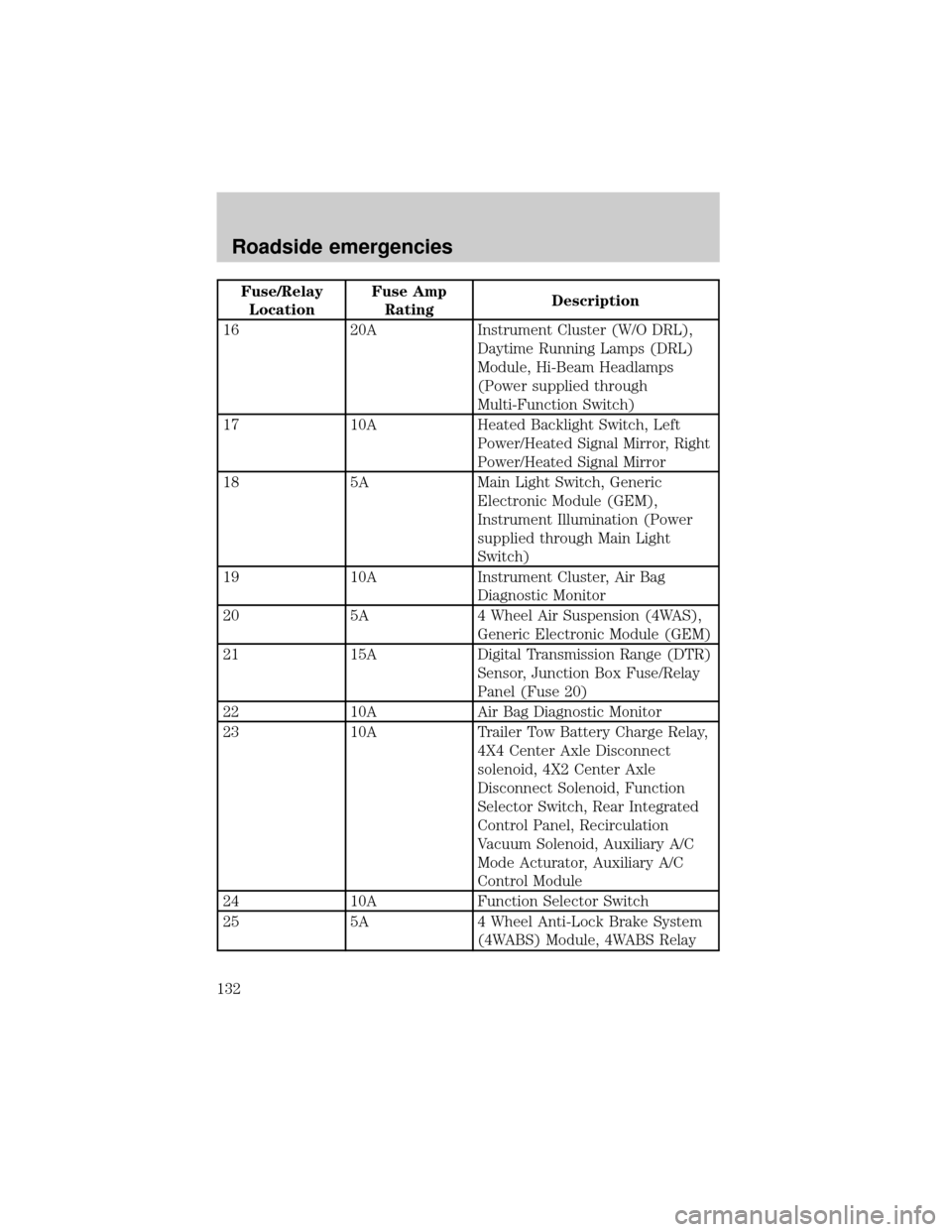
Fuse/Relay
LocationFuse Amp
RatingDescription
16 20A Instrument Cluster (W/O DRL),
Daytime Running Lamps (DRL)
Module, Hi-Beam Headlamps
(Power supplied through
Multi-Function Switch)
17 10A Heated Backlight Switch, Left
Power/Heated Signal Mirror, Right
Power/Heated Signal Mirror
18 5A Main Light Switch, Generic
Electronic Module (GEM),
Instrument Illumination (Power
supplied through Main Light
Switch)
19 10A Instrument Cluster, Air Bag
Diagnostic Monitor
20 5A 4 Wheel Air Suspension (4WAS),
Generic Electronic Module (GEM)
21 15A Digital Transmission Range (DTR)
Sensor, Junction Box Fuse/Relay
Panel (Fuse 20)
22 10A Air Bag Diagnostic Monitor
23 10A Trailer Tow Battery Charge Relay,
4X4 Center Axle Disconnect
solenoid, 4X2 Center Axle
Disconnect Solenoid, Function
Selector Switch, Rear Integrated
Control Panel, Recirculation
Vacuum Solenoid, Auxiliary A/C
Mode Acturator, Auxiliary A/C
Control Module
24 10A Function Selector Switch
25 5A 4 Wheel Anti-Lock Brake System
(4WABS) Module, 4WABS Relay
Roadside emergencies
132
Page 134 of 216
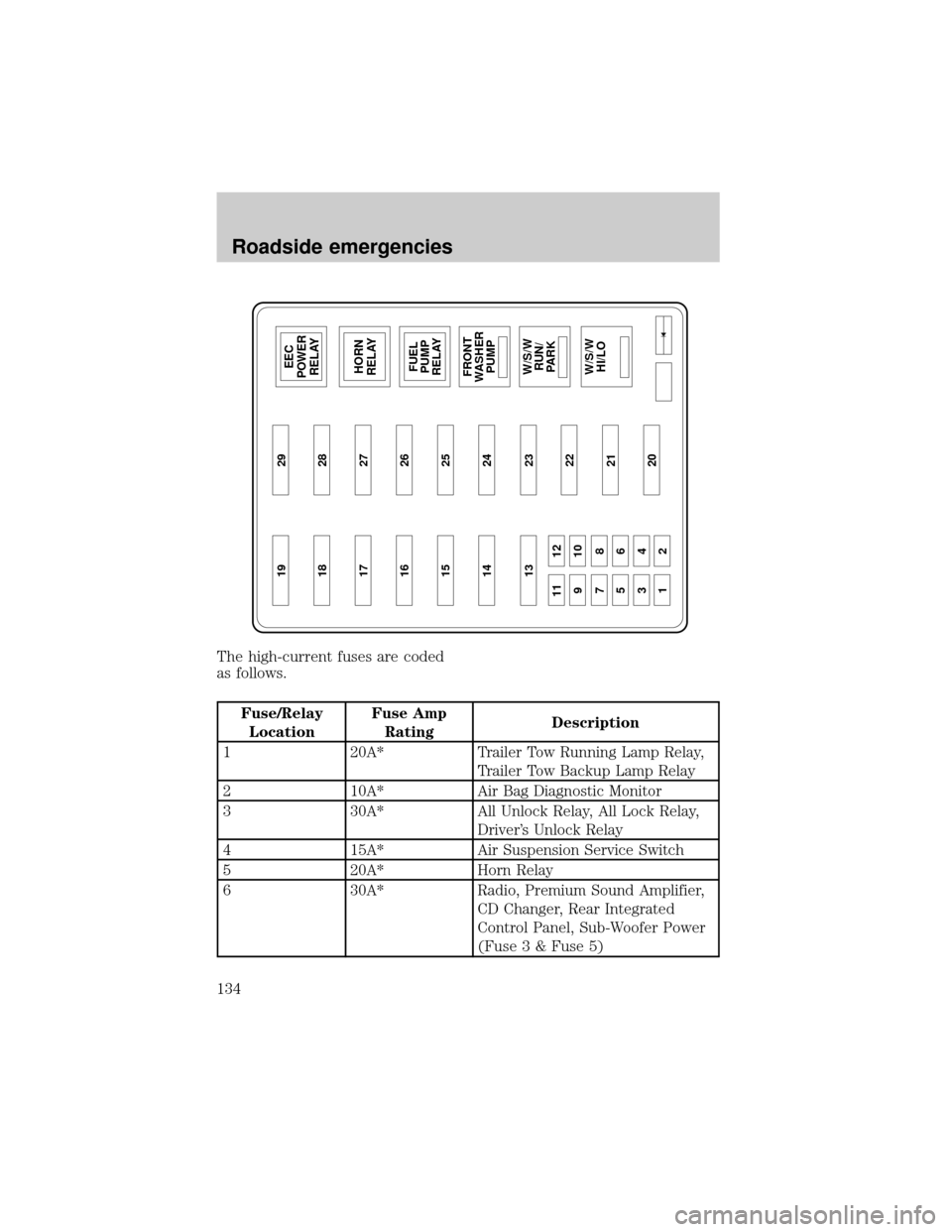
The high-current fuses are coded
as follows.
Fuse/Relay
LocationFuse Amp
RatingDescription
1 20A* Trailer Tow Running Lamp Relay,
Trailer Tow Backup Lamp Relay
2 10A* Air Bag Diagnostic Monitor
3 30A* All Unlock Relay, All Lock Relay,
Driver's Unlock Relay
4 15A* Air Suspension Service Switch
5 20A* Horn Relay
6 30A* Radio, Premium Sound Amplifier,
CD Changer, Rear Integrated
Control Panel, Sub-Woofer Power
(Fuse 3 & Fuse 5)
19 29
18 28EEC
POWER
RELAY
FUEL
PUMP
RELAY
FRONT
WASHER
PUMP HORN
RELAY 17 27
16 26
15 25
14 24
13
11 12
910
78
56
34
1223
22
21
20
W/S/W
RUN/
PARKW/S/W
HI/LO
Roadside emergencies
134
Page 135 of 216
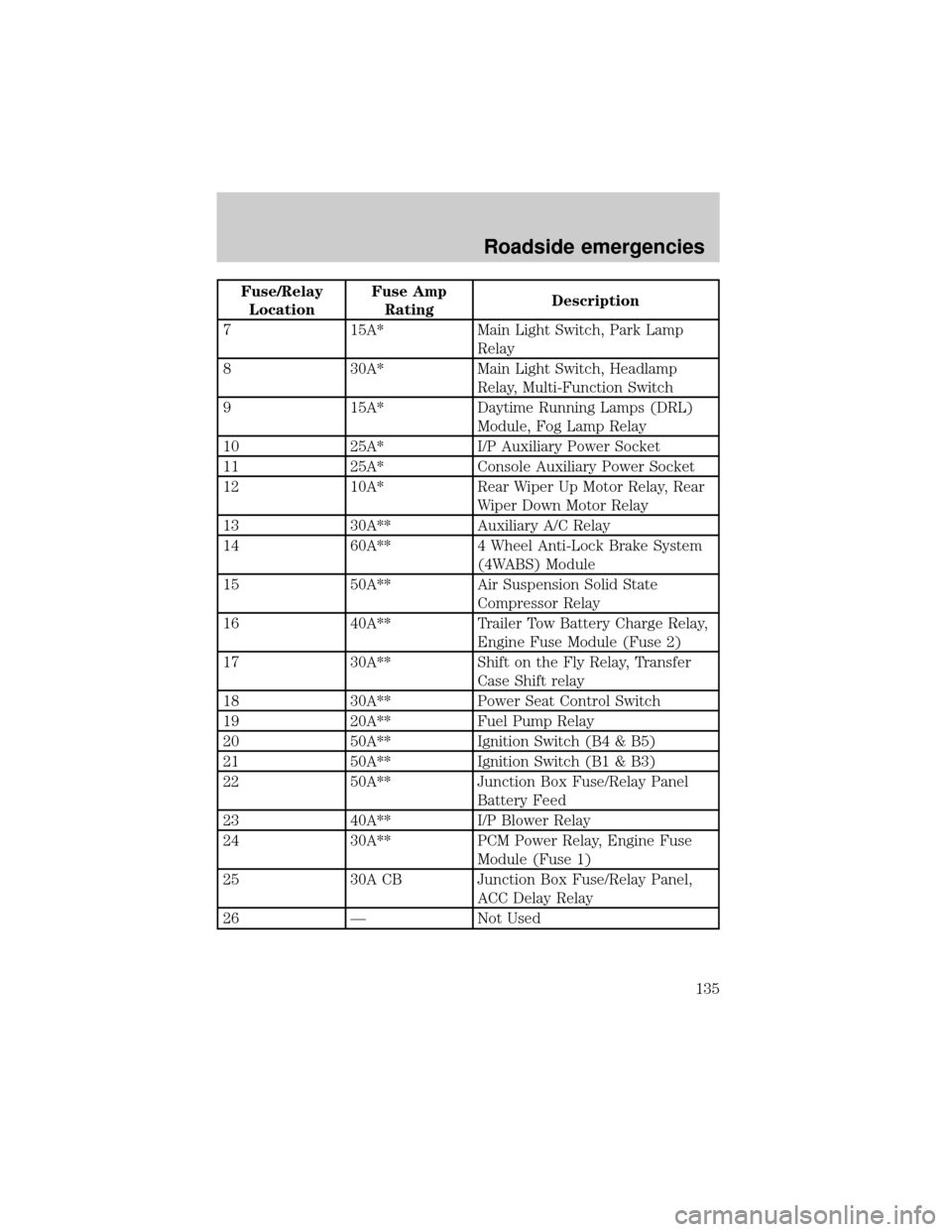
Fuse/Relay
LocationFuse Amp
RatingDescription
7 15A* Main Light Switch, Park Lamp
Relay
8 30A* Main Light Switch, Headlamp
Relay, Multi-Function Switch
9 15A* Daytime Running Lamps (DRL)
Module, Fog Lamp Relay
10 25A* I/P Auxiliary Power Socket
11 25A* Console Auxiliary Power Socket
12 10A* Rear Wiper Up Motor Relay, Rear
Wiper Down Motor Relay
13 30A** Auxiliary A/C Relay
14 60A** 4 Wheel Anti-Lock Brake System
(4WABS) Module
15 50A** Air Suspension Solid State
Compressor Relay
16 40A** Trailer Tow Battery Charge Relay,
Engine Fuse Module (Fuse 2)
17 30A** Shift on the Fly Relay, Transfer
Case Shift relay
18 30A** Power Seat Control Switch
19 20A** Fuel Pump Relay
20 50A** Ignition Switch (B4 & B5)
21 50A** Ignition Switch (B1 & B3)
22 50A** Junction Box Fuse/Relay Panel
Battery Feed
23 40A** I/P Blower Relay
24 30A** PCM Power Relay, Engine Fuse
Module (Fuse 1)
25 30A CB Junction Box Fuse/Relay Panel,
ACC Delay Relay
26 Ð Not Used
Roadside emergencies
135
Page 138 of 216
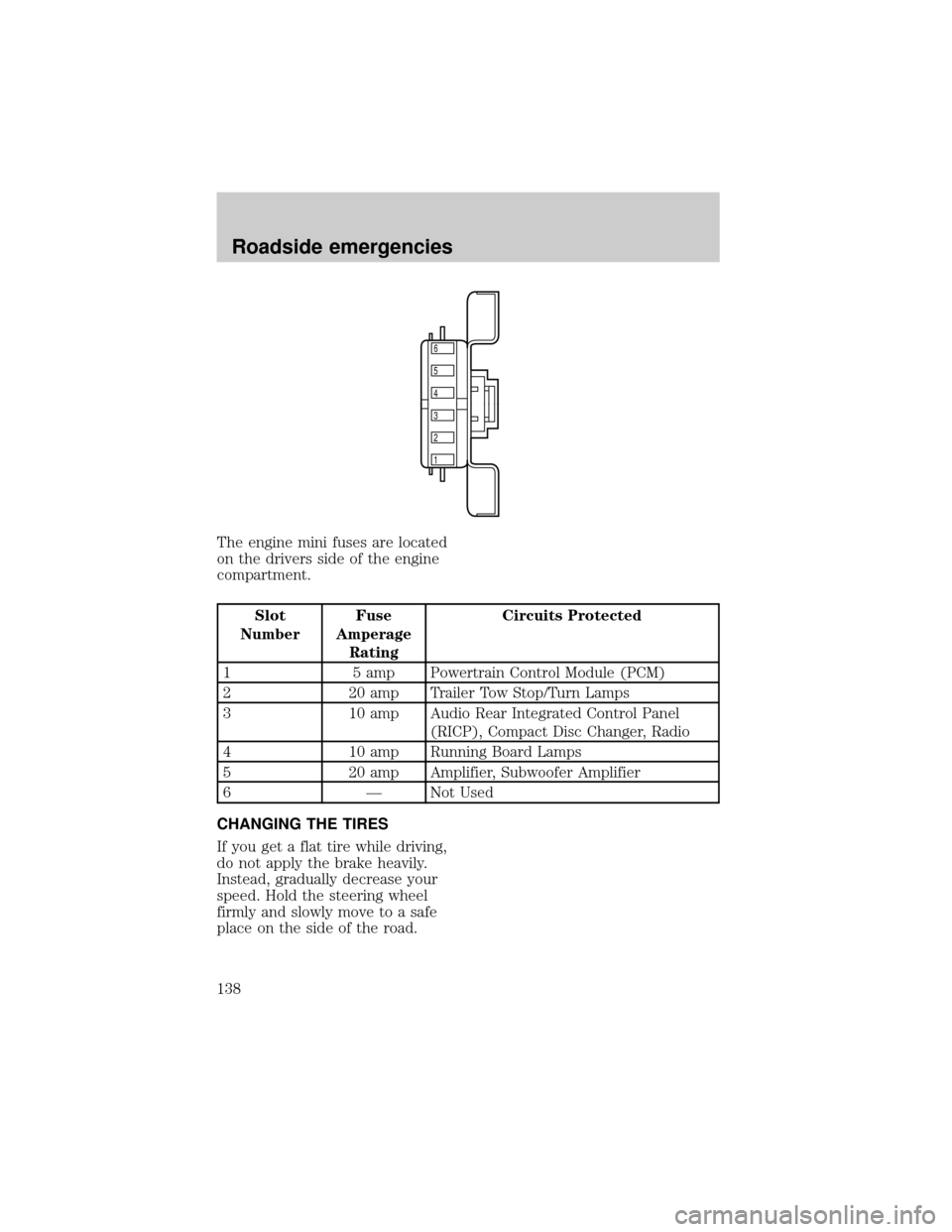
The engine mini fuses are located
on the drivers side of the engine
compartment.
Slot
NumberFuse
Amperage
RatingCircuits Protected
1 5 amp Powertrain Control Module (PCM)
2 20 amp Trailer Tow Stop/Turn Lamps
3 10 amp Audio Rear Integrated Control Panel
(RICP), Compact Disc Changer, Radio
4 10 amp Running Board Lamps
5 20 amp Amplifier, Subwoofer Amplifier
6 Ð Not Used
CHANGING THE TIRES
If you get a flat tire while driving,
do not apply the brake heavily.
Instead, gradually decrease your
speed. Hold the steering wheel
firmly and slowly move to a safe
place on the side of the road.
6
5
4
3
2
1
Roadside emergencies
138
Page 139 of 216
Spare tire information
Your vehicle is equipped with a
spare tire that may be used as a
spare or a regular tire. The spare
is identical to the other tires on
your vehicle, although the wheel
cover may not match.
Location of the spare tire and
tools
The spare tire and tools for your
vehicle are stowed in the following
locations:
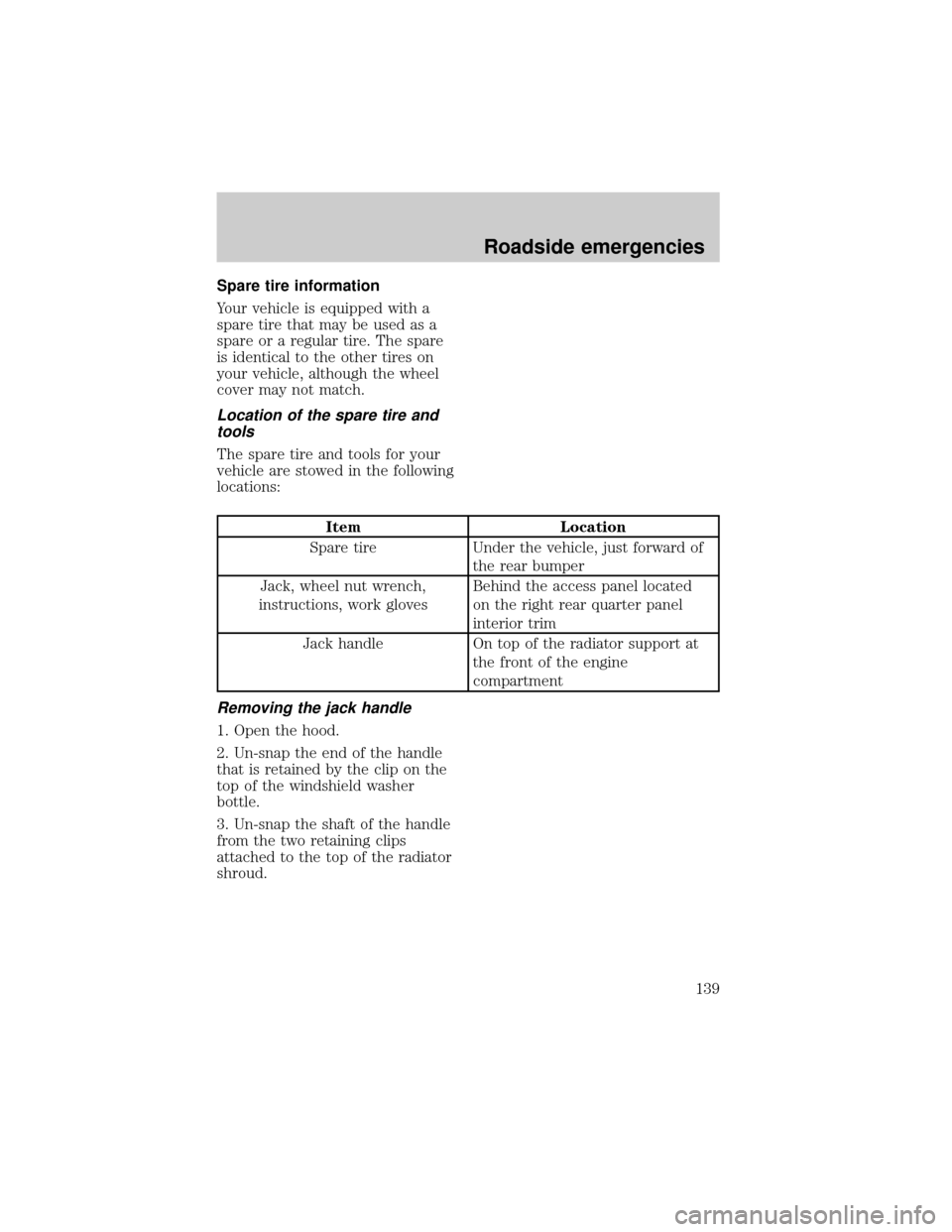
Item Location
Spare tire Under the vehicle, just forward of
the rear bumper
Jack, wheel nut wrench,
instructions, work glovesBehind the access panel located
on the right rear quarter panel
interior trim
Jack handle On top of the radiator support at
the front of the engine
compartment
Removing the jack handle
1. Open the hood.
2. Un-snap the end of the handle
that is retained by the clip on the
top of the windshield washer
bottle.
3. Un-snap the shaft of the handle
from the two retaining clips
attached to the top of the radiator
shroud.
Roadside emergencies
139
Page 140 of 216
Removing the jack and tools
1. Locate the access panel on the
interior trim. Lift and rotate the
two panel retaining clips and
remove the panel.
2. Un-snap the wheel lug nut
wrench, instructions and work
gloves from their retaining bracket.
3. Remove the jack by turning the
thumbwheel counterclockwise to
relieve tension against the stowage
bracket.
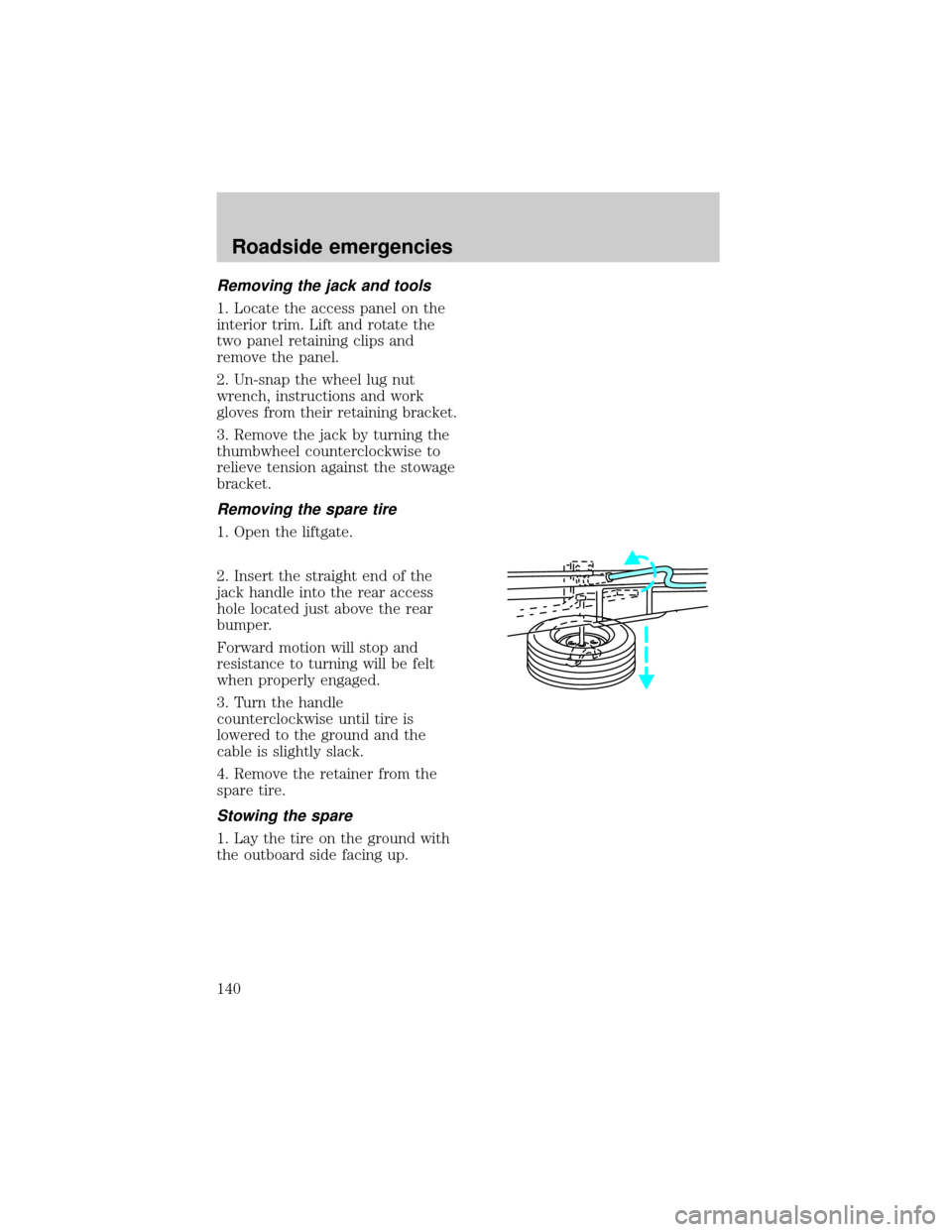
Removing the spare tire
1. Open the liftgate.
2. Insert the straight end of the
jack handle into the rear access
hole located just above the rear
bumper.
Forward motion will stop and
resistance to turning will be felt
when properly engaged.
3. Turn the handle
counterclockwise until tire is
lowered to the ground and the
cable is slightly slack.
4. Remove the retainer from the
spare tire.
Stowing the spare
1. Lay the tire on the ground with
the outboard side facing up.
Roadside emergencies
140