radio FORD EXPEDITION 2000 1.G Owner's Manual
[x] Cancel search | Manufacturer: FORD, Model Year: 2000, Model line: EXPEDITION, Model: FORD EXPEDITION 2000 1.GPages: 256, PDF Size: 2.08 MB
Page 86 of 256
Changes or modifications not expressly approved by the party
responsible for compliance could void the user's authority to
operate the equipment.
Replacing the battery
The remote transmitter is powered by one coin type three-volt lithium
battery CR2032 or equivalent. Typical operating range will allow you to
be up to 10 meters (33 feet) away from your vehicle. A decrease in
operating range can be caused by:
²weather conditions
²nearby radio towers
²structures around the vehicle
²other vehicles parked next to the vehicle
To replace the battery:
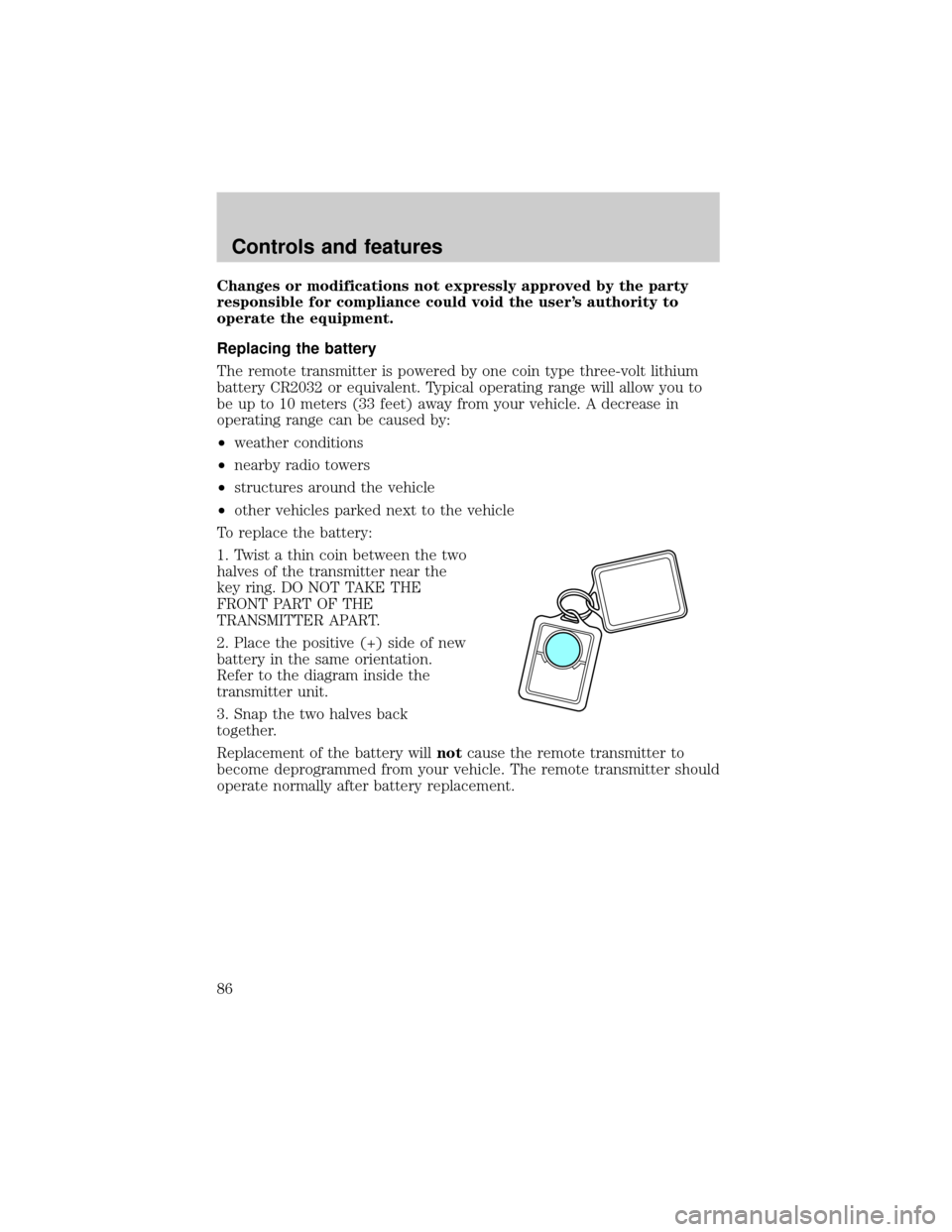
1. Twist a thin coin between the two
halves of the transmitter near the
key ring. DO NOT TAKE THE
FRONT PART OF THE
TRANSMITTER APART.
2. Place the positive (+) side of new
battery in the same orientation.
Refer to the diagram inside the
transmitter unit.
3. Snap the two halves back
together.
Replacement of the battery willnotcause the remote transmitter to
become deprogrammed from your vehicle. The remote transmitter should
operate normally after battery replacement.
Controls and features
86
Page 129 of 256
PREPARING TO START YOUR VEHICLE
Engine starting is controlled by the powertrain control system. This
system meets all Canadian Interference-Causing Equipment standard
requirements regulating the impulse electrical field strength of radio
noise.
When starting a fuel-injected engine, avoid pressing the accelerator
before or during starting. Only use the accelerator when you have
difficulty starting the engine. For more information on starting the
vehicle, refer toStarting the enginein this chapter.
Extended idling at high engine speeds can produce very high
temperatures in the engine and exhaust system, creating the risk
of fire or other damage.
Do not park, idle, or drive your vehicle in dry grass or other dry
ground cover. The emission system heats up the engine
compartment and exhaust system, which can start a fire.
Do not start your vehicle in a closed garage or in other enclosed
areas. Exhaust fumes can be toxic. Always open the garage door
before you start the engine. SeeGuarding against exhaust fumesin
this chapter for more instructions.
If you smell exhaust fumes inside your vehicle, have your dealer
inspect your vehicle immediately. Do not drive if you smell
exhaust fumes.
Important safety precautions
A computer system controls the engine's idle revolutions per minute
(RPM). When the engine starts, the idle RPM runs faster to warm the
engine. If the engine idle speed does not slow down automatically, have
the vehicle checked. Do not allow the vehicle to idle for more than 10
minutes at the higher engine RPM.
Before starting the vehicle:
1. Make sure all vehicle occupants have buckled their safety belts. For
more information on safety belts and their proper usage, refer to the
Seating and safety restraintschapter.
Starting
129
Page 164 of 256
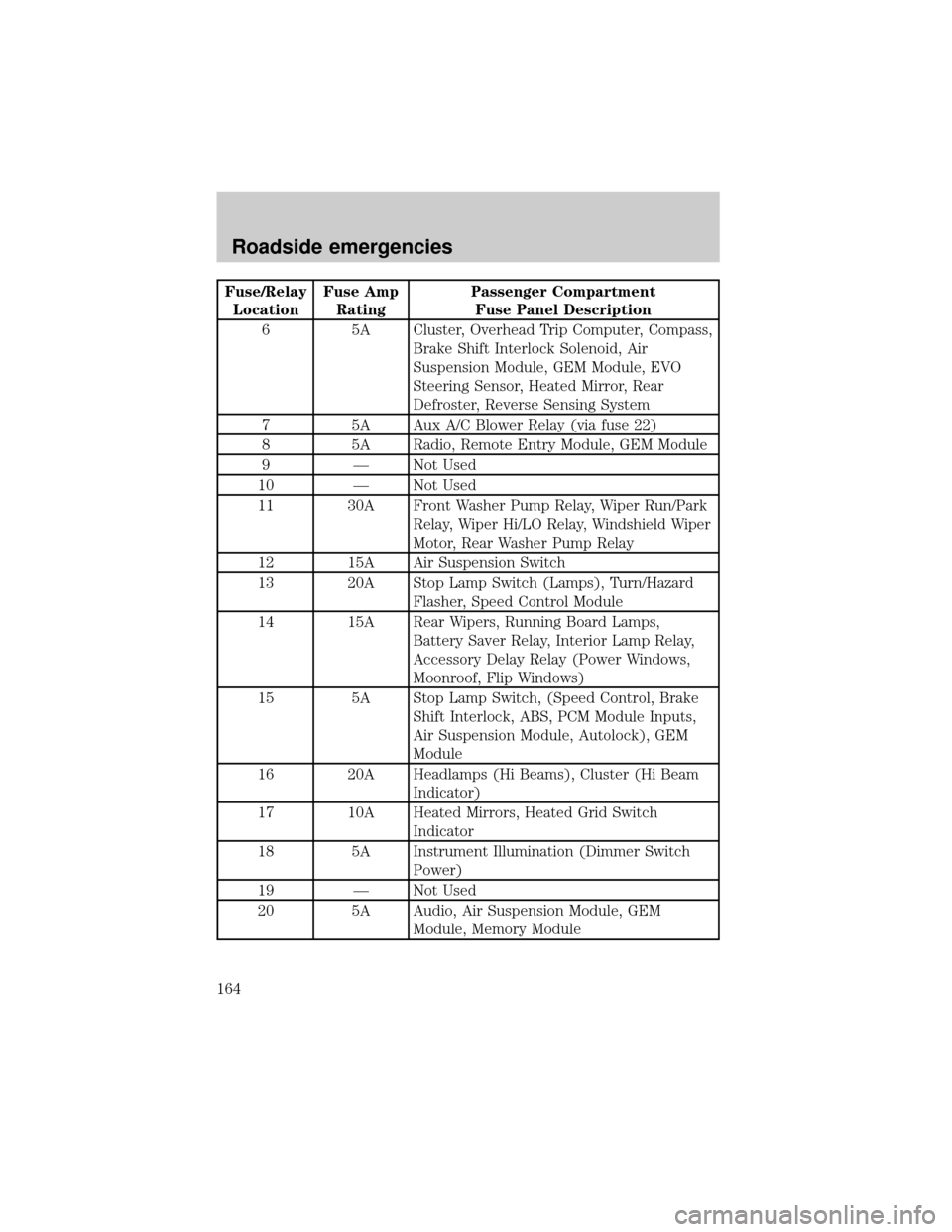
Fuse/Relay
LocationFuse Amp
RatingPassenger Compartment
Fuse Panel Description
6 5A Cluster, Overhead Trip Computer, Compass,
Brake Shift Interlock Solenoid, Air
Suspension Module, GEM Module, EVO
Steering Sensor, Heated Mirror, Rear
Defroster, Reverse Sensing System
7 5A Aux A/C Blower Relay (via fuse 22)
8 5A Radio, Remote Entry Module, GEM Module
9 Ð Not Used
10 Ð Not Used
11 30A Front Washer Pump Relay, Wiper Run/Park
Relay, Wiper Hi/LO Relay, Windshield Wiper
Motor, Rear Washer Pump Relay
12 15A Air Suspension Switch
13 20A Stop Lamp Switch (Lamps), Turn/Hazard
Flasher, Speed Control Module
14 15A Rear Wipers, Running Board Lamps,
Battery Saver Relay, Interior Lamp Relay,
Accessory Delay Relay (Power Windows,
Moonroof, Flip Windows)
15 5A Stop Lamp Switch, (Speed Control, Brake
Shift Interlock, ABS, PCM Module Inputs,
Air Suspension Module, Autolock), GEM
Module
16 20A Headlamps (Hi Beams), Cluster (Hi Beam
Indicator)
17 10A Heated Mirrors, Heated Grid Switch
Indicator
18 5A Instrument Illumination (Dimmer Switch
Power)
19 Ð Not Used
20 5A Audio, Air Suspension Module, GEM
Module, Memory Module
Roadside emergencies
164
Page 199 of 256
7. Drive the vehicle to complete the relearning process.
²The vehicle may need to be driven 16 km (10 miles) or more to
relearn the idle and fuel trim strategy.
²If you do not allow the engine to relearn its idle trim, the idle
quality of your vehicle may be adversely affected until the idle
trim is eventually relearned.
If the battery has been disconnected or a new battery has been installed,
the clock and the preset radio stations must be reset once the battery is
reconnected.
²Always dispose of automotive
batteries in a responsible manner.
Follow your local authorized
standards for disposal. Call your
local authorized recycling center
to find out more about recycling
automotive batteries.
AIR FILTER MAINTENANCE
Refer to the Scheduled Maintenance Guide for the appropriate intervals
for changing the air filter element.
When changing the air filter element, use only the Motorcraft air filter
element listed. Refer toMotorcraft Part Numbersin theCapacities and
specificationschapter.
Do not start your engine with the air cleaner removed and do
not remove it while the engine is running.
LEAD
RETURN
RECYCLE
Maintenance and care
199
Page 245 of 256

Carpet floor mats
Cleaners, waxes and polishes
Flat splash guards
Front end covers (full and sport)
Hood deflectors
Inside mirror with compass display
Inside mirror with compass and temperature display
Locking gas cap
Lubricants and oils
Molded splash guards
Molded vinyl floor mats
Outside signal mirror (requires power mirrors)
Rear air deflectors
Side window air deflectors
Spare tire lock
Touch-up paint
Universal floor mats
For maximum vehicle performance, keep the following information in
mind when adding accessories or equipment to your vehicle:
²When adding accessories, equipment, passengers and luggage to your
vehicle, do not exceed the total weight capacity of the vehicle or of
the front or rear axle (GVWR or GAWR as indicated on the Safety
compliance certification label). Consult your dealer for specific weight
information.
²The Federal Communications Commission (FCC) and Canadian Radio
Telecommunications Commission (CRTC) regulate the use of mobile
communications systems - such as two-way radios, telephones and
theft alarms - that are equipped with radio transmitters. Any such
equipment installed in your vehicle should comply with FCC or CRTC
regulations and should be installed only by a qualified service
technician.
²Mobile communications systems may harm the operation of your
vehicle, particularly if they are not properly designed for automotive
use or are not properly installed. When operated, such systems may
Customer assistance
245
Page 248 of 256

Accessory delay ..........................78
Air bag supplemental
restraint system .................114,118
and child safety seats ............116
description .......................114,118
disposal .............................118,121
driver air bag ...................116,119
indicator light ...............9,118,120
operation ..........................116,119
passenger air bag ............116,119
side air bag ..............................118
Air cleaner filter .........199,200,226
Air conditioning ..........................51
automatic temperature
control system ..........................54
auxiliary heater and air
conditioner ................................60
Air suspension ...........................138
description ..............................138
warning light .............................12
Ambulance packages ....................3
Antifreeze
(see Engine coolant) ................187
Anti-lock brake system
(see Brakes) .......................134,135
Anti-theft system
warning light .............................11
Armrests ......................................94
Audio system (see Radio) .........25
Automatic transmission
driving an automatic
overdrive .................................142
fluid, adding ............................194
fluid, checking ........................194
fluid, refill capacities ..............226
fluid, specification ..................232
Auxiliary power point .................24
Axle
lubricant specifications ...229,232
refill capacities ........................226
traction lok ..............................139
Battery .......................................197acid, treating emergencies .....197
charging system
warning light .............................11
jumping a disabled battery ....175
maintenance-free ....................197
replacement, specifications ...226
servicing ..................................197
voltage gauge ............................16
Belt minder ...............................110
Brakes ........................................134
anti-lock ............................134,135
anti-lock brake system (ABS)
warning light ......................10,135
brake warning light ..................10
fluid, checking and adding ....186
fluid, refill capacities ..............226
fluid, specifications ..........229,232
lubricant specifications ...229,232
parking ....................................136
pedals (see Power
adjustable foot pedals) ............21
shift interlock ..........................141
Break-in period .............................3
Capacities for refilling fluids ....226
Cassette tape player ...................25
CD changer .................................47
Certification Label ....................234
Child safety restraints ..............122
child safety belts ....................122
Child safety seats ......................123
in front seat ............................124
in rear seat .......................124,127
tether anchorage hardware ...128
Cleaning your vehicle ...............221
engine compartment ..............222
exterior ....................................222
exterior lamps .........................223
instrument panel ....................224
instrument panel lens ............224
interior ..............................224,225
plastic parts ............................223
safety belts ..............................225
Index
248
Page 252 of 256

fluid, specifications ..........229,232
Preparing to
drive your vehicle .....................140
Radio ............................................25
Relays .................................161,169
Remote entry system ............84,85
illuminated entry ......................88
locking/unlocking doors ...........85
panic alarm ...............................85
replacement/additional
transmitters ...............................87
replacing the batteries .............86
Reverse sensing system .............22
Roof rack ...................................158
Safety belts
(see Safety restraints) ........13,104
105,106,107,109
Safety defects, reporting ..........247
Safety
restraints .......104,105,106,107,109
belt minder .............................110
cleaning the
safety belts .......................113,225
extension assembly ................109
for adults ...................105,106,107
for children ......................121,122
lap belt ....................................108
warning light
and chime ...............10,13,109,110
Safety seats for children ..........123
Seat belts
(see Safety restraints) .............104
Seats ............................................92
child safety seats ....................123
cleaning ............................224,225
memory seat ........................88,96
SecuriLock passive
anti-theft system ....................82,83
Servicing your vehicle ..............181
Snowplowing .................................3
Spark plugs,
specifications ......................226,232Special notice ................................3
ambulance conversions ..............3
utility-type vehicles ....................3
Specification chart,
lubricants ............................229,232
Speed control ..............................63
Speedometer ...............................14
Starting your vehicle .........129,131
jump starting ..........................175
Steering
speed sensitive .......................138
Steering wheel
tilting .........................................67
Tachometer .................................16
Tires .............................169,202,203
changing ...........................169,171
checking the pressure ............203
replacing ..................................204
rotating ....................................203
snow tires and chains ............205
tire grades ...............................203
treadwear ................................202
Towing ................................152,203
recreational towing .................156
trailer towing ..........................152
wrecker ....................................180
Traction-lok rear axle ...............139
Transmission .............................141
fluid, checking and adding
(automatic) .............................194
fluid, refill capacities ..............226
lubricant specifications ...229,232
Trip odometer .............................15
Turn signal .............................10,63
Vehicle dimensions ...................232
Vehicle Identification
Number (VIN) ...........................234
Vehicle loading ..........................149
Ventilating your vehicle ...........133
Warning chimes ...........................13
Warning lights (see Lights) .........8
Washer fluid ..............................187
Index
252